


Anti Money Laundering compliance is the mandatory set of rules and processes all UAE businesses must follow to stop their services being used for financial crime. If you ignore it, the enforcement risk is real. In 2025, the UAE Ministry of Economy imposed fines totalling over AED 115 million on companies for failures in anti-money laundering and counter-terrorism financing compliance.
If you're setting up a company in Dubai, Abu Dhabi, Sharjah, or a free zone, AML often feels like one more layer of paperwork sitting on top of licensing, visas, banking, and tax. New founders usually ask the same practical question: what exactly do I need to do, and does it change if I'm on the UAE Mainland, in a Free Zone, or using an Offshore structure?
The short answer is yes. The United Arab Emirates has a single national policy direction against financial crime, but your day-to-day obligations depend on what your business does, where it is licensed, and which authority supervises you. That's the part many founders miss. AML isn't just a bank problem, and it isn't something to sort out later after incorporation.
Table of Contents
- Understanding AML Compliance in the UAE
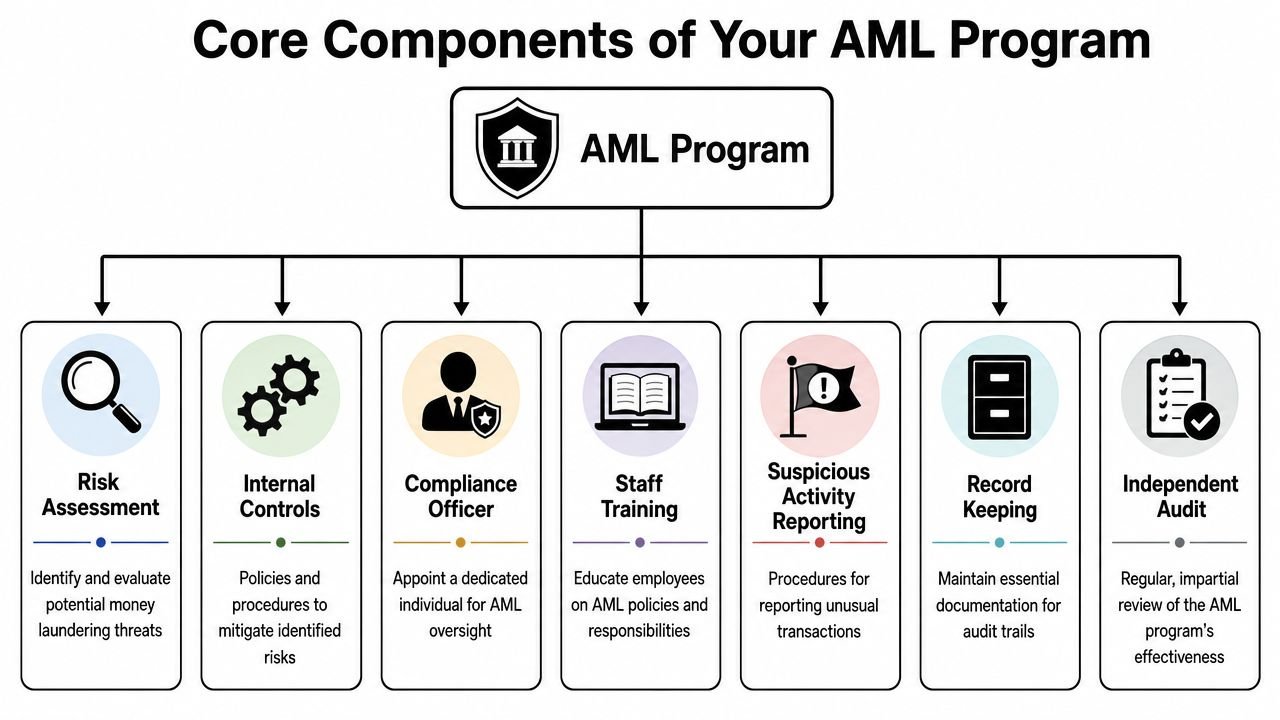
- The Core Components of Your AML Program
- AML Rules Across UAE Jurisdictions
- Implementing Your AML Program as an SME
- Common AML Pitfalls and Penalties
- Your Next Steps for Full AML Compliance
Understanding AML Compliance in the UAE
What is anti money laundering compliance
Anti Money Laundering compliance is the internal system a business uses to identify risk, verify customers, spot suspicious activity, keep records, and report issues when required. In the UAE, this isn't an optional governance extra. It's part of operating a lawful business in a market that takes financial crime seriously.
For founders, the useful way to think about AML is simple. Before you accept a client, a payment, a transaction, or a business relationship, you need a process that answers: who is this, what are they doing, and does anything about this relationship look wrong?
Why does it matter for a new UAE business
A small company can fall into AML trouble faster than it expects. That usually happens when a founder assumes only banks or large financial firms need controls, or when the company starts trading before anyone has documented customer checks, approvals, or record retention.
Practical rule: If your business handles clients, money flows, company structures, property, advisory work, or cross-border transactions, you should assume AML needs review from day one.
The United Arab Emirates applies AML rules across a wider group of businesses than many new entrants expect. That includes not only financial firms, but also many non-financial activities that can be used to hide ownership, move value, or disguise the source of funds.
The Core Components of Your AML Program
What makes an AML program workable
Risk assessment is the process of identifying where your business is exposed. A Dubai marketing agency serving local SMEs has a different risk profile from a corporate services firm handling foreign shareholders, nominee structures, and international payments. Your AML controls should match your actual activity, not a generic template copied from the internet.
Customer due diligence is the process of knowing who your customer is before you deal with them. In practice, that means collecting identification documents, understanding the business activity, checking who owns or controls the company, and asking sensible questions about source of funds when the relationship calls for it.
Ongoing monitoring is the habit of checking whether customer behaviour still makes sense after onboarding. A client who initially said they need light consultancy support but then starts pushing unusual payment routes, using unrelated third parties, or refusing to explain counterparties should trigger review.
Here's the simplest way to structure those first pillars:
- Risk-map the business: List your services, customer types, countries involved, payment methods, and whether you deal with cash, crypto exposure, real estate, or complex ownership.
- Verify before you act: Don't treat KYC as a formality after signing. Complete the check before starting work or accepting funds where your obligations require it.
- Monitor what changes: AML failures often start with a customer who looked normal at onboarding and became riskier later.
Who needs to own AML inside the business
Internal controls are the written policies and approval rules that stop ad hoc decisions. They cover who can onboard a client, when extra checks are required, how escalations work, and who signs off on higher-risk relationships. If everyone can make exceptions, your policy doesn't control anything.
An AML compliance officer is the person responsible for oversight. In a small UAE business, that may be a founder, finance lead, or operations manager rather than a standalone compliance hire. What matters is that the person has authority, access to records, and enough time to review issues properly.
Training is the process of making sure staff can recognise red flags and know what to do next. It is often an area where many SMEs underperform. They circulate a policy PDF once, collect signatures, and assume the problem is solved. It isn't. Staff need short, role-specific guidance on what suspicious behaviour looks like in your business.
A useful AML program is boring in the right way. Staff know the steps, managers follow them, and exceptions are documented.
What does good evidence look like in practice
Record keeping is maintaining evidence of what you checked, when you checked it, what you found, and what decision you made. If a regulator or bank asks how you approved a customer, you should be able to show the file without rebuilding the story from memory.
Suspicious activity reporting is the escalation and reporting process used when a transaction or relationship appears inconsistent, unexplained, or deliberately opaque. The most common mistake here isn't missing an obvious criminal pattern. It's failing to act when several smaller warning signs appear together.
Independent review is a periodic check on whether your AML controls are effective. For a small business, that can mean a structured internal review or external assessment rather than a large audit project. The point is to test whether the documented process matches daily behaviour.
A workable founder checklist looks like this:
| AML component | What it means in plain English | What often goes wrong |
|---|---|---|
| Risk assessment | Know where your business is exposed | Using a generic policy with no business-specific risks |
| KYC and CDD | Confirm who the customer is | Collecting documents but not reviewing them |
| Monitoring | Watch for unusual behaviour | Treating onboarding as the end of AML |
| Reporting | Escalate suspicious matters | Waiting too long because the signs feel uncertain |
| Records | Keep an audit trail | Saving files in scattered inboxes and chats |
| Ownership | Assign one responsible person | Everyone assumes someone else handles AML |
| Review and training | Test and refresh the system | Running AML only on paper |
AML Rules Across UAE Jurisdictions
A founder sets up in a free zone, opens a bank account application, and assumes the licence choice settled the AML position. Then the bank asks for ultimate beneficial owner documents, source of funds, business rationale, and an explanation of why the structure sits in that jurisdiction. That is usually the moment the underlying issue becomes clear. In the UAE, AML duties follow your activity, ownership profile, and risk exposure, not the marketing label on the company setup.
How do Mainland rules usually apply
For a Mainland company, the first job is to identify whether the business falls within a regulated AML category. The legal form matters less than the actual activity on the licence and in practice. A consultancy that helps with company formation, a real estate business, or a dealer in high-value goods can trigger a very different AML burden from a standard low-risk services business.
For many non-financial businesses, the key authority is the UAE Ministry of Economy, particularly where the company qualifies as a Designated Non-Financial Business and Profession, or DNFBP. That group can include real estate brokers, dealers in precious metals and stones, corporate service providers, auditors, and certain legal or accounting activities, depending on what the firm does.
Founders regularly miss the practical point here. A Mainland licence gives broad market access, but that commercial flexibility can increase AML exposure if the business serves higher-risk clients, handles complex ownership structures, or supports transactions that are difficult to verify. The Ministry of Economy imposed fines totalling over AED 115 million in 2025 on companies for AML and counter-terrorism financing compliance failures, according to the UAE Ministry of Economy media centre.
If there is any doubt about whether your Mainland activity falls into a DNFBP category, get that answered early. Treating it as an admin question usually becomes an expensive mistake later.
How are Free Zones different
Free zones create a different setup path, not a carve-out from federal AML obligations. For a standard non-financial free zone company, the licensing authority handles incorporation and licence administration, but AML exposure still turns on what the business does, who it serves, and how money moves through the business.
This catches new founders all the time. A free zone consulting licence may look simple on paper, but if the company advises on corporate structuring, introduces investors, supports property transactions, or deals with overseas counterparties using layered ownership vehicles, the AML risk profile rises quickly. The free zone address does not reduce the need for proper customer due diligence, screening, monitoring, and recordkeeping.
Two free zones need separate treatment. DIFC and ADGM are financial centres with their own legal systems and regulators. A firm carrying on regulated financial activity there should expect more formal governance, clearer evidence requirements, and closer supervisory scrutiny than a standard commercial business in a non-financial free zone.
That is the key trade-off. A non-financial free zone may offer setup efficiency and ownership flexibility. DIFC or ADGM may suit a business that needs a financial-centre framework. Neither option lowers the need to explain ownership, source of funds, customer risk, and transaction purpose in a way a regulator or bank can follow without guesswork.
What about Offshore companies
Offshore companies are often set up to hold shares, own assets, or support international structures rather than trade directly in the UAE market. Founders sometimes assume that limited local operations mean limited AML concern. Banks and counterparties usually take the opposite view.
An offshore structure often attracts more questions, not fewer, because the commercial purpose, beneficial ownership chain, and source of funds can be harder to verify from outside the structure. If the entity exists mainly as a holding vehicle, the file still needs to explain why it exists, who ultimately controls it, how it is funded, and what transactions it is expected to receive or make.
In practice, offshore entities face less day-to-day operating activity and more friction at onboarding and review points. The weakness is rarely the certificate of incorporation. It is the absence of a clean, consistent documentary story behind the people and funds connected to the company.
Here is the practical comparison founders should use:
| Jurisdiction | Primary regulator | What founders need to get right |
|---|---|---|
| Mainland | Relevant licensing authority, with AML supervision depending on activity and, for many DNFBPs, the Ministry of Economy | Confirm whether the business is in scope for AML supervision and document controls around actual services, customers, and transactions |
| Non-financial Free Zone | Free zone authority for licensing, with AML obligations driven by business activity and applicable federal rules | Avoid treating the free zone licence as the AML answer. Match controls to the real risk in the customer base and service model |
| Financial Free Zone such as DIFC or ADGM | The free zone's own financial regulator | Prepare for more formal policies, governance, evidence, and regulatory expectations from the start |
| Offshore | Offshore authority for formation, with practical scrutiny often coming from banks and counterparties | Maintain clear ownership, purpose, source-of-funds, and supporting documents before any bank or counterparty asks for them |
The setup choice changes who asks the questions and how technical those questions become. It does not remove the need to answer them properly.
Implementing Your AML Program as an SME
How do you start if you have no compliance team
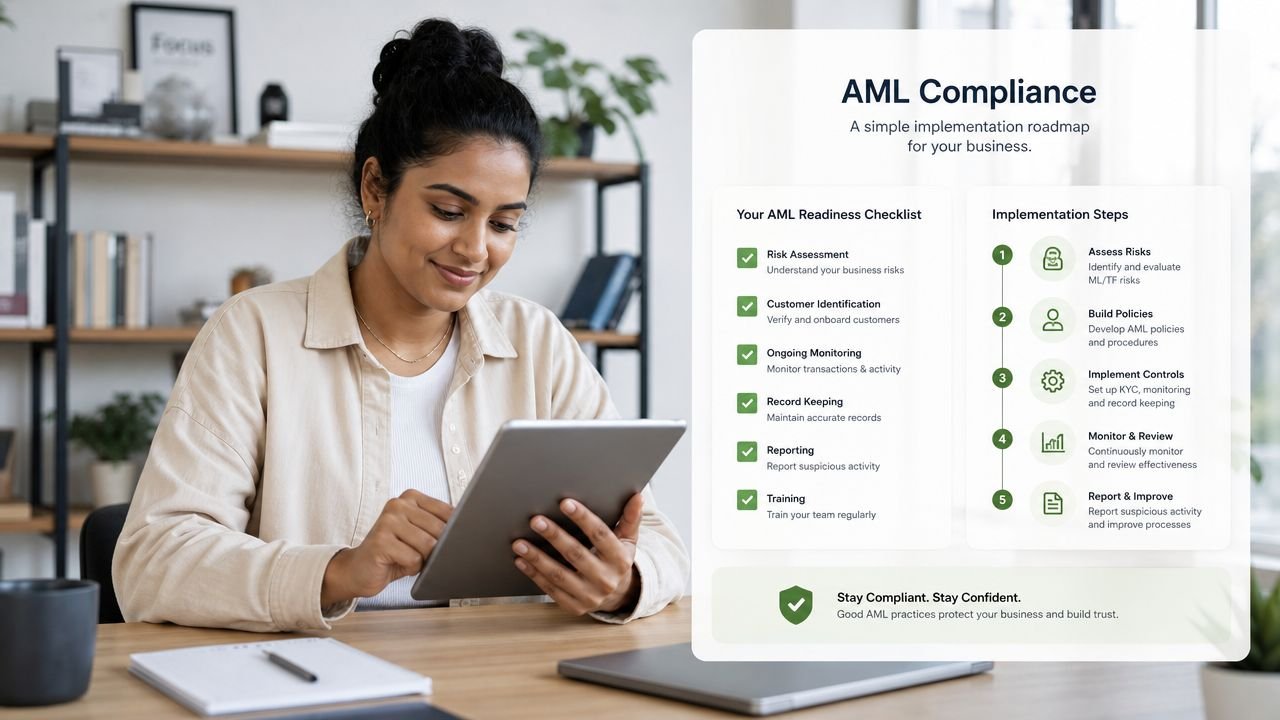
Start with a simple rule. Build the smallest AML system that still reflects your real business. A two-person consultancy in Sharjah doesn't need an enterprise compliance stack, but it does need a documented risk assessment, onboarding checks, escalation rules, and retained records.
The first practical step is to map your business across five points: services, customer types, geographies, payment patterns, and ownership complexity. If you serve only local clients with plain corporate structures and straightforward bank payments, your controls can stay lighter. If you serve cross-border clients, facilitate formations, advise on investments, or handle layered ownership, your checks need to go deeper.
A founder can get this moving quickly with familiar tools. Many SMEs begin with secure document collection, a controlled onboarding checklist, role-based approval in Microsoft 365 or Google Workspace, and a simple case log maintained by the appointed owner. The mistake is not using a basic stack. The mistake is having no disciplined process behind it.
What should your first AML documents include
Your first set of documents doesn't need legal theatre. It needs clarity.
Write a short AML policy that answers these points:
- Who you serve: Define your customer categories and the kinds of services you provide.
- What risk you see: Note the customer, jurisdiction, transaction, and ownership risks relevant to your business.
- How onboarding works: State what documents you collect, who reviews them, and when enhanced checks apply.
- How escalation works: Explain when staff must stop, ask questions, and refer a case internally.
- How records are kept: Set out where files live, who can access them, and how long they are retained according to your obligations.
The best AML policy for an SME is one your team will actually follow on a busy Tuesday afternoon.
Then create two operating documents. First, a client onboarding checklist. Second, a suspicious matter escalation form. Those two documents usually reveal whether the policy is usable or just decorative.
A short visual guide can help if you're building your process for the first time.
How do you train a small team without overbuilding
Training for SMEs works best when it is brief, repeated, and role-based. Your sales or client-facing team needs to know what to collect and when to pause onboarding. Your finance team needs to know what payment behaviour is inconsistent. Your operations lead needs to know how to escalate and document decisions.
Keep the format practical:
- Use real scenarios: For example, a client refuses to identify the ultimate owner, wants an unrelated third party to pay, or changes the business purpose after onboarding.
- Teach stop points: Staff should know the exact moment they must halt progress and ask for review.
- Record attendance and updates: Keep a dated log of who was trained, on what, and when material changed.
What doesn't work is overproduced compliance language nobody reads. Staff don't need abstract lectures on global financial crime trends. They need to know what suspicious behaviour looks like inside your own UAE business model.
Common AML Pitfalls and Penalties
Which mistakes get founders into trouble
A common UAE startup scenario looks like this. The company is incorporated, the first client is ready to sign, the bank is still asking questions, and the founder decides AML can wait until the business is larger. That is how small gaps turn into compliance failures.
The mistake is rarely outright misconduct. It is usually false confidence. Founders assume a simple setup means simple AML, but that breaks down quickly in the UAE because the compliance burden changes by jurisdiction. A Mainland business may deal with one reporting expectation, a Free Zone company may face another operational reality, and an Offshore structure can attract heavier scrutiny from banks and counterparties even before a regulator asks questions. The legal vehicle does not remove the need to identify risk, verify ownership, and document decisions.
Beneficial ownership is where many files start to fail. Founders collect a trade licence, passport copy, and incorporation documents, then treat the file as complete. If the ownership chain runs through multiple entities, includes nominees, or does not match the stated commercial purpose, the file is not complete. Someone in the business must be able to explain who ultimately owns or controls the customer relationship, why the structure makes commercial sense, and whether the payment flow matches that explanation.
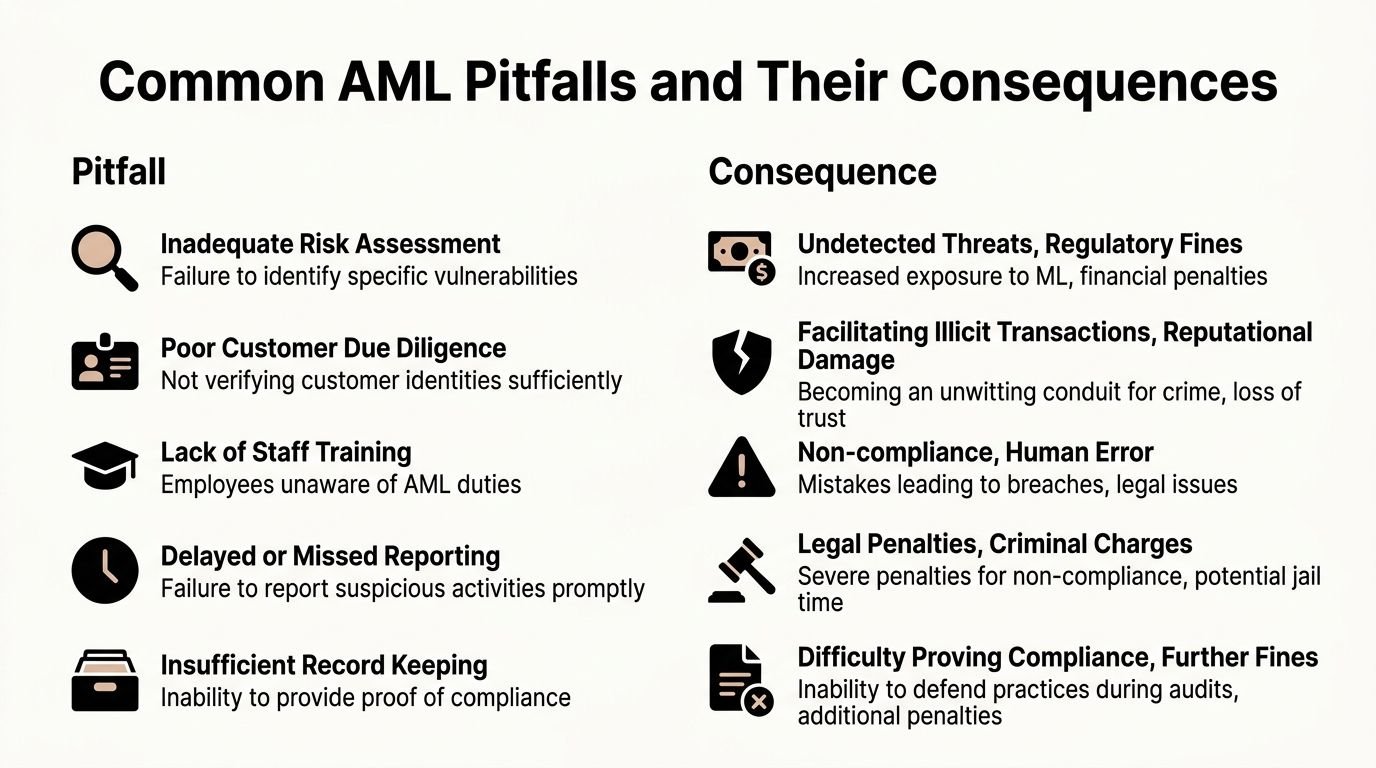
The repeat offenders are usually practical failures, not technical ones:
- No usable risk assessment: The business has a template on file but has not assessed its own customers, geographies, delivery channels, or transaction patterns.
- KYC collected but not reviewed: Staff gather documents, yet nobody checks whether the ownership, activity, and source of funds make sense together.
- Jurisdiction confusion: Founders assume a Free Zone or Offshore setup reduces AML exposure, when in practice it often creates more questions during onboarding and banking.
- Payment red flags ignored: Third-party payments, urgency without a clear business reason, and mismatches between invoice, contract, and sender details are allowed through.
- Poor record keeping: Evidence sits in WhatsApp chats, inboxes, and personal folders, which makes it hard to prove what was checked and who approved it.
What happens when your AML program exists only on paper
A paper-only AML program fails at the point of use. The policy says higher-risk clients require extra checks, but the sales team pushes the file through because revenue is delayed. The escalation form exists, but nobody knows who can approve an exception. Training was delivered once, yet staff cannot identify the red flags that apply to the company's own customer base.
That gap matters for two reasons. The business may onboard a customer it should have paused or rejected. It may also fail the much more ordinary test that comes later, which is explaining its file clearly to a bank, auditor, Free Zone authority, designated regulator, or enforcement body.
In practice, reviewers look for consistency. They compare the customer profile, ownership documents, transaction pattern, and internal notes. If the story does not hold together, the policy document will not rescue the business.
Banks usually judge AML maturity by the quality of the customer file and the logic behind the approval, not by polished policy language.
How serious is enforcement in the UAE
Enforcement in the UAE is active, and founders should treat it that way from day one. As noted earlier, authorities have imposed significant penalties for AML and counter-terrorism financing failures. The financial penalty is only one part of the problem.
The operational damage often hurts earlier and lasts longer. Weak AML controls can delay bank account opening, trigger repeated requests for supporting documents, cause counterparties to question the business, and complicate licence renewals or expansion plans. This is especially common where the company structure, licensing jurisdiction, and actual commercial activity do not line up cleanly.
The correct takeaway is discipline. Keep the program proportionate to the business, but make sure it works in real life. If your team can explain who the customer is, who owns them, why the transaction makes sense, and what you did when something looked unusual, you are in a far stronger position.
Your Next Steps for Full AML Compliance
What should you do first
Start by identifying two things with absolute clarity. First, your jurisdiction. Are you on the Mainland, in a non-financial Free Zone, in a financial free zone such as DIFC or ADGM, or using an Offshore structure? Second, your activity. What your company does matters more than the label on the licence.
Then draft a basic risk assessment before you onboard more clients. Keep it plain. Note your customer profile, countries involved, payment channels, service lines, and any ownership complexity. That document will guide everything else, including what checks you collect and when you escalate.
When should you get outside help
Outside help makes sense when your structure is cross-border, your ownership is layered, your activity falls into a DNFBP category, or you're not sure which authority expects what from you. It also makes sense when the founder is trying to do everything at once. Company formation, visas, banking, tax setup, and AML often hit at the same time.
Anti Money Laundering compliance in the UAE is strict, but it isn't mysterious. Once you identify your regulator, define your real risk, and put an operating process behind your policy, the work becomes manageable.
Not sure where to start? Inpro Corporate Services L.L.C. can help you assess your UAE setup, identify the right jurisdiction, and put the right compliance foundations in place before small gaps become expensive problems.