


Abu Dhabi business setup is simpler than many founders expect on paper, but one missing approval can still push your launch back 3 to 5 weeks. The essential work involves choosing the right jurisdiction, securing the right trade licence, and planning visas and cash flow in the right order so the process stays smooth.
A lot has improved in Abu Dhabi and across the UAE. Mainland entry costs have fallen for many activities, digital government channels are better organised, and foreign ownership rules are more open than they used to be. But business setup in Abu Dhabi still punishes founders who treat it like a form-filling exercise instead of a commercial decision.
Table of Contents
- Your 2026 Abu Dhabi Business Setup Roadmap
- Choosing Your Jurisdiction Abu Dhabi Mainland vs Free Zone
- Your Licensing and Registration Workflow
- The Real Costs and Timelines for Your Abu Dhabi Setup
- Securing Visas and Managing Government Relations
- Life After Formation Banking Tax and Compliance
- How to Decide If You Need a Formation Partner
Your 2026 Abu Dhabi Business Setup Roadmap
Business setup in Abu Dhabi starts with three linked decisions. You choose Mainland or Free Zone, you match your trade licence to your actual activity, and you structure residency visas around how the business will operate day to day.
That sounds simple, but each choice affects the next one. If you pick the wrong jurisdiction, you can end up with a company that's legally active but commercially awkward. If you choose an activity that's too narrow, your banking and invoicing story gets harder. If you buy the cheapest office option without thinking about visas, your hiring plan can stall.
In the United Arab Emirates, founders often compare Dubai, Abu Dhabi, Sharjah, and different free zones as if the setup process is mainly a price list. It isn't. The better question is this: where will your customers be, who needs a visa, what kind of contracts will you sign, and how much cash needs to stay free after formation?
Practical rule: Don't optimise for the lowest advertised setup fee. Optimise for market access, visa capacity, and cash left in the business after launch.
A sensible roadmap looks like this:
- Start with revenue logic: Decide whether you'll sell inside the UAE market, mainly internationally, or both.
- Match structure to operations: Mainland usually suits wider onshore activity. A Free Zone can suit international, specialised, or contained operating models.
- Define the activity carefully: Your approved activity shapes your licence path, external approvals, and compliance burden.
- Map the visa plan early: Founder-only setups need one answer. A business planning hires needs another.
- Budget for locked cash, not just fees: Licence fees are only one part of entry cost.
Abu Dhabi has become easier to enter, but founders still win or lose on sequencing. The strongest setups aren't the fastest-looking ones. They're the ones that avoid avoidable rework.
Choosing Your Jurisdiction Abu Dhabi Mainland vs Free Zone
The first real fork in the road is jurisdiction. In Abu Dhabi, that usually means Mainland, registered with the Abu Dhabi Department of Economic Development (ADDED), or a Free Zone such as Abu Dhabi Global Market (ADGM) or Masdar City.
What is a Mainland company in Abu Dhabi
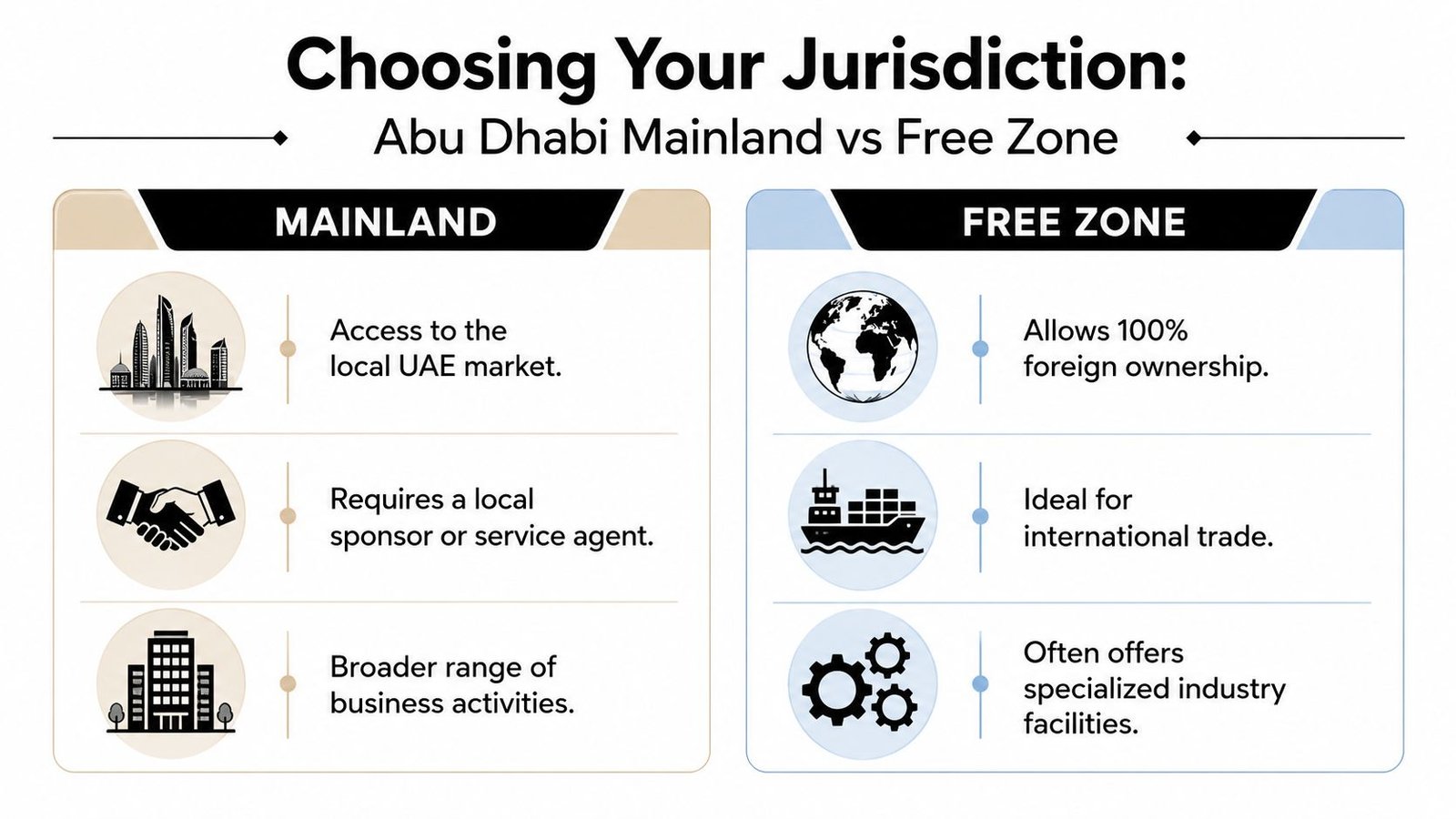
A Mainland company is a business licensed under ADDED so it can operate in the wider local market in Abu Dhabi and, where the activity permits, across the UAE. This is usually the cleaner choice if you want to serve onshore clients directly, bid for local contracts, or build a business with a broader operational footprint.
Older advice still tells founders they need a local partner by default. That's outdated for many activities. Under the updated UAE Commercial Companies Law, foreign investors can own 100% of many business activities in Abu Dhabi without requiring a local partner or service agent, as noted in GAAP Audit's overview of company formation rules.
What is a Free Zone company in Abu Dhabi
A Free Zone company is a business incorporated inside a designated economic zone with its own authority and regulatory framework. In practice, that often means a more structured setup path and an environment designed for international trade, holding structures, consultancy, tech, or sector-specific operations.
Free Zones can be a good fit when your clients are outside the United Arab Emirates, your team is lean, or you want a contained administrative environment. They can be less elegant when your commercial reality requires regular direct access to the local onshore market.
How should you choose between Mainland and Free Zone
The wrong way to choose is by asking which one is “better”. The right way is to ask which one fits your operating model with the least friction.
If your revenue depends on direct UAE market access, choose for access first. If your revenue depends on international flexibility, choose for operating efficiency first.
Here's the comparison founders need:
| Attribute | Mainland (ADDED) | Free Zone (e.g. ADGM, Masdar) |
|---|---|---|
| Regulator | Abu Dhabi Department of Economic Development | Free Zone authority |
| Market access | Better suited to wider local UAE activity | Better suited to zone-based or international activity |
| Ownership | Many activities allow full foreign ownership | Commonly structured for full foreign ownership |
| Activity range | Broad and commercially flexible | Often more structured by zone focus |
| Government and local contract fit | Usually stronger | Depends on structure and scope |
| Office logic | Often linked more closely to practical local operations | Often packaged with zone solutions |
| Best for | Retail, services with UAE clients, broader trading footprint | Export-oriented, consultancy, holding, startup and specialised models |
A few practical examples help:
- A founder selling advisory services to overseas clients: a Free Zone may keep things cleaner.
- A business targeting local customers in Abu Dhabi or Dubai: Mainland often avoids later workarounds.
- A company planning to hire steadily in the UAE: office and visa logic may matter more than the launch package headline.
The trade-off is simple. Mainland gives reach. Free Zones often give structure. The right decision in business setup in Abu Dhabi is the one that still works after your first customers, first hire, and first bank review.
Your Licensing and Registration Workflow
Once the jurisdiction is set, the next job is getting the company from idea to issued licence without creating avoidable delays. This part frustrates founders because it looks linear from the outside, but in reality it's a dependency chain.
What does your business activity actually control
A business activity is the legally defined description of what your company is allowed to do. It drives your licence type, document set, office expectations, external approvals, and sometimes your banking profile later.
Many applications become messy when founders often describe what they want commercially, but authorities register what fits the approved activity list. If those two don't line up, the company forms, but operations become awkward when you start invoicing, hiring, or opening a bank account.
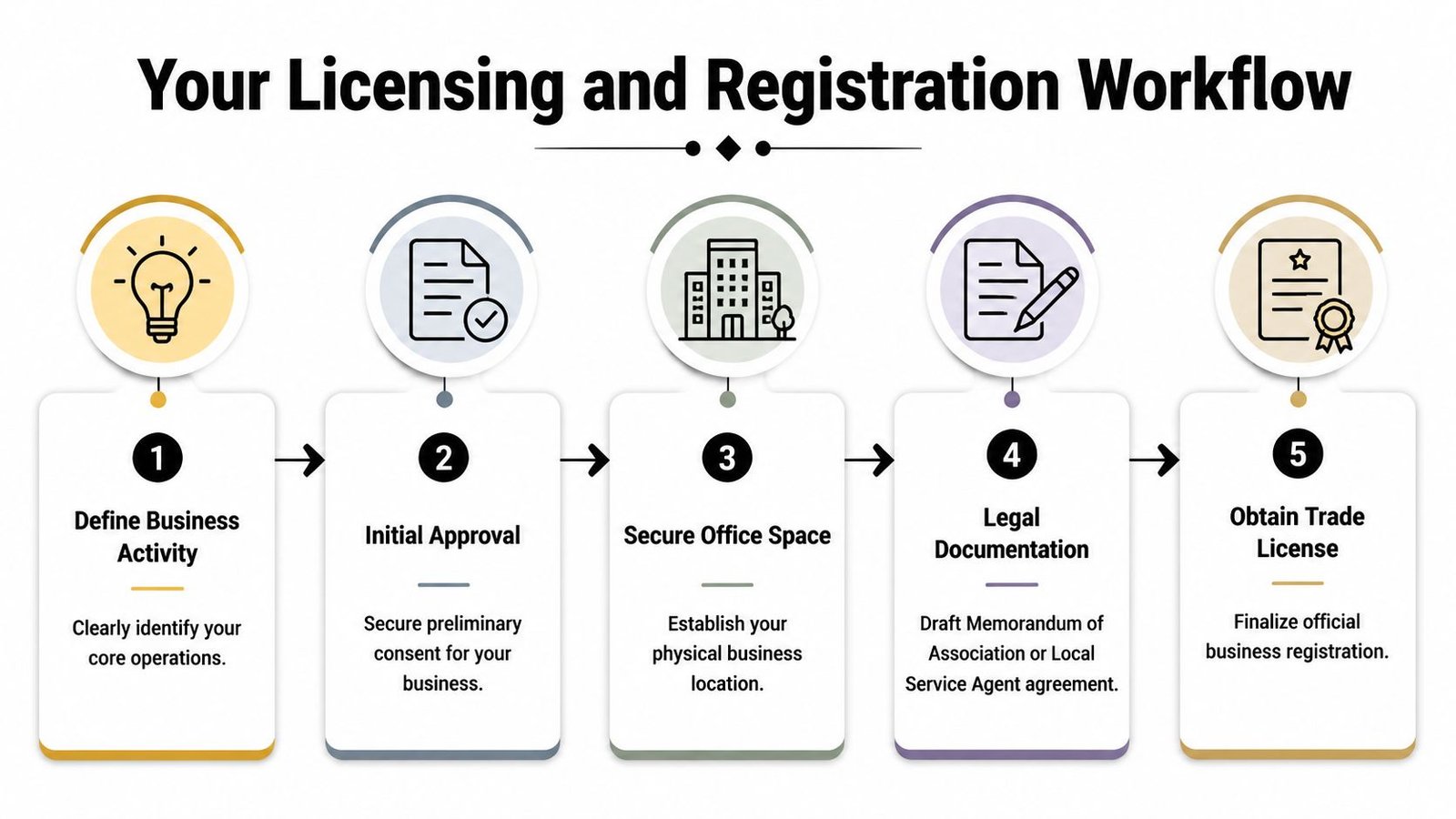
A practical workflow usually includes:
- Activity selection that matches what you'll really sell.
- Trade name reservation that meets naming rules.
- Initial approval from the relevant authority.
- Premises or address planning based on activity and visa needs.
- Legal document preparation, such as a Memorandum of Association.
- Final submission and licence issuance.
How does initial approval really work
Initial approval is the authority's preliminary consent to proceed with the formation. It doesn't mean you can operate yet. It means the setup can move forward if the rest of the file is in order.
For foreign investors on the Abu Dhabi Mainland, this stage has a specific trap that catches people repeatedly. ADDED states that foreign investors must obtain prior approval from the General Directorate of Residency and Foreigners Affairs, the immigration authority, before applying for initial approval in these cases. According to ADDED's business establishment guidance and 2025 operational compliance report, approximately 42% of foreign applicant batches are initially rejected for missing this prerequisite, causing delays of 3 to 5 weeks.
A rejected file doesn't always mean something is fundamentally wrong. Often it means the sequence was wrong.
That point matters because founders often assume digitisation removed sequencing risk. It hasn't. Online portals make submission easier. They don't fix a file built in the wrong order.
What happens between legal documents and final licence issuance
A Memorandum of Association is the legal document that sets out ownership and company structure for many entity types. Depending on the setup, you may also need supporting corporate documents, shareholder resolutions, passport copies, and attested records if a foreign corporate shareholder is involved.
Then comes the part many guides flatten into one line: premises. Some activities allow more flexibility than others, but your address solution still needs to match the licence path. If the activity is regulated, extra approvals may be required before the final licence is issued.
Here's what works better in practice:
- Keep the activity list tight: Too broad can trigger unnecessary review. Too narrow can restrict operations later.
- Check whether the shareholder is an individual or corporate entity: Corporate shareholders usually create more document work.
- Resolve translation and attestation early: Delays here tend to appear late, when everyone assumes the licence is almost ready.
- Treat regulated activities separately: Healthcare, education, and similar sectors often need extra authority sign-off.
By the time the final trade licence is issued, the founder should already know the next operational move. That usually means immigration registration, visa planning, and banking preparation. If you wait until the licence arrives to think about those, you've already lost time.
The Real Costs and Timelines for Your Abu Dhabi Setup
A low headline fee does not mean a low-cash setup. Founders get caught when they budget for incorporation but not for the money that gets tied up around it.
Why can a cheap licence still create cash pressure
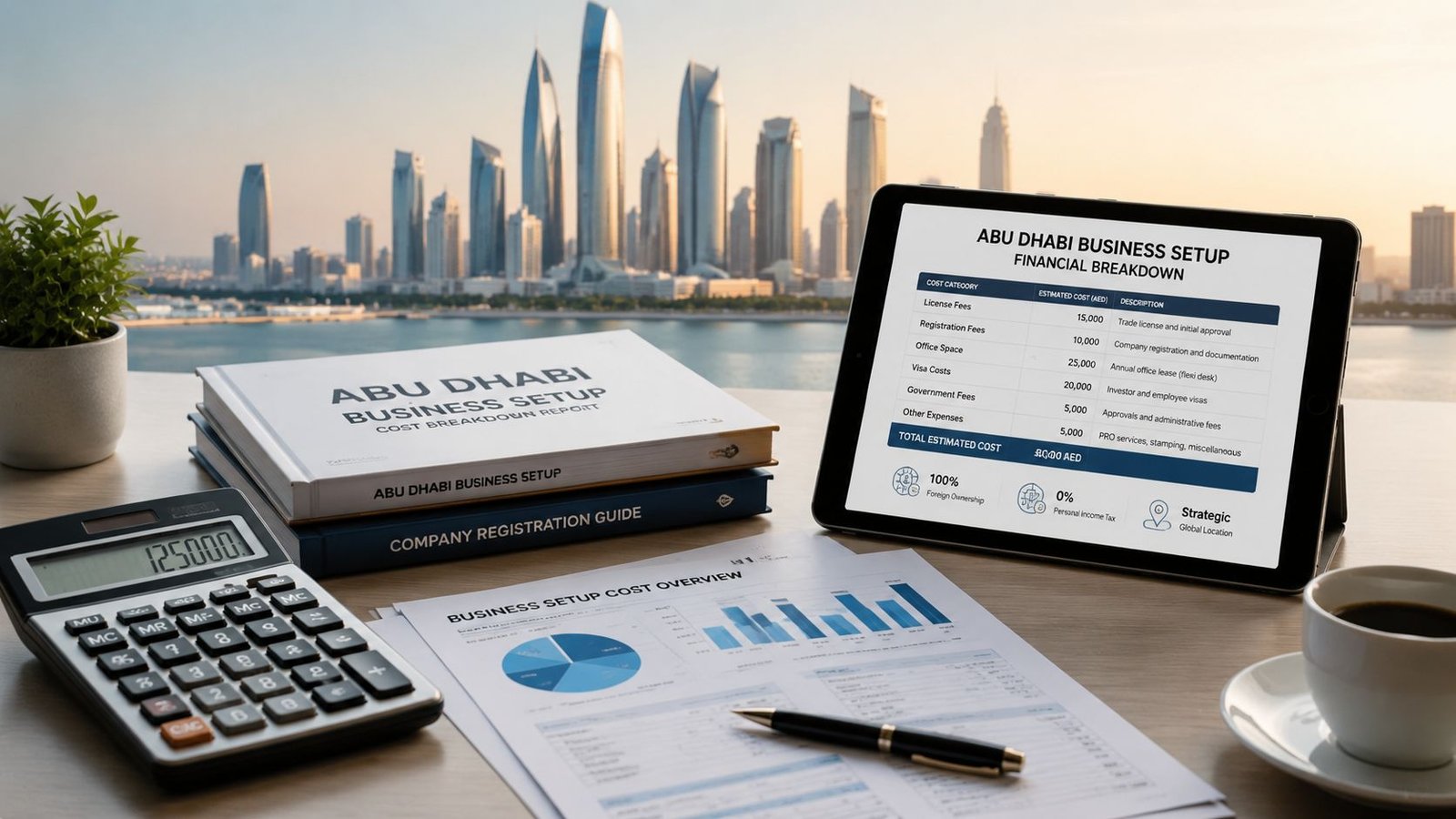
Abu Dhabi did make entry easier. As of 27 July 2021, the initial cost to establish a mainland business was reduced by 94%, dropping from AED 15,500 to AED 1,000, with renewals for existing businesses also lowered to AED 1,000 for most commercial, industrial, and professional activities under DED regulations, according to Whiteworth's summary of the Abu Dhabi fee reduction.
That headline matters. It does not tell you what the first 60 to 120 days will do to your liquidity.
In practice, the pressure shows up in the support layers around the licence. Legal drafting, attestations, translations, office commitments, immigration file setup, medicals, Emirates ID steps, and banking preparation all pull cash out before the business is fully operating. Critically, some of that cash stops being working capital.
According to Engel & Völkers' discussion of Abu Dhabi company setup realities, banks in the UAE often require cash deposits that are locked for the contract period, which can restrict access to growth capital. The same source notes a second pressure point. Virtual office or flexi-desk packages may suggest visa eligibility, but the visa quota is tied to the number of physical desks allotted.
That changes the economics of a cheap package fast.
I usually tell founders to separate cost from cash availability. A setup can be affordable on paper and still leave the company short on usable funds during hiring, stock purchases, or the first few months of operating expenses.
The bigger risk is not overspending. It is locking cash too early, then needing that same cash to start trading.
What timeline should you plan for in practice
Founders ask for one timeline. Abu Dhabi setup work does not move that way.
A straightforward file with a standard activity and complete documents can move quickly. Add foreign corporate shareholders, regulated activities, missing attestations, or a mismatch between office package and visa plan, and the file slows down in stages. The lost time rarely comes from one dramatic rejection. It usually comes from waiting on small corrections, one approval at a time.
For planning, use two dates, not one:
- Licence issuance date: the point when the company is legally formed
- Operational readiness date: the point when banking, staffing, invoicing, and access to the market are workable
That distinction matters for cash flow. If your sales plan assumes revenue starts as soon as the licence is issued, your forecast is probably too optimistic.
Where do founders usually misread the budget
The budgeting mistake is simple. Founders treat setup as a registration expense instead of a launch phase.
A better way to build the budget is to split it into three decision buckets:
| Budget area | What founders expect | What often happens |
|---|---|---|
| Government formation fees | The main cost | Only one layer of the entry bill |
| Premises and visa capacity | A cheap package covers early growth | Office terms can restrict hiring and visa allocation |
| Banking and working capital | Cash remains available after setup | Part of the cash can be locked, delayed, or reserved |
The office decision is where I see the most avoidable mistakes. A founder plans for one visa, chooses the lowest-cost package, then needs two or three hires within a quarter. At that point, the company is not just paying to upgrade space. It is paying in delay, revised paperwork, and slower recruitment.
Abu Dhabi is still one of the more cost-efficient places in the UAE to launch. The smarter question is not, “What is the licence fee?” It is, “How much liquid cash will the business still control after formation, office commitments, and bank requirements are in place?”
Securing Visas and Managing Government Relations
Your trade licence gives the company legal life. Your visa file gives the founder and team the right to live and work in the UAE under that company. Those are related, but they aren't the same process.
Which government bodies handle visas and labour
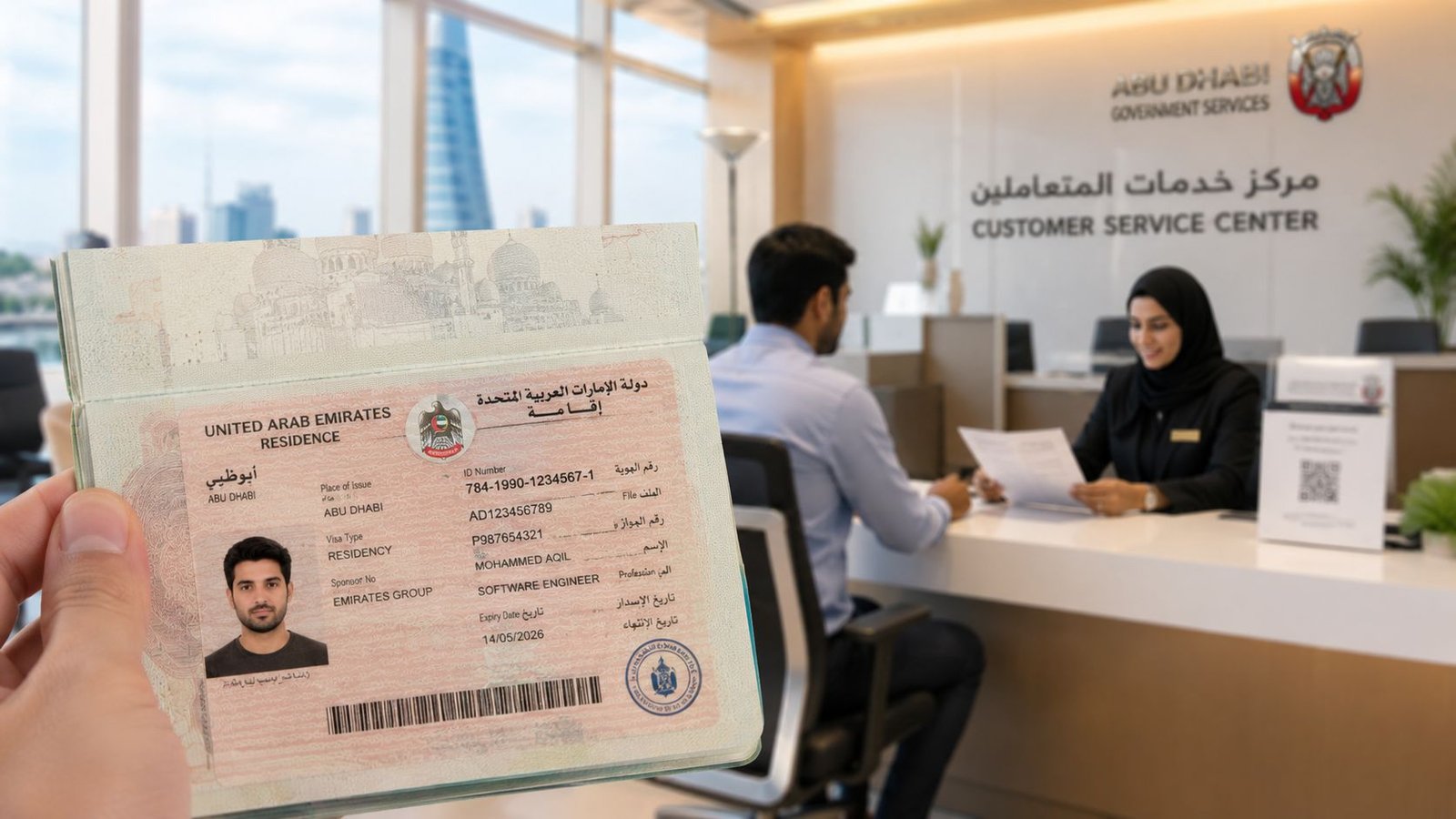
The General Directorate of Residency and Foreigners Affairs (GDRFA) is the immigration authority that handles residency and visa issuance. The Ministry of Human Resources and Emiratisation (MOHRE) is the federal body that oversees labour matters such as work permits and employment regulation.
For founders and HR teams, that split matters. Immigration status and labour permission are connected, but they move through different channels and checks. If the company's establishment file isn't properly active, the visa process won't move cleanly.
A Public Relations Officer, often called a PRO, is the person or service provider that handles these government-facing procedures, submissions, renewals, and document follow-up. In practice, good PRO work isn't just messenger work. It's sequencing, chasing, and fixing issues before they become missed joining dates.
How does the investor and employee visa flow work
The visa flow usually starts after company formation and immigration registration are in place. For most founder and employee cases, the pattern includes entry permission or status adjustment, medical testing, Emirates ID biometrics, and final residency issuance.
The details vary by case, but the operational reality is straightforward:
- Founders need the company file active first: You can't shortcut this with the trade licence alone.
- Employees need aligned labour and immigration processing: Offer letters, contracts, and permits need to match the company structure.
- HR should plan renewals before expiry windows become urgent: Reactive visa management creates disruption fast.
This overview gives a useful visual explanation of the wider process:
How does office space affect visa planning
An Establishment Card is the company's immigration file that allows visa processing under the business. Once that exists, founders often assume visa numbers are only an administrative question. They aren't. Office setup and licence conditions still shape practical visa capacity.
That's where package marketing can mislead people. A flexi-desk may be enough for formation, but it may not support the hiring plan the founder has in mind. If you know you'll need staff soon, set up the office solution around likely visa demand, not just initial cash savings.
Visa planning works best when finance, office selection, and hiring plans are made together. Separate them, and one of them usually breaks the others.
For businesses expanding between Abu Dhabi, Dubai, and other UAE locations, that discipline matters even more. The company structure should support the team you plan to build, not just the launch month.
Life After Formation Banking Tax and Compliance
The licence isn't the finish line. It's the point where scrutiny shifts from formation to operations.
Why does banking depend on your setup choices
A corporate bank account is the business account used for company transactions, payroll, supplier payments, and client receipts. Banks in the United Arab Emirates look past the licence itself. They assess the business model, shareholder profile, activity wording, source of funds, and whether the company's setup makes commercial sense.
That's why formation choices echo later. If your licence activity is vague, your office setup looks inconsistent with your stated business, or your ownership documents are messy, the banking review gets harder. Founders often think the bank account is a post-setup admin task. In reality, it's a second due diligence event.
What tax and compliance work starts after formation
Value Added Tax (VAT) is the UAE's indirect tax on taxable goods and services. Corporate Tax is the federal tax regime that applies to taxable business profits under the current UAE framework. After formation, the company needs to assess whether registration is required and then maintain proper filing discipline.
The practical work usually includes:
- Accounting setup: Keep records clean from day one. Retroactive clean-up is expensive and unreliable.
- Tax assessment: Check whether your activity and turnover create VAT or Corporate Tax obligations.
- Renewal management: Trade licence renewals, tenancy-related renewals, and immigration renewals need a single calendar.
- Document consistency: Bank records, invoices, contracts, and licence activity should tell the same story.
A compliant business is easier to bank, easier to renew, and easier to grow. In Abu Dhabi, that matters because expansion usually creates more documentation, not less.
How to Decide If You Need a Formation Partner
You can handle business setup in Abu Dhabi yourself. Online systems are better than they were, and straightforward cases are more manageable than many founders assume. The pertinent question isn't whether DIY is possible. It's whether it's a good use of founder time when one wrong activity choice or one sequencing mistake can slow the whole launch.
A formation partner earns their place when the case has moving parts. Foreign shareholders, regulated activities, visa planning, document attestation, office strategy, and banking preparation all create points where experience matters. Good support also helps with the less visible decisions, such as choosing a structure that won't box you in when you hire, raise capital, or expand from Abu Dhabi into Dubai or the wider UAE.
If your setup is simple and you have time to learn the system, DIY can work. If speed, certainty, and fewer mistakes matter more, experienced help usually pays for itself in saved time and avoided rework.
Not sure where to start? Inpro Corporate Services L.L.C. helps founders set up in Abu Dhabi and across the United Arab Emirates with clear timelines, transparent support, and hands-on help with formation, visas, banking, and compliance. Use their cost estimator or book a free strategy call to see what your UAE setup might cost.