


The most common advice about business setup services abu dhabi is still wrong. It tells founders to optimise for licence cost, setup speed, and the broad promise of a tax-light jurisdiction. That advice was already incomplete. In 2026, it's risky.
A UAE entity that looks cheap on day one can become expensive once you hit banking checks, visa sequencing, tenancy requirements, accounting obligations, and corporate tax compliance. A structure that's easy to incorporate isn't always easy to operate. That's the significant dividing line.
Abu Dhabi remains one of the region's strongest entry points for founders and expanding SMEs. Between 2021 and 2023, Abu Dhabi established 67,085 companies, and new registrations increased by 30% from 2021 to 2023, according to HAL UAE's review of Abu Dhabi company formation growth. More founders are entering the market, but more of them are also competing for bank approval, regulator comfort, and operational credibility.
If you're planning market entry, the question isn't “How do I get a licence?” It's “Which setup gives me the best chance of trading, hiring, invoicing, collecting money, and staying compliant without constant rework?”

Table of Contents
- Why Setting Up a Business in Abu Dhabi is Now a Strategic Game
- Choosing Your Arena Mainland Free Zone or Offshore
- The Abu Dhabi Business Setup Workflow Demystified
- Activating Your Business Visas Banking and PRO Services
- Operating Legally Accounting VAT and Corporate Tax Essentials
- Budgeting and Timelines Common Costs and Pitfalls
- How Inpro Delivers Speed Clarity and Growth
Why Setting Up a Business in Abu Dhabi is Now a Strategic Game
The old “tax-free paradise” framing doesn't help serious founders anymore. Abu Dhabi still offers a strong business environment, but your setup decision now sits inside a more mature regulatory reality. Corporate tax exists. Banks ask harder questions. Authorities expect cleaner documentation and clearer business substance.
The licence is no longer the finish line
A founder can still get trapped by the wrong priorities. They choose a low-entry package, then realise the structure doesn't fit their client base, can't support the intended visa plan, or creates friction with banks because the activity, business plan, and operating footprint don't line up.
That's why business setup services abu dhabi need to be assessed as an operating system, not a filing service. The legal entity has to support four things at once:
- Market access: where you can legally trade and invoice
- Bankability: how credible the business looks during due diligence
- Compliance: how cleanly you can handle accounting, VAT, and tax
- Scalability: whether the structure still works when you hire, raise capital, or expand across the UAE
Practical rule: If your setup saves money at incorporation but weakens banking, contract execution, or compliance later, it wasn't cheaper. It was deferred cost.
Abu Dhabi rewards well-planned entrants
Abu Dhabi's momentum is real, but momentum creates competition. More businesses entering the market means more founders are trying to open accounts, secure tenancy, activate visas, and position themselves in the same jurisdictions.
What works now is preparation. Founders who arrive with a clear activity list, coherent ownership structure, usable business plan, and a realistic compliance model usually move faster. Founders who rely on generic package sales often end up restructuring after incorporation.
Establishing a presence in Abu Dhabi is strategic in the same way a market entry strategy is strategic. It's about fit. A local services firm, a fintech operator, a trading company, and a holding structure should not be formed the same way, even if they all want “100% ownership” and a fast licence.
What this means for you
Before you compare providers, compare outcomes. Ask whether the proposed setup supports your actual sales model, banking path, and reporting obligations. If the consultant only talks about licence issuance, they're only solving the first layer of the problem.
Choosing Your Arena Mainland Free Zone or Offshore
Most guides describe mainland, free zone, and offshore as categories. That's not enough. Founders need a decision framework that reflects how the business will sell, contract, bank, and grow. As Stratrich notes in its analysis of Abu Dhabi setup decision gaps, many guides stay generic and don't give founders a practical way to choose between mainland and specific free zones based on sector rules, bank vetting, and competitive pressure.
Start with how revenue will happen
Jurisdiction choice should begin with your revenue path, not your preference for a lower setup fee.
If you'll serve clients across the UAE directly, hire locally, and potentially bid for public sector work, mainland usually deserves first review. If you're building an international services business, a holding platform, or a specialist business that benefits from a particular ecosystem, a free zone may be the better fit. Offshore structures are different again. They're generally used for holding and structuring objectives rather than day-to-day operating presence in the local market.
Here are the questions that matter most:
- Who pays you: UAE customers, overseas customers, group companies, or investors
- Where delivery happens: onshore in Abu Dhabi, online across borders, or as a holding function
- How regulated the activity is: some sectors face tighter scrutiny than others
- What the bank needs to see: a credible reason for that entity in that jurisdiction
- What the next stage looks like: staff visas, warehousing, local contracts, capital raising, or asset ownership
Jurisdiction comparison
| Feature | Mainland (DED) | Free Zone (e.g., ADGM, KIZAD) | Offshore (e.g., ADGM, RAK ICC) |
|---|---|---|---|
| Primary use case | Local UAE trading and service delivery | Zone-based or international operations, specialist ecosystems | Holding, structuring, asset ownership |
| Market access | Broad UAE-wide trading access | Strong for cross-border and zone-specific models, local access depends on structure | Not the usual route for active local trading |
| Ownership approach | Depends on activity and legal form | Often favoured by foreign founders seeking control and administrative simplicity | Usually selected for structural rather than operating reasons |
| Office expectations | More likely to require premises-linked documentation | Varies by zone and package | Usually not chosen for operational office-led scaling |
| Bankability | Can be strong when local commercial logic is clear | Can be strong if the zone matches the business model and substance is credible | More sensitive to purpose, ownership clarity, and real use case |
| Operational scaling | Good for hiring, local sales, contracts, and wider UAE footprint | Good for specific sectors and international models | Limited as an operating vehicle |
| Best fit | Local services firms, traders, SMEs expanding in-market | SaaS, advisory, cross-border trade, specialist sector businesses | Holding companies and asset protection structures |
What usually works
The strongest setups are often unsurprising. They match legal form to commercial reality.
A local consulting or services company that expects UAE clients and local staff often works better on mainland because the operational logic is obvious. A founder who wants a respected ecosystem for financial or specialist activity may prefer a free zone, but should expect more attention on business plan quality and substance. An investor setting up a pure holding arrangement usually shouldn't force that structure into an operating role it wasn't designed for.
Choose the jurisdiction that best explains your business to a banker, regulator, and customer. If all three understand why the company exists, the rest of the setup tends to be smoother.
The Abu Dhabi Business Setup Workflow Demystified
The process looks bureaucratic until you see the logic. Each stage exists because the next stage depends on it. Founders lose time when they treat setup as a document collection exercise instead of a sequence with hard dependencies.
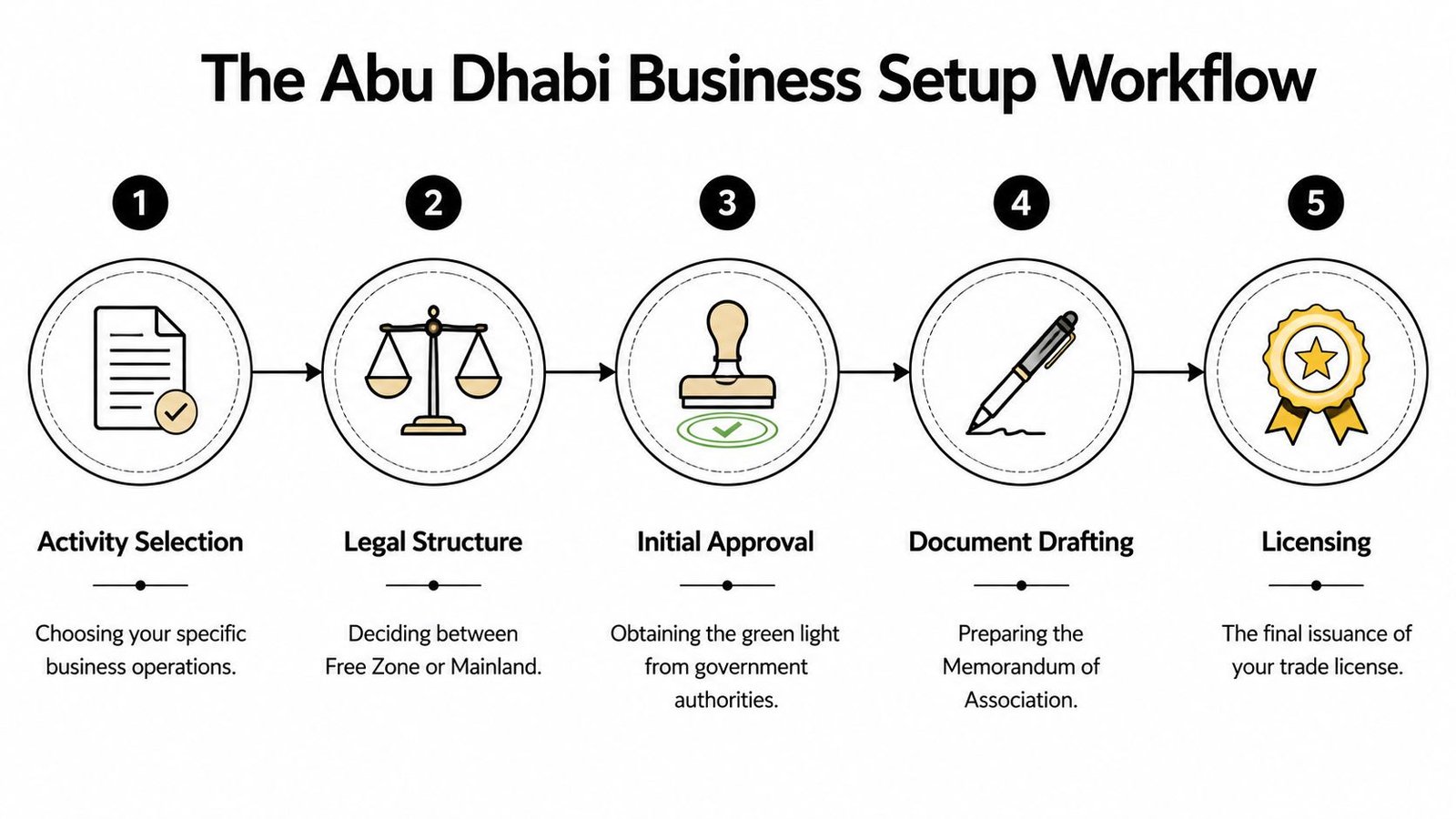
The sequence matters
A practical workflow usually follows this order:
Activity selection Many mistakes begin at this stage. Your approved activity shapes licence type, regulator interaction, document requirements, and sometimes banking posture.
Legal structure choice
LLC, branch, sole structure, free zone entity, or another form. This decision affects ownership, liability, and what documents need to be prepared.Trade name and initial approval
The authorities need a compliant identity for the entity and a first-pass review of what you're applying to do.Document drafting and legalisation
This may include the Memorandum of Association, resolutions, identification documents, and supporting approvals where relevant.Premises and supporting registrations
Depending on the structure, this may involve tenancy-linked documentation or zone-specific facility requirements.Final licence issuance
Only after the earlier dependencies are cleanly resolved does the licence get issued.
Where founders lose time
The biggest delays usually don't come from one dramatic rejection. They come from small mismatches.
- Activity mismatch: The business plan says one thing, the licence activity says another.
- Name issues: The reserved trade name doesn't align with the application logic.
- Document inconsistency: Passport names, signatures, translations, and corporate documents don't match exactly.
- Premature commitments: A founder signs for office space before confirming what the authority or bank will require.
Clean sequencing beats speed claims. A slower but correct filing is usually faster than a rushed filing that needs to be redone.
Founders also underestimate how much setup depends on responsive coordination. One missing signature, one un-attested document, or one unclear shareholder resolution can pause the whole chain. The best operators treat formation like project management. They track dependencies, not just forms.
Activating Your Business Visas Banking and PRO Services
A trade licence creates the company. It doesn't make the company operational. Activation starts when immigration, identity, and banking are coordinated properly.

A licence doesn't activate the company
Founders usually need three things soon after incorporation. Residency status for key people, a functioning corporate bank account, and a local operator who can move documents through government channels without procedural drift.
For mainland, the cost logic is especially important. Global Biz UAE's breakdown of Abu Dhabi mainland formation states that mainland setup can cost 20 to 40 per cent more than free zones, with total setups averaging AED 15,000 to AED 35,000, driven by office contracts and multi-tier approvals. The same review notes that bundling PRO services for visa processing can cut delays by 4 to 6 days.
That matters because these aren't separate tracks. Visa processing affects identity issuance. Identity affects account opening readiness. PRO coordination affects how quickly filings and follow-ups move.
Banking is a credibility test
Banks aren't just checking whether your licence exists. They want to understand the business.
A stronger banking file usually includes:
- A coherent business plan: what the company does, who it serves, and why Abu Dhabi is the right base
- Clear ownership records: shareholders, beneficial owners, and decision-makers must be easy to verify
- Substance indicators: operational logic, contracts in progress, staffing intent, and evidence the entity will be used
- Consistent paperwork: licence, constitutional documents, passport records, and supporting explanations should all align
Weak applications often fail because the founder can't explain the structure cleanly. “We chose this because it was cheap” is a poor banking narrative.
Here's a useful overview before planning your own onboarding:
Why PRO coordination matters
A competent PRO function isn't clerical. It's operational control.
Medical tests, Emirates ID steps, establishment card sequencing, immigration filings, and document clearances all depend on timing. If the founder handles them ad hoc, delays stack up. If the process is coordinated properly, each filing supports the next one.
The fastest visa process is usually the one with the fewest handoffs.
In terms of business setup services abu dhabi, many providers underdeliver. They stop at incorporation and leave founders to solve activation alone. Preventable delays frequently start at that specific stage.
Operating Legally Accounting VAT and Corporate Tax Essentials
A lot of setup advice still treats accounting and tax as something to “handle later”. That approach made more sense in an earlier era. It doesn't now.
As Global Biz UAE's guidance on Abu Dhabi setup compliance points out, many guides gloss over the 9% corporate tax, record-keeping duties, and substance expectations. It also notes that founders often underestimate the long-term regulatory load, especially as entities in zones such as ADGM face stricter scrutiny around bank account opening, business plans, and proof of substance.
Corporate tax changed setup logic
The introduction of corporate tax changed the practical meaning of “best jurisdiction”. It's no longer enough to choose a licence based on what gets issued fastest. You have to ask whether the entity can support proper bookkeeping, expense classification, intercompany logic where relevant, and defensible commercial substance.
That has direct consequences during setup:
- Activity selection affects accounting design: revenue categories, invoicing patterns, and cost allocation should make sense from the start.
- Entity structure affects documentation: groups, branches, and related-party arrangements need cleaner record-keeping.
- Banking and tax now overlap: the same business plan that helps with banking often supports tax credibility and operating substance.
What to build from day one
A compliant company should establish a few habits immediately.
- Bookkeeping discipline: Keep invoices, contracts, bank records, and expense support organised from the first transaction.
- VAT readiness: If your turnover reaches the AED 375,000 threshold, you must register for VAT, as noted in the earlier verified guidance on Abu Dhabi setup costs and compliance. Don't wait until invoicing has already become messy.
- Payroll and expense logic: Staff costs, reimbursements, and contractor payments should be documented in a way that supports both finance and immigration records.
- Substance evidence: Maintain records that show the company's real activity, decision-making, and operating footprint.
A compliant UAE company isn't the one with the nicest licence folder. It's the one whose records explain the business clearly to a bank, auditor, and tax authority.
Founders who design these workflows early usually spend less time cleaning up after the first year. Founders who postpone them often discover that simple tasks like VAT registration, bank reviews, or annual renewals become much harder because the evidence trail is weak.
Budgeting and Timelines Common Costs and Pitfalls
The licence fee is only one line in the launch budget. Founders who plan properly budget for the whole operating start, not just the incorporation event.
Budget the whole launch not just the licence
If you're comparing mainland and free zone options, don't stop at the advertised package. A workable setup budget usually includes some mix of the following:
- Licence and authority fees: The formal cost of incorporation and approvals.
- Legal document handling: Drafting, notarisation, attestations, and any corporate support documents.
- Premises-related costs: Particularly relevant when the structure depends on tenancy-linked approvals.
- Visa activation costs: Immigration processing, medical steps, Emirates ID, and insurance-linked requirements where applicable.
- Banking preparation costs: Not usually a government fee, but often a real cost in terms of documentation work and advisory effort.
- Compliance setup: Accounting system design, VAT readiness, payroll structure, and record-keeping process.
The practical mistake is treating optional support as unnecessary overhead. In reality, some “optional” support only looks optional until a missing document or wrong filing forces a reset.
Delays usually come from dependencies
Abu Dhabi timelines vary because setup isn't one approval. It's a chain. The timeline extends when one stage depends on a document, tenancy confirmation, regulator approval, or immigration file that wasn't prepared correctly.
Common pitfalls include:
- Wrong activity choice: This affects licensing, regulator touchpoints, and bank explanations.
- Weak banking file: A company can be incorporated and still remain commercially stuck.
- Poor document consistency: Names, signatures, and shareholder records must line up exactly.
- Unclear post-setup plan: Founders launch without deciding who will handle bookkeeping, tax filings, and renewals.
A realistic launch budget should also protect your cash runway against delay. If the account opens later than expected or a visa step takes longer, the business still needs to function. That's why the best planning model isn't “minimum setup cost”. It's “minimum avoidable friction”.
How Inpro Delivers Speed Clarity and Growth
Founders don't usually struggle because Abu Dhabi is inaccessible. They struggle because the process crosses too many functions at once. Jurisdiction selection, licensing, visas, banking, and compliance all affect each other, and most service providers only own one piece of that chain.
That's where a modern operator stands out. The value isn't just filing documents quickly. It's giving founders a setup path that fits their business model, then keeping the process coherent from incorporation through operational launch.
A strong partner should do four things well:
- Clarify the jurisdiction decision: mainland, free zone, or offshore based on your actual commercial model
- Control the workflow: formation, legal documents, attestations, and authority handling without procedural gaps
- Activate the company: visas, PRO support, and bank account opening preparation
- Support the long term: accounting, VAT, tax filing, and renewal discipline after setup
For founders, that means fewer hidden handoffs. It also means a cleaner operating picture from day one. You're not forced to re-explain the same company to a formation agent, a PRO, a bank contact, and a tax adviser who all work from different assumptions.
The practical advantage of a company like Inpro is that it treats formation as the start of an operating relationship, not the end of a transaction. That matters even more for SMEs scaling into the UAE, holding structures that need clean governance, and partner-led platforms that want embedded workflows instead of manual coordination.
The other difference is transparency. Founders need clear timelines, understandable pricing, and direct communication about trade-offs. If a setup route is cheaper but weaker for bankability, you should hear that before incorporation, not after.
If you want a practical setup plan rather than a generic package, Inpro Corporate Services L.L.C. helps founders compare Mainland, Free Zone, and Offshore options, manage licences and visas, open the path to banking, and build compliant accounting and tax workflows for the UAE from day one.