


If someone asks you for a certificate of good standing in the UAE, don't look for that exact label first. In the United Arab Emirates, the practical equivalent is usually a current trade licence, a status certificate/extract, or a certificate of incumbency/existence, and many banks and investors want it issued within 30–90 days.
The popular advice online gets this wrong. It treats the document as if every country has one standard certificate with one standard name. The UAE doesn't work that way. Dubai mainland, Abu Dhabi mainland, Dubai free zones, financial free zones, and regulated sectors can all use different documents for the same underlying purpose, which is proving that your company is active, properly registered, and current enough to be relied on for the transaction in front of you.
That distinction matters more than most founders expect. If you ask the wrong authority for the wrong document, you can lose days on a simple bank update, a visa file, or a cross-border attestation bundle. The fix is straightforward once you understand the local logic: stop searching for a universal certificate, and identify which UAE status document your counterparty needs.
Table of Contents
- What Is a Certificate of Good Standing in the UAE
- Why You Need Proof of Your Company's Good Standing
- UAE Equivalents to a Good Standing Certificate A Jurisdictional Breakdown
- How to Obtain Your Company's Status Certificate in the UAE
- Common Pitfalls That Can Block Your Certificate Request
- Certificate Validity Timelines and Costs
What Is a Certificate of Good Standing in the UAE
In the UAE, a certificate of good standing is usually not the official name of the document you need. The function exists, but the label changes by authority and transaction. In practice, the closest equivalents are a current trade licence / registration status document or a certificate of incumbency/existence, depending on the issuing body and the reason you need it.
Why the term causes confusion
Foreign founders often assume there should be one universal paper that proves the company is compliant. That assumption comes from other systems where the concept is standardised. In the UAE, the better question is, “Which authority-issued document proves my company's current status for this specific use?”
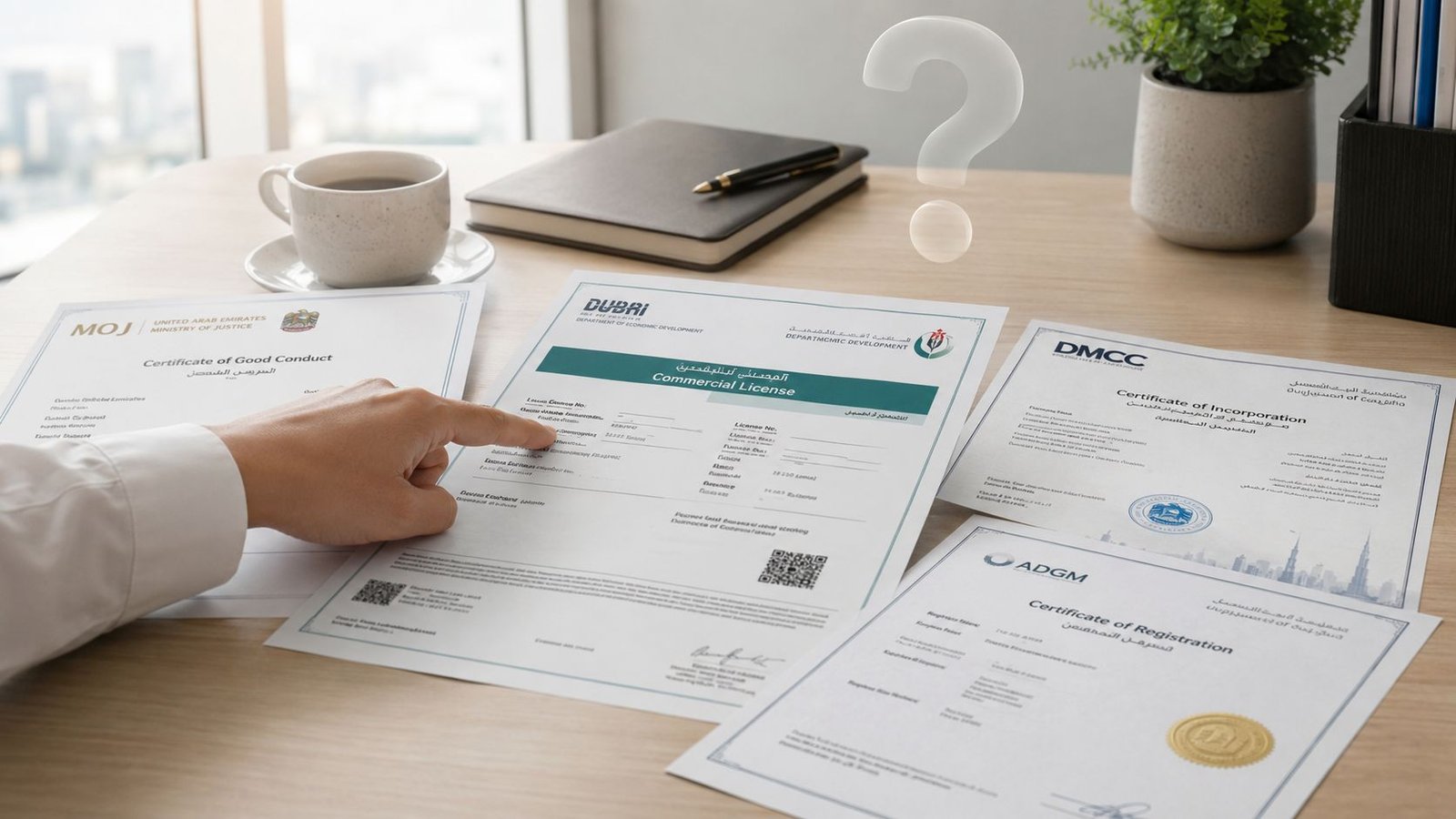
One nuance trips people up repeatedly. A status document does not promise future compliance. It only reflects the filing office's records on the day it was issued. New York's Department of State makes this explicit when it refers to the document as a Certificate of Status, which reflects the record on that specific date. The same “snapshot” logic is the right way to think about UAE documents.
Practical rule: In Dubai, Abu Dhabi, Sharjah, or any free zone, treat the certificate as evidence of current registry status, not as a permanent badge of compliance.
What good standing means in practice
Good standing is the practical condition of being active, registered, and current on the filings, fees, and registry details the issuing authority expects to see. In the UAE, that usually comes down to whether the authority's own system shows a valid licence, matching company records, and no blocking compliance gap that prevents issuance.
That means the useful document may be different from one company to another:
| Situation | Usual UAE evidence |
|---|---|
| Basic proof that the company is active | Current trade licence or commercial registration extract |
| Proof of directors, shareholders, or signatories | Certificate of incumbency or company extract |
| Bank or investor due diligence | Freshly issued status certificate or authority extract |
| Cross-border filing or notarisation support | Jurisdiction-specific status document, often recently issued |
A founder setting up in Dubai mainland may solve the issue with a current licence and commercial register evidence. A founder in a free zone may need a separate authority-issued certificate because the counterparty wants a more formal status confirmation. A regulated business may also need an additional clearance or sector-specific confirmation beyond the company registrar's document.
The reassuring part is simple. The UAE does have the documents people are asking for. You just need the right local equivalent, issued by the right authority, for the right use case.
Why You Need Proof of Your Company's Good Standing
Most requests for a certificate of good standing arrive when something important is already moving. A bank is reviewing signatories. An investor is running due diligence. Human resources is trying to finalise a visa file. A parent company abroad needs updated entity evidence for a filing or corporate resolution.
When founders usually get asked for it
A common example is corporate banking. A bank may already know your company, but when you change authorised signatories, refresh know-your-customer records, or add a shareholder, the compliance team often asks for current evidence that the entity is still active and properly registered. If your file is stale, the bank can stop the next step until you replace it.
Another common moment is investor diligence. A term sheet may be agreed in principle, but legal counsel still wants present-day evidence that the company exists in good order and that the signatories match the registry. The same thing happens when a UAE company signs a large customer, applies to become a supplier, or needs to legalise documents for use outside the United Arab Emirates.
For HR teams, this can become urgent around visas. Some immigration and labour-related workflows are tied to an active company record and valid licensing position. If the company status document can't be issued cleanly, the delay tends to spill into the next linked task.
When a counterparty asks for “good standing,” they're usually trying to reduce risk before they let the company do something consequential.
Why timing affects acceptance
Founders often lose time by ordering too early. Historically, the concept of good standing comes from proving that a company is active and current on filings and fees. In the UK, a certificate can only be issued if the company has had continuous, unbroken existence and satisfied filing obligations, and the certificate is treated as valid for only 3 months from issue. That short validity period is a good benchmark for how banks and authorities think about these documents.
The practical lesson is that good standing is continuous, not one-off. You don't “earn” it at incorporation and keep it forever. You maintain it by keeping the licence live, registry details accurate, and authority-facing compliance current.
A few patterns work well:
- Order close to the transaction: If a bank meeting or filing is scheduled, request the document near that date.
- Match the request to the use case: Ask whether the counterparty wants basic existence proof, signatory confirmation, or a formal status certificate.
- Check whether legalisation is needed: Cross-border use can add another layer of timing and document preparation.
- Keep HR informed: If visas depend on the same company file, delays on the corporate side can quickly affect staff timelines.
What doesn't work is relying on an old copy in the company folder and assuming it will still be accepted. In UAE practice, that's one of the easiest ways to turn a routine task into a deadline problem.
UAE Equivalents to a Good Standing Certificate A Jurisdictional Breakdown
The UAE does not run on one national company registry for all business types. That's why there isn't one universal certificate. The issuing document depends on whether the company sits on the mainland, in a commercial free zone, or in a financial free zone with its own registrar.
Which document matches which authority
The closest rule of thumb is this: the registrar or licensing authority that governs your company is the place that issues the status evidence that acts as your good standing document.
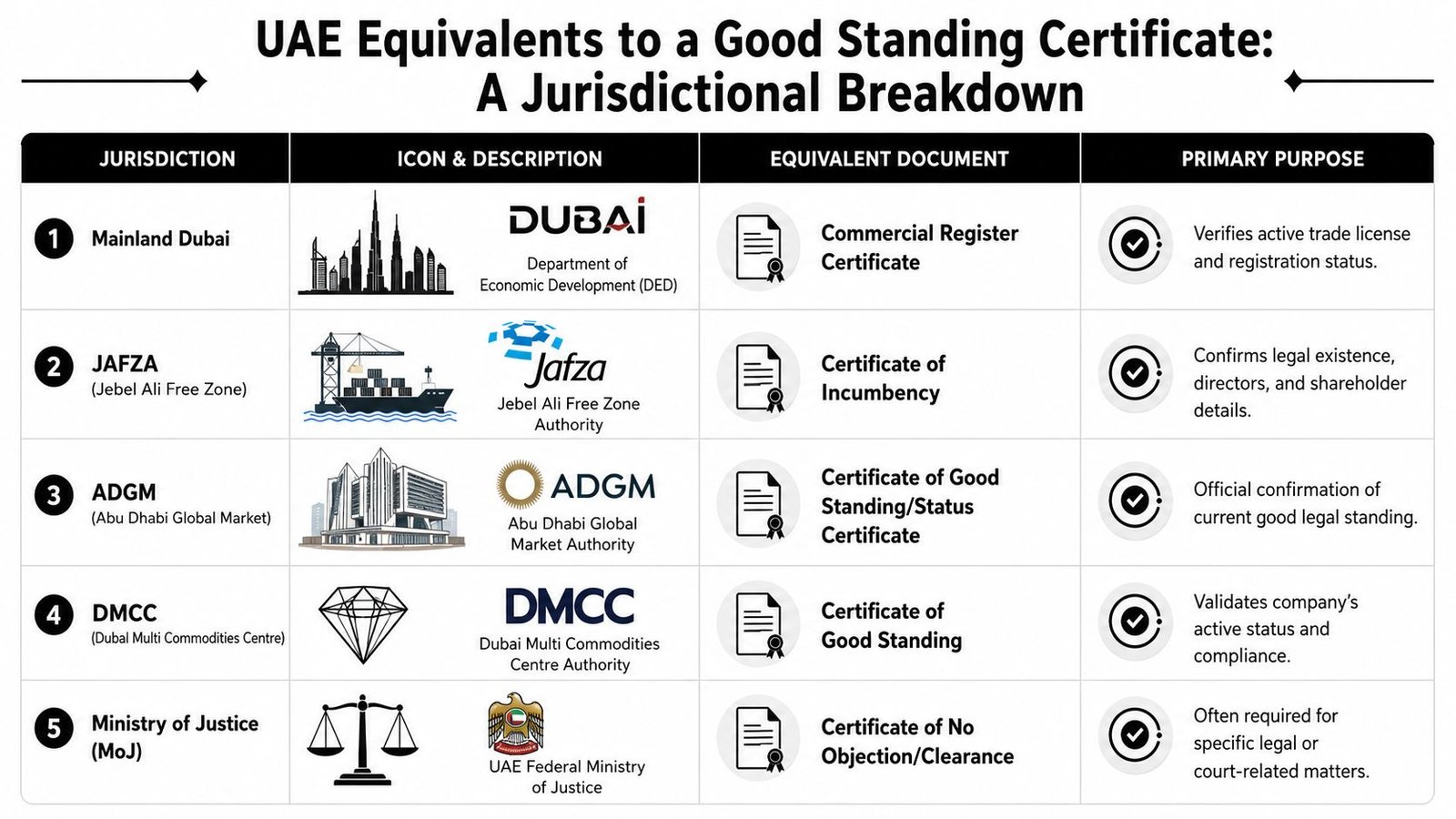
Here is the practical map founders usually need:
| Jurisdiction or authority | Common UAE equivalent | What it usually proves | Typical use cases |
|---|---|---|---|
| Mainland Dubai | Commercial Register Certificate and current trade licence | Active trade licence and registration status | Banking, supplier onboarding, government checks |
| JAFZA (Jebel Ali Free Zone Authority) | Certificate of Incumbency | Legal existence plus directors and shareholders | Bank accounts, overseas filings, legal opinions |
| ADGM (Abu Dhabi Global Market) | Certificate of Good Standing / Status Certificate | Current legal standing in that registrar system | Investor diligence, finance transactions, legal filings |
| DMCC (Dubai Multi Commodities Centre) | Certificate of Good Standing | Active status and compliance position | Banking, renewals, counterparties abroad |
| Ministry of Justice | Certificate of No Objection / Clearance | Matter-specific legal or court-related clearance | Litigation-linked or notarisation-related requirements |
That table is a working guide, not a promise that one document will satisfy every request. A bank may still ask for a current trade licence plus a separate incumbency-style document showing directors and signatories. A foreign law firm may accept a status certificate but still request attested constitutional documents with it.
How to choose the right document for the use case
If the request is about basic company activity, start with the current trade licence and registration extract. If the request is about who can sign, look for a certificate of incumbency or official extract showing directors, managers, or shareholders. If the request is tied to a formal legal or banking checkpoint, ask the authority for the most current status certificate it issues for your entity type.
This is especially relevant in financial free zones. Abu Dhabi Global Market and Dubai International Financial Centre both operate with a more registrar-driven style of documentation than many standard commercial free zones. Mainland authorities often rely more heavily on the live trade licence and registry file. That doesn't make one system better. It just means the paperwork vocabulary changes.
A good operational rule is to identify these three things before ordering anything:
- The governing authority: mainland licensing body, free zone authority, or regulated registrar.
- The exact purpose: bank KYC refresh, amendment, visa-related support, investor due diligence, or foreign filing.
- The level of detail needed: existence only, current status, or incumbency and signatory detail.
In the UAE, the official status certificate from the relevant registrar or free-zone authority is the functional equivalent to a U.S. certificate of good standing, and its value is time-sensitive because it proves compliance only at the moment of issuance, as explained in Brex's discussion of status certificates. That's why corporate banks and government bodies often use it as a checkpoint before they process signatory changes, board resolutions, or similar actions.
A mainland licence can be enough for one task and inadequate for the next. The deciding factor isn't what your company prefers to submit. It's what the receiving party is willing to rely on.
The point that trips up foreign founders is fragmentation. They search for one UAE-wide certificate. What works in practice is a decision tree based on jurisdiction, purpose, and recipient expectations.
How to Obtain Your Company's Status Certificate in the UAE
Once you know which authority controls your company, the process becomes much more predictable. The exact portal and form differ between jurisdictions, but the preparation logic is mostly the same across Dubai, Abu Dhabi, and the wider United Arab Emirates.
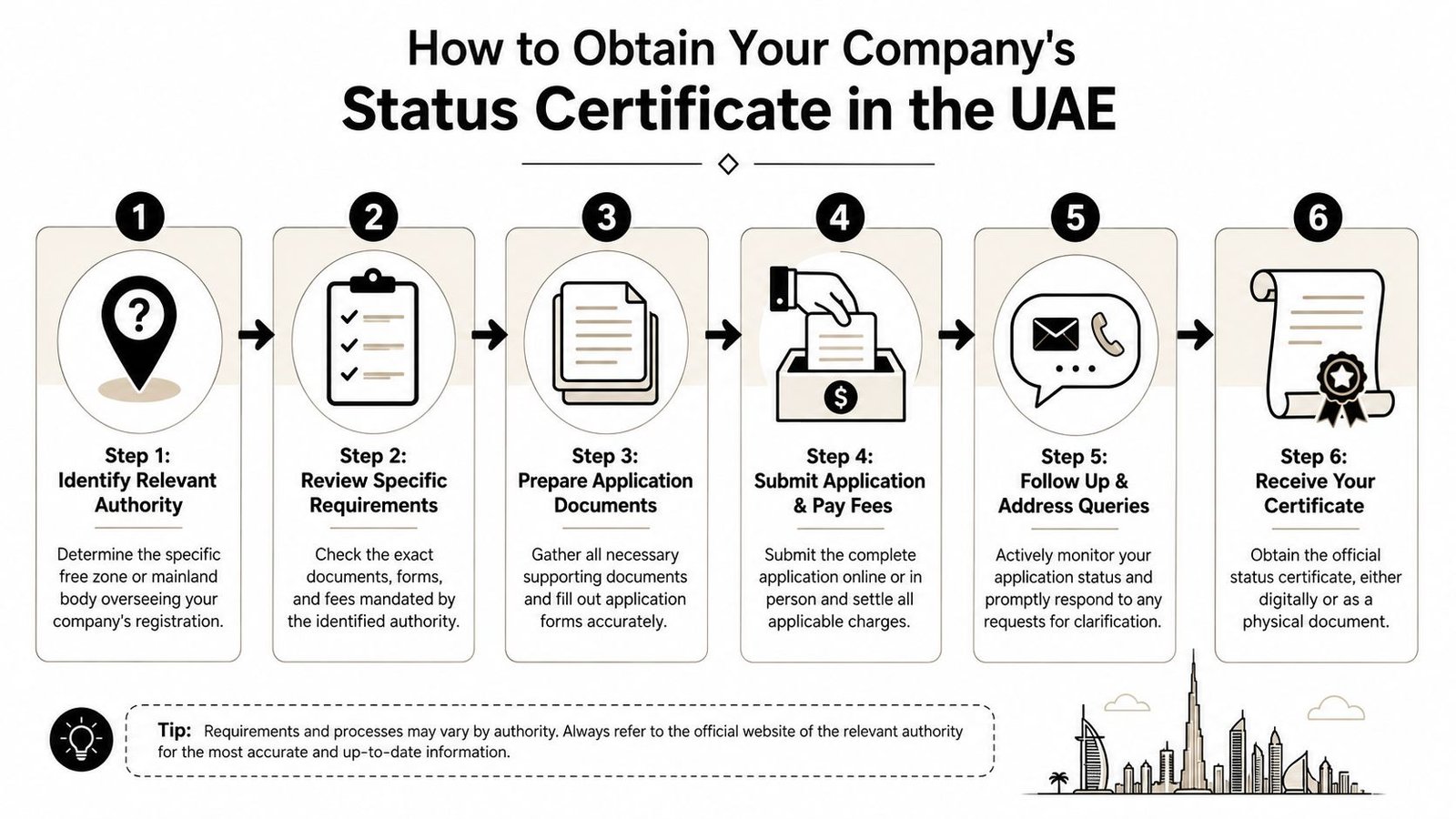
To make the workflow easier to picture, here's the standard sequence most founders follow.
What to check before you apply
Before anyone clicks “request certificate,” verify the company file as if you were the authority reviewing it. Start with the licence. If it's near expiry, renew first. Even when the portal allows you to submit a request, the system may still block issuance if the record isn't current enough.
Then review the registry data. Check the exact legal name, licence number, registered address, shareholder details, manager or director records, and any Ultimate Beneficial Owner record if your jurisdiction maintains one. The authority will normally issue the document based on what its own database can verify, not what your internal spreadsheet says is correct.
Checklist before filing: valid licence, paid authority fees, matching registry data, and a clear understanding of which document the recipient has requested.
A final pre-check that saves time is asking whether the recipient needs anything beyond the certificate itself. Some banks want the certificate plus constitutional documents. Some foreign authorities want attestation or legalisation after issuance. If you only order the first document and discover the rest later, the calendar can get tight.
A practical six step workflow
Identify the relevant authority
Determine whether your company is registered with a mainland licensing authority, a commercial free zone, or a financial free zone registrar. The issuing body matters more than the generic phrase “certificate of good standing.”Review the authority's specific requirements
Some authorities make the document available directly through an online portal. Others require a typed request, service centre submission, or account-level approval from an authorised signatory. Don't assume the process is identical across jurisdictions.Prepare the application documents
Gather the company basics first. In many cases that means the current trade licence, passport or Emirates ID copy of the authorised person if required, a board resolution if someone else is applying, and any authority-specific request form.
After those first steps, many founders find it helpful to see the process in a visual format before they submit. This walkthrough gives a simple overview of how status document requests are usually handled in practice.
Submit the application and pay the fee
Use the correct portal or service channel for your authority. Pay attention to spelling, punctuation, and company identifiers. A mismatch between the request and the registry entry can trigger rejection or manual delay.Follow up and answer queries quickly
Some requests issue automatically. Others pause because the authority wants a clarification, a corrected document, or proof that the applicant has authority to request the certificate. Fast responses matter when the certificate is tied to a bank deadline or immigration file.Receive and review the certificate
When it's issued, check the legal name, issue date, and content carefully. If the bank asked for signatory evidence and the certificate only confirms existence, you may need an additional document before your file is complete.
The process looks simple on paper, but what separates smooth applications from frustrating ones is preparation. Founders who verify the company record first usually move quickly. Founders who treat the request as a one-click admin task often discover the underlying file has issues that only show up when the certificate is needed urgently.
Common Pitfalls That Can Block Your Certificate Request
Most certificate delays don't happen because the authority is difficult. They happen because the authority's system can't confirm the company file in the way the requested document requires. In UAE practice, that usually means the problem is already sitting in the registry before the request is ever submitted.
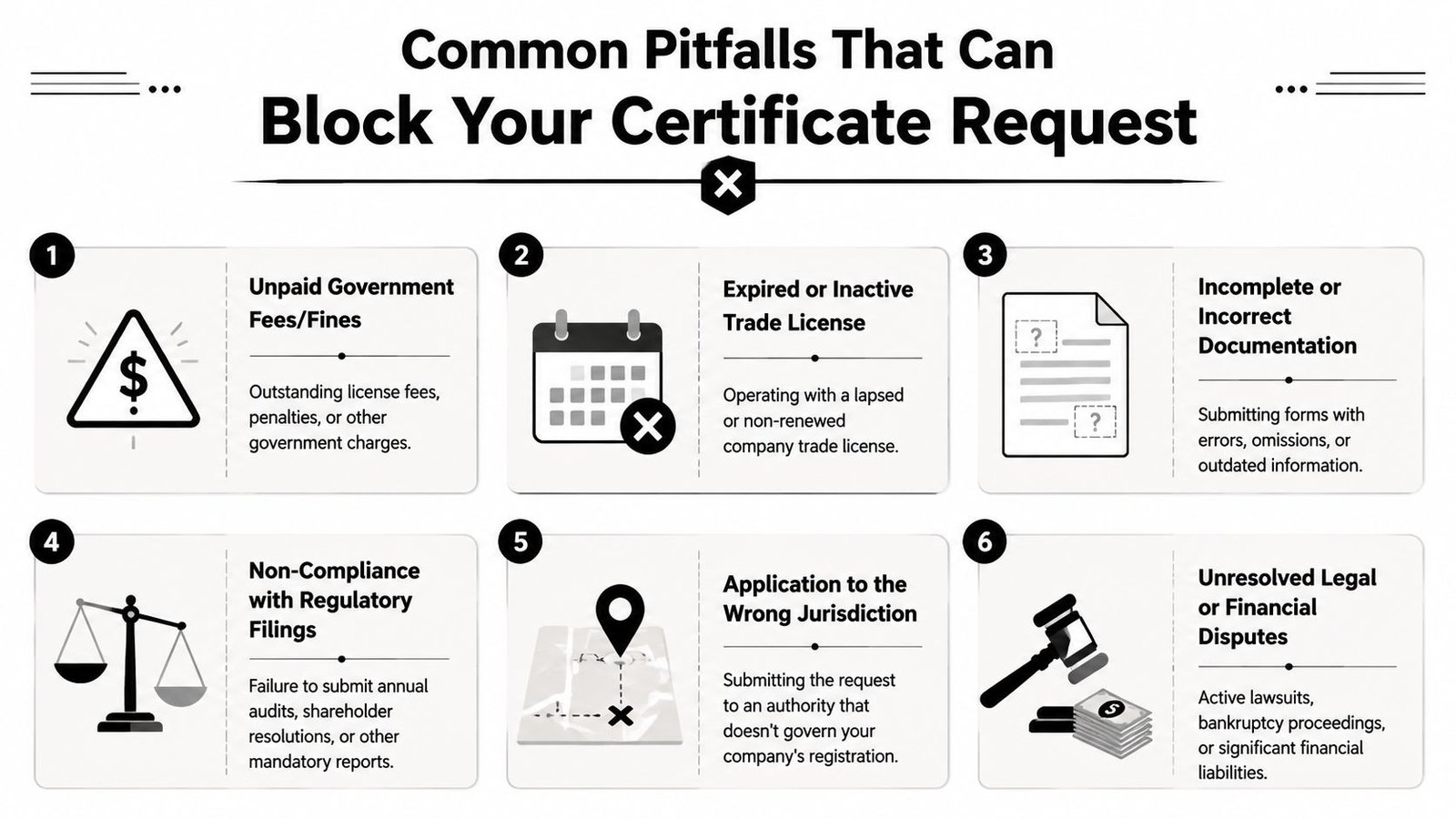
What usually goes wrong
Here are the issues that cause the most disruption:
Unpaid government fees or fines
An unpaid renewal amount, penalty, or outstanding authority charge can stop issuance until the account is clear.Expired or inactive trade licence
If the licence has lapsed, the authority usually won't produce a clean status document because the underlying registration isn't current.Incomplete or incorrect documentation
A wrong licence number, outdated company name format, or missing authorisation can push the file into manual review.Non-compliance with regulatory filings
Some authorities or sectors expect specific periodic submissions, and gaps there can affect whether the system treats the company as fully current.Application to the wrong jurisdiction
This is more common than people think. A mainland company can't solve a mainland request by asking a free zone authority for a certificate, and the reverse is also true.Unresolved legal or financial disputes
Matter-specific restrictions can affect whether a clearance-type document is available, especially when the request goes beyond simple existence proof.
How to fix the issue before it delays something bigger
The practical issue in the UAE is that the authority database is the control point. For mainland and free-zone entities, certificate issuance is usually blocked until core statutory obligations are current, especially licence validity and registry-record consistency. The authority's own records are what count. That cause-and-effect chain is described clearly in Pennsylvania's explanation of good standing and subsistence certificates, and the same operational logic applies well to UAE status requests.
If you want a cleaner process, fix the record before you order the certificate. That usually means:
| Problem | Practical fix |
|---|---|
| Licence close to expiry | Renew before requesting the certificate |
| Name mismatch across records | Update the authority record first |
| Shareholder or manager changes not reflected | File the amendment and wait for system update |
| Address inconsistency | Align the official registered address across relevant records |
| Missing beneficial ownership data | Complete or correct the filing with the governing authority |
One overlooked point is sequencing. If you've just corrected a filing issue, don't assume the certificate will issue instantly. The update has to appear properly in the authority system. Founders often pay the overdue item and submit the certificate request in the same hour, then wonder why the portal still rejects it.
Fix the registry first, then order the document. Doing it the other way round usually costs more time, not less.
The implications are substantial because a blocked certificate rarely stays an isolated problem. It can delay bank know-your-customer refreshes, visa processing, shareholder amendments, notarisation, and any transaction that depends on proof of active status.
Certificate Validity Timelines and Costs
A status certificate in the UAE is best treated as a time-sensitive document, even if the paper itself doesn't print a formal expiry date. In real transactions, acceptance is usually driven by the receiving party's recency rule rather than by the wording on the certificate.
How long counterparties usually accept it
For business transactions, banks and investors commonly ask for a document issued within 30–90 days, as explained in Ramp's guidance on good standing documents. That range matters in the United Arab Emirates because so many linked processes depend on active registration, including licensing, banking, and some immigration-related workflows.
If you're preparing documents for a bank account opening, a compliance refresh, or a foreign filing, don't pull the certificate too early. A document that looked fresh when you ordered it may be treated as stale by the time the counterparty reviews the file, especially if other documents in the bundle take longer.
What affects fees and processing
Costs vary by jurisdiction, by document type, and by whether the document needs any extra handling after issue. A basic digital status extract is usually simpler than a certificate that also needs signatory detail, stamping, legalisation support, or physical collection. Financial free zones, commercial free zones, and mainland authorities also package services differently, so there isn't one reliable UAE-wide fee to quote.
Processing works the same way. Some authorities issue digital documents quickly when the company file is clean. Others require review, especially if the request is tied to a more formal certificate or if the applicant's authority to request it needs checking.
The practical approach is:
- Confirm what the recipient will accept before you order.
- Check the company record first so you don't pay for a request that stalls.
- Allow extra time if the document will be used outside the UAE and may need attestation or legalisation.
A certificate of good standing is manageable in the UAE once you stop treating it as one standard form and start treating it as a jurisdiction-specific status document. That shift saves time, reduces rejection risk, and helps you line up bank, visa, and corporate deadlines properly.
Need help figuring out which UAE status document your bank, investor, or immigration file needs? Book a free strategy call with Inpro Corporate Services L.L.C. for a clear timeline, the right authority path, and practical support across mainland and free zone compliance.