

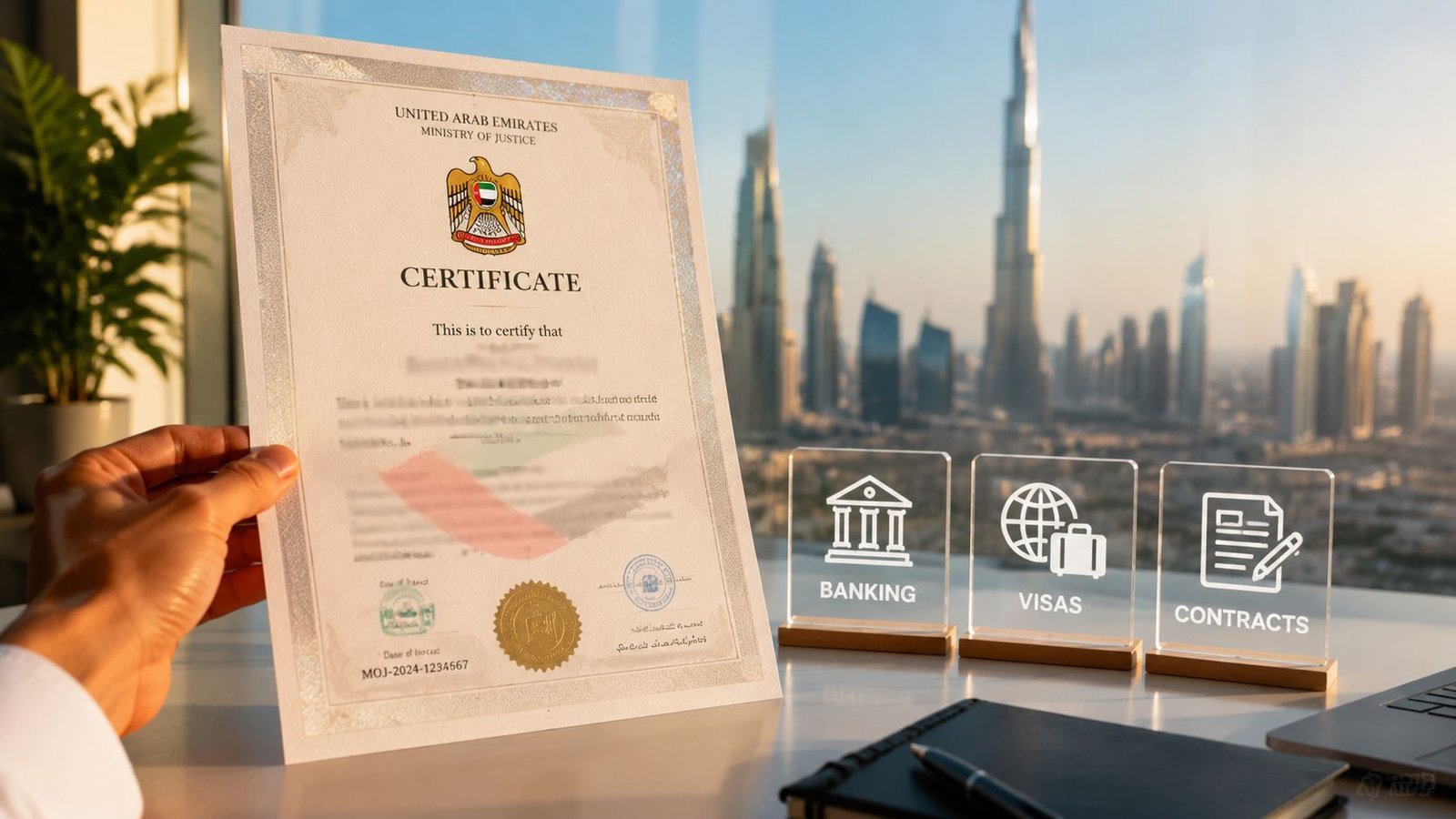
A certificate of incorporation in the UAE is the official proof that a company exists as a separate legal entity, and the issuing authority depends on whether the business is set up in Mainland, a Free Zone, or Offshore. If you've just received one in your inbox, you're probably at the point where the paperwork looks finished but the real questions are just starting.
You may be checking an email from Dubai, Abu Dhabi, or Sharjah and wondering whether this document is the same as a trade licence, what you can do with it, and what still needs to happen before banking or visas. The answer is usually more structured than founders expect, because the United Arab Emirates ties incorporation to a compliance process, not a single filing.
Table of Contents
- What the Certificate of Incorporation Actually Is in the UAE
- Why the Certificate Matters and What It Lets You Do
- The Three Routes for Getting One in the UAE
- The Step-by-Step Process From Name to Certificate
- How the Certificate Connects to Banking, Visas, and Tax
- Common Issues, Attestation, and the Trade License Confusion
- FAQs Founders Ask After Reading the Main Guide
What the Certificate of Incorporation Actually Is in the UAE
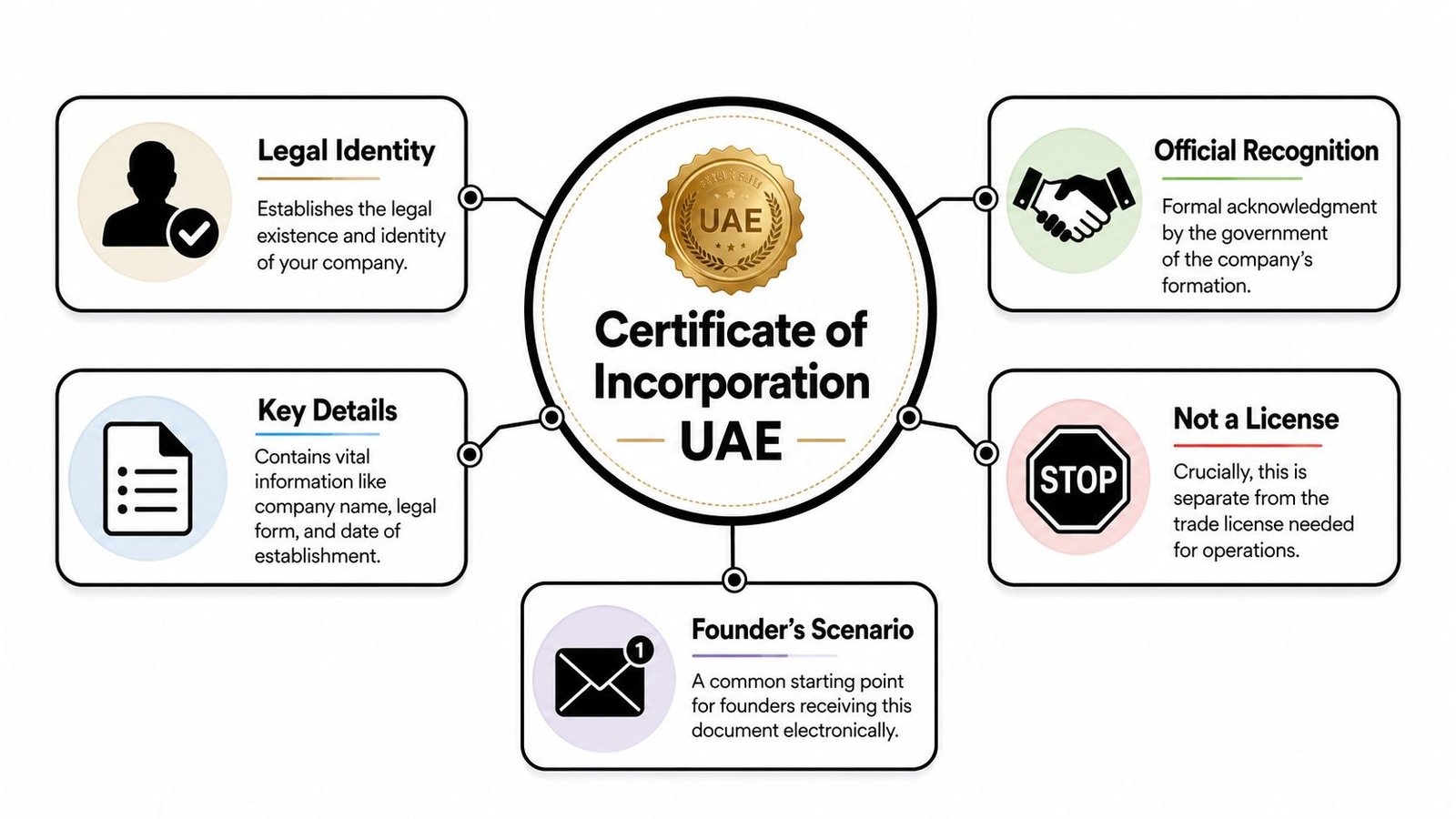
A founder in Dubai Internet City might receive an attachment titled Certificate of Incorporation and assume it is a final operating permit. It isn't. In the UAE, this document is the official proof that a company has been properly registered and exists as a separate legal entity, and the issuing authority depends on where the company is formed. Movingo's overview of UAE incorporation documents explains the split clearly across Mainland, Free Zone, and Offshore routes.
Which authority issues it?
For Mainland companies, the certificate comes from the relevant emirate authority, such as the Department of Economy and Tourism in Dubai or the Department of Economic Development in other emirates. For Free Zone companies, the relevant free zone authority issues it, and for Offshore structures, the offshore registry handles it. That jurisdiction split is why the same document can look similar but still follow different rules.
What does the certificate usually show?
A typical certificate includes the company name, legal form, registered address, and shareholder names. Those details matter because banks, regulators, and counterparties use them to verify that the entity exists and that the signatory is dealing with the right legal person. In practice, the certificate functions like the company's birth certificate under UAE law, because it confirms the company's legal existence after the full setup process is complete.
Practical rule: if the company hasn't cleared the jurisdiction selection, trade name, approval, lease evidence, document submission, and fee payment stages, the certificate won't appear yet.
That is the part many first-time founders miss. The certificate is the end-state output of incorporation, not the starting point. Preparation before filing matters just as much as the filing itself, because one missing document can push the whole process back.
Why the Certificate Matters and What It Lets You Do
The certificate is the document that turns a paper company into a legally recognised entity in the United Arab Emirates. Once it's issued, it becomes the gateway for the next steps founders usually care about most, especially banking, visas, and contracts. BusinessSetup's UAE incorporation guide notes that founders often ask what they can legally do immediately after receiving it, and that question makes sense because the certificate sits right between formation and operations.
What it unlocks in practice
A bank will usually ask for the certificate before it even begins a corporate account review, because the document shows the entity exists and states the basic legal details of the company. Employers and investors also rely on it for visa and immigration workflows, since it helps prove who the company is and who may act on its behalf. Government counterparties and commercial clients can use it when they want confirmation that they are contracting with a real UAE entity.
What it does not do
The certificate does not replace the trade licence. It confirms legal existence, while the trade licence authorises the company to carry out its activity. That distinction is the source of many founder mistakes, especially when people assume the company is “ready to trade” the moment the certificate arrives.
A certificate of incorporation is proof of existence, not permission to operate in every case.
That's why the wording on the document matters so much. When founders look at the legal form, address, and shareholder names, they are not just checking boxes. They are confirming that the later banking and compliance steps will match the company's actual structure.
The practical result is simple. The certificate is the bridge between legal formation and operational launch, and accuracy at the filing stage determines how smooth that bridge is.
The Three Routes for Getting One in the UAE
The route you choose shapes who issues the certificate, what office proof you need, and how broad your trading rights are. In the UAE, the choice is usually between Mainland, Free Zone, and Offshore, and each route produces a certificate with a different purpose. Peak Consultancy's UAE setup guide also notes that the country has 45+ free zones, which is one reason founders get overwhelmed by options.
Mainland, Free Zone, and Offshore at a glance
| Route | Issuing Authority | Office Requirement | Best For |
|---|---|---|---|
| Mainland | Department of Economy and Tourism in Dubai, or Department of Economic Development in other emirates | Physical office evidence is usually expected | Businesses that want wider UAE market access |
| Free Zone | Relevant free zone authority | Flexi-desk, office, or tenancy evidence depending on zone | International trade, specialist activities, faster setup in some zones |
| Offshore | Offshore registry such as a Jebel Ali Free Zone Offshore or RAK International Corporate Centre structure | Registered agent or similar registered presence, not a regular trading office | Holding, IP, and asset-protection structures |
How founders usually choose
Mainland is the route many founders pick when they want direct access to the local market, especially in Dubai, Abu Dhabi, or Sharjah. Free Zone companies often suit international-facing businesses that value a faster or cleaner setup path, but the scope of local trading can be narrower unless a mainland distributor or additional arrangement is in place. Offshore is usually chosen for structural reasons, not for day-to-day trading.
The office expectation follows the route. Mainland setups lean toward a physical office, Free Zones may allow a flexi-desk or leased workspace depending on the authority, and Offshore structures usually work through a registered agent model rather than a standard office lease.
Decision rule: speed, market access, and cost rarely point to the same jurisdiction, so founders need to decide which outcome matters most before they file.
That is why jurisdiction choice comes first. The authority that issues the certificate also defines the rest of the paperwork trail.
The Step-by-Step Process From Name to Certificate
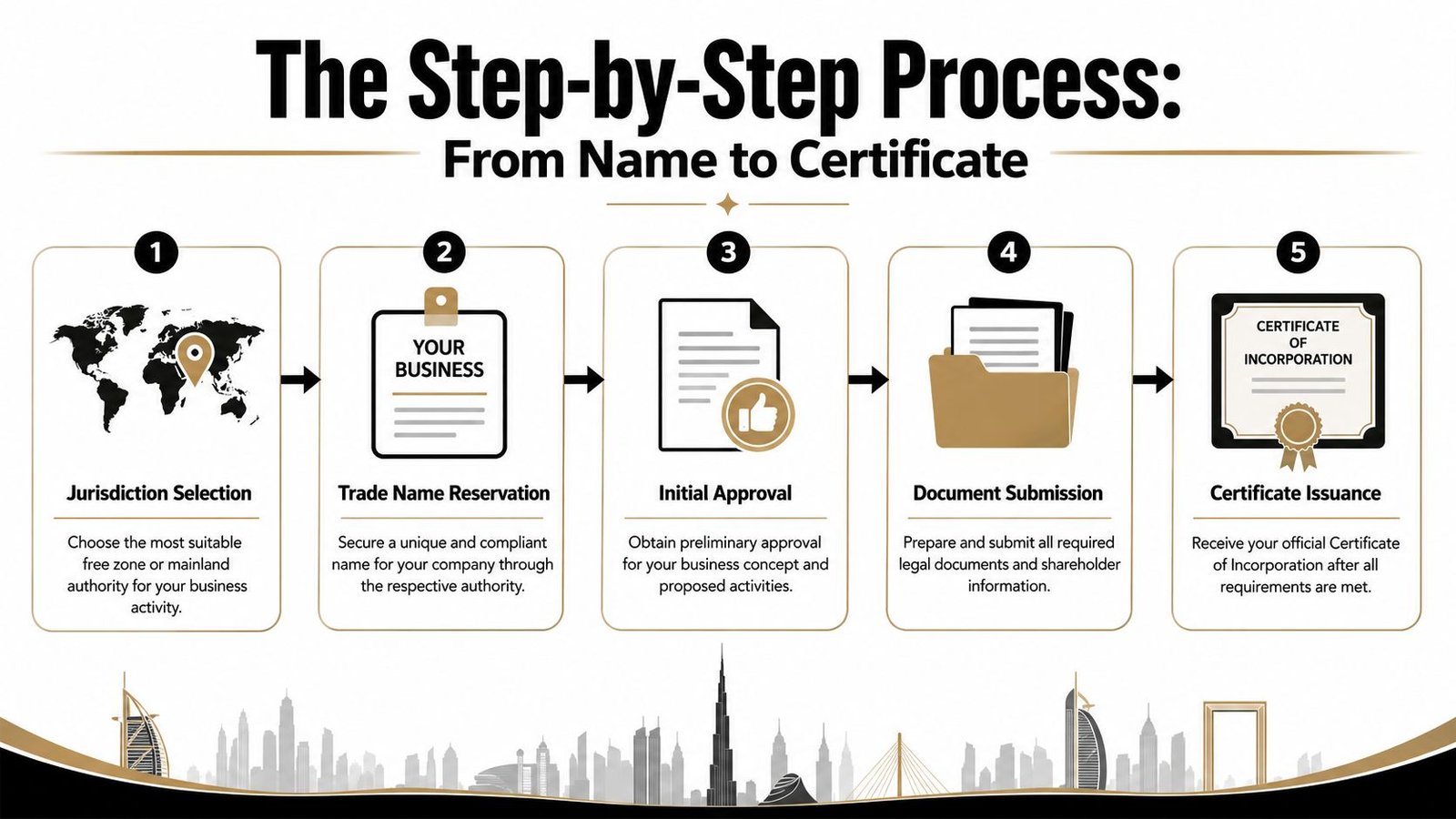
The incorporation path in the UAE usually starts with choosing the right jurisdiction, because that choice decides the authority, document set, and office evidence you will need. After that comes trade name reservation, then initial approval, then the drafting of the Memorandum of Association (MOA) and, where applicable, the Articles of Association (AOA). Only after that do office or flexi-desk documents, fee payment, and final issuance come into play.
Where delays usually start
The most common delay is not the final issue of the certificate, it's one of the earlier approvals. A missing signature, an unavailable trade name, or the wrong tenancy evidence can hold everything up because the certificate is normally issued only after the authority completes the full workflow. Shuraa's explanation of the UAE incorporation sequence makes the same point, the certificate is the end result, not the first filing.
What can make the process heavier
Free Zone setups can ask for more documentation than a simple Mainland filing. Published UAE setup guidance notes that authorities may request notarised MOA/AOA, board resolutions, proof of minimum share capital, a UBO declaration, proof of address, a valid residence visa for the owner, and a physical office tenancy agreement before issuing incorporation documents. Smart Classic's incorporation guide shows why completeness matters so much, because document gaps directly affect approval speed and rejection risk.
The process has also become more digital in some places. Recent 2025 to 2026 guidance points to faster trade-name approval, e-payment, and digital Certificates of Incorporation in some Free Zones, with processing times ranging from minutes to 7 days depending on the authority. Consulting.ae's 2026 guide and Peak Consultancy's authority comparison both point to that shift.
A simple way to think about the sequence
- Jurisdiction first: choose Mainland, Free Zone, or Offshore based on scope and office needs.
- Name second: reserve a compliant trade name with the relevant authority.
- Approval third: obtain initial approval before spending time on final documents.
- Documents fourth: prepare the MOA, AOA, and supporting evidence with care.
- Issuance last: the certificate arrives only once the authority clears everything.
This is why founders who try to rush the end document often lose time. The certificate follows the evidence trail, it doesn't replace it.
How the Certificate Connects to Banking, Visas, and Tax
Once the certificate is issued, it becomes the key that opens several other government and commercial workflows. Corporate banks often want it first, because they need to confirm the company exists before they review the rest of the file. Visa processing also leans on it, since the certificate supports entry permits, medical checks, Emirates ID, and residence stamping for owners and employees.
Banking and contract work
Banks usually ask for the certificate together with the MOA, board resolution, and passport copies. That bundle helps them verify the company structure, the authorised signatory, and the ownership chain. The same set of documents can also support client onboarding and commercial contracting, because counterparties want proof that the legal entity they are dealing with is real and properly formed.
VAT and tax entry points
For tax workflows, the certificate sits alongside the trade licence as proof of the entity before registration with the Federal Tax Authority. One source notes that VAT registration becomes relevant once taxable turnover exceeds AED 375,000. PrimeAdvices on UAE incorporation and compliance gives that threshold, and it is the figure many founders use when planning the first tax conversation.
A company can be incorporated before it is operationally ready, but tax and banking teams will still want the legal documents in place.
That matters even more for Free Zone entities that want to preserve a zero percent corporate tax position, because substance and proper structure matter in later review. The certificate itself does not create tax treatment, but it does help establish that the entity exists and is ready for the next compliance step.
In day-to-day terms, the certificate is not a trophy document. It is the file banks, immigration teams, and tax advisers reach for first when they need to confirm the business is real and set up correctly.
Common Issues, Attestation, and the Trade License Confusion
The biggest confusion is simple. Many founders think the certificate of incorporation and the trade licence are the same thing. They are not. The certificate confirms legal existence, while the trade licence authorises the business activity, and depending on jurisdiction they may be bundled together or issued in sequence.
The usual reasons files get delayed
A name conflict can stop a file before it gets close to the final certificate. Missing UBO declaration documents, unsigned MOA pages, and weak office evidence can do the same. In Mainland Dubai, for example, a missing Ejari or equivalent tenancy evidence can create problems, while some Free Zones are stricter about notarisation and shareholder documentation.
Attestation is the next place where founders get stuck. A UAE-issued certificate may need apostille, embassy attestation, or consular stamping if it will be used outside the UAE. If the document stays inside the UAE for ordinary banking, licensing, or immigration purposes, those extra steps are often not needed, but the receiving authority decides that.
A sensible pre-check saves time
A good formation partner usually reviews these items before submission rather than after rejection. That means checking the name, shareholder documents, office evidence, and any notarisation needs before the authority sees the file. It also means knowing which documents can be reused later for banking or visa processing and which ones need fresh certification.

If the office evidence, name reservation, or shareholder paperwork is shaky, the certificate will usually be the last document to arrive.
That is why founders should treat the certificate as a checkpoint, not just a formality. The less friction there is in the file, the faster the authority can finish the issuance.
FAQs Founders Ask After Reading the Main Guide
How long does a certificate of incorporation take in 2026?
It depends on the jurisdiction. Recent guidance says some Free Zones can issue digital or near-instant certificates in minutes to 7 days, while mainstream explanations still describe a few working days or about 5 to 10 days as a general window, depending on the authority. The safest answer is to check the relevant Mainland, Free Zone, or Offshore registry before you plan banking or visa deadlines. Consulting.ae and Peak Consultancy both point to that variation.
Do I need the certificate to open a bank account or sign contracts?
Yes, in practice, banks usually want it first, and counterparties often ask for it too. It proves the company exists and identifies the legal entity, which is why it matters so early in the process.
What if I lose the certificate?
The issuing authority handles re-issue requests, so Mainland cases go back to the relevant emirate department, while Free Zone and Offshore cases go back to their own registries. Keep a clean electronic copy, but if you need a fresh copy, ask the authority that originally issued it.
Does it need apostille or attestation for use outside the UAE?
Sometimes, yes. If a foreign bank, embassy, or overseas counterparty asks for a legalised document, then apostille, embassy attestation, or consular stamping may be required. If you're using it inside the UAE, that extra step may not be necessary unless the receiving authority asks for it.
If you want a clearer path through Mainland, Free Zone, or Offshore setup, Inpro Corporate Services L.L.C. can help you compare the right route, prepare the document set, and handle the filings without unnecessary back-and-forth. Visit Inpro Corporate Services L.L.C. to book a free strategy call and map your UAE incorporation with a local team that handles company formation, PRO work, visas, and compliance end to end.