

The biggest mistake founders still make in Dubai is treating the commercial licence as an admin task. It isn't. It's a market access decision, a hiring decision, a banking decision, and increasingly a compliance decision wrapped into one document.
That matters because Dubai isn't a small, slow licensing market where you can afford to get it wrong and fix it later. One industry report says nearly 19,000 companies secured commercial licences in Dubai in the first quarter of 2025 alone, which shows how competitive and high-volume the entry environment has become (Dubai commercial licensing momentum in Q1 2025). In a market moving at that pace, choosing the cheapest setup instead of the right one usually creates problems after incorporation, not before it.
In 2026, that old shortcut breaks down even faster. Founders need a licence structure that fits how they'll sell, where they'll hire, how they'll open a bank account, and what operational footprint they'll need on the ground. A cheap structure that blocks local market access or creates avoidable friction with offices, visas, or banking often ends up costing more than a properly planned setup from day one.
Table of Contents
- Your 2026 Guide to a Dubai Commercial License
- Understanding the Dubai Commercial License
- Mainland vs Free Zone The Critical Decision
- The Commercial License Application Process
- Costs Timelines and Required Documents
- Streamlining Your Dubai Setup with Inpro
Your 2026 Guide to a Dubai Commercial License
A commercial license in Dubai is often described as permission to trade. That's accurate, but it's too narrow to be useful. In practice, the licence defines how your business enters the UAE economy and what operational choices stay open after launch.
Founders usually begin with the wrong question. They ask, “What's the fastest option?” or “What's the lowest starting price?” The better question is, “What structure supports the way this company will operate for the next two years?” Those are not the same thing.
The licence is the business model filter
A founder selling software abroad, a trader importing consumer goods, and an e-commerce operator targeting UAE customers don't face the same constraints. They may all want a commercial licence, but the right jurisdiction and activity selection can differ sharply.
That's why the licence decision sits upstream of several other decisions:
- Market access: Can you contract and sell in the UAE the way you expect to?
- Hiring model: Will your office and visa structure support the team you plan to build?
- Banking readiness: Does the setup match what banks usually want to see in your business profile?
- Compliance footprint: Are you choosing a structure you can maintain cleanly once the company is active?
A licence that looks efficient on setup day can become restrictive on your first client contract, your first hire, or your first banking review.
What works and what doesn't
What works is starting with revenue flow. If you'll actively trade into the UAE market, lease premises, build a local team, or need broad operating flexibility, the licence choice should reflect that from the start.
What doesn't work is copying another founder's setup because it was quick for them. Dubai company formation is full of packages that sound interchangeable. They aren't. Two licences can look similar in a proposal and behave very differently once you try to invoice customers, secure approvals, or scale the team.
A good 2026 decision framework is simple:
- Match the licence to the actual activity.
- Choose the jurisdiction that fits your sales geography.
- Budget for total operation, not just issuance.
- Treat compliance as part of setup, not a later clean-up exercise.
Founders who do that usually move faster overall, even if the initial planning takes a bit longer.
Understanding the Dubai Commercial License
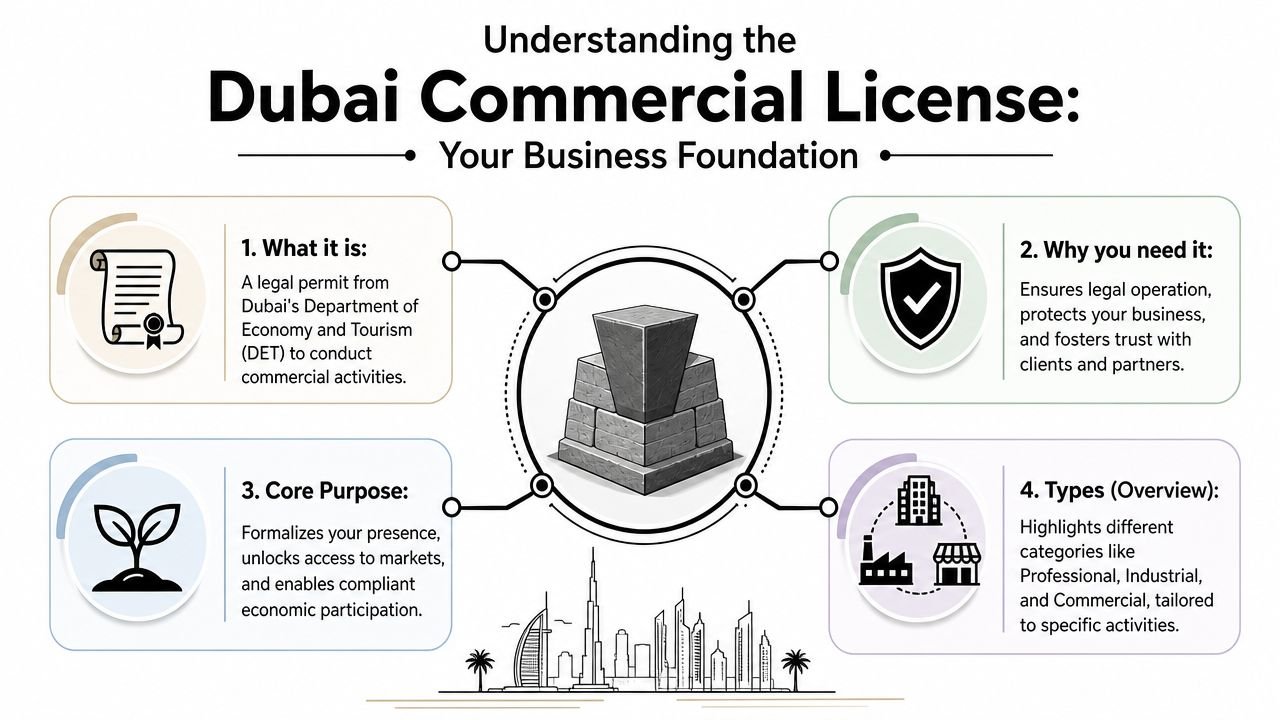
A commercial license in Dubai is the legal instrument that allows a company to carry out trading activity. The UAE's licensing framework recognises six license types and covers 2,000 various economic activities, which is why activity selection matters so much at formation stage (UAE business licensing framework and activity scope).
What a commercial licence actually does
The simplest way to think about it is this. A commercial licence is a passport for goods and trading activity. It gives the company legal standing to buy, sell, distribute, import, export, and carry on commercial transactions within its approved activity scope.
It also ties the company to a formal presence. For Dubai-based operations, the Ministry notes that the lease contract must be registered through Ejari. That requirement isn't random. It connects the licence to a traceable business location, which is part of how Dubai regulates real commercial presence.
Practical rule: If your planned activity depends on moving products, selling inventory, distributing goods, or operating an e-commerce trading model, don't assume a general business description is enough. The approved activity must match the actual revenue model.
What it covers and what it does not
A lot of content online collapses everything into “trading”, but founders shouldn't. Commercial activity is not the same as every type of business activity.
Commercial licences generally fit businesses involved in:
- Trading goods: buying and selling products
- Import and export: moving goods into or out of the UAE
- Distribution: supplying products to wholesalers, retailers, or end users
- E-commerce trading: online sale of goods where the licensed activity supports that model
They are not a catch-all for every service business. If the core revenue model is advisory work, consulting, design, medical treatment, or another regulated service, the right licence category may be different.
Founders often get into trouble when they choose a commercial activity because it sounds broad, then discover later that the company's actual operations sit outside what the licence authorises. Fixing that after incorporation is slower and more expensive than selecting correctly at the start.
Mainland vs Free Zone The Critical Decision
The mainland versus free zone decision isn't a branding choice. It's the point where founders decide how much operating flexibility they want, what kind of market access they need, and what constraints they're willing to live with.
Dubai's official company services make a useful point that many setup guides miss. The choice of jurisdiction directly affects market access and compliance, and founders need to pay attention to office requirements, visa allocation, and banking instead of focusing only on issuance speed (Dubai company licence enquiry and jurisdiction considerations).
Choose based on revenue path
The cleanest way to decide is to map where revenue will come from and how the company must operate to earn it.
If your business depends on broad, direct engagement with the UAE market, mainland is usually the more natural fit. If your model is more international, operationally lean, or structured around a free zone ecosystem, a free zone can be the better platform.
| Factor | Dubai Mainland | Dubai Free Zone |
|---|---|---|
| Primary fit | Businesses targeting broad UAE market activity | Businesses prioritising a specific free zone framework or international focus |
| Local operating flexibility | Usually stronger for companies that need wider onshore presence | Can work well, but founders must check practical operating boundaries |
| Office model | Physical premises planning often becomes central early | Can be more package-driven, but workspace choices still affect operations |
| Hiring setup | Good for businesses building a locally present team | Often attractive for lean teams, but visa and space planning still matter |
| Banking preparation | Works well when the business model, premises, and activity align cleanly | Can also work well, but banks will still look at substance and business logic |
| Typical founder mistake | Underestimating total running costs beyond licence issuance | Assuming a fast setup automatically suits UAE sales and long-term scaling |
Operational reality matters more than setup speed
A free zone is often attractive because providers package it neatly. The process can feel simpler, the pricing is easier to market, and the setup is framed as founder-friendly. Sometimes it is. But speed is not strategy.
For example, many founders choose a free zone because they want a low-friction launch, then later realise their actual needs are different. They need staff visas beyond the initial expectation. They need clearer banking positioning. They need premises that support credibility with customers or counterparties. They need a structure that matches how they sell into the UAE.
Mainland can feel heavier at the start because it forces earlier decisions about premises, documents, and operational presence. That extra discipline is often useful. It pushes the founder to design the business properly instead of buying a licence first and figuring out the rest later.
If you already know you'll need UAE client access, local hiring, and room to scale operations, don't let a faster initial issue date decide the jurisdiction.
A practical way to assess the two options is to test them against common founder profiles.
- SaaS founder: If customers are mostly outside the UAE and the team starts lean, a free zone can make sense. If enterprise sales in the UAE are central, mainland may remove future friction.
- E-commerce operator: If the business will trade goods actively into the UAE, activity scope and market route matter more than package marketing. The wrong structure causes problems in fulfilment, contracting, and expansion.
- Global trading firm: If the business needs commercial credibility, supplier relationships, warehousing logic, and flexible UAE presence, mainland often deserves serious consideration even if a free zone quote looks simpler.
The wrong comparison is “which one is better?”. The right comparison is “which one fits the way this company will make money and operate in 2026?”
The Commercial License Application Process
The application process is straightforward once you stop viewing it as paperwork and start viewing it as a sequence of legal checkpoints. Dubai separates the trade licence application from other setup tasks, and the base government fee for the application is AED 1,070 plus AED 300 for Dubai Chamber membership before activity-specific approvals, premises, and immigration costs are added (Dubai trade licence government fee breakdown).
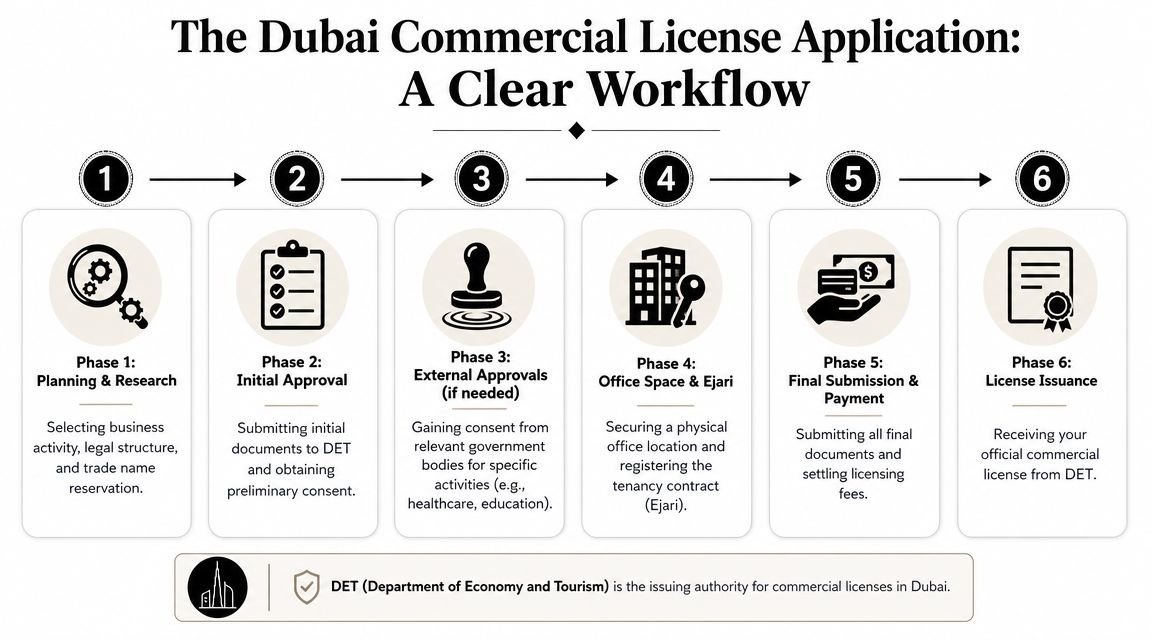
A clear workflow helps:
The sequence that actually matters
Most applications follow a familiar path. The order matters because later stages depend on earlier approvals being clean.
Activity selection and initial approval
Many errors begin here. If the chosen activity doesn't reflect the actual business model, everything built upon it becomes unstable.Trade name reservation
Founders often treat the name as a branding exercise. It's also a compliance exercise. If the name conflicts with naming rules or the stated activity profile, it can delay the file.MOA drafting and review
The Memorandum of Association isn't boilerplate. It records the legal relationship between the company, its owners, and its operating scope. Weak drafting creates future issues around authority, ownership, and internal governance.Premises and Ejari
For setups that require it, premises aren't an afterthought. They are part of the legal structure. Waiting too long to deal with office arrangements usually delays the licence.Final submission and payment
Only after the file is complete does payment make practical sense. Incomplete files can create repeated revisions and wasted time.
A useful visual summary sits below.
Where founders lose time
The common delay isn't usually the government portal itself. It's document readiness and misalignment between the chosen setup and the actual business plan.
These are the friction points I see most often in practice:
- Activity mismatch: The founder describes one business to the advisor and another to the bank or landlord later.
- Loose shareholder documentation: Passport copies, IDs, and supporting papers don't line up cleanly.
- Premises handled too late: The team tries to solve office requirements after the rest of the file is ready.
- MOA reviewed too casually: Shareholders sign quickly, then discover the wording doesn't reflect how they'll operate.
A smooth application isn't about rushing the portal step. It's about having the right file before the portal step starts.
If the file is complete and fees are paid within the required deadline, licence issuance follows the approval workflow. The Ministry notes that issuance is completed after the required steps are finished and the applicable fees are paid within the stated period, which is usually 30 days from the payment receipt issuance, as noted in the earlier official guidance.
Costs Timelines and Required Documents
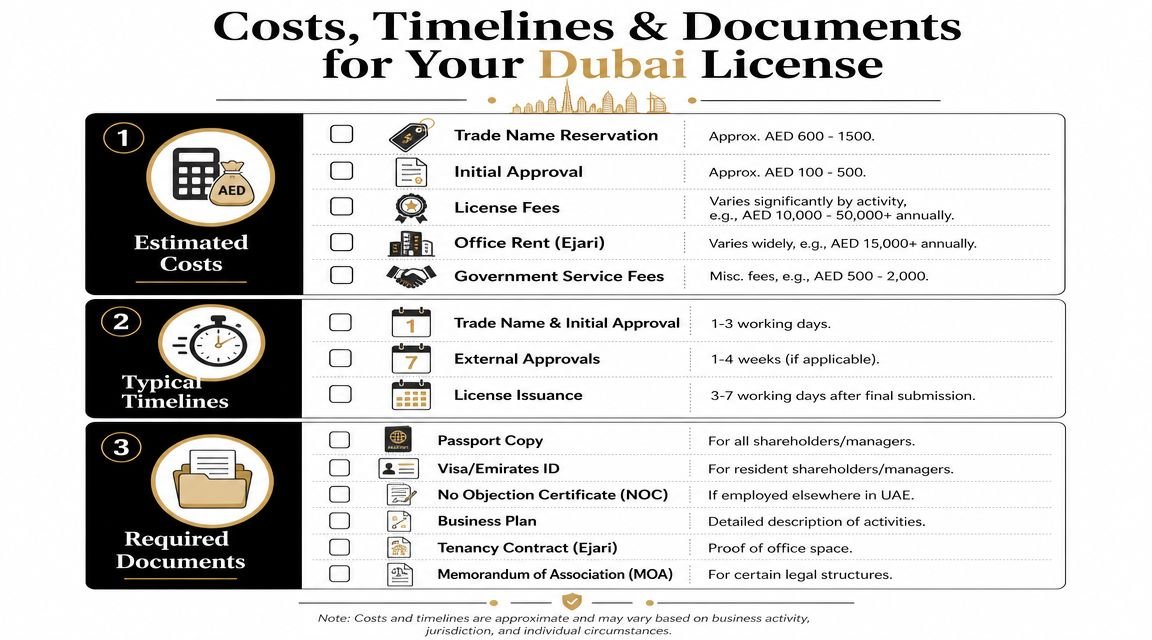
Founders often ask, “What does a commercial license in Dubai cost?” The better question is, “What is the total cost of establishment for my exact activity and jurisdiction?” Those are very different numbers.
For mainland technical services, one Dubai provider reports a standard cost band of about AED 16,125 to AED 30,000, with mainland licences reaching around AED 18,500 before additional registration, approval, municipal, and overhead charges. The same source notes that MOA certification at a public notary in Dubai takes about two hours, which is a practical bottleneck if the file isn't prepared properly (Dubai technical services company formation costs and notarisation timing).
The right way to read setup costs
Founders get confused because the market mixes three different pricing layers into one number.
- Government charges: these are the official filing and licence-related amounts.
- Jurisdiction package pricing: these often bundle licence issuance with workspace or setup support.
- Operating add-ons: visas, premises, immigration, attestations, and ongoing admin costs sit on top.
That's why one provider can market free zone commercial licence packages starting from AED 12,500, while an instant setup option such as a Fawri licence may be priced at AED 15,000, as noted in the earlier Ministry-linked context. Those figures can be valid, but they don't answer the whole budgeting question.
A more reliable way to budget is to split costs into buckets:
| Cost bucket | What it usually includes |
|---|---|
| Core establishment | Licence issuance, registration-related charges, and formation support |
| Legal structuring | MOA work, notarisation, attestations, and activity-specific drafting |
| Premises | Lease commitments, Ejari where required, and workspace upgrades |
| People costs | Investor or employee visa processing and related immigration steps |
| Operational compliance | Accounting, tax registration, filings, renewals, and document maintenance |
Documents that usually drive the timeline
The document list isn't long, but missing one key item can stop the whole file.
Most commercial licence workflows commonly require:
- Passport copies: for shareholders and managers
- Photographs: used in the application file
- MOA documents: where the legal structure requires them
- Ejari tenancy contract: especially where a Dubai premises requirement applies
The sequence matters here. If the passports are ready but the tenancy isn't, the file stalls. If the tenancy is ready but the MOA wording still needs correction, the notary step becomes the bottleneck.
Clean setup files are built backwards from the final submission. Advisors who start with documents, authority, and premises usually get better outcomes than teams that start with package pricing.
Timelines are therefore less about nominal processing time and more about preparedness. A founder who has aligned activity, shareholders, legal structure, and premises can move cleanly. A founder who is still changing the business model during filing usually can't.
Streamlining Your Dubai Setup with Inpro
By 2026, the hardest part of getting a commercial licence in Dubai usually isn't filing the application. It's making the right strategic choices before the filing begins.
That means choosing the correct jurisdiction, selecting the right activity, separating real government cost from marketed package cost, and making sure the setup supports banking, hiring, and compliance after incorporation. Founders who treat those as separate problems often end up revisiting the structure later. Founders who treat them as one connected decision usually build on firmer ground.
The value of a strong setup partner is clarity. You need someone who can tell you when mainland makes more sense than free zone, when a low advertised entry price is misleading, when your activity list is too vague, and when your operating plan doesn't match the licence you're about to buy.
The strongest support model is end-to-end. That means handling formation, licensing, visas, PRO workflows, and bank account preparation as one operational stream instead of passing the founder between separate providers. It also means transparent pricing, realistic timelines, and plain advice about trade-offs.
If you're setting up in Dubai, don't optimise for the fastest quote. Optimise for the structure that still works when you're hiring, invoicing, renewing, and scaling.
If you want a practical route to the right licence structure, Inpro Corporate Services L.L.C. helps founders compare Mainland, Free Zone, and Offshore options, manage licensing and visa workflows, and build a UAE setup that works beyond incorporation day.