


You can form a company in Dubai mainland without turning it into a months-long admin project, but only if you treat the licence as the start of the setup, not the end. The mainland route is the right one when you want to trade directly in the UAE, hire locally, and build a real operating base with Ejari, immigration files, and tax registrations tied to the licence.
Table of Contents
- What Company Formation in Dubai Mainland Actually Involves
- Mainland vs Free Zone vs Offshore in the UAE
- Choosing Your Legal Structure and Ownership Setup
- Documents You Need Before You Start
- Costs and Timelines for Mainland Formation
- After the Licence Comes the Real Work
- Common Pitfalls and When to Use a Formation Partner
What Company Formation in Dubai Mainland Actually Involves
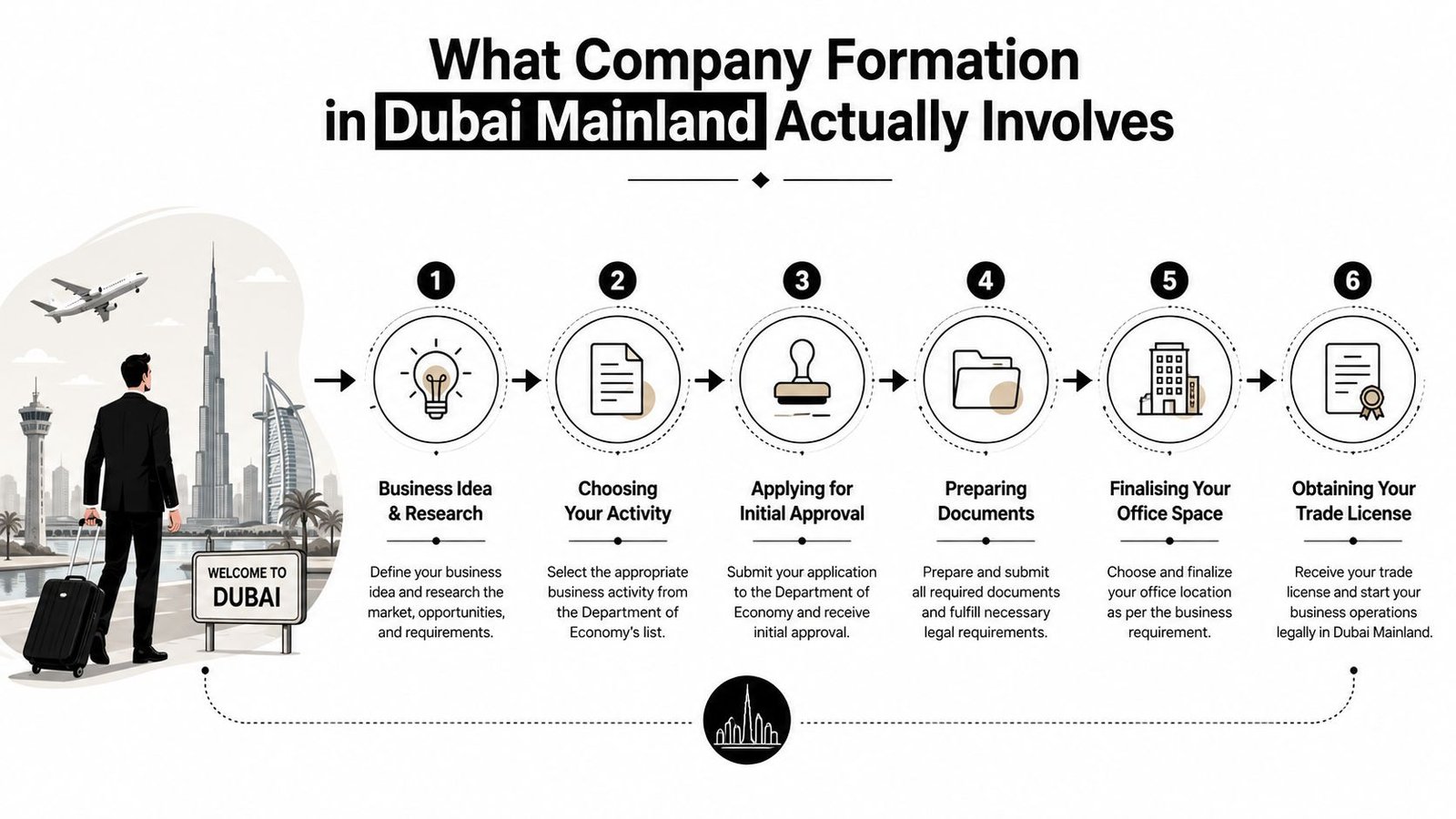
A founder often arrives in Dubai with a business idea, a laptop, and the assumption that a trade licence is a quick formality. In practice, company formation in Dubai mainland follows a fixed regulatory sequence, and each step exists because the licence is tied to a real business activity, a legal structure, and a physical office.
Why the mainland route feels more procedural
Dubai mainland licensing sits under the Department of Economy and Tourism, or DET, which used to be known as the Dubai Department of Economic Development, or DED. Other emirates, including Abu Dhabi and Sharjah, run their own mainland licensing through their respective economic departments, but the logic is similar across the UAE, and the United Arab Emirates system still expects proper approvals before you trade.
The sequence is straightforward. You choose the business activity, select the legal form, reserve the trade name, obtain initial approval, draft the Memorandum of Association, or MOA, secure a physical office with Ejari, clear any sector-specific approvals, and then submit the final file for the trade licence. Each stage filters a different risk, activity fit, ownership structure, naming, premises, and regulated business scope.
Practical rule: if a step feels repetitive, it usually exists because a later department needs proof that the earlier one was handled properly.
What the mainland licence actually gives you
A mainland licence lets you operate directly inside the UAE market, instead of working through a free-zone intermediary. That matters for founders who want to sell to local customers, open branches, work with bigger domestic counterparties, or build a company that looks and behaves like a normal onshore business.
The physical office requirement is part of that reality. Mainland formation isn't designed around a virtual presence, so the lease and tenancy registration are not afterthoughts. They are formation mechanics, and they sit in the middle of the approval chain because the licence is attached to a real premises.
Mainland vs Free Zone vs Offshore in the UAE
The choice between mainland, free zone, and offshore isn't really about labels. It's about how you plan to trade, where your customers sit, and whether you need a physical operating base in the UAE.
Mainland suits local trade and real operations
Mainland is the direct route when your business model depends on the UAE market. You can deal with customers across the country, build commercial relationships without a distributor in the middle, and set up a presence that matches a local operating company rather than a ring-fenced entity.
The big shift since the 2021 ownership reform is that 100% foreign ownership is now the default for most mainland activities in Dubai, which removes the old assumption that you needed a local equity partner for a standard setup. That change is one reason more founders now compare mainland on actual operating needs instead of on ownership anxiety alone.
Free zones and offshore still serve different purposes
Free zones are still attractive when the business is export-led, remote-first, or built around zone-specific incentives. They often have simpler base packages, but they can be a poor fit if you want direct local market access or regular onshore work without added structure.
Offshore is different again. It's mainly used for holding structures, intellectual property, or asset protection, not for running a shop, office, or employee-heavy operating company in the UAE. Offshore is not the right answer if the core plan is to hire in Dubai and sell locally.
A mainland company is usually the right call when the founder expects to sell to UAE customers, bid for government or semi-government work, or sponsor staff visas as the business grows.
The decision is often simpler than founders expect. If the company is meant to operate inside Dubai, Abu Dhabi, or Sharjah as a live business, mainland is usually the cleanest route. If the company is meant to stay outside the local market, a free zone or offshore structure may fit better.
Choosing Your Legal Structure and Ownership Setup
The legal form should match how the business will run, not how it looks on a pitch deck. On the Dubai mainland, the right structure usually comes down to whether you have one founder, multiple shareholders, or a professional services model.
The most common structures
A Sole Establishment is a one-owner structure, and it works well when the activity is permitted for single ownership. A Limited Liability Company, or LLC, is the default for most international founders because it suits two or more shareholders and keeps the operating structure familiar.
A Civil Company is used for professional services such as consulting or legal work, where the nature of the service matters more than trading stock. A Branch of a Foreign Company is the right fit when an existing overseas entity wants to extend into the UAE under the same corporate umbrella.
The MOA, or Memorandum of Association, is the founding document that sets out ownership, powers, and the company's internal rules. A Local Service Agent, or LSA, is a UAE national who does not hold equity or management control, and may still be required in limited cases such as foreign branches or certain professional structures.
How ownership works now
For most Dubai mainland activities, 100% foreign ownership is now the norm after the 2021 reform. That said, a small list of strategic activities still sits outside the automatic full-ownership rule, so the activity code always matters more than a generic assumption.
The practical decision rule is simple. Choose an LLC unless you are a solo founder with a permitted activity that fits a Sole Establishment. The LLC is usually easier to explain to banks, counterparties, and future hires, while the Sole Establishment can be lighter if your activity and risk profile allow it.
Documents You Need Before You Start
Most mainland delays don't start with the licence form. They start with missing documents, wrong versions, or attestation problems that force the file back into the queue. If the file is clean from day one, the process moves much faster.

The core checklist most founders need
Start with the universal items. You'll usually need passport copies, visa or entry-stamp copies if you're already in the UAE, a passport-size photo, proof of address, the trade-name reservation certificate, and the MOA. The lease agreement belongs on the same checklist because the office is part of the licence mechanics, not a later operational detail.
If you're a UAE resident and already employed, a No Objection Certificate, or NOC, from your current sponsor or employer may be needed. That document tells the authorities that your current sponsor does not object to the new setup or the activity you're applying for.
When a parent company is involved
If the shareholder is a company rather than an individual, the paperwork expands. Typical corporate documents include the Certificate of Incorporation, the MOA and Articles of Association, a board resolution, a certificate of good standing, and the shareholder structure.
These documents usually need attestation and legal translation. In UAE practice, attestation means the document has been properly notarised, stamped by the relevant ministry or foreign affairs authority, and, where it originated overseas, often stamped by the UAE embassy as well. That step is routine, but it's also where many files stall.
Common delay point: the wrong attestation sequence on shareholder documents causes more rework than the licence application itself.
A good rule is to gather every identity document, corporate document, and tenancy document before the first submission. If something needs translation or attestation, handle it early. It's much easier to fix a document pack at the start than to hold up the whole formation after the trade-name and initial approval stages are already done.
Costs and Timelines for Mainland Formation
Formation costs on the mainland are easier to manage when you break them into the actual line items instead of reading a single wide estimate online. The total depends on the activity, office requirement, and any external approvals, but the budget always has a similar shape.
Where the money usually goes
| Line item | Indicative range (AED) | Purpose |
|---|---|---|
| Trade-name reservation | Qualitative | Reserves the company name with the licensing authority |
| Initial approval | Qualitative | Confirms the activity and ownership structure can proceed |
| Trade licence fee | Qualitative | Issues the mainland licence for the selected activity |
| MOA notarisation | Qualitative | Formalises the company's ownership and operating terms |
| Ejari office lease | Qualitative | Registers the physical premises required for mainland formation |
| PRO service fees | Qualitative | Covers filing support, document handling, and government coordination |
| Standard government service charges | Qualitative | Covers administrative fees linked to processing and approvals |
The office lease is often the biggest single cost pressure point, because it's not optional in a standard mainland setup. The licence itself sits inside a wider formation package that also includes premises, notarisation, and government processing.
What timeline is realistic
A clean file usually takes 3 to 4 weeks end to end when documents are complete and no extra approvals are needed, according to industry guidance on Dubai company formation (Inlex Partners on Dubai company formation timelines). A 21-day target is possible only when name reservation, initial approval, Ejari, and the notarised MOA all move without rework.
The usual delay triggers are predictable. A business-activity mismatch can create extra approvals, a trade name can be rejected on the second pass, shareholder documents can come in incomplete, and Ejari can slip if the office deal is not ready.
If a provider quotes a single neat price without separating licence, office, and visa-linked costs, ask for the breakdown before you sign.
That is the issue with many online formation ranges. They bundle the licence fee, premises, and downstream compliance into one number, which makes the quote look simple but doesn't help you plan cash flow or timing. A founder needs the line items, not just the headline.
After the Licence Comes the Real Work
A trade licence opens the door, but it doesn't finish the job. For a mainland company in Dubai, the post-licence steps are what make the entity operational, employable, and bankable.
The post-licence sequence
First comes the immigration file and the establishment card, which is the company's basic record with the immigration system. Without that file, the business can't sponsor people properly, even if the licence itself is already active.
Next comes registration with the Ministry of Human Resources and Emiratisation, or MOHRE, which is the UAE labour authority for work permits and quota management. The government process guide for mainland companies also points to later registration for Corporate Tax and VAT through the Federal Tax Authority's EmaraTax platform when thresholds apply (EGSH on mainland company formation steps).
What this looks like in real life
A two-person SaaS company doesn't just need a licence. It needs an immigration file, the right work permit quota, the founder's and employee's residence process, and a business bank account that can handle operating payments and payroll.
That bank stage has its own reality. UAE banks usually want KYC checks, source-of-funds evidence, and sometimes an in-person visit before they activate the account. A licence helps, but it doesn't replace the bank's compliance review.
The tax layer matters too. Corporate Tax registration is part of becoming an operating entity in the United Arab Emirates, even if the business is still too small to register for VAT. The practical mistake founders make is assuming the licence alone makes the company ready for staff, payroll, invoicing, and tax compliance.
Common Pitfalls and When to Use a Formation Partner
Most mainland mistakes are avoidable. They usually come from trying to save a few days at the front end, then paying for it with rework, extra approvals, or a stalled visa file later.
The errors that waste the most time
- Choosing the wrong activity: If the stated activity doesn't match the actual business model, you can end up needing a re-licence or extra approvals.
- Picking a weak trade name: If the name gets rejected twice, you lose time and often have to rethink the branding.
- Treating the office as optional: Mainland formation needs a physical, Ejari-registered lease, so office selection should happen early.
- Underestimating immigration: The licence is not the same thing as visas, and staff mobility only starts after the immigration file is set up.
- Assuming full ownership applies everywhere: Most activities allow it now, but not every activity does.
- Skipping tax registration: A licence does not automatically solve Corporate Tax or VAT obligations.
Where a formation partner fits
A good PRO, or Public Relations Officer, is the licensed intermediary who files on the company's behalf with UAE government departments. In practice, that means handling DED or DET filings, Ejari coordination, MOA notarisation, immigration paperwork, and the bank introduction that follows incorporation.
Inpro Corporate Services L.L.C. is one option for that type of work in the UAE, with company formation, PRO support, visa processing, and tax registration handled as part of the operational setup. That kind of support matters when the founder wants clear timelines and fewer handoffs between licensing, immigration, and banking.
If you're setting up in Dubai mainland and want a straightforward path from licence to live operations, book a free strategy call with the inpro.me team. They can map the licence, office, visa, and tax steps in one pass, or you can use Inpro Corporate Services L.L.C. to compare your setup options and move forward with a clear plan.
Inpro Corporate Services L.L.C. helps founders set up mainland, free zone, and offshore companies in the UAE, along with the PRO, visa, banking, and tax steps that follow. If you want a cleaner route through company formation in Dubai mainland, visit Inpro Corporate Services L.L.C. and ask for a setup review before you start filing.