


If your company's financial year ends on 31 December, your corporate tax return is due on 30 September the following year. In the UAE, that deadline is fixed at nine months after the end of the tax period, so a 31 December 2025 year-end means a 30 September 2026 filing and payment deadline.
That catches some founders off guard because the old image of the United Arab Emirates as a simple, tax-light place for business hasn't disappeared, but the compliance reality has changed. The rule itself is straightforward. What makes it risky is that the filing window is strict, general grace periods don't exist, and a few first-return details can create problems even for organised businesses in Dubai, Abu Dhabi, Sharjah, and the free zones.
Table of Contents
- The New Reality of UAE Tax Deadlines
- How Your Corporate Tax Deadline Is Determined
- Who Is Required to Register and File for Tax
- Understanding Penalties and Extensions
- Your Practical Tax Filing Preparation Checklist
- How Inpro Simplifies Your UAE Tax Compliance
The New Reality of UAE Tax Deadlines
What has changed for businesses in the UAE
The UAE is still one of the most attractive places to build a company, but the operating model is more structured now. Founders can still set up efficiently across Mainland, Free Zone, and Offshore structures, yet tax deadlines now sit alongside licensing, banking, visas, and accounting as a normal part of running a business in the United Arab Emirates.
That's not a bad thing. It means the system is clearer than many people expect. The Federal Tax Authority (FTA) is the government body responsible for administering tax rules and filings, and once you understand your filing date, your record-keeping duties, and your registration position, the process becomes manageable.
Practical rule: treat corporate tax filing deadlines as a finance calendar issue, not a last-minute admin task.
What does corporate tax actually mean here
Corporate tax is a tax on taxable business profits. In the UAE, the rate is 0% on taxable income up to AED 375,000 and 9% on taxable income above AED 375,000, and that threshold applies across Mainland and Free Zone entities unless a Free Zone company meets the conditions for Qualifying Free Zone Person treatment, as explained in Peak Consultancy's overview of the UAE corporate tax filing deadline.
For founders, the shift isn't just the tax rate. It's the need to run the business with cleaner books, better timing, and clearer internal ownership. A company in Dubai that invoices across borders, a holding entity in Abu Dhabi, and a service business in a Sharjah free zone all need the same discipline around year-end records and filing readiness.
A lot of stress comes from assuming the system is vague. It isn't. The deadlines are clear. The trade-off is that the system expects you to be ready on time.
How Your Corporate Tax Deadline Is Determined
Missing your UAE corporate tax deadline is usually not a date problem. It is a year-end governance problem.
What is a tax period
A tax period is the financial period used to calculate your company's taxable income for corporate tax purposes. For many businesses, that is a 12-month financial year, but it does not need to match the calendar year.
If your books run from 1 January to 31 December, your tax period ends on 31 December. If your business uses another year-end, such as 31 March, the filing deadline shifts with it. The core rule is straightforward. Count forward nine months from the end of the relevant tax period.
That sounds simple, and legally it is. In practice, the trap is using the wrong reference date. Founders sometimes work from the incorporation date, trade licence renewal date, or first invoice date. None of those determines the return deadline. Your financial year-end does.
How do you work out your own filing date
Start with the financial year stated in your accounting records and tax registration. Then count forward nine months.
For UAE companies with a 31 December 2024 year-end, the return was due by 30 September 2025. Record retention still matters after filing. The Ministry of Finance's corporate tax overview confirms the framework for tax periods and compliance obligations, including the broader corporate tax rules businesses need to apply: UAE Ministry of Finance corporate tax page.
A few examples make the timing easier to see:
| Financial year end | Standard filing deadline |
|---|---|
| A financial year ending on 31 December 2025 | had a filing deadline of 30 September 2026 |
| A financial year ending on 31 March 2026 | has a filing deadline of 31 December 2026 |
| A financial year ending on 30 June 2026 | has a filing deadline of 31 March 2027 |
The deadline itself is rarely the hard part. The actual risk is misalignment between your audited or management accounts, your tax registration data, and what the finance team assumes is the active year-end.
That problem shows up more often than founders expect. A company may change its internal reporting cycle, migrate accountants, or restructure a group without clearly updating the tax position. The result is a filing date that looks obvious in one system and different in another. By the time someone notices, the buffer is gone.
What records do you need to keep
Accounting records are the documents that support the figures in your return. That includes invoices, contracts, ledgers, bank statements, expense support, and year-end financial statements.
Good records do more than support an audit file. They determine whether the return can be prepared accurately within the nine-month window. If the books are late, the tax return is late in substance even before the portal submission becomes urgent.
Set an internal deadline for “books ready for tax review” well before the legal filing date. That is the date that protects you.
For businesses using the EmaraTax system, the FTA's online tax portal, this distinction matters. Portal access helps with submission. It does not fix weak reconciliations, missing support, or an unclear year-end. Those are the hidden procedural traps that cause avoidable deadline pressure, even in otherwise well-run companies.
Who Is Required to Register and File for Tax
Which companies usually need to file
A taxable person is a business or person that falls within the UAE corporate tax system and has registration and filing obligations under the law. In practice, many companies operating under a UAE commercial licence need to consider registration and return filing, including businesses established in the Mainland, free zones, and some Offshore structures where the UAE tax rules apply.
Founders often make a bad assumption. They think no profit means no filing. That's not a safe shortcut in the United Arab Emirates. Corporate tax compliance is about whether the entity is within the regime and required to file, not only whether tax is payable.
What about free zone businesses
Free Zone companies often hear two messages that sound contradictory. One says a free zone can access a 0% corporate tax rate. The other says it still has compliance duties. Both can be true.
A Qualifying Free Zone Person (QFZP) is a Free Zone entity that meets the conditions for preferential tax treatment. But QFZP status doesn't turn filing into an optional exercise. Free Zone businesses in places such as Dubai International Financial Centre, Abu Dhabi Global Market, or other UAE free zones still need to get the classification, records, and return position right.
What works in practice is early classification. Founders should decide early whether the company is likely to be treated as a standard taxable business or whether it may qualify for Free Zone treatment, then align bookkeeping to that position. What doesn't work is leaving the question until the filing month and hoping the return can sort it out.
Do freelancers and sole proprietors need to register
Yes, some do. Natural persons, including sole proprietors, freelancers, and individual partners in the UAE, must register for corporate tax if their business turnover exceeded AED 1 million during 2025, with the registration deadline set for 31 March 2026, according to GFLO Law's note on the UAE corporate tax filing deadline for 2026.
That point matters for consultants, creators, and independent professionals who moved to Dubai or Abu Dhabi assuming only companies need to think about corporate tax. If you operate personally rather than through a separate legal entity, your position still needs review. The registration trigger for a natural person is different from the annual filing date for a company, so don't mix the two together.
Here's a simple way:
- Licensed companies: usually need to assess registration and filing duties under the corporate tax rules.
- Free Zone entities: may have special treatment, but filing discipline still matters.
- Individuals carrying on business: need to check whether their turnover crosses the registration threshold for natural persons.
Understanding Penalties and Extensions
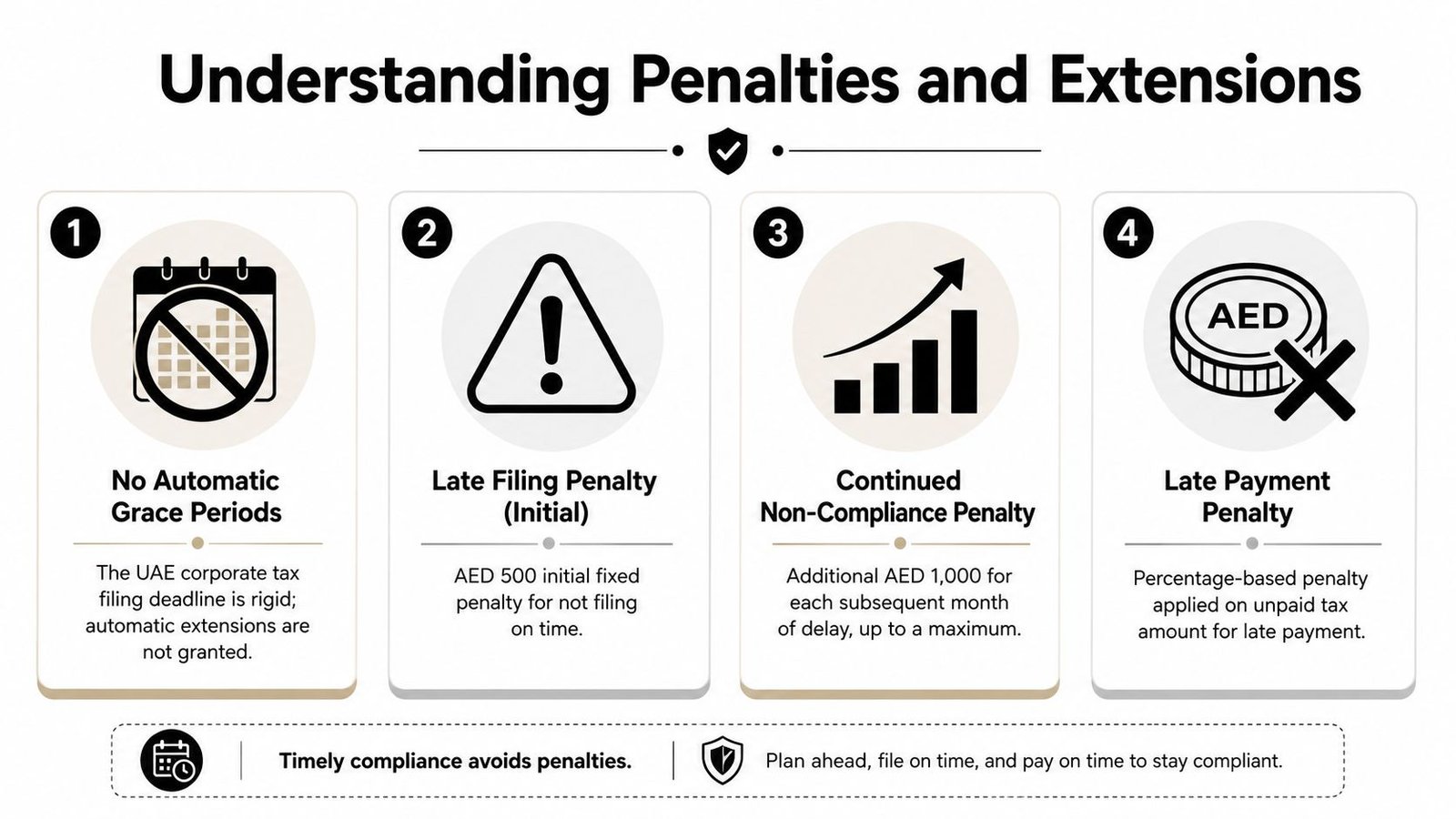
Miss the UAE corporate tax deadline by a day, and the system still treats it as late. That is the operating reality founders need to plan for.
How strict are UAE corporate tax filing deadlines
They are strict in the legal sense, not just in the administrative sense. The filing and payment deadline is generally fixed at 9 months after the end of the financial year, and businesses should assume there is no grace period. The Accountant's explanation of the UAE corporate tax filing deadline reflects that position clearly.
That matters because many founders bring habits from other jurisdictions. They expect a short tolerance window, a routine extension request, or a practical delay if the amount due is small. In the UAE, that assumption creates avoidable risk.
I have seen the actual cost show up outside the tax file itself. A late return can trigger urgent internal reviews, distract finance teams during close, and create uncomfortable questions from shareholders, auditors, or group finance.
Are extensions available
For ordinary planning purposes, assume no general extension is available.
There has been a narrow exception. The FTA issued Decision No. 7 of 2024 on 25 September 2024, extending the deadline to 31 December 2024 for certain entities incorporated between 1 June 2023 and 1 September 2023 with tax periods ending on or before 29 February 2024, as outlined in DLA Piper's summary of FTA Decision No. 7 of 2024.
That relief was targeted and procedural. It was not a sign that the FTA intends to offer broad deadline flexibility. Deloitte made the same point in its analysis of the extension for UAE corporate tax returns in specified cases.
The hidden trap is timing. Founders sometimes hear that an extension existed once and assume they can wait for a similar concession. That is not a filing strategy. It is a gamble.
Build your compliance calendar around the deadline already tied to your financial year-end, not around the hope of a future relief decision.
A short video overview can help if you want a visual explanation of the filing pressure points:
What happens if you file late
Late filing creates two separate exposures. One is the penalty for missing the return deadline. The other is the consequence of unpaid tax, which can include interest and further enforcement depending on the facts.
The exact amount can change based on the applicable rules and the nature of the default, so the safe approach is not to treat late filing as a minor admin issue. PwC Middle East's summary of UAE corporate tax penalties and filing obligations is a useful reference point on how the regime approaches non-compliance.
The practical trap is that businesses often delay for reasons that feel reasonable internally. The accounts are still being cleaned up. A group review is pending. The tax due may be nil. None of those points changes the filing deadline itself.
Prepared companies do one thing differently. They aim to have the return ready before the legal deadline, with enough buffer to fix portal issues, final review comments, or missing support without turning the last week into a risk event.
Your Practical Tax Filing Preparation Checklist
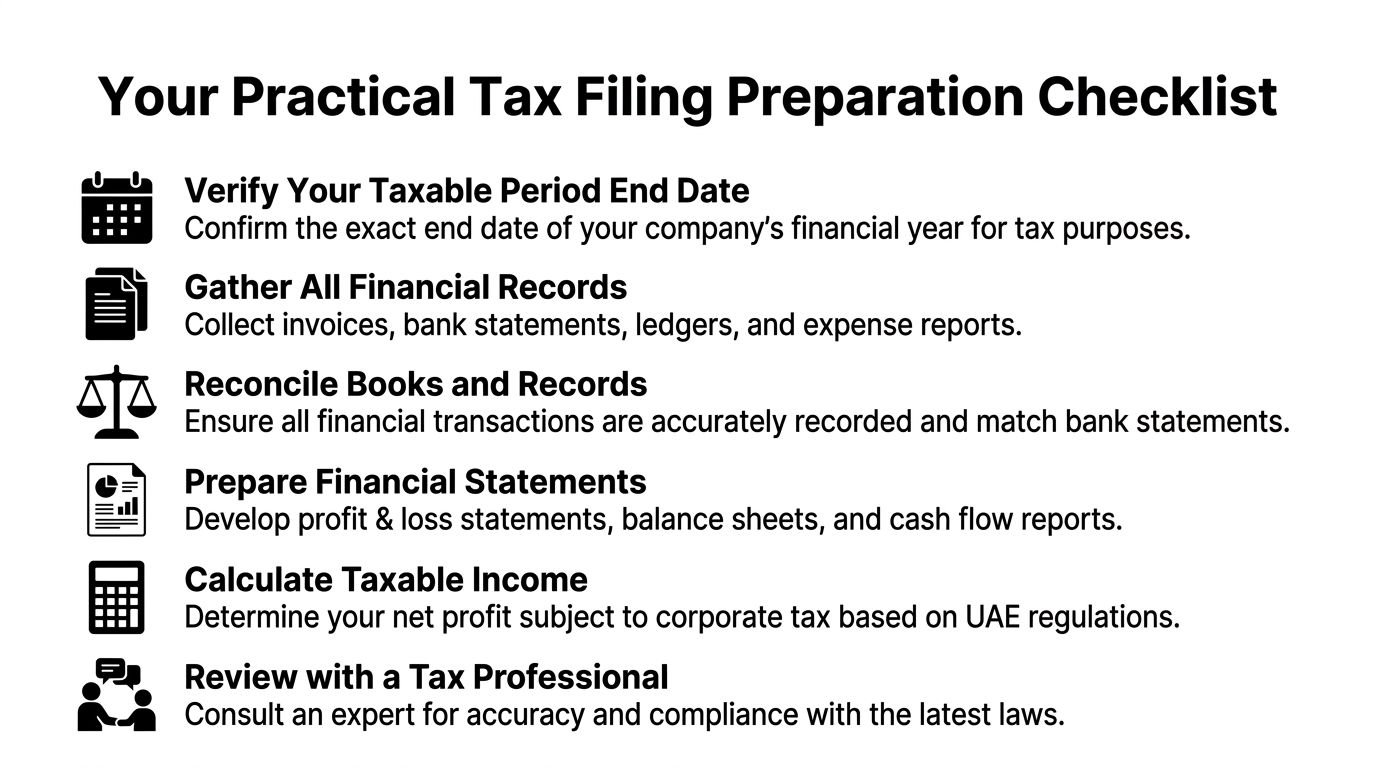
Good tax filing starts long before the return is uploaded. The companies that handle this well don't just “do tax”. They run a repeatable close process, review the right elections early, and leave enough time for questions before submission.
What should you do first
Start with the date and work backwards. Confirm your exact financial year-end, confirm who owns the finance file internally, and make sure your FTA access through EmaraTax is active before filing season begins.
Then organise the preparation in a practical order:
- Lock the period end: confirm the company's tax period and make sure management, accounting, and corporate records all match.
- Clean the books: reconcile bank accounts, review unpaid invoices, check expense support, and fix coding errors while the details are still easy to trace.
- Prepare draft financial statements: the tax return sits on top of the accounting records, so weak accounts produce weak tax filings.
- Review structure questions early: if the company is in a free zone, part of a group, or has cross-border elements, decide the filing position before the final week.
- Assign review responsibility: one person should own submission, another should review the return, and management should sign off on key assumptions.
That approach works because it separates accounting cleanup from tax review. What doesn't work is trying to solve bookkeeping gaps and tax analysis at the same time in the last few days.
How do you avoid first-return mistakes
The first return is where hidden procedural traps appear. One of the least discussed examples involves transition rule benefits for qualifying immovable properties. These benefits must be irrevocably disclosed in the first corporate tax return itself, with specific property details such as address and MACAN number, and if that disclosure is missed, the business must make a separate pre-filing amendment application, as explained in the FTA first return guidance video on transition rule disclosures.
That's the kind of issue that catches prepared founders because the problem isn't laziness. It's timing. If the first return is treated as a simple upload, elections and disclosures that should have been decided earlier can be missed.
A tax return doesn't only report numbers. In some cases, it also locks in choices.
The same principle applies more broadly. If your business has unusual assets, Free Zone considerations, ownership changes, or one-off transactions, identify them before the filing window gets tight. A calm review meeting a few weeks early is usually far cheaper than corrective work after a deadline problem appears.
What preparation approach actually works
The best preparation model is plain and disciplined:
| What works | What causes problems |
|---|---|
| Monthly bookkeeping kept current | Backdated accounting close near filing time |
| Early review of Free Zone and structural issues | Leaving classification questions to the last minute |
| Shared document folder with clean support | Finance documents spread across email and chat |
| Pre-filing review by a tax professional | Assuming the accounting file is enough on its own |
A few habits make a noticeable difference in real businesses:
- Put the tax deadline on the board calendar. If leadership sees it, the finance team gets time and attention.
- Close accounts regularly. A clean month-end process makes year-end filing easier.
- Keep supporting documents together. When invoices, contracts, and payment records are fragmented, review slows down.
- Test the unusual items early. Property, Free Zone treatment, related-party matters, and first-year elections need earlier thought than ordinary expenses do.
Founders often assume tax stress comes from the law being complicated. Usually, it comes from compressed timing. Give the process room, and it becomes far more manageable.
How Inpro Simplifies Your UAE Tax Compliance

What support makes the process easier
Most founders don't struggle because the deadline is impossible to understand. They struggle because tax sits on top of everything else. Company formation, licensing, visas, banking, payroll, and accounting all need attention at once, especially in the first year of operating in the UAE.
That's why hands-on support matters. The right support usually includes tax registration, ongoing bookkeeping that matches UAE requirements, clean financial statements, and final filing through EmaraTax. When those pieces are handled together, the process feels organised instead of rushed.
Why founders outsource this early
The main benefit isn't only technical accuracy. It's control. Founders get a clearer filing calendar, fewer last-minute document requests, and a better view of what the business is reporting.
This is especially useful for international entrepreneurs entering the United Arab Emirates for the first time. Someone launching in a Dubai free zone, expanding to the Abu Dhabi Mainland, or operating as a consultant while sorting residency and visa matters often needs one local team that understands how compliance tasks connect. Good support reduces friction across those moving parts and helps the business stay focused on operations, hiring, and growth.
Corporate tax filing deadlines in the UAE are strict, but they aren't mysterious. Once the financial year, filing obligation, and internal preparation process are clear, the rules become manageable.
Not sure where to start? Book a free strategy call with Inpro Corporate Services L.L.C. and get clear guidance on UAE company setup, tax registration, accounting support, and corporate tax filing.