


UAE corporate tax applies at 9% on taxable income above AED 375,000, with a 0% rate up to AED 375,000 and a separate 0% regime for Qualifying Free Zone Persons on qualifying income. The practical question for founders isn't only how much tax they'll pay, but how their entity, transactions, records and deadlines will support the position they're claiming.
You may be choosing between a Dubai Mainland licence and a Free Zone company, preparing to relocate to Abu Dhabi, or trying to understand whether your small consultancy must register even though it has made little profit. The UAE's corporate tax system now affects company formation, bookkeeping, contracts, intercompany charges and annual filing routines.
The guidance below is designed for founders, international entrepreneurs, freelancers, HR teams and investors who need a workable view of corporate tax in the UAE, not just a headline rate.
Table of Contents
- What Founders Need to Know About UAE Corporate Tax
- Who Pays Corporate Tax in the UAE
- How the 9% Rate and AED 375,000 Threshold Work
- Free Zone 0% Treatment vs Small Business Relief
- Transfer Pricing Rules for Connected Companies
- Registration and Filing Deadlines
- Why UAE Corporate Tax Is Now an Operations Issue
- Next Steps and Common Mistakes to Avoid
What Founders Need to Know About UAE Corporate Tax
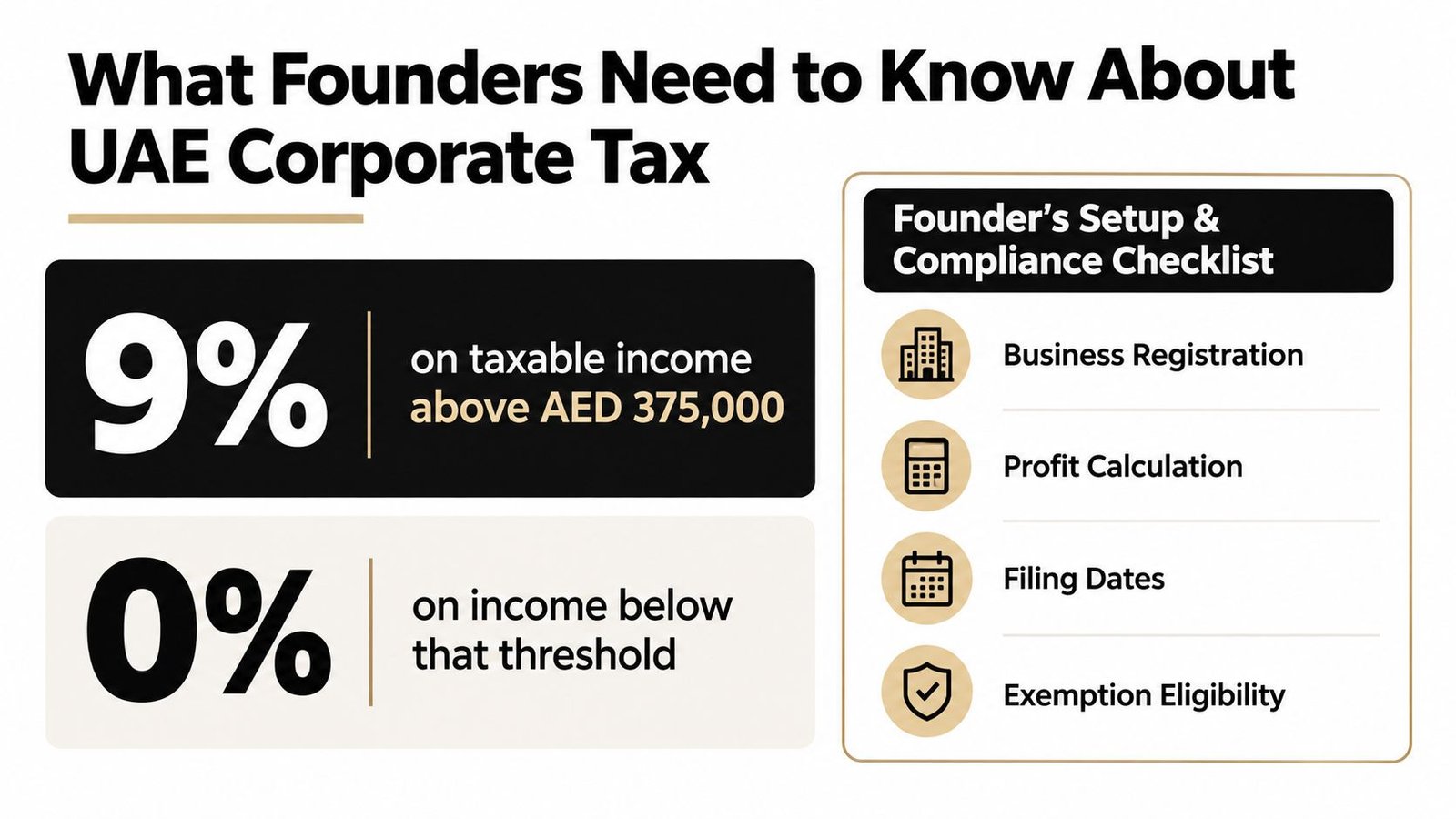
A founder registering a company in Dubai, Abu Dhabi or a Free Zone must make tax readiness part of setup. The United Arab Emirates introduced its federal corporate tax regime on 1 June 2023. Under the Federal Decree-Law on Corporate Tax, taxable income up to AED 375,000 is taxed at 0%, while taxable income above that threshold is taxed at 9%.
What should a founder decide first?
Make four decisions before choosing a licence or finalising contracts:
- Entity scope: Is the business a taxable person, an exempt entity, or a natural person carrying on a business?
- Jurisdiction: Will it operate from Dubai, Abu Dhabi, Sharjah or another emirate through the Mainland, or use a Free Zone structure?
- Income classification: For a Free Zone company, which revenue can qualify for 0% treatment, and which revenue will fall outside that treatment?
- Readiness and timing: Can the business maintain accurate accounts, document related-party dealings and submit its return by the required deadline?
The first tax period begins on or after 1 June 2023, according to the company's financial year. A company using a calendar financial year may begin its tax period on 1 January after the regime took effect. Another company may follow a different annual period based on its approved accounts.
Corporate tax is an annual operating responsibility. Registration and filing obligations do not disappear because a startup is loss-making or its taxable income remains below the 0% threshold. The threshold affects tax payable. It does not decide whether the business must comply.
Practical rule: Choose the legal structure for business access first, then test the tax result against actual income flows. A Free Zone licence alone does not create 0% treatment.
Set up bookkeeping, contracts and related-party records from the first accounting period. The scope, rate, Free Zone, transfer pricing, registration and filing rules must work together in the company's daily operations.
Who Pays Corporate Tax in the UAE
A Taxable Person is a business or other person that falls within the UAE corporate tax rules. This generally includes a juridical person incorporated or effectively managed in the UAE, and a non-resident person that has a Permanent Establishment in the UAE.
A UAE-registered branch, Limited Liability Company, or Public Joint Stock Company can therefore fall within the regime. A foreign company may also be in scope if its UAE activities create a Permanent Establishment, meaning a sufficient business presence in the United Arab Emirates under the applicable rules.
How does tax residency work?
Tax residency is the connection that places a juridical person within the UAE resident corporate tax framework. A company is resident if it's incorporated under UAE law or if its place of effective management is in the UAE.
Effective management is assessed through practical facts rather than the address printed on a licence. Relevant indicators can include where the board holds its meetings, where strategic decisions are made and where senior executives work. A company registered in a Dubai Free Zone but managed from another country shouldn't assume that its UAE registration settles every residency question.
A tax period is the accounting period used to calculate taxable income and prepare the return. In practice, it commonly follows the company's financial year, so founders should align bookkeeping from the start rather than reconstructing records at year end.
Which entities are outside the usual scope?
Certain categories have specific exclusions or separate treatment. These can include government entities, government-controlled companies, extractive businesses subject to emirate-level taxation and qualifying public benefit entities. Natural persons conducting business can also fall within corporate tax where the activity meets the relevant business conditions.
| Category | Status | Founder Note |
|---|---|---|
| UAE LLC, branch or PJSC | Generally in scope | Registration and filing obligations should be checked from incorporation and licensing details. |
| UAE Free Zone company | Generally in scope | It may qualify for 0% on qualifying income, but it still has compliance duties. |
| Foreign company with a UAE Permanent Establishment | Potentially in scope | Review the UAE activities and operating presence before assuming no liability exists. |
| Natural person conducting business | Potentially in scope | Separate personal activity from casual income and assess whether it constitutes a business. |
| Government or qualifying public benefit entity | May be excluded or subject to special treatment | Confirm the entity's exact legal and regulatory status. |
| Extractive business subject to emirate-level taxation | May be outside federal corporate tax | The exclusion depends on the business and applicable emirate-level framework. |
A useful self-test is simple. Ask where the entity was incorporated, where key management decisions are made, whether it has a UAE branch or Permanent Establishment, what business it conducts and whether an exclusion clearly applies. If the answers point to a UAE business presence, treat corporate tax registration and filing as part of the operating setup.
How the 9% Rate and AED 375,000 Threshold Work
A founder forecasting profit should calculate corporate tax for the full tax period, not invoice by invoice or month by month. Under the standard UAE structure, taxable income up to AED 375,000 is taxed at 0%, while the portion above AED 375,000 is taxed at 9%.
Taxable income is the company's accounting profit adjusted under the Corporate Tax Law. Financial statements provide the starting point, but the tax computation can change after reviewing deductible expenses, exempt income and available reliefs. Keep the accounting records detailed enough to identify these adjustments before filing.
Common adjustments include:
- Non-deductible expenses: Certain client entertainment costs above permitted limits, penalties and some dividends from non-qualifying participations may need to be added back.
- Exempt income: Qualifying intra-group dividends and income from qualifying participations may receive exempt treatment when the legal conditions are satisfied.
- Available reliefs: Small Business Relief, group relief and transitional rules for certain immovable property transactions can affect the final liability.
Is AED 375,000 an automatic exemption?
No. It is a 0% tax bracket, not an exemption from registration or filing. A business with taxable income below AED 375,000 may owe no corporate tax under the standard rates, yet still need to register, retain records and submit a return.
For example, a company with AED 1,000,000 of taxable income applies the 0% rate to the first AED 375,000. The remaining AED 625,000 is taxed at 9%, creating AED 56,250 of corporate tax. This calculation follows the rate structure in the UAE Federal Decree-Law on Corporate Tax.
| Taxable Income (AED) | Tax Due (AED) | Effective Rate |
|---|---|---|
| 375,000 | 0 | 0% |
| 1,000,000 | 56,250 | 5.625% of total taxable income |
| Income above 375,000 | 9% of the excess | Depends on total taxable income |
The example's effective rate is below 9% because the first AED 375,000 is taxed at 0%. Do not use that effective rate as a default budget assumption. Forecasts must account for accounting adjustments, relief elections and whether the company's income falls within a Free Zone regime.
How does a QFZP differ?
A Qualifying Free Zone Person, or QFZP, is a Free Zone company that meets the conditions for 0% treatment on qualifying income. Its non-qualifying income is taxed at 9%, and the AED 375,000 0% bracket does not apply to that non-qualifying income under the Free Zone rules.
The operational choice matters. A QFZP may have 0% treatment for one income stream and 9% treatment for another. Set up the accounting system to separate revenue by activity and counterparty from the first transaction. Classification made after year-end is harder to defend and can distort both forecasts and the first tax return.
Free Zone 0% Treatment vs Small Business Relief
A founder choosing between a Mainland licence and a Free Zone licence is also choosing how the company will qualify for corporate tax treatment. QFZP treatment is an income-based Free Zone regime, while Small Business Relief is an elected relief for eligible UAE resident businesses. The right option depends on expected customers, activities, records and filing position, not only on the headline rate.
A QFZP can receive 0% on Qualifying Income if it satisfies the applicable conditions. Qualifying Income may include transactions with other Free Zone Persons, qualifying activities with non-Free-Zone Persons, qualifying intellectual property income and other income covered by the de minimis rules, as set out in Cabinet Decision No. 100 of 2023.
The QFZP route requires operational control. Maintain adequate activity, classify each revenue stream correctly, retain supporting records and monitor the conditions throughout the tax period. The de minimis test limits non-qualifying revenue to 5% of total revenue or AED 5 million, whichever is lower. The official Free Zone legislation sets out the qualifying-activity and income mechanics. Set up separate accounting codes for qualifying and non-qualifying income before the first invoice.
Small Business Relief follows a different design. A UAE resident business with revenue at or below AED 3,000,000 may elect the relief on its return, provided it is not a QFZP and satisfies the other conditions. According to Federal Tax Authority guidance on Small Business Relief, the relief is scheduled to apply to tax periods ending on or before 31 December 2029, subject to further updates.
| Criteria | Qualifying Free Zone Person (QFZP) | Small Business Relief |
|---|---|---|
| Main basis | Qualifying income and Free Zone conditions | Revenue threshold and election |
| Rate outcome | 0% on qualifying income, 9% on non-qualifying income | Relief applies where eligibility conditions are met |
| Revenue test | De minimis requirements apply to other income | Revenue at or below AED 3,000,000 |
| Eligibility | Free Zone company meeting QFZP conditions | UAE resident business that isn't a QFZP |
| Time limit | Depends on continued compliance | Tax periods ending on or before 31 December 2029 |
| Best fit | A Free Zone business with clean qualifying transactions | A smaller Mainland or non-QFZP resident business |
For a Mainland startup with modest revenue, Small Business Relief is usually easier to administer than building a QFZP position. A Free Zone company with strong qualifying activity may choose QFZP treatment, but it must track income by activity and customer. A pre-revenue company should base the decision on its planned transactions, not its current revenue.
Do not treat the AED 375,000 bracket as a fallback for QFZP non-qualifying income. That income can be subject to 9% without the standard threshold.
Transfer Pricing Rules for Connected Companies
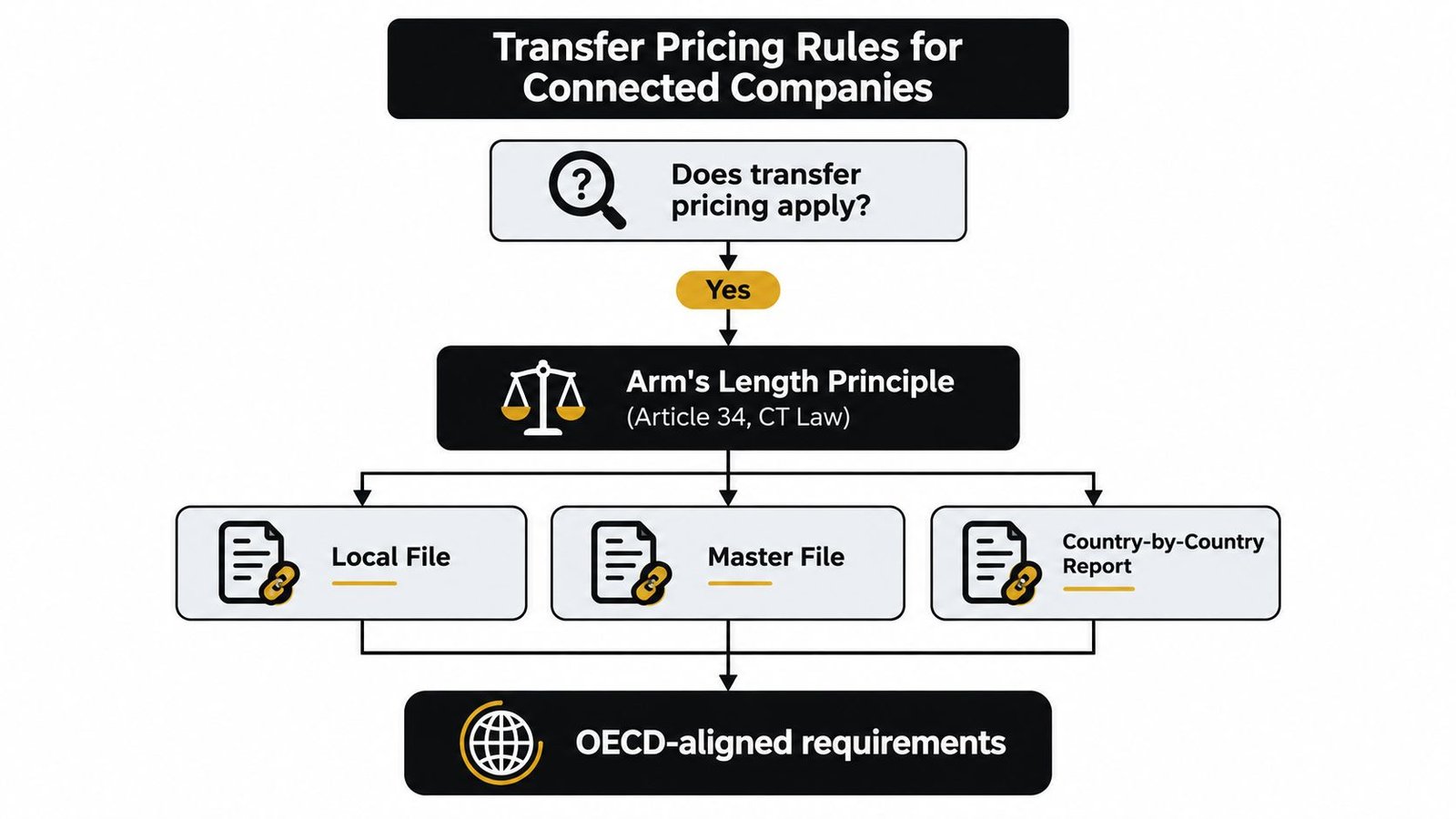
Transfer pricing is the process of pricing transactions between connected or related parties as if independent businesses had agreed the terms. The arm's length principle under Article 34 of the Corporate Tax Law requires connected-party pricing to reflect the functions performed, assets used, risks accepted and value received.
The Federal Tax Authority distinguishes between disclosure and full documentation. A Transfer Pricing Disclosure Form is required for controlled transactions in the tax period. A Master File and Local File are required only where the taxable person's revenue reaches AED 200 million or the multinational group's consolidated revenue reaches AED 3.15 billion, according to the FTA Transfer Pricing Guide.
What should a smaller group do?
Don't wait until a documentation threshold is reached. Suppose a Dubai Mainland company charges its Free Zone sister company AED 250,000 a year for shared management services. The group should define the services, prepare a service-level agreement, record who performs the work and test whether the receiving company benefits from it.
The pricing method might involve comparable service providers or a cost-plus approach. The correct markup depends on the facts, so a founder shouldn't pick a convenient percentage without support. Keep invoices, time records, approval evidence, cost allocations and the reasoning behind the charge together.
Related parties can include companies under common ownership or control. Intercompany payments for management, software, intellectual property, loans, marketing and central staff should therefore be identified before the first return is prepared.
Keep the contract, calculation and evidence of benefit together. A bank transfer proves payment, not that the charge was arm's length.
The OECD-aligned documentation structure includes a Local File, Master File and Country-by-Country Report. The Country-by-Country Report applies to multinational groups at the relevant consolidated revenue level, while the other files depend on the local thresholds and facts. Disclosure still matters for smaller entities, even where full files aren't triggered.
The embedded explainer below provides another visual introduction to the process.
Registration and Filing Deadlines
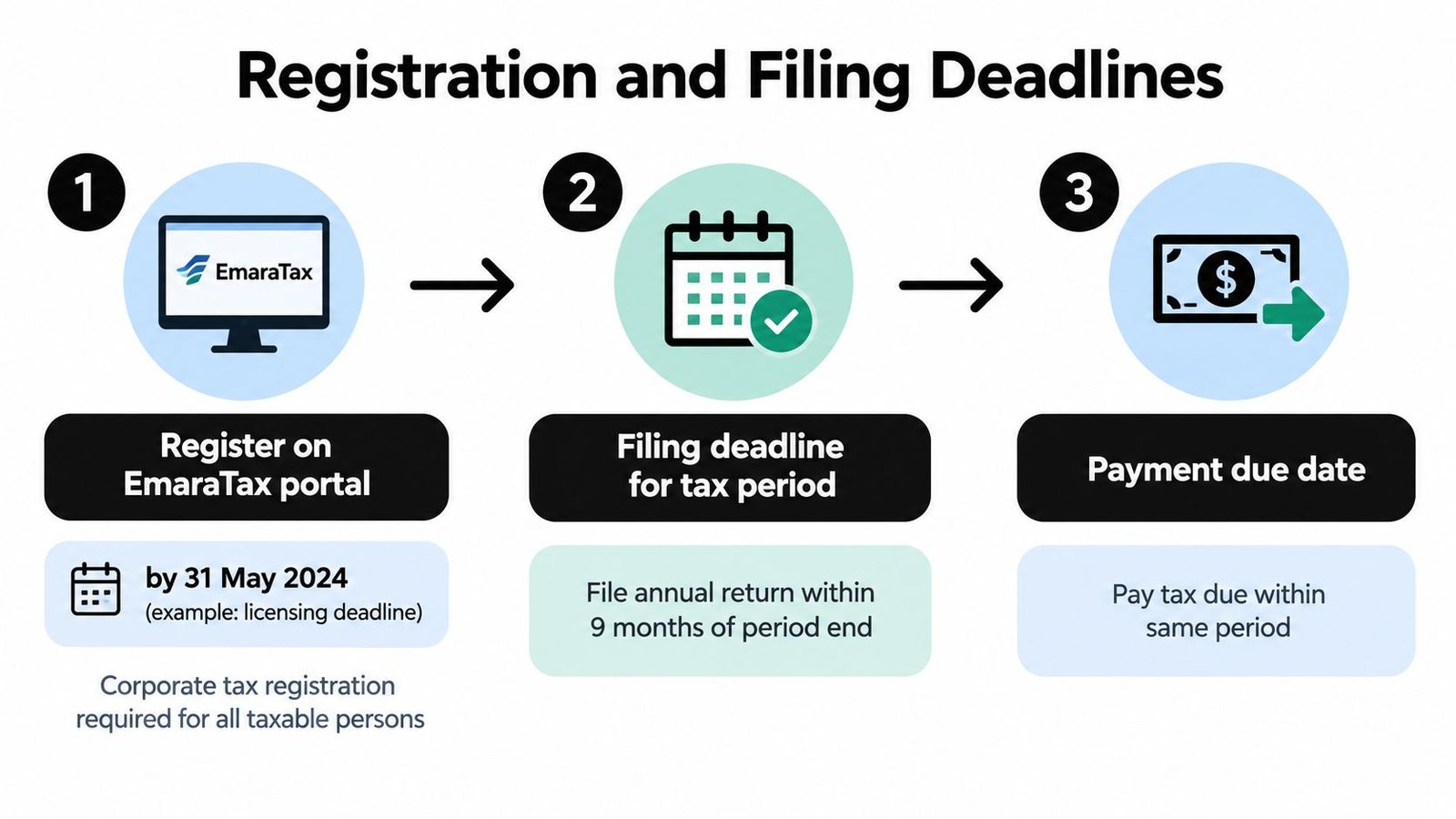
Corporate tax registration is handled through EmaraTax, the Federal Tax Authority's online tax services portal. The registration date depends on the entity's licensing circumstances, so founders should check the applicable FTA timeline rather than wait for the first profitable year.
For example, the FTA stated that a juridical person without a licence as of 1 March 2024 had a corporate tax registration deadline of 31 May 2024. The FTA public clarification on registration timelines sets out that specific rule.
When is the return due?
The annual Tax Return is generally due 9 months after the end of the tax period. A company with a calendar-year tax period ending on 31 December files by 30 September. A company using a 1 July to 30 June financial year files by 31 March after the period ends.
The return is required even if the business has no taxable income or no tax to pay. Payment, where corporate tax is due, follows the applicable filing timetable. Founders should set aside funds during the year instead of treating the liability as a surprise at filing time.
What records must the company keep?
Maintain accounting records, invoices, contracts, bank statements, payroll information and tax calculations for at least 7 years. Related-party support should sit with the underlying transaction, not in a separate folder that disappears when the bookkeeper changes.
The penalty framework makes delay expensive. The stated penalty ladder includes AED 10,000 for late registration and AED 1,000 per month for late filing, alongside administrative penalties for failing to maintain records. The exact liability depends on the breach and applicable rules, so a missed deadline should be addressed quickly rather than ignored.
A practical calendar should contain three entries: the registration deadline, the return date nine months after period end and the payment date. Assign one person to own each item, with a second person checking the records before submission.
Why UAE Corporate Tax Is Now an Operations Issue
The old assumption that a UAE trade licence means “no tax work” no longer fits the regulatory environment. A company can owe no corporate tax and still need registration, accounting records, income classification, disclosures and a return.
The Federal Tax Authority's 2025 reporting shows that tax registrations reached 1.7 million, up 20%, while audits increased by 46%. The same report records AED 46 billion in VAT and excise revenues in 2025. These figures indicate a tax administration that is expanding its registration base and enforcement activity, as shown in the FTA's 2025 annual report announcement.
| Metric | Value | Why it matters for founders |
|---|---|---|
| Tax registrations | 1.7 million, up 20% | More entities are entering the reporting system. |
| Tax audits | Up 46% | Weak records are more likely to create practical problems during review. |
| VAT and excise revenues in 2025 | AED 46 billion | UAE tax administration now operates at significant national scale. |
What changes inside the business?
Before the federal corporate tax regime, some founders treated the UAE licence as a standalone administrative item. Today, the licence connects to a broader pipeline: accounting records, tax registration, annual returns, related-party disclosures and evidence supporting a Free Zone position.
A profitable Free Zone company can still lose its expected tax outcome if it mixes qualifying and non-qualifying revenue, records contracts under the wrong entity or fails to demonstrate the required business activity. A loss-making company can still create risk if it doesn't register or file on time.
Corporate tax is a finance process, but the evidence starts with sales, procurement, HR, banking and contract management.
The right response is not to build a large tax department on day one. It's to make ownership clear. Finance should classify transactions, operations should preserve contracts, HR should track the people and activity supporting the entity, and directors should approve the annual filing process.
Treat corporate tax readiness like payroll and VAT setup. If the records are organised monthly, the first filing becomes a review exercise. If the company waits until the deadline, even a simple return can become a reconstruction project.
Next Steps and Common Mistakes to Avoid
A founder can turn the rules into a short operating checklist. Start before incorporation if possible, because the choice between Dubai Mainland, Abu Dhabi, Sharjah and a Free Zone affects both market access and the evidence needed for the intended tax treatment.
What should the company do first?
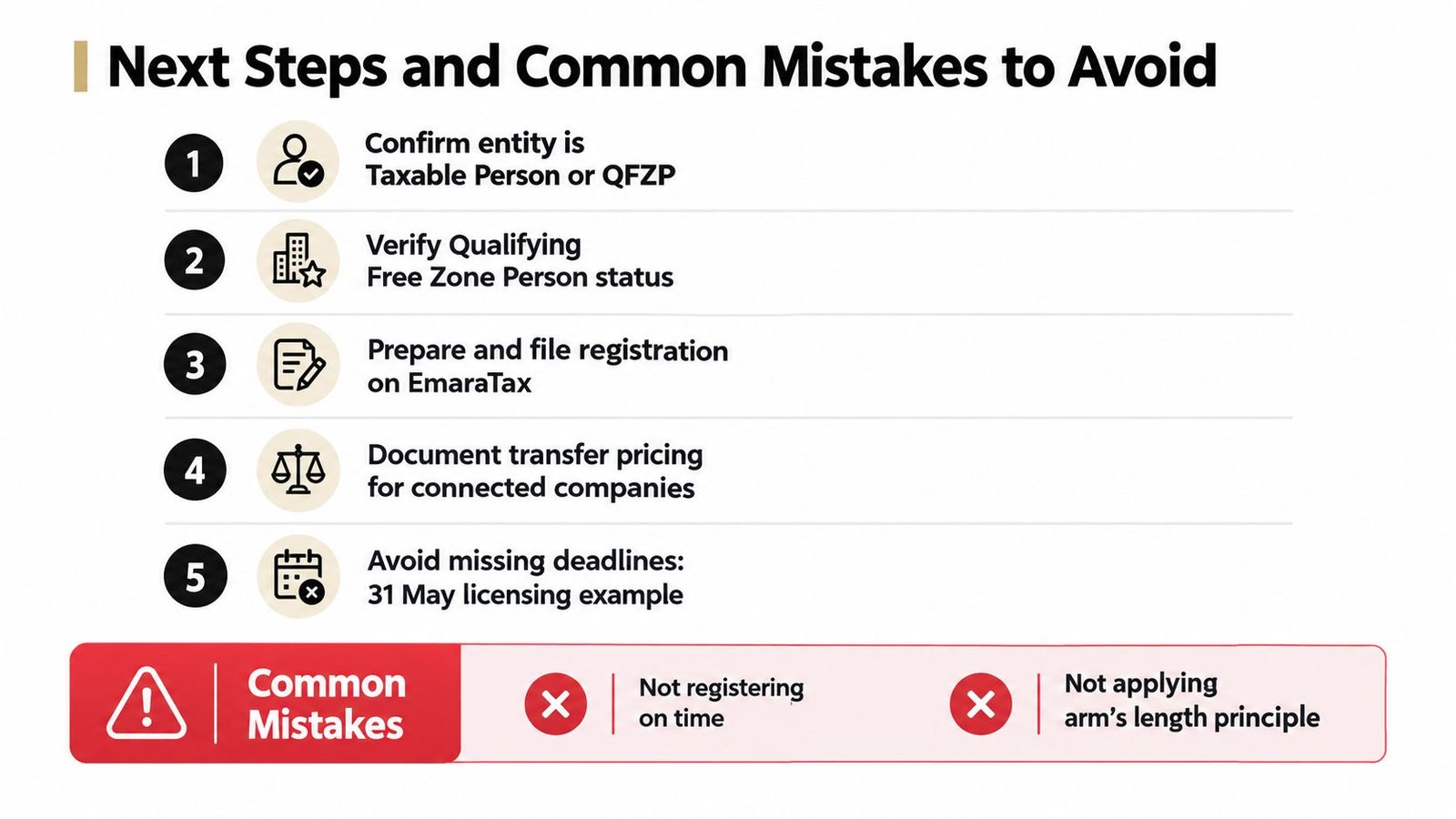
- Confirm entity scope: Decide whether the company is a Taxable Person and check whether any exclusion applies.
- Test QFZP status: If the company is in a Free Zone, map its activities, counterparties and expected revenue against the qualifying-income rules.
- Set the tax period: Align the tax period with the financial statements and make sure the bookkeeping system can close accounts consistently.
- Prepare connected-party records: Identify common-ownership companies, management charges, loans, IP licences and shared costs before the first filing.
- Register and calendar the return: Complete corporate tax registration through EmaraTax and reserve the filing date nine months after the end of the tax period.
Which mistakes create the most trouble?
- Treating Free Zone 0% as universal: The benefit applies to qualifying income, not every invoice issued by the company.
- Mixing revenue categories: Qualifying and non-qualifying income should be tracked separately from the transaction date.
- Ignoring related-party charges: Shared management, software, IP and financing flows need contracts and arm's length support.
- Applying the AED 375,000 threshold to QFZP non-qualifying income: That income doesn't receive the standard 0% bracket.
- Leaving registration until later: The FTA's 31 May 2024 licensing example shows why companies must check deadlines tied to their licence status.
- Allowing records to drift: Missing invoices, unsigned agreements and unexplained journal entries make the return harder to defend.
A company doesn't need perfect systems to begin. It needs a clear entity classification, a reliable bookkeeping process, a transaction map and an owner for each deadline. If the business is forming now, include tax registration and accounting in the launch plan rather than adding them after the licence is issued.
Inpro can support UAE company formation, corporate tax registration through EmaraTax, accounting and tax filing, alongside PRO services and investor, Golden and employee visa processing. If you want help matching your jurisdiction and operating model to your compliance needs, visit Inpro to discuss the setup and filing steps with the team.