


Most founders ask the wrong question first. They ask, “Which free zone is best?” when the better question is, “Where will my goods move, where will VAT apply, and what will that do to working capital?”
That gap matters because not every free zone gives you the same treatment. In the UAE, a Designated Zone is a specific kind of free zone area that meets customs and security conditions. The Federal Tax Authority officially lists 23 Designated Zones under Cabinet Decision No. 59, and that status matters because goods in those areas can receive different VAT treatment from mainland movements, while services generally don't get the same benefit according to this UAE Designated Zones overview. For physical-goods businesses, that distinction can shape warehousing strategy, import timing, re-export flows, and the actual cost of carrying stock.
The UAE's wider free zone model began with Jebel Ali Free Zone in 1985, and it expanded into a national network of over 45 free zones, with more than two dozen in Dubai alone as outlined in this UAE free zones overview. But “free zone” and “designated free zone” aren't interchangeable terms.
This guide focuses on designated free zones in uae from a practical operator's angle. Not just who is famous, but who properly fits e-commerce fulfilment, heavy manufacturing, air cargo, regional distribution, or cost-sensitive trading.
Table of Contents
- 1. Jebel Ali Free Zone JAFZA
- 2. Dubai Airport Freezone DAFZ
- 3. Dubai South Dubai Aviation City within DWC
- 4. KEZAD Group Khalifa Industrial Zone and Khalifa Port Free Trade Zone
- 5. Sharjah Airport International Free Zone SAIF Zone
- 6. Hamriyah Free Zone Authority HFZA
- 7. Umm Al Quwain Free Trade Zone UAQ FTZ
- 7 UAE Designated Free Zones: Quick Comparison
- Choose Your Zone and Launch with Confidence
1. Jebel Ali Free Zone JAFZA
Need a designated zone that works for sea freight, storage, and re-export at scale? JAFZA is usually the first serious option to test. It was established in 1985 and remains one of the UAE's best-known port-linked free zones, built around Jebel Ali Port rather than around office demand or low entry cost according to DP World's JAFZA overview.
That matters in practice. If your business depends on container arrivals, bonded warehousing, light assembly, and onward distribution across the GCC or wider region, JAFZA can reduce handoffs between port, customs, storage, and transport. For import-reexport models, that operational logic often matters more than saving on the first-year licence fee.
Why operators choose JAFZA
JAFZA is one of the UAE zones treated as a Designated Zone for VAT purposes, subject to the conditions in the VAT rules and the way goods move in and out of the zone under the Federal Tax Authority's Designated Zones guidance. This status explains why many trading businesses shortlist it early. The label only helps if the supply chain is set up correctly. Goods can move very efficiently in the right structure, but the VAT result changes fast once stock is released into mainland UAE or services are mixed into the transaction.
For e-commerce operators, that creates a clear trade-off. JAFZA can work well for regional stockholding and re-export, but mainland last-mile fulfilment needs careful VAT treatment and usually adds complexity. For manufacturers and distributors importing raw materials or finished goods by sea, the zone often makes more operational sense because the logistics pattern already matches the infrastructure.
Practical rule: If your inventory arrives in containers, sits in storage, and is sold onward in bulk or re-exported, JAFZA deserves a hard look before lower-cost zones.
A few points usually decide the outcome:
- Best fit for sea-led models: Strong option for trading, distribution, light manufacturing, and assembly linked to Jebel Ali Port.
- Useful VAT position: Designated Zone treatment can support better VAT outcomes on qualifying goods movements, but only with clean documentation and correct stock flow.
- Better for volume than speed: If your priority is container efficiency and warehouse access, JAFZA usually beats airport-led zones. If your business depends on urgent, high-value, low-volume shipments, it may not.
- Higher operating cost: Warehouses, land, and support services are rarely the cheapest in the market.
- Less room for poor structuring: Weak invoice flow, unclear transfer points, or casual VAT assumptions become expensive here.
JAFZA is not the cheapest answer, and it is not the right answer for every startup. But for businesses built around sea freight, industrial use, or regional redistribution, it often gives the cleanest logistics model and the most usable VAT planning options.
2. Dubai Airport Freezone DAFZ
Need goods in and out fast, with less tolerance for delay, damage, or extra handling? That is the commercial logic behind DAFZ.
DAFZ sits next to Dubai International Airport, so the zone suits businesses where transit speed and controlled handling matter more than warehouse scale. I usually point clients here when they trade high-value, low-volume goods such as electronics, aviation parts, medical devices, watches, jewellery, or urgent replacement stock. In those models, cheaper rent in a sea-led zone can be a false saving if every delay affects customer commitments or forces you to hold more inventory.
The VAT angle matters too. DAFZ can be useful for businesses that move qualifying goods through a designated zone structure, especially where stock is imported, stored under customs control, and re-exported without entering the UAE mainland supply chain too early. The benefit comes from the way the goods move and where control passes. It does not come from the zone name alone, and it does not change the normal VAT treatment of services.
Where DAFZ earns its cost
DAFZ usually works best where shipment value is high and timing is tight. A business shipping AED 500,000 of compact inventory by air each week will judge the zone very differently from a business importing pallets of low-margin consumer goods. One is paying for speed, handling discipline, and proximity to air cargo. The other is often paying for an address it does not really need.
The practical fit is often clear once you examine the operating model:
- Strong match for air-freight businesses: Useful for urgent, high-value, or temperature-sensitive goods that cannot sit in long port and road cycles.
- Better control over stock movement: Helpful where customs handling, re-export timing, and chain of custody affect VAT treatment and customer risk allocation.
- Good option for compact setups: Suits companies that need office space, light storage, and a credible Dubai base without taking industrial-scale premises.
- Less suitable for bulk inventory: Weak fit for container-led trading, heavy manufacturing, large plots, or businesses built around low-margin volume.
- Premium pricing needs a reason: Licence, facility, and operating costs make more sense when faster turnaround protects margin or service levels.
A common mistake is choosing DAFZ because it sounds prestigious. The better question is simpler: does airport proximity improve your stock flow enough to offset the higher operating cost? If the answer is yes, DAFZ can be one of the more efficient designated free zones in uae for the right business model. If the answer is no, the same budget often goes further in a zone built for storage depth or mixed-mode logistics.
For tax planning, use official and adviser-grade guidance rather than generic zone lists. The UAE Cabinet decision on Designated Zones and the Federal Tax Authority's VAT public guidance are the documents that shape the precise analysis. Corporate tax treatment for free zone persons is separate again, and firms such as PwC outline that distinction in their UAE tax guidance. That separation matters because founders often mix up designated-zone VAT rules with Qualifying Free Zone Person rules, even though they solve different problems.
Visit Dubai Airport Freezone.
3. Dubai South Dubai Aviation City within DWC
Dubai South often attracts founders who want modern logistics infrastructure without stepping straight into the highest-cost Dubai zones. For e-commerce fulfilment, cross-dock activity, and aviation-linked operations, that can be a sensible middle ground.
But this zone needs more care at selection stage than people expect. In Dubai South, designated status is not a label you should assume across every facility choice. The fenced, customs-controlled footprint matters.
The real trade off in Dubai South
Dubai South is attractive because it supports scalable logistics and fulfilment models near Al Maktoum International Airport and with practical access toward Jebel Ali. That's useful for businesses that blend air, road, and sea movements and want flexibility as their fulfilment model evolves.
The caution is simple. You need to confirm the exact unit, plot, or facility sits within the relevant designated area if your VAT treatment depends on that status. Founders sometimes hear “Dubai South” and assume all sections work the same way. They don't.
Services remain under normal VAT logic. The designated-zone advantage is mainly about qualifying movements and storage of goods, not a blanket VAT holiday for everything your company sells.
This zone suits businesses such as:
- E-commerce fulfilment operators: Especially if they need warehouse efficiency and regional dispatch options.
- Aviation support firms: MRO-adjacent, parts handling, or flight-linked logistics businesses often fit well.
- Growth-stage traders: Companies that want more room to scale than central Dubai usually offers.
- Hybrid operators: Good for firms balancing imported inventory, re-export, and local delivery planning.
What doesn't work is vague planning. If you choose Dubai South, map the goods journey first, then choose the exact facility. This is one of those designated free zones in uae where location detail matters almost as much as the free zone name.
Visit Dubai South.
4. KEZAD Group Khalifa Industrial Zone and Khalifa Port Free Trade Zone
Need a zone that works for manufacturing, bulk trading, or port-based distribution?
KEZAD deserves a serious look because it solves a different problem from the Dubai airport-led options. This is less about prestige and speed-to-meeting, and more about land, utilities, truck movement, port access, and the ability to build an operation that still fits three years from now.
That distinction matters. Companies choosing among designated free zones in uae often focus on the label first and the goods flow second. With KEZAD, that order should be reversed. Start with the cargo profile, storage cycle, and whether your model depends on sea freight, palletised inventory, light production, or imported inputs.
KEZAD Group itself was formed through the integration of Khalifa Industrial Zone Abu Dhabi and ZonesCorp under AD Ports Group, a change the group outlines in its corporate profile and operating structure on the KEZAD Group about page. For operators, the practical effect is a broader industrial platform rather than a small free zone built around offices and standard units.
The VAT angle is where this zone becomes commercially interesting. The UAE's designated zone treatment applies to qualifying areas that meet the conditions set under the VAT rules, and the Federal Tax Authority's public guidance makes clear that the special treatment is mainly relevant to goods, subject to the conditions for movement, storage, and use inside the designated zone under the FTA VAT Designated Zones guide. In plain terms, KEZAD can work well for businesses that import goods, hold them in-zone, process or redistribute them, and only trigger standard UAE VAT treatment when goods enter the mainland in a taxable way.
That makes KEZAD a better fit for some business models than others.
- Manufacturers and processors: Good choice if you need industrial plots, heavier utility support, production space, and direct port logic for inbound materials and outbound goods.
- High-volume traders: Strong option for firms moving containers, bulk goods, machinery, chemicals, packaging, or other inventory that is inefficient to run through an airport-led setup.
- High-value goods with controlled storage needs: Can make sense if security, customs control, and delayed mainland release are part of the operating model, though facility selection matters.
- Large 3PL and distribution operators: Useful when truck access, yard space, and long-term warehouse scaling matter more than being close to central Dubai.
The trade-off is operational geography. If your founders, customers, and sales teams are concentrated in Dubai, KEZAD can add real management friction. Site visits take longer. Hiring patterns may shift. Staff transport and last-mile planning need more thought than they do in zones closer to Dubai's commercial core.
Cost also needs a realistic reading. KEZAD can be more efficient over time for businesses that would otherwise outgrow a smaller warehouse and relocate, refit, or split operations across multiple sites. But it is not automatically the lowest-cost answer. The wrong company can overbuy space here and carry unnecessary overhead.
A simple rule helps. If your margin depends on handling goods well, KEZAD usually deserves to be shortlisted. If your business mainly sells services, light stock, or fast-turn air cargo, the designated-zone advantage here is less meaningful than many founders assume.
Visit KEZAD Group.
5. Sharjah Airport International Free Zone SAIF Zone
SAIF Zone is one of the more balanced choices on this list. It doesn't try to out-position JAFZA on port scale or DAFZ on air cargo prestige. What it does offer is a practical setup environment for SMEs, trading companies, and regional distributors who want workable warehousing and manageable overhead.
That's why SAIF Zone remains popular with companies that need movement, not theatre. It is especially useful for founders who want access to Dubai, Sharjah, and the Northern Emirates without paying for a flagship Dubai address they may not need.
Who should shortlist SAIF Zone
SAIF Zone works well when your business needs decent logistics access, straightforward setup, and stock-holding capability, but doesn't need the heaviest industrial utilities. A lot of importers and regional distributors fit that profile.
The zone's operational appeal comes from its airport-linked location, practical warehouse options, and support structure around setup and documentation. In consultant terms, it is often a “low-regret” option. It may not be the absolute best at one thing, but it is good at many things that matter to SMEs.
“If your sales team works across several emirates and your warehouse needs are still moderate, SAIF Zone often gives you fewer compromises than a premium Dubai licence.”
The watch-outs are straightforward:
- Good for regional distribution: Especially for businesses serving nearby emirates with regular stock movement.
- Better pricing posture than prime Dubai zones: That matters when your first objective is operating margin, not brand signalling.
- Suitable for standard trading activities: Warehousing, office use, and conventional import-export models are usually easy to understand here.
- Less suited to heavy industrial demand: If you need serious utility depth or highly specialised industrial infrastructure, KEZAD or Hamriyah may fit better.
SAIF Zone is often overlooked because it isn't the loudest brand in the market. For many SMEs, that's exactly why it works.
Visit Sharjah Airport International Free Zone.
6. Hamriyah Free Zone Authority HFZA
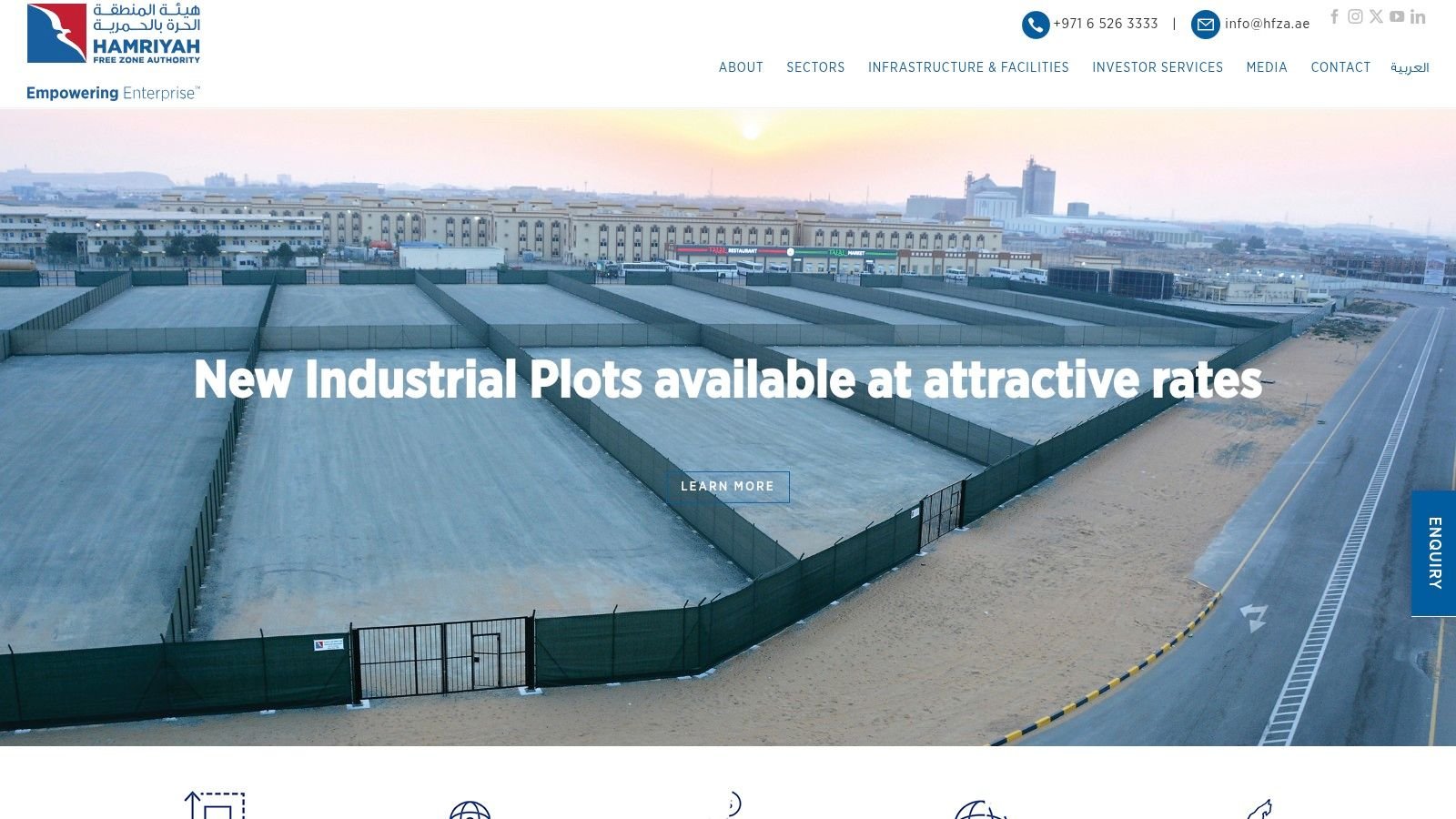
Need a Designated Zone that suits tanks, bulk inventory, industrial plots, and constant truck movement?
HFZA earns attention early for businesses that handle physical goods at scale. If your model involves raw materials, packaging lines, petrochemicals, food processing inputs, timber, steel, or large-format storage, the practical fit is often better here than in office-led zones with a stronger brand name but tighter operational limits.
The primary advantage is not the label alone. It is the combination of industrial infrastructure and designated-zone VAT treatment. For goods businesses, that pairing can improve storage economics and simplify stock planning, provided the operation is set up correctly and the goods stay within the conditions that apply to designated zones. The UAE Federal Tax Authority explains the framework in its guidance on VAT treatment of designated zones.
HFZA makes more sense as the business gets heavier, more space-hungry, or more utility-dependent. That includes operators who need open yard space, long-term warehousing, tank storage, or room to separate importing, processing, and re-export activity. Those are practical needs, not branding decisions.
A common trade-off shows up quickly. HFZA can save money and reduce operational strain for industrial businesses, but it will not give you the polished corporate feel of a central Dubai address. For many manufacturers and commodity traders, that is a fair exchange. For client-facing firms that host visitors often, it may not be.
Where HFZA fits best
HFZA is a strong match for businesses where logistics and storage drive margin.
- Best suited to industrial and bulk trading models: Manufacturing, assembly, packaging, and large-volume storage are easier to accommodate here than in zones built around offices.
- Useful for liquid and specialised storage: Businesses dealing with chemicals, oils, or other tank-based inventory should shortlist HFZA early.
- Practical for re-export and regional distribution: Sharjah access can work well for road freight and for companies moving goods across the UAE and wider GCC.
- Less suitable for premium front-office needs: Teams that prioritise prestige address value, frequent client meetings, or high-end business park amenities may find the environment too operational.
HFZA is usually the right answer for a specific type of operator. If the business model depends on moving, storing, processing, or staging goods efficiently, it deserves a serious look before you pay Dubai-level costs for facilities you may not need.
Visit Hamriyah Free Zone Authority.
7. Umm Al Quwain Free Trade Zone UAQ FTZ
Need a designated zone without taking on Dubai-level occupancy costs from day one?
UAQ FTZ usually enters the conversation when a business wants the VAT positioning of a designated zone, but does not need a major port complex, an airport cluster, or heavy industrial infrastructure. For founder-led trading companies, smaller import-export operations, and early e-commerce stockholding models, that can be a practical starting point.
UAQ FTZ is recognised by the Federal Tax Authority in its list of designated zones, which is the point that matters for VAT planning, not brand recognition alone. See the FTA designated zones list. In practice, that means the operating footprint must be checked carefully. The designated zone label helps only if the goods activity is structured correctly, the warehouse location is within the qualifying area, and customs and stock records are handled properly.
That is the actual trade-off here. UAQ FTZ can reduce setup and facility costs, but it does not solve weak operational planning.
When UAQ FTZ makes commercial sense
UAQ FTZ fits businesses that need controlled overheads more than they need ecosystem prestige.
A common example is a small trading company importing goods into the UAE, storing limited inventory, and re-exporting to GCC or African markets. Another is an e-commerce seller holding stock locally before last-mile delivery or marketplace fulfilment. In both cases, the question is usually not "Which zone sounds strongest?" It is "Where can we store goods compliantly without paying for infrastructure we will not use?"
UAQ FTZ tends to work best in these situations:
- SMEs focused on cost discipline: Licence and facility costs are generally easier to absorb than in larger Dubai zones.
- Light warehousing and standard goods flows: Suitable for stockholding, trading, packaging, and straightforward distribution models.
- Early-stage e-commerce operations: Useful where the business needs a warehouse base and clean VAT treatment, but volumes do not justify a larger logistics platform.
- Founder-led setups that need speed: Standard activity profiles are often easier to process than complex industrial or regulated structures.
- Businesses with modest client-facing needs: The zone works better for operational teams than for companies selling a premium corporate image.
There are limits, and they matter.
If the model depends on dense freight connections, frequent air cargo movements, large-scale manufacturing, or immediate buyer recognition from a well-known logistics address, UAQ FTZ will feel narrower than JAFZA, DAFZ, or KEZAD. Banking can also be less straightforward for very new entities with thin documentation. In those cases, founders should expect requests for invoices, supplier agreements, or proof of trading activity before the account process moves smoothly.
Used properly, UAQ FTZ is a disciplined choice, not a second-tier one. It suits businesses that care more about VAT treatment, workable storage, and cost control than about headline prestige.
Visit Umm Al Quwain Free Trade Zone.
7 UAE Designated Free Zones: Quick Comparison
| Free Zone | 🔄 Implementation Complexity | ⚡ Resource Requirements & Cost | 📊 Expected Outcomes | 💡 Ideal Use Cases | ⭐ Key Advantages |
|---|---|---|---|---|---|
| Jebel Ali Free Zone (JAFZA) | Medium–High, mature cluster, longer lead times for large plots | High, premium occupancy and infrastructure needs | High impact, world‑class logistics reliability and scale | Large distribution, re‑export, manufacturing, enterprise hubs | Scale and multimodal connectivity; strong brand recognition |
| Dubai Airport Freezone (DAFZ) | Low–Medium, streamlined digital licensing, airside procedures | High, premium rents and licence fees | Very high for time‑sensitive goods, rapid clearance and JIT enablement | High‑value/time‑sensitive cargo (electronics, pharma, perishables) | Airside proximity; fast customs; strong regulatory reputation |
| Dubai South – Dubai Aviation City (DWC) | Medium, designated‑area specifics; confirm VAT footprint | Medium, competitive packages vs central Dubai; modern facilities | Optimised for fulfilment & cross‑dock; scalable operations | E‑commerce fulfilment, MRO, aviation logistics | Purpose‑built aerotropolis facilities; strong airport links |
| KEZAD Group (Khalifa) | Medium–High, large industrial projects, build‑to‑suit lead times | Medium, generally more cost‑efficient land/utilities vs Dubai | High for manufacturing/industrial scale and port‑linked logistics | Manufacturing, heavy logistics, cold chain, large warehousing | Deep‑water port adjacency; government backing; large scale options |
| Sharjah Airport Int'l Free Zone (SAIF Zone) | Low, rapid company setup with on‑site immigration/customs | Low–Medium, competitive facility pricing and incentives | Good for SMEs/regional distributors, quick operational start | SMEs, regional distribution, trading, light warehousing | Fast setup; cost‑competitive; practical regional access |
| Hamriyah Free Zone Authority (HFZA) | Medium, industrial approvals required for heavy activities | Low, strong value for money for industrial footprints | Strong for bulk/heavy industry and tank/storage operations | Heavy manufacturing, bulk/liquids storage, GCC overland distribution | Industrial utilities, deep‑water berths, tank farm options |
| Umm Al Quwain FTZ (UAQ FTZ) | Low, straightforward licensing and fast documentation | Low, one of the most budget‑friendly designated pathways | Cost‑efficient outcomes for SMEs and startups; smaller ecosystem | Startups, trading, e‑commerce, consulting, light warehousing | Low entry cost; fast cycles; designated VAT areas for eligible goods |
Choose Your Zone and Launch with Confidence
Choosing among designated free zones in uae is not about picking the most famous name. It is about matching the zone to the way your goods move. If you get that part right, VAT handling is cleaner, customs planning is easier, and your warehouse cost structure makes more sense. If you get it wrong, the business carries avoidable friction from day one.
JAFZA is the strongest all-round answer for sea-led logistics, large-scale trading, and mature supply chains. DAFZ fits high-value, time-sensitive inventory where speed matters more than footprint size. Dubai South suits fulfilment and aviation-linked operations, but only when you verify the exact designated-area location. KEZAD is a serious industrial platform for manufacturers and larger operators that need room to grow. SAIF Zone is practical for regional distributors and SMEs that want balance. HFZA is the sharper choice for industrial storage, bulk activity, and heavier-use operations. UAQ FTZ gives smaller firms a more accessible designated-zone route without forcing flagship-zone overhead.
The biggest misunderstanding I see is founders assuming the label alone solves the problem. It doesn't. A Designated Zone helps with qualifying goods movements. It doesn't turn every transaction into a tax-free supply, and it doesn't automatically make the company a Qualifying Free Zone Person for corporate tax. You still need the right activity mix, documentation, facility choice, and compliance structure.
That is where experienced setup support saves time and money. Inpro can help you compare zones against your actual business model, not a brochure version of it. That includes licence selection, facility matching, VAT and customs implications, visa planning, and the bank-account-opening process. The goal is simple: launch in the right jurisdiction once, with a structure that still works when the business grows.
If you're deciding between JAFZA's scale, DAFZ's speed, KEZAD's industrial depth, or a more cost-conscious option like SAIF Zone or UAQ FTZ, get a proper side-by-side review before you commit.
Inpro Corporate Services L.L.C. helps founders and companies choose the right UAE setup path with practical guidance across free zone formation, mainland expansion, visas, bank account opening, accounting, tax, and VAT compliance. If you want a clear recommendation on which designated zone fits your trading, logistics, manufacturing, or e-commerce model, speak with Inpro for a personalised consultation and a launch plan built around your real operating needs.