

You're probably choosing between a UAE remote-work visa, a local company setup, or a visa in another country and trying not to make an expensive mistake. The right answer is usually boring, practical, and tied to your income source, tax position, and whether you need a UAE entity.
Table of Contents
- What a Digital Nomad Visa Actually Is
- How the Global Market Looks in 2026
- Comparing the UAE, Spain, Japan, Türkiye and Costa Rica
- The Step-by-Step UAE Application Pipeline
- Tax Residency and the Compliance Blind Spot
- Who the UAE Program Is Really For in 2026
- Founder and SME Setup Considerations in the UAE
- Choosing Your Path and Getting Started
What a Digital Nomad Visa Actually Is
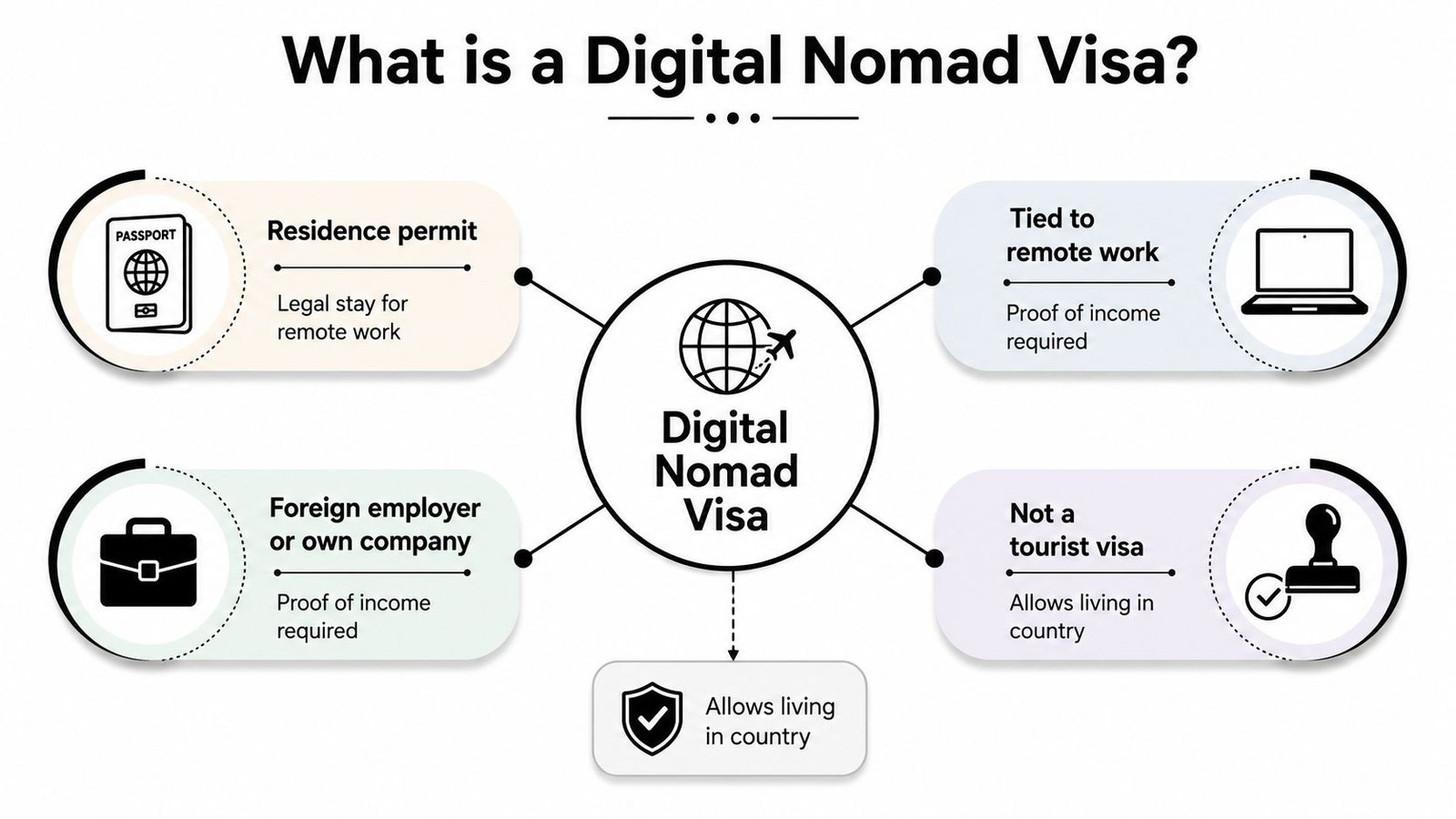
A digital nomad visa is a residence permit tied to remote work, not a general right to work in the local labour market. In plain English, it lets you live in a country while earning from a foreign employer, your own foreign company, or, in some systems, foreign clients.
If you're comparing this to a tourist visa, stop there. A tourist visa is for visiting, a digital nomad visa is for living there legally while working remotely, and a freelance licence or business licence is a different tool again because it often creates a local operating footprint. Think of it more like a long-stay study visa than a standard work visa, because the permission to stay is the key point, not access to local jobs.
The modern version of this category is still new. 91% of tracked nomad and remote-worker visas worldwide were launched after 2020, according to the Global Citizen Solutions 2025 report Global Citizen Solutions 2025 report. That matters because the typical applicant is still reacting to a fast-moving policy class, not a settled old system.
What you should check before you apply
The first question is simple. Are you trying to reside in the UAE while keeping your income outside the UAE labour market, or are you building a local business and hiring locally?
Practical rule: if your work is already tied to a foreign employer or foreign clients, a digital nomad visa is often the cleanest starting point. If you need local trading rights, a company licence matters more than the visa label.
The typical structure is one year, usually with renewal available in many countries, which is why this route suits people who want a medium-term base rather than permanent relocation. That setup is very different from investor-led residence or Golden Visa routes, which are designed around a deeper local commitment.
For UAE readers, that distinction is everything. The wrong visa can leave you with the right address and the wrong permissions.
How the Global Market Looks in 2026
The digital nomad visa market is no longer niche, and the UAE and United Arab Emirates are now competing in a crowded field rather than testing a one-off idea. EY's global immigration review found that, as of the start of May 2025, there were over 43 jurisdictions worldwide with digital nomad or remote-work visas and permits, with 33% Americas, 33% Europe, 20% Asia-Pacific, and 14% Africa and the Middle East EY Global Immigration Index, May 2025.
Why the regional picture matters
That regional split puts the UAE in a serious policy race, not a side market. It also tells you who the country is really competing against for the same mobile workers and founders.
The fight is now on income thresholds, insurance checks, document controls, and renewal rules because countries want the same profile of applicant. The UAE is not selling a novelty anymore, it is selling location, a tax environment, and a cleaner residency setup than many peers.
For a founder or remote professional, that changes the decision completely. A visa that looks generous on paper can be the wrong move if the tax outcome, family setup, or work permissions do not match how you earn.
The countries that win here are the ones that make the paperwork predictable and the compliance story clear.
For a UAE applicant, the question is not whether digital nomad visas exist. It is whether the UAE route fits your income model better than Spain, Japan, Türkiye, or Costa Rica.
Comparing the UAE, Spain, Japan, Türkiye and Costa Rica
The cleanest way to compare a digital nomad visa is by the controls that shape approval and what happens after entry. I'd focus on duration, income proof, insurance, dependants, and tax framing, because those are the parts that decide whether the route fits your actual business model.
| Country | Typical Duration | Minimum Income | Insurance | Dependants | Tax Notes |
|---|---|---|---|---|---|
| UAE | Remote-work residency path | Proof of income is required, exact thresholds vary by route | Health insurance is part of the application package | Family planning depends on the residence route | Residence and tax status are the deciding factors |
| Spain | National visa route | 200% of the Spanish national minimum wage, commonly around €2,850, with extra thresholds for dependants Spanish consular guidance Centuro Global overview | Health insurance from an authorised insurer is required Spanish consular guidance | First dependent adds 75% of minimum wage, each additional applicant 25% Spanish consular guidance | Good on paper for relocation, but the tax side needs care |
| Japan | Short-stay framework | JPY 10 million annual income floor Japan MOFA | Private insurance with at least JPY 10 million medical coverage Japan MOFA | Short stay only, family planning is tighter | Best for high-earning short stays |
| Türkiye | Identification certificate route | USD 3,000 monthly income or USD 36,000 annual income GoTürkiye | Application is document-led, with supporting requirements online GoTürkiye | Ages 21 to 55 only GoTürkiye | Better for eligible mid-career applicants |
| Costa Rica | Digital nomad programme | USD 3,000 per month, or USD 5,000 per month for families Visit Costa Rica | Mandatory medical insurance for the full stay Visit Costa Rica | Family threshold is built in Visit Costa Rica | Straightforward if your income is cleanly documented |
Spain is stricter on paper than many people expect. Japan suits higher earners who want a short stay and clear insurance rules. Türkiye filters applicants by age and income band, which makes it a narrower fit. Costa Rica is the easiest to read if your income records are tidy and your family package is already settled.
The UAE stands out for a different reason. The UAE differentiates itself by offering a residency platform that can sit alongside a wider UAE setup if the business later needs one. That is why founders compare it with Spain, Japan, Türkiye, and Costa Rica, and also with a free zone or investor-led visa path when they are thinking beyond a simple remote-work stint.
The Step-by-Step UAE Application Pipeline
The UAE remote-work route is usually less about paperwork drama and more about whether your documents line up cleanly the first time. If they do, the process is manageable. If they don't, the delays are self-inflicted.
What happens first
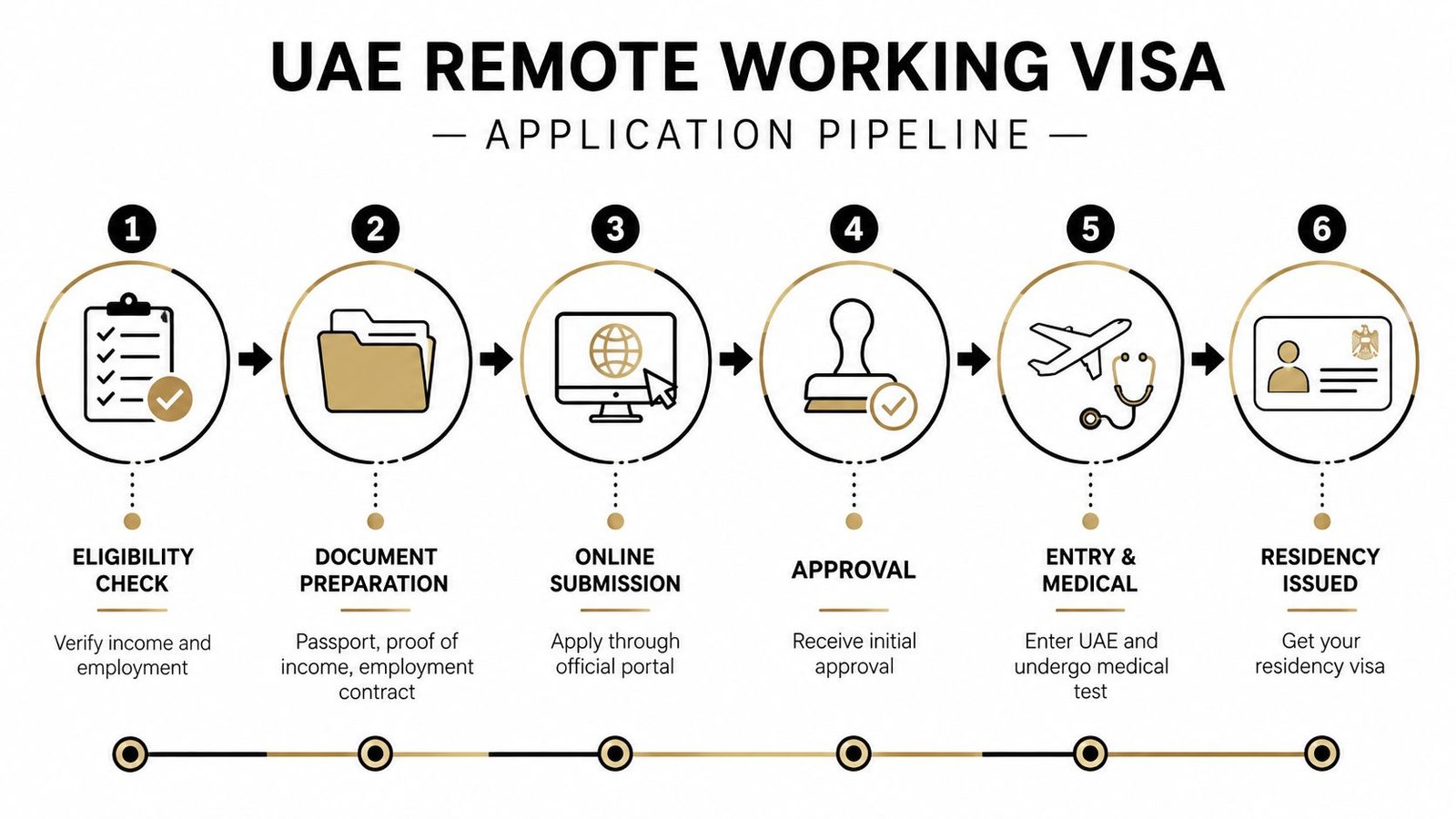
Start with eligibility. You need to confirm that your income, contract type, and remote-work status all point in the same direction, because mixed evidence causes trouble later.
The next step is document collection. In practice, that means your passport, proof of employment or company ownership, bank statements, health insurance, and salary or contract evidence. If your income story is messy, clean it up before you file.
How the government stages fit together
The entry permit is usually filed through the Federal Authority for Identity and Citizenship, or ICA, which is the federal body handling identity and residency workflows. After approval, you move to the medical test, then Emirates ID biometrics, then visa stamping and residency activation.
Practical rule: if your bank statements don't match the income you claim, fix that before submission. The file should read like one story, not three different ones.
Where PRO services fit
A PRO is a Public Relations Officer, but in UAE practice that means the person or team that channels documents through government portals and keeps the filing sequence on track. If you later hire locally, MOHRE, the Ministry of Human Resources and Emiratisation, can become relevant for labour and employment handling.
Common failure points are predictable. Bank statements that don't support the declared income, insurance policies that don't meet UAE coverage expectations, and missed medical appointments all cause avoidable friction.
If you want a visual walk-through of the sequence, the process video below shows the pipeline in motion.
Tax Residency and the Compliance Blind Spot
Most digital nomad visa articles go soft. The visa gets you in, but tax residency decides what your move really means for your income and compliance exposure.
OECD research frames digital nomad visas as residency statuses that permit remunerated activity during the stay, not as standalone tax exemptions for cross-border income OECD research. That wording matters, because being allowed to live and work remotely in the UAE does not automatically answer where you're taxed.
What people miss
Personal tax exposure depends on where you are considered resident, how many days you spend in a place, and whether your home country still treats you as resident. If you move to Dubai or Abu Dhabi and keep the wrong records, you can create a tax mess in two countries at once.
Founders need to think one step further. If you keep an overseas company, you need clear proof of where the income comes from and whether your activity in the UAE could create a Permanent Establishment, which is the kind of footprint that can pull a business into local tax or filing analysis.
Keep the foreign entity clean, keep the invoices clean, and keep travel records clean. Sloppy records create the dispute, not the visa.
The separate point is corporate tax. Whether you face UAE Corporate Tax depends on your actual entity structure and business activity, not just on holding a personal remote-work visa. A personal visa is not a substitute for corporate structuring.
For anyone with existing overseas contracts, the wrong move is to assume the UAE address alone solves everything. The right move is to line up your visa, entity, contract, and day-count position before you settle into routine.
Who the UAE Program Is Really For in 2026
The UAE route works best for people who need residency flexibility, not people who want the deepest possible permanent settlement path. That's the honest read, and it saves time.
By February 2026, more than 48 jurisdictions worldwide had remote-work or digital-nomad pathways, according to EY's regional immigration tracking EY Global Immigration Index, March 2026. So the differentiator is no longer “does a digital nomad visa exist”, it's “which profile fits this route”.
Who usually benefits
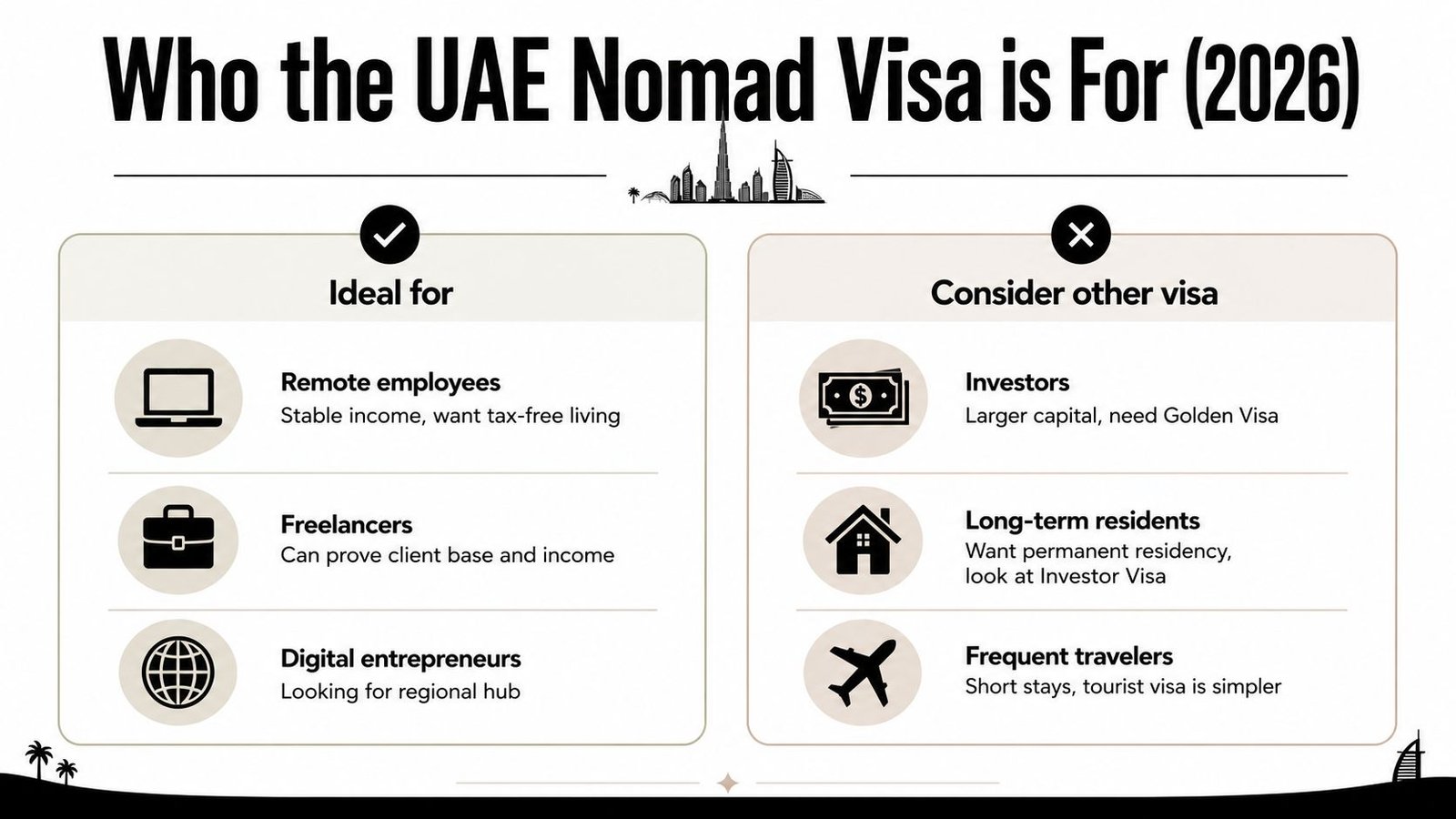
Remote employees with stable foreign pay tend to fit neatly, because their income evidence is straightforward and they don't need local trading rights. Founders testing the UAE market also benefit, especially if they want to live in Dubai or Abu Dhabi before deciding whether to form a UAE company.
Freelancers are mixed. If you can show a clean client base and steady income, the route can work, but early-stage freelancers often need a stronger paperwork story than they expect. Families can also make this route practical when schooling, spouse residence, and a predictable base matter more than permanent migration.
Who should look elsewhere
If you want to build a lasting local business, an Investor Visa or Golden Visa path may make more sense. If you're a frequent traveller who only needs short stays, a tourist visa is often simpler and cheaper in practice.
Straight answer: the UAE digital nomad visa is best for people who want a base, not a badge.
The bad fit is the person who wants permanent residency outcomes from a route that's designed for remote work. That's where expectations go wrong and the paperwork starts to feel disappointing.
Founder and SME Setup Considerations in the UAE
For founders, the visa question is never just personal. It's about whether you're staying lean with a foreign company, or whether the business case now justifies a UAE entity.
The UAE has three broad setup lanes. Mainland companies are licensed through local economic departments, often referred to as DED, which means Department of Economic Development. Free Zones are separate jurisdictional zones with their own rules, and Offshore structures are usually used for holding or specific structuring purposes rather than day-to-day local trading.
How the pieces fit together
If you're still testing the market, a personal remote-work visa plus your existing foreign company is often the simplest pairing. You keep the foreign entity, contract through it, and avoid creating a local payroll or trading footprint too early.
Once you start hiring, invoicing locally, or needing a stronger market presence, the equation changes. At that point, a Free Zone company and a switch to an Investor or Partner visa can make more sense than staying on a personal remote-work route.
Dubai, Abu Dhabi, and Sharjah all offer viable paths, but the right jurisdiction depends on activity. DIFC, the Dubai International Financial Centre, and ADGM, the Abu Dhabi Global Market, suit specific finance, holding, and regulated business models better than a general-purpose licence.
Don't form a company just because you got a visa. Form it when the business model actually needs it.
The payroll point matters too. If you start paying staff or contractors the wrong way, you can accidentally create a local presence you didn't plan for. That's where company structure, visa type, and accounting need to be designed together.
At a practical level, that's where setup teams earn their keep, especially when the job includes jurisdiction comparison, licensing, PRO and visa channelling, corporate bank account opening, and accounting, tax, and VAT registration and filing. If your UAE plans are still evolving, the cleanest move is usually to choose the simplest legal path that matches the next 12 months, not the fanciest one.
Choosing Your Path and Getting Started
The decision is simpler than it seems. First, confirm that your income evidence, contract structure, and health insurance are all clean. If they aren't, fix those before you think about country choice.
Then ask the question that matters. Do you need a UAE entity, or do you just need UAE residence while you keep earning from abroad? If it's the second case, a remote-work visa is often enough. If it's the first, company formation belongs in the plan from day one.
A good decision checklist looks like this:
- Confirm income source: make sure your earnings are foreign, documented, and easy to prove.
- Check your tax position: don't assume a visa settles residency or foreign income treatment.
- Test your business model: decide whether you're still remote-first or already operating locally.
- Compare alternatives fairly: if you qualify for an investor route, Golden Visa, or another country's programme, compare the actual outcome, not the marketing.
- Plan the paperwork chain: entry permit, medical, Emirates ID, and activation all need to line up.
The right visa is the one that matches how you earn, where you want to live, and how much compliance you're willing to carry. If those three things don't line up, the cheapest-looking option usually becomes the most expensive one.
If you want a clean read on whether the UAE digital nomad visa, a Free Zone setup, or a different residency path fits your situation, talk to the team at Inpro Corporate Services L.L.C.. They help founders, remote professionals, and HR teams handle UAE company setup, PRO work, visa processing, banking, and compliance without the usual back-and-forth.