


If you're dealing with a payment dispute, a contract breach, or an employee complaint in the UAE, dispute resolution services are the formal and informal ways to solve the problem without losing control of time, cash flow, or focus. In the United Arab Emirates, the right path usually comes down to one question: should you negotiate, go to court, or use a private process such as arbitration?
Table of Contents
- Overview of Dispute Resolution Services
- Key Dispute Resolution Methods Explained
- Jurisdictional Options and Institutional Rules
- Engagement Process for Dispute Resolution
- Timelines and Cost Considerations
- Enforcing Awards and Judgments
- Choosing the Right Adviser and Service Provider
- Practical Checklist and Common Questions
Overview of Dispute Resolution Services
Dispute resolution services are the routes a business can use to settle a disagreement. In the UAE, that usually means litigation, arbitration, or mediation, depending on the dispute, the contract, and the forum that has authority.
For a founder in Dubai, Abu Dhabi, or Sharjah, the practical issue isn't legal theory. It's whether a dispute will freeze revenue, block operations, or damage a business relationship. That's why the system puts real weight on early settlement and structured pre-court steps.
In Dubai alone, more than 80% of commercial disputes were resolved amicably in the first half of the year, with each case taking an average of 13 days, and 1,239 disputes settled for Dh20.2 billion through the Dubai Courts' Amicable Dispute Resolution Centre, according to Gulf News reporting on ADREC results. That tells you something useful. The UAE system often tries to solve business conflict before it turns into a long court fight.
What are dispute resolution services for UAE businesses
Dispute resolution services are the legal and practical mechanisms used to settle commercial, civil, and labour disagreements. They can be public, such as court proceedings, or private, such as arbitration and mediation.
For companies in the United Arab Emirates, these services matter because the wrong choice can make a manageable dispute expensive and slow. The right choice can preserve a contract, close a claim, or give you an enforceable outcome with less disruption.
Practical rule: Your first decision isn't "Who is right?" It's "Which forum gives this dispute the best chance of a usable result?"
Key Dispute Resolution Methods Explained
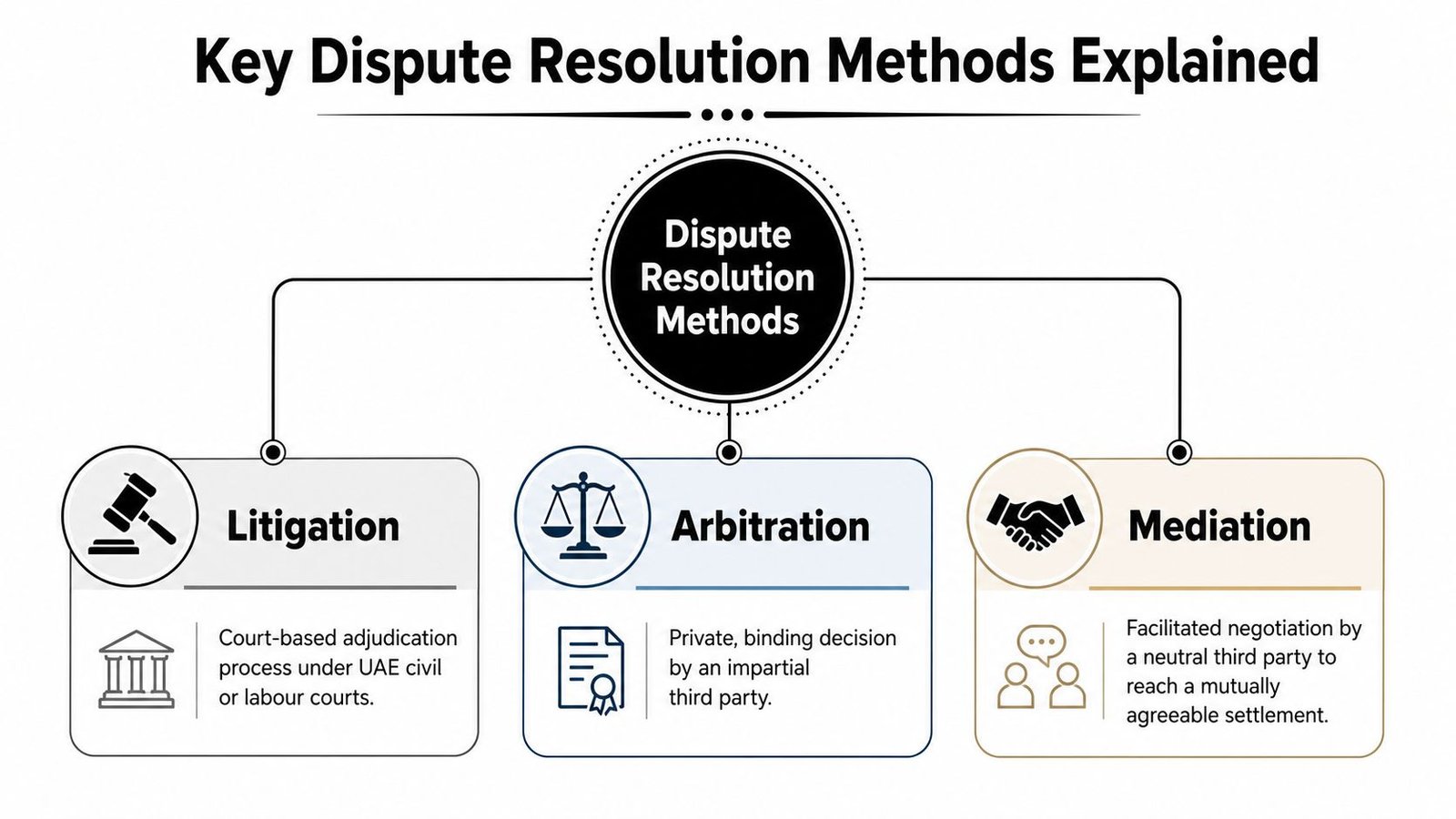
Some disputes need a judge. Some need a private decision-maker. Some need a structured conversation before positions harden. That's why dispute resolution services aren't one thing. They're a set of tools.
What are dispute resolution services for UAE businesses
Litigation is a court-based process. A judge reviews evidence, hears the parties, and issues a binding decision. In mainland UAE civil courts, commercial court fees range from 3% to 6% of the claim amount, capped at AED 40,000, paid upfront, and proceedings must be in Arabic through a licensed UAE National lawyer, according to Chambers' guide on commercial dispute resolution in the UAE.
Arbitration is a private binding process. Instead of going before a state court judge, the parties present the case to one or more arbitrators. Think of arbitration as appointing a specialist referee by agreement. It's still formal, but it's usually more flexible about procedure, confidentiality, and language.
Mediation is a voluntary negotiation process led by a neutral third party. The official UAE government guidance on mediation defines it as a voluntary alternative dispute resolution method for civil and commercial conflicts where parties engage an impartial third-party mediator to facilitate settlement without court adjudication, whether the dispute comes from an existing contract or a possible future disagreement.
How is litigation different from arbitration and mediation
The easiest way to think about the three methods is this:
| Method | Who decides | Is it public or private | Best fit |
|---|---|---|---|
| Litigation | A judge | Public court system | Claims needing state court powers or mandatory court routes |
| Arbitration | An arbitrator or tribunal | Private process | Commercial disputes where parties want confidentiality or specialist decision-makers |
| Mediation | The parties themselves, with mediator help | Private settlement process | Ongoing relationships, deadlocked negotiations, early-stage disputes |
Litigation gives you the authority of the court. Arbitration gives you a chosen forum. Mediation gives you control over the outcome because no one imposes a result unless both sides agree.
A common point of confusion is enforceability. Court judgments and arbitral awards are binding outcomes. A mediated settlement becomes powerful once it is properly recorded and documented through the correct legal path.
Why do founders often start with mediation
Mediation is often the least destructive starting point. If you're arguing with a supplier, co-founder, or service provider, you may still need that relationship after the dispute ends.
This matters in the UAE because many business arrangements are cross-border, fast-moving, and relationship-driven. A mediated outcome can solve the immediate problem without turning every email into evidence for a courtroom later.
A smart founder doesn't confuse a softer tone with a weaker position. Mediation can be firm, structured, and commercially effective.
Jurisdictional Options and Institutional Rules
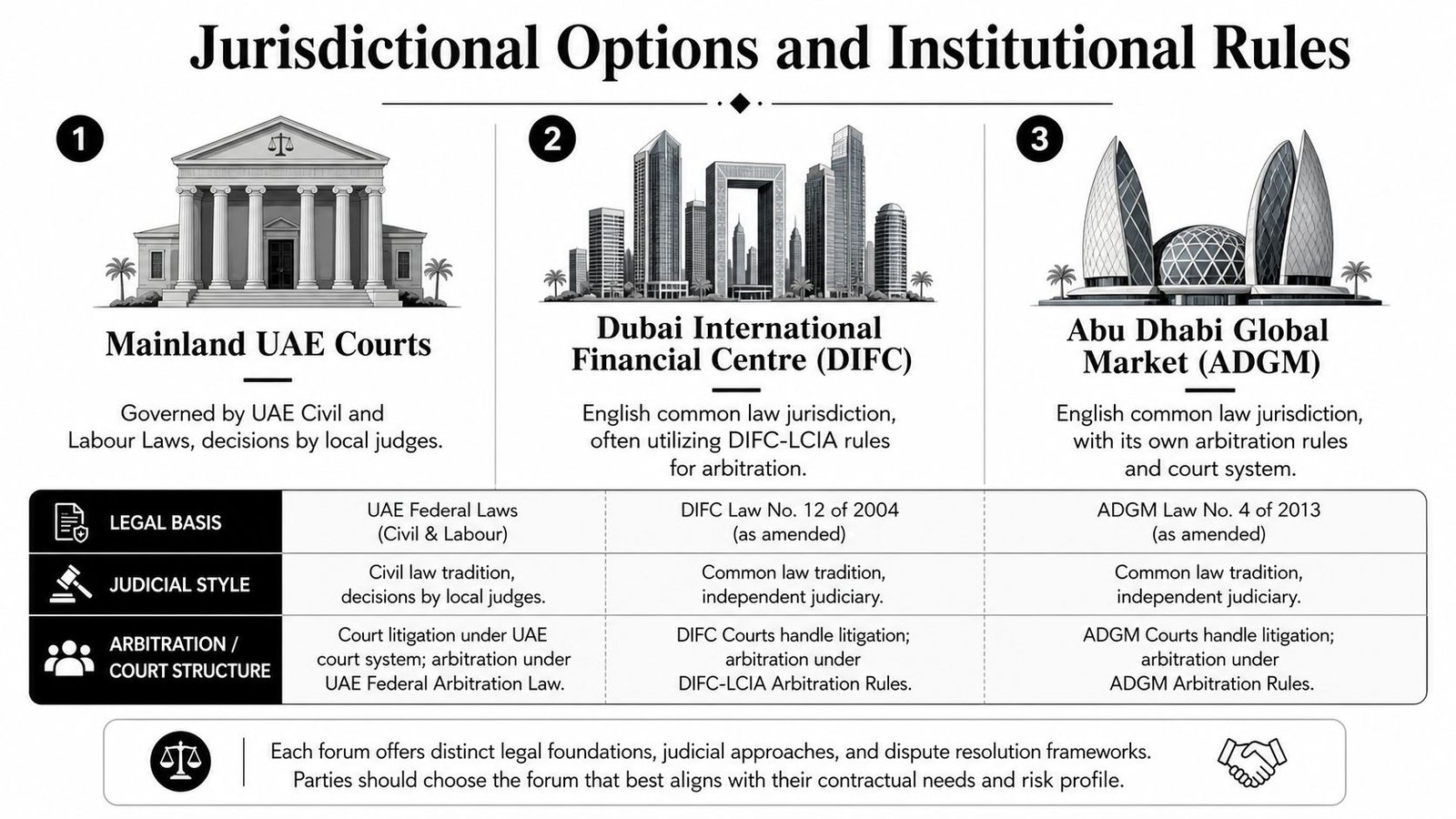
The next layer is forum. Even if you know you want litigation or arbitration, you still need to ask where the dispute belongs. In the United Arab Emirates, that answer can change the language, procedure, and timeline.
Where can a UAE business bring a dispute
A business may end up in mainland courts, a free zone court system, a specialist tribunal, or a private arbitration forum. The answer usually depends on the contract, the parties' location, and whether the law gives a particular authority exclusive power.
Mainland courts apply UAE federal and local laws. The Dubai International Financial Centre (DIFC) and Abu Dhabi Global Market (ADGM) are separate financial free zones with their own legal frameworks and court structures. For many foreign founders, that distinction matters because DIFC and ADGM often feel more familiar if you're used to English-language proceedings and common law style processes.
How do mainland courts differ from DIFC and ADGM
A simple comparison helps:
- Mainland UAE courts handle a wide range of civil, commercial, and labour matters under UAE law. They are the default route unless a valid arbitration clause or another jurisdictional arrangement changes the path.
- DIFC is a financial free zone in Dubai with its own courts. It is often chosen for contracts where parties want an English-language forum and an efficient environment for cross-border business disputes.
- ADGM is a financial free zone in Abu Dhabi with its own courts and arbitration ecosystem. It is often considered where parties want a separate common law framework.
The official UAE government page on labour disputes also adds an important labour rule. The Ministry of Human Resources and Emiratisation, or MOHRE, can issue a final binding decision on individual labour disputes where the claimed amount is less than AED 50,000, or where the parties reach an amicable settlement regardless of value. If the claim exceeds AED 50,000 and no settlement is reached, MOHRE must refer the case to the judiciary within three days of receiving the request.
What rule in UAE arbitration often surprises foreign founders
One technical point catches many international businesses off guard. Under UAE Federal Law No. 6 of 2018 on Arbitration, which came into force on 15 June 2018, onshore arbitration proceedings officially begin the next day after the arbitral tribunal is fully constituted, not when the request is first filed, as explained in Aceris Law's discussion of arbitration in the UAE.
That timing point affects planning. If you're budgeting or calculating deadlines, the start date may not be where a foreign claimant expects it to be.
Watch the trigger date: In UAE onshore arbitration, the legal clock for proceedings starts after the tribunal is fully formed, not simply when one side announces the claim.
Engagement Process for Dispute Resolution
Most stressed founders don't need more theory. They need a sequence. What do you do first, what do you file, and what should you prepare before anyone says "hearing" or "award"?
What should you do before filing anything
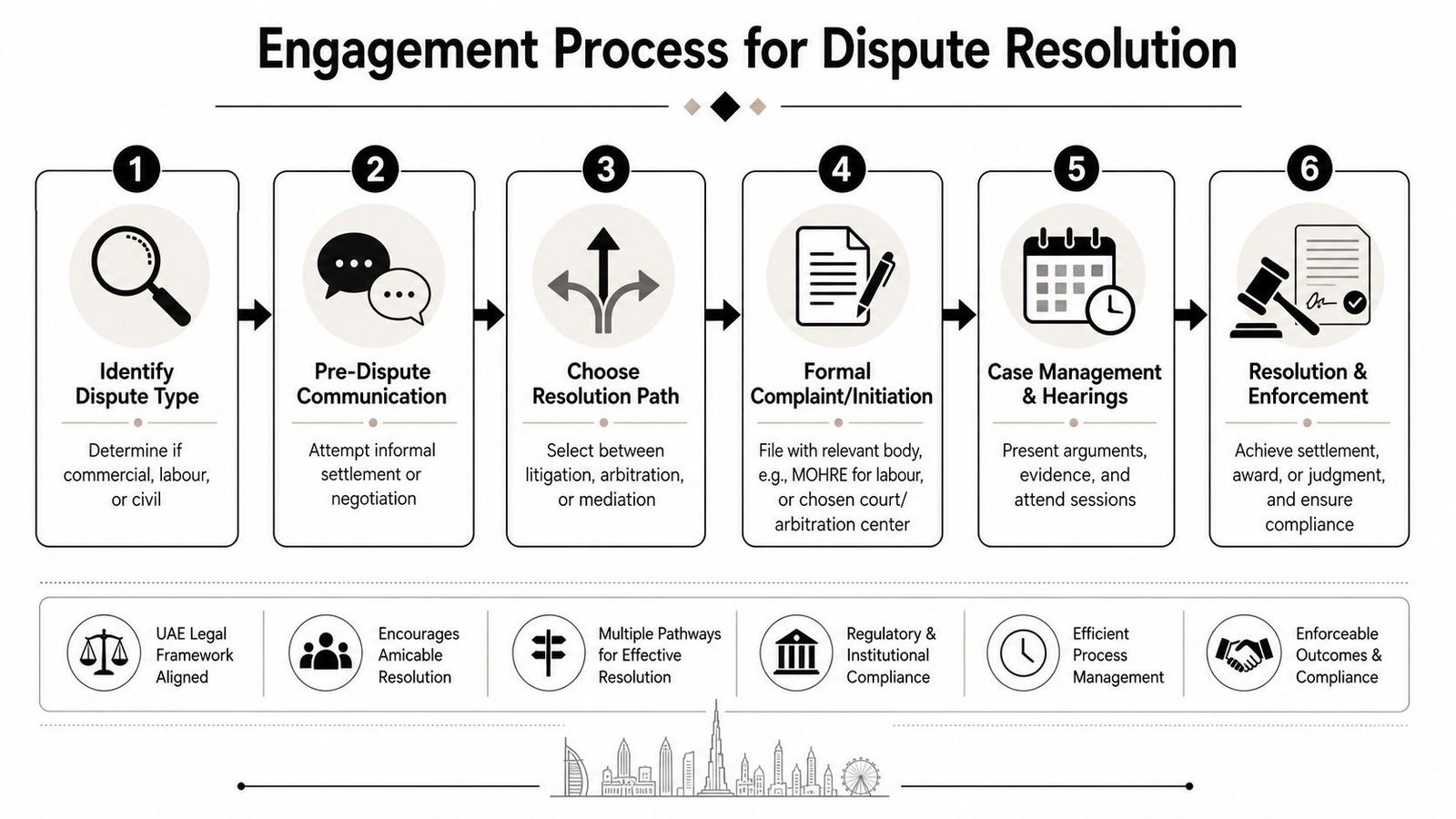
Start by sorting the dispute into the right box. Is it labour, commercial, or civil? Then check the contract for a jurisdiction clause, arbitration clause, notice clause, and any requirement to attempt negotiation first.
Gather your documents before you send a complaint. That usually includes the contract, invoices, statements of account, emails, WhatsApp exchanges if relevant, signed amendments, delivery records, employment documents, and any settlement offers already made.
A practical pre-filing sequence looks like this:
- Identify the claim clearly. Write down what happened, what term was breached, and what outcome you want.
- Check the forum clause. A contract may require DIFC, ADGM, arbitration, or mainland courts.
- Send a measured notice. A short formal notice can solve the dispute or at least frame it properly.
- Preserve evidence. Save files in an organised folder and keep originals where possible.
Later in the process, missing documents cause more trouble than hard legal arguments.
The following overview is useful if you want a quick visual of how a case usually progresses.
How does a labour dispute usually start
A labour dispute in the private sector usually starts with a complaint to MOHRE, the Ministry of Human Resources and Emiratisation. This is the first formal stop for many employee-employer disagreements in the United Arab Emirates.
According to Hyring's summary of MOHRE dispute resolution in 2025, 98.6% of private sector labour disputes were resolved through mandatory mediation in 2025, with only 1.4% referred to Labour Courts. The same source notes that mediation must be attempted within 14 days of a complaint filing under Federal Decree-Law No. 33 of 2021, and that complaint filing is free for workers.
For HR teams, that means speed matters. If a salary, leave, visa, or termination issue is heading toward a complaint, organise the file early and make sure your internal records match what was issued to the employee.
How does a commercial dispute move from complaint to outcome
Commercial disputes usually follow a different path. Some go first to negotiation or mediation centres. Others move directly into litigation or arbitration because the contract says so.
A simple commercial workflow often looks like this:
- Informal contact first. One side raises the issue and asks for payment, performance, or correction.
- Formal notice next. Facts, contract terms, and requested remedies are set out more carefully.
- Forum activation. The claimant files with the court, tribunal, or mediation centre that has authority.
- Case management stage. Documents are exchanged, dates are fixed, and each side presents evidence.
- Outcome stage. The case ends in settlement, judgment, or award.
If you're unsure which path applies, the contract usually answers half the question.
Timelines and Cost Considerations
A founder often asks the wrong first question under pressure: "Can we win?" The better first question is, "Does this route still make commercial sense after six months, filing fees, management time, translation work, and enforcement planning?"
How long does each path usually take
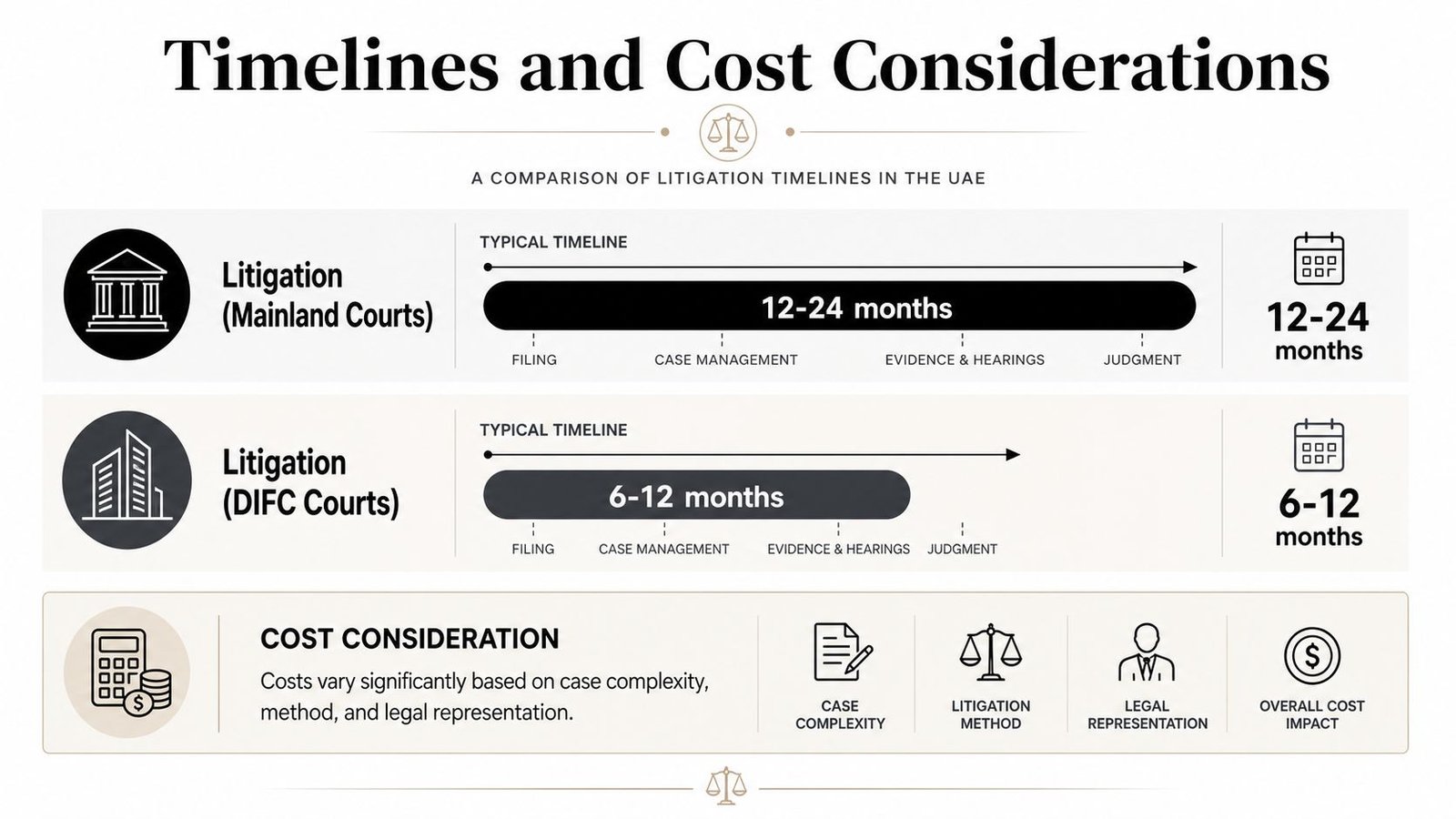
Timelines in the UAE depend on the forum, the wording of the dispute clause, the other side's conduct, and whether urgent relief is needed. A payment claim with clean documents moves very differently from a shareholder dispute with competing expert evidence.
A practical way to judge timing is to break the process into stages, much like tracking a shipment rather than focusing only on the final delivery date. First comes pre-action work, such as notices, document collection, and checking the correct forum. Then comes filing and procedural setup. After that, the primary time-cost driver appears: evidence exchange, hearings, expert steps where applicable, and any procedural objections.
For arbitration users, one deadline is often missed at contract stage and remembered too late during a dispute. Under the DIAC Arbitration Rules 2022, the respondent generally has 28 days from receiving the request for arbitration to submit an answer. That matters because a slow internal handover can waste a large part of the response window before counsel even sees the file.
Court timing also has hidden variables. Mainland proceedings may involve Arabic translation, court-appointed experts, and multiple procedural hearings. DIFC or ADGM proceedings may move with tighter case management, but that does not automatically make them cheaper for every claim. Faster procedure can still be expensive if the claim value is modest and the parties contest every issue.
What does the cost value threshold actually mean
Cost-value threshold means matching the dispute route to the financial size and business importance of the problem. A formal process should not consume an unreasonable share of the amount you are trying to recover.
A simple way to assess it is to treat dispute resolution like repairing equipment. You would not spend AED 80,000 fixing a machine worth AED 50,000 unless downtime risk made the repair commercially sensible. Disputes work the same way. The legal answer and the commercial answer are sometimes different.
This decision matrix helps:
| Claim profile | Often better fit | Why the economics may work |
|---|---|---|
| Lower-value debt or straightforward contract claim | Litigation or negotiated settlement | Procedure is more standardised, and tribunal costs in arbitration may be hard to justify |
| Mid-value dispute with ongoing commercial relationship | Mediation first, then litigation or arbitration if needed | Early settlement may protect the account, supply chain, or joint project |
| High-value, technical, or cross-border dispute | Arbitration | Privacy, specialist decision-makers, and easier award enforcement planning may justify the higher spend |
| Urgent claim where delay itself causes loss | Forum with interim relief options | Speed may be worth higher upfront cost if assets, stock, or confidential information are at risk |
The hidden point is not just claim size. It is claim size plus complexity, evidence burden, senior management distraction, and enforcement prospects. A AED 300,000 claim can become uneconomic if three departments must spend months rebuilding records. A AED 5 million claim may justify arbitration if the counterparty's assets sit across several jurisdictions.
Which hidden costs catch founders off guard
Legal fees are only one line on the full bill.
The costs that surprise SMEs usually sit outside the fee quote:
- Translation and language handling. Mainland court submissions and supporting documents may require Arabic translation, especially for contracts, invoices, and correspondence first drafted in English.
- Internal staff time. Finance teams pull ledger records. Sales teams explain variations and delivery history. Operations staff reconstruct what transpired.
- Forum entry costs. Filing fees, administrative charges, and deposits can arrive early, before the other side feels any pressure to settle.
- Jurisdiction fights. A weak clause can trigger an argument about where the case belongs before anyone addresses the unpaid invoice, defective work, or broken promise.
- Expert evidence. Construction, technology, valuation, and accounting disputes can become much more expensive once experts are needed.
- Delay cost. Cash tied up in a dispute is not available for payroll, supplier payments, or growth.
One practical rule helps stressed management teams: if the process cost, internal disruption, and likely timeline together approach the realistic recovery value, reconsider the route before filing.
A sound dispute strategy is not the one that looks toughest on paper. It is the one that gets a commercially sensible result within a timeframe your business can absorb.
Enforcing Awards and Judgments
Winning the case is only half the job. A judgment, award, or settlement has value when it can be enforced against money, assets, or obligations.
What happens after you win
Enforcement is the process of turning a legal result into practical compliance. That might mean collecting payment, compelling performance, or formally closing the dispute through a recognised settlement.
The route depends on the forum that issued the result. A mainland court judgment generally goes through the UAE court enforcement system. An arbitral award may need recognition before execution steps begin. A settlement is only as strong as the legal form used to record it.
Early planning holds particular importance. If the other side has assets in Dubai but the contract points elsewhere, your enforcement route should be considered before proceedings begin, not after the decision arrives.
When is the DIFC Small Claims Tribunal useful
The DIFC Courts' Small Claims Tribunal is one of the clearest examples of an efficient forum in the UAE. According to Jafza's announcement on access to DIFC Courts services, it handles disputes up to AED 500,000, requires no legal representation, and aims to resolve cases within 90 days.
That matters for SMEs and free zone businesses because not every dispute justifies a full-scale formal case. If a claim fits the tribunal's scope and jurisdiction, the process can be more workable for management teams that need speed and simplicity.
The same Jafza announcement notes that a 2024 Memorandum of Understanding expanded access for Jebel Ali Free Zone member companies. For businesses operating through that trade hub, that can widen the practical options available.
How should you prepare for enforcement from day one
Think backwards. Before filing, ask where the other side holds assets, who signed the contract, and whether the clause you're relying on matches the forum you want.
Keep these enforcement habits in mind:
- Name the right party. Enforcement gets harder if the contract party and operating entity don't match.
- Keep signed documents clean. Missing signatures and messy amendments create avoidable arguments later.
- Store proof of service. Notices and delivery records often matter more than people expect.
- Check settlement wording carefully. A badly drafted settlement can create a second dispute.
Choosing the Right Adviser and Service Provider
A dispute rarely needs just one person. You may need a lawyer, an arbitrator, a mediator, a translator, and administrative support for filings and government-facing paperwork. The right team depends on the dispute type and forum.
Who do you actually need on your side
For a labour issue, you may start with employment counsel and structured document support. For a shareholder or commercial dispute, you may need a disputes lawyer with experience in the exact forum named in your contract.
A useful distinction is this:
- Lawyer. Gives legal advice, drafts filings, and appears where representation is required.
- Mediator. Helps the parties negotiate a settlement but doesn't decide the case.
- Arbitrator. Decides the dispute in arbitration.
- PRO support. Helps manage document processing, attestations, translations, and practical filing steps where business operations intersect with UAE administration.
What questions should you ask before hiring anyone
Ask direct questions and listen for direct answers.
- Forum experience: Have you handled disputes in mainland courts, DIFC, ADGM, or MOHRE, depending on my case?
- Language handling: Who manages Arabic filings, translations, and hearing preparation if needed?
- Fee structure: Is the work billed as fixed fee, staged fee, or hourly fee?
- Strategy view: Would you try settlement first, and why?
- Document risk: What missing document or contract weakness could hurt this case most?
If the answers stay vague, keep looking.
Choose the adviser who explains the process clearly enough that your finance lead or HR manager can follow it. Clarity is part of competence.
How can you compare proposals without legal jargon
Use a simple scorecard. Rate each provider on forum fit, communication clarity, likely responsiveness, budget transparency, and understanding of UAE process.
Don't choose only on price. In dispute work, a cheaper proposal can become the more expensive one if the adviser misses a filing issue, misreads the jurisdiction clause, or pushes the wrong forum.
Practical Checklist and Common Questions
Before you start, slow the situation down enough to get organised. Most bad dispute decisions are rushed ones.
What should you check before you start
Use this checklist:
- Contract terms: Confirm the governing law, jurisdiction clause, arbitration clause, and notice requirements.
- Claim type: Separate labour issues from commercial claims. They don't follow the same route.
- Evidence file: Save contracts, invoices, messages, payment records, employee documents, and settlement offers.
- Decision goal: Decide whether you want payment, performance, exit, reinstatement, or a negotiated closure.
- Enforcement reality: Ask where the other side has assets and whether the final result will be easy to execute.
What do founders and HR teams usually ask
Can one dispute involve several parties?
Yes. But multi-party disputes get harder quickly if different contracts point to different forums. Check whether all parties signed the same dispute clause before taking formal steps.
What if the dispute involves a government-related body?
Treat jurisdiction and procedure with extra care. Public or semi-public entities may have specific contractual and procedural requirements, so forum analysis matters before filing.
Do I need to translate evidence?
Often yes, especially in mainland court settings where Arabic procedure applies. Plan for this early so your evidence pack isn't delayed or presented inconsistently.
Are there faster options in free zones?
Sometimes yes. Free zone and specialist forum structures can offer more expedited tracks, especially where the contract already points there and the claim fits the forum's scope.
Not sure where to start? Book a free strategy call with Inpro Corporate Services L.L.C. to get practical guidance on UAE business setup, visas, PRO support, and the government processes that often sit in the background of commercial and employment disputes.