

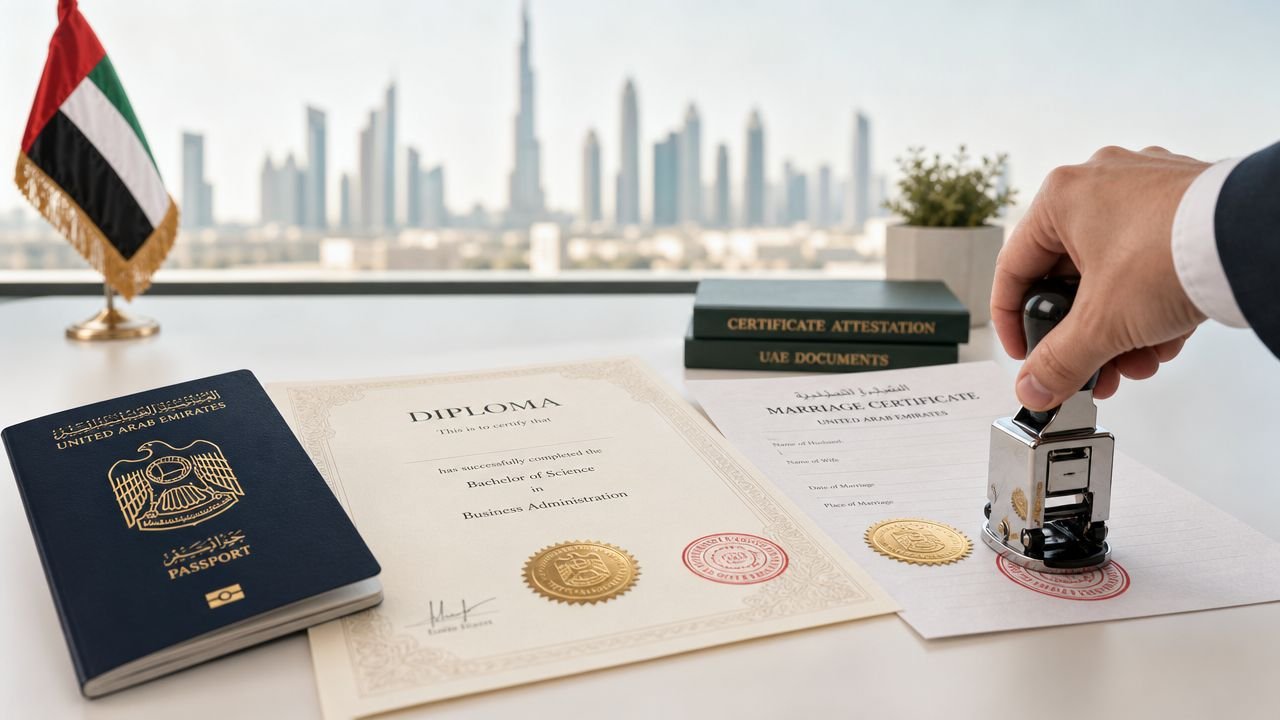
You usually meet document attestation when everything else is already moving. Your UAE visa file is open, your company setup is underway in Dubai or Abu Dhabi, or HR has asked for a degree certificate, marriage certificate, or board resolution that suddenly “must be attested”. In plain terms, documents attested for the UAE are documents that have passed an official verification chain so authorities in the United Arab Emirates can trust them.
Table of Contents
- Your Guide to Document Attestation for the UAE
- What Is Document Attestation and Why Does the UAE Require It
- The Two Paths Apostille vs Consular Legalization
- Which Documents Typically Need Attestation for the UAE
- Your Step-by-Step Attestation Workflow
- Common Delays Costs and How to Avoid Them
- How a Professional Service Removes the Burden
Your Guide to Document Attestation for the UAE
A founder expanding into the UAE often assumes the hard part is choosing between Mainland, a free zone, or an offshore structure. Then the checklist arrives. Passport copies are easy. The friction starts with the documents issued somewhere else: a university degree from the United States, a marriage certificate from the United Kingdom, a certificate of incorporation from India, or a power of attorney signed in Europe.
That's where attestation comes in. Document attestation is the formal process of verifying that a document, signature, and official seal are genuine so the document can be accepted for official use in the UAE. The UAE Ministry of Foreign Affairs describes attestation as the process used to verify the authenticity of signatures and official seals on documents issued inside or outside the country, and notes that the workflow differs depending on where the document was issued, through the UAE Ministry of Foreign Affairs attestation service.
For first-time applicants, the rules can feel arbitrary. They aren't. The logic is simple: a UAE immigration officer, licensing authority, bank, court, university, or free zone registrar can't take a foreign document at face value. They need a chain that proves who issued it, which authority checked it, and whether it's fit for use in the United Arab Emirates.
Practical rule: If a document will support a legal status, family relationship, academic qualification, or corporate authority in the UAE, assume someone may ask for attestation.
There's also a practical split that catches people out. A document issued inside the UAE follows one path. A document issued outside the UAE follows another. That distinction affects timing, format, and whether a digital copy is enough or the original paper document must travel.
What Is Document Attestation and Why Does the UAE Require It
What attestation actually means
Document attestation is the process of verifying the authenticity of a document issued in one place so it can be recognised in another. In the UAE context, it's the difference between “I have this certificate” and “this certificate is legally acceptable for visa, business, or administrative use.”
People often confuse attestation with notarisation. They aren't the same thing. Notarisation is a local certification step, usually confirming that a signature, copy, or declaration was properly witnessed. It may be part of the chain, but it usually isn't the final answer for UAE use.
Apostille is another source of confusion. An apostille is a treaty-based form of international certification used between certain countries. It can simplify cross-border recognition in some cases, but it doesn't replace the UAE's own acceptance requirements by default. That's why people arrive with a document that looks official and still get told the file isn't complete.
Here's the easiest way to look at it:
| Process | What it does | Is it usually enough for UAE use on its own |
|---|---|---|
| Notarisation | Confirms a signature, declaration, or copy at a local level | Usually no |
| Apostille | Adds treaty-based international certification in some countries | Not always |
| Attestation / legalisation chain | Builds the acceptance trail authorities want for UAE use | Usually yes, when done correctly |
Why the UAE insists on the chain
The UAE requires this chain because it has to rely on foreign records without direct control over the institution that issued them. If a company in Sharjah submits overseas incorporation records, or an employee in Dubai submits a degree from abroad, the receiving authority needs confidence that the document is genuine and that the prior certifying bodies had authority to certify it.
This is why the process is sequential. Each authority confirms the authority before it. By the time the document reaches the final UAE stage, it carries a trust trail rather than just a stamp.
A rejected document usually doesn't mean the document itself is false. It often means the verification chain is incomplete, out of order, or from the wrong authority.
That's the part many first-time founders miss. The UAE isn't asking whether your degree exists or your company exists. It's asking whether the document has moved through the right legal route for cross-border acceptance.
The Two Paths Apostille vs Consular Legalization
Why people mix these up
People searching for documents attested for UAE often run into two terms: apostille and consular legalization. They sound similar because both are used to make documents acceptable abroad. In practice, they solve different problems.
An apostille is often treated as a shortcut. In countries that use the Hague Convention route for the receiving country, one recognised certification may be enough for international acceptance. That's why many entrepreneurs from Europe, the Americas, and Australia assume an apostille should settle the matter.
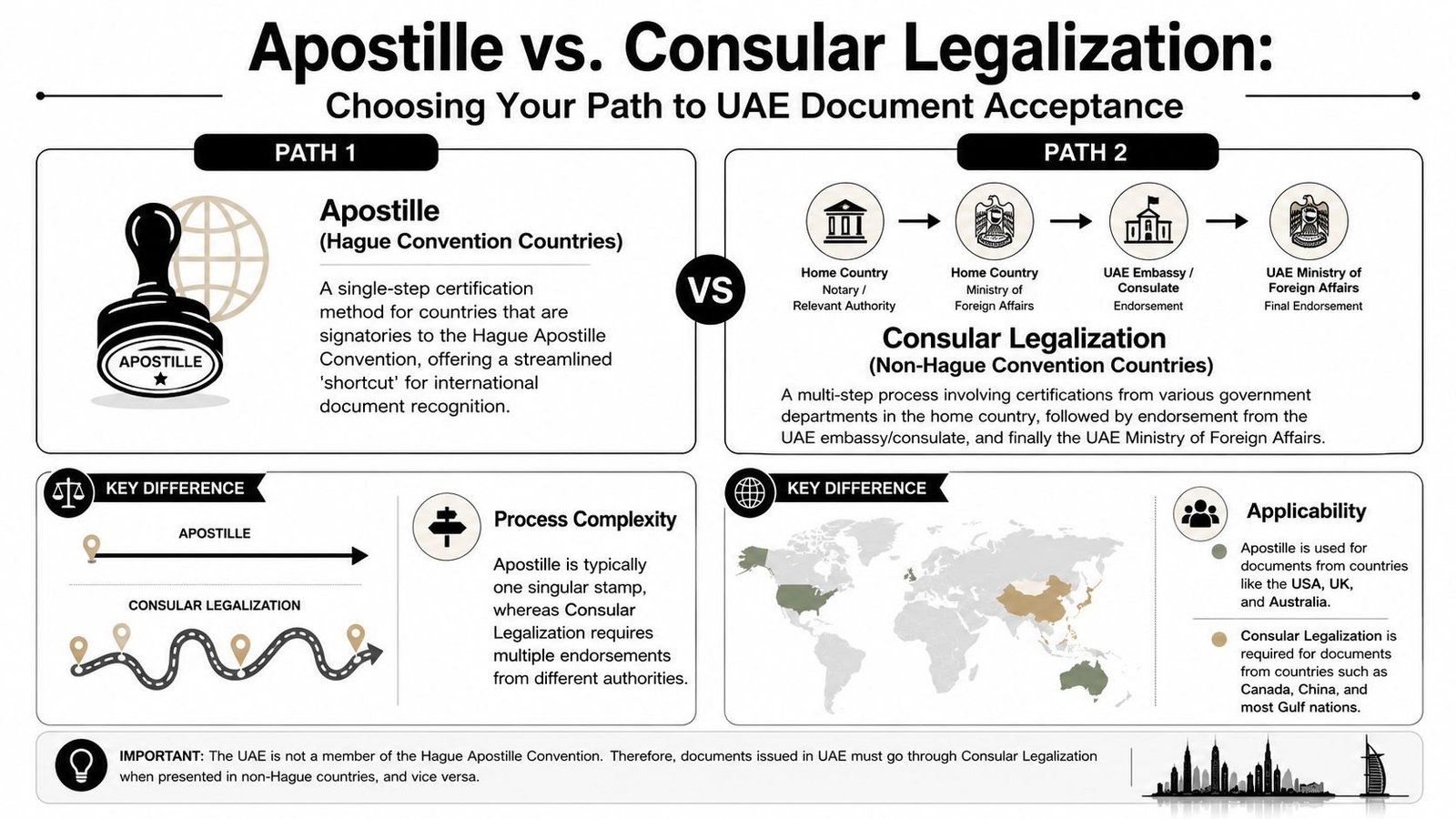
The trouble starts when someone applies general international advice to a UAE-specific process. A document can be properly certified for one international route and still not meet the exact route expected for use in the United Arab Emirates.
Which route usually works for the UAE
For UAE use, consular legalization is the route people most often need to understand. That means the document is checked by the relevant authorities in the country of issue, then by the UAE embassy or consulate for that country, and then completed through the UAE side.
A UAE-focused guide commonly referenced in practice describes a multi-stage chain for educational records that may include university or state verification, Human Resource Development attestation where applicable, Ministry of External Affairs authentication, and UAE Embassy attestation before the document is used in the UAE. It also notes that the final Ministry of Foreign Affairs step in the UAE is what makes the document fully recognised for official use, as outlined in this UAE attestation process guide.
That's why a founder shouldn't ask only, “Can I apostille this?” The better question is, “What acceptance path does the UAE require for this document, from this country, for this use?”
A simple comparison helps:
- Apostille route: Best understood as a simplified certification route used in certain country-to-country situations.
- Consular legalization route: Better for documents that must satisfy a specific UAE recognition chain.
- Business reality: If the receiving UAE authority expects embassy and Ministry confirmation, a document with only an apostille can still stall your file.
If you're handling documents from more than one country for one UAE application, don't assume they all follow the same route. Mixed-country files are where DIY submissions often go wrong.
Which Documents Typically Need Attestation for the UAE
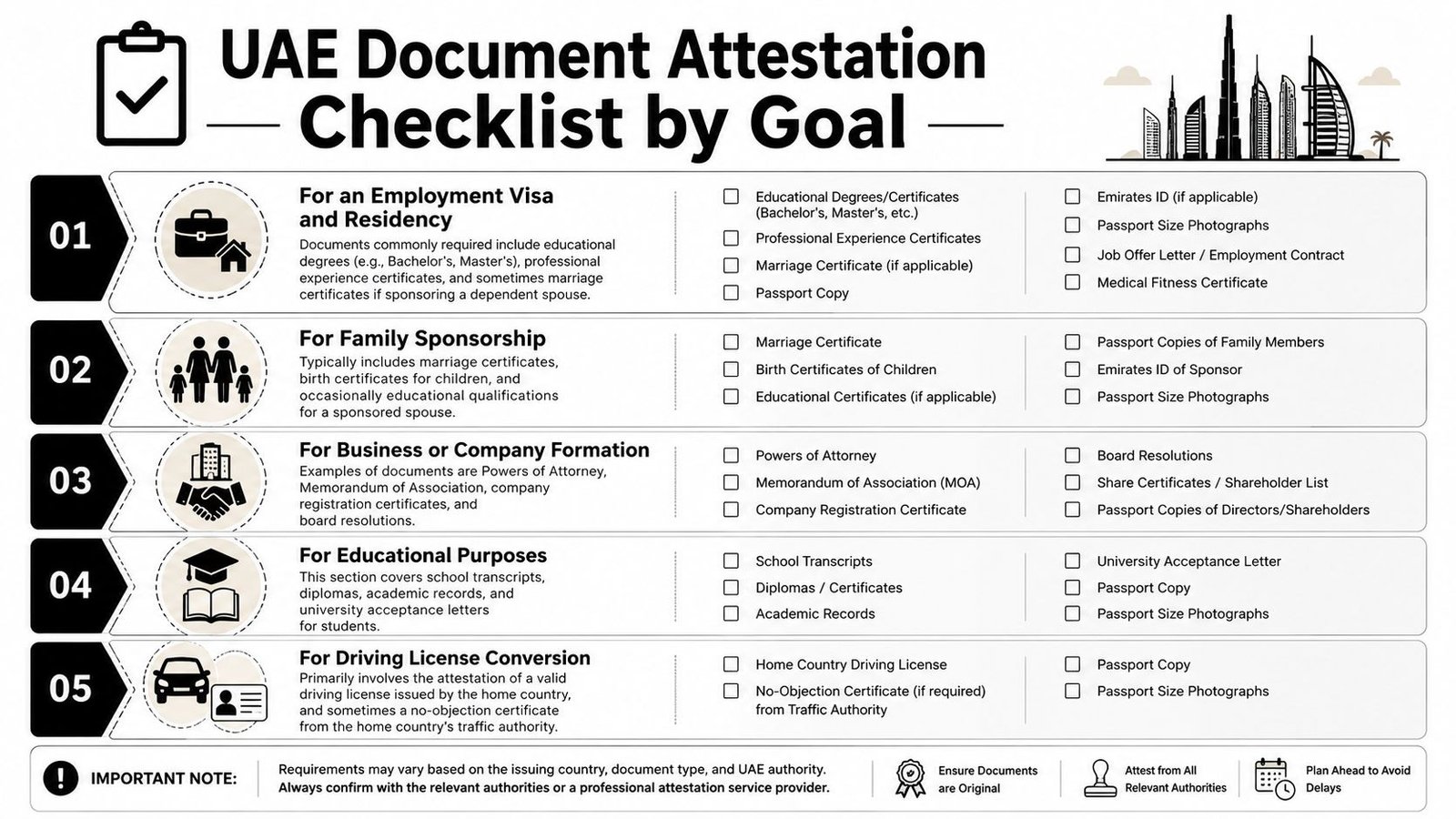
The answer depends less on the document type than on the purpose. A degree might matter for an employment visa, while a marriage certificate matters for family sponsorship, and company records matter for business formation or cross-border shareholding.
Personal and family documents
For relocation and family life in Dubai, Abu Dhabi, or elsewhere in the UAE, these are the documents that most often need formal acceptance:
- Marriage certificates: Often needed when sponsoring a spouse or proving marital status.
- Birth certificates: Commonly requested for sponsoring children, school enrolment, or certain administrative files.
- Police or civil status records: Sometimes needed depending on the authority and the application type.
- Driving-related records: These may come up for licence conversion or related traffic authority requests.
For family visa work, names and dates matter more than people expect. If the passport spelling, certificate spelling, and application spelling don't align, the issue isn't just clerical. It can stop processing until the mismatch is resolved.
Educational documents
Educational records are among the most commonly attested documents in the United Arab Emirates. Typical examples include:
- University degree certificates
- Diplomas
- Academic transcripts
- School leaving certificates
- Professional training records, when an employer or authority asks for them
These documents usually matter for employment visas, regulated roles, academic admissions, and some residency pathways. A degree that has never been through the legalisation chain may still be academically valid, but it won't automatically be administratively acceptable.
Corporate and commercial documents
Founders usually discover this category when opening a branch, appointing an authorised signatory, or restructuring ownership across borders. Documents in this bucket often include:
| Goal | Documents commonly checked for attestation |
|---|---|
| Company setup or branch registration | Certificate of incorporation, memorandum or constitutional documents |
| Shareholder or board authority | Board resolutions, incumbency records, power of attorney |
| Commercial transactions | Agency agreements, commercial invoices, certificates of origin in some contexts |
| Banking and compliance | Authorisation documents, constitutional records, beneficial ownership support papers |
The practical test is straightforward. If the document proves identity, relationship, qualification, or authority, there's a good chance someone in the UAE will want it attested.
Founders often prepare personal documents and forget the company papers. Then the visa side is ready, but the corporate authority documents are still abroad waiting for certification.
Your Step-by-Step Attestation Workflow
A founder gets the green light to hire, books a medical, and assumes the degree and company papers can be stamped in a day or two. Then the file stops because one document was certified in the wrong country sequence. That is how attestation usually becomes urgent.
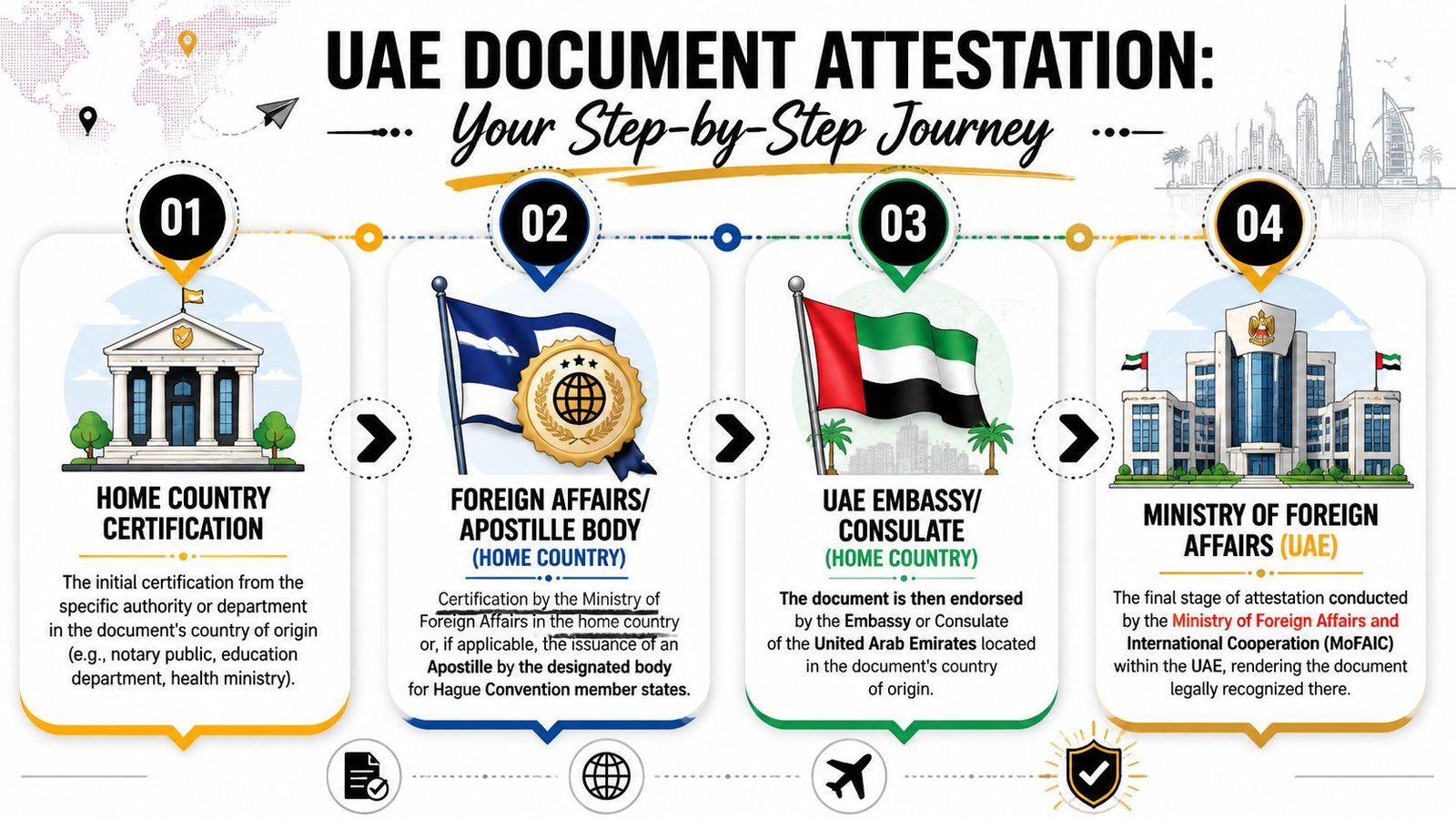
The practical way to handle documents attested for UAE is to treat attestation as a chain of trust. Each authority is not re-checking everything from scratch. It is confirming the signature or seal that came before it. If one link is missing, the next authority often cannot accept the document, even if the document itself is genuine.
Stage one in the home country
The process starts in the country where the document was issued, not where the holder lives and not where the company is based. That point causes more confusion than people expect.
The first check usually comes from the issuing institution or a local competent authority. After that, the document may need notarisation, state-level authentication, department-level verification, or foreign affairs authentication, depending on the document type and country rules. Academic documents often follow a different route from birth certificates or board resolutions.
For foreign-issued documents used in the UAE, the order matters. The UAE mission attestation information explains that U.S.-issued documents must complete the relevant local or state authentication route, then move to the U.S. Department of State, and only then go to the UAE mission. The same guidance also states that the original physical document is required for digital attestation and notes that educational institutions are checked for regional accreditation.
That tells you why the chain is strict. The UAE is not only looking at your certificate. It is relying on the issuing country to confirm that the document came from a legitimate source and passed through recognised authorities.
Stage two at the UAE mission
Once the home-country authorities have completed their part, the document goes to the UAE embassy or consulate responsible for that jurisdiction. This is the point where the UAE mission accepts the foreign authentication chain.
Founders with mixed personal and business paperwork usually hit complexity here. A marriage certificate from one country, a degree from another, and incorporation documents from a third country do not move as one tidy file. Each document follows the route tied to its own country of issue, and one complete file does not fix another incomplete one.
Use this checklist before you submit:
- Confirm the country of issue for each document.
- Verify the correct upstream authority for that document category.
- Check whether the original physical document is required before sending anything.
- Match names, dates, and document details to the passport and UAE application file.
Here's a short explainer that gives a practical overview of how the chain works in real life.
Stage three inside the UAE
The last step happens in the UAE. This is the final local acceptance step that makes the document usable for the authority that asked for it, whether that is for a visa file, labour matter, family sponsorship, or a company process.
This final step exists for a practical reason. A UAE embassy abroad can confirm that the foreign authentication chain was accepted by the mission. The authority inside the UAE still needs domestic confirmation before it will act on the document. In other words, embassy stamping alone does not always make a document ready for use onshore.
For UAE-issued documents, the process can be more digital. As noted earlier, MoFA accepts digital documents issued within the UAE when they contain a built-in verification feature such as a QR code, reference number, or barcode. Foreign-issued documents are usually more paper-based because the UAE is relying on checks completed outside its own system first.
Common Delays Costs and How to Avoid Them
A founder often learns the hard way that attestation delays do not start at the counter. They start weeks earlier, when a degree is pulled from an old file, a passport spelling was never corrected, or a company document is sent for stamping in the wrong order. By the time the document reaches the UAE authority that needs it, the underlying problem is already built into the file.
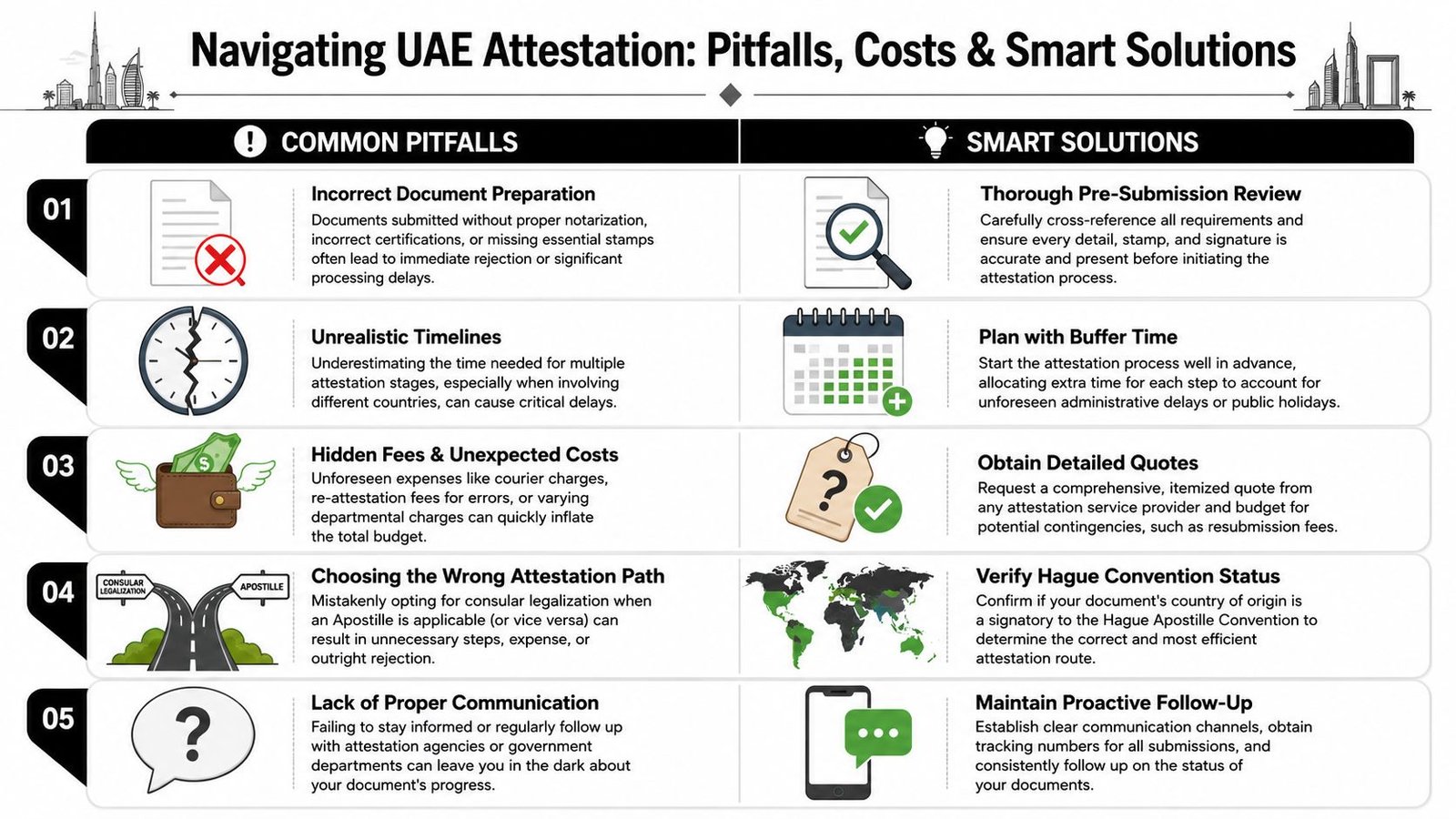
The reason these mistakes cause so much disruption is simple. Attestation is a trust chain. Each authority is relying on the step before it. If one link is missing, unclear, or out of sequence, the next authority has little reason to accept the document. That is why a file that looks complete to the applicant can still be unusable in practice.
Where delays usually start
The patterns are predictable:
- Wrong document version: An old certificate, laminated original, damaged paper, or scan is submitted when the route calls for a current or physical original.
- Name mismatch: Passport names, initials, maiden names, and transliteration differences trigger questions that stop the file.
- Wrong authority order: A genuine stamp from the wrong body, or the correct stamp taken too early, can force the document back to the beginning.
- Institution problems: Educational documents are often delayed when the issuing institution cannot be verified quickly or the prior certification does not match the expected route.
- Country confusion: The process follows the country where the document was issued, not the holder's nationality.
I see one mistake more than any other. People plan around the visa appointment, licence application, or onboarding date, then treat attestation as a short admin task. It is better handled as a dependency. If the attested document is needed for employment, family sponsorship, or company formation, build your timeline around the document first.
The fastest file is usually the one checked before submission, not the one submitted first.
Buffer matters. Courier delays, public holidays, document re-issue requests, and embassy workload can all slow a case that looked straightforward on paper.
What people miss about cost
Applicants usually focus on the visible fee and miss the underlying drivers of spend. The official charge is only one part of the total. The larger cost often comes from repeats, corrections, extra courier movement, and rushed handling after an avoidable mistake.
That is the practical trade-off. A careful file review at the start feels slower, but it usually costs less than fixing a rejected chain halfway through.
| Cost factor | Why it changes the total |
|---|---|
| Country of origin | Each country has its own authority structure, so the number of checks and handling steps can vary |
| Document type | Personal, educational, and corporate papers often follow different routes and standards |
| Courier and handling | Originals may need secure delivery, collection, and return across more than one jurisdiction |
| Error correction | Re-issuing, translating, or re-submitting documents adds both delay and extra fees |
| Urgency | Faster turnaround usually requires tighter coordination and higher service costs |
UAE-issued documents can be easier to process because some are verifiable in digital form, as noted earlier. Foreign-issued documents are usually less flexible. They depend on checks completed outside the UAE system first, which means more room for delay if the file is not prepared correctly.
How to avoid the expensive mistakes
A few habits prevent most problems:
- Check the exact document version before starting. Do not assume a scan, copy, or older issue date will be accepted.
- Match every name to the passport and application file. If there is a difference, deal with it before the document enters the chain.
- Confirm the route by document origin, not by citizenship. This avoids using the wrong embassy or upstream authority.
- Ask whether the receiving UAE authority needs anything beyond attestation. Some cases also need legal translation or supporting records.
- Start earlier than feels necessary. The time lost to one rejection is usually greater than the time spent on proper checking at the start.
The logic is straightforward. UAE authorities are not asking for attestation to create paperwork for its own sake. They are checking whether the document can be trusted enough to act on it for a visa, family file, labour matter, bank request, or company process. Once applicants understand that, the sequence makes more sense, and the avoidable delays become easier to prevent.
How a Professional Service Removes the Burden
A good attestation service doesn't just carry documents between counters. It solves three harder problems: route selection, sequence control, and error prevention.
What changes when an expert handles it
For a first-time founder, the biggest risk isn't paperwork. It's false confidence. The file looks complete because every document exists, but the chain is still wrong. A professional team checks the document type, issuing country, required authority, embassy route, and final UAE use case before the first submission goes out.
That changes the experience in practical ways:
- Fewer avoidable rejections: The file is checked against the actual route rather than general internet advice.
- Better timing control: Personal, educational, and corporate documents can be coordinated in parallel where possible.
- Less operational drag: HR, founders, and family sponsors don't spend their week chasing courier updates and stamp sequences.
- Clearer escalation: If a mismatch or missing prior certification appears, it's caught early.
For business owners, that matters because attestation usually isn't their main job. Their core job is launching the company, hiring staff, opening bank relationships, or relocating the family to the United Arab Emirates. The paperwork should support that move, not delay it.
If you want a calmer route for document legalisation, visa paperwork, and company setup in Dubai, Abu Dhabi, Sharjah, or another UAE jurisdiction, Inpro Corporate Services L.L.C. can help you organise the right attestation path before delays start. Not sure where to begin? Book a free strategy call with the team.