

If you're trying to get a UAE visa, company licence, or attested document approved without going back and forth between counters, documents clearing services are the support layer that keeps the paperwork moving. They coordinate the approvals, attestations, translations, and filings that turn a stack of documents into something government systems in the UAE and the United Arab Emirates can accept.
Table of Contents
- Introduction to Documents Clearing Services
- What Is Documents Clearing Services
- Which Services Are Included in Document Clearing
- How Does the Document Clearing Process Work
- How Jurisdiction Differences Affect Document Clearing
- What Timelines and Costs Should You Expect
- What Common Pitfalls to Avoid
- What Checklist to Follow and How to Choose a Provider
Introduction to Documents Clearing Services
If your papers keep stalling at a ministry, free zone, or embassy counter, documents clearing services are the people and processes that sort the sequence, fix the errors, and submit things in the right order. They matter because UAE approvals often depend less on the document itself and more on whether every supporting step has been completed correctly.
Founders, HR teams, freelancers, and Golden Visa applicants usually get stuck on the same things, the order of attestation, whether a translation is needed, which authority handles the next step, and whether a document needs MOFA approval, an apostille, or both. The sections below break that down in plain English, with a focus on the hidden parts most competitors gloss over, like exception handling, jurisdiction differences, and cost clarity.
What Is Documents Clearing Services
Documents clearing services are the support services that prepare, route, and submit official paperwork so it meets the requirements of UAE government bodies, courts, ministries, free zones, and sometimes embassies. In practice, that means checking the document, arranging the right certification steps, and making sure the submission is complete enough to be accepted the first time.
In the UAE, that role has become more visible because the government has pushed hard to reduce unnecessary steps. The UAE Cabinet launched the Zero Government Bureaucracy Programme on 4 September 2023 to simplify and speed up government services, which reframes paperwork as an efficiency problem rather than a permanent obstacle (Emirabiz on the Zero Government Bureaucracy Programme). For businesses and individuals, that does not mean paperwork disappeared. It means the remaining friction now sits in the exceptions, unclear scans, missing translations, wrong sequencing, and documents that need special handling.
Why these services matter in the UAE
A company setup in Dubai, Abu Dhabi, or Sharjah often touches more than one authority. A visa file can involve immigration, labour-related checks, and internal compliance reviews, while a business file may need trade licence steps, signatory documents, and attestations. Documents clearing services exist because those workflows are spread across systems, and a founder or HR manager usually does not have time to learn every submission rule from scratch.
Practical rule: the document itself is only one part of the job. The other part is proving it belongs in the exact sequence that the receiving authority expects.
This is why people often use a clearing partner for time-sensitive work. The value is not just speed. It is reducing the risk of a rejected file that sends you back to square one, which is especially stressful when an employee's start date, licence renewal, or residence process is already under pressure.
What changed with digital government
Dubai's digital shift has changed how this work is done. Dubai's Department of Economy and Tourism reported that 90% of its licensing transactions were completed through digital channels in 2024 (Al Nahda Centre on Dubai licensing transactions). That means the bottleneck is often not “Can we submit it?” but “Can we submit the right version, in the right format, with the right supporting steps?”
That is where a clearing service earns its keep. It can organise the workflow, spot missing items early, and handle the odd case where the rules do not fit the standard template. For stressed founders and HR teams, that kind of support is less about convenience and more about keeping the whole file alive.
Which Services Are Included in Document Clearing
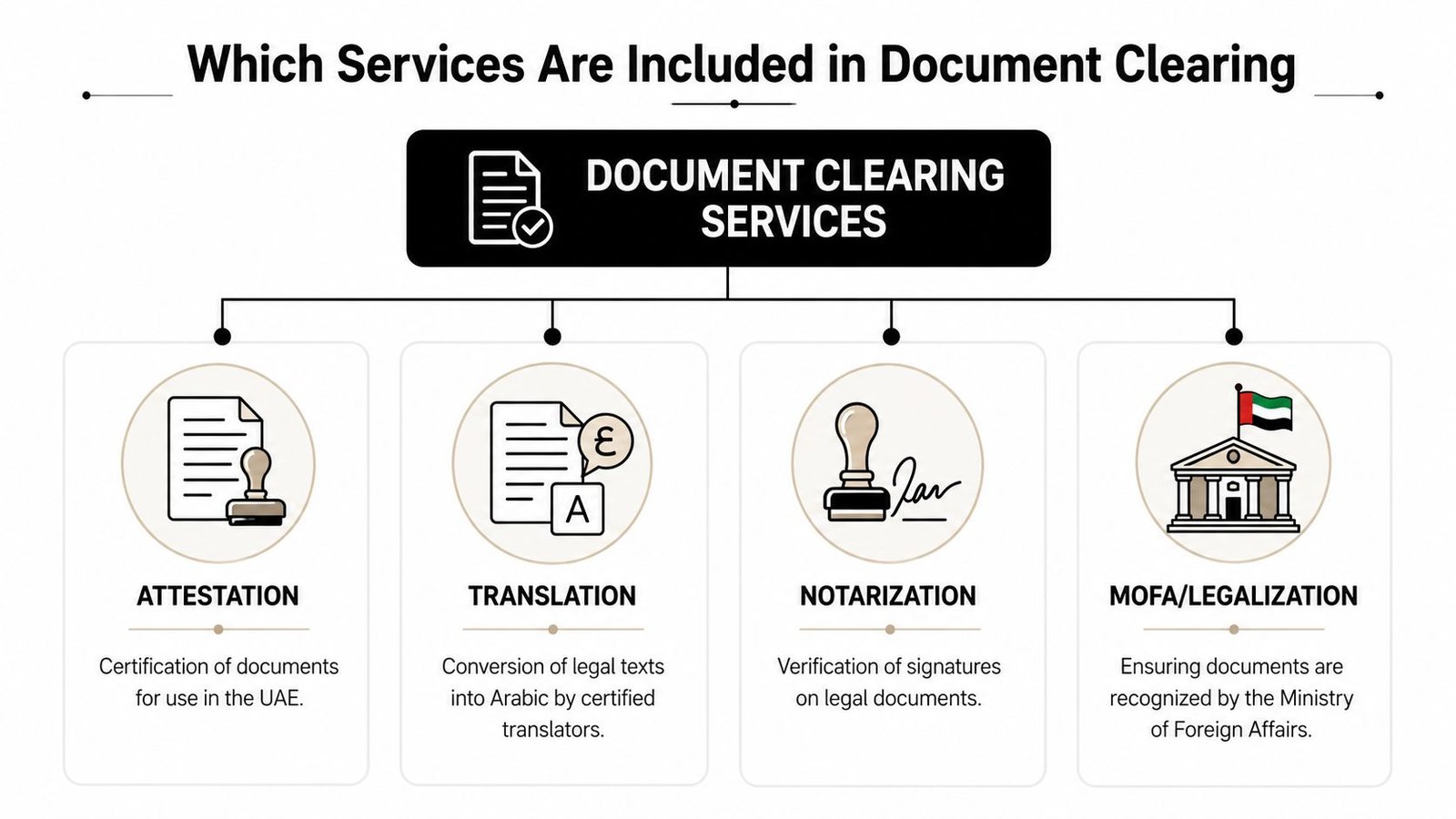
Document clearing is not one service, it is a bundle of linked tasks. The exact mix depends on whether you are preparing business setup papers, employee visas, investor files, or documents that need to be used outside the UAE.
Attestation and legalization
Attestation means certifying a document so it is accepted for a specific purpose in the UAE. If you have a degree, marriage certificate, birth certificate, board resolution, or company paper, attestation can be the step that makes it valid for official use.
Legalization is related, but it usually points to the broader process of getting a document recognised through the correct authority chain. For some papers, that includes the Ministry of Foreign Affairs, often called MOFA, which is the UAE ministry involved in federal-level certification. If a document is going abroad, embassy or consular legalization may also enter the picture.
The key point is that these are not interchangeable. A document that is fine for one authority may still need another layer before it can be accepted elsewhere. That is why document clearing is often a sequencing exercise, not a single submission.
Translation, notarization, and PRO work
Translation means converting the legal text into the required language, often Arabic, using a certified translator. In the UAE, that matters because many authorities expect Arabic versions for official files, and a loose translation is not the same as a certified one.
Notarization is the formal verification of signatures, declarations, or copies by a notary or notary public. It matters most when the authority needs proof that the person signing really signed the document, or that the copy matches the original.
PRO stands for Public Relations Officer in the UAE context, but the role is really government liaison work. A PRO handles submissions, follow-ups, and approval chasing with departments such as economic departments and labour authorities. For employee visas, investor visas, and Golden Visa files, PRO work often includes assembling the document set, tracking progress, and returning to the authority when a correction is requested.
Visa document handling is its own layer. That can include personal identification, photos, education papers, company papers, tenancy-related documents, and any extra approvals tied to the applicant's case.
Simple way to think about it: attestation proves authenticity, translation makes the content usable, notarization confirms signatures, and PRO work gets the file in front of the right desk.
Missing one step can hold up the whole sequence. A translated document with the wrong certification, or a notarised document submitted before the attestation step, can send you back for rework. That is why good clearing providers build the process as a chain, not a menu.
How Does the Document Clearing Process Work
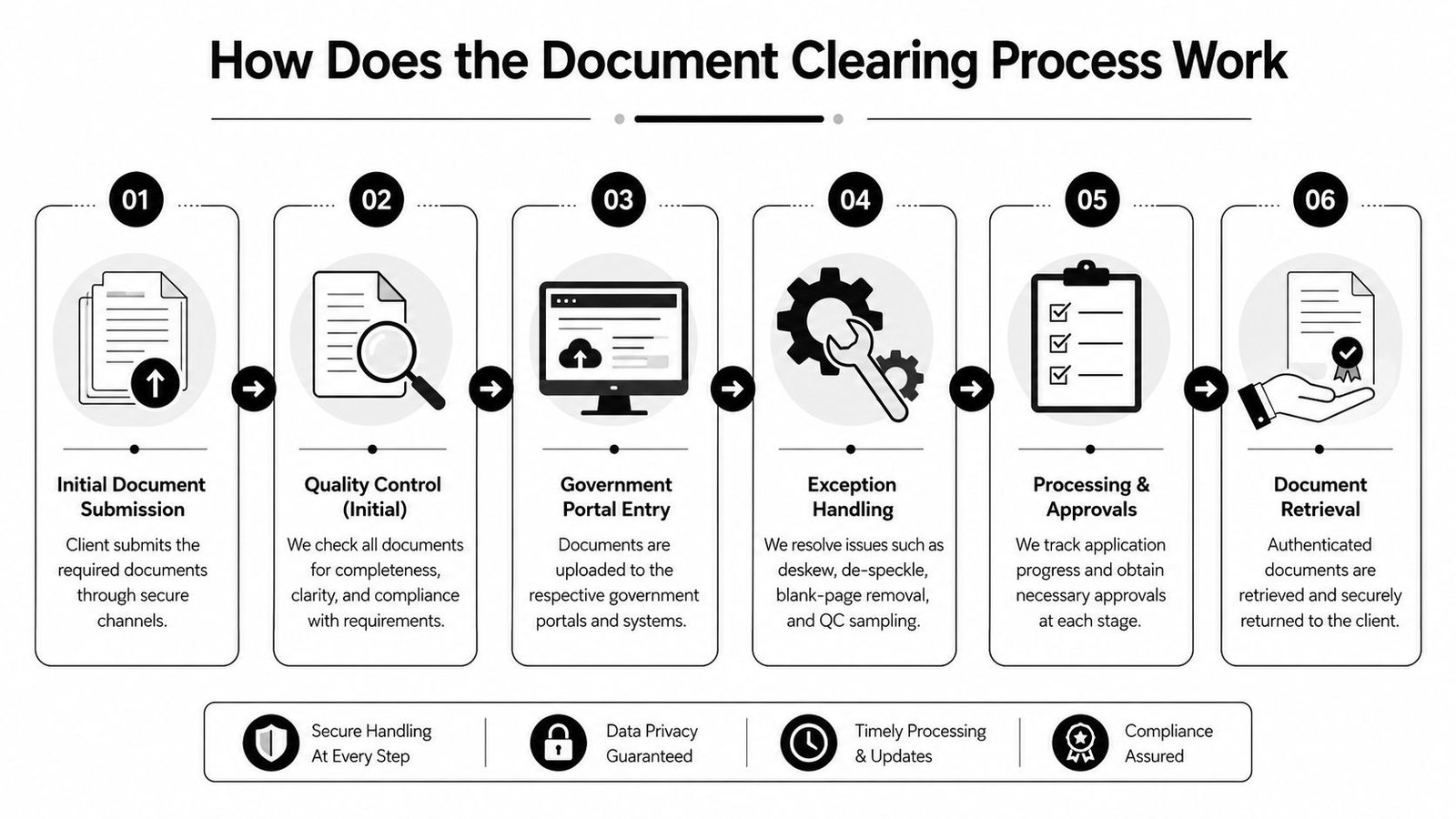
The workflow usually starts with collection and checking, then moves into submission, exception handling, and delivery. For busy founders and HR managers, the mistake is assuming the process is only about sending files to a portal. In reality, a lot of the effort sits in making sure the file survives the first review.
From submission to final delivery
The first step is initial document submission. The client hands over originals, scans, or supporting details, and the clearing team checks whether anything obvious is missing. Then comes quality control, where the file is checked for legibility, completeness, and whether the document type matches the intended use.
Next is government portal entry or physical submission, depending on the authority and the transaction type. Many approvals now pass through digital systems, especially in Dubai, but not every case is fully digital. Some approvals still need a physical visit, a stamp, or an in-person handover of originals.
If the file comes back with an issue, the process enters exception handling. That is the stage where the team fixes the problem, corrects the scan, resubmits, or adds a missing supporting item. Once approvals are issued, the team tracks the file until the final document retrieval stage, when the processed papers are returned to the client.
Why scan quality affects approval
A lot of rejected files are not rejected because the document is wrong. They are rejected because the scan is unusable. Procurement guidance for secure scanning workflows recommends clear rules for deskew, de-speckle, blank-page removal, and rescan handling for blurred, torn, folded, or handwritten pages, because those controls shape whether downstream OCR and government delivery are usable on the first pass (Scan.Place on secure document scanning RFPs).
Government OCR systems do not care that a file was “sent on time” if they cannot read it cleanly.
That is why professional clearing teams and scanning teams often work as one chain. A clean scan reduces resubmissions, and a clear resubmission rule tells everyone what happens when a page is damaged, obscured, or handwritten. In practical terms, that saves time in Dubai, Abu Dhabi, and Sharjah because the same quality issue can trigger repeated delays if nobody fixes it properly the first time.
How Jurisdiction Differences Affect Document Clearing
A founder may prepare one file set and still receive different instructions in Dubai, depending on whether the file belongs to mainland, a free zone, or an offshore structure. The document may look identical on paper, yet the approval route can change at the first checkpoint.
Mainland, free zone, and offshore paths
In Dubai mainland, a Documents Clearing Services licence is classified under activity code 8299.85 and issued by the Dubai Department of Economy and Tourism, formerly known as DED, the Department of Economic Development (Meydan Free Zone on Dubai clearing activity code 8299.85). Free zones issue similar licences through their own authorities, so the approval chain can differ even when the service name sounds the same.
That difference shows up in the paperwork. The issuing authority often decides which supporting documents are needed, which department stamps first, and where the file goes next. A mainland file can follow one route, while a free zone file in the same city may follow another. Offshore structures add a further layer because the use case is often cross-border rather than purely local.
For HR teams and founders, the practical lesson is simple. Do not assume one licence path fits every jurisdiction. The same business activity can be handled through different administrative doors, and each door has its own checklist.
Apostille and MOFA differences
The hardest point for many teams is apostille versus legalization. The UAE joined the Hague Apostille Convention in 2023, and the Ministry of Foreign Affairs confirmed the Apostille entered into force for the UAE on 12 September 2024. Even with that change, many documents still require UAE MOFA legalization for local use, so an apostille does not automatically replace every other step.
This is why the key question is where the document will be used. A file prepared for a UAE mainland submission may need one chain of authentication, while a document meant for use abroad may need a different finish. A file for a free zone submission can also follow a separate route, depending on the authority and the receiving party.
A simple way to sort the issue is to ask two questions before sending anything. First, will the document stay inside the UAE or leave the country? Second, does the receiving authority want MOFA legalization, apostille, or embassy legalization? That small check saves teams from resubmitting the same file through the wrong pathway.
Useful rule of thumb: if the document is for use inside the UAE, ask whether MOFA still applies. If it is for use abroad, ask whether apostille or embassy legalization is the correct ending point.
That is the day-to-day value of document clearing. It helps teams avoid the wrong route, catches exceptions before they turn into delays, and keeps each jurisdictional file tied to the correct authority chain.
What Timelines and Costs Should You Expect
People often ask for one finish date and one total fee. UAE document work rarely works that neatly, because the timeline changes with the document type, the authority involved, and whether any step needs a correction or an exception path.
A practical cost table
The first cost trap is assuming every file follows the same route. A straightforward notarization may move quickly, while a file that needs translation, a corrected scan, or embassy follow-up can add both time and handling work. Dubai's digital shift has reduced friction for standard licensing transactions, but special cases still need manual review, especially when the receiving authority asks for a specific chain of authentication.
| Typical Timelines and Cost Ranges | |||
|---|---|---|---|
| Service | Timeline | Government Fees (AED) | Service Fees (AED) |
| Notarization | Often the quickest step, depending on the authority and document type | 50-150 | 100-250 |
| Translation | Depends on document length and certification needs | 0-100 | 80-250 |
| MOFA legalization | Depends on the document chain and appointment flow | 150-250 | 100-300 |
| Embassy legalization | Often slower than local steps because more than one authority may be involved | 150-500 | 150-400 |
| PRO handling for visas or licensing | Depends on the number of follow-ups and corrections | 0-200 | 200-600 |
A transparent quote should separate government pass-through charges from service fees. That split matters because the government charge is usually fixed by the authority, while the service fee reflects the work involved in filing, tracking, and correcting the file if a step is rejected or sent back.
Where delays usually happen
Delays often appear when a document is incomplete, placed in the wrong sequence, or missing a supporting page that the next authority expects. A corrected scan can also send the file back into the review queue, which means the issue is not the form itself but the handoff between steps.
A clearer budget starts with a line-by-line breakdown. Ask what belongs to the government, what belongs to handling, and what happens if a file needs resubmission or an extra verification step. That level of detail helps founders and HR teams compare providers properly, especially when documents need to move between systems, portals, and approvals without confusion.
Some providers also work with API-enabled integrations for intake, status updates, or document tracking. For busy teams, that can reduce follow-up calls and make the workflow easier to monitor, but it still should not hide the actual fees. A clean quote should show the full path, from the first submission to the final approval, so there are fewer surprises when the file hits an exception.
What Common Pitfalls to Avoid
A file can look ready on paper and still stall at the first handoff. In UAE document workflows, the delays usually come from a missed exception, the wrong authority sequence, or a team assuming one stamp solves every later use case.
The mistakes that cause rework
One common error is treating apostille and MOFA legalization as interchangeable for every document type. That confusion often shows up with university degrees, power of attorney files, and corporate papers, where the path depends on where the document will be used and which authority will receive it first. A certificate that looks complete after one round of authentication may still need another step before it is accepted locally, and the U.S. Department of State on document authentication explains why document use and destination matter.
Another error is poor scan quality. If a scan is skewed, speckled, cropped, or missing a supporting page, the file can bounce before a person reviews it. That creates a different problem from a missing stamp, because the issue sits at the intake stage, not the authority stage. A third problem is assuming one provider can handle every embassy, ministry, and free zone step without checking where the file changes hands. Those handoff points matter, like checkpoints in a route, because each authority may expect a different order or supporting paper.
A fourth mistake is ignoring renewal timelines. A document may be cleared and still become unusable later if the business licence, visa file, or related support paper expires first, which means the team has to start again. The fifth issue is accepting a vague price. If a provider does not separate government pass-through charges from service fees, founders and HR teams cannot see what they are paying for, or compare two quotes on equal terms.
Clear routing beats rushed submission. A document that lands on the wrong desk quickly is still a failed file.
The safer approach is to ask, before submission, which authority should see the file first, which certification comes next, and what the provider does if the document later needs use outside the UAE. That question matters most for cross-border files, because the wrong jurisdiction path is hard to fix after the file has already moved through the queue.
What Checklist to Follow and How to Choose a Provider
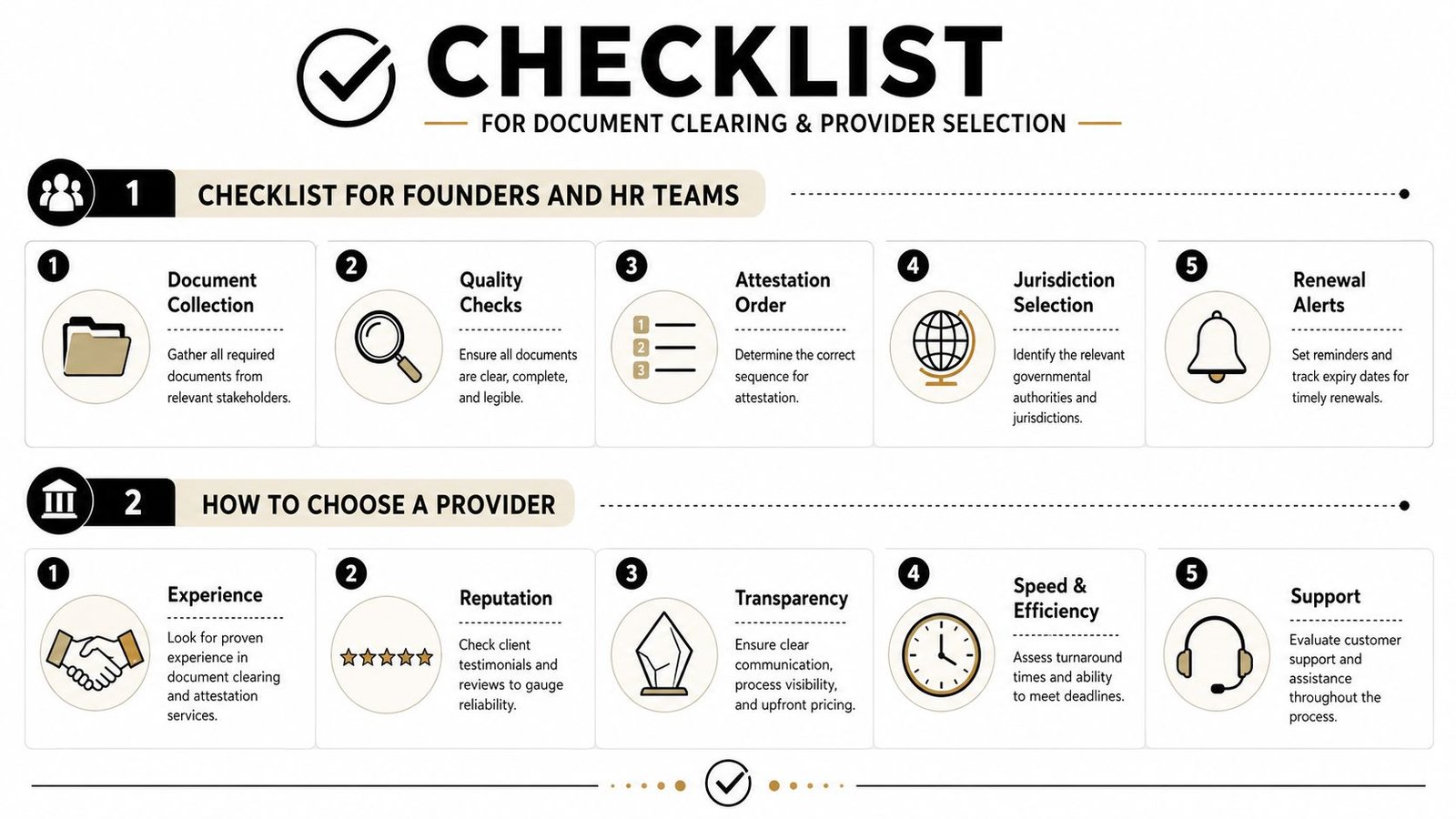
A good document file starts with a clean checklist and a provider that can explain the process without hiding the messy parts. Founders and HR teams usually want three things at once, correctness, speed, and cost clarity.
A founder and HR checklist
- Document Collection: Gather originals, copies, and any supporting papers before the file is handed over.
- Quality Checks: Confirm that every page is clear, complete, and readable, especially if it will be scanned.
- Attestation Order: Confirm the correct sequence before anything is sent for stamping or certification.
- Jurisdiction Selection: Check whether the case belongs to mainland, free zone, or offshore processing.
- Renewal Alerts: Set reminders so visas, licences, and supporting papers do not expire unnoticed.
That checklist is simple on purpose. The hard part is not listing the steps, it is making sure each one happens in the right order and with the right authority. A cleaning-up service that only reacts after a rejection is too late for a stressed HR team.
How to compare providers
A strong provider should explain fee transparency, show how it handles exceptions, and tell you what happens when a document needs rework. You should also ask whether it has direct digital portal access, whether it supports API-enabled workflows, and whether its process can integrate with your internal HR or company-formation systems. That last point matters for teams that want clean handoffs between onboarding, visa tracking, and document storage.
Look at local knowledge too. A provider that understands Dubai, Abu Dhabi, Sharjah, and free zone processes can tell you where the likely choke points are before you submit. Ask for the turnaround logic, the escalation path, and the answer to one simple question, who owns the file when an authority asks for a correction?
A strong provider should answer that clearly, without hiding behind jargon.
If you're setting up in the UAE, renewing employee files, or trying to get attestation right the first time, book a free strategy call with Inpro Corporate Services L.L.C. and get a clear next step before the paperwork starts piling up.