


A typical Dubai business setup cost is usually AED 18,000 to AED 34,000 in a free zone, while a mainland company often starts above AED 30,000 to AED 40,000 in the first year. The main reason is simple: jurisdiction changes everything, and mainland structures usually carry office and licensing overhead that free zone packages often avoid.
Most founders look at the licence first. That's understandable, but it's also where budgets go wrong. In the UAE, and across the wider United Arab Emirates, the critical figure is the total cost of becoming operational: licence, registration, visas, office, immigration paperwork, renewals, and the admin work needed to keep the company compliant after setup.
Table of Contents
- Your Guide to UAE Business Setup Costs in 2026
- Which Jurisdiction Is Right for Your Budget
- Mapping Your One-Time vs Recurring Expenses
- The Costs Beyond Your Trade Licence
- Sample Cost Scenarios for 2026
- Hidden Costs and How to Save Money
- How Inpro Makes Your Setup Predictable and Fast
- Frequently Asked Questions About Dubai Setup Costs
Your Guide to UAE Business Setup Costs in 2026
A setup quoted at AED 18,000 can easily land much higher by the time the company is ready to trade, hire, bank, invoice, and stay compliant. The core budgeting question is broader than the licence application. It is the full cost of becoming operational in the UAE without delays, rework, or avoidable add-ons.
A 2026 Dubai business setup guide from Engel & Völkers puts a typical free zone setup at about AED 18,000 to AED 34,000, while mainland first-year costs often run above AED 30,000 to AED 40,000. In practice, that difference usually comes from what sits around the licence. Office requirements, immigration files, document attestations, and recurring compliance costs push the total up.
Under-budgeting usually happens when founders price the licence application instead of the total cost of becoming operational.
What actually drives the number
Three cost drivers shape the first-year budget and the ongoing one.
- Jurisdiction: Mainland, free zone, and offshore structures come with different authority fees, facility rules, and operating limits.
- Business activity: Consulting, trading, manufacturing, and regulated services each trigger different approval paths and supporting documents.
- Visa plan: The cost changes quickly once the business needs investor visas, employee visas, medicals, Emirates ID processing, and immigration establishment cards.
The practical mistake is simple. Founders often compare two licence packages and assume they are comparing two complete setups. They usually are not.
A mainland company can trade directly in the UAE market, but that access often brings added obligations tied to tenancy, municipal charges, and government processing. A free zone company is set up under a specific zone authority and may look cheaper at entry, but the total still depends on visa allocation, desk or office eligibility, and the rules for working with mainland clients. An offshore company is usually used for holding assets or international ownership structures, not day-to-day trading inside the UAE.
That distinction matters because the licence fee is only one line item. The total cost of ownership includes the company staying usable after incorporation. That means visas, workspace, accounting support, VAT registration where required, renewals, and the small administrative fees that tend to appear one step at a time.
Which Jurisdiction Is Right for Your Budget
A founder can save money or waste it at the jurisdiction stage. In Dubai, the gap often is not the starting licence fee alone. It is the total operating cost that follows from that first choice.
What makes Mainland more expensive
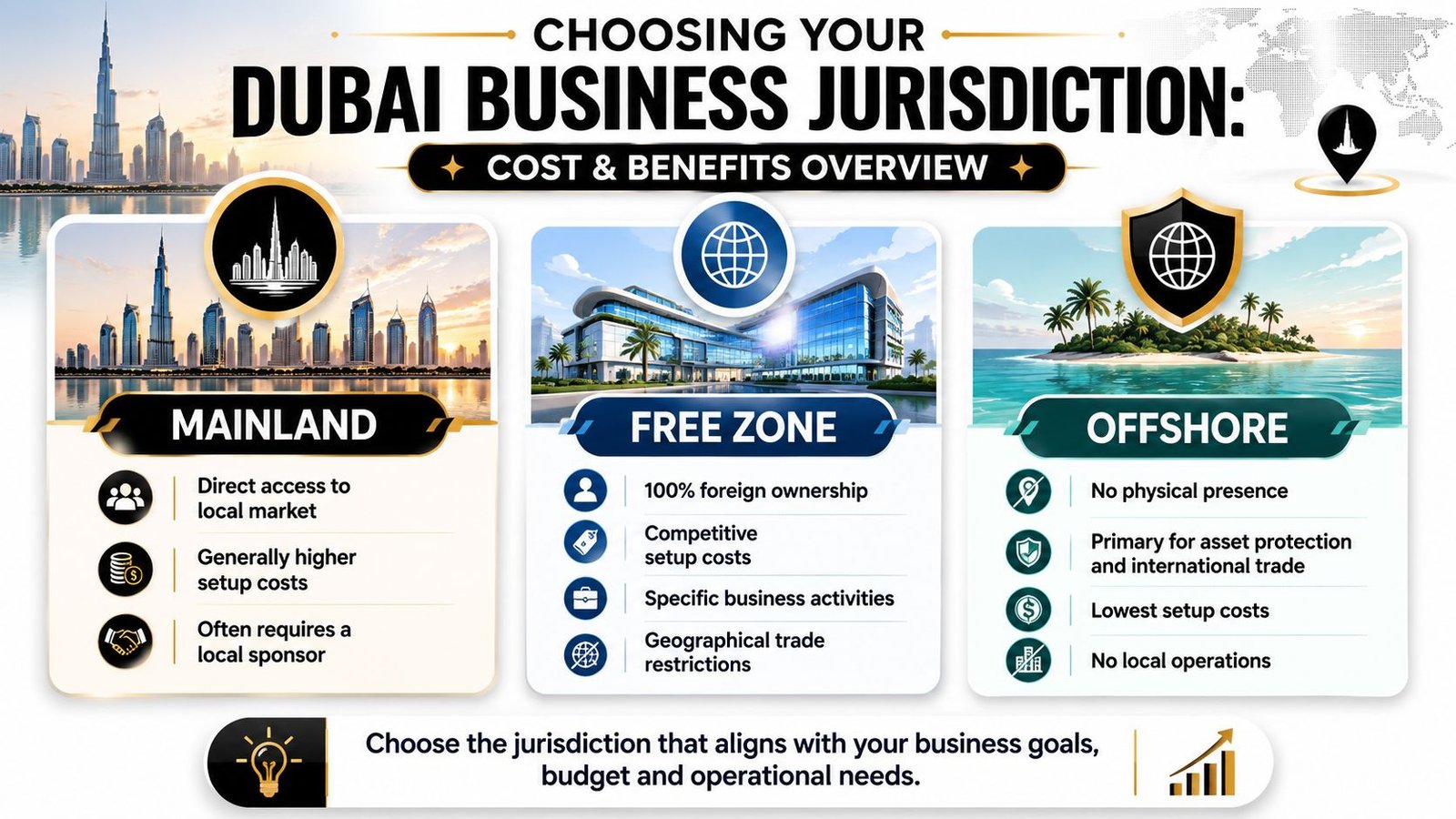
Mainland suits businesses that need to sell directly into the UAE market, sign local client contracts without structural workarounds, or operate in activities that customers expect to see under a Dubai Economic Department licence. That access carries extra cost because mainland setup usually pulls in more moving parts: initial approvals, licence issuance, tenancy documentation, and in some cases municipality-linked charges tied to the office.
A practical mainland budget is rarely just "licence plus visa." Office choice affects more than rent. It can also affect market-fee calculations, Ejari-related paperwork, and the level of flexibility you have when adding visas or renewing the company later. Founders who only compare the first invoice usually miss that chain reaction.
Mainland also makes sense for some founders precisely because it costs more. If the business model depends on local walk-in trade, broad UAE commercial activity, or hiring at scale, the extra spend can support smoother operations later.
Why Free Zone pricing feels simpler
Free zone setups usually look cleaner on paper because many authorities package the registration, licence, and a desk or office entitlement into one offer. That helps with first-year budgeting, especially for consultants, digital businesses, and international service firms that do not need full mainland trading access from day one.
The budget logic for each jurisdiction is distinct:
| Jurisdiction | Budget logic | Best fit |
|---|---|---|
| Mainland | Higher market access, with more linked compliance and facility costs | Local market trading, retail, service delivery across the UAE |
| Free Zone | Lower entry cost, more defined package pricing | Startups, consultants, remote-first firms, international service providers |
| Offshore | Lower structural overhead, but limited operating use inside the UAE | Holding structures, international ownership, asset protection |
The key comparison is between setup cost and total cost of ownership. A free zone can look cheaper because the first invoice is tighter and the authority process is more standardised. The trade-off is operational. Some free zone companies need extra steps to work with mainland clients, lease outside the zone, or expand visa capacity beyond the original package.
That is why I usually tell founders to start with the revenue model, not the cheapest licence quote. A business earning from UAE-based customers may be better served by mainland from the start. A founder testing an advisory, ecommerce, or remote service model often protects cash better with a free zone, then upgrades structure later if the business justifies it.
This video gives a quick visual summary of those trade-offs and is useful if you want to see how founders typically compare the three routes before committing:
Where Offshore fits
Offshore is usually the wrong answer for founders who want to run a business on the ground in Dubai. It is designed for holding assets, owning shares, or managing international structures outside the local UAE operating market.
That difference matters for budgeting. Offshore may appear inexpensive at formation, but it does not solve the costs tied to visas, premises, local hiring, or day-to-day trading inside the UAE. If the plan includes employees, client meetings, invoicing local customers, and a real operating presence, offshore often adds restructuring costs later instead of saving money now.
Mapping Your One-Time vs Recurring Expenses
A founder who budgets only for the first invoice usually underestimates Dubai setup costs by a wide margin. The licence gets the company approved. The recurring spend keeps it active, compliant, and usable in the market.
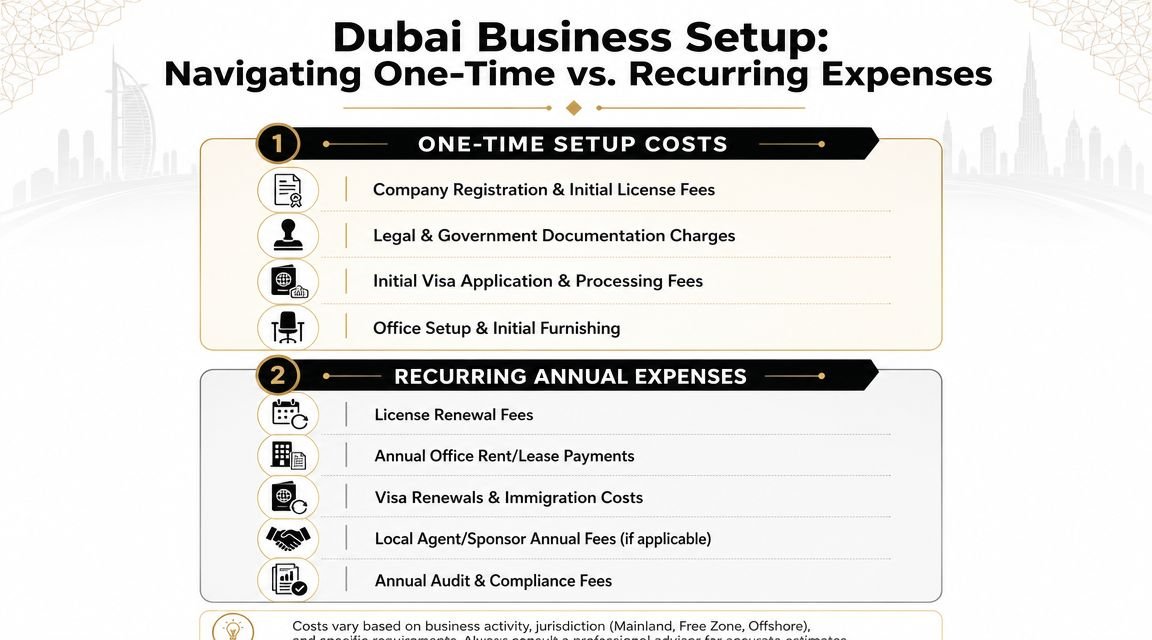
The practical way to budget is to split costs into two buckets. First, the one-time formation charges needed to get the file opened and the entity issued. Second, the annual and operational costs that continue long after incorporation.
What you pay once
Initial setup usually includes the trade licence, name reservation, initial approvals, establishment card, and any first-round immigration processing tied to the founder or team. The exact mix depends on activity, jurisdiction, and visa count.
The UAE government's Basher service overview explains that company formation passes through multiple approvals and registrations, which is why setup is charged as a stack of administrative steps rather than one flat filing fee. In practice, that is why founders see separate line items instead of a single all-in government bill.
One fee that catches people off guard is the establishment card. It opens the company's immigration file and allows visa processing to start. It is not usually the largest charge, but it sits early in the process, so it affects cash timing from day one.
Another one-time cost is document work. That can include attestation, legal translation, or certified copies if the shareholder structure or activity requires extra review. Founders often skip this in their first budget draft, then discover it only when the bank, free zone, or immigration file asks for it.
What keeps coming back every year
Recurring costs are where total cost of ownership shows up. Dubai does not become expensive because of the licence alone. It becomes expensive when the business needs to keep renewing permissions, maintaining premises, supporting visas, and handling tax and compliance work year after year.
The Dubai Department of Economy and Tourism's business setup guidance makes clear that licences are issued and renewed through an ongoing regulatory process. That matters because renewal is not a symbolic admin step. It is a core operating cost.
Recurring expenses usually include:
- Licence renewal: Typically one of the largest annual charges.
- Office occupancy: Flexi-desk, shared office, or full lease costs continue whether revenue is strong or weak.
- Visa renewals and related processing: Emirates ID, medical testing, status changes, and renewals return on a cycle.
- Accounting and tax support: VAT registration, bookkeeping, corporate tax records, and filing support become part of the operating budget.
- Audit or compliance requirements: Required in some jurisdictions and often missed in early-stage planning.
A budget that only covers incorporation is incomplete. It is merely an application budget.
I usually tell founders to pressure-test one question before they commit. “What will this company cost me to keep alive for 12 months if sales are slower than planned?” That is the number that protects cash flow. It also changes the jurisdiction decision, because a cheaper licence can still produce a higher annual burn once visas, office requirements, and compliance are added back in.
The Costs Beyond Your Trade Licence
The trade licence gets the attention, but it doesn't get the company running on its own. The practical budget starts to change once the founder asks three operational questions: who needs a visa, where will the company be registered physically, and who is handling the government paperwork.
How visas change the budget
A business with no visa requirement looks different from a business with one shareholder visa and a small team. Once visas enter the plan, timing and process matter as much as cost.
A solo consultant in a free zone may keep things lean by limiting the initial structure to one visa and a simple desk package. A startup with co-founders and early hires usually feels the cost pressure quickly, because each additional immigration file adds medical, ID, and document steps to the workflow. A trading business can face even more admin because staffing, warehousing, and approvals often need to line up together.
Why office and PRO support are operational costs
PRO stands for Public Relations Officer in the UAE business context. A PRO handles government-facing paperwork such as immigration files, licence updates, labour-related processing, submissions, collections, and follow-ups across multiple authorities.
For most foreign founders, PRO support isn't a luxury purchase. It's the layer that keeps deadlines from slipping and documents from bouncing back for minor errors. That's why experienced operators budget it as part of setup and not as an optional extra.
Office requirements also change the shape of the budget:
- Mainland companies: Usually need a physical office arrangement tied to their licensing and tenancy paperwork.
- Free zone companies: Often have more flexibility through flexi-desk or shared workspace structures, depending on the zone and activity.
- Operational reality: The cheaper office option is only cheaper if it still supports your visa quota, banking process, and licence conditions.
What catches founders after incorporation
After the company is formed, the next wave of spend usually comes from practical needs rather than government headlines.
These often include:
- Banking support: Corporate bank account preparation usually takes paperwork discipline, clear activity descriptions, and properly organised company documents.
- Accounting setup: Even a small company should decide early who will maintain books and prepare for tax and renewal requirements.
- VAT registration: Value Added Tax (VAT) is the UAE's consumption tax framework. Not every company registers immediately, but founders should understand whether their model will require it and what admin it creates.
- Document work: Attestation, translation, courier handling, and resubmissions can gradually stretch both budget and timeline.
Sample Cost Scenarios for 2026
The biggest misconception in this market is that the advertised licence fee is the setup budget. It isn't. A real budget is the licence plus the operating conditions attached to it.
How three common setups look in practice
For a company in a free zone like DMCC, a DMCC cost guide says first-year setup is typically driven by a one-time registration fee starting at AED 9,000, an annual licence fee of AED 10,000 to AED 50,000, and office or flexi-desk occupancy of roughly AED 15,000 to AED 20,000 per year, landing the total around AED 35,000 to AED 50,000 before optional items such as share capital and visa processing are added.
That doesn't mean every free zone company will land there. It means the licence headline on its own is often incomplete.
| Cost Item | Scenario 1: Freelancer (Free Zone) | Scenario 2: Tech Startup (Free Zone) | Scenario 3: Trading Co. (Mainland) |
|---|---|---|---|
| Jurisdiction logic | Lean setup, low overhead, limited initial visa need | Growth-focused free zone with office eligibility | Local market access and trading flexibility |
| Licence and registration | Usually the core package cost | Usually a broader package with occupancy included or linked | Activity-driven and often higher due to approvals |
| Visa cost effect | One visa can materially affect the total | Multiple visas shift the budget fast | Team visas and admin load can become significant |
| Office requirement | Flexi-desk may be enough | Desk or office requirement often rises with team size | Physical office is commonly part of the structure |
| Ongoing cost profile | Lower, if operations stay simple | Moderate to high as team and compliance grow | Higher recurring exposure through office and renewals |
Here's how I'd think about each one in practice.
A freelancer usually gets the cleanest economics from a free zone package that keeps the company simple. What works is matching the licence to the actual service activity and avoiding a package loaded with unused visa capacity or office features. What doesn't work is buying a cheap headline package and discovering later that the chosen activity, banking profile, or client model doesn't fit.
A tech startup often assumes software means low overhead. Sometimes that's true, sometimes it isn't. Once there are founders, employees, and client contracts, the budget starts behaving like an operating system, not a registration exercise.
A trading company on the mainland tends to face the widest spread between licence price and true first-year cost. The office has a bigger role, approvals matter more, and the company often needs stronger document discipline from day one.
The cheaper setup is only cheaper if it still lets you invoice, hire, bank, and renew without restructuring six months later.
Hidden Costs and How to Save Money
Surprise costs in Dubai business setup are rarely a single large fee. They are usually a string of small admin and compliance charges that show up late, slow the process, and push the first-year budget above the original plan.
Which hidden costs appear most often
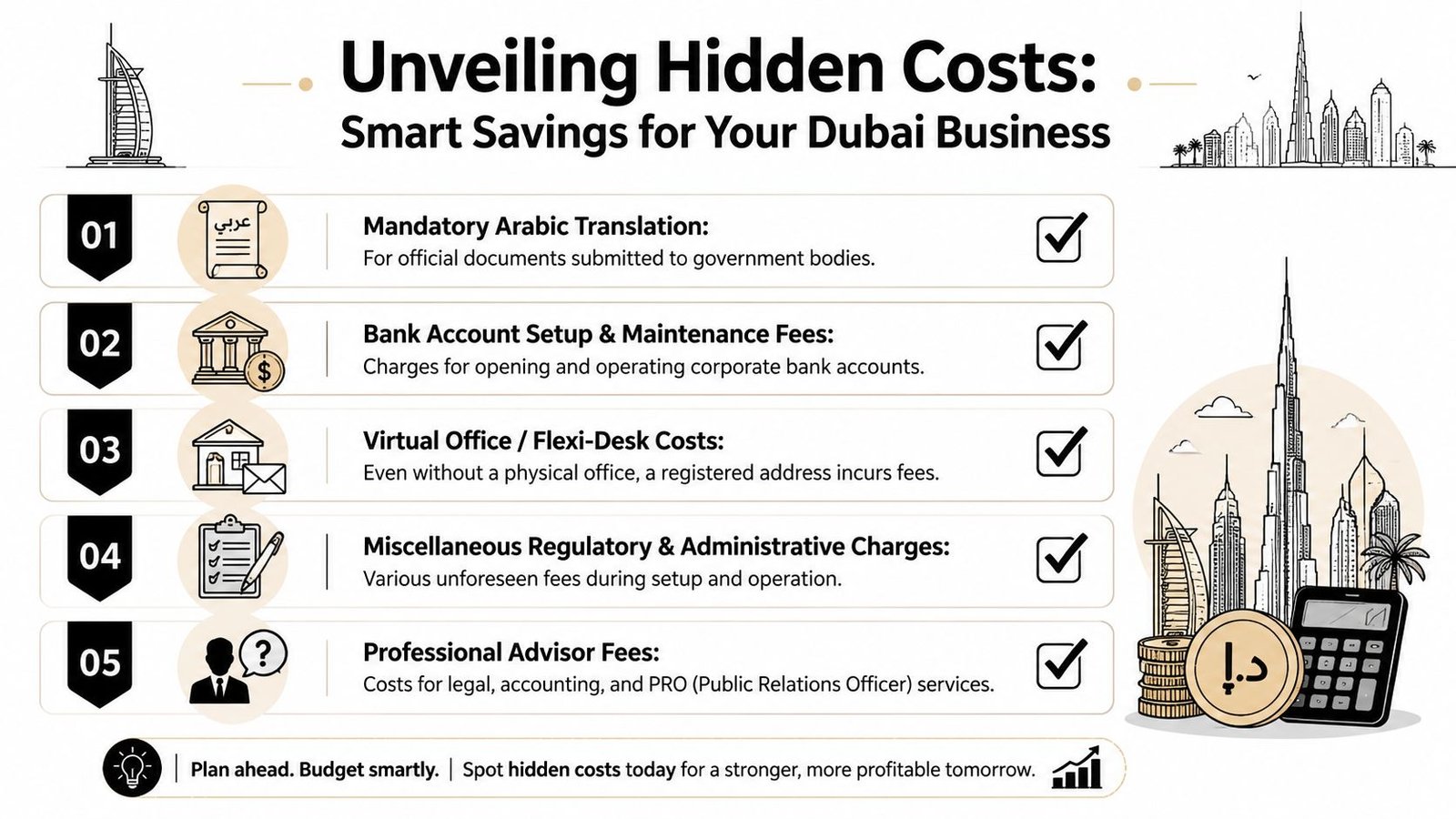
In practice, the biggest budget mistakes come from treating setup as a licence purchase instead of a full operating setup. The licence is only one line item. The total cost of ownership usually expands through immigration steps, document handling, office compliance, and post-incorporation admin.
The charges that catch founders most often include:
- Arabic translation: Certain supporting documents and authority submissions need certified Arabic translation.
- Attestation and legalisation: Overseas powers of attorney, corporate documents, and certificates often need to be legalised before UAE authorities or banks will accept them.
- Typing, medical, Emirates ID, and visa processing fees: These are routine, but they multiply fast once there are several shareholders or employees.
- Courier and resubmission costs: Small on paper, expensive in aggregate when signatures, original documents, or corrected forms move back and forth.
- Renewal timing penalties: Late licence renewal, immigration card delays, or missed establishment card deadlines can trigger fines that add no business value at all.
- Banking file preparation: A weak business profile, unclear activity description, or incomplete shareholder documents often leads to extra rounds of document work after incorporation.
- VAT and accounting setup: Some founders register the company, start trading, then realise they also need bookkeeping support, invoicing discipline, and tax registration planning.
None of these fees are unusual. The problem is sequencing. If the company is set up before the visa plan, office requirement, and banking file are properly defined, the founder ends up paying for corrections.
How to control the final bill
Saving money in Dubai usually comes from better scoping, not from choosing the cheapest package.
Start with the business model. A founder selling UAE-based services, hiring locally, and needing several visas should not choose a structure built only around a low entry fee. That decision often creates higher costs later through office upgrades, visa limitations, or banking friction.
Visa planning deserves its own line in the budget. I have seen founders approve a low-cost setup, then discover that adding family visas, employee visas, or repeated status changes materially changes the first-year spend. The government fees are predictable. The surprise comes from not counting them early.
Office costs also need a stricter review. A flexi-desk can work well if the authority accepts it and the company will stay lean. If the bank, landlord, client base, or visa allocation pushes the company toward a physical office, delaying that decision does not save much. It usually postpones a cost that was coming anyway.
A practical checklist helps:
- Match the activity to the actual business. Wrong activity selection can trigger amendments, extra approvals, or bank compliance questions.
- Build the first-year visa count before incorporation. Include founders, employees, and dependants if relevant.
- Confirm the office rule in writing. Do not assume the package shown in marketing will satisfy visa, banking, or renewal needs.
- Price the recurring obligations separately. Renewal, immigration cards, office rent, bookkeeping, VAT support, and compliance admin should sit outside the headline formation fee.
- Ask for an itemised quote. Licence, government fees, immigration, medical, Emirates ID, office, and service fees should all be visible as separate lines.
- Prepare the banking file early. A clean activity description, clear source of funds, and complete shareholder documents reduce costly delays after incorporation.
For founders who want one provider to scope the setup properly and handle licensing, visas, attestations, tax registration, and PRO support, Inpro Corporate Services L.L.C. provides those services in the UAE.
How Inpro Makes Your Setup Predictable and Fast
Predictability matters more than a low headline price. Most founders can handle a realistic budget. What they struggle with is uncertainty, especially when government paperwork, visa sequencing, and banking preparation all depend on each other.
A good setup process usually has three traits. It starts with a clear scope, it uses itemised pricing, and it keeps the document path tight enough to avoid avoidable resubmissions. That's what turns UAE bureaucracy from stressful into manageable.
What founders usually ask before they commit
Can I keep my first-year cost lower without creating future problems
Yes, if the lower-cost structure still matches your actual business model. The mistake is choosing a setup only because the entry price looks attractive, then discovering it doesn't support your client base, office needs, or visa plan.
Should I choose the zone first or the activity first
Choose the activity first. The business activity determines approvals, fit, and often the list of authorities involved. The right zone or mainland route comes after that.
Is a fixed quote enough on its own
Not unless it's itemised. A useful quote should separate company formation, immigration, office or desk requirement, and recurring obligations so you can see the first-year commitment clearly.
A smooth setup usually comes from good sequencing, not luck. Activity first, jurisdiction second, documents third.
Frequently Asked Questions About Dubai Setup Costs
Do I need a visa to own a UAE company
Not always in the most simplistic sense of ownership, but many founders do need a residence path if they want to live in the UAE, manage the company on the ground, or sponsor staff and dependants through the business structure. The practical answer depends on how you plan to use the company, not just whether your name appears on the licence.
What is share capital in practice
Share capital is the capital value assigned to the company structure in its constitutional documents. In practice, founders often worry about it more than they need to at the start. What matters is whether the chosen jurisdiction requires a formal share capital treatment for the specific entity and whether that requirement affects banking, documentation, or authority approval.
How long does setup usually take
The timeline depends on the activity, jurisdiction, document readiness, and whether any outside approvals are needed. Straightforward applications can move quickly when documents are in order. Delays usually come from unclear activity selection, mismatched paperwork, name issues, or immigration steps being started in the wrong order.
If you're comparing Dubai, Abu Dhabi, Sharjah, or a specific free zone, the process should always be planned around the intended operating model. That's the difference between a cheap-looking setup and one that works.
Not sure where to start? Book a free strategy call with Inpro Corporate Services L.L.C. to get a clear, itemised view of what your UAE setup is likely to cost.