


A Dubai Free Zone licence can start from AED 6,000, but a realistic first-year budget with one visa and a basic office setup usually lands between AED 20,000 and AED 32,000. That gap is where most founders get caught, because the advertised licence price is rarely the full setup cost.
The question isn't just “what is the Dubai Free Zone license cost?” It's what you'll pay to get the company active, immigration-ready, and usable in the United Arab Emirates. In practice, setup quotes vary because one provider may show only the licence, while another includes registration, desk space, and part of the visa process.
A useful way to think about it is the difference between a car's sticker price and the on-road price. The base figure gets attention, but founders make decisions based on the total cash needed in year one.
Table of Contents
- What Are the Main Parts of a License Fee
- What Factors Influence the Final Cost
- How Do Costs Compare Across Popular Free Zones
- What Are the Add-On Costs I Should Budget For
- How Can I Create a Realistic First-Year Budget
- What Are the Smartest Ways to Lower My Setup Costs
What Are the Main Parts of a License Fee
A Free Zone company quote usually has three core parts: the annual licence fee, the one-time setup charges, and the facility cost for your desk or office. If you don't separate those items, it's hard to compare one Free Zone against another.
What does the licence fee actually cover
The licence fee is the annual charge you pay to keep the company authorised for its approved activity. In Dubai Free Zones, that recurring fee typically ranges from AED 10,000 to AED 50,000, and it sits apart from setup charges, according to DMCC's guide to Dubai Free Zone company setup cost.
That's where many first-time founders make a budgeting mistake. They hear a licence price and assume that's the cost of launching the business, when it's really only one part of the first invoice.
Practical rule: If a quote mentions only the licence, it isn't showing your real first-year cost.
What are the one-time setup charges
The registration fee is a one-time government or authority charge for creating the company record. In Dubai Free Zones, that one-time registration fee starts from AED 9,000 in the DMCC example above, which is why the first year always costs more than the annual renewal.
You may also see setup-related items such as trade name reservation, incorporation paperwork, and document drafting. Different authorities package these differently, so one quote can look cheaper because some charges are listed later rather than upfront.
A founder should read the proposal line by line and identify:
- Annual items: Licence renewal, facility renewal, visa renewals where applicable.
- One-time items: Registration, incorporation processing, initial immigration file setup.
- Conditional items: Extra approvals, legal translation, attestation, courier, amendment fees.
Why does office space matter so much
Office space is the facility requirement attached to the company licence. In practical terms, this can be a flexi-desk, shared workstation, or dedicated office. The wider your visa needs and operational footprint, the more likely you'll move away from the lowest-cost package.
A flexi-desk keeps the entry budget lower. A private office gives more operational substance, but it changes the cost profile fast because the facility itself becomes a major line item.
There's also an Establishment Card, which is the company's immigration file that allows it to sponsor visas in the UAE. Founders sometimes overlook it because it may not appear under the word “licence”, but if you plan to sponsor yourself or staff, it's part of the practical setup path.
What Factors Influence the Final Cost
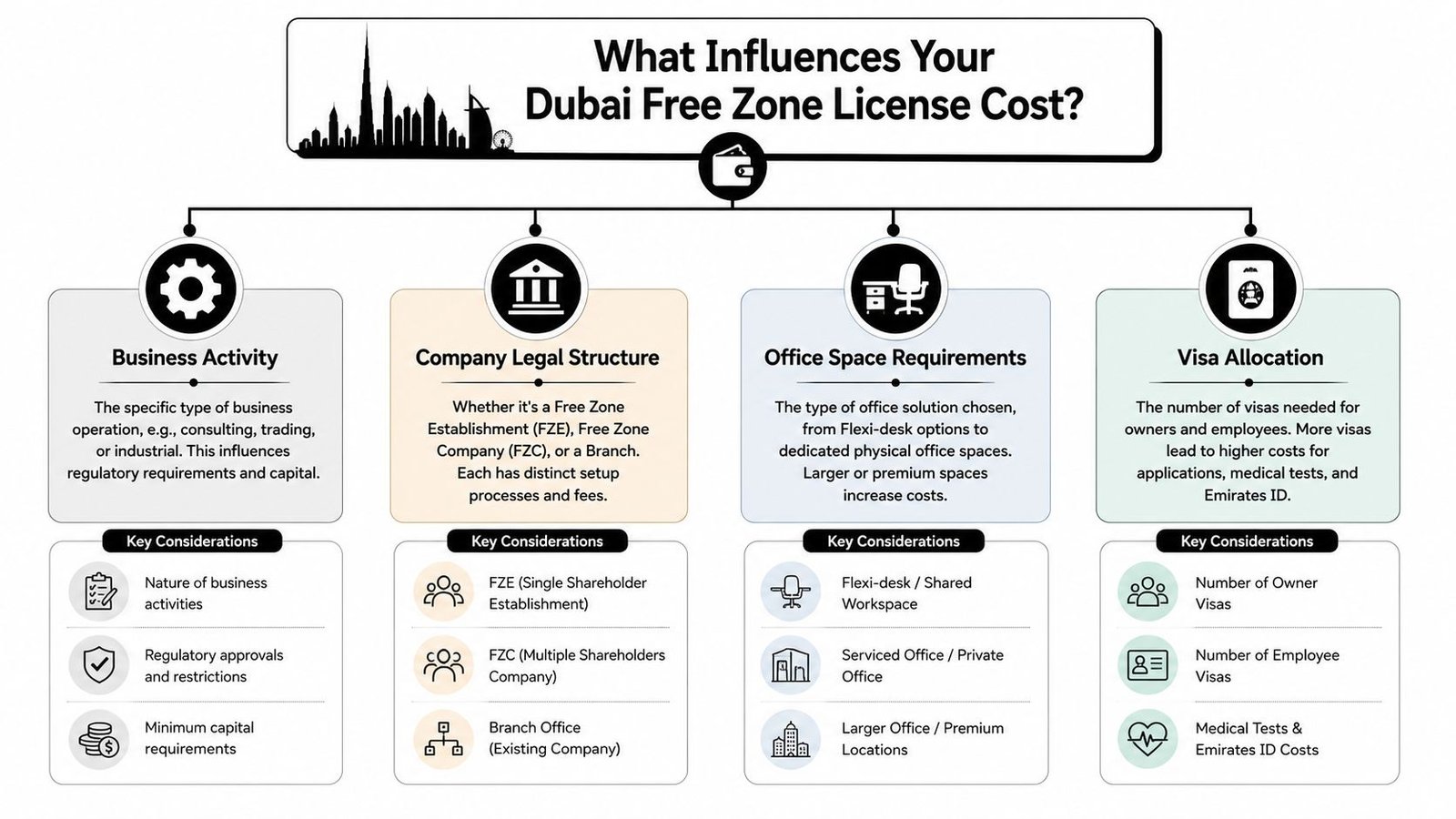
The final invoice changes because Free Zone pricing follows regulation, not just branding. The UAE government states that Free Zone licence costs depend on the licence type, entity structure, and business activity, and standard applications usually receive the licence within 14 working days after document submission through the relevant authority, as explained in the UAE Ministry of Economy's Free Zone business guidance.
How does the business activity change the fee
Business activity is the licensed description of what your company is allowed to do. A simple consulting activity is usually cleaner to approve than a broader trading or industrial activity, because the authority may need to assess more documents, more operational detail, or extra approvals.
That's why two companies in the same Dubai Free Zone can receive different pricing. One may be doing straightforward professional services, while the other needs permissions linked to products, storage, education, health, or specialised technical work.
Why does legal structure affect pricing
Legal structure is the form of the company itself, such as a Free Zone Establishment for a single owner, a Free Zone Company for multiple shareholders, or a branch of an existing overseas or UAE entity. The more complex the ownership and document trail, the more administration tends to sit behind the quote.
A branch often sounds simpler because it isn't a brand-new business concept. In practice, it can still involve more supporting paperwork because the authority needs to verify the parent entity and its legal documents.
A cheap quote can become an expensive setup if the legal structure doesn't match the shareholder documents you actually have.
How do visas and office choices move the budget
Visa allocation has a direct cost effect even when the licence looks affordable. Each additional sponsored person usually adds immigration processing, medical testing, Emirates ID processing, and related admin.
Office requirements also drive cost because Free Zones link many packages to facility type. A founder working alone in Dubai or Sharjah can often start with a shared facility, while a growing team in the United Arab Emirates may need a proper office to support staff count and daily operations.
A simple way to think about the cost drivers is this:
| Cost driver | Why it changes the budget | Typical effect |
|---|---|---|
| Activity type | Some activities need broader permissions or added approvals | Can raise fee and timeline |
| Entity structure | Ownership model changes documentation and incorporation process | Can increase setup complexity |
| Visa count | Each person adds immigration steps | Raises first-year budget |
| Office type | Flexi-desk and dedicated office are priced differently | Often the largest variable |
How Do Costs Compare Across Popular Free Zones
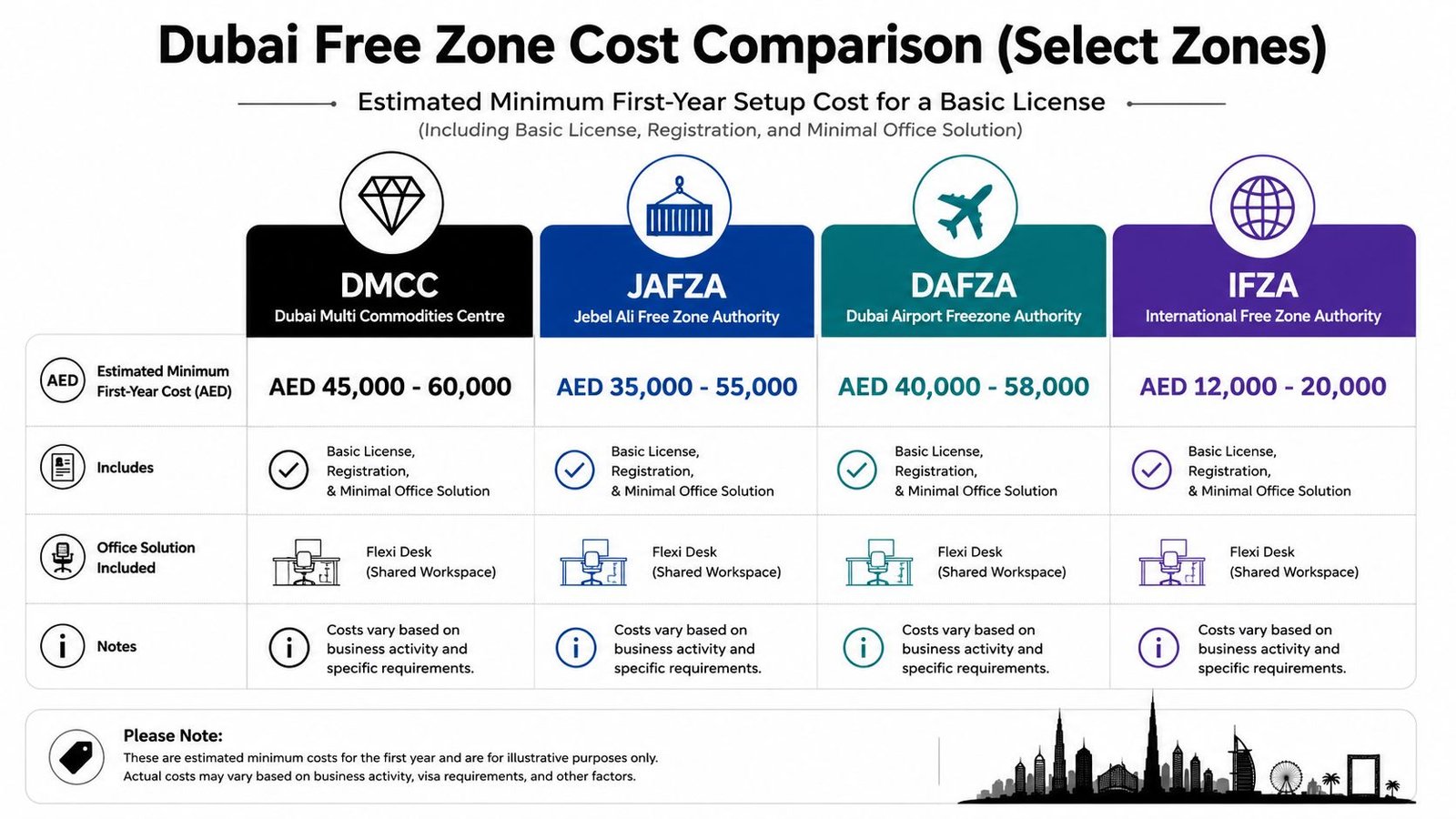
Free Zones don't compete on price alone. They also differ in reputation, facilities, bank-facing perception, and what's bundled into their standard packages. That's why comparing the Dubai Free Zone license cost by headline number alone often leads founders to the wrong shortlist.
Why do budget zones and premium zones feel so different
Aston's market comparison says a standard all-in first-year budget in most established Dubai Free Zones is AED 40,000 to AED 80,000, while budget-friendly zones such as IFZA can start from AED 10,000 for the licence, with additional visas around AED 2,500 each. The same analysis also notes a refundable share capital benchmark of AED 50,000 for a credible Dubai Free Zone entity in many cases, which matters for founders planning substance and banking from day one, according to Aston VIP's comparison of fees across top Dubai Free Zones.
That split tells you a lot about the market. Some zones are priced for lean entry. Others are priced for established trading groups, firms that want stronger infrastructure, or businesses that expect more operational depth.
DMCC is the Dubai Multi Commodities Centre. It's widely seen as a mature, premium Free Zone and its own published example shows AED 20,285 per year for the licence alone, which reinforces the point that first-year totals go well beyond the annual licence line.
IFZA is the International Free Zone Authority. It's often shortlisted by solo founders and small teams because entry pricing can be lighter, especially when the founder wants a lean start rather than a prestige address.
Meydan Free Zone is often considered by service-led businesses looking for a Dubai address and a relatively straightforward setup path. The appeal is usually ease and packaging, not just the starting fee.
What does a side-by-side comparison look like
A side-by-side view helps, but only if you treat it as a starting point. The right comparison is not “which zone is cheapest?” It's “which quote includes what I need?”
| Free Zone | Best For | Estimated First-Year Cost (AED) |
|---|---|---|
| IFZA | Solo founders and small teams looking for a lower entry point | From AED 10,000 for the licence, with visa costs added separately |
| DMCC | Businesses that want a well-known, established Dubai base | Part of the wider AED 40,000 to AED 80,000 first-year range seen in established zones |
| Meydan Free Zone | Service businesses prioritising convenience and a Dubai presence | Varies by package, activity, visa need, and office requirement |
The lowest headline price doesn't always mean the lowest usable budget. One package may include part of the facility cost, while another shows only the licence and leaves immigration and office costs for later.
When comparing quotes, ask these questions in writing:
- What is included in the first-year amount
- Is the visa included, or only the visa allocation
- Is the office a flexi-desk or a dedicated space
- Are establishment, immigration, and ID-related charges included
- What will renewal look like if nothing changes
What Are the Add-On Costs I Should Budget For
A low advertised licence price rarely reflects the cash you need to get the company operational. In practice, the gap comes from immigration charges, facility upgrades, document work, and service fees that sit outside the headline package.
For a new founder, the key question is not the licence price. It is the total first-year cost to open, activate, and maintain the company without delays.
Which add-ons are usually mandatory
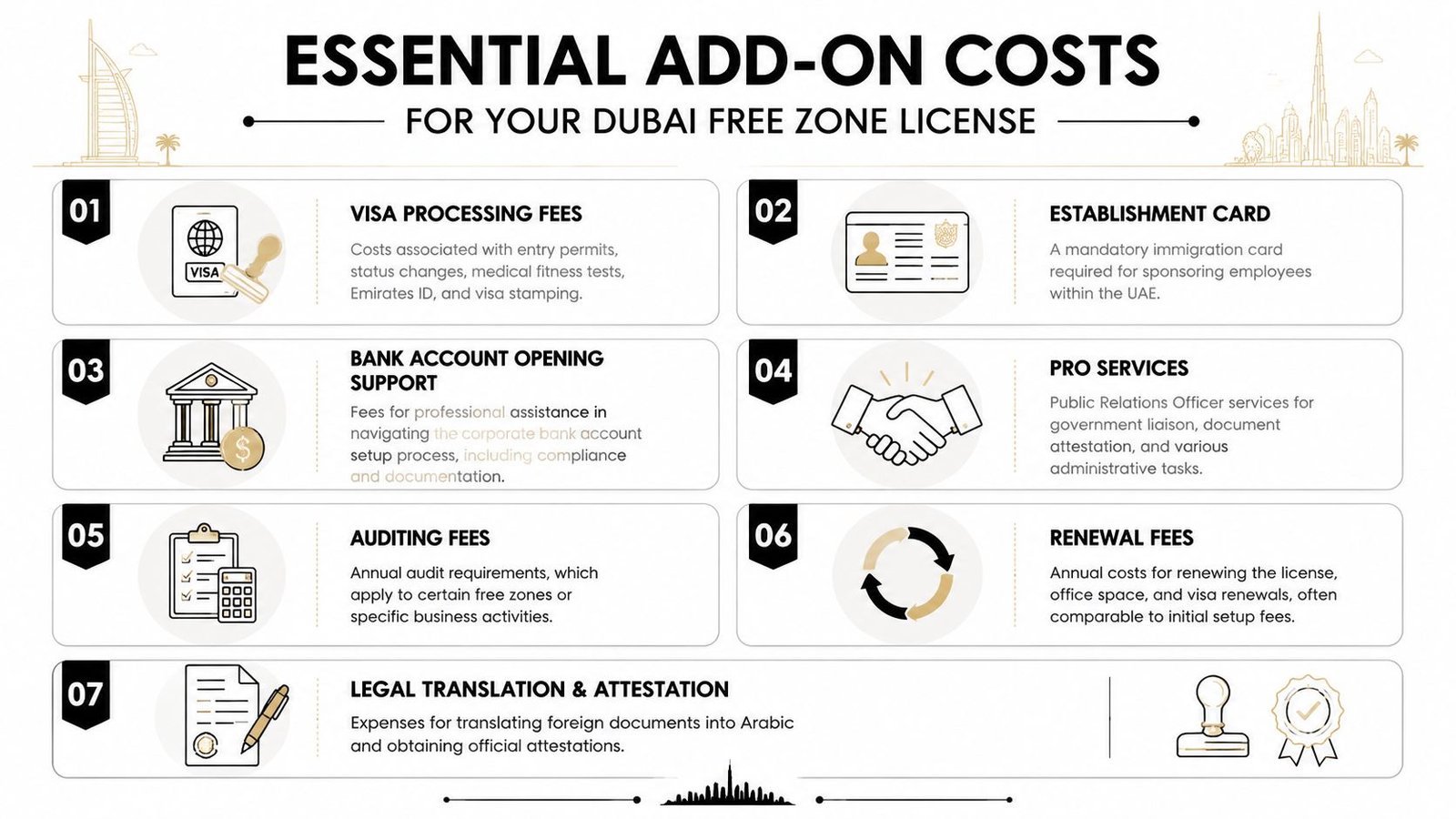
The first item to check is visa processing. Many entry packages mention a visa, but that can mean visa eligibility only, not the full chain of costs. You need to confirm whether the quote includes status adjustment or entry permit, medical fitness testing, Emirates ID, and visa stamping or issuance.
The Establishment Card is another regular omission. If the company will sponsor the owner or staff, this immigration file is usually part of the setup. Founders often assume it is built into the main registration fee, then find it added later.
Document translation and attestation can also become a real cost if any shareholder or corporate papers were issued outside the UAE. Such expenditures can cause budgets to go off track, especially for overseas parent companies, multiple shareholders, or documents that need notarisation before submission.
I tell clients to check these items before approving any quote:
- Visa processing: Ask whether the amount covers the full visa path or only the quota.
- Establishment Card: Confirm if it is included in year one.
- Medical and Emirates ID: Check if they are bundled or charged separately.
- Translation and attestation: Review foreign documents early.
- External approvals: Some regulated activities need consent from another authority before the licence is issued.
A practical explainer helps if you're new to the process:
Which costs are often left out of basic quotes
Some fees are optional, but they are still common enough to budget for.
Bank account opening support is one example. It is not a government fee, and some founders do not need it. But banking in the UAE is documentation-heavy, and support can reduce back-and-forth if the shareholder is overseas, the activity is sensitive, or the file is not straightforward.
PRO services are another common add-on. These cover government submissions, amendments, follow-up, and document clearing. A founder with time and clean paperwork may handle part of this alone. A founder trying to launch quickly usually prefers to pay for support rather than lose weeks to avoidable filing errors.
Office upgrades also catch people out. A package may include a flexi-desk, but the business may later need a dedicated desk, private office, or extra visa capacity. That changes the total first-year spend fast.
Audit or accounting support can matter too, depending on the free zone, licence activity, and reporting rules. It is better to ask about this upfront than discover the requirement near renewal.
If a package looks unusually cheap, check what has been left outside the quote. The usual gaps are visa processing, immigration file charges, document formalities, and workspace upgrades.
What should you ask before accepting a quote
Ask for a line-item quotation. It should separate the licence, registration, facility, immigration charges, and optional service fees. If the provider cannot show that clearly, the number is not reliable enough for budgeting.
Then ask what happens if your documents need correction, resubmission, translation, or amendment after submission. Those are standard first-year costs in many setups, and they are exactly the kind of expenses that do not appear in a “starting from” price.
How Can I Create a Realistic First-Year Budget
A realistic budget is usually far higher than the licence headline price. The first-year number needs to cover the company setup, the people who need residency support, the workspace the free zone requires, and a buffer for paperwork that does not go perfectly the first time.
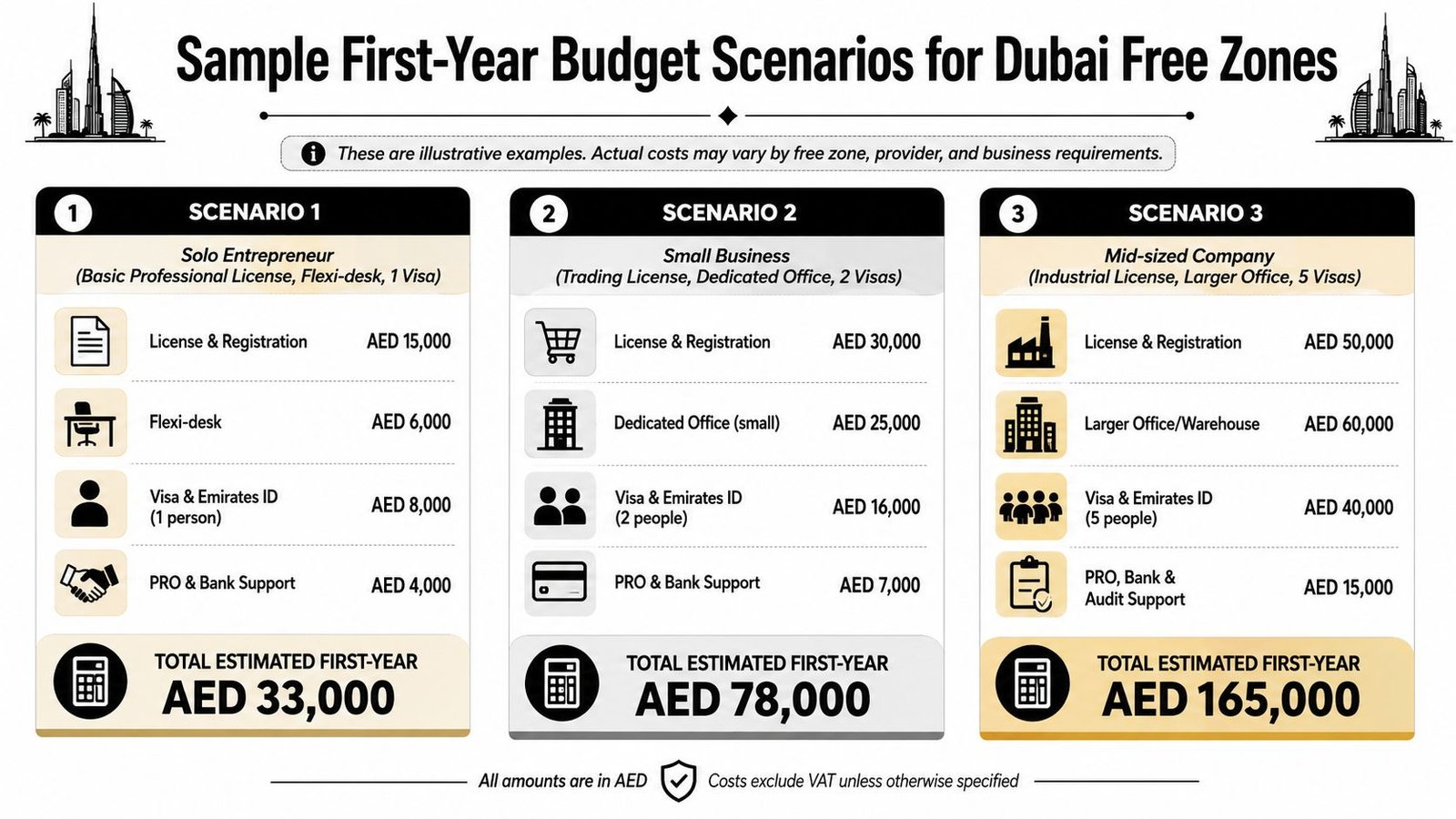
Start with the business model, because that determines where the money really goes. A solo consultant buying a freelance-style setup has a very different cost profile from a trading company that needs visas for staff and proper premises from the start. If you build your budget around a promotional licence figure, you will almost always come up short.
What might a lean freelancer budget look like
A lean freelancer budget should be built in four lines, not one:
- Company formation costs, including the licence and registration
- Facility costs, even if the package only gives a basic desk entitlement
- One residency path, if the founder needs a visa, Emirates ID, and medical testing
- A contingency amount for translations, amendments, resubmissions, courier charges, or timing-related extras
That structure matters more than any advertised starting price. In practice, a freelancer setup can look affordable at the quote stage and still become expensive once visa processing and admin charges are added. Founders who already hold valid UAE residency often save meaningfully here. Founders who need a full visa path should assume the first-year cash outlay will be materially higher than the licence fee alone.
The safer approach is simple. Budget for the full operating setup you need in year one, not the cheapest possible entry point.
How should a small team budget differently
A two or three person team should budget by headcount as well as by company. That sounds obvious, but it is where under-budgeting happens most often.
The company has its own setup cost. Then each sponsored founder or employee adds immigration, medical, Emirates ID, and processing expenses. In some free zones, the workspace package also has to change once visa capacity or actual usage increases. A team budget that ignores those layers usually misses the actual number by a wide margin.
I usually tell clients to separate the worksheet into two blocks. One block covers company costs. The second block lists each person who needs to be operational in the UAE, with their own immigration and onboarding costs. That makes trade-offs easier to see. You can decide whether to launch with two visas instead of three, or whether one founder can enter later after revenue starts.
The cleanest first-year budget is built around who must be on the ground in the UAE from day one, not who might join later.
What changes when a business needs trading or industrial capacity
Trading and industrial businesses should budget more conservatively from the outset. The licence fee is only one part of the spend. These setups often trigger higher facility requirements, more detailed document review, and activity-specific approvals that can add both direct fees and delay costs.
A trader may need extra paperwork tied to goods, customs processes, or product categories. An industrial applicant may need a warehouse, a larger unit, or technical approvals before the file is complete. Those items do not always appear in headline package pricing, but they affect the first-year number immediately.
For that reason, first-year budgeting for trading or industrial activity should include a buffer that is larger than a service business would usually need. The risk is not just paying more. The risk is tying up cash in stages you did not plan for, then having to upgrade the package mid-process.
A useful rule is to build the budget in three layers. First, the company setup. Second, all people-related costs. Third, activity-related extras such as premises upgrades, approvals, and document work. That gives you a working first-year figure you can use, instead of a licence price that only gets you through the first invoice.
What Are the Smartest Ways to Lower My Setup Costs
The cheapest setup on paper isn't always the cheapest setup in practice. Cost control works best when you reduce unnecessary complexity, not when you strip out mandatory items and hope to fix them later.
Which savings are sensible and which are risky
Start with the activity list. Founders often add extra activities “just in case”, but every extra activity should have a reason. If an activity may trigger extra review or approvals, don't include it unless you plan to use it.
Choose the office type based on your real first-year need. If a flexi-desk supports your visa plan and your way of working, it's usually a cleaner place to start than a private office you don't yet need.
Keep the shareholder documents clean and ready before filing. Delays caused by inconsistent names, missing attestations, or translation gaps can create extra admin and extra spend.
How do you avoid false economy
A low quote becomes expensive when it leads to rework. That happens when the chosen Free Zone doesn't suit the activity, the visa assumption is wrong, or the package excludes items the founder thought were included.
The better approach is simple:
- Match the activity to the actual business model: Don't buy a broad licence if a narrower one does the job.
- Set visa needs early: Count founders and staff who need residency support in year one.
- Ask for a line-item proposal: If the provider can't show what's included, the quote isn't decision-ready.
- Plan renewals from the start: Annual costs matter. A setup only works if you can carry it into year two.
Good cost planning doesn't mean buying the smallest number. It means buying the right structure once, with enough clarity that there are no surprises after incorporation.
Not sure which Free Zone fits your activity, visa plan, and budget? Speak with Inpro Corporate Services L.L.C. for a clear first-year cost breakdown and practical guidance on setting up in Dubai, Abu Dhabi, Sharjah, and across the UAE.