


There isn't one Dubai investor visa cost. In practice, you can be looking at roughly AED 10,000 to AED 15,000+ in government and processing fees for a basic route, while a 10-year Golden Visa can require an AED 2 million qualifying investment before you even count the permit package.
That gap is why so many articles mislead readers. They quote one fee, usually the neatest-looking government number, and ignore the actual cost stack that investors face once medicals, Emirates ID, status changes, company setup choices, and family sponsorship enter the picture. If you're budgeting for 2026, the right question isn't “What is the visa fee?” It's “Which investor route fits my profile, and what will the full pathway cost me from eligibility to residency?”
Table of Contents
- The Myth of the Single Price Tag
- Anatomy of the Cost What Are You Actually Paying For
- Comparing the Three Main Investor Visa Pathways
- Mainland vs Free Zone How Your Business Setup Impacts Cost
- Sample Scenarios Dubai Investor Visa Costs in 2026
- Planning for the Future Renewal and Dependent Visa Costs
- Get a Transparent Investor Visa Quote from Inpro
The Myth of the Single Price Tag
If you've searched for Dubai investor visa cost online, you've probably seen articles that present a single price as if the answer were simple. It isn't. The confusion starts with official channels themselves, because different routes and service bundles produce different totals.
One official channel lists a 2-year investor residence application at AED 10,212.50 on the Dubai Land Department investor visa service page. Elsewhere, government channels show a different figure for a Golden Visa package. That doesn't mean anyone is wrong. It means investors are often comparing unlike-for-like numbers.
Practical rule: If someone gives you one neat visa number without asking whether you're investing through property, a company, or a long-term Golden Visa route, the quote is probably incomplete.
Why the “single fee” answer fails
The final cost depends on three moving parts:
- Your route. A property-linked visa and a company-linked investor visa don't follow the same eligibility logic.
- Your duration. A shorter residence route and a 10-year Golden Visa sit in different fee structures.
- Your processing path. The total changes once medicals, ID issuance, residency confirmation, delivery, file opening, and professional handling are added.
The practical mistake is treating eligibility and processing as the same thing. They aren't. One determines whether you can apply. The other determines what you must pay to complete the file.
What serious applicants actually need to budget for
Investors usually need to separate their budget into two layers:
| Cost layer | What it covers |
|---|---|
| Eligibility capital | Property value, company share value, or qualifying investment amount |
| Processing and residency costs | Application fees, medicals, Emirates ID, administrative charges, and family permits |
That distinction matters because a low headline processing fee doesn't make a route cheap if the qualifying investment is high. The reverse is also true. A route may become accessible to more applicants, but the service-fee side of the process can still be material.
In other words, there is no single Dubai investor visa cost. There is a decision tree. The investors who budget well are the ones who price the whole pathway, not just the first number they see.
Anatomy of the Cost What Are You Actually Paying For
The visa invoice makes more sense when you treat it like a bundle of separate compliance steps rather than one government product. That's how residency is processed in practice.
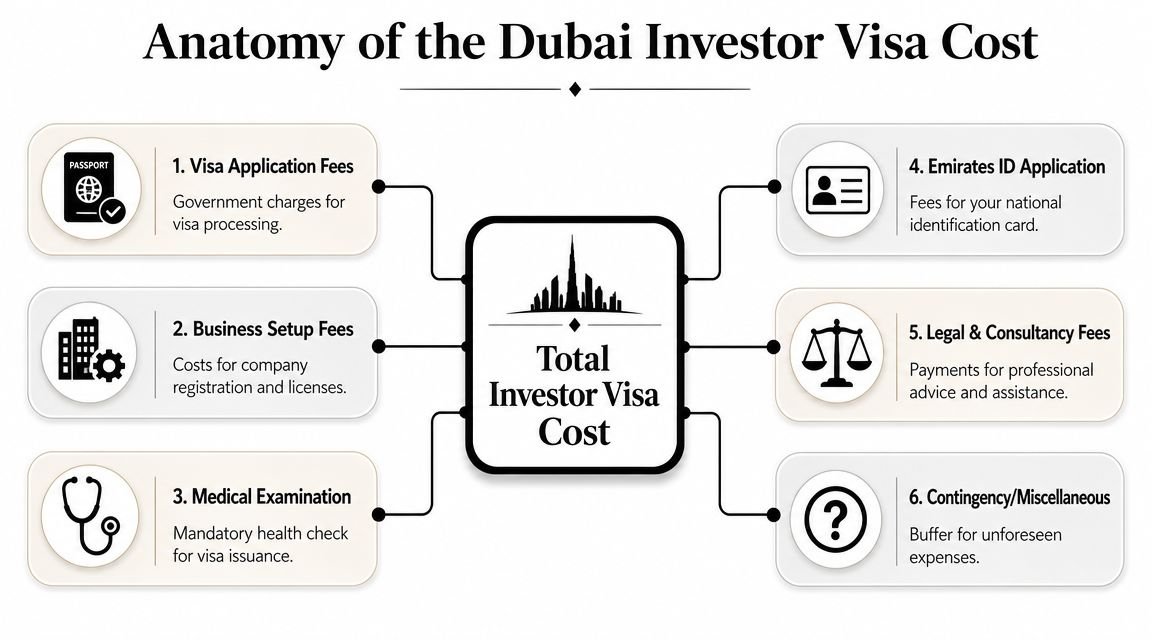
The invoice is a bundle, not a line item
A typical investor file can include some or all of the following:
- Visa application fees. These are the core government charges attached to the residence process.
- Business setup fees. If your path depends on company ownership, licence and incorporation costs sit upstream of the visa.
- Medical examination. Residency issuance requires a medical fitness step.
- Emirates ID application. Your residency process includes your UAE identity card workflow.
- Legal and consultancy handling. Many investors use PRO or advisory support because missing one document can delay the file.
- Contingency and miscellaneous charges. Courier, file opening, status changes, and document correction costs can appear late in the process.
A lot of buyers fixate on the first line and ignore the rest. That's where budgets drift.
What usually pushes the final number higher
The painful part isn't usually the official base fee. It's the extras that feel small in isolation but become material once they're combined.
The cheapest-looking route on paper often stops being the cheapest once you add the business structure required to support it.
Three cost drivers show up repeatedly in real investor planning:
Status and processing mechanics
Entry status, in-country processing, and documentation handling can change the final bill even when the visa category stays the same.The underlying investment vehicle
A company visa isn't just a visa. It's a visa attached to a legal entity that has to be formed, licensed, and kept compliant.Dependants and renewals
Many investors model the primary applicant only. Then they discover the family file doubles the administrative work and adds a fresh layer of permit charges.
A cleaner way to assess cost
Before you compare quotes, break them into four questions:
| Question | Why it matters |
|---|---|
| What qualifies me? | Property, company ownership, or another approved investment path |
| What does the authority charge? | The government fee bundle for the permit itself |
| What supporting costs are mandatory? | Medicals, ID, file handling, and compliance paperwork |
| Who else is included? | Spouse, children, and parents can change the total sharply |
That framework strips away the sales language. It also helps you spot when someone is quoting a visa while subtly excluding the structure needed to obtain it.
Comparing the Three Main Investor Visa Pathways
Most applicants fall into one of three lanes: company investor, property investor, or Golden Visa. The right route depends less on what sounds prestigious and more on what you're already doing with your capital.
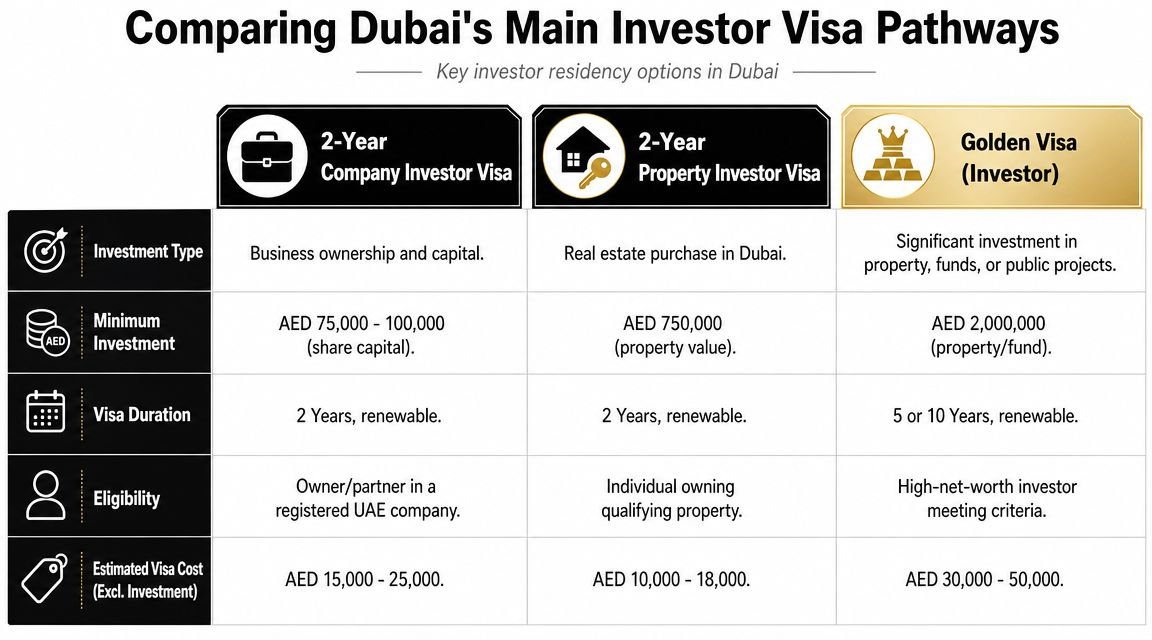
Company investor route
This route suits founders, partners, and business owners who hold a stake in a UAE company. For long-term investor status linked to company ownership, official Dubai guidance says the applicant must hold a company value of no less than AED 2 million, based on their share of company assets, and provide a certified financial report from an accredited UAE audit firm. The GDRFA Dubai investor service page lists the golden residence permit for investors at AED 2,790, plus AED 1,100 for the residence permit, AED 10 Knowledge Dirham, AED 10 Innovation Dirham, AED 500 inside-country fee, and AED 20 delivery, with the note that issuance rises by AED 100 annually whenever residency exceeds two years.
That official guidance matters because it shows two things. First, company-linked investor residency is tied to underlying corporate substance, not just a visa application. Second, the government fee is only one part of the commitment. The company itself must support the route.
Property investor route
This route appeals to buyers who want residency through real estate ownership rather than active business operations. It has become more nuanced recently.
According to recent reporting on investor visa eligibility updates, the previous AED 750,000 minimum property value for the 2-year property investor visa has been removed for sole owners, while the 10-year Golden Visa still requires property worth at least AED 2 million. That changes the entry point for some buyers, but it doesn't eliminate the service-cost layer attached to the application.
A lower property threshold can widen eligibility. It doesn't automatically make the full residency process cheap.
The property route tends to work well for investors who already planned to buy in Dubai and want residency as an extension of that decision. It works less well for people who buy solely for visa purposes without thinking through title structure, ownership paperwork, and future renewals.
A quick explainer helps visualise the differences in routes and expectations:
Golden Visa route
The Golden Visa is the long-term option commonly referred to when discussing an investor visa in Dubai, but it isn't one single category. For investors, official UAE guidance recognises eligibility through a qualifying fund deposit, enterprise capital, or company share value at the AED 2,000,000 level, as covered by the same GDRFA service guidance cited above.
Here is the practical comparison:
| Pathway | Best fit | Cost logic |
|---|---|---|
| Company investor | Active founders and shareholders | Visa cost sits on top of incorporation and compliance |
| Property investor | Buyers using real estate as residency anchor | Property ownership is the main eligibility base |
| Golden Visa | Investors seeking longer residence certainty | Higher capital threshold, longer-term residency profile |
What usually works is choosing the route that matches your genuine investment activity. What doesn't work is forcing yourself into a route because one fee looks lower in a headline.
Mainland vs Free Zone How Your Business Setup Impacts Cost
For company-based applicants, the visa decision starts much earlier than the residence application. It starts with where the company is formed and how it will trade.
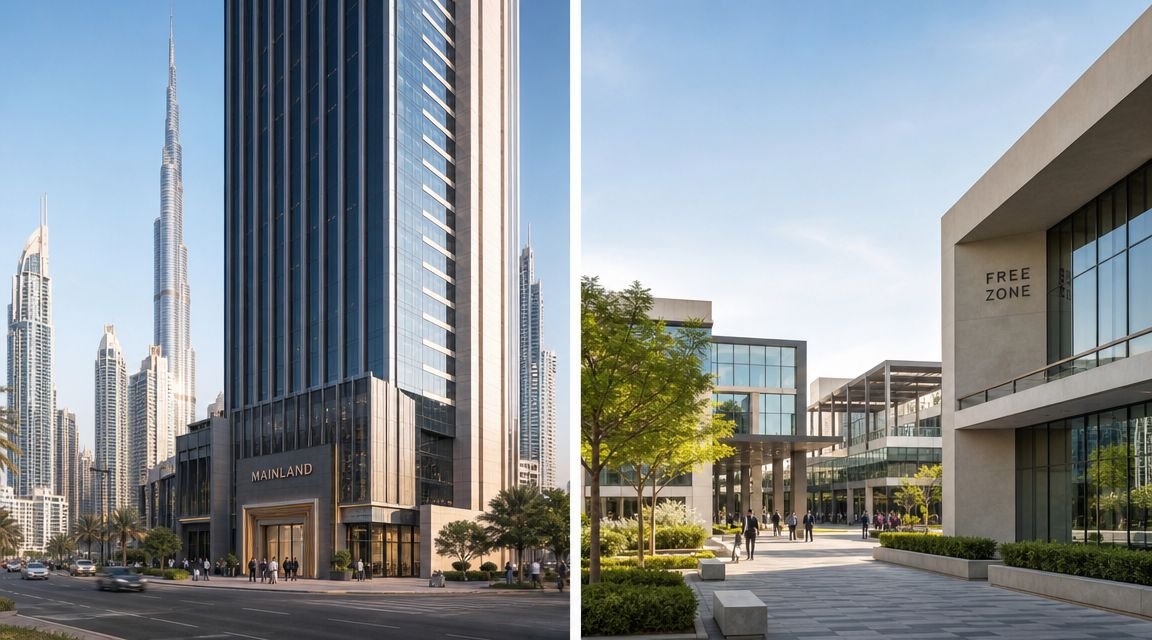
Why the visa decision starts with the licence
A Free Zone setup often appeals to international founders because the launch process can feel simpler, especially when the business serves clients outside the UAE or operates digitally. A Mainland setup becomes more relevant when the company needs direct access to the local UAE market, certain regulated activities, or a more traditional operating footprint.
The visa cost itself isn't the only variable. Your jurisdiction can influence:
- Licence structure and what activity you can legally conduct
- Office or facility expectations, depending on the authority and business model
- Corporate paperwork required to prove investor or partner status
- Ongoing compliance effort, which affects time and advisory spend
Many first-time founders make a costly mistake. They choose the cheapest incorporation option first, then discover it doesn't suit their commercial plan.
What works and what usually backfires
The better approach is to decide based on how revenue will be generated.
| Setup choice | Often works for | Risk if chosen for the wrong reason |
|---|---|---|
| Free Zone | Online services, international consulting, remote-first teams | You may need a different structure later if your local market activity grows |
| Mainland | Local trading, onshore service delivery, broader UAE market access | You may pay for capabilities you don't need if your business stays cross-border |
If your business model is simple, keep the structure simple. If your market access needs are broad, don't save a little upfront and pay for a restructure later.
The practical trade-off is clear. A lower-entry setup can reduce early spend, but only if it matches the actual operating plan. A misaligned structure often creates more cost later through amendments, additional approvals, and duplicated compliance work.
For the Dubai investor visa cost question, that means the visa cannot be assessed in isolation from the company architecture supporting it.
Sample Scenarios Dubai Investor Visa Costs in 2026
Real budgeting gets easier when you map the route to an investor profile. These examples show how the same search term, Dubai investor visa cost, can point to very different financial realities.
Scenario A solo founder using a company route
A solo tech founder wants UAE residency and plans to build a software business serving clients across several markets. In this case, the visa is only one piece of the budget. The founder also needs a legal entity, licence, establishment paperwork, and investor-status documentation that fits the ownership structure.
Because government fee bundles vary by route and authority, the founder shouldn't treat a single quoted number as the whole answer. The smarter budget separates:
- Company formation and licensing
- Investor or partner visa processing
- Medical and Emirates ID workflow
- Document handling and PRO support
- Renewal planning
This is the profile that most often underestimates the all-in cost. Founders compare visa quotes when they should be comparing market-entry structures.
| Budget area | Practical note |
|---|---|
| Company setup | The structure determines whether the visa route is even available |
| Residence processing | This is only one slice of the total spend |
| Support and compliance | Errors here usually cost time more than money, but time matters |
Scenario B property buyer targeting a 10-year Golden Visa
A property investor buys qualifying real estate and wants the longer-term stability of a 10-year residence route. Here the maths is much cleaner because the official threshold and package are published.
The Dubai Land Department Golden Visa investor service states that a 10-year real estate Golden Visa requires a property investment of at least AED 2 million. The same official service page lists the main applicant's permit package at AED 9,884.75, including AED 700 medical examination, AED 1,153 Emirates ID for 10 years, AED 2,856.75 residency confirmation, AED 4,020 Dubai Land Department fees, and AED 1,155 administrative fees.
That gives the investor a much more reliable core budget.
| Cost component | Amount |
|---|---|
| Qualifying property investment | AED 2,000,000 minimum |
| Medical examination | AED 700 |
| Emirates ID for 10 years | AED 1,153 |
| Residency confirmation | AED 2,856.75 |
| Dubai Land Department fees | AED 4,020 |
| Administrative fees | AED 1,155 |
| Main permit package total | AED 9,884.75 |
One more practical detail from that same service page matters. The stated processing time is 7 to 10 business days for the application route listed there, which helps investors plan travel, handover timing, and document readiness.
The Golden Visa property route is expensive because of the capital threshold, not because the government package itself is unusually mysterious.
That distinction is useful. Once the property qualifies, the permit side becomes easier to forecast than many company-based routes.
Planning for the Future Renewal and Dependent Visa Costs
Investors often budget like the visa is a one-off purchase. It isn't. Residency in the UAE is an ongoing compliance relationship, and long-term planning matters more than the first invoice.
Renewal changes the maths
A shorter investor route may look attractive at the start, especially when the qualifying investment barrier is lower. But shorter validity means you return to the renewal cycle sooner, with fresh paperwork, updated supporting documents, and another round of administrative handling.
For company-linked investor permits, the official GDRFA guidance noted earlier also states that the issuance fee increases by AED 100 annually whenever residency exceeds two years. That doesn't tell you every future cost, but it does show that duration affects pricing logic.
For planning purposes, experienced applicants usually ask:
- Will I keep the same qualifying investment through renewal?
- Will my company documents still support my investor status cleanly?
- Am I choosing a shorter route now only to rework the same file later?
Family sponsorship is where budgets often slip
This is the part many families miss. The principal applicant's visa may be fully budgeted, but dependant files create a separate cost stack.
The official Dubai Land Department Golden Visa investor service lists family sponsorship permits at AED 5,774.50 per person, plus AED 318.75 for file opening. That means family residency can become one of the largest secondary costs in the process, especially once a spouse, children, or parents are added.
| Dependant-related item | Amount |
|---|---|
| Family permit per person | AED 5,774.50 |
| File opening | AED 318.75 |
A practical example helps. A family of four can end up spending more on dependant residency than on the main applicant's permit package itself, based on that same official fee structure. That's why family planning shouldn't be treated as an afterthought.
Family residency is rarely “just an add-on”. It needs its own budget line from day one.
The strongest applications are usually the ones where the investor models the full household, not just the lead file.
Get a Transparent Investor Visa Quote from Inpro
Dubai investor visa cost isn't a single figure you can lift from a pricing table. It's a combined answer to four questions: what investment path you're using, what entity or asset supports it, which authority handles it, and whether your family is part of the file.
The investors who get this right don't chase the lowest-looking fee. They choose the route that fits their business or asset plan, then price the full compliance journey properly. That's the difference between a smooth application and a budget that keeps expanding mid-process.
If you're comparing options for 2026, insist on clarity around three things:
- Eligibility basis. Property, company ownership, or another qualifying investment.
- Government fee bundle. The actual permit-related charges, not just the most attractive line item.
- All-in support scope. Setup, processing, dependants, renewals, and any compliance work around them.
That level of visibility is what turns a confusing residency decision into an investable plan.
If you want a clear, all-in quote rather than a headline number, speak with Inpro Corporate Services L.L.C.. Their team helps founders and investors compare Mainland, Free Zone, property, and Golden Visa routes, then maps the full cost stack from setup and visa processing to dependant planning and compliance, with transparent pricing and no hidden surprises.