


You've registered a UAE company, or you're preparing to, and the visa application is where the uncertainty starts. For a Dubai investor visa for Bangladeshi founders, passport nationality doesn't create a separate federal capital rule. The outcome usually depends on the investment route, the company's ownership structure, and whether every document tells the same story.
Table of Contents
- Understanding the 2026 Capital Thresholds
- Comparing the Standard Partner Visa and Golden Visa
- Structuring Your Company Equity for Approval
- Synchronizing Your Document Checklist
- Navigating the Medical and Emirates ID Process
- Securing Your Setup with a PRO Partner
Understanding the 2026 Capital Thresholds
What capital does a Bangladeshi investor need?
The UAE investor-visa framework uses clear investment thresholds rather than nationality-specific rules. The same federal criteria apply to Bangladeshi applicants and other foreign investors entering the United Arab Emirates, although the issuing authority and supporting documents depend on the route you choose.
The central long-term benchmark is AED 2 million. Under the UAE Government Golden Visa platform, investors in public investments may qualify for a 10-year residence, while real-estate investors may qualify for a 5-year residence, subject to the applicable criteria. The Ministry of Economy and Tourism describes long-term residence as running from 5 to 10 years for investors, entrepreneurs, and talented individuals.
That threshold shouldn't be confused with the requirements for every ordinary company-owner visa. A standard investor or partner residence route is generally connected to a valid UAE business licence and shareholding position, rather than one fixed federal minimum capital amount. The AED 2 million figure is the documented baseline for the long-term investor route, not a universal minimum for forming a company or applying for every partner visa.
How does the public-investment route work?
For public investments, the investor must meet the capital requirement through qualifying deposited capital, company equity, or another accepted investment form. The official criteria also refer to ownership or contribution to an establishment that pays at least AED 250,000 annually in taxes, where that route applies. The capital must be owned by the applicant and not financed through a loan, and health insurance is required for the investor and family members under the published Golden Visa conditions.
This distinction matters before you select Dubai, Abu Dhabi, Sharjah, or a free zone. A founder may qualify for a short-term partner residence through a licensed entity while remaining far below the Golden Visa threshold. That can be a sensible starting point when the business is new, but it doesn't create Golden Visa eligibility by itself.
Practical rule: Choose the visa route before paying for a company structure. The licence, shareholding evidence, property records, and immigration application must support the same investment story.
For Bangladeshi applicants, the useful first question is therefore not whether Bangladesh has a special visa quota. It is whether the proposed investment is documented under the route being used. That approach removes a common source of anxiety and directs attention to the issues that delay applications, ownership evidence, valuation, passport validity, and document matching.
Comparing the Standard Partner Visa and Golden Visa
What is the standard Dubai investor or partner visa?
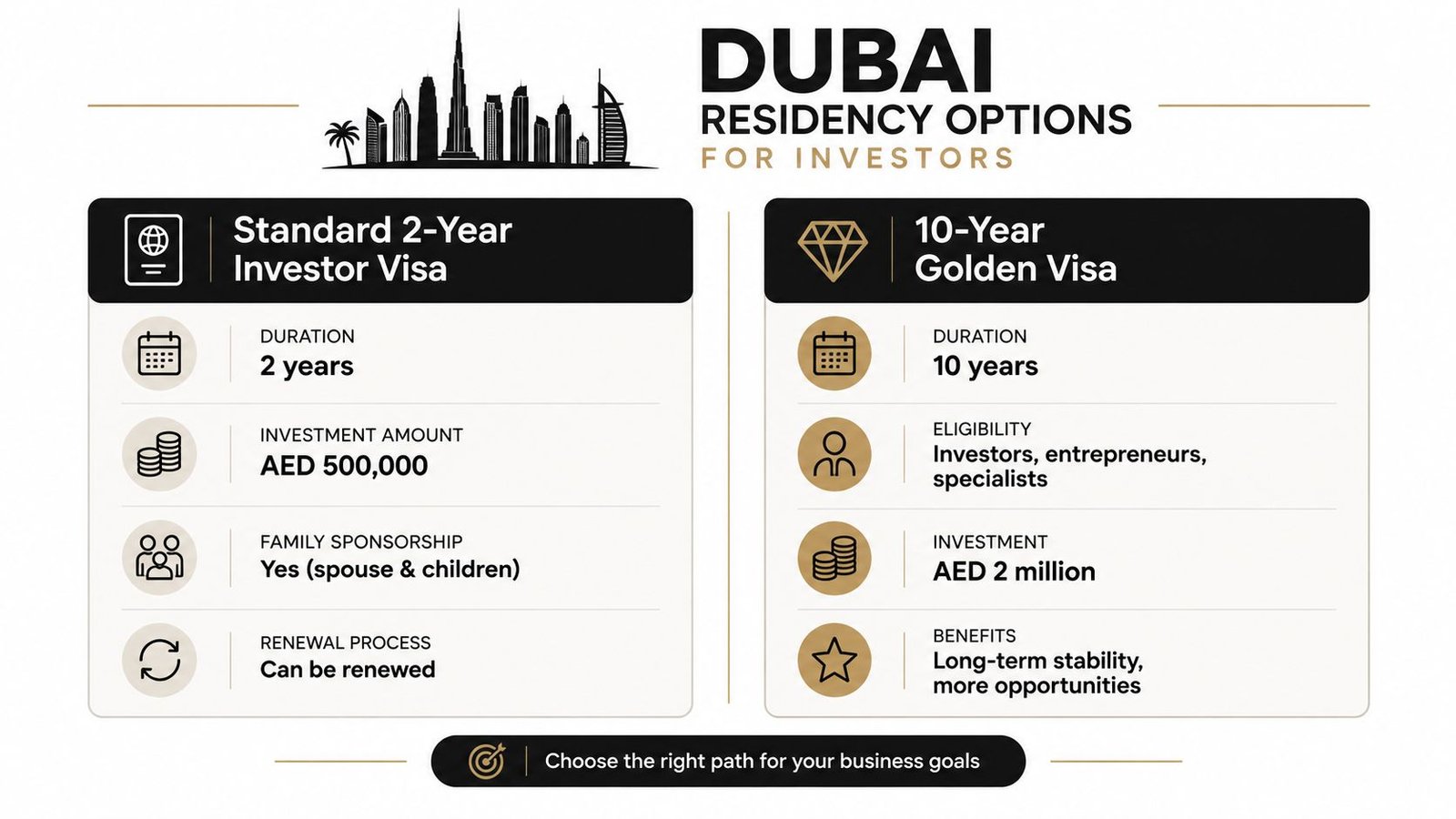
A standard investor or partner visa is a residence permit linked to ownership or partnership in a UAE-licensed business. In Dubai, the typical duration for this route is 2 years, and the application depends on holding a valid business licence and an acceptable shareholding structure rather than meeting the Golden Visa's AED 2 million investment threshold. The route can suit a founder who needs residence to operate a new company but hasn't yet deployed the capital required for long-term residency.
For a free zone company, the relevant free zone authority usually manages the visa process under UAE immigration rules. Mainland businesses use the applicable Dubai immigration and labour channels, with the Ministry of Human Resources and Emiratisation, or MOHRE, involved in mainland employment matters. A free zone visa is tied to the relevant free zone business and doesn't automatically authorise mainland employment.
What makes the Golden Visa different?
The Golden Visa is a long-term residence permit. For investors, the federal framework provides a 10-year period for qualifying public investments and a 5-year period for qualifying real-estate investments, with AED 2 million as the principal documented investment threshold in the routes described by the UAE authorities.
The trade-off is straightforward:
| Route | Main basis | Typical residence position |
|---|---|---|
| Standard investor or partner route | Valid UAE business licence and qualifying shareholding | Usually 2 years |
| Golden Visa investor route | Qualifying investment or company capital of AED 2 million | 5 or 10 years, depending on route |
The standard route is more accessible for a founder whose capital is committed to licensing, premises, staff, or working capital. The Golden Visa offers a longer residence horizon, but the authority will examine the qualifying investment itself, not the existence of a trade licence.
Does the jurisdiction change the decision?
A free zone may appeal to founders who want a structured setup process and foreign ownership within the zone. Mainland may fit a company that needs direct access to the wider UAE market or local contracting arrangements. Abu Dhabi, Dubai, and Sharjah each have their own licensing authorities and practical workflows, so the best jurisdiction depends on the activity, office requirement, ownership plan, and visa needs.
The key mistake is choosing a jurisdiction solely because an agent advertises a low setup price. A cheap licence that leaves the founder with an unsuitable shareholding structure or insufficient visa allocation can cost more to correct than a properly planned setup.
Structuring Your Company Equity for Approval
Why can a valid trade licence still fail?
A trade licence proves that a company exists and is authorised for its activity. It doesn't automatically prove that the person applying for an investor or partner residence has the right ownership position for that visa route.
The cap table, meaning the record of who owns what percentage or shareholding in a company, becomes decisive. Dubai South's published guidance for Bangladeshi entrepreneurs refers to initial approval, a sole-shareholder structure, and one residence visa reserved for that shareholder in the relevant setup route. A company can therefore hold a valid licence while its ownership pattern doesn't support the intended founder visa.
What equity structure should you check first?
Before incorporation, confirm whether the authority expects one qualifying investor or permits several partners for the selected activity and visa route. Don't rely on a verbal assurance that “investor visa” means every shareholder qualifies. Ask for the ownership condition in writing and compare it with the proposed memorandum, partnership contract, and licence application.
Use this order:
- Confirm the activity and authority. Check whether the company will be established in Dubai Mainland, Dubai South, a Dubai free zone, Abu Dhabi, Sharjah, or another jurisdiction.
- Identify the qualifying shareholder. Decide whose investment and ownership will support the residence application.
- Test the cap table. If the route requires a sole shareholder, adding a second founder can block the application even if both founders are genuine investors.
- Match the legal documents. The trade licence, partnership or investment contract, shareholder register, and immigration application should identify the same investor in the same capacity.
- Only then submit the visa file. Immigration officers shouldn't have to reconcile conflicting ownership documents.
A multi-partner structure isn't automatically wrong. It becomes a problem when the selected authority's investor route is designed around one qualifying shareholder.
The practical choice may involve a real business trade-off. A sole-shareholder company can make the founder visa simpler, while a multi-partner company may better reflect commercial reality. If more than one person needs residence, the structure must be checked before incorporation, not after the first application is rejected.
Synchronizing Your Document Checklist
Which documents are needed for a company-linked visa?
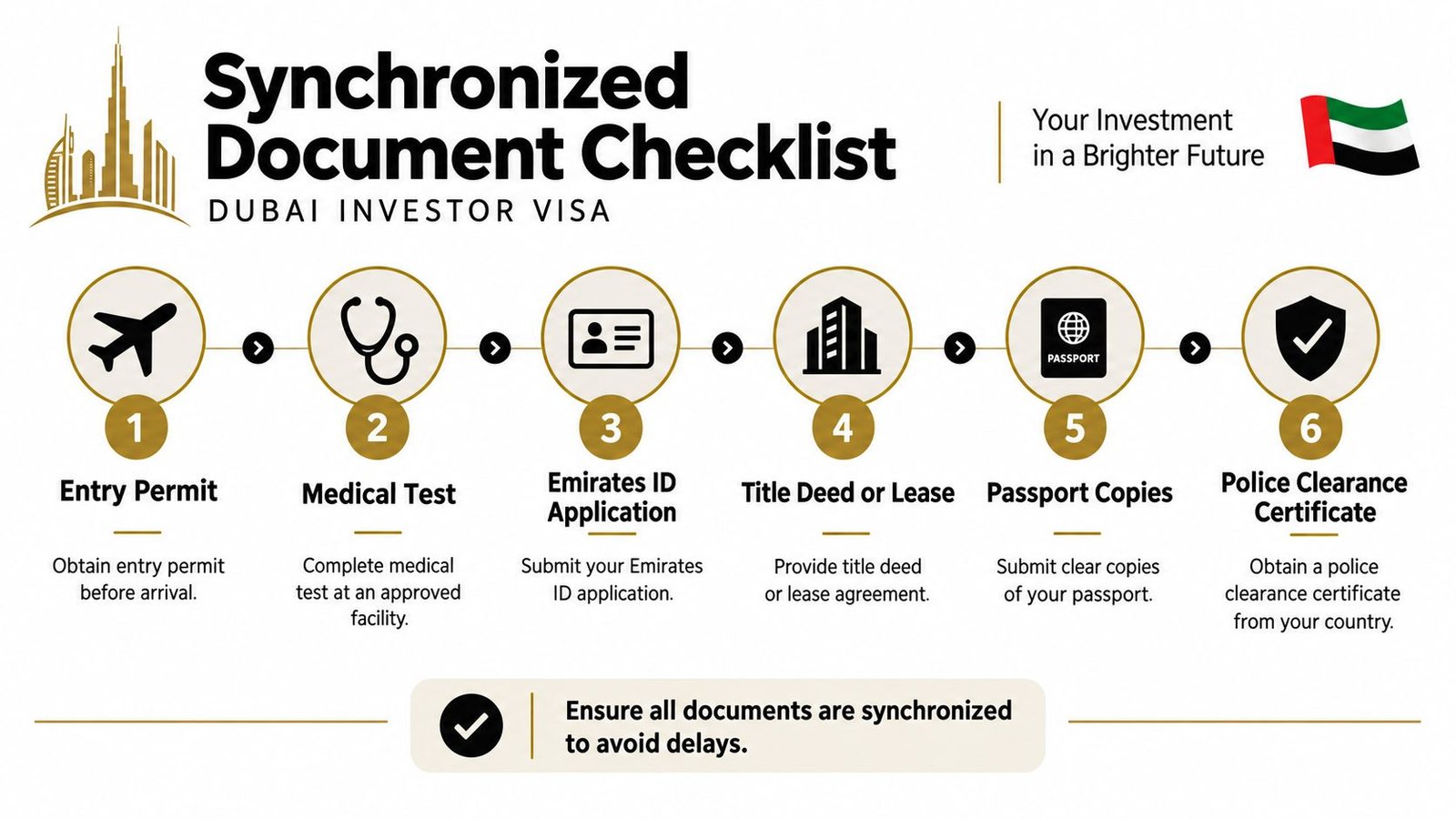
For Dubai investor or partner residence, the UAE Government investor-visa requirements identify a passport copy valid for at least 6 months, a partnership or investment contract, and a trade licence as core documents. Dubai's General Directorate of Residency and Foreigners Affairs, commonly called GDRFA, uses the same basic document logic.
The issue is rarely the existence of one document. It's whether the documents agree on the applicant's name, ownership role, company details, and current status. A passport renewed after incorporation, for example, can create a mismatch if the older passport information still appears in the company or immigration file.
What should a property investor prepare?
For a Dubai property-linked route, the Dubai Land Department investor-visa service identifies the relevant evidence. Individual property owners may apply regardless of property value under that route, while joint owners need a share worth at least AED 400,000 to qualify for the residence visa.
The file should include:
- Title deed: Confirm that the owner name and ownership share match the passport.
- Personal photograph: Use a current photograph that meets the application specification.
- Emirates ID: Include it if available.
- Residence status: Add the current residence visa or entry permit if available.
- Good Conduct Certificate: Provide the Dubai-issued certificate required by the Dubai Land Department.
- Golden Visa evidence: For the higher-tier investor route, prepare proof of at least AED 2 million in qualifying deposited capital, company equity, or accepted tax-paid activity, together with evidence that the investment is fully owned and not loan-financed.
In what order should you assemble the file?
Start with identity documents, then confirm the company or property evidence, then obtain police-clearance documentation, and finally submit the immigration file. This order helps you catch discrepancies before paying application fees or attending a typing centre.
For a joint property owner, verify the registered share before collecting the remaining documents. For a company founder, verify the shareholding structure and contract before preparing the application. The valuation or document-matching stage is often where an application stops, so treat consistency as a requirement rather than an administrative detail.
Navigating the Medical and Emirates ID Process
What happens after the entry permit?
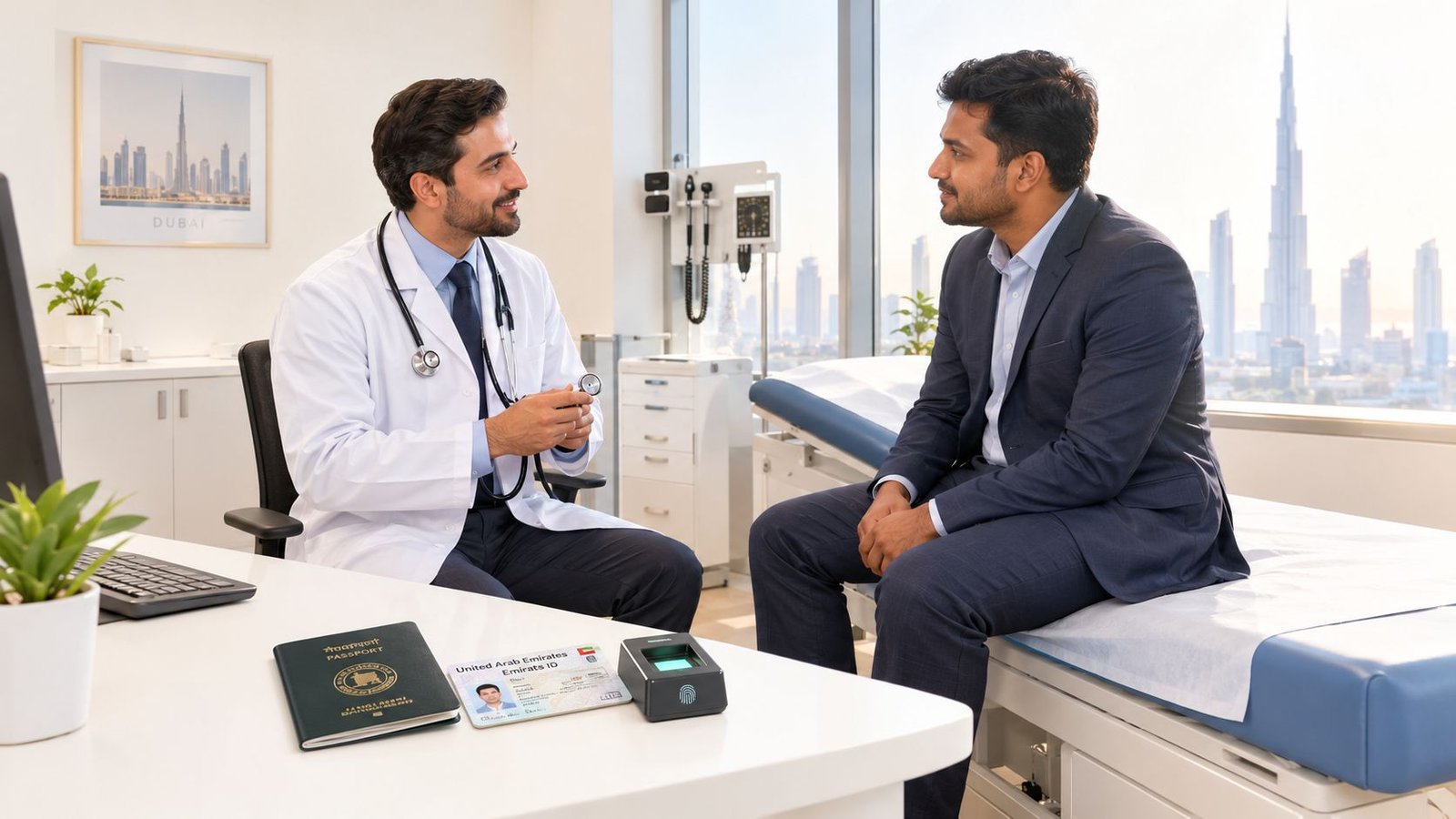
Once the entry permit or status-change stage is ready, the process becomes physical. The applicant attends an approved medical fitness centre for the required examination, then completes the Emirates ID application and biometric registration. The Emirates ID is the UAE identity card issued by the Federal Authority for Identity, Citizenship, Customs and Port Security, and it becomes a central identity document for banking, government services, and daily administration.
A typing centre, officially a service centre that prepares and submits government applications, checks the application data and uploads the supporting documents. It doesn't decide whether the investor qualifies. That decision remains with the relevant immigration or authority channel, so a typing-centre submission can't fix an unsuitable equity structure or contradictory title deed.
What should you expect at the medical centre?
Bring your passport and the entry or residence application details supplied by the authorised service channel. Staff register the applicant, verify identity, conduct the required medical fitness procedures, and issue the result through the relevant system.
The useful preparation is simple. Keep the name spelling identical across the passport, application, and company documents. If the applicant has changed passports, tell the PRO, meaning Public Relations Officer, before the medical booking rather than allowing the old passport number to remain in the file.
How does biometric registration finish the process?
After the medical result is recorded, the applicant attends the Emirates ID service appointment for fingerprints and other biometric information. The authority then completes the residence issuance process through the applicable Dubai or federal channel.
A founder shouldn't schedule travel around an assumed approval date until the medical result and identity application have been accepted. If the applicant is already inside the UAE, the status-change route must be handled within the permitted period. If the applicant is outside the United Arab Emirates, the entry permit and arrival sequence must be coordinated carefully.
Keep one controlled digital folder and one printed file. Every passport copy, photograph, contract, licence, and clearance certificate should be checked against the same spelling and ownership details before submission.
Securing Your Setup with a PRO Partner
What does a PRO partner actually handle?
A PRO partner manages government-facing administration for company formation, licensing, immigration, document attestation, and related approvals. The useful role isn't submitting forms. It's checking that the business structure, ownership evidence, property records, passport details, and visa application are ready in the correct order.
For a Bangladeshi founder, that can mean reviewing the proposed cap table before incorporation, confirming whether the selected authority accepts the intended shareholder arrangement, and preparing the trade licence and investment contract so they identify the same applicant. It can also mean checking whether a joint property share reaches the required threshold before the owner spends time on an otherwise incomplete file.
When does professional support add value?
Support is most useful at the points where a correction becomes expensive:
- Before licensing: Compare Mainland, Dubai free zone, Abu Dhabi, and Sharjah options against the founder's activity and residence plan.
- Before incorporation: Test sole-shareholder and multi-partner structures against the intended investor visa.
- Before submission: Reconcile passport validity, contracts, licences, title deeds, Emirates ID records, entry permits, and police-clearance documents.
- During processing: Coordinate with the relevant Dubai immigration or federal channel and track requests for additional evidence.
- For long-term residence: Review whether the documented investment supports a Golden Visa application rather than assuming that a standard partner visa converts automatically.
Inpro offers company formation and licensing support across Mainland, Free Zone, and Offshore structures, together with investor, Golden, and employee visa services. Its PRO team coordinates immigration and document workflows with channels including the Federal Authority for Identity, Citizenship, Customs and Port Security, known as ICP, and GDRFA Dubai, while the founder remains responsible for providing truthful and complete information.
How should you choose the route?
Start with the business activity and ownership reality, then select the jurisdiction and visa. Don't reverse that sequence because a package price appears attractive. A residence plan that conflicts with the company's equity structure will create delays regardless of how quickly the application is typed.
The Bangladesh Consulate General in Dubai also publishes a separate investor visa process for entry to Bangladesh. Its consular investor-visa guidance states that the visa is issued for a maximum of one year, may be single, double, or multiple entry, and requires an online application, passport photographs, a passport valid for at least six months, Emirates ID or residence-visa evidence, and proof from bodies such as BIDA, BEZA, BEPZA, or Hi-Tech Park showing bona fide investor status. That is a Bangladesh consular matter, not a substitute for the UAE residence route, so keep the two processes separate.
The safest setup is one where the licence, shareholder record, investment evidence, and identity documents were planned together from the start. That is also the point at which a PRO partner can prevent avoidable rework rather than merely respond to it.
Inpro can review your intended UAE jurisdiction, equity structure, and investor or Golden Visa documents before submission. Visit Inpro to compare setup options, estimate costs, and request practical support for your Dubai residence application.