


AED 15,000 to AED 40,000 is a common all-in first-year budget for a straightforward Dubai mainland company setup, while complex structures can reach AED 60,000 to AED 80,000. The government-fee core alone can be about AED 13,900 to AED 16,200 before office premises and visas are added.
That difference explains why the Dubai mainland company formation cost often feels higher than the advertised licence price. A licence is only one layer of the budget. You may also need trade-name approval, initial approval, Memorandum of Association (MoA) preparation, notarisation, Tasheel typing, an Ejari-registered office, immigration files and visas.
This guide is for international founders, small and medium-sized enterprises (SMEs), freelancers, HR teams handling employee visas and Golden Visa applicants considering Dubai or the wider United Arab Emirates (UAE). It also helps founders comparing Dubai with Abu Dhabi, Sharjah and the UAE's free zones.
The clearest way to plan is to treat formation as a staged cost stack, not one invoice. Once you separate government charges, premises, immigration and activity-specific approvals, the range becomes easier to understand and control.
Table of Contents
- Introduction to Dubai Mainland Company Formation Cost
- What a Dubai Mainland Company Is and How Pricing Works
- Core Government Fees and Initial Cost Components
- What Drives Your Final Cost Up or Down
- Sample Budget Scenarios for Different Founder Needs
- Dubai Mainland vs Free Zone and Offshore on Cost and Access
- How to Save Money and Plan for Renewals
Introduction to Dubai Mainland Company Formation Cost
Dubai mainland formation has a documented first-year range of AED 15,000 to AED 40,000 all-in for simpler setups, while more involved structures with larger offices, several visas or specialist activities can rise to AED 60,000 to AED 80,000, according to the 2026 Dubai mainland formation cost benchmark. These figures include more than the trade licence, which is why a low government quote shouldn't be treated as the final operating budget.
A zero-visa mainland setup can show government fees of about AED 13,900 to AED 16,200 before office and visa costs, based on the 2026 UAE mainland cost breakdown. Add premises, immigration registration and staff visas, and the total changes quickly. The same legal entity can be inexpensive to register on paper but costly to make operational.
Why does the price vary so widely?
The main variables are business activity, legal structure, office requirement and visa count. A consultant may need a professional licence and a modest workspace, while a trading company may need commercial licensing, storage or a larger office. A regulated activity can also require approval from another authority.
Dubai mainland companies are licensed by Dubai's Department of Economy and Tourism (DET). DET is the Dubai government authority responsible for business licensing and related commercial registration. Your activity determines which licence route and approvals apply.
Who needs this cost guide?
A founder relocating from overseas needs to budget for immigration as well as incorporation. A freelancer may focus on a lean professional setup, while an HR manager needs to understand how premises affect employee visa capacity. A Golden Visa applicant may also need a properly structured company and supporting documents, but personal visa eligibility and company formation are separate questions.
Free zones in Dubai, Abu Dhabi and Sharjah can offer different office models and bundled pricing. Offshore structures can be cheaper for permitted holding or international purposes, but they don't provide the same UAE operating access. The right answer depends on where your customers are and how you plan to work.
Planning principle: Ask for a cost sheet that separates one-time approvals, annual licensing, premises, immigration and optional services. That format makes hidden assumptions easier to spot.
What a Dubai Mainland Company Is and How Pricing Works
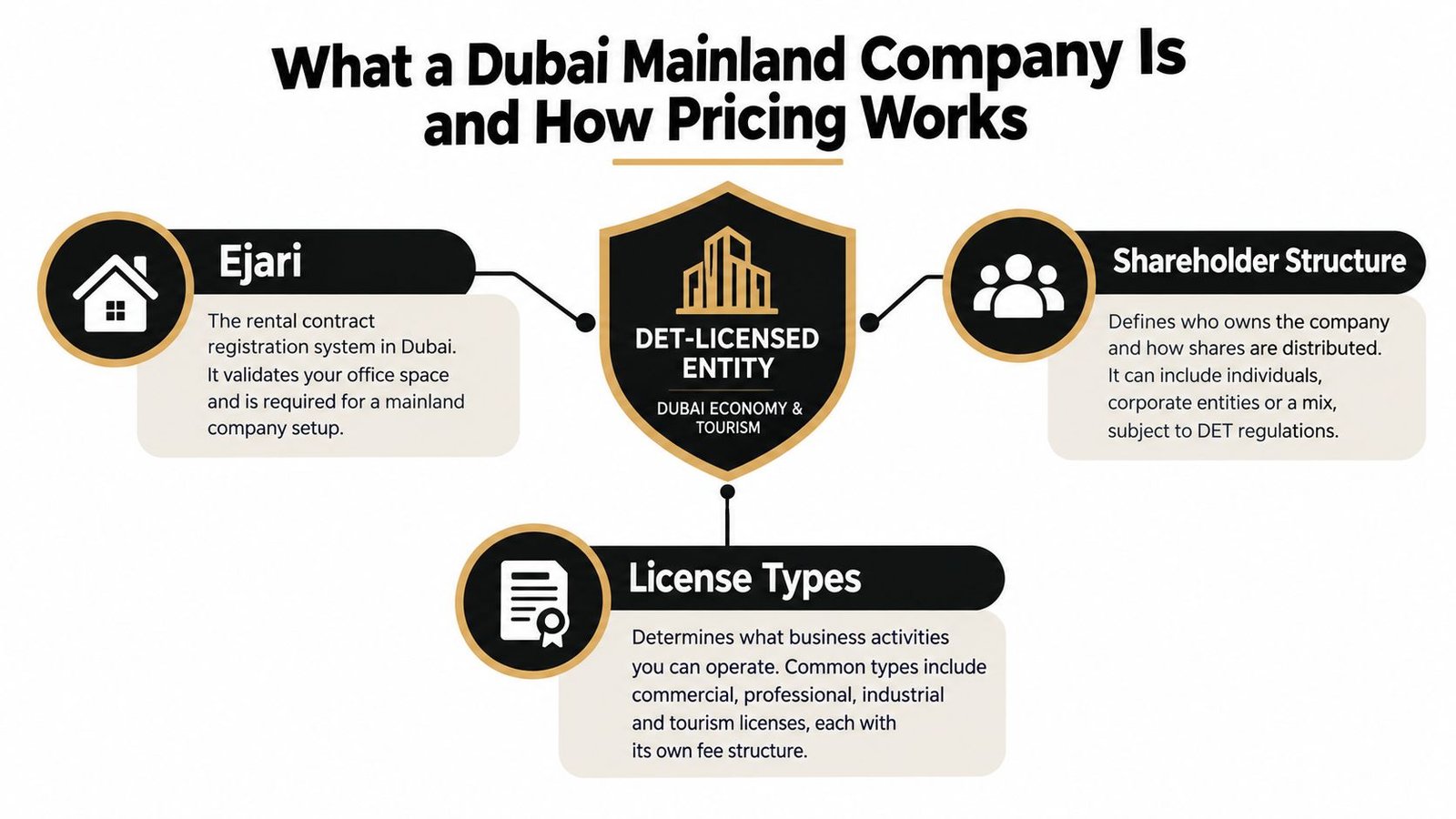
A Dubai mainland company is an entity licensed by DET to conduct an approved business activity in Dubai. Mainland licensing generally gives a company direct access to customers and commercial opportunities across the UAE, subject to the rules of the activity, contracts, customs and sector regulators.
DET licensing is the government approval that permits the company to conduct its selected activity. The licence category may be professional, commercial, industrial or another approved class. The category isn't just a label. It affects the application path, documentation, premises and likely fee range.
Ejari is Dubai's tenancy contract registration system. A mainland company normally needs lease evidence linked to its business premises, and the Ejari record helps show that the company has a registered operating address. A flexi-desk, shared workspace or physical office may be suitable depending on the activity and authority requirements, but the exact arrangement must be checked before payment.
An establishment card is the company's immigration file. It connects the business to immigration and labour processes and supports visa applications. It isn't the same thing as the trade licence, so a quote that includes licensing but excludes the establishment card may not represent a visa-ready setup.
Why is the cost built as a stack?
Think of the setup as building blocks:
- Business identity: Reserve the trade name and obtain initial approval.
- Legal documents: Prepare and notarise the MoA, where the structure requires it.
- Operating permission: Issue the DET trade licence.
- Physical presence: Secure premises and register the tenancy through Ejari.
- Immigration readiness: Open the establishment card and process visas if needed.
Each block answers a different government or operational requirement. Removing one from a quotation doesn't necessarily remove it from the actual process.
How is mainland different from free zone and offshore?
A free zone company is licensed by a specific free zone authority, such as an authority in Dubai, Abu Dhabi or Sharjah. It may offer flexible workspace options and international trading benefits, but mainland access can require a distributor, branch, permit or another approved route.
An offshore company is an international or holding structure registered in an offshore jurisdiction. It generally isn't designed to operate an active UAE business, maintain a UAE office or sponsor residence visas. Mainland is usually the more direct structure for founders selling services or products inside the UAE.
Core Government Fees and Initial Cost Components
The government-fee stack begins before the licence is issued. A 2026 zero-visa breakdown lists trade-name approval at AED 620, initial approval at AED 120, Tasheel at AED 464, MoA typing and notarisation at AED 1,200 to AED 1,500, and the trade licence at AED 11,500 to AED 13,500. Together, these items produce about AED 13,900 to AED 16,200 before office and visa costs, as detailed in the Dubai mainland government cost analysis.
| Fee Component | Typical Range AED | Notes |
|---|---|---|
| Trade-name approval | 620 | Reserves the proposed business name |
| Initial approval | 120 | Preliminary permission to continue the application |
| Tasheel typing | 464 | Government-service typing and submission support |
| MoA typing and notarisation | 1,200 to 1,500 | Applies according to legal structure and documents |
| Trade licence issuance | 11,500 to 13,500 | The main licensing component in this example |
| Chamber of Commerce membership | Varies | May be included or quoted separately |
| Government-fee total | About 13,900 to 16,200 | Before office and visas |
What is trade-name approval?
Trade-name approval is the step that reserves an acceptable name for the company. DET checks the name against its naming rules and availability. A name that includes restricted terms, regulated references or a mismatch with the activity may require revision, which can create delay or additional administrative work.
The name should match the intended legal structure and activity. Founders who choose a name before confirming availability can lose time when the application needs to be amended.
What is initial approval?
Initial approval is the authority's preliminary confirmation that the proposed company can proceed with formation. It isn't the final licence. The application can still require legal documents, premises evidence or external approvals before licensing is complete.
This distinction matters because some quotations list initial approval as though it authorises trading. It doesn't replace the issued trade licence.
How does Tasheel typing affect the application?
Tasheel refers to government service support for typing and submitting certain applications. The fee covers the service channel or typing step, not every government charge connected with the company. Check whether a consultant's quote includes Tasheel separately or absorbs it into a formation package.
How does MoA notarisation affect cost?
The Memorandum of Association is the document that records the company's constitutional and ownership arrangements. Typing and notarisation costs depend on the structure, shareholders and documentation. A sole establishment, limited liability company or corporate shareholder arrangement may follow different document requirements.
The MoA should be reviewed before notarisation. Errors in shareholder names, passport details or ownership information can force corrections and repeat processing.
Is the licence fee fixed?
No. A separate 2026 market guide places the licence component broadly around AED 10,000 to AED 18,000, with professional, commercial and industrial activities sitting in different bands, as shown in this Dubai company registration cost guide. The quoted amount can change with the activity class, legal structure and visa requirements.
Chamber membership, establishment-card processing, immigration files and external approvals may also sit outside the headline licence number. Always request an itemised quote.
What Drives Your Final Cost Up or Down
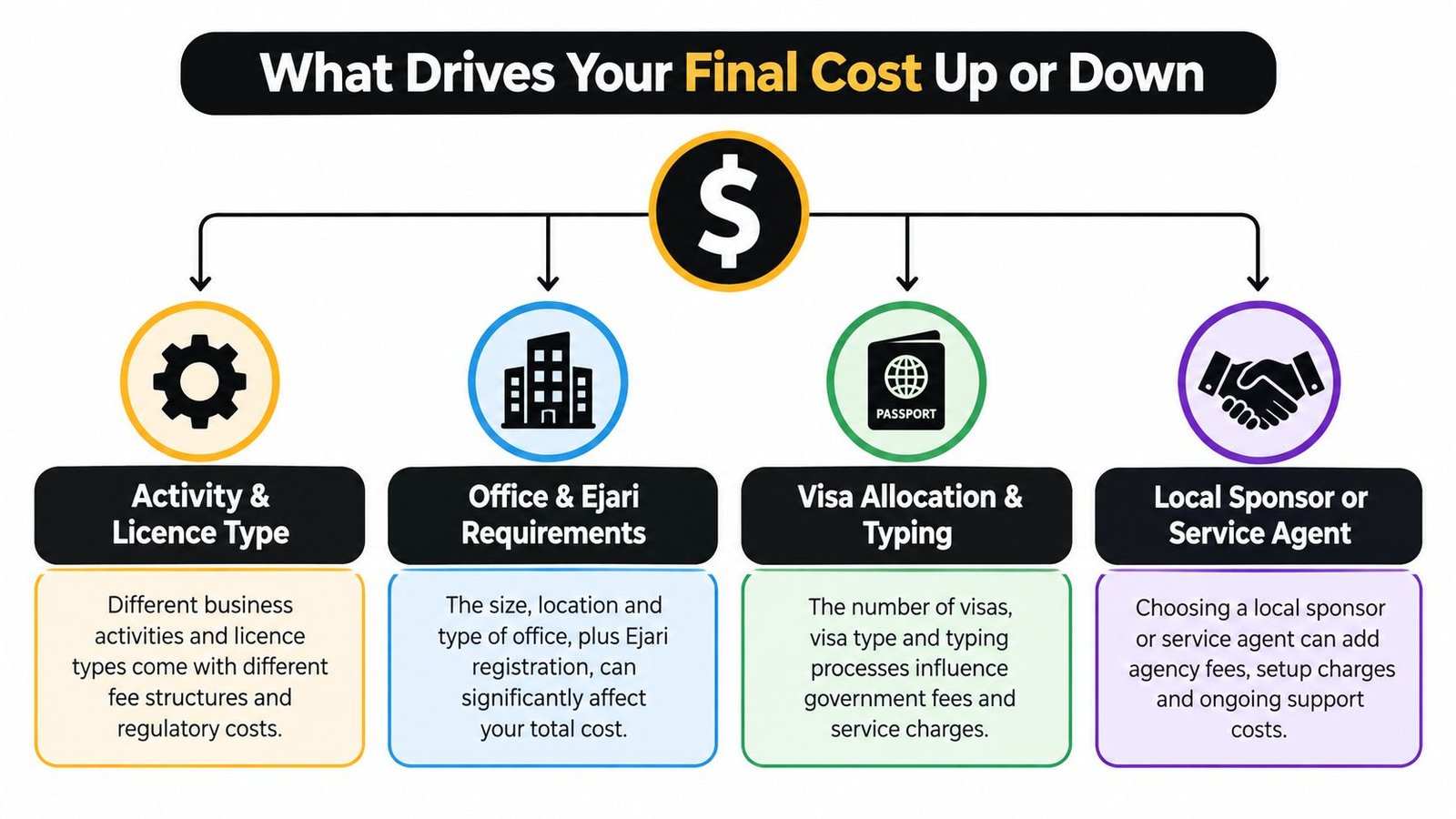
Two founders can choose similar company structures and still receive different budgets. The reason is that mainland cost follows the operating model, not just the legal entity.
How does activity and licence type change the price?
A professional licence generally suits service-led work such as consultancy or certain individual professional activities. A commercial licence supports trading and other commercial activities. An industrial licence relates to manufacturing or industrial operations, and a tourism licence covers approved tourism activities.
A 2026 activity-based breakdown lists professional licences at AED 15,000 to AED 17,000, commercial licences at AED 18,000 to AED 22,000, industrial licences at AED 20,000 to AED 25,000, and tourism licences at AED 21,000 to AED 24,000, according to this 2026 Dubai licence cost breakdown. These are licence ranges, not complete first-year budgets.
Why does office and Ejari create the biggest swing?
Office compliance is often the largest variable. Independent UAE guidance places low-complexity office and Ejari costs at AED 6,000 to AED 15,000 or more, while wider annual market ranges can reach AED 15,000 to AED 80,000, as outlined in this Dubai mainland office and formation cost guide.
A solo consultant may need only a modest registered workspace. A company hiring staff, meeting clients or storing goods may need a larger physical office. Premises can also affect the approved visa quota, so choosing the cheapest address may limit growth.
What does one visa add?
A one-investor-visa setup can rise to roughly AED 18,750, with visa processing adding about AED 4,850 to the licensing and approval charges, according to the mainland cost structure analysis. The final visa file can include immigration processing, medical testing and Emirates Identity Card steps, depending on the application.
External approvals create another layer for regulated activities. Real estate, education, food and other specialist sectors may involve a competent regulator beyond DET. Ask for those approvals to be identified before signing.
| Setup choice | Cost effect | Suitable question |
|---|---|---|
| Narrow professional activity | Lower licensing complexity | Does the activity match the actual service? |
| Commercial trading activity | Higher licence band and possible approvals | Will the company import, sell or distribute goods? |
| Shared or lean premises | Lower office commitment | Does the activity and visa plan permit it? |
| Growth-ready office | Higher annual rent | Will headcount and client meetings justify it? |
| Zero visas | Avoids visa processing at launch | Does the founder need UAE residence now? |
| One or more visas | Adds immigration cost and quota needs | Who needs residence and when? |
Practical rule: Don't choose an office or visa count before confirming the activity class. The activity controls more of the cost chain than most founders expect.
Sample Budget Scenarios for Different Founder Needs
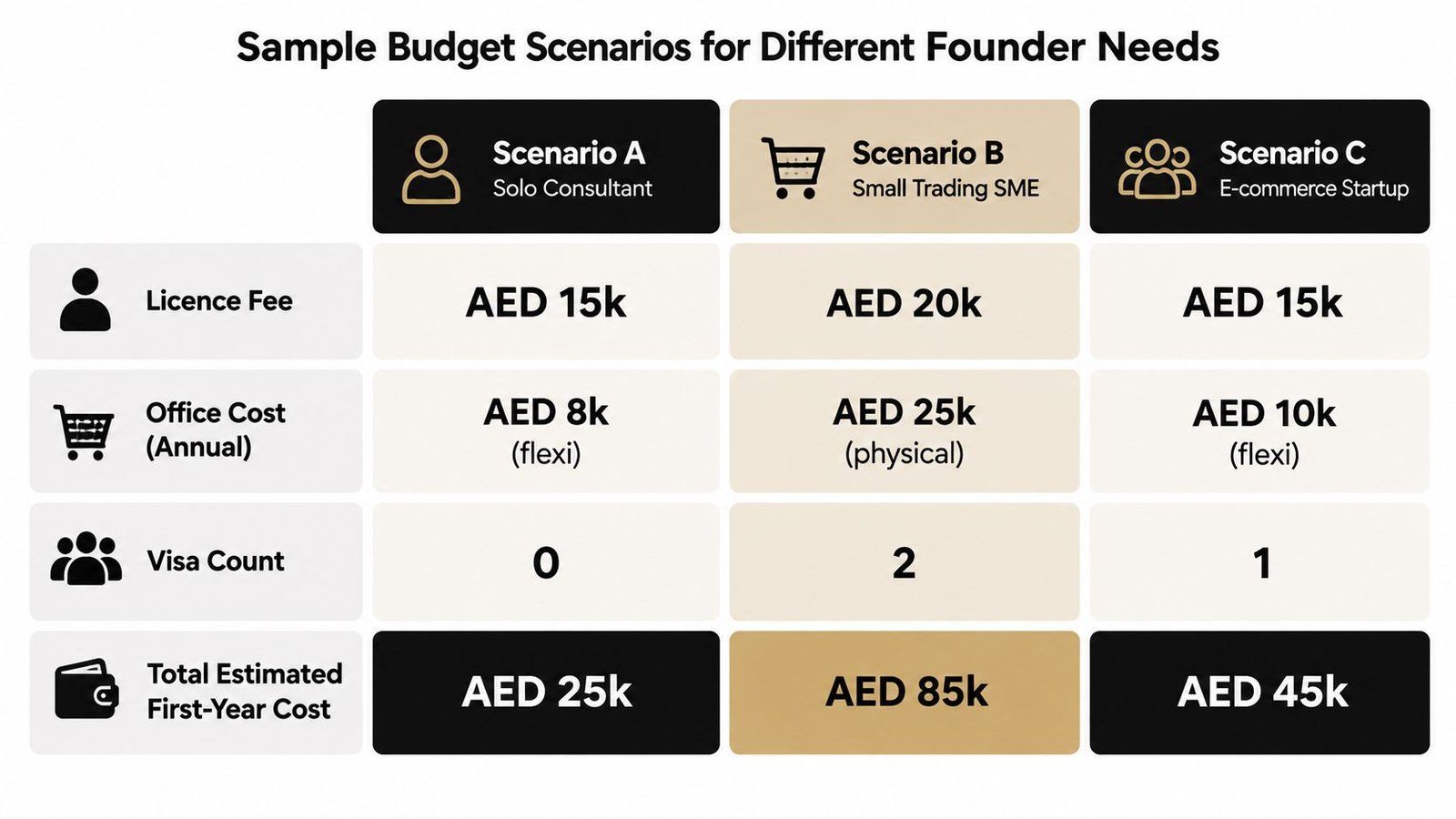
The following examples show how founders can think about a budget without treating every business as identical. They use the scenario figures supplied for the comparison visual, while the broader market benchmark remains the safer planning range for an actual quotation.
What would a solo consultant need?
A solo consultant choosing a professional activity may start with a lean licence, a flexi-office and no visas. The supplied scenario uses AED 15,000 for the licence, AED 8,000 for a flexi-office and zero visas, producing an estimated first-year cost of AED 25,000.
That budget is designed for someone who wants a legal operating base without immediately building a team. The consultant still needs to verify whether the chosen workspace satisfies the mainland activity and Ejari requirements.
| Scenario | Licence | Office or Ejari | Visa count | Estimated first-year total |
|---|---|---|---|---|
| Solo consultant | AED 15,000 | AED 8,000 flexi-office | 0 | AED 25,000 |
| Small trading SME | AED 20,000 | AED 25,000 physical office | 2 | AED 85,000 |
| E-commerce startup | AED 15,000 | AED 10,000 flexi-office | 1 | AED 45,000 |
What would a small trading SME need?
The small trading SME example assumes a commercial licence, a physical Dubai office and two employee visas. Its scenario figures allocate AED 20,000 to the licence and AED 25,000 to the office, with an estimated first-year total of AED 85,000.
The gap between licence and total reflects the operating model. A trading company may need premises that support staff, customer activity, documentation and possibly stock or logistics arrangements. The founder should also ask whether customs registration, product permissions or other approvals apply.
How should an e-commerce startup budget?
The e-commerce example uses AED 15,000 for the licence, AED 10,000 for a flexi-office and one visa, with an estimated first-year total of AED 45,000. The company may not need a large customer-facing office, but its activity, fulfilment model and products still determine the approvals required.
These examples don't establish universal renewal prices. Licence renewals, premises, Chamber membership, immigration files and visas can recur, while some formation documents and initial approvals are tied to the original setup. Treat each recurring item as a separate line in the renewal calendar.
Budget discipline: Keep a separate reserve for annual renewal and immigration costs. A first-year quote can look complete while excluding the costs that keep the company active later.
Dubai Mainland vs Free Zone and Offshore on Cost and Access
The cheapest formation route isn't automatically the right operating route. A Dubai mainland company generally costs more to make operational because it combines licensing with registered premises and immigration readiness, but it gives direct access to the local UAE market.
How do the structures compare?
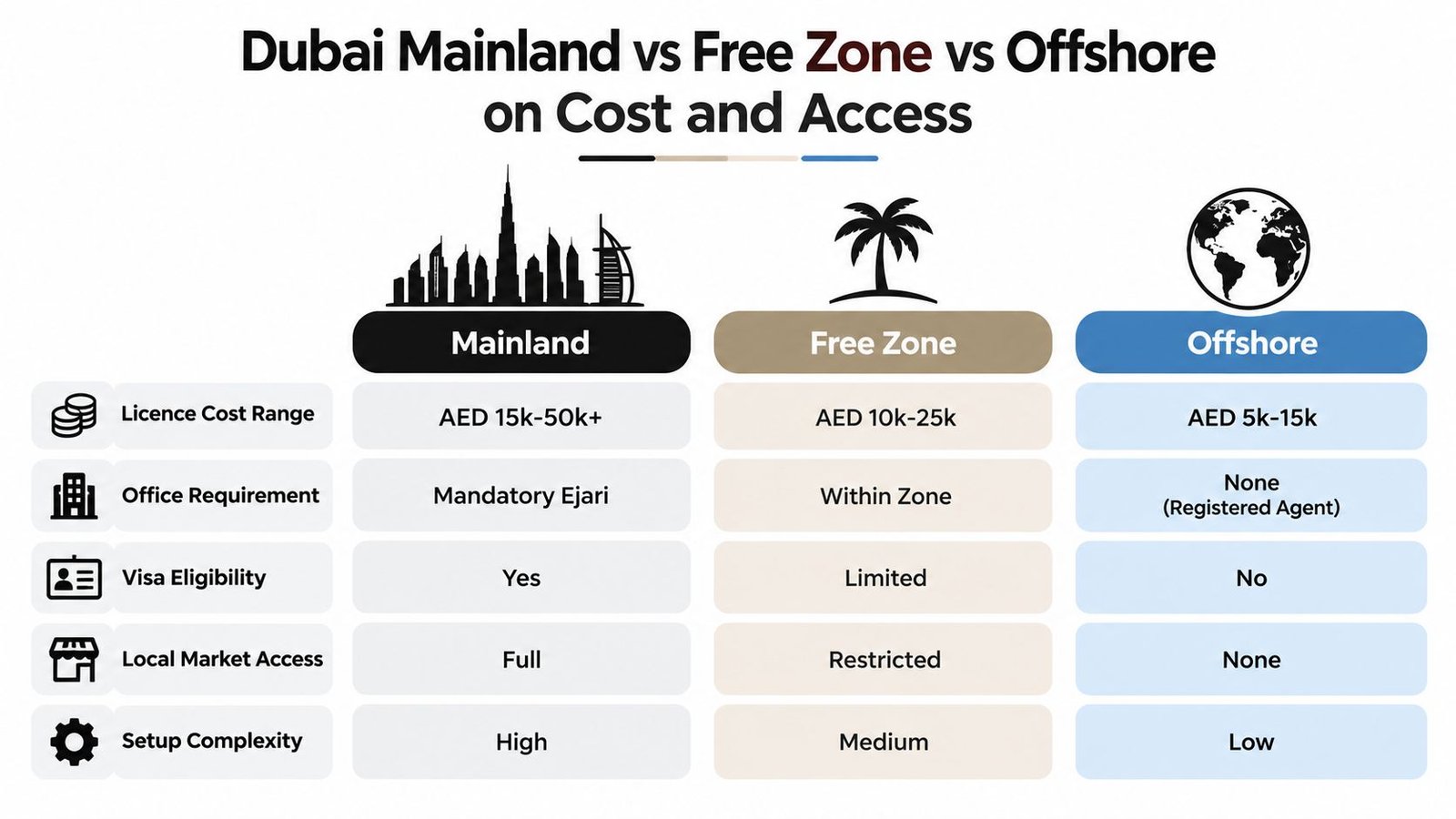
A free zone company is licensed by a free zone authority and may suit international services, technology businesses or companies working with free zone clients. A Dubai mainland company is licensed by DET and is generally the cleaner route for direct sales and operations across the UAE. An offshore company is a permitted international structure that usually doesn't support active UAE trading, local premises or residence visas.
| Criteria | Mainland | Free Zone | Offshore |
|---|---|---|---|
| Licence cost range | AED 15,000 to AED 50,000 or more | AED 10,000 to AED 25,000 | AED 5,000 to AED 15,000 |
| Office requirement | Mandatory Ejari | Within the zone | None, registered agent |
| Visa eligibility | Yes | Limited by zone and premises | No |
| Local market access | Full | Restricted or indirect | None |
| Setup complexity | High | Medium | Low |
The comparison figures above are the supplied market illustration for the three structures, not a guaranteed quotation. Mainland premises and visas can push the total beyond the licence range, while a free zone package may bundle several items differently.
When is a free zone a better fit?
A free zone in Dubai, Abu Dhabi or Sharjah may suit a founder whose customers are outside the UAE or within the same free zone ecosystem. The founder may receive a flexible desk or serviced-office option, but direct mainland sales can require a distributor, branch, permit or separate mainland arrangement.
Tax treatment also requires care. A Qualifying Free Zone Person may receive 0% corporate tax on qualifying income, while non-qualifying taxable income is subject to 9%, according to the Dubai mainland and free zone comparison. Mainland companies face the UAE corporate tax rules applicable to their taxable profits, including the stated standard treatment for profits above the relevant threshold. Confirm the position with a UAE tax adviser.
What is offshore suitable for?
Offshore structures can work for permitted holding, investment or international structuring purposes. They can't replace a mainland operating company when the business needs UAE customers, local staff or residence visas.
How to Save Money and Plan for Renewals
Cost control starts with choosing the narrowest activity that accurately describes the business. A broad commercial licence may create extra approvals and higher premises expectations before the company has customers to support them.
How can you reduce mainland setup costs?
- Right-size the office: Choose premises that meet the activity and visa plan rather than paying for unused space.
- Stage visas: Start with the people who need residence or work authorisation, then expand when headcount grows.
- Confirm approvals early: Ask whether the activity needs a regulator's approval before reserving premises or submitting documents.
- Review the legal structure: Shareholder numbers and corporate ownership can affect MoA preparation and notarisation.
- Track renewal dates: Licence, premises, Chamber and immigration items may renew on different schedules.
What will you pay after formation?
Annual costs vary by activity, premises, visa count and service requirements. A renewal budget should include the licence, registered office, Ejari, Chamber membership, establishment-card maintenance and visa-related renewals where applicable.
A PRO, or Public Relations Officer, can coordinate government submissions, document typing, attestations and immigration workflows. Inpro provides company formation, licensing, PRO support, investor and employee visas, Golden Visa support, banking assistance and accounting, tax and value-added tax (VAT) services across Dubai and the wider UAE.
Before signing: Request two totals, the amount needed to obtain the licence and the amount needed to operate legally for the first year. The second figure is the one your cash flow plan needs.
If you need a clear Dubai mainland company formation cost plan, visit Inpro for help comparing activities, premises and visa requirements. The team can prepare an itemised UAE setup route and support licensing, PRO work and immigration steps across Dubai and the wider United Arab Emirates.