


A Dubai Police Clearance Certificate costs AED 200 for UAE residents and AED 300 for applicants outside the country, and online applications typically take 1 to 2 working days when submitted correctly through the approved channels. A Dubai Police Clearance Certificate, also called a Good Conduct Certificate, is the official document from Dubai Police confirming you had no criminal record during your time in the UAE.
If you're dealing with a new hire start date, a Golden Visa file, or an overseas immigration deadline, this is usually one of those documents that feels simple until it suddenly holds up everything else. For founders and HR teams in Dubai, Abu Dhabi, Sharjah, and free zones across the United Arab Emirates, the process is manageable once you know which version of the process applies to you and which small mistakes trigger rejection.
Table of Contents
- Your First Step to Getting a Dubai Police Clearance
- Understanding Who Needs a Police Clearance Certificate
- How to Apply for Your Dubai Police Clearance in 2026
- Your Document Checklist and the Attestation Process
- Common Rejections and How to Avoid Them
- Strategic Advice for Founders and HR Teams
Your First Step to Getting a Dubai Police Clearance
A Dubai Police Clearance Certificate is an official document issued by the Dubai Police General Headquarters' Criminal Investigation Department confirming that you had no criminal record or pending cases during your stay in the United Arab Emirates. In day-to-day business terms, it's the background clearance document people are asked for when a visa, licence, or international immigration file reaches the due diligence stage.
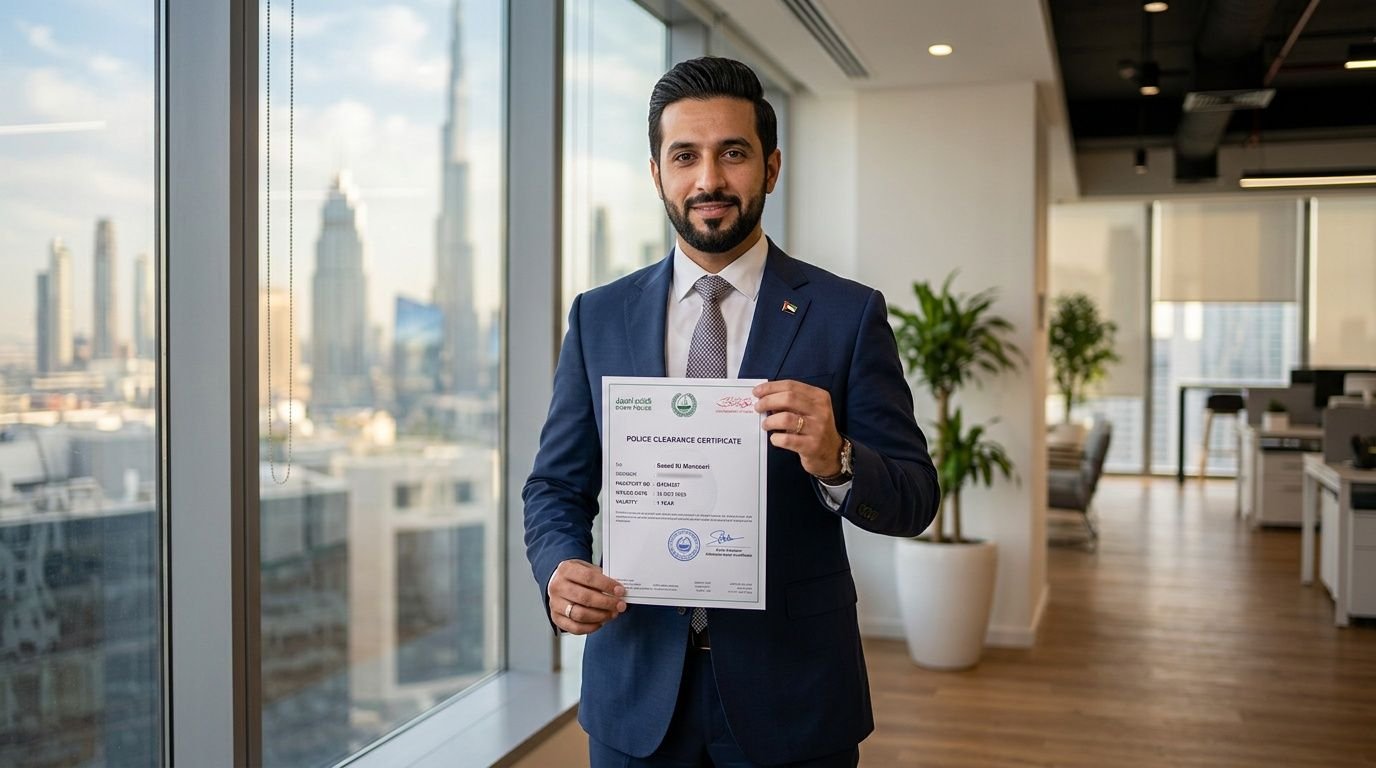
The part that confuses people most is the name. “Dubai” describes the issuing police authority, not a limit on where the certificate can be used inside the country. The UAE Ministry of Foreign Affairs guidance on obtaining a police clearance certificate explains that police clearance certificates in the UAE are jurisdiction-specific for issuance but nationally accepted for use, so a single certificate from one emirate is accepted for visa or residency purposes across the country.
That matters if your company is incorporated in one place and your people live in another. A founder living in Dubai can use the relevant UAE police clearance for a process tied to Abu Dhabi. An employee hired into a Sharjah free zone doesn't need a separate certificate from every emirate they've passed through.
Practical rule: Think of the certificate as one UAE-wide compliance document issued by one emirate authority, not as a document you must duplicate across Dubai, Abu Dhabi, and Sharjah.
For most applicants, the first step isn't filling out a form. It's identifying the right issuing authority based on where you lived, then checking whether your end use is a UAE visa matter, an overseas immigration file, or an employment screening request. Once that's clear, the rest of the process becomes much easier to control.
Understanding Who Needs a Police Clearance Certificate
Some people only discover they need a PCC when a government portal stops their application or an HR team asks for it at the last stage. For business owners and team managers, it's better to know the common use cases early so hiring and immigration timelines don't slip.
Do I need a PCC for a new job visa
A new job visa is the residence and work permission process that lets an employer sponsor an employee in the UAE. In many cases, the police clearance step forms part of the wider background and immigration file, especially where a nationality-specific rule applies.
As of 2024, the UAE introduced a mandatory PCC requirement for new entry permit applicants from 16 specific nationalities, including Afghanistan, Algeria, Bhutan, Bulgaria, Cameroon, Cuba, Egypt, Ghana, Indonesia, Iraq, Kenya, Mexico, Nepal, Nigeria, Sri Lanka, and Uganda, according to Envoy Global's 2024 update on the UAE police clearance requirement for select nationalities. That same update states that if the applicant is outside the UAE, the PCC must come from the home country and be attested by the UAE Embassy and Ministry of Foreign Affairs.
For HR teams, this changes recruitment planning. A candidate may be fully ready from a hiring standpoint but still need time to obtain and legalise the correct police certificate before the entry permit stage can move.
Is a PCC relevant for founders and investors
Yes, often. A founder opening a company, applying for residency through that company, or preparing investor-related immigration paperwork may be asked for a police clearance as part of identity and compliance checks.
This comes up more often than people expect when the structure involves multiple steps. A founder might finish company registration, then hit document requests during residency, banking support, or later mobility planning. It isn't a hard requirement in every scenario, but it's common enough that founders should treat it as a likely document, not a rare exception.
If your timeline is tied to fundraising, travel, or a relocation date, wait-and-see is the slowest approach. Check the PCC requirement before the rest of the file is ready.
Is a PCC required for Golden Visa applicants
A Golden Visa is a long-term residency route in the UAE for eligible investors, skilled professionals, founders, and other qualifying applicants. In practice, police clearance requests often appear during document review because authorities want a clean conduct record as part of the file.
For applicants with complex histories, such as previous visas, cancelled residence permits, or time spent both inside and outside the UAE, the issue isn't only whether a PCC is requested. The issue is whether the document is fresh enough and issued through the correct channel when the file reaches final review.
Do former UAE residents need it for immigration abroad
Often, yes. If you've worked in Dubai and later apply for immigration in another country, that country may ask for a police certificate covering your period in the UAE.
This catches founders and senior hires off guard because they assume they need one certificate from Dubai and another from a different emirate where they once held a visa. In practice, the confusion is usually about issuing authority, not legal necessity. The better approach is to match the certificate to the authority that can lawfully issue it, then confirm what the receiving country requires.
How to Apply for Your Dubai Police Clearance in 2026
A founder lines up a new CTO, HR books the visa medical, and then the file stops because the police clearance was requested through the wrong channel or issued too early to still be valid at final review. That is a common delay. The fix is simple. Pick the correct application path before anyone uploads a document or pays a fee.
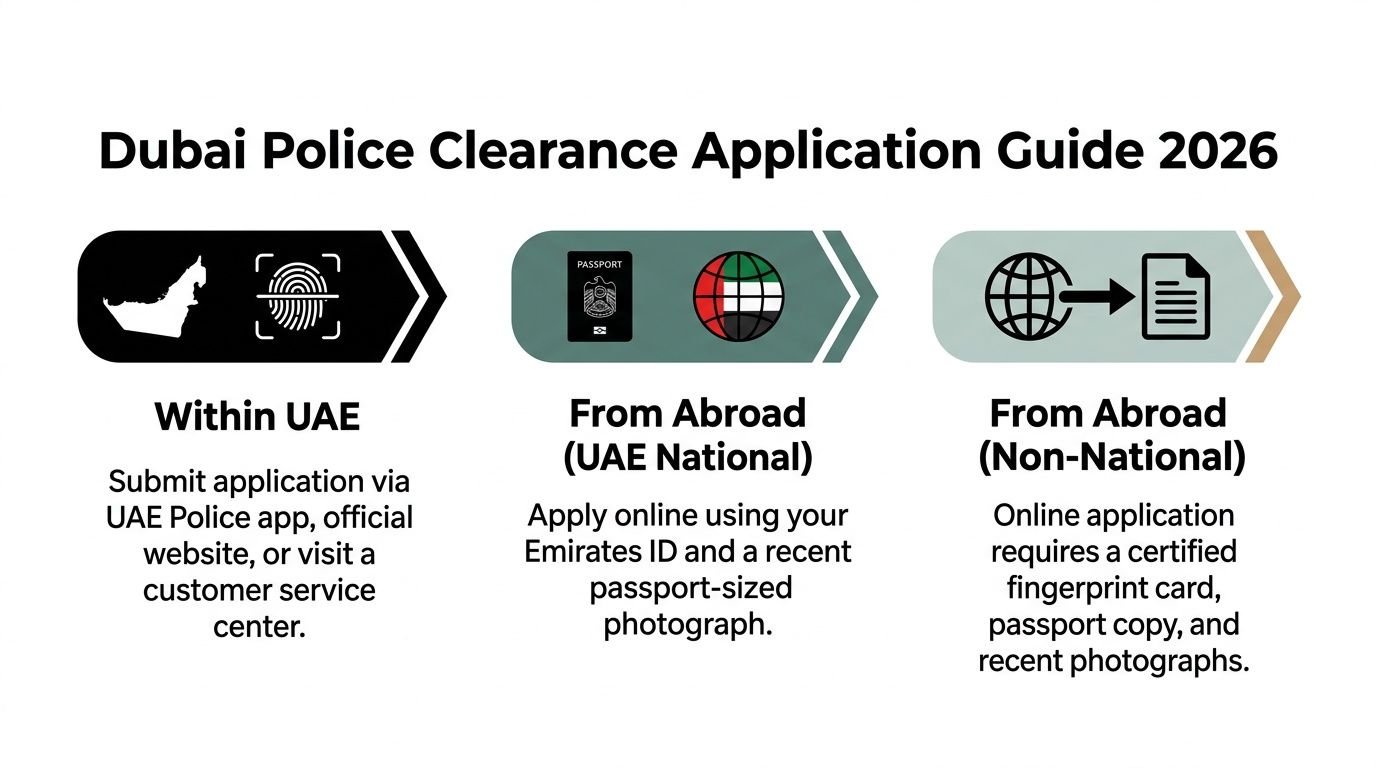
There is no single workflow for every applicant. The right route depends on where the person is now, whether they still have a usable UAE identity record, and what the certificate will be used for. For HR teams, that last point matters more than people expect. A PCC for onboarding, a Golden Visa file, and an overseas immigration file can trigger different timing and document issues.
Which application path should you choose
Start with the applicant category, not the app.
A 2024 guide to getting a police clearance certificate in Dubai states that the standard fee is AED 200 for UAE residents and AED 300 for applicants abroad, with additional nominal charges. The same source states that online applications typically take 1 to 2 working days once the file is accepted.
That processing estimate is useful, but in practice the actual timeline is set by document readiness. A resident with matching records can often move quickly. A former resident applying from abroad usually spends more time on fingerprints and legalisation than on the online submission itself.
| Method | Who It's For | Typical Cost (AED) | Processing Time |
|---|---|---|---|
| Online from within UAE | Current or recent UAE residents with the required ID and supporting documents | 200 plus nominal fees | Often 1 to 2 working days after acceptance |
| Online from abroad | Former residents and overseas applicants submitting the required fingerprint documentation | 300 plus nominal fees | Depends on fingerprint and legalisation steps, then often 1 to 2 working days after acceptance |
| Smart Police Station | Applicants in Dubai who want an in-person service point | 200 plus applicable charges | Depends on document readiness and service channel |
For employers, the decision rule is straightforward. If the team member is inside the UAE and their identity records are current, use the online route first. If they are outside the UAE, treat the fingerprint process as the main task and build your hiring timeline around that.
How do you apply from within the UAE
For residents applying within the UAE, the online route is usually the most direct option. The common channels are UAE Pass, the Dubai Police app, and in some cases the Ministry of Interior app, depending on the record and issuing authority tied to the case.
Use this sequence:
- Check the identity record first. Confirm the Emirates ID details, passport details, and visa record match the current government record.
- Prepare clean digital copies. Keep the passport copy, photo, visa page if requested, and Emirates ID details ready in the correct format.
- Submit through the official channel. Select the police clearance service, enter the details exactly as shown on the documents, upload the file set, and pay the fee.
- Monitor the status until issuance. If approved, the certificate is issued digitally in the available language option.
The common mistake is filing while another status update is still pending. If a residence visa was just cancelled, an Emirates ID was renewed, or passport details changed recently, the system may still show older information. That is how a simple application turns into a rejection or manual review.
This is also where HR teams can save time with one basic control. Ask the employee or candidate to send the exact ID page and passport page they plan to use before submission. A two-minute pre-check often catches spelling differences, old passport numbers, or incomplete scans.
Later in the process, some applicants prefer a visual walkthrough before they file. This short video can help if you want to see the sequence on screen.
How do you apply from outside the UAE
Applications from abroad need more care because the file must prove identity and criminal record history without relying on a current UAE residence profile.
The usual route is to collect fingerprints in the current country of residence, complete any required local legalisation, add the UAE attestation step if required for the case, and then submit online with the supporting identity documents. If the fingerprint card is poorly prepared, signed incorrectly, or attested through the wrong chain, the portal submission may be quick but the overall process will still stall.
The practical order is:
- Get fingerprints taken by an authorised provider in the current country of residence.
- Complete the legalisation steps required there, where applicable.
- Arrange UAE recognition or attestation if the case requires it.
- Submit the application online with the fingerprint card, passport copy, and other identity documents.
Founders hiring international staff should be careful here. A candidate who previously lived in Dubai but now lives abroad does not follow the same path as a person still in the UAE on a current or recently cancelled visa. If HR gives both people the same checklist, one of those files will usually come back.
Can you apply in person at a Smart Police Station
Yes. Dubai Police offers Smart Police Station access for many public services, and the official Dubai Police Smart Police Station page sets out that these stations operate as self-service access points across multiple locations.
That option helps applicants who want a physical service point in Dubai or need guidance at the kiosk stage. It does not change the underlying document rules. If the identity record does not match, the fingerprint requirement is unresolved, or a supporting document is missing, an in-person visit will not cure the problem by itself.
For HR teams, Smart Police Stations are best treated as a service access option, not a separate legal route. The certificate still needs to be accepted by the receiving authority, still needs to be valid on the day the wider file is reviewed, and still needs to match the applicant's actual record. Those are the details that prevent last-minute delays.
Your Document Checklist and the Attestation Process
A PCC application usually succeeds or fails before payment. If the document set is clean, the submission is usually routine. If one core item is wrong, the file stalls.
What documents do you need if you are in the UAE
The standard file is short. The LinkedIn guide on obtaining a UAE police clearance certificate states that the application requires a valid or expired Emirates ID number, a copy of the passport, photographs, and, for overseas applicants, an attested fingerprint card. That same source states that the certificate is issued in Arabic and/or English by the Dubai Police General Headquarters' Criminal Investigation Department.
For someone applying from inside Dubai or elsewhere in the UAE, the practical checklist is:
- Emirates ID number. Current is simplest, but an expired number can still be relevant in some cases.
- Passport copy. Use a clear copy that matches the identity details on your application.
- Recent photograph. Keep it formal and current.
- Visa page copy. Include it where the channel or your case requires it.
A lot of rejected files aren't missing major paperwork. They're missing a clean scan, the correct version, or a readable image.
What changes if you are applying from abroad
The main extra document is the fingerprint card. A fingerprint card is the formal record of your fingerprints taken by an authorised body in your current country. It stands in for the in-country identity checks that are easier to complete when you're physically in the UAE.
If you're overseas, the checklist usually looks like this:
- Passport copy
- Recent photographs
- Old Emirates ID number if available
- Attested fingerprint card
This is the part HR teams should verify before they tell an overseas joiner that the process is “just online”. The form may be online. The preparation isn't.
A clean overseas application starts with the fingerprint card, not with the portal login.
What is attestation in plain English
Attestation is the process of adding official stamps or legal confirmation so a document issued in one country can be accepted by authorities in another country. In this context, it usually means your fingerprint card is authenticated in your home country and then recognised for UAE use through the required embassy and foreign affairs steps.
Think of attestation as the document's travel permission. Without it, the fingerprint card may be genuine but still not accepted for the purpose you need.
For applicants outside the UAE, the safest approach is simple. Get fingerprints taken by a recognised authority, confirm the exact attestation chain for your nationality and location, and only then submit the online application. That order saves repeat work.
Common Rejections and How to Avoid Them
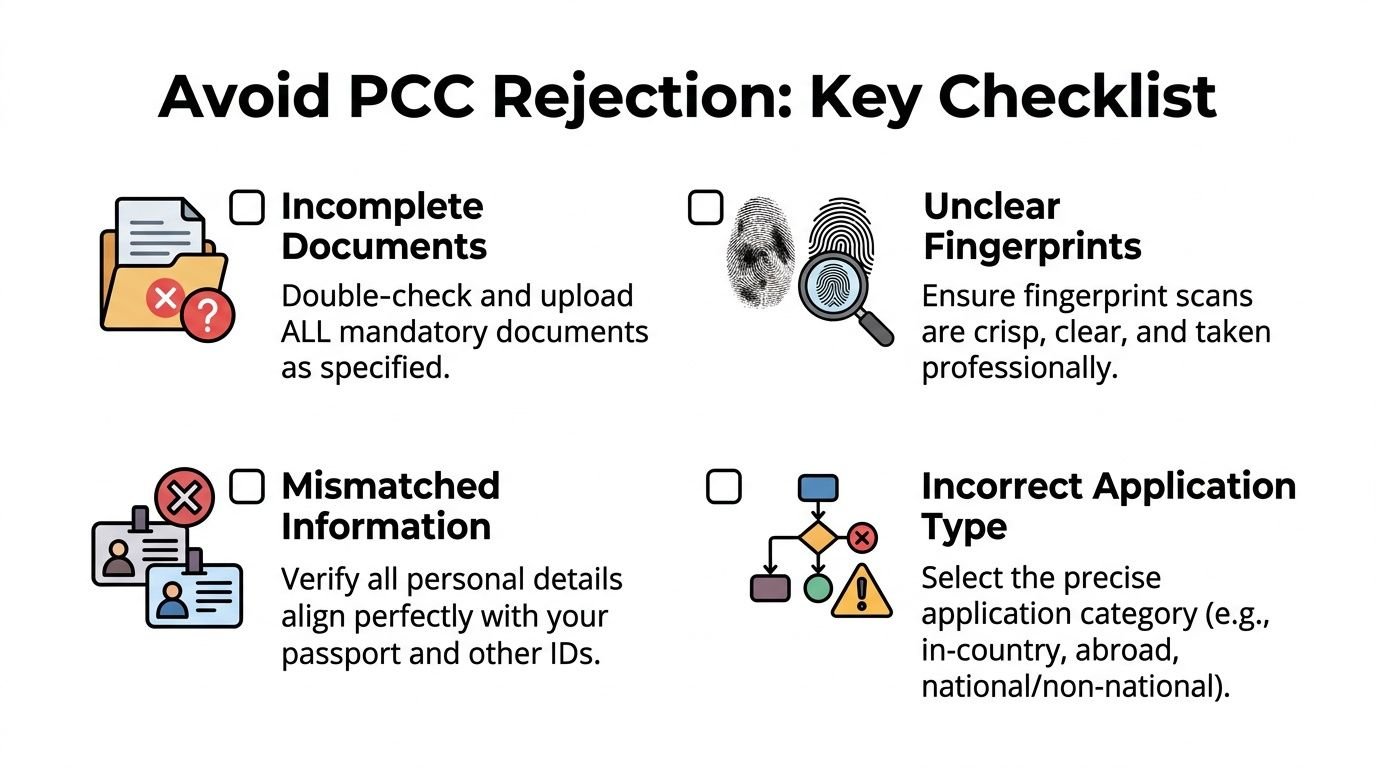
A founder approves an offer, HR starts visa planning, and the PCC request looks like a quick admin item. Then the application gets rejected over a mismatched ID number, the certificate expires before the immigration file is ready, or an overseas hire is submitted under the wrong category. Those delays are common, and they are usually preventable.
Why does the Emirates ID mismatch cause instant rejection
This failure usually comes from old records, not bad intent. An applicant renewed an Emirates ID, changed status, or copied details from a previous file, and the portal checks the entry against the active record. If the number does not match what the system expects, the application can stop there.
For HR teams, rushed onboarding causes trouble because a passport copy in the folder does not confirm that the Emirates ID entered in the PCC application is the current one. Before submission, verify the active ID tied to the applicant's latest residency record, especially for rehires, former residents returning to the UAE, and staff who recently moved from one sponsor to another.
A quick pre-check saves a resubmission cycle.
Why do fingerprint and category errors slow everything down
The next problem is choosing the wrong application path. This comes up often with former residents, overseas hires, and Golden Visa applicants whose status changed recently. The person knows their history, but the government system only sees the category selected and the documents uploaded to support it.
Use these checks before you submit:
- Match the application route to the applicant's actual location. A person applying from outside the UAE should not be handled like someone currently resident in Dubai or another emirate.
- Check that fingerprint records are clear and usable. Poor-quality prints often trigger review questions or rejection.
- Keep the name format identical across all documents. Even minor differences in spelling, spacing, or sequence can create manual review.
- Choose the applicant type carefully. UAE national, current resident, and former resident cases are processed differently in practice.
This is the point where founders and HR managers should slow the file down for five minutes. One wrong dropdown selection can cost more time than collecting the right document set in the first place.
How does certificate validity create timing problems
Approval is not the end of the process. Timing still matters.
Dubai Police states on its Police Clearance Certificate service page, the certificate is valid for a limited period. For company cases, that creates a real scheduling issue. If HR orders the PCC too early, it may expire before the visa file, foreign employer check, university attestation, or Golden Visa bundle is ready for submission.
The practical answer is to time the PCC near the end of the wider process, not at the start. For a single applicant, that avoids repeat fees and repeat uploads. For a hiring team managing several joiners, it prevents the common mistake of having one document in the pack expire while everything else is still moving through approvals.
Strategic Advice for Founders and HR Teams
For a single person, a PCC is an admin task. For a company, it's an operations issue. The difference is timing, repeatability, and document control.

How should HR teams build a workable PCC workflow
Treat police clearance as an early screening item in onboarding, not a late-stage add-on. Ask three questions at offer stage: where the person is now, whether they previously held UAE residency, and whether their nationality triggers extra entry permit requirements.
Then keep one internal checklist for each group. One for people already in Dubai or elsewhere in the UAE. One for overseas hires. One for founders or senior staff whose immigration route may run in parallel with company setup or Golden Visa preparation. That small split avoids most confusion.
When is one UAE PCC enough
This point saves both time and money. The Government of Canada guidance for police certificates from the United Arab Emirates makes clear that a single UAE Police Clearance Certificate from any emirate satisfies the requirement, and the same point matters more broadly because many applicants still waste fees by ordering multiple certificates. The avoidable cost can be AED 200 to AED 300 per application when people duplicate filings they didn't need.
For founders with staff who have lived in Dubai and worked with entities in other emirates, this matters a lot. If the receiving authority accepts one UAE police certificate, don't create extra work by ordering one from every emirate touched by the person's history.
What does good timing look like for founders
Good timing means the PCC is neither too early nor too late. It should land after the surrounding documents are stable and before the file reaches final submission pressure.
For founders and HR leads, the best operating habit is to link the police clearance date to the key decision point in the wider process. If the employee entry permit isn't ready, the Golden Visa supporting file isn't assembled, or the overseas attestation chain isn't complete, filing the PCC too early only increases the chance of expiry or duplication.
A calm process usually beats a fast-looking process. Get the category right. Get the documents right. Then submit once.
Not sure where to start? Book a free strategy call with Inpro Corporate Services L.L.C. if you need help with UAE police clearance planning, visa document workflows, attestations, or wider company setup in Dubai and across the United Arab Emirates.