


A Dubai visa run is leaving the UAE briefly and re-entering on a new visit visa to reset your stay. In 2026, that old fix is narrower because many 30-day and 60-day visit visas can now be extended online without leaving the country, and the overstay fine is now AED 50 per day across all visa types.
That's the part many old articles still get wrong. They treat the Dubai visa run as the default answer, when the better question in the United Arab Emirates now is simpler: should you extend online, regularise your status, or exit immediately before fines build up? If you're in Dubai, Abu Dhabi, Sharjah, or a free zone and your visa clock is running down, the right move depends on your current file, not on old border-run habits.
Table of Contents
- What a Dubai Visa Run Actually Is
- The 2026 Legal Landscape and Overstay Fines
- Who Should Still Consider a Visa Run
- Preparing for a Border Run the Right Way
- Common Routes and What Each Day Looks Like
- Smarter Alternatives to Repeated Visa Runs
- Making the Right Call and Getting Help
What a Dubai Visa Run Actually Is
A Dubai visa run is a short exit from the UAE for one reason: to come back only after a fresh entry permission is approved and usable. In 2026, that distinction matters more than the old slang. Leaving the country does not reset anything on its own. Re-entry does.
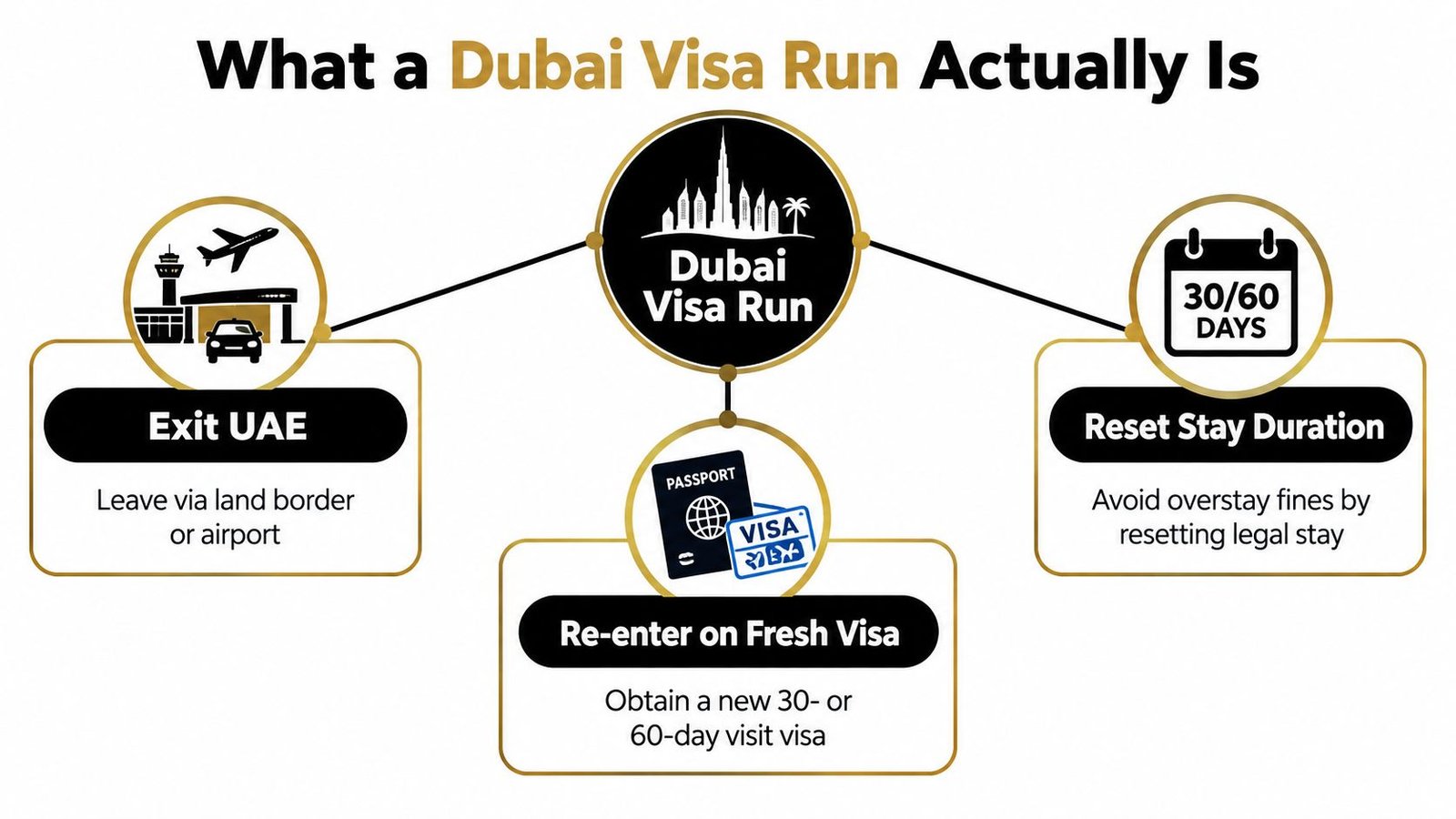
Old advice treated the border trip itself as the solution. That is outdated. A proper visa run only works if your current file allows exit, your new permit is issued correctly, and immigration can see a valid basis for your return. If any one of those pieces is wrong, the trip turns into a delay, extra cost, or a refused boarding or re-entry problem.
What counts in practice is simple. You exit. Your old stay ends. You wait for the new visit permission or entry permit to be active. Then you re-enter on that new permission.
People often mix up three different actions:
- Visa run: exit the UAE and return on a new, approved entry permission
- Extension: stay inside the UAE and add time through an approved in-country process
- Regularisation: fix a file that already has an overstay, block, cancellation issue, or status mismatch
Those are different tracks. Treating them as interchangeable is how people make preventable mistakes.
A short border trip also does not erase prior issues on your file. If you have an overstay, a pending cancellation, a sponsor-side problem, or a mismatch between what you were told and what is in immigration, the system will still show it when you try to come back. As noted in this UAE overstay and extension explainer, in-country options now cover some cases that people used to handle by exiting first.
The usual visa-run formats are still familiar:
- Land exit: drive or go by arranged transport to a nearby border, exit, wait for clearance, then return
- Short flight exit: fly to a nearby country, stay briefly, and come back once the new entry document is active
- Agency-managed exit and re-entry: a packaged process where the travel step and permit handling are coordinated together
My advice is straightforward. Call it a visa run only if the re-entry permission is the plan and has been checked properly. If you are only leaving to buy time and hoping the paperwork gets sorted later, that is not a strategy. That is how people get stuck outside the UAE.
The 2026 Legal Landscape and Overstay Fines
Start with the number that now matters most. Since 11 February 2026, the UAE applies a unified overstay fine of AED 50 per day across visa categories and emirates, and if the overstay passes 30 days, you need an exit permit before departure, according to this UAE overstay fines update.
That one change has narrowed the old visa-run playbook. In 2026, the smart order is simple: check if you can extend online, regularise any file issue, or exit cleanly before fines stack up. Leaving this too late turns a routine decision into a paid problem.
What changed from older practice
A lot of advice still circulating in WhatsApp groups is expired. The 10-day grace period for many tourist and visit visas was removed in 2023, and later guidance reported that fines for those categories can start from day one after expiry, as explained in this Dubai visa run rules article.
If someone tells you, “You still have ten days,” verify your exact visa type first. Do not rely on memory, old agency scripts, or what applied to a friend last year.
UAE Overstay Fines. Older Practice vs 2026 Rules
| Issue | Older Practice | 2026 Rule | What it means in practice |
|---|---|---|---|
| Grace period on many tourist and visit visas | Many travellers relied on a 10-day grace period before fines started | That grace period was removed for many tourist and visit visas | Waiting after expiry is riskier than it used to be |
| Daily fine model | Rules were less uniform across categories and emirates | AED 50 per day | The cost is easier to calculate and harder to ignore |
| Long overstay | Departure handling could differ by case | After 30 days of overstay, an exit permit is required before departure | Delay adds both cost and an extra processing step |
My advice is blunt. Once your visa is close to expiry, stop treating a visa run as the default answer. Check first whether an online extension is available, whether your file needs regularisation, or whether a clean exit is still the safest route.
What to check before you book anything
Use the correct system first. Dubai-issued visas are handled through GDRFA. Federal files and visas from other emirates are handled through ICP. Dubai residents can also use an Amer service centre for fine checks and payment handling, according to this report on standardised overstay fines and payment channels.
If you do not know which authority holds your file, fix that before you plan transport, hotels, or a border exit. I see people lose time on border-run planning when the solution is a status check, a fine payment, or an in-country extension filed through the right channel.
Who Should Still Consider a Visa Run
A Dubai visa run still has a place. It's just no longer the answer for everyone with a countdown problem.
The people who should still consider it are those with a short-term, temporary need to stay in the UAE, no clean in-country route that fits their file, and no intention to move straight into long-term residence. Everyone else should look hard at extension or status change first.
The narrow group where it still makes sense
A border exit can still be reasonable for visitors who need a short reset and whose file won't be better solved online. That can include someone testing life in Dubai before setting up properly, a job seeker between interview rounds, or a traveller whose current permit doesn't fit the next few weeks.
It can also make sense when the issue is timing rather than strategy. If your business setup, residence permit, or sponsorship file won't be ready in time, a quick lawful exit may keep you compliant while the longer process catches up.
Visa Run vs Online Extension vs Residency Who Fits Where
| Traveller Profile | Best Option | Approx. Cost | Effort Level |
|---|---|---|---|
| Visitor with a visa type that can be extended online | Online extension | Varies by visa and issuing channel | Low |
| Founder planning to stay and build in the UAE | Residency route | Higher upfront, better long-term fit | Medium |
| Freelancer between contracts needing short extra time | Depends on extension eligibility first, visa run second | Varies | Medium |
| Person already in overstay | Regularise status or settle fines before any exit plan | Added fines may apply | Higher |
| Remote worker testing Dubai short-term | Depends on how long the stay is genuinely needed | Varies | Medium |
The key mistake is trying to use a visa run for a problem that is a residency problem. If you're opening a company in a Dubai free zone, joining an employer in Abu Dhabi, or preparing a Golden Visa application, repeated exits are usually a sign you're using the wrong tool.
A visa run is for buying lawful short time. It isn't a substitute for residence planning.
Preparing for a Border Run the Right Way
If you're going to do a Dubai visa run, treat it like paperwork first and travel second. Most failed runs don't fail at the border road. They fail because the traveller leaves with the wrong assumptions, an unpaid fine, or no valid re-entry basis.
Start with dates. A same-day exit doesn't help if your current status already shows as expired in the system.
What to verify before you leave
Check your exact expiry date and whether any grace treatment applies to your category. Don't guess. The federal update described in this 2026 overstay fine explainer says tourist and visit visas get zero extra days in the unified 2026 framework, while cancelled-residence holders keep category-based grace periods.
Then check whether you owe anything. Unpaid overstay fines can stop departure processing or turn a simple exit into secondary clearance.
What to carry
Take a practical file, not just your passport.
- Passport and copy: Carry the original passport and a clear copy in case a counter asks for it.
- Visa evidence: Keep a screenshot or PDF of your current visa and any newly issued entry permission.
- Photo and address proof: A passport photo and proof of accommodation can save time if an agent or service desk requests supporting documents.
- Onward proof: Keep a return or onward ticket available if asked during re-entry processing.
- Payment method: Bring a card and enough available funds to deal with transport, visa processing, and any surprise service charges.
What to arrange in advance
If your file allows it, get the new entry permission handled before you leave the UAE. That way, the trip is just an exit and re-entry event, not a gamble.
Save the contact details for the relevant channel as well. For Dubai files, that may mean GDRFA or an Amer centre. For federal files, it means ICP.
Don't leave the country hoping someone will “sort it while you're on the road.” Have the next step lined up before the first stamp.
If you're driving, check the border opening status and your vehicle paperwork. Rental drivers should confirm cross-border permission before departure. If someone else sponsored your stay or hosted the application, confirm there's no active issue on the file that could interfere with re-entry processing.
Common Routes and What Each Day Looks Like
Most Dubai visa runs follow one of three patterns. The route matters less than people think. What matters is whether your file is ready for re-entry when you come back.
Land route through Oman
This is the route commonly imagined when hearing "visa run." You leave Dubai early, head towards the border, complete the UAE exit, enter the neighbouring side, wait for the new UAE permission to be usable if needed, then return for re-entry processing.
The day is long, but simple in structure. It's mostly driving, waiting, queueing, and checking messages for file updates.
Land route from the Abu Dhabi side
Travellers based in Abu Dhabi or the western side of the UAE sometimes prefer the Saudi-facing route instead of heading back towards the northern crossings. It can fit the geography better, especially if the traveller isn't starting from Dubai.
From a paperwork point of view, it's the same concept. Exit first. Re-enter only when your file is clean and your new permission is valid.
Short flight exit
For some nationalities and file types, the cleaner route is a short flight out and back. It usually costs more than a land crossing, but it can remove some border friction and make the process easier to coordinate with agency handling.
Dubai Visa Run Routes Compared
| Route | Travel Time from Dubai | Typical Cost (AED) | Best For |
|---|---|---|---|
| Oman land exit | Varies by border traffic and starting point | Varies | People comfortable with road travel and same-day movement |
| Saudi-side land exit | Usually more relevant for Abu Dhabi-based travellers | Varies | Travellers outside central Dubai |
| Short flight exit | Usually faster in travel rhythm, but more expensive overall | Varies | Files better handled through airport-based processing |
Here's the honest version. No route is “easy” if the visa side is wrong. A smooth trip happens when the paperwork is settled before the traveller gets back to UAE immigration.
Smarter Alternatives to Repeated Visa Runs
Repeated visa runs are usually a sign that the wrong tool is being used for the job. In 2026, the smarter order is simple: try to extend if your visa type allows it, regularise if your status has slipped, and exit only if neither of those routes works.
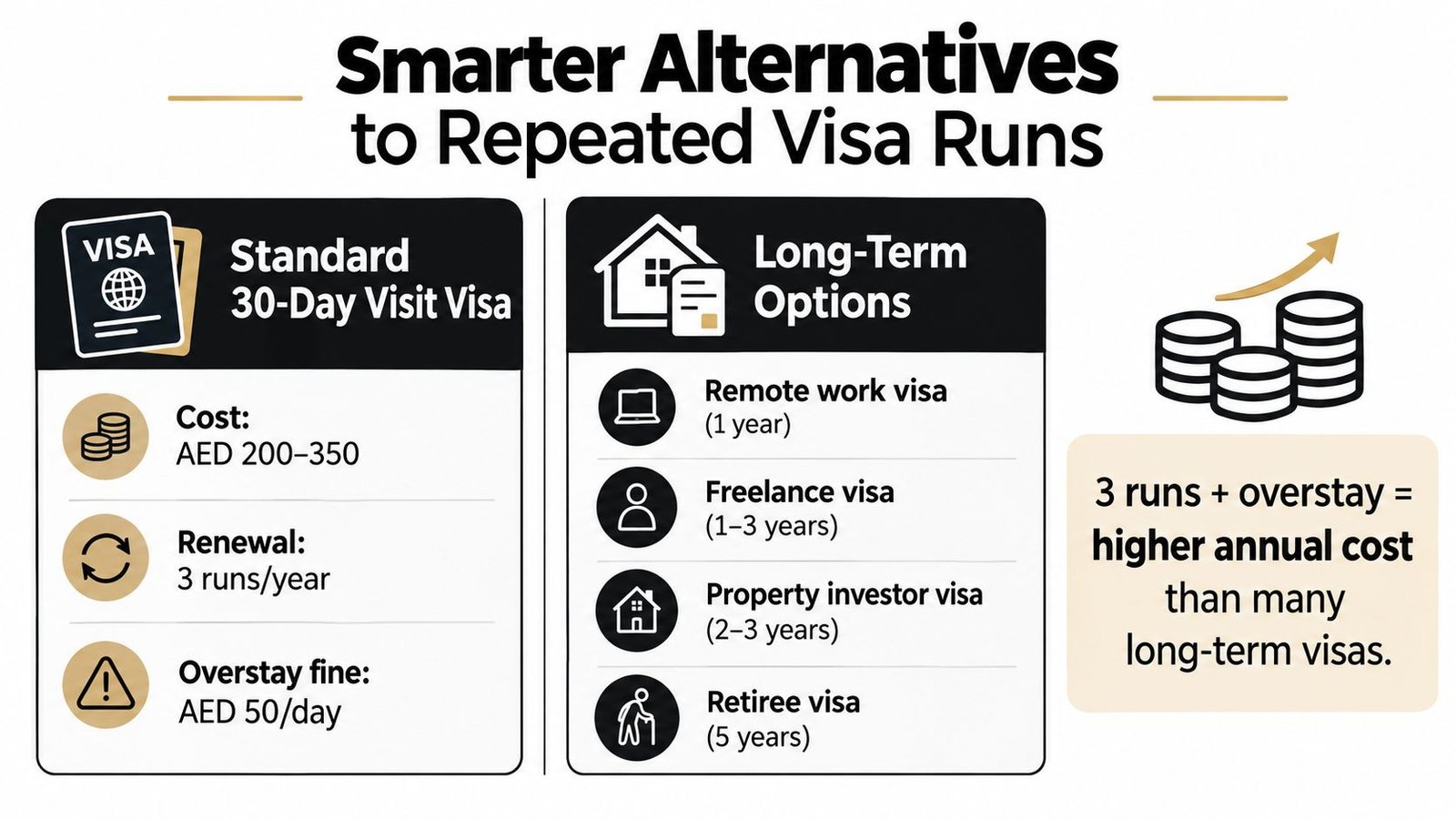
The online extension route has changed the calculation, but it is not universal. Before paying for another border trip, check three points first: your current visa category, whether your issuer supports in-country extension, and whether you still have valid stay left to file cleanly. If one of those points fails, stop guessing and verify the file before you move.
Here is the practical decision tree I use with clients:
- Extend online first: Best for short extra time when the current visit visa is eligible and the file is still valid.
- Regularise immediately: Best when fines have started or the record needs cleaning before any next step.
- Switch to residence planning: Best for founders, contractors, employees-in-waiting, and anyone clearly building a base in the UAE.
- Exit and re-enter: Use this only when the file supports it and an in-country solution is not available.
For founders, contractors, and operators, repeated runs usually mean the business plan and immigration status no longer match. If you are opening a company, preparing staff sponsorship, or setting up a longer stay in Dubai, Abu Dhabi, or Sharjah, visit-status patching becomes expensive fast. The AED 50 per day unified overstay fine makes delay a cost issue, not just an admin issue.
Better long-term answers
A residence route is usually the cleaner answer when you are no longer behaving like a visitor.
- Investor residence: Fits company owners and partners setting up a UAE entity.
- Employment residence: Fits people joining a UAE employer with active sponsorship capacity.
- Remote work or similar residence categories: Fits people with an existing work model that supports longer lawful stay.
- Golden Visa review: Fits applicants whose income, profession, assets, or academic profile may already place them in a longer-term category.
This short video gives a useful high-level view of the broader choice between short stays and longer-term planning.
Why founders should stop patching the problem
A quick exit can look cheaper on paper. It often is not. Travel costs, lost work time, rescheduling, file errors, and overstay exposure turn a supposed low-cost fix into the messy option.
If your real goal is to live, work, hire, study, or build in the UAE, switch categories and fix the status properly. Repeated visa runs made more sense under older habits. In 2026, they are a shrinking option.
Making the Right Call and Getting Help
The right decision is usually obvious once you strip away the old myths. A Dubai visa run is still reasonable when your stay need is short, your re-entry basis is clear, and you don't need residence yet.
It's the wrong move when your real need is to live, work, hire, study, or build in the UAE for more than a temporary period.
Three signs a border exit is still reasonable
- Short stay need: You only need a limited additional stay and don't plan to settle yet.
- Clean file: Your status is still valid or can be regularised immediately before exit.
- Clear re-entry basis: Your passport and visa path support lawful return without guesswork.
Three signs you should switch strategy
- You're staying longer: If your plans now go beyond a short visit, stop acting like a visitor.
- Work or study is involved: That usually points to residence, not another run.
- This keeps repeating: If you're watching the calendar every cycle, the system is telling you to change categories.
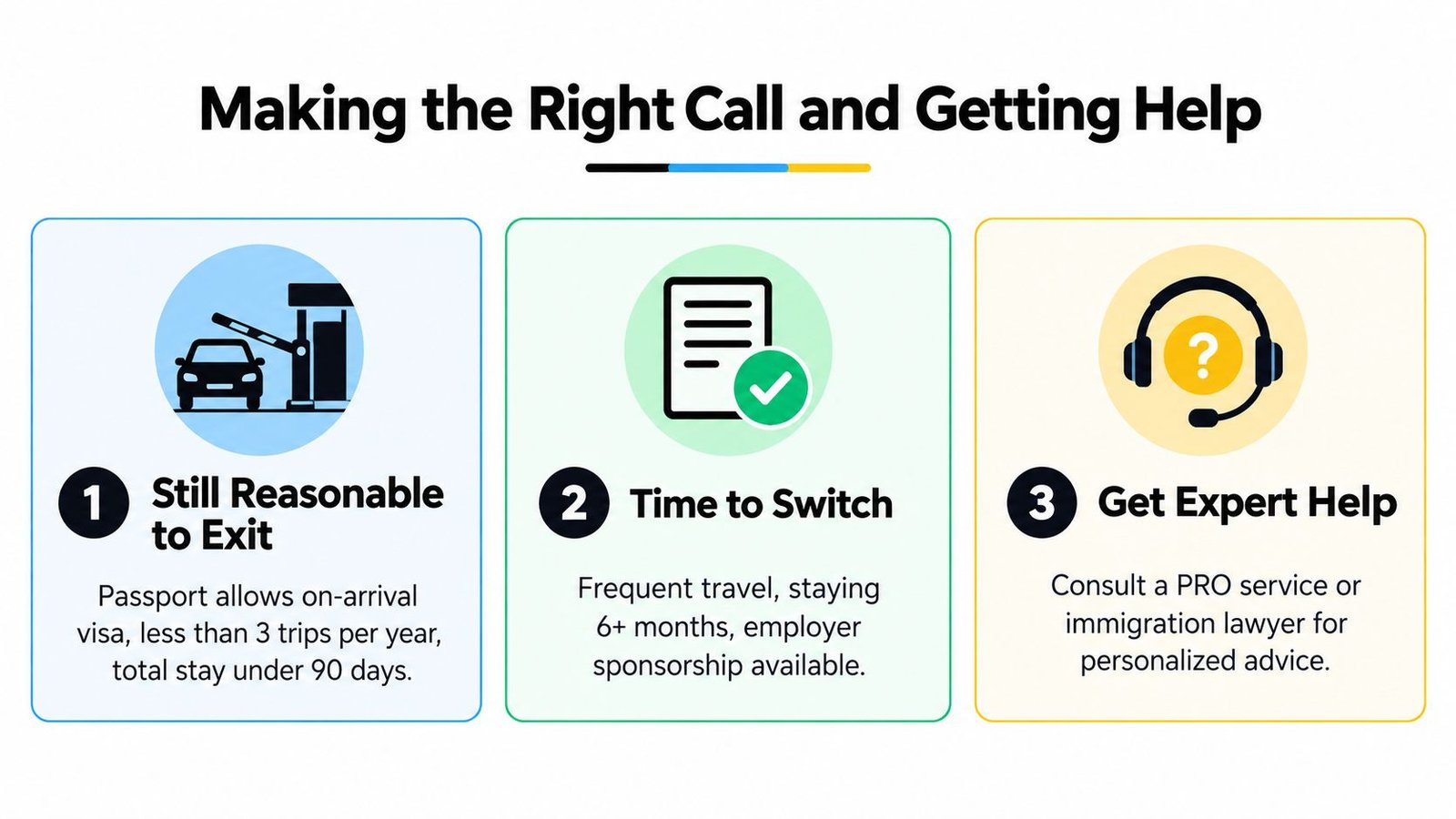
For people who don't want to manage the bureaucracy themselves, a UAE PRO service is often the sensible middle ground. A PRO service is a local government-processing support service that handles filings, approvals, and appointment coordination. If your case involves online extension, residence conversion, medical testing, Emirates ID steps, or a Golden Visa check, one option is Inpro, which handles UAE visa and PRO workflows for founders, companies, and individual applicants.
Most stay problems in 2026 can be fixed without leaving the country. The trick is choosing the right fix before the deadline, not after it.
The calm approach is this. Check the file. Pick one path. Execute it quickly.
If your Dubai visa run question is really a residency, extension, or overstay issue, Inpro can help you sort the practical next step without guesswork. The team handles UAE visa filings, online extensions, PRO processing, Emirates ID and medical appointment coordination, and Golden Visa eligibility checks, so you can fix the status problem before it becomes a travel problem.