

You're probably at the point where the business is real, the product is ready, and the paperwork is the part slowing you down. An e commerce licence in the UAE is the right move if you want to sell online legally, but the wrong jurisdiction or activity code can still block launch after the licence is issued.
Table of Contents
- What an E-Commerce Licence in the UAE Is
- Mainland vs Free Zone vs Offshore for Online Sellers
- The Application Process and Realistic Timelines
- Cost Breakdown and the Fees Most Guides Hide
- PRO Work, Visas, and Opening a Bank Account
- Beyond the Licence, VAT, Regulated Goods, and Common Pitfalls
- Pre-Launch Checklist and How to Move Forward
What an E-Commerce Licence in the UAE Is
An e commerce licence in the UAE is a normal trade licence that lets you sell goods or services online. It is not a separate magic document. In practice, it is issued by a mainland authority such as the Department of Economy and Tourism in Dubai, the Department of Municipalities and Transport in Abu Dhabi, or by a free zone authority.
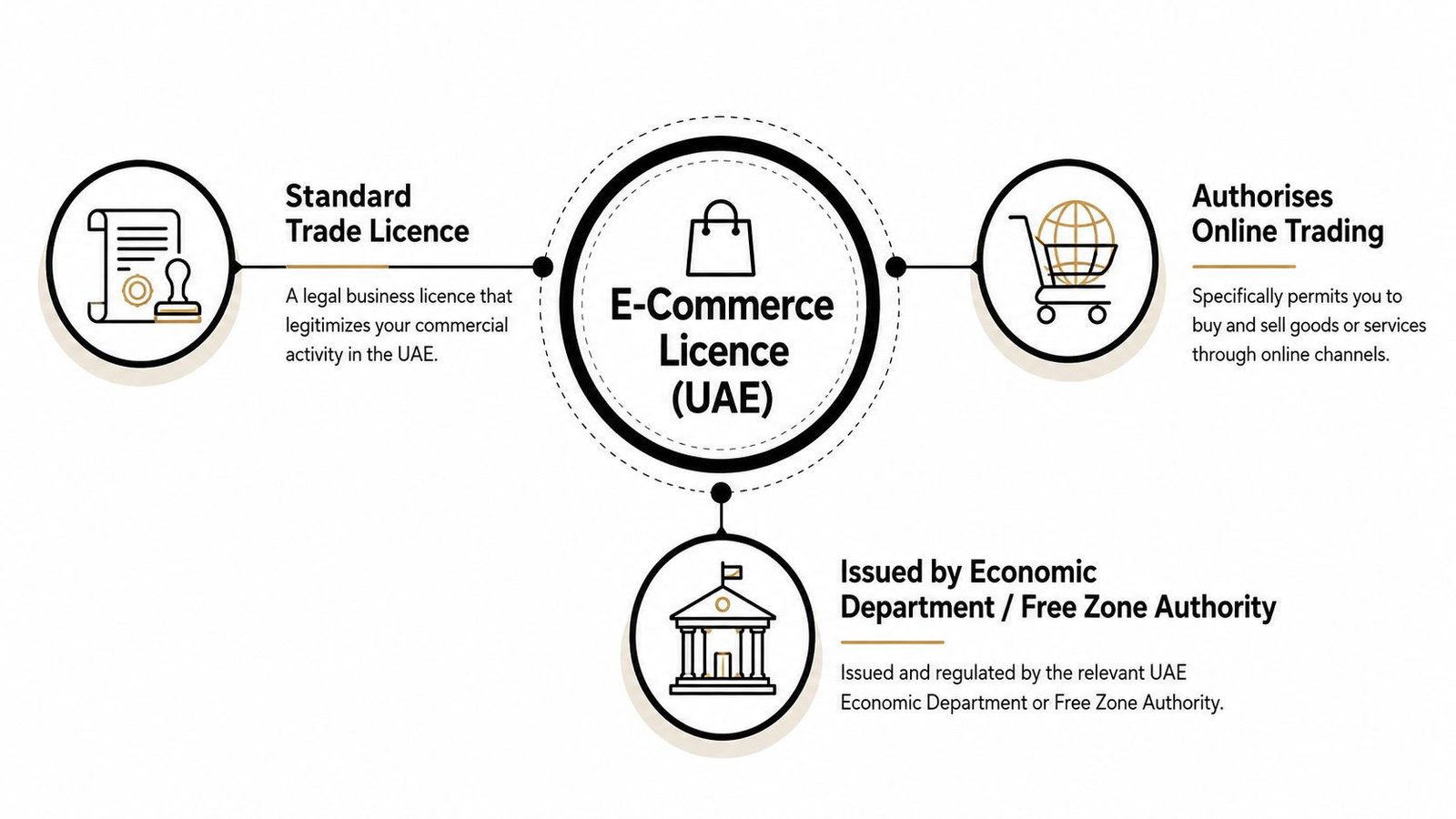
The clean way to think about it is this, “e-commerce” is an activity code, not a standalone business identity. That code sits inside a broader licence, and the licence sits inside a jurisdiction choice, mainland, free zone, or offshore. A freelancer, a startup, and a multinational subsidiary can all hold a form of online-trading licence if the activity and structure match the business model.
Practical rule: do not ask only, “Can I get an e-commerce licence?” Ask, “Which authority will issue a licence that matches how I sell, store, invoice, and ship?”
That question matters because the licence is only the first layer. The next layer is where many founders get stuck, trade name rules, document matching, premises proof, and later approvals for regulated goods or specific sales channels. If you treat the licence like a complete compliance package, you will miss the approvals that come later and cost you time at launch. TDRA NOCs, regulated goods approvals, and the difference between B2B and B2C activity codes can block a launch even after the licence is issued.
The UAE market has already shown how fast this activity can scale. A Dubai Economy report, 2020 said there were 1,969 active businesses in the activity of developing and managing e-commerce platforms in Dubai, and the average annual growth rate of new licences over the previous five years was 120%. The same report noted 2019 had the highest annual growth rate at 183%.
That tells you the market is not niche. It also tells you the licensing system had to adapt quickly, which is why UAE founders now see so many options across Dubai, Abu Dhabi, Sharjah, and the free zones.
Mainland vs Free Zone vs Offshore for Online Sellers
For online sellers, the key choice is not branding, it's where you want the legal entity to live and what that entity must be able to do. Mainland gives you the broadest local trading reach inside the United Arab Emirates, free zone gives you a controlled setup with lighter premises options, and offshore is for ownership or holding use, not for normal local selling.
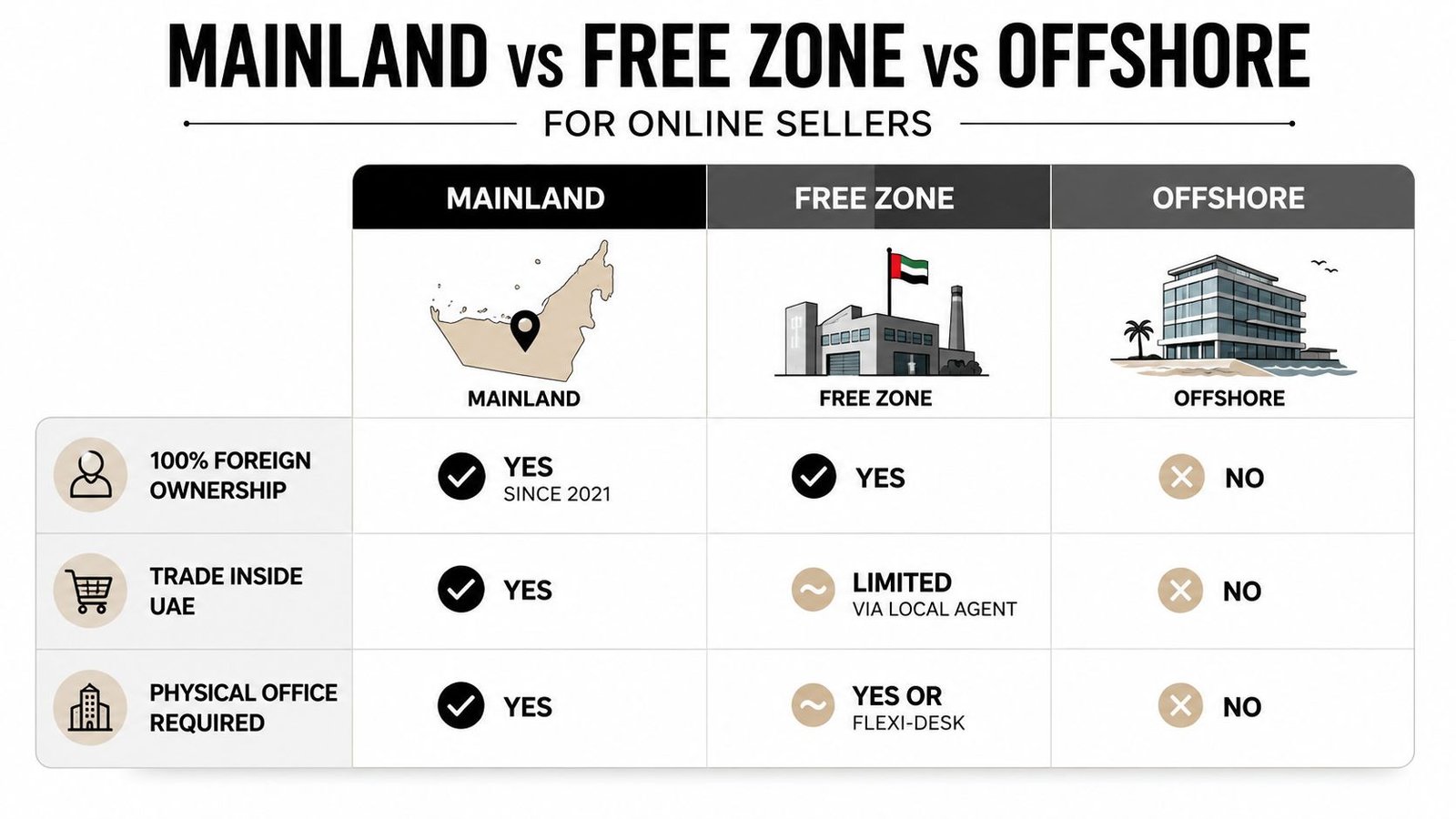
The rule of thumb is simple. Pick mainland if you need full UAE market access, government work, or a normal operating base with local customers. Pick free zone if you want a cleaner setup for online trade, holding, export-oriented activity, or a leaner office model. Pick offshore if you want a structure for international holding or IP ownership and you do not need to trade locally.
The ownership question is easier than it used to be. Mainland companies can now have 100% foreign ownership in many activities after the 2021 reform, so the old assumption that mainland means local sponsor is no longer a reliable shortcut for decision-making. The dividing line is market access and operating fit, not ownership alone.
Here is the point most guides skip. A free zone licence can be excellent for setup speed and flexi-desk use, but it does not automatically mean you can trade with every buyer in Dubai or Abu Dhabi without checking the activity code and supply chain. An offshore company is even narrower, so if your plan depends on local customers, local fulfilment, or UAE-based storefront activity, offshore is usually the wrong tool.
The 2024 licensing industry infographic also shows why online sellers now need to think digitally from day one. It reported that global retail sales of licensed products and services reached $356.5 billion in 2023, up 4.6% from 2022, and that the e-commerce retail channel captured 37% of global licensing sales (licensing industry infographic, 2024). For founders in Dubai or Sharjah, that means digital selling is not an add-on channel, it is the main one.
My view: if you are a real trader, don't default to offshore. In most UAE e-commerce setups, offshore is the wrong answer unless your business is genuinely holding-led or international-only.
| Criteria | Mainland (DET, DMT) | Free Zone | Offshore |
|---|---|---|---|
| 100% foreign ownership | Yes, in many activities | Yes | No local trading model |
| Trade inside UAE | Yes | Limited and model-dependent | No |
| Physical office required | Usually yes, often Ejari-based | Yes or flexi-desk | No local office |
| Best fit | Local sales, government buyers, wider UAE operations | Online sellers, startups, export, lean setup | Holding, IP, asset structuring |
The Application Process and Realistic Timelines
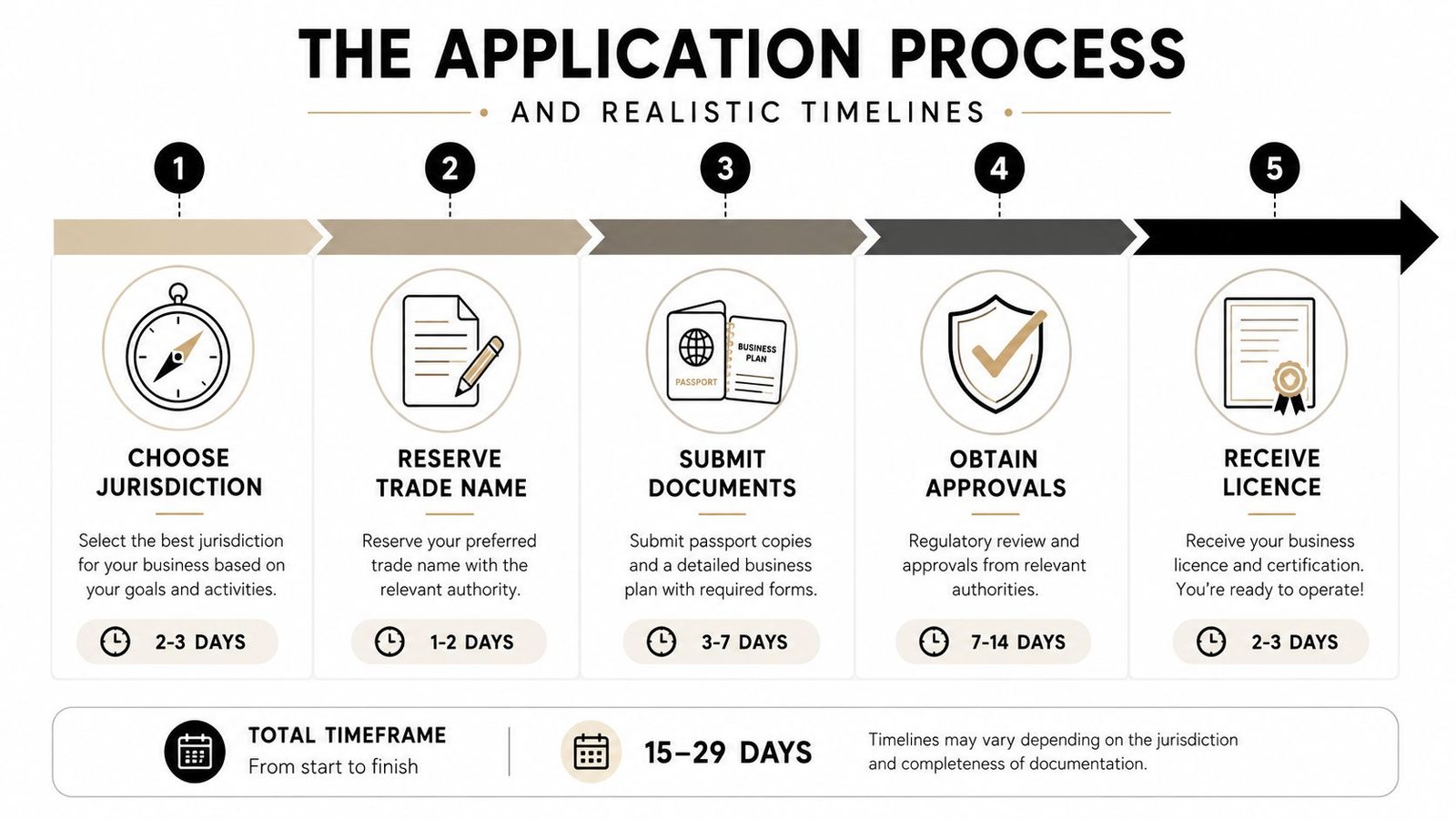
The application runs best when you treat it as a jurisdiction-first workflow. Choose mainland or free zone first, then reserve the trade name, submit the identity and business-use documents, wait for initial approval, pay the authority invoice, and receive the licence digitally.
What you submit first
The file usually starts with passport copies, identity documents, and in some zones a business plan. Some authorities also want proposed trade names, Emirates ID or visa copies where applicable, and proof of the workspace route you picked, for example a tenancy document, a flexi-desk arrangement, or an office file. The cleaner the document set, the fewer back-and-forth emails you'll get.
The fastest way to lose time is to submit documents that don't match the chosen activity or the chosen jurisdiction. If the sales model is mainland but the premises file looks like a free zone setup, the authority will stop and ask questions. If the activity code is too broad, you may get approval on paper and then hit trouble later when you try to open the bank account or add products.
How long it really takes
Neutral UAE guides note that free-zone approvals are often issued within 24 to 48 hours and the licence certificate can come in 3 to 5 business days for standard cases, while Abu Dhabi guidance says initial approval is typically 3 to 5 business days for complete submissions (Dubai South BH guidance). That is the actualistic window when the file is clean. If the file is messy, the timeline becomes whatever the correction cycle becomes.
Don't confuse initial approval with business readiness. You still need the licence issued, the premises file aligned, and the banking side moving before you can act like a live company.
A good PRO clears friction points, not just forms. The PRO is the person who tracks submissions, authority comments, amendment requests, and payment steps, so founders do not lose days inside email chains. In practice, that is where much of the delay sits, not in the headline licence issuance itself.
What you do not need yet
You do not need to treat this stage as full commercial launch. You are not at the visa stamping stage yet, and you are not solving every tax issue on day one. Get the licence issued first, then move to the next layer with the entity in hand.
Cost Breakdown and the Fees Most Guides Hide
Headlines like “AED 5,750 free zone licence” are marketing shorthand, not a full first-year budget. They usually exclude the items that make the setup real, especially workspace, visas, and the annual repeat costs that return in year two.
The honest way to budget is to split the spend into licence, formation, workspace, visas, and recurring compliance. For a mainland setup, that often means a trade licence fee, establishment-related charges, office or Ejari costs, and visa processing expenses if you need residency. For a free zone setup, the licence headline can look lower, but the flexi-desk, visa allocation, and renewal stack still matter.
| Cost Component | Mainland (approx.) | Free Zone (approx.) |
|---|---|---|
| Trade licence fee | Varies by authority and activity | Varies by free zone package |
| Registration or incorporation fee | Usually separate | Usually separate |
| Office or flexi-desk | Often office-based, Ejari-linked | Often flexi-desk or small office |
| Visa allocation | If needed, tied to structure | If needed, tied to package |
| Establishment card | Commonly required | Commonly required |
| Medical and Emirates ID | For each visa holder | For each visa holder |
| PRO and filing support | Ongoing | Ongoing |
| Renewal in year two | Licence, office, visa renewals | Licence, flexi-desk, visa renewals |
The fee most founders miss is the second-year repeat. Licence renewal, visa renewal, and office renewal can all land at once, and that's when cash flow feels tighter than it did at launch. If you budget only for the first invoice, you are underestimating the cost of staying compliant.
Budget rule: the cheapest setup on paper is not always the cheapest operating model. A structure that looks lean at incorporation can become expensive if it forces repeated amendments, extra approvals, or a bad banking profile later.
Free zone pricing also needs context. Some zones are better for a freelancer-style launch with minimal overhead, while others are built for larger operating companies with more formal office needs. Mainland is often the better fit if you need direct UAE trade, but you should expect the premises and visa structure to be part of the cost equation from the start.
I've seen founders waste money by choosing a package that looks small, then paying for amendments because the activity code was wrong from day one. That is avoidable. Choose the model that matches the sales channel, the inventory flow, and the future customer base, not just the cheapest brochure price.
PRO Work, Visas, and Opening a Bank Account
A PRO is a Public Relations Officer who handles government-facing paperwork, submissions, and follow-up with authorities. In the UAE, that work is not cosmetic, it keeps the licence, visa, and filing chain moving when the founder does not want to sit in portals all day.
How the visa chain works
Once the licence is issued, visa processing becomes the next practical step for many founders. Investor visas, employee visas, and dependent sponsorship all sit on the entity's legal status, so you need the company file active before you move people into residency. The usual sequence is medical testing, biometrics, and visa stamping, with the exact order depending on the emirate and the type of visa.
The key mistake is hiring or relocating before the company can support the visa plan. If you need staff in Dubai or Abu Dhabi, check the visa allocation and the premises route first. If you need family sponsorship later, make sure the founder visa path is clean before you assume the dependents can follow automatically.
What banks ask for
The corporate bank account is often the slowest part after licensing. UAE banks usually want a trade licence, Memorandum of Association, beneficial ownership declaration, proof of physical address, and source of funds information before they are satisfied with the file. Even when the licence is already issued, account opening can still take 4 to 8 weeks in real life because the bank's KYC review is separate from the licensing review.
Banks don't care that the licence was easy to get. They care whether the company has a real business profile, a clean ownership trail, and documents that match each other.
That is why document consistency matters. The bank should see the same business name, the same activity, the same owners, and the same address logic that the authority approved. If the licence says one thing and the support file says another, the bank will stall.
For founders who want practical help across setup, visa, and banking, Inpro Corporate Services L.L.C. handles this kind of UAE filing and compliance work alongside licence setup, which is useful when your main problem is coordination rather than legal theory.
What to prepare before the bank meeting
- Clean entity file: keep the licence, ownership documents, and address proof aligned.
- Source-of-funds story: be ready to explain where the business money comes from and how it will move.
- Real activity evidence: bring contracts, product details, website screenshots, or supplier context if the bank asks.
- Signer readiness: make sure the person who will sign the account forms is available and properly authorised.
If the bank rejects the file, don't panic and don't start guessing. Fix the inconsistency first, then resubmit with the same story from top to bottom.
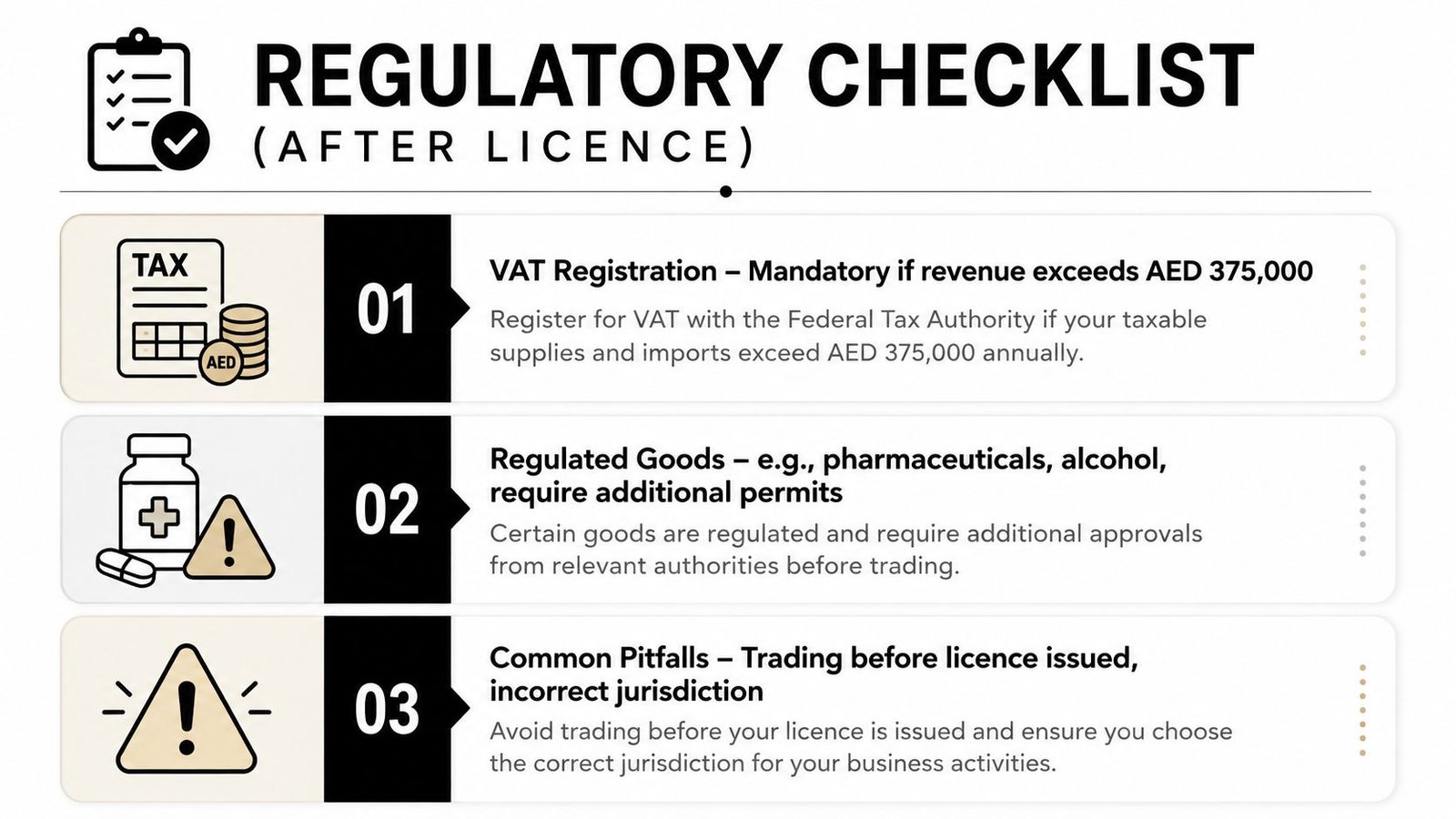
Beyond the Licence, VAT, Regulated Goods, and Common Pitfalls
Many founders treat the licence as the finish line. It is not. The second regulatory layer is where online sellers get caught, especially when they expand into new product types or start selling across channels that were never covered by the original activity code.
Which extra approvals can show up
If your products or services fall into regulated buckets, extra approvals can apply. That can include the Telecommunications and Digital Government Regulatory Authority (TDRA) for telecom-adjacent products, ESMA for electronics, Dubai Municipality for food and cosmetics, and the National Media Council for media content. If the business model crosses into one of these areas, the basic e-commerce licence is only the starting point.
The gap is simple. A retail e-commerce activity may be issued directly when it sits inside a defined activity code and does not need third-party approval, but that does not mean every future product line is covered. If you start with unregulated goods and later move into regulated goods, re-check the file before you sell.
VAT and tax registration
VAT registration becomes mandatory once taxable supplies cross the AED 375,000 threshold. Corporate tax registration with the Federal Tax Authority is a separate compliance step, and founders should treat it as part of setup planning, not last-minute admin. If you wait until sales are already moving, you create avoidable risk.
The usual mistakes
- Wrong activity code: you launch with a licence that does not match B2B, B2C, marketplace, or import flow.
- Trading too early: you start selling before the licence is issued or before the file is clean.
- Premises mismatch: mainland entities often need an office or Ejari, while free zones often allow a flexi-desk or virtual office, and that difference changes approval logic.
- Domain and trademark gaps: the .ae domain and trademark position should match the brand before scale starts.
If your plan includes marketplaces, cross-border shipping, or regulated goods, the key question is not “Do I have a licence?” It is “Does this licence cover the way I'm selling today?”
That is the part most guide pages skip. Licensing risk is not only about entry, it is about expansion. A business that starts clean can still fail compliance later if the next product line or channel sits outside the original approval.
Pre-Launch Checklist and How to Move Forward
Before you go live, run the file like an auditor would. The licence should be issued, the trade name should match the brand, and the activity code should match the actual sales model, not the optimistic version of it.
Use this as your final check:
- Licence received: confirm the issued activity matches online trading, not a generic placeholder.
- Ownership and signatures aligned: the authority file, bank file, and internal records should show the same owners.
- Workspace active: office, flexi-desk, or Ejari should match the jurisdiction rules.
- Visas allocated and started: investor, employee, or dependent routes should be aligned before anyone assumes residency is ready.
- Bank account progressing: the KYC pack should already be assembled.
- VAT and corporate tax filed where needed: don't wait for the first tax problem to ask questions.
- Trademark and .ae domain checked: brand ownership should match the company plan.
- Marketplace accounts linked properly: the seller profile should sit under the legal entity, not a random personal account.
The biggest launch mistake is trying to move fast with a half-right file. If the jurisdiction, the premises, the banking, and the tax picture all line up, the business can operate instead of just existing on paper.
If you want a clean start in Dubai, Abu Dhabi, Sharjah, or another UAE jurisdiction, use a team that files these cases every day and knows where the delay really comes from. Not sure which route fits your model? Book a free strategy call with the inpro.me team and get the setup path mapped before you submit anything.
Inpro Corporate Services L.L.C. helps founders set up the right UAE licence, align visa and banking steps, and keep the compliance file moving after incorporation. If you need a practical review of your e-commerce structure, visit Inpro Corporate Services L.L.C. and start with the route that fits your actual sales model.