

An E-Trader license is a permit for UAE residents to legally sell products and services online through social media from their home. In Dubai, it can cost AED 1,070 per year and was launched in 2017, which makes it one of the cheapest legal entry points for solo online sellers, but it can also become a bottleneck once you need visas, staff, or a physical setup.
That's the trade-off many overlook. The Dubai E-Trader model works well when you're testing a business, freelancing online, or running a small home-based operation through Instagram, WhatsApp, Snapchat, Amazon, or a simple website. It stops working well when your business starts to look like a real company rather than a side business.
For founders moving into Dubai, Abu Dhabi, Sharjah, or the wider United Arab Emirates, the key question isn't just “Can I get an E-Trader license?” It's “Will this structure still fit six months from now?” If you choose the wrong licence at the start, you don't save time. You just delay the harder setup decision.
Table of Contents
- What Is an E-Trader License and Who Needs One
- Eligibility Rules and Jurisdictional Differences
- Your Step by Step Application Guide
- Analyzing the Costs Benefits and Limitations
- Understanding Visa Tax and Banking Rules
- Alternatives and Knowing When to Upgrade
- Find Your Ideal UAE Business Setup
What Is an E-Trader License and Who Needs One
What is an E-Trader license
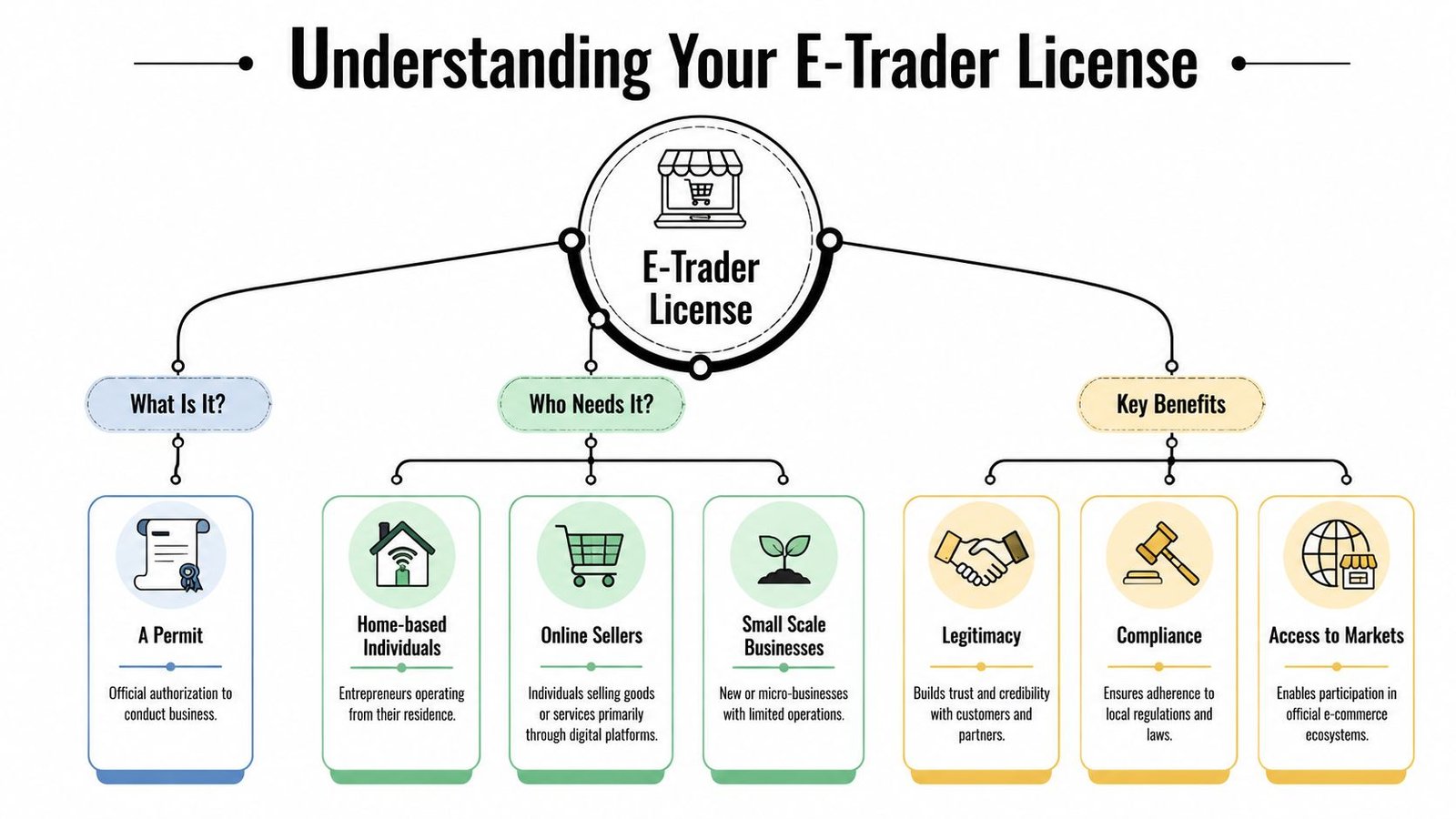
An E-Trader license is a Dubai-issued permit for an individual to carry out online business activity from home. It was launched by Dubai's Department of Economic Development in 2017 to legalise and support home-based businesses operating through social media, and confirmation often arrives within five to ten minutes of application according to this overview of the 2017 launch and process timing.
That speed is the main reason the licence gets so much attention. It gives solo sellers a legal route into Dubai's online market without the usual weight of a full mainland or free zone company setup.
Who is it designed for
This licence was built for individuals, not teams and not foreign corporate entities. In practice, it suits freelancers, home-based sellers, creators who monetise services, and small operators who want to invoice and trade more formally inside the UAE.
It also suits people who already live in Dubai and don't need the licence to solve immigration. That point matters. Many applicants assume a trade licence automatically gives them the same rights as a full company, but the E-Trader model is narrower by design.
Practical rule: If you're one person, already resident in Dubai, and selling online from home, the E-Trader licence is often a clean first step. If you need infrastructure around the business, it usually isn't.
What activities does it suit
The E-Trader licence is best for online-first, low-overhead activity. That includes selling through Instagram, Snapchat, WhatsApp, Amazon, and similar digital channels, as long as the activity fits the approved scope for this type of permit.
What it doesn't suit is a business that already needs a shop, staff structure, warehousing under a broader commercial model, or a company identity separate from the individual founder. The licence exists to formalise small online trading, not to replace a full company formation route in the United Arab Emirates.
A simple way to think about it is this:
| Business situation | E-Trader fit |
|---|---|
| Selling handmade goods from home | Strong fit |
| Freelance digital services under your own name | Strong fit |
| Testing a niche product on Instagram | Strong fit |
| Opening a retail unit in Dubai | Poor fit |
| Hiring a team | Poor fit |
| Expanding as a foreign company into the UAE | Poor fit |
The E-Trader licence works best when your business is still close to the founder. Once the operation starts needing separate corporate capacity, the limits show up fast.
Eligibility Rules and Jurisdictional Differences
Who qualifies in Dubai
The Dubai E-Trader licence has stricter entry rules than many people expect. It is strictly available only to individuals aged 21 or older who hold a valid Emirates ID and reside in Dubai, and it excludes non-residents according to this explanation of Dubai E-Trader eligibility rules.
That means tourists, overseas founders without UAE residency, and foreign companies looking for direct market entry need a different structure. It also means someone living in Abu Dhabi or Sharjah shouldn't assume the Dubai route applies automatically to them just because they live somewhere in the UAE.
A lot of confusion comes from the phrase “UAE business licence.” In reality, licensing in the United Arab Emirates is jurisdiction-based. The emirate where you live, the authority issuing the licence, and the business activity all shape what you can apply for.
Why does jurisdiction matter so much
Jurisdiction is the licensing authority and legal home of the business. In the UAE, that can mean mainland Dubai, a Dubai free zone, mainland Abu Dhabi, an Abu Dhabi free zone such as Abu Dhabi Global Market, or other emirate-level systems.
The E-Trader brand belongs to Dubai's licensing system. Other emirates may offer ways to license small e-commerce or solo commercial activity, but they don't all follow Dubai's exact rules, naming, scope, or processing style. That's where founders make avoidable mistakes. They read one Dubai article and assume it covers the whole country.
The right question isn't “Can I get an E-Trader licence in the UAE?” It's “Which authority can license my activity where I live and where I plan to sell?”
For someone based in Dubai, the E-Trader route may be the simplest legal fit. For someone based in Abu Dhabi, Sharjah, or outside the country and planning a move, the better option may be a free zone or mainland commercial licence from the start.
Here's the practical distinction:
- Dubai resident individual: The Dubai E-Trader route may work if the activity is small-scale and online only.
- Non-resident founder: You'll usually need a full business licence, not an E-Trader permit.
- Foreign company entering the UAE market: You need a standard commercial structure, not a personal permit.
- Founder planning relocation: It's better to map visa, banking, and business scope first, then choose the licence.
That's why eligibility isn't just a checklist item. It's the first sign of whether this licence is the right tool.
Your Step by Step Application Guide
A lot of applicants expect a paper-heavy process. In practice, the E-Trader route is more digital and faster than most UAE licensing paths.
What should you prepare first
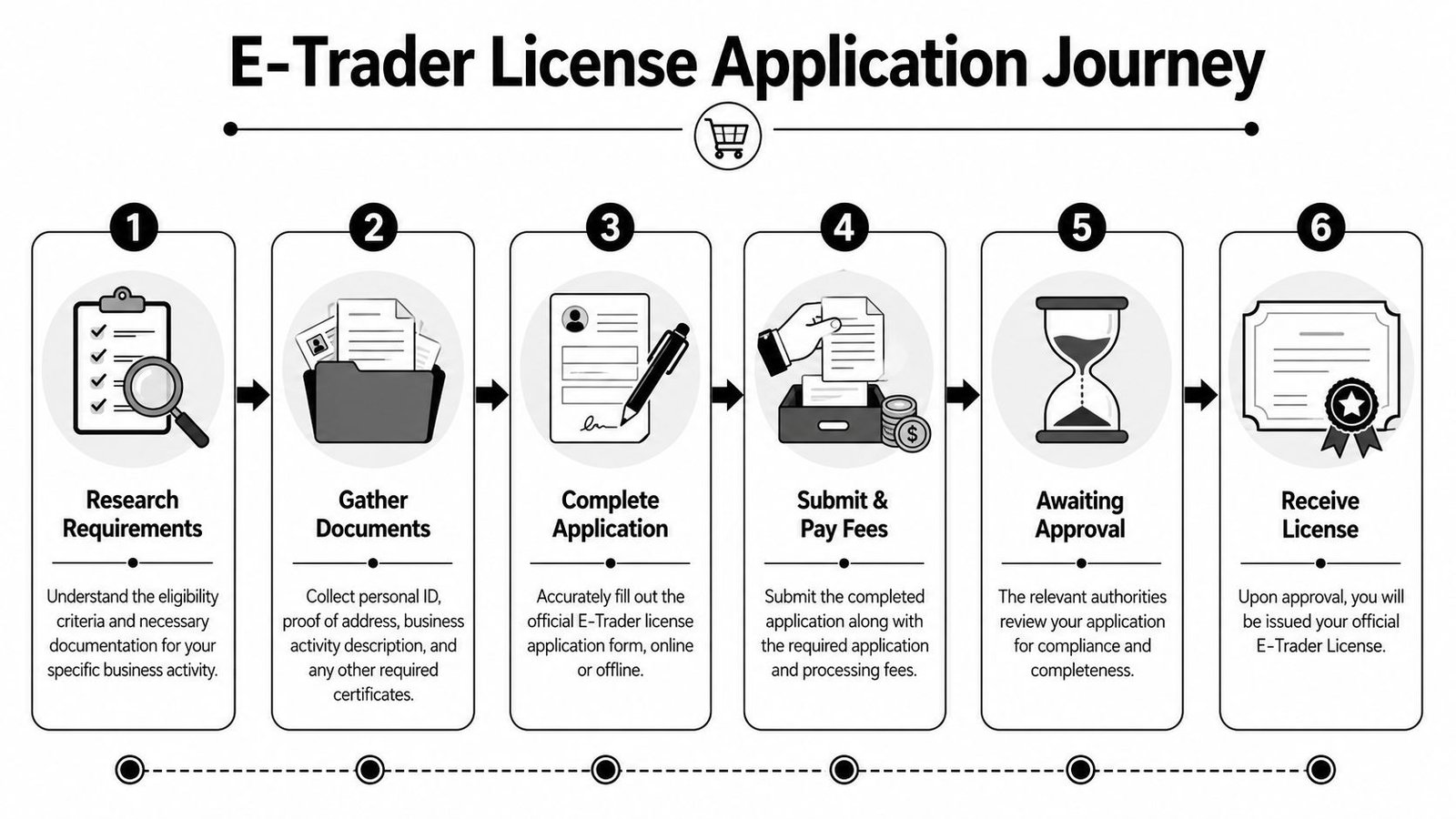
Start with the basics that prove identity, residence, and activity fit. The system is built around the individual applicant, so your Emirates ID and Dubai residency status matter more than the kind of corporate paperwork you'd need for a larger company.
Before you begin, make sure your proposed activity is clear in plain language. Vague descriptions create friction. “Online sale of handmade accessories” is easier to process than broad wording that could fall outside the allowed activity list.
A practical prep list looks like this:
- Valid Emirates ID so the authority can verify that you're eligible as a Dubai resident.
- Accurate personal details that match your government records.
- Clear business activity description so the licence category is easy to assess.
- Trade name choice if the portal asks you to reserve or confirm one.
- Payment readiness because the timing matters once the voucher is issued.
How does the application actually move
The application is usually submitted through the official Dubai licensing channels such as the DED Trader or Invest in Dubai pathway. Once your details are entered and accepted, you'll receive a payment voucher. That voucher has to be handled quickly.
According to DED Cafe's process summary for E-Trader applications, the payment voucher must be paid within 24 hours of issue, Dubai Chamber of Commerce membership is mandatory to commence commercial activity, and the licence is issued for one year and must be renewed annually.
This video gives a useful visual sense of the process flow:
What tends to delay approval
Most delays come from simple issues, not legal complexity. The common ones are a mismatch between residency details and application records, an unclear business activity, or a missed payment window after the voucher is generated.
Pay attention to the payment voucher. People spend time researching the licence, then lose momentum on the one step that actually closes the file.
If you want the process to feel smooth, treat it like a same-day task. Prepare first, submit carefully, pay promptly, and complete the Chamber requirement without waiting for a reminder.
Analyzing the Costs Benefits and Limitations
The strongest argument for the E-Trader licence is cost. The strongest argument against it is capacity.
Why is the E-Trader license attractive at the start
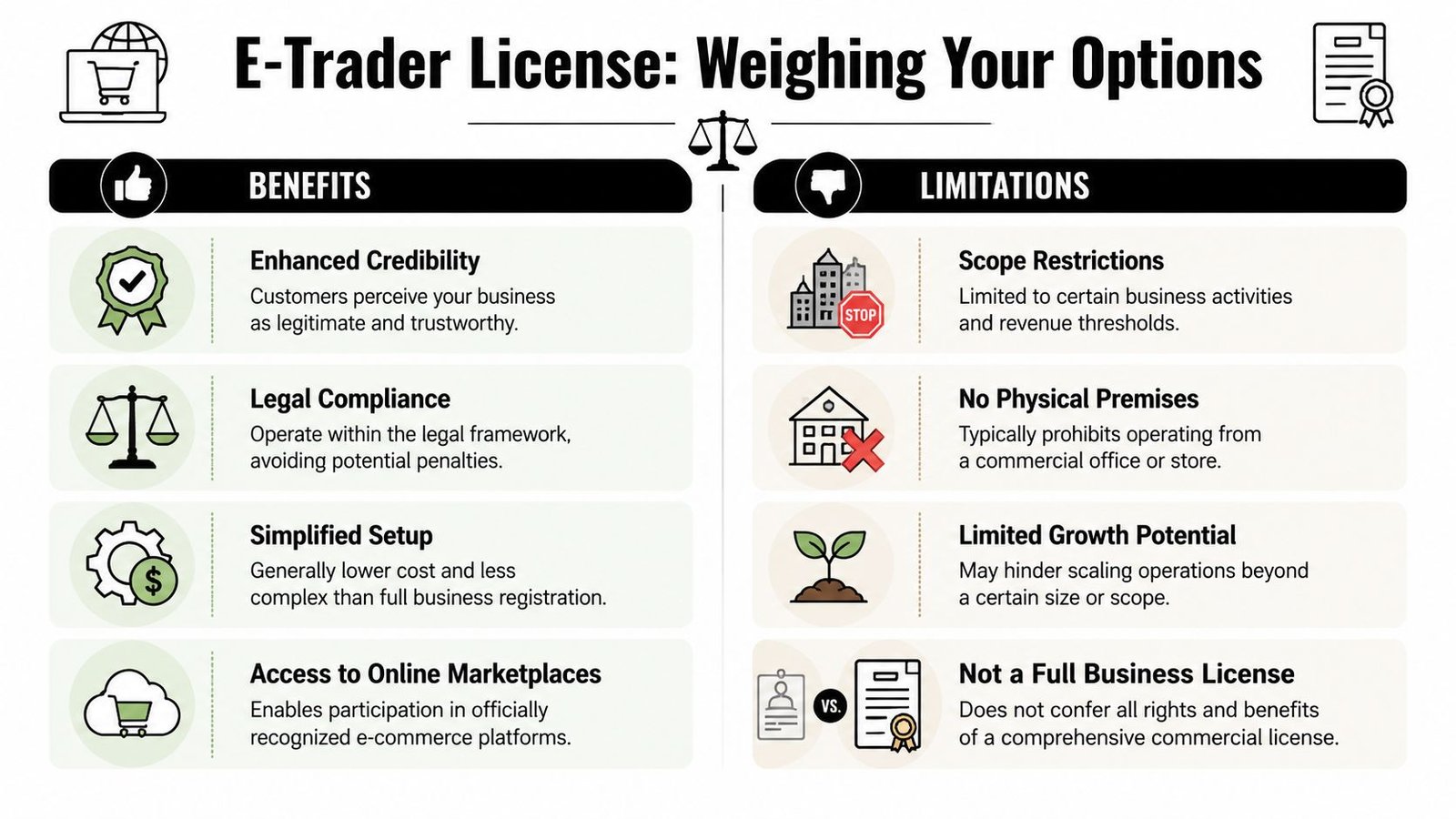
For a solo founder, AED 1,070 per year is hard to ignore. According to Al Tamimi & Company's review of e-trading business activities in Dubai, a Dubai E-Trader licence can cost as little as AED 1,070 annually, while alternative free zone e-commerce licences range from AED 10,000 to AED 19,000, with total setup costs often exceeding AED 15,000.
That difference changes the risk profile of starting a business. If you're testing demand, validating a service, or building an audience before committing to larger overheads, the E-Trader route gives you legal cover at a much lower entry cost than a conventional free zone setup.
Here's the side-by-side reality:
| Option | Typical cost position | Best for |
|---|---|---|
| E-Trader licence | Lower annual entry cost | Solo online sellers and small home-based operators |
| Free zone e-commerce licence | Higher setup cost | Founders who need a fuller business structure |
| Mainland commercial licence | Broader commercial setup | Businesses planning wider operational scope |
Where does the low-cost model stop helping
The catch is simple. The licence stays cheap because it stays limited.
It can't be used to open a physical retail store, and it isn't designed as a route to large-scale expansion. If your business model depends on premises, broad staffing, or a structure that looks and behaves like a normal company, you'll outgrow the licence quickly.
The same legal framework that makes the permit accessible also keeps it tightly controlled. That's good when you want a home-based start. It's frustrating when the business begins to scale and you realise the licence is holding the model in place.
- What works well: testing products, freelancing, selling through social media, starting with minimal fixed costs.
- What doesn't work well: building a team, expanding into a retail footprint, or creating a structure for wider corporate operations.
- What founders often miss: low entry cost doesn't mean low transition cost later if you picked the wrong setup.
A good E-Trader strategy is temporary by design. A bad one is trying to force it to serve as your permanent company structure.
Understanding Visa Tax and Banking Rules
What does the license mean for residency and employment visas
Many applications are based on a misunderstanding. The E-Trader licence is for people who are already resident in Dubai. It is not, in normal practical use, a substitute for a broader immigration-linked business setup.
Some guidance in the market refers to the licence as allowing limited visa capacity, while other guidance frames it more narrowly around personal online trading. In practice, if your main objective is to secure or manage your own residence pathway, support HR functions, or build an employee visa structure, you should assess a full mainland or free zone licence before you commit to E-Trader.
When do tax obligations start to matter
Value Added Tax is the UAE's indirect tax on most goods and services. If your business turnover crosses the threshold, registration stops being optional. The E-Trader model doesn't exempt you from tax rules just because it is simple or home-based.
According to Pro Partner Group's note on Dubai E-Trader rules, holders must still comply with UAE VAT regulations once annual turnover exceeds AED 375,000, and the licence also exempts qualified holders from needing a Local Sponsor.
That matters for two reasons. First, many solo founders start informally and then grow faster than expected. Second, once money starts moving through a business regularly, poor record-keeping becomes a problem fast.
Keep business records from day one, even if your first months are small. Tax questions usually become painful because the paperwork was casual, not because the rules were complex.
What should you expect from banks
Banking is often more difficult than the licence itself. The legal form is lighter, and some banks prefer dealing with structures that look more like full companies with broader operating footprints.
That doesn't mean banking is impossible. It means you should be realistic. A personal permit for home-based online trade won't always receive the same response as a mainland limited liability company or a free zone entity with a fuller document trail.
Founders usually get better results when they can clearly explain:
- What the business does
- Where customers are located
- How payments are received
- Why the E-Trader structure fits the activity
- How records and tax compliance are being handled
If smooth corporate banking is central to your plan from the start, that's often a signal that a fuller licence may fit better.
Alternatives and Knowing When to Upgrade
The best way to use an E-Trader licence is as a deliberate first stage, not as a permanent answer to every business need.
When is an E-Trader license the right first move
It's a good fit when your business is still founder-led, digital, and small enough to run without a bigger legal shell. A designer selling through Instagram, a home baker taking orders online, or a consultant monetising services under a personal brand can all make sensible use of it.
It also works well when your immediate goal is market testing. You don't always need a free zone company on day one. Sometimes the smarter move is to start lean, validate demand, and keep your compliance in place while you learn what customers end up buying.
When should you move to a full licence
You should plan an upgrade when the business starts demanding rights the E-Trader structure can't comfortably support. The turning point usually isn't emotional. It's operational.
Typical upgrade triggers include:
- You need visas tied to the business for yourself or team members.
- You want to hire staff and create a proper employment structure.
- You need premises such as an office, retail point, or broader commercial base.
- You need stronger banking support and a more conventional company profile.
- You're expanding beyond a solo business into a brand with multiple moving parts.
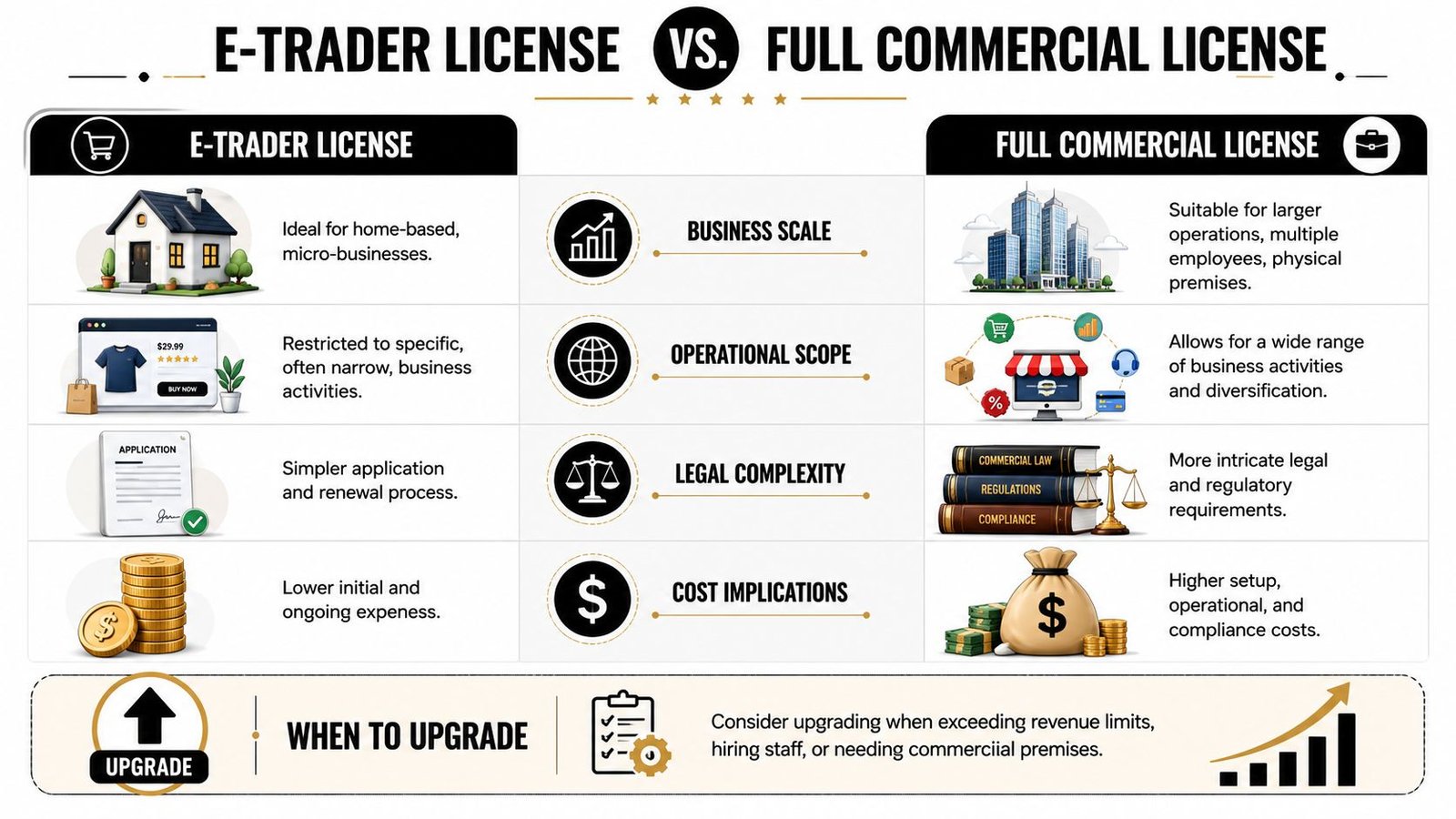
If the business depends on you personally for everything, E-Trader can work. If the business needs systems around you, it's time to upgrade.
What are the realistic alternatives
For most founders, the realistic next step is one of two routes.
A free zone licence usually suits businesses that want a structured setup, possible visa allocation, and an easier framework for service-led or international activity. A mainland licence usually suits businesses that want broader access to the local UAE market and fewer practical restrictions on operational scope.
The wrong move is waiting too long because the E-Trader licence felt cheap and convenient. Cheap is useful at the start. It becomes expensive when it blocks contracts, staffing, banking, or market access.
Find Your Ideal UAE Business Setup
The E-Trader licence is one of the smartest entry tools in Dubai when your business is small, online, and tied closely to you as the founder. It gives a legal route into the UAE market without the cost burden of a full commercial setup, and that makes it attractive for freelancers, side businesses, and early-stage e-commerce ideas.
Its weakness is the same as its strength. It is simple because it is limited.
If you already know you'll need employee visas, stronger banking support, wider commercial activity, or a structure built for growth across Dubai and the wider United Arab Emirates, skipping straight to a free zone or mainland company often saves time. If you're still validating the idea, the E-Trader path can be exactly the right tool.
The decision isn't about choosing the cheapest licence. It's about choosing the licence that matches the next stage of the business, not just today's version of it.
Not sure which structure fits your goals in Dubai or the wider UAE? Book a free strategy call with Inpro Corporate Services L.L.C. to compare E-Trader, Free Zone, and Mainland options with clear timelines, practical guidance, and no guesswork.