

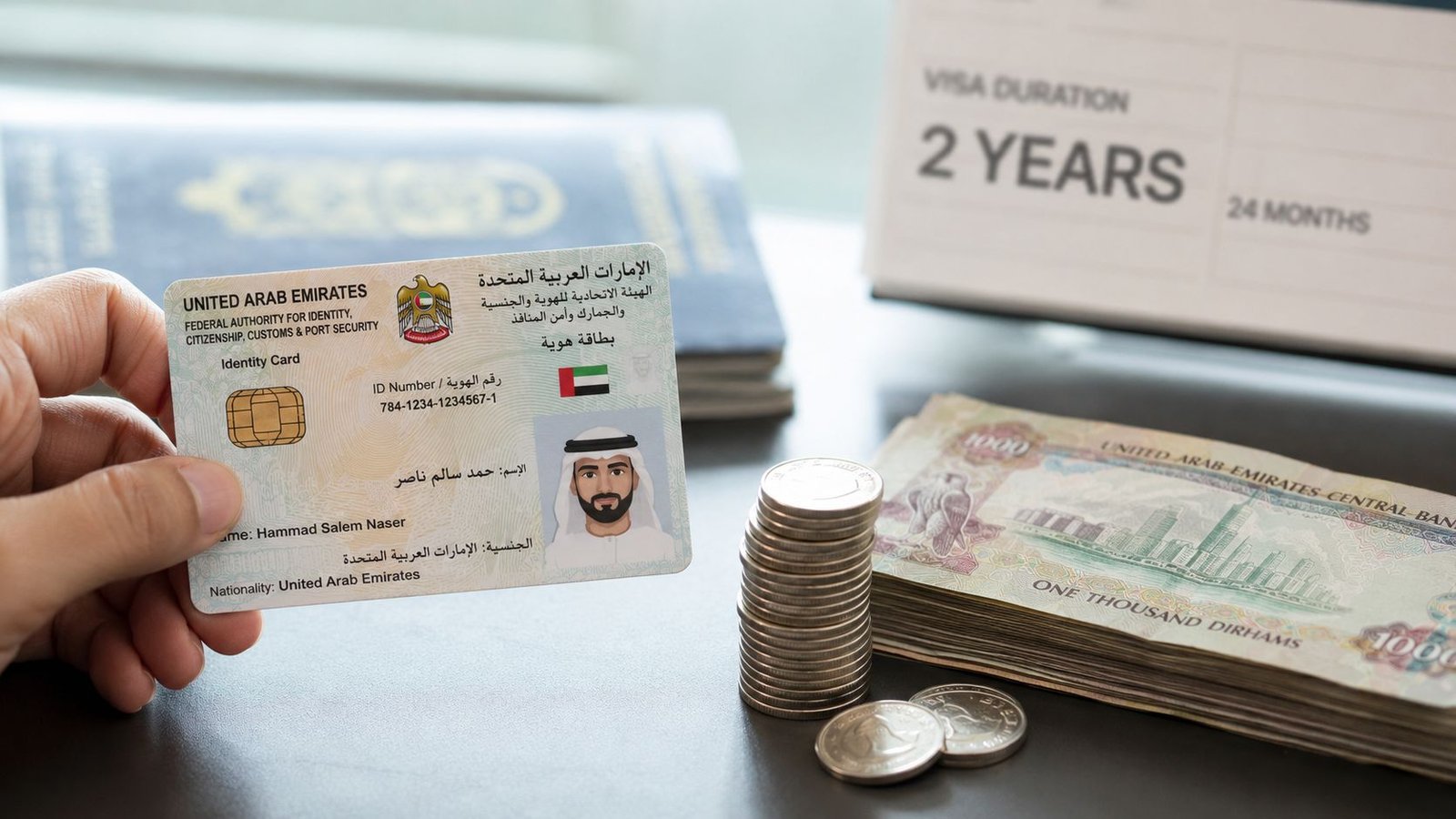
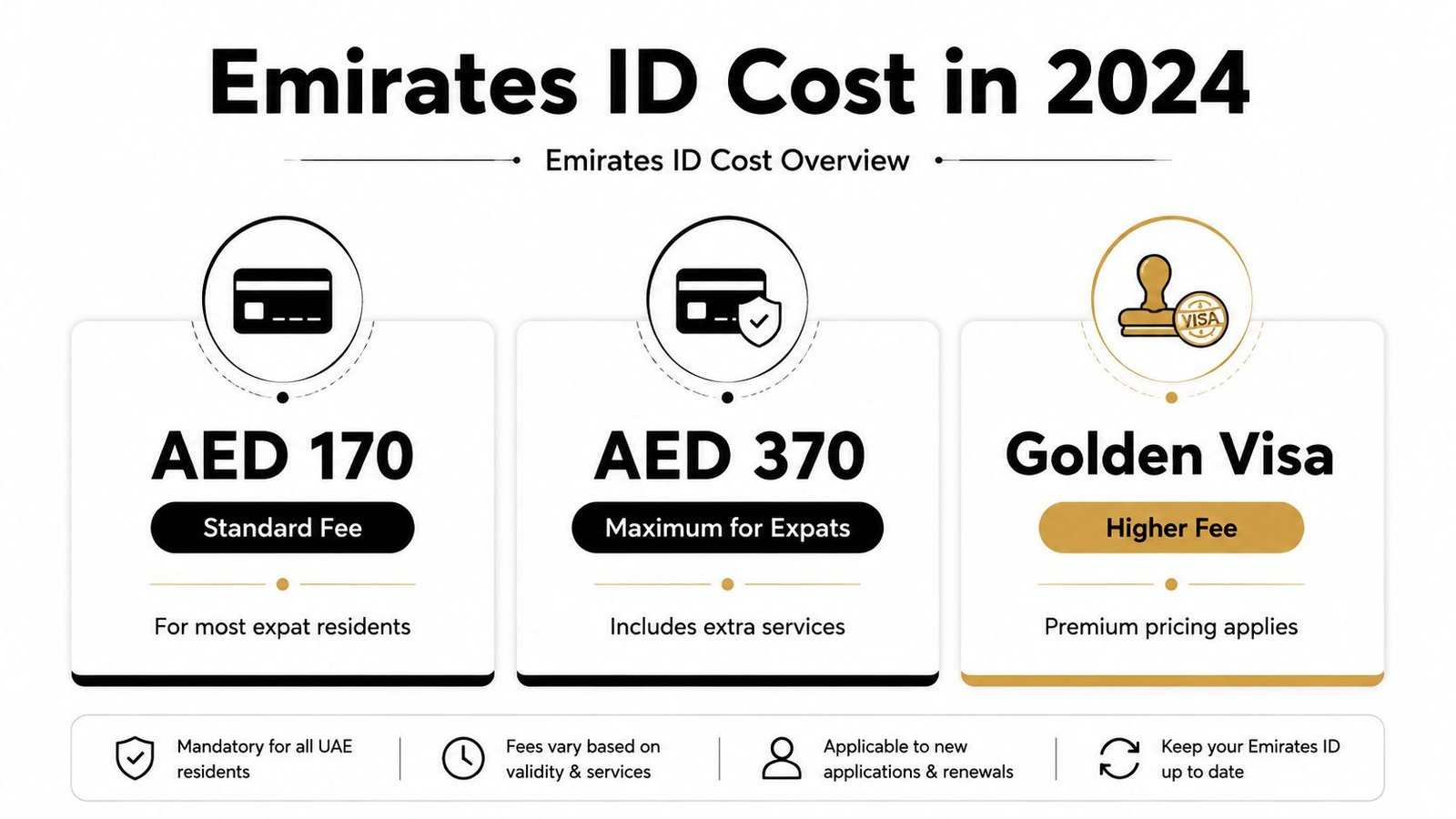
The standard Emirates ID cost for most expat residents is usually AED 170 to AED 370, while Golden Visa cards start higher because the fee follows the card's validity period. The popular shortcut, “just expect one fixed price,” is wrong, because the total changes with visa term, application channel, and whether you pay for urgent processing.
Table of Contents
- What the Emirates ID Cost Looks Like Right Now
- How Emirates ID Fees Are Structured
- Application Channels and Price Variations
- Step by Step Emirates ID Application Process
- Penalties and Hidden Costs to Watch For
- When to Use a PRO Service
- Frequently Asked Questions
What the Emirates ID Cost Looks Like Right Now
How the headline range breaks down
For most expat residents, the practical Emirates ID cost lands between AED 170 and AED 370 depending on the visa term and where the application is submitted, while Golden Visa holders pay more because the card stays valid for longer. The official ICP fee is tied to validity, with AED 100 per year forming the base and the total government fee reaching AED 200 for 2 years, AED 300 for 3 years, AED 500 for 5 years, and AED 1,000 for 10 years for longer-validity categories such as Golden Visa holders. That is why a single search result rarely tells the whole story. The number you pay at the counter is usually a blend of the ICP fee, a service or typing charge, and sometimes delivery.
Practical rule: if you see one flat Emirates ID price online, treat it as a partial quote until you know the visa duration and the channel.
Why Golden Visa cards cost more
The official fee model explains the price jump cleanly. A one-year residency card sits on a lower government fee base than a card linked to a longer residence term, and that same logic applies across the United Arab Emirates, whether the applicant is in Dubai, Abu Dhabi, Sharjah, or a free zone structure tied to a residence visa. The cost system no longer behaves like a flat identity card charge, it behaves like a validity-linked government document.
For founders and HR teams, that matters because Emirates ID is not an isolated line item. It is part of the residency process, so the card term usually follows the visa term. In practice, the government fee is predictable, but the final payment can still differ by channel and service level.
How Emirates ID Fees Are Structured
The base fee and the service fee
The cleanest way to think about Emirates ID cost is to split it into three layers. First is the official ICP charge, which is AED 100 per year of validity. Second is the fixed service fee, commonly listed at AED 40. Third is the typing or processing charge at an authorised centre, which is usually AED 30 to AED 70. The combined model is why expat totals often land above the raw ICP fee, even when the card itself is standard.
That structure is widely used in UAE service guides and matches the way many applicants experience the system in practice. It also explains why two residents with the same visa term can still pay slightly different totals if they submit through different channels or choose different support points.
| Visa term | Typical total range | Why it lands there |
|---|---|---|
| 1 year | about AED 170 to AED 230 | Base fee plus service and processing charges |
| 2 years | about AED 270 to AED 310 | Higher validity term, same added service layers |
| 3 years | about AED 370 to AED 410 | Highest common expat term in standard guidance |
What that means in real totals
A common guidance model shows a 2-year expat card at about AED 270 to AED 310, and a 3-year card at about AED 370 to AED 410. Those figures come from the base per-year structure plus the service and processing layers, so they are better planning numbers than any one promotional quote.
The safe assumption is simple, budget for the validity-based government fee first, then add the service layer if you are not submitting directly through a low-cost digital path.
For international founders and HR professionals, the main mistake is budgeting only for the base government amount. That underestimates the cash you need at the point of submission, especially when multiple employee files are being handled at once.
Application Channels and Price Variations
Online smart application versus typing centre versus Customer Happiness Centre
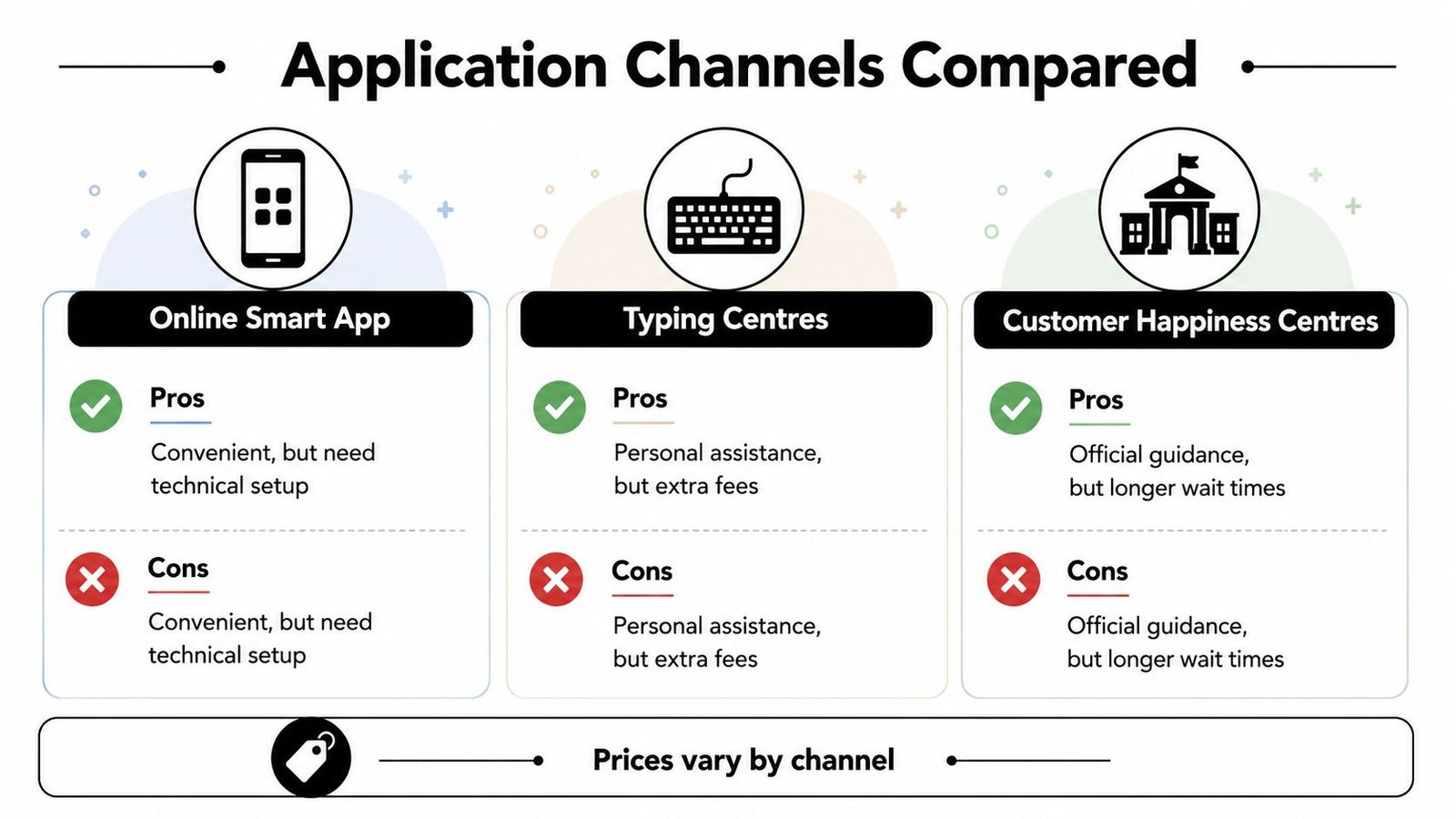
The application channel changes the final bill. A widely cited breakdown shows AED 140, AED 240, and AED 340 for 1-, 2-, and 3-year cards through an online smart application. The same cards are listed at AED 170, AED 270, and AED 370 through typing centres, and AED 290, AED 390, and AED 490 at Customer Happiness Centres when the urgent fee is included. That spread is the clearest example of why people who only compare “Emirates ID price” miss the actual decision.
The cheapest route tends to be the digital one, but the cheapest option is not always the easiest for a first-time applicant. A typing centre adds a moderate premium because someone checks and enters the paperwork for you. A Customer Happiness Centre is the highest-cost route because it is built for in-person support and, in some cases, faster handling of the file.
Where Fawri fits in
The urgent Fawri service adds AED 150 on top of standard fees and is used when speed matters more than price. That can make sense for a founder with an upcoming bank meeting, a new hire who needs a residence file finished, or any applicant who has left the process too late.
The channel choice is really a trade-off between control, speed, and paperwork support. Online submission works well for applicants who are already comfortable with UAE systems and have a clean file. Typing centres suit people who want human help without paying the highest urgent route. Customer Happiness Centres make sense when the file is sensitive or the applicant wants in-person guidance.
Step by Step Emirates ID Application Process
What happens from documents to delivery
The process usually starts with document preparation, and weak preparation is where many delays begin. Passport details, visa status, a recent photo, and proof of residence need to be aligned before the file goes in. If the information on the visa and the application does not match, the file can bounce back and cost you time.
The next step is submission through the ICP channel or an authorised typing centre, followed by biometric enrolment. That means fingerprints and a photograph are captured and linked to the identity record. Payment is then made through the official gateway or at the chosen service point, and the card is issued for delivery or collection depending on the channel used.
Practical rule: the smoothest files are the ones where the applicant's passport, residence details, and contact information are already consistent before the first submission.
For companies, a PRO team can save time. A good PRO does not just “send forms”, it checks for mismatch risk, organises the steps in the right order, and keeps the file moving when the system asks for corrections. That matters more for HR teams processing multiple employees than for a single straightforward applicant.
The process is mostly digital now in the UAE, including Dubai and Abu Dhabi, but the final experience still depends on the quality of the submission. A clean file moves quickly. A messy file usually creates extra visits, extra back-and-forth, and avoidable delay.
Penalties and Hidden Costs to Watch For
What late renewal really costs
The most common surprise is the late renewal surcharge. Emirates ID applications submitted after expiry can attract a daily penalty of AED 10, so waiting even a little while can turn a routine renewal into an avoidable expense. That is why on-time filing is cheaper than hoping there will be no penalty.
There are also replacement costs if the card is lost or damaged. The exact amount can vary by urgency and channel, but the point is the same, a replacement request is not free, and urgency pushes the total higher. Visa expiry penalties can sit beside that problem, which means a missed deadline can affect both the identity document and the broader residency file.
A missed renewal rarely stays a single issue. Once a card expires, the applicant may face pressure from the employer, sponsor, or family sponsor to fix the file quickly, and that urgency often leads people toward higher-cost processing options they would otherwise avoid.
| Risk | Cost effect | Best response |
|---|---|---|
| Late renewal | AED 10 per day | Renew before expiry |
| Lost or damaged card | Replacement fee applies | Report and replace quickly |
| Visa expiry | Broader residency penalties can follow | Keep visa and ID timelines aligned |
If you manage employees, build renewal reminders into your HR calendar well before expiry. If you are a founder or freelancer, don't wait until the last week. The cheapest Emirates ID is the one that is renewed before the system starts charging you for delay.
When to Use a PRO Service
DIY versus professional support
DIY works when the file is simple, the applicant has time, and the paperwork already matches across every record. In that case, the online path can be enough, especially for one resident who is confident with UAE government systems. The trade-off is that the applicant owns every correction, every login, and every follow-up.
A PRO service becomes more sensible when there are multiple applications, tight deadlines, or a file that touches several government steps at once. That is common for international founders, HR teams, and family sponsors who are managing visas across different emirates or free zones. A good PRO handles the back-and-forth, spots avoidable errors, and keeps the file moving without turning it into a full-time task.
DIY versus PRO Service
| Option | Main strengths | Main drawbacks |
|---|---|---|
| DIY | Lower cash outlay, full control | Time-consuming, more room for paperwork errors |
| PRO service | Faster handling, experienced guidance | Extra cost |
Inpro Corporate Services L.L.C. offers UAE PRO support that includes Emirates ID processing as part of wider visa and document handling, which is useful when the card is only one step in a larger residency file. That kind of support makes the most sense when the cost of delay is higher than the service fee itself.
For most straightforward renewals, DIY is fine. For multi-employee hiring, investor visas, or files with unusual timing, the fee for professional handling often buys back time and reduces avoidable mistakes.
Frequently Asked Questions
Does the cost change by visa type
Yes, because the Emirates ID price follows validity. The official ICP structure shows AED 100 per year, with totals scaling to AED 200 for 2 years, AED 300 for 3 years, AED 500 for 5 years, and AED 1,000 for 10 years for longer-validity categories such as Golden Visa holders, according to the ICP fee structure published by the UAE government in 2026 for current service guidance. That means an investor, employee, or family sponsor may pay a different total depending on the visa term attached to the residency file.
How long does issuance take
The exact timeline depends on the channel, the quality of the file, and whether you choose urgent processing. Standard applications move through document submission, biometrics, payment, and delivery, while the Fawri path exists for faster turnaround at an added AED 150. If speed matters, the key question is not whether the card can be processed, but whether the file is clean enough to move without correction.
What if the card is lost or damaged
Replacement is possible, but it is not a free reset. A lost or damaged card usually brings extra cost, and a rushed replacement can be more expensive than a routine renewal because urgency affects the service route. If this happens, act quickly and keep the replacement tied to the same residency details so the file stays consistent.
Do children need their own Emirates ID
Yes, children on UAE residence visas need their own Emirates ID because the card is tied to residency and identity, not just employment. Families in Dubai, Abu Dhabi, Sharjah, and the free zones usually treat this as part of the child's residence file, which means it should be planned alongside the visa process rather than left for later. If you are sponsoring dependants, build their card timing into the overall residency calendar.
What's the smartest way to budget for Emirates ID
Budget for the visa-term-based government fee first, then add the service or typing layer if you are not using the lowest-cost digital route. For most expat residents, that means planning around the AED 170 to AED 370 standard market range rather than assuming the base ICP fee will be the whole bill. That simple habit prevents surprise costs at the point of payment.
Inpro Corporate Services L.L.C. helps founders, HR teams, and visa applicants handle Emirates ID processing alongside residency and PRO work across the UAE. If you want a clear breakdown of your likely Emirates ID cost and the best channel for your case, visit Inpro Corporate Services L.L.C. and ask the team to map the file before you submit.