


Your company is live. The trade licence is issued, the bank account is moving, and you're ready to hire. Then the first visa step stalls because the system asks for an establishment number you don't have.
That's where many founders in Dubai realise the trade licence was only the first layer of setup. A company can exist commercially and still be unusable for immigration processing. If you want to sponsor yourself, hire staff, or run employee onboarding without last-minute surprises, the establishment card is the operational key.
Most articles stop at a document list. That doesn't help when you're deciding whether your path runs through GDRFA, ICP, a free zone portal, or a separate MOHRE file. The core issue isn't just getting a card. It's getting the right registration with the right authority so hiring doesn't stop halfway.
Table of Contents
- Your Business Is Launched But You Can't Hire
- What Is a Dubai Establishment Card Really For
- Mainland vs Free Zone Who Needs a Card
- The 2026 Application Workflow and Documents
- Fees Timelines Renewal and Amendments
- Common Pitfalls and How to Avoid Them
- Why Smart Founders Outsource This Process
- Frequently Asked Questions
Your Business Is Launched But You Can't Hire
This happens all the time. A founder signs the incorporation documents, receives the trade licence, starts speaking to candidates, and assumes visa processing can begin immediately. Then the immigration system asks for the establishment card number.
At that point, the business has a legal presence, but it still isn't ready to sponsor anyone. That includes employees, and in many cases it also affects investor or partner visa steps tied to the company's immigration record.
The practical point is simple. Your trade licence allows the company to exist. Your establishment card allows the company to function inside the immigration system. If you skip that distinction, hiring plans can slip for reasons that feel administrative but have a direct commercial impact.
Practical rule: If your company will sponsor any person for a UAE immigration process, treat the establishment card as part of launch readiness, not as paperwork to sort out later.
This is why founders searching for establishment card Dubai guidance usually aren't doing casual research. They're already blocked by a real operational issue. The fix is straightforward once you know which authority you're dealing with and which record you need.
What Is a Dubai Establishment Card Really For
The easiest way to think about the establishment card is this. It is your company's immigration identity record.
A trade licence tells the market and licensing authority that your business is registered. The establishment card tells the immigration authority that your company exists in its system and can carry out visa-related transactions. Without that record, your company isn't properly connected to the immigration workflow that handles sponsorship and residency processing.
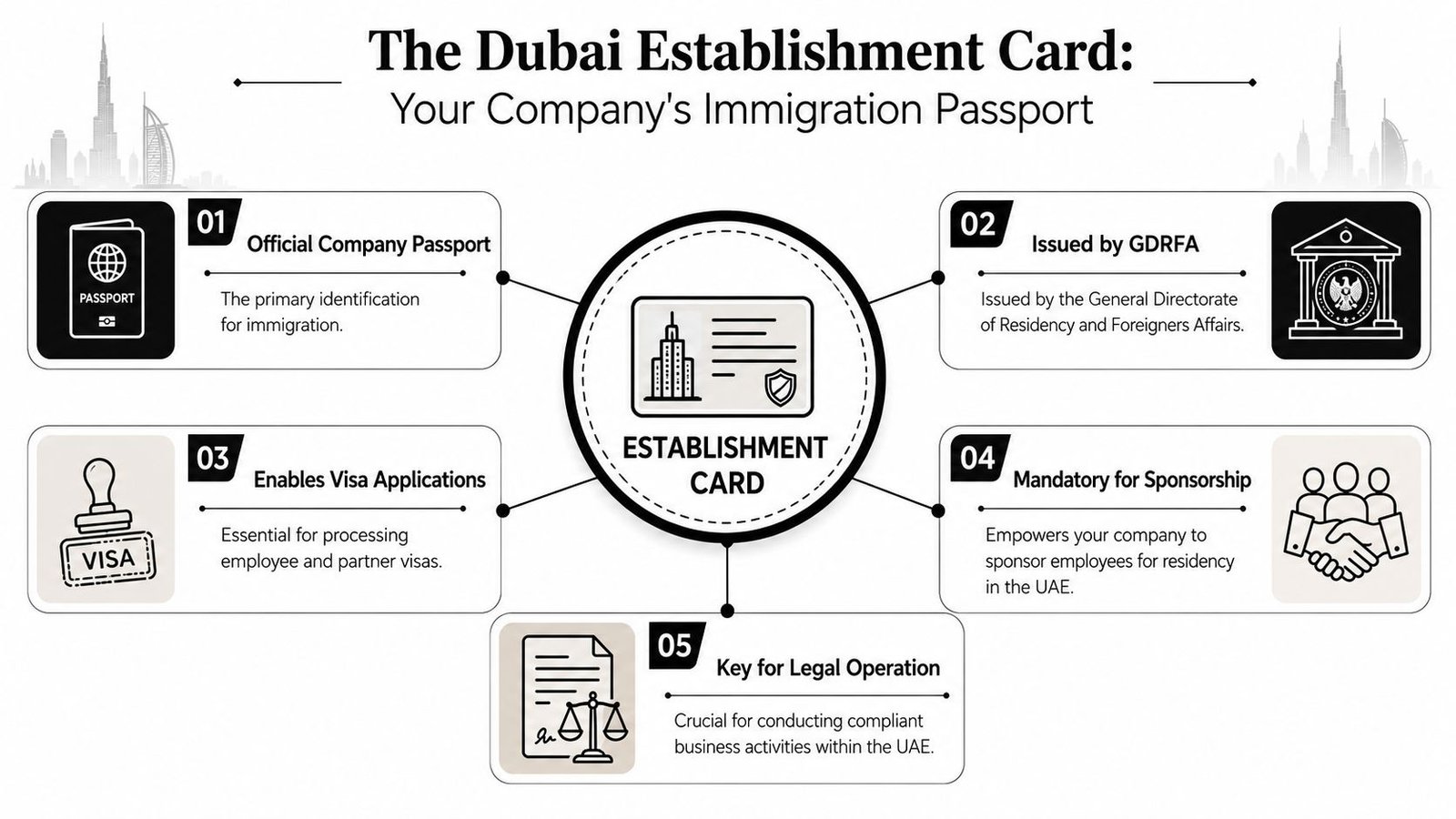
It is your company record inside immigration systems
At the federal level, the electronic establishment card includes registered establishment data such as the trade name, and ICP states that it can be issued through its Smart Services System on the website or mobile app 24/7, while Customer Happiness Centres operate during working hours only, according to the ICP establishment card service details.
That matters because the process is no longer mainly about standing at a counter. It's about whether the data you submit is clean, complete, and aligned with the company record already on file. If the record is right, the workflow moves. If it isn't, the system catches the inconsistency.
In practice, the establishment card supports things such as:
- Immigration registration: Your company becomes visible inside the authority's processing environment.
- Visa sponsorship access: You can proceed with company-linked residency steps once the record is active.
- Operational continuity: HR and PRO teams can work from a recognised immigration file instead of trying to patch documents together later.
It is not the same as the MOHRE card
Many founders encounter delays because the GDRFA or ICP establishment card and the MOHRE establishment file or card are not interchangeable.
Official MOHRE guidance shows mainland employers must first register establishment details, owners, authorised signatories, business activity, and location before MOHRE issues its card, while the immigration-side record separately carries establishment data for immigration use, as shown on the MOHRE establishment card service page.
So which one do you need?
| Purpose | Authority path | Why it matters |
|---|---|---|
| Immigration and visa processing | GDRFA in Dubai or ICP in federal channels | This is the record used for company immigration transactions |
| Labour and employment administration for mainland employers | MOHRE | This supports labour-side compliance and onboarding steps |
A founder often asks, “Do I just need one establishment card?” The strategic answer is no. You need the right registration for the authority handling the next transaction. If you only complete the labour side, immigration can still stop. If you only complete the immigration side, labour-side processing can still remain incomplete.
The safest approach is to map the first action you need to perform. Hiring, visa issuance, labour registration, or employee onboarding. The authority behind that action tells you which file must exist first.
Mainland vs Free Zone Who Needs a Card
Any company that plans to sponsor visas needs the relevant establishment record. The confusion isn't about whether it's needed. The confusion is about where the process sits and who controls it.
Mainland companies
For a Dubai mainland business, the path usually sits closest to Dubai immigration requirements, alongside the separate labour-side position that applies to mainland employers. This is why mainland founders often face a dual-compliance reality earlier than free zone founders do.
A mainland company should think about establishment records in two layers:
- Immigration layer: Needed when the company is going to sponsor a person through immigration processing.
- Labour layer: Needed when the employer relationship must be recognised for work-related administration.
If you only budget attention for one of those layers, the second one tends to appear when the first employee is already waiting.
Free zone companies
Free zone businesses usually experience a more bundled process. Many free zones integrate immigration-related steps through their own internal portal or support team, so the founder sees one guided flow rather than separate authority journeys.
That doesn't mean the underlying requirement disappears. It means the free zone often acts as the operating channel through which the company becomes registered for the immigration actions attached to that jurisdiction.
What works well in free zones is following the exact internal sequence the zone provides. What doesn't work is assuming a mainland explanation applies unchanged to a free zone company. The business activity may be similar, but the administrative route often isn't.
A simple decision framework
Use this framework before you file anything:
- Check your jurisdiction first. Mainland and free zone entities don't always use the same path.
- Ask who will sponsor the visa. If the company will be the sponsor, the company needs the right establishment record.
- Separate immigration from labour. If your issue is visa issuance, focus on the immigration-side card. If your issue is labour setup for a mainland employer, confirm the MOHRE position too.
- Follow the channel tied to your licence. Don't copy another company's process just because the trade activity looks similar.
- Plan for your first hire, not your first application. Founders often file reactively. The better approach is to prepare the company's compliance stack before recruitment begins.
The phrase establishment card Dubai sounds singular. The practical reality is not. You are dealing with a company record inside a wider compliance system, and the right route depends on where your entity was formed and which authority controls the next step.
The 2026 Application Workflow and Documents
A founder's licence can be live, the office can be ready, and recruitment can still stall because the company record for immigration use was not set up cleanly. That is why this stage needs more than a document checklist. It needs the right sequence.
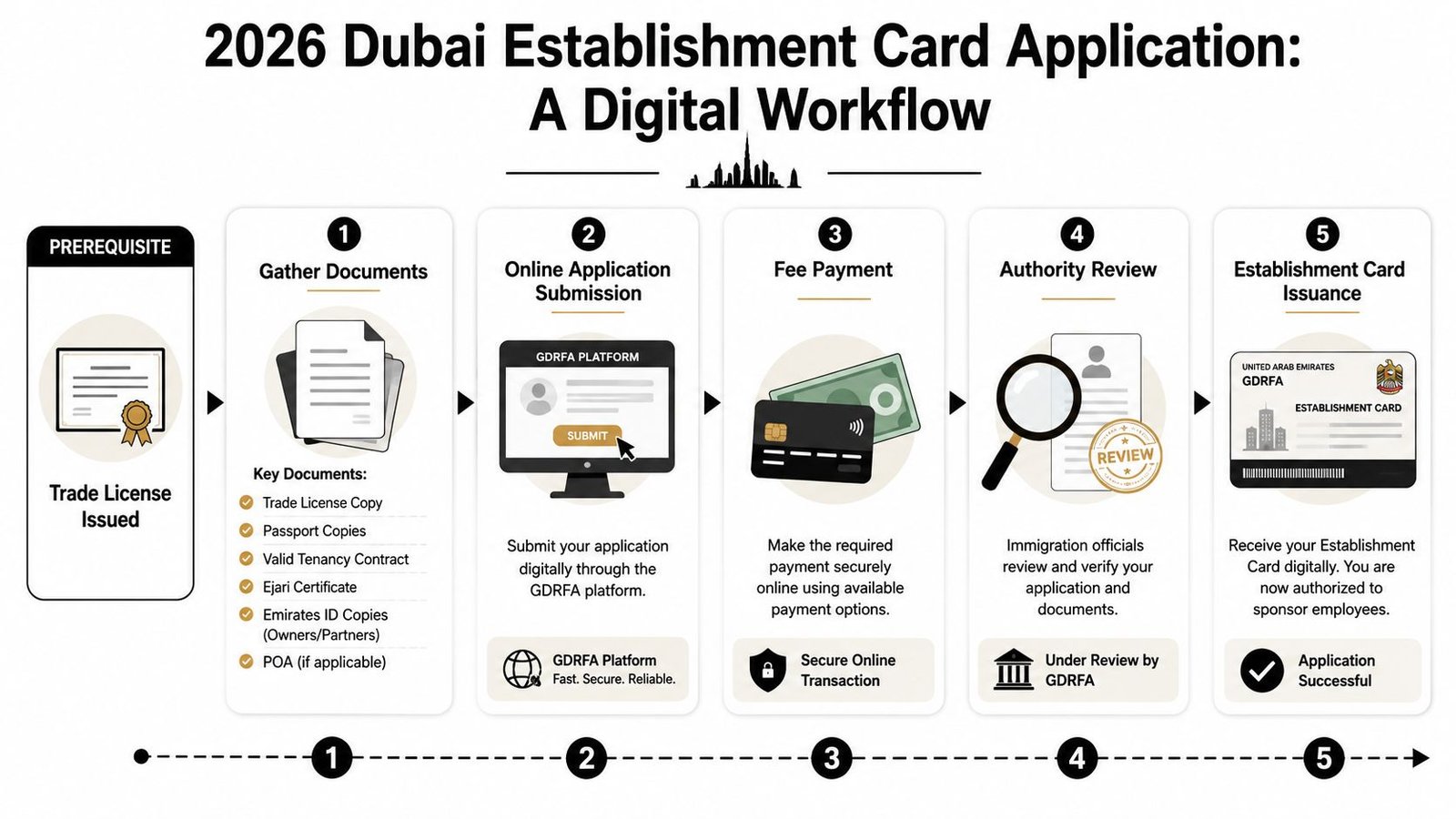
What to prepare before you submit
The application succeeds or fails on data consistency. Authorities are not reviewing your commercial intent. They are matching records across licence, shareholder identity, authorised signatory details, and, where relevant, premises information. If one record shows a different spelling, passport number, or signatory format, the file slows down.
Prepare a working file with these documents:
- Trade licence copy: This is the base record. The legal name, licence number, and activity should match every related document.
- Passport copies of partners, shareholders, or authorised signatories: These confirm the individuals tied to the company file.
- Emirates ID copies where applicable: Some channels request current ID support for the people linked to the application.
- Tenancy proof such as Ejari where relevant: This matters in structures that require proof of physical premises.
- Authority-specific approvals or support documents: These vary by jurisdiction, licence type, and signatory setup.
For mainland companies, I usually tell founders to spend extra time on the authorised signatory block. That is where avoidable errors happen. A signatory named one way on the licence and another way on the passport copy can trigger a clarification request that delays the whole file.
Clean records move faster than rushed submissions.
How the workflow moves
The practical order matters because the Establishment Card and the MOHRE setup do not do the same job. The Establishment Card supports the company's immigration record. MOHRE registration applies on the labour side for mainland employers. Founders lose time when they treat them as interchangeable and open the wrong process first.
A workable application flow looks like this:
Confirm the company can use the immigration channel tied to its jurisdiction
Start with the licence and jurisdiction rules. A mainland company follows a different administrative path from a free zone entity, even when both plan to hire staff.Verify the company data before anyone uploads documents
Check the legal name in English and Arabic where relevant, licence number, passport details, signatory authority, and address records. This step prevents most rejections.Build the submission pack around the sponsoring entity
The sponsoring company must be clear in the file. If the company will sponsor visas, its establishment record must be accurate before visa processing starts.Submit through the correct authority channel
This is a strategic step, not clerical work. Mainland and free zone portals, service desks, and approval chains can differ. Using the wrong channel often creates a dead-end application rather than a fixable typo.Review the full application before payment
Payment does not validate the file. It only moves the case forward. The right time to catch errors is before submission, not after a reference number is issued.Answer authority queries with corrected documents
If the authority raises a comment, respond with revised paperwork that matches the company record. Explanatory emails rarely solve a data mismatch.
Once approved, the company receives the electronic establishment record needed for immigration processing. That does not mean every hiring requirement is finished. For a mainland employer, labour-side registration may still need to be handled separately through MOHRE. Keeping those two tracks clear is what prevents founders from filing one card and assuming the company is fully ready to onboard staff.
Professional support helps most at two points. First, before submission, by checking whether the company is following the right mainland or free zone path. Second, after a query, by fixing the exact mismatch without restarting the process. That saves more time than handing over document typing.
Fees Timelines Renewal and Amendments
A founder often discovers the actual cost of an establishment card only after the company is ready to hire and a small mismatch turns into a delay. The government fee is usually the simple part. The expensive part is paying twice, correcting records mid-process, or learning too late that the immigration-side card and the mainland labour-side setup are different files with different uses.
Official Dubai fees
For a Dubai immigration establishment card, GDRFA Dubai lists a service fee of AED 150, an issuance fee of AED 200, and 5% VAT on the service through its official establishment card service page (https://www.gdrfad.gov.ae/en/services/8b45d552-6747-11ea-0320-0050569629e8).
| Fee Component | Authority | Amount |
|---|---|---|
| Service fee | GDRFA Dubai | AED 150 |
| Issuance fee | GDRFA Dubai | AED 200 |
| VAT | GDRFA Dubai | 5% |
Use that breakdown as a control point when reviewing a quote from a typing centre, consultant, or PRO. If the amount is higher, the difference is usually not a hidden government charge. It is a service layer such as submission handling, document review, Arabic typing, courier support, or amendment work.
That distinction matters. Founders regularly compare one all-in quote against another without separating official fees from execution fees. A cheap quote can become expensive if the file is submitted incorrectly and later needs correction.
How to think about timing
Processing times vary by authority, jurisdiction, and file condition. The more useful question is whether the company record is ready to pass system checks without comments.
Clean files move faster. Files with outdated licence data, the wrong authorised signatory, or unresolved amendments slow down because the authority is validating records, not just accepting uploaded documents.
The same logic applies to the mainland versus free zone decision. A mainland company may need to keep both tracks clear. The immigration establishment card supports visa and sponsorship transactions, while the MOHRE card covers labour-side employer registration. A founder who budgets time for only one of those items can still end up unable to onboard staff.
Renewal is a compliance task, not an admin reminder
Renewal problems usually start earlier than founders expect. The card may still exist in the system, but if the underlying company details changed and the record was never updated, the file can stall at the moment the business needs it most.
Three points matter in practice:
- Renew before a live immigration need arises. If the company will sponsor visas, check validity in advance rather than during an active employee file.
- Amendments matter as much as expiry dates. A current card with outdated manager, address, licence, or ownership data can create the same blockage as an expired one.
- The electronic record is what the authority relies on. UAE federal services for establishment card updates are handled digitally through the Ministry of Foreign Affairs update service (https://www.mofa.gov.ae/en/services/update-establishment-card-service), which reflects how authorities expect company records to be kept current.
Founders lose time by treating renewal as a yearly checkbox. It is better handled as part of every corporate change. If the licence changes, if the manager changes, or if the company restructures, review the establishment record at the same time.
Amendments that usually trigger extra work
Some amendments are simple. Others require supporting records to be aligned first.
Common examples include:
- change of authorised signatory
- trade licence updates
- office address changes
- ownership or partner changes
- manager or company representative changes
The trade-off is straightforward. Filing quickly with outdated documents may save a day at the start and cost a week later. Filing after a proper record check takes longer upfront but reduces the risk of authority queries and duplicate fees.
Professional help earns its value here. A good corporate services team does not just submit the request. It checks whether the immigration record, licence record, and labour-side setup match before money is paid. That is the difference between a routine renewal and a correction project.
Common Pitfalls and How to Avoid Them
Most establishment card delays don't happen because the rules are impossible. They happen because founders file the wrong thing, with the wrong data, at the wrong time.
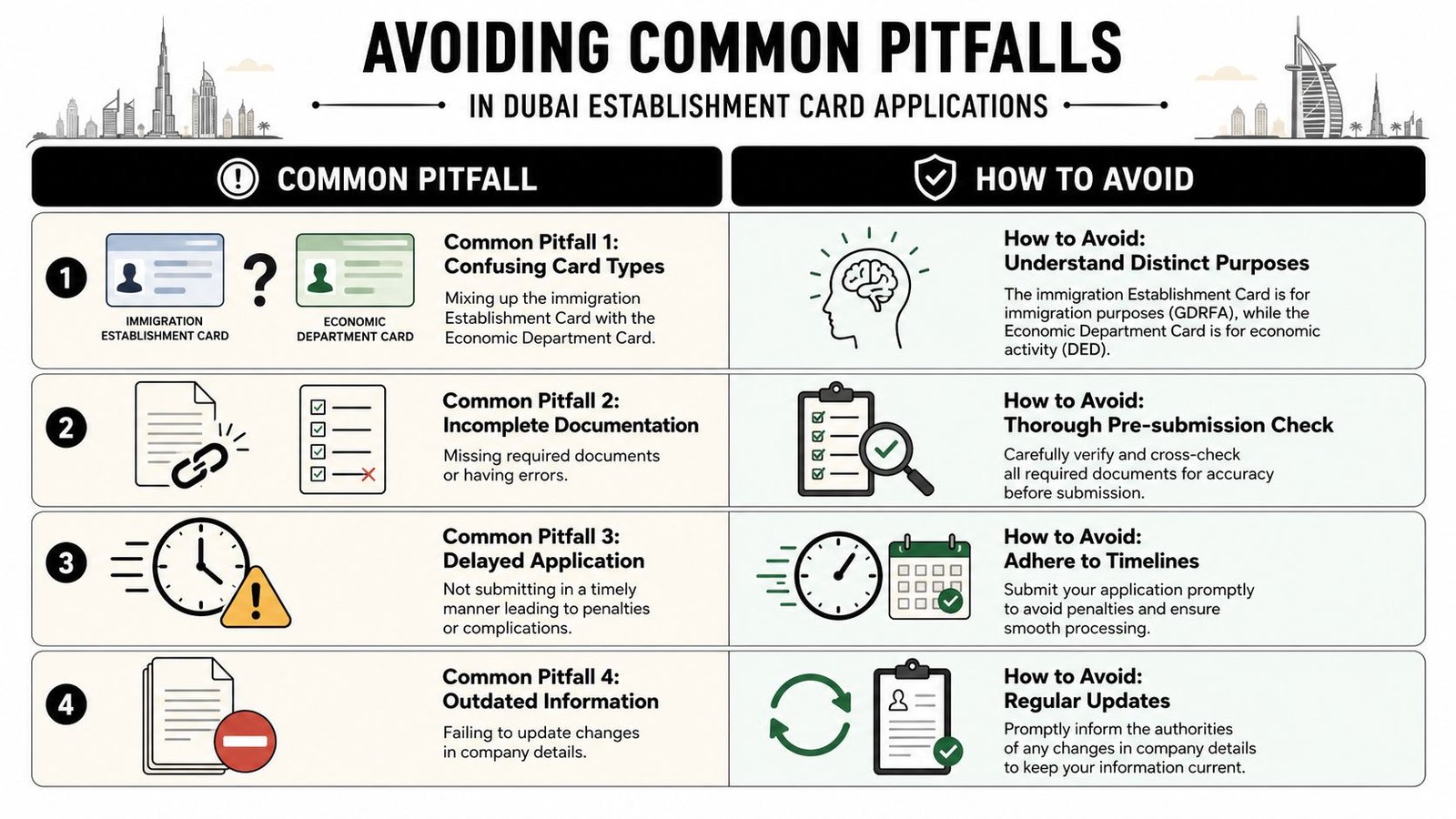
The wrong card problem
A founder sets up a mainland company, hears that an establishment card is needed, and proceeds with the labour-side assumption only. The business then tries to start immigration processing and discovers the required immigration record is still missing.
The fix is simple but important. Identify the authority tied to the immediate action. If the next step is a visa or sponsorship transaction, confirm the immigration-side establishment record first. If the next step is labour administration for a mainland employer, confirm the MOHRE side too.
The mismatch problem
Another common scenario is the wrong signatory or outdated licence information. A company amends something material, such as management details or address information, but uses an older document pack for the application.
This kind of issue looks minor to a founder and major to an authority. Systems compare records exactly. The name on the application must match the authorised record. The tenancy evidence must still support the current company file. The signatory must be the one the authority recognises.
Use this pre-check before submission:
- Match legal names exactly: Don't assume spelling variations are acceptable.
- Use the latest licence version: An older copy can undermine an otherwise complete file.
- Validate signatory authority: The person acting for the company must be the recognised person in the record.
- Review premises documents carefully: Where location evidence is needed, expired or inconsistent tenancy documents can stop the application immediately.
The update problem
A company gets the card, then forgets about it. Later, a renewal, amendment, or visa application fails because the authority's digital record no longer reflects the actual business.
Federal services now handle establishment updates electronically as part of the UAE's digitised compliance framework, which means the quality of the live digital record matters continuously, not just on filing day, as reflected in the earlier-cited MOFA guidance.
The practical response is ongoing maintenance. Whenever a material company detail changes, check whether the establishment-side record also needs an update. Founders who do this early avoid the most frustrating kind of delay, the one that appears only when an employee has already resigned from their previous job or booked travel around a visa timeline.
Why Smart Founders Outsource This Process
Founders can file an establishment card themselves. The question is whether that is the best use of time once hiring, visa timing, and authority coordination are in play.
I see the same pattern often. A founder assumes this is a basic document task, delegates it internally, and only discovers the hidden complexity when the company reaches the first employee onboarding deadline. The problem is rarely the document list itself. The problem is choosing the correct authority path, understanding whether the case sits on the immigration side, the labour side, or both, and making sure the company record says the same thing everywhere it matters.
That distinction matters more in the UAE than many new business owners expect. The establishment card and the MOHRE card do different jobs. Mainland companies often need both layers handled properly because labour approval and immigration processing are connected but not interchangeable. Free zone companies usually follow a different route through their own authority framework. A good adviser does not just collect papers. They identify which system your company is dealing with and in what order.
Professional support earns its fee by reducing filing risk and protecting hiring timelines. A strong PRO team or corporate services provider should help with:
- Authority mapping: Confirming whether your company should apply through mainland immigration channels, a free zone portal, or a setup that involves more than one authority.
- Card distinction: Explaining whether you are dealing with an establishment card issue, a MOHRE registration issue, or a combined compliance sequence.
- Record alignment: Checking that licence details, authorised signatory records, and supporting documents match before submission.
- Process control: Handling the application, follow-up, and any correction requests without the founder losing days to portal errors or incomplete responses.
- Update discipline: Reviewing later changes, such as licence amendments or signatory updates, before they interrupt visa or onboarding activity.
Outside help makes the most sense in a few specific situations.
- You need to hire quickly. A delay here does not stay administrative. It pushes back onboarding, payroll planning, and visa milestones.
- Your structure has changed since incorporation. Signatory changes, partner amendments, and licence updates create mismatches that are easy to miss.
- You are unclear on mainland versus free zone consequences. That confusion often leads to founders chasing the wrong card first.
- Your HR or operations team should be focused elsewhere. Senior staff should not spend hours interpreting government workflow logic if specialist support can handle it faster.
Inpro Corporate Services L.L.C. is one provider in this category, handling UAE company formation, PRO support, visa processing, and document workflow management tied to establishment-card-related compliance. The useful test is simple. Can the provider identify the right authority path, separate the establishment card process from the MOHRE requirement where relevant, and keep the company record aligned with your hiring plan?
If the answer is yes, outsourcing becomes a practical control decision, not an administrative luxury.
Frequently Asked Questions
How long is an establishment card valid for
The practical rule is to treat the card as something that must stay aligned with the company's active compliance records and licence status. The exact handling can differ by authority and jurisdiction. What matters operationally is not waiting until a visa application exposes an expiry or update issue.
Can I apply before the trade licence is issued
No. The licence is the foundation of the company record. If the company hasn't been fully issued, the establishment registration has nothing reliable to attach to.
Do I need a physical office
It depends on the jurisdiction and licence conditions. Mainland setups often require stronger location evidence, while some free zones work through their own facility models such as flexi-desk arrangements or bundled office packages. The right question isn't “Do all companies need the same office setup?” It's “What premises evidence does my licensing authority and immigration route require?”
Is the establishment card the same as the MOHRE card
No. They serve different authority functions. The immigration-side establishment card supports immigration transactions. The MOHRE side relates to labour administration for mainland employer requirements.
Is the card still a physical document
The process is now largely digital in the channels covered earlier. In practice, founders should expect the useful record to be electronic and should focus on keeping the underlying company data accurate.
What usually causes the biggest delay
Document mismatch. Not missing a famous secret paper. Just ordinary inconsistency between the licence, signatory details, identity documents, and company records.
If you need help getting the right establishment-card path in place before hiring begins, Inpro Corporate Services L.L.C. can support company setup, PRO coordination, visa processing, and the document workflow needed to keep your Dubai entity compliant and operational.