

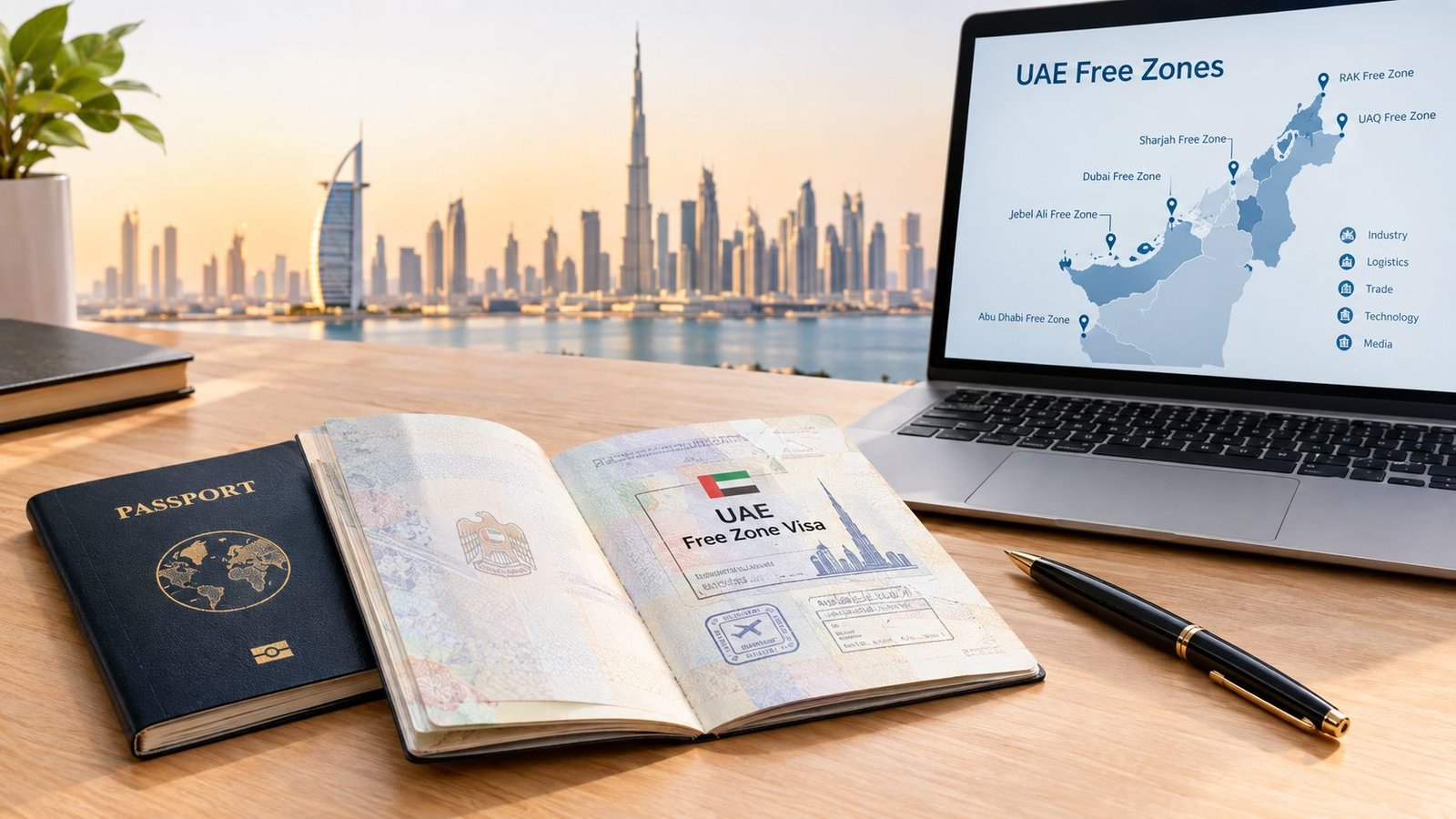
A free zone visa is a UAE residence visa sponsored by a free zone company, usually valid for two to three years depending on the zone. It gives you legal residence in the United Arab Emirates, but the exact rules, quota, cost, and renewal process depend on the authority behind your company.
You may be choosing a jurisdiction from abroad, hiring your first employee in Dubai, or trying to relocate before an entry permit expires. The mistake is treating “free zone visa” as one standard product. The UAE has over 40 free zones, concentrated heavily around Dubai, and each authority applies its own licensing, office, quota, and immigration procedures. The right question isn't just whether you can get a visa. It's which free zone structure gives you the residence, staffing capacity, and market access your business needs.
Table of Contents
- What a Free Zone Visa Actually Is
- Employee, Investor, and Partner Visas
- Who Qualifies and What the Benefits Look Like
- How the Application Process Works
- Costs, Timelines, and What Is Usually Missing
- Free Zone vs Mainland Visa
- Practical Checklist Before You Apply
What a Free Zone Visa Actually Is
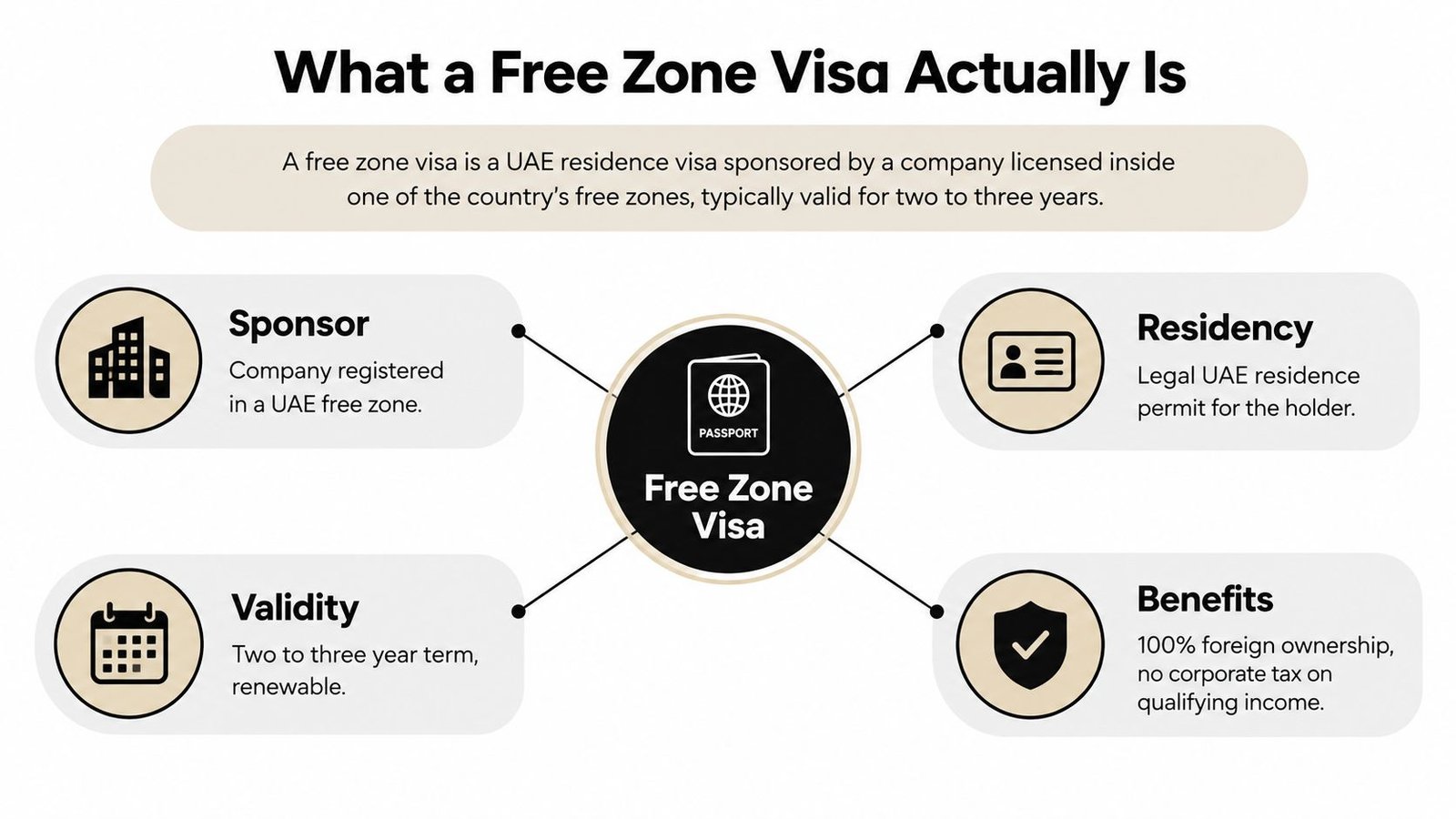
A free zone visa is a UAE residence visa sponsored by a company licensed inside one of the country's free zones, typically valid for two to three years. The company is registered in a designated business area governed by a specific authority, such as Dubai Multi Commodities Centre, Jebel Ali Free Zone, Ras Al Khaimah Economic Zone, or International Free Zone Authority.
The free zone authority usually acts as both business licensor and visa sponsor. That means your residence status is connected to the zone-licensed company, not to a mainland employer or an individual mainland sponsor. The authority submits the application through the relevant immigration channels, while the federal immigration system remains responsible for the final residence approval.
The model has a long history. Jebel Ali Free Zone was established in 1985 to attract foreign investment through a customs-friendly trading environment. The UAE later expanded the model into specialised centres for logistics, finance, media, technology, and trade. A free zone visa is therefore part of a wider economic framework built around foreign ownership and sector-focused business districts.
What does the visa give you?
The visa gives the holder legal stay in the UAE, an Emirates Identity Card, access to local banking subject to bank approval, and the right to live and work under the sponsoring arrangement. Your company's trading rights and ownership conditions still come from the free zone licence and its regulations.
That distinction matters. A free zone residence visa doesn't automatically give you unrestricted permission to sell directly across the UAE mainland. Your commercial activity, work authorisation, dependants, and employee quota all need to be checked against the rules of the particular authority.
Practical rule: Choose the business jurisdiction and office package before you plan the visas. The visa follows the company structure, not the other way around.
Employee, Investor, and Partner Visas
The three main residence routes serve different people. An employee visa is for staff working for the free zone company. An investor visa is for an owner or shareholder who wants residence through their own company. A partner visa is suited to an equity holder who may not manage daily operations.
| Visa Type | Who It Is For | Sponsor | Transferability | Typical Validity |
|---|---|---|---|---|
| Employee | Staff hired by a free zone company | Relevant free zone authority through the employer | Usually linked to the sponsoring employer and must be cancelled or transferred under authority rules | About two to three years, depending on the zone |
| Investor | Owner or shareholder operating through the company | The free zone company and authority | Depends on shareholding and the receiving authority | About two to three years, depending on the zone |
| Partner | Equity holder in a shared ownership structure | The free zone company and authority | Depends on the company structure and authority approval | About two to three years, depending on the zone |
Which route suits an employee?
The employee visa is the standard option for a company hiring a resident worker. The free zone authority processes the application, and the visa remains tied to that employer. If the employee resigns, the company normally needs to cancel the visa or complete an approved transfer before the person can remain sponsored elsewhere.
This route works well for employees who will work inside the free zone structure. It becomes less straightforward when the person will regularly work for clients on the mainland, because a free zone residence visa isn't the same thing as unrestricted mainland work permission.
When should an owner use an investor or partner visa?
An investor visa generally suits the founder who owns and operates the company. A partner visa is more suitable where several people hold equity, or where an investor has a formal shareholding but won't act as a day-to-day employee.
Don't choose between these labels based only on marketing language. Ask the authority what proof it requires, whether the shareholding qualifies, how cancellation works, and what happens if the company changes its shareholders. Those details affect banking, renewals, family sponsorship, and future restructuring.
Who Qualifies and What the Benefits Look Like
Eligibility starts with the applicant and the sponsoring company. In practice, you should expect to provide a passport with sufficient validity, a compliant photograph, medical fitness clearance, Emirates ID biometrics, and proof of the relationship with the company. For an employee, that normally means an employment offer or contract. For an owner or partner, it means shareholding or company documents accepted by the authority.
The relevant free zone authority checks the company file first. Federal immigration authorities then apply the UAE's residency rules. A security or immigration restriction can stop an otherwise complete application, so document quality alone doesn't guarantee approval.
What benefits can you expect?
A free zone structure can provide 100% foreign ownership, subject to the activity and authority's rules. It can also support repatriation of capital and profits, access to UAE banking, and a residence route for founders and employees. The UAE doesn't impose personal income tax on individuals, although company-level tax, VAT, and sector rules still need separate advice.
Dependants may be sponsored when the resident meets the applicable requirements. Don't assume the company visa automatically covers a spouse or children. The sponsor must check the current family-sponsorship conditions, income evidence, accommodation, insurance, and document attestation requirements.
What does it not allow?
A free zone visa doesn't automatically permit direct mainland trading or employment. A company selling into Dubai, Abu Dhabi, or Sharjah may need a distributor, commercial agent, mainland permit, or another approved arrangement. Some zones have introduced routes that can support mainland activity, but the answer depends on the activity, location, and approval path.
Your residence also depends on the sponsoring licence. If the company is liquidated, its establishment file is closed, or the licence isn't renewed, your visa position may be affected or cancelled.
The office package determines much of your practical capacity. UAE government guidance confirms that visa numbers depend on the signed package. The same guidance gives a Dubai example where a flexi-desk supports up to 3 visas, a serviced office supports 4 to 5 visas depending on size, and a physical office supports roughly 1 visa per 9 square metres.
That is why a founder in DMCC, Sharjah, or another Dubai free zone should treat the office decision as an immigration decision, not just a facilities purchase.
How the Application Process Works
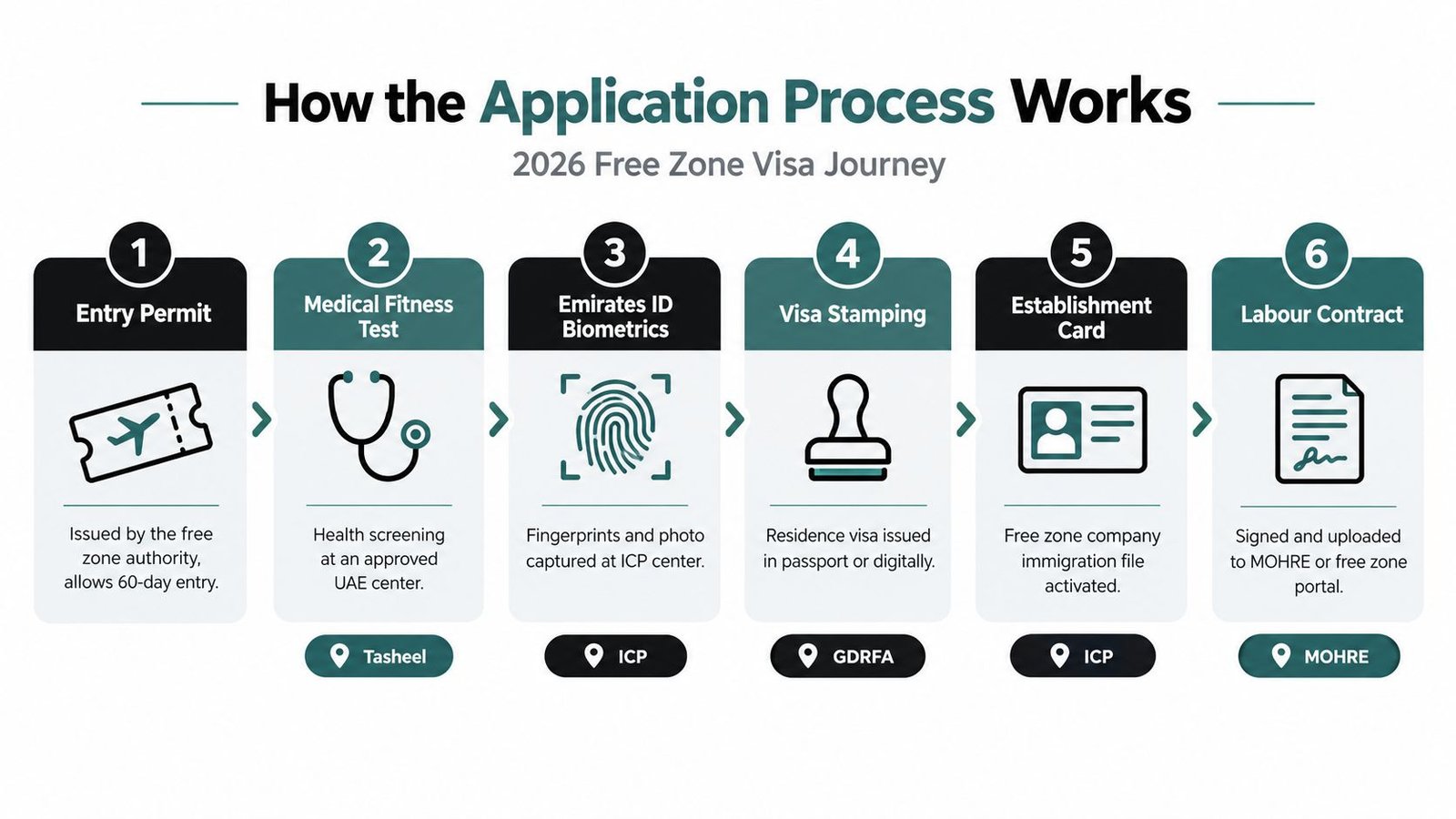
A free zone visa is a coordinated process between the chosen authority and federal immigration. The authority submits the company-sponsored request, while immigration controls entry, medical screening, identity registration, and residence approval. The exact route differs across the UAE's free zones, so confirm the authority's checklist before paying for an office package or visa quota.
What happens first?
The authority applies for an entry permit. It allows the applicant to enter the UAE for the residence process, or supports an in-country status change where permitted. The Federal Authority for Identity, Citizenship, Customs and Port Security requires entry within the permit's 60-day validity period from the date of issue. Review the official entry permit service guidance before booking travel.
After entry, the applicant completes a medical fitness test at an approved centre and registers biometrics for the Emirates Identity Card. Residence approval and Emirates ID issuance then proceed through the relevant channel, which may provide digital residence confirmation rather than a physical visa stamp.
What are the practical stages?
- Entry permit: The free zone authority submits the application and receives immigration approval.
- Entry or status amendment: The applicant enters the United Arab Emirates or changes status inside the country where permitted.
- Medical fitness test: The applicant completes the required health screening.
- Emirates ID biometrics: The applicant provides fingerprints and a photograph at the assigned centre.
- Residence completion: Immigration issues the residence status in the format used by the current system.
- Employment records: For an employee, the company completes the relevant employment documentation through the free zone process.
The order and terminology can vary by authority. Ajman Free Zone's published process lists the entry permit first, followed by visa status amendment and residence visa stamping.
What usually causes delays?
Document mismatches create many avoidable delays. Use a clear passport copy, a compliant photograph, and identical names across every document. Certificates that require attestation or translation must be prepared before submission.
Insurance may be required before the residence stage. Investor and partner applications can also require company documents that employees do not submit. Build the file around the selected authority's checklist, and confirm that the office package supports the intended visa quota before the application starts.
Costs, Timelines, and What Is Usually Missing
A free zone visa is not one standard product. Each authority sets its own package, processing route, and quota rules. Your real cost depends on both the applicant's visa file and the company's office and immigration setup. A quote showing only the visa line may leave out the office package, quota capacity, establishment registration, insurance, medical testing, or status amendment.
Public UAE market guidance commonly places a standard free zone employment visa at AED 3,500 to AED 7,500. Freelancer visa costs are often around AED 7,000 to AED 15,000 per year. Gulf News describes these ranges and a typical processing period of two to four weeks. Use these figures for comparison, not as a fixed tariff.
| Cost Component | Typical Range or Rule | Paid To |
|---|---|---|
| Visa processing | AED 3,500 to AED 7,500 for a standard employment visa | Free zone authority or approved service channel |
| Freelancer visa | Around AED 7,000 to AED 15,000 per year | Relevant authority or service provider |
| Processing time | Commonly two to four weeks | Time depends on authority, documents, and applicant status |
| E-Channel registration | AED 2,500, plus a refundable AED 5,000 security deposit in one official-facing guide | Relevant immigration channel or authority |
Which extra charges should you ask about?
Request an itemised quote before paying. Check whether it covers the entry permit, in-country status amendment, medical test, Emirates ID application, insurance, establishment card, E-Channel registration, and any refundable deposit.
Official-facing guidance reports an E-Channel registration fee of Dh2,500 and a refundable security deposit of Dh5,000. Confirm the current amount with your free zone authority before budgeting, because charges can differ between authorities.
Quota capacity can change the whole calculation. A flexi-desk may not support the number of people you intend to sponsor. You could then need a larger office package or a separate quota request. Choose the office package with your hiring plan in mind, not only the licence price.
Processing also depends on document quality and applicant status. A complete file can move through the authority's process within the stated period, while missing documents or status complications can extend it.
Cost rule: Compare the full first-year and renewal invoice, including office, quota, immigration, and applicant charges. The cheapest advertised visa may not be the cheapest workable setup.
Free Zone vs Mainland Visa
The choice between free zone and mainland residence usually follows the company's market, not the founder's nationality. A free zone visa suits a business trading internationally, operating inside its zone, or keeping setup and office requirements controlled. A mainland structure is more direct for a company whose main customers and staff activity sit across the UAE.
| Factor | Free Zone Visa | Mainland Visa |
|---|---|---|
| Sponsor | Free zone company through its authority | Mainland company through the applicable government and labour channels |
| Ownership | Often supports 100% foreign ownership, subject to activity and authority rules | Can also support 100% foreign ownership for many activities under current Companies Law rules |
| Mainland market access | May require a distributor, agent, permit, or approved structure for direct activity | Direct local trading is generally the intended route |
| Visa capacity | Linked to the free zone office package and authority quota | Linked to labour quota and approved office tenancy |
| Renewal | Usually connected to renewal of the underlying free zone licence | Processed through the mainland company's licensing and immigration files |
| Best fit | International trade, zone-based operations, specialist sectors, and leaner office models | UAE-wide B2B sales, local premises, and teams working across the mainland |
When is free zone the better choice?
Choose a free zone when your company's clients are outside the UAE, your operations fit the zone's licensed activities, or you want a business base in Dubai, Abu Dhabi, or Sharjah without building a mainland operation immediately. The zone can also be a sensible first structure for a founder who needs residence and a small team while testing demand.
The trade-off is commercial reach. A residence visa doesn't change the company's licence permissions. If your staff will deliver services at customer sites throughout Dubai or Abu Dhabi, confirm the work and activity permissions before incorporation.
When does mainland make more sense?
Choose mainland when local UAE sales dominate, customers expect a mainland supplier, or your staff must work routinely across local client premises. Mainland doesn't mean every administrative requirement disappears. You still need the correct activity, office documentation, labour quota, insurance, and immigration file.
The old assumption that mainland always requires a local ownership partner is no longer reliable. Ownership can be available to foreign investors for many activities, but regulated sectors may still have special conditions. Ask for an activity-specific answer rather than relying on a general comparison.
Practical Checklist Before You Apply
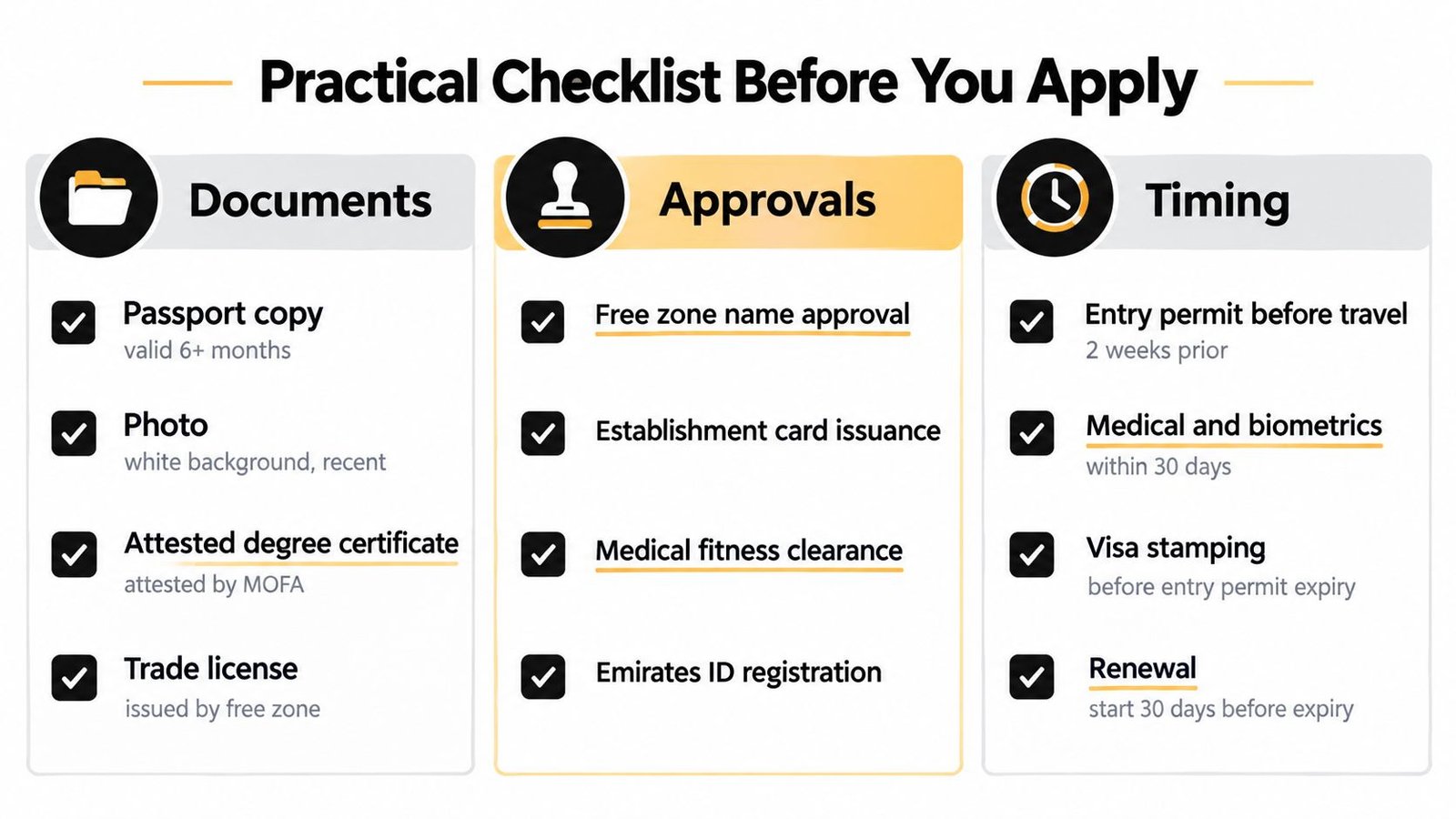
A founder can lose weeks because the documents are ready, but the office package does not support the planned visa quota. Treat a free zone visa as a product set by one of more than 40 authorities, not as one standard UAE application. Confirm the authority's rules, office package, licensed activity, and available quota before paying or submitting.
Which documents should be ready?
- Passport: Check that each applicant's passport meets the authority's validity requirement, and provide a clear copy.
- Photograph: Prepare a recent photograph with the required background and dimensions.
- Company evidence: Keep the trade licence, establishment information, and sponsor details together.
- Employment proof: For an employee, prepare the offer letter or contract requested by the authority.
- Shareholding proof: For an investor or partner, prepare the share certificate and company documents proving the relationship.
- Qualifications: Attest and translate educational or professional certificates if requested.
- Insurance: Confirm the required health insurance before the residence stage.
- Current sponsorship: If the applicant already lives in the UAE, obtain a No Objection Certificate from the current sponsor where required.
What approvals and bookings need attention?
Ask the free zone authority to confirm the company's establishment file, office package, and number of visas available. Do this before applying for an employee. If the package does not cover the planned headcount, the company may need a quota or workspace adjustment.
Book the medical fitness appointment and Emirates ID biometrics as soon as the entry or status process permits. Applicants may need to attend in person. Overseas founders should plan travel around these appointments rather than assuming the process is fully remote.
What deadlines should you control?
The entry permit holder must enter the UAE within its 60-day validity period, as stated by Federal Authority for Identity, Citizenship, Customs and Port Security guidance. Track the permit issue date, entry date, medical appointment, biometrics appointment, and residence completion date in one place.
Visa terms can change under government policy. A 2022 report on UAE free zone visa validity stated that certain free zone visas changed from three years to two years for new visas, renewals, and transfers, while existing three-year visas remained valid until renewal. Confirm the current term with your authority before budgeting renewals.
Inpro helps founders compare UAE free zone and mainland structures, prepare company and visa documents, and manage entry permits, medical screening, Emirates ID, and residence completion. Visit Inpro to discuss your activity, office needs, team size, and visa plan.