


You're probably in one of two positions right now. Either you already live in the UAE and want to stop building long-term plans on a short-term visa, or you're outside the country and trying to work out whether the Golden Visa is a realistic route for your business, assets, or professional profile.
That's where applicants often lose time. They start by hunting for forms, fees, or a shortcut. In practice, how to apply for golden visa uae comes down to a narrower question first: which category can you prove, with the exact evidence the authorities expect? If you get that wrong, everything after it becomes slower, messier, and more expensive than it needs to be.
Table of Contents
- The UAE Golden Visa Your Gateway to Long-Term Residency
- Decoding Your UAE Golden Visa Eligibility Path
- Your Complete Golden Visa Document Checklist
- Navigating the Official Application Channels
- Common Pitfalls That Derail Golden Visa Applications
- Beyond Approval How Inpro Streamlines Your UAE Journey
The UAE Golden Visa Your Gateway to Long-Term Residency
A founder setting up in Dubai usually wants the same three things. Stability, control, and room to plan properly. The UAE Golden Visa sits at the centre of that conversation because it gives eligible applicants a long-term residence route that isn't built around short renewal cycles and constant sponsor dependency.
For investors and senior professionals, the appeal is practical. You can make decisions about business structure, family relocation, banking, and hiring with more confidence when your residence position is built for the long term. That changes how people approach the UAE. They stop treating it as a temporary base and start organising around permanence.

Why founders and investors pursue it
The Golden Visa isn't a niche immigration route anymore. According to GDRFA Dubai's official update on Golden Visa issuance, 151,666 Golden Visas were issued between 2019 and 2022. That matters because it tells you the programme is being handled at scale through formal government systems.
A process at that volume tends to reward clean files and punish assumptions. Authorities aren't reviewing applications based on how convincing your story sounds. They're reviewing whether the evidence in your file matches the category you selected.
Practical rule: treat the Golden Visa as a compliance exercise before you treat it as a residency opportunity.
Why the process must be treated seriously
Applicants often assume the hard part is “qualifying”. In reality, many people who are broadly eligible still hit delays because their documentation doesn't line up properly with the route they chose. A strong profile helps, but a strong profile without the right papers doesn't move.
That's why the smartest approach is structured from day one:
- Choose the right lane: investor, entrepreneur, exceptional talent, or another eligible route.
- Match evidence to that lane: category-specific proof matters more than generic supporting material.
- Use the official channel: submissions run through government systems, not informal workarounds.
- Expect verification: documents are checked for consistency, completeness, and compliance.
People who handle the process well usually do one thing differently. They pre-validate before they submit. That single habit removes a large share of the friction.
Decoding Your UAE Golden Visa Eligibility Path
Most avoidable mistakes happen before an application is ever uploaded. Someone owns property and assumes that automatically makes them eligible. Someone runs a startup and files as an entrepreneur without the required supporting letters. Someone with an impressive career history applies under the wrong talent route and ends up being asked for proof that doesn't exist in their file.
The category decision comes first
The UAE government's official Golden Visa guidance makes one point very clear. This is a category-driven process. Investors can receive 10-year residency for public investments and 5-year residency for real estate, while exceptional talents can receive 10 years but must prove eligibility through specialised evidence such as recommendation letters, accredited degrees, or professional records.
That difference isn't administrative detail. It shapes the whole application. The authorities are not asking, “Does this applicant seem valuable to the UAE?” They are asking, “Has this applicant satisfied the exact conditions for this category?”
UAE Golden Visa Categories at a Glance
| Category | Minimum Investment/Value | Key Evidence Required | Residency Duration |
|---|---|---|---|
| Real estate investment | AED 2 million | Property ownership evidence from the Real Estate Registration Department showing qualifying ownership | 5 years |
| Public investment | Qualifying investment under the investor route | Evidence tied to the public investment category under official guidance | 10 years |
| Entrepreneurship | AED 500,000 project value | Auditor's letter confirming project value, plus relevant innovation or incubator support documentation | Category-based route under official guidance |
| Exceptional talents and specialists | No single universal amount listed across all talent routes | Specialised proof such as recommendation letters, accredited degrees, or professional experience | 10 years |
What works in practice
The cleanest applications are the ones where the category is obvious before the first document is uploaded. If you're a property investor, your file should look like a property investor's file. If you're an entrepreneur, your application should stand on business value evidence and recognised support documents, not on unrelated personal achievements.
What doesn't work is hybrid storytelling. A common example is an applicant who partly qualifies through property, partly through business activity, and tries to combine both into one unclear submission. That usually creates questions instead of confidence.
A better decision filter is simple:
- Use the route with the strongest official evidence, not the route that sounds most prestigious.
- Prefer the route with fewer interpretive gaps if more than one category could apply.
- Check duration only after checking proof, because the longer term doesn't help if your file is weaker.
If your category needs explanation, it's usually the wrong category or the wrong evidence set.
Applicants often need an outside review. Not because the rules are hidden, but because the trade-offs are easy to misread when you're too close to your own case.
Your Complete Golden Visa Document Checklist
A Golden Visa file rarely fails because the applicant had no basis to apply. It usually slows down because the evidence was incomplete, outdated, inconsistent, or issued in the wrong format. By the time that problem shows up in the portal, the delay has already started.
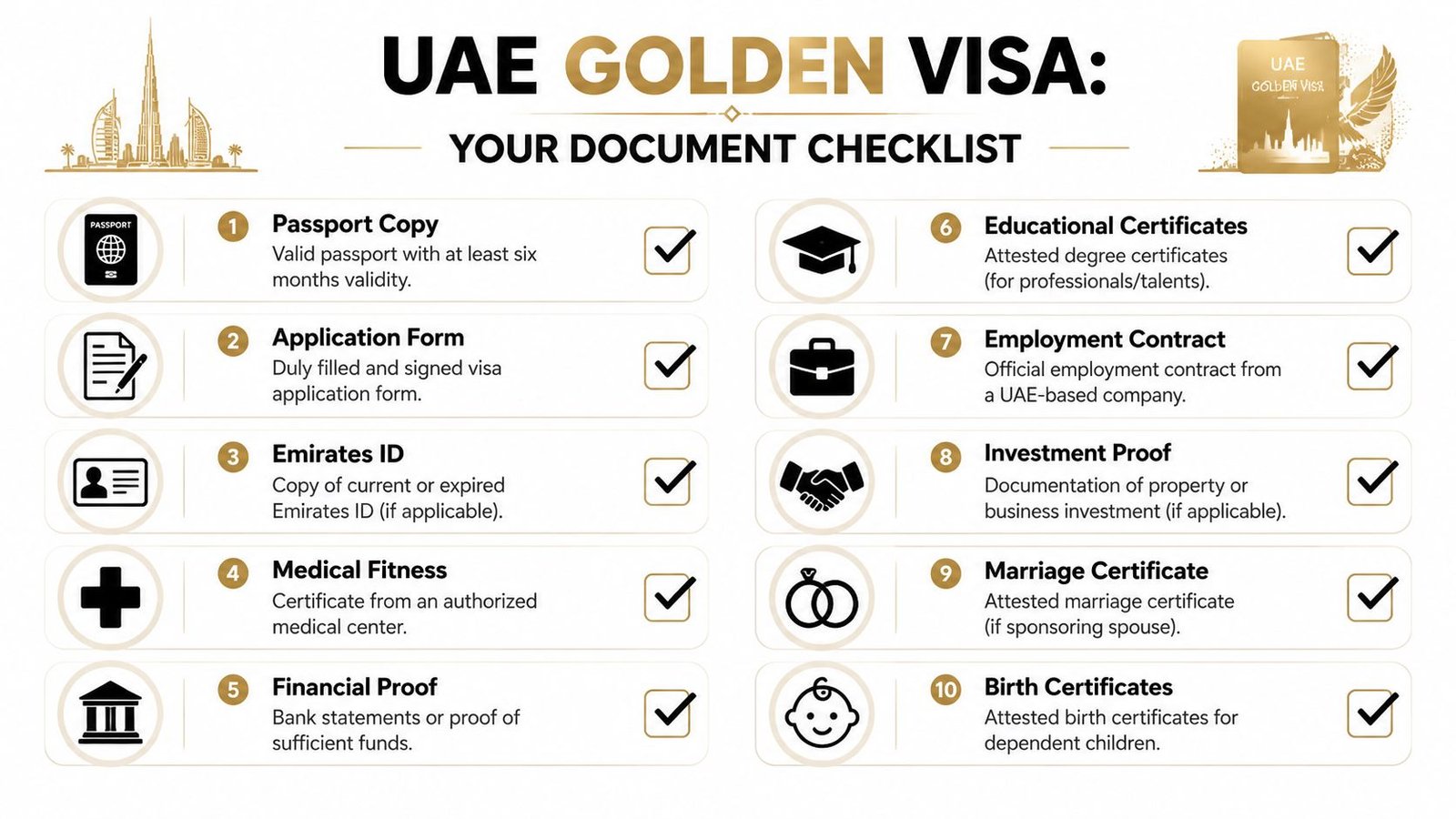
The practical rule is simple. Build the file in two layers. First, prepare the standard identity and civil documents that support any application. Then add the category proof that the reviewing authority expects for your chosen route. Mixing these steps, or treating category proof as something to sort out later, is one of the most common reasons a promising case turns into a back-and-forth exercise.
Core documents you should prepare early
Before category evidence is uploaded, the baseline file should already be clean and ready for submission. In practice, that usually means preparing:
- Passport copy: valid, clear, and fully readable, including all key details.
- Application details: name, passport number, nationality, and date of birth must match across every document.
- Emirates ID copy if applicable: current or previous residency records should align with the identity file.
- Medical and background-related requirements: these may be requested during processing, so it helps to prepare for them early.
- Family documents if sponsoring dependants: marriage certificates and birth certificates should be available in the accepted form, with translation or attestation where required.
This part looks routine, but it causes more friction than applicants expect. A blurred passport scan, a name mismatch between English and Arabic records, or an unprepared dependent file can interrupt an otherwise strong submission.
The category evidence that decides the file
The federal ICP Golden Residency service portal sets out route-specific proof. For example, a real estate investor is expected to provide a letter from the Real Estate Registration Department confirming ownership of property or properties valued at at least AED 2 million, without loans. An entrepreneur is expected to provide an auditor's letter confirming project value of at least AED 500,000, along with the supporting documents required for that category.
That is the part applicants often underestimate. The authority does not review the file based on general commercial credibility. It reviews whether the threshold has been proven through the document type the rule calls for.
For property cases, a title deed on its own may not settle the valuation point. For entrepreneur cases, trade licence documents, invoices, decks, and company material can support context, but they do not replace the required letter from the relevant authority, auditor, or approved body.
I have seen founders with real businesses lose time here because the operating story was strong but the category proof was weak. The same applies to investors who own qualifying assets but submit records that do not answer the exact ownership and value requirement.
What a compliant file looks like
A compliant file is easy for a reviewer to follow. The selected category matches the uploaded evidence. The proof of value is current. Names are consistent across passport, property records, company documents, and support letters. Scans are legible. The file states the qualifying facts directly instead of leaving the reviewer to piece them together.
A useful pre-submission check should cover:
- Threshold proof: does the file prove the qualifying amount or status in an official document?
- Document source: was the letter issued by the authority, auditor, department, or approved body specified for that route?
- Consistency: do names, dates, references, and identity details match across the full set?
- Readability: are all scans complete, clear, and uploaded in the correct format?
- Relevance: does each supporting document strengthen the case, or is it adding noise?
Experienced review is most critical. At Inpro, the work is often less about collecting more paperwork and more about testing whether the existing paperwork will survive scrutiny before it is submitted. That pre-validation step saves time, reduces avoidable queries, and gives the application a cleaner path through review.
Navigating the Official Application Channels
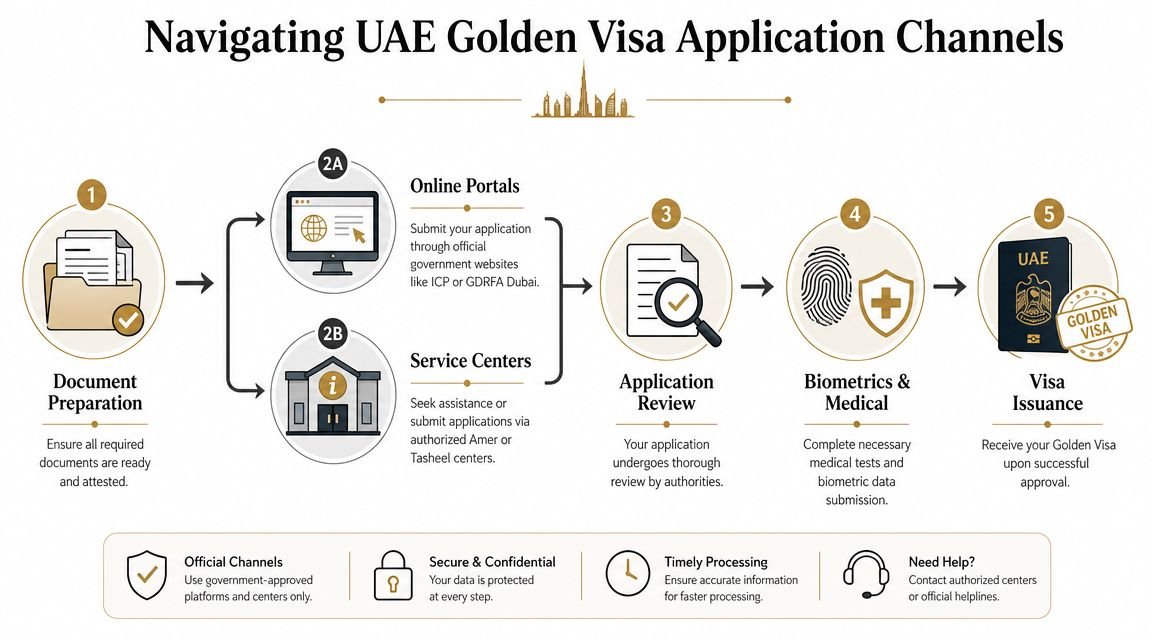
Once the file is ready, the next issue is channel selection. This part sounds straightforward, but it matters. Applications should go through the correct official route, and the submission workflow is much less forgiving than many people expect when high volumes are moving through the system.
Early in the process, it helps to keep the channel map simple.
Which portal to use
Across the UAE, the Federal Authority for Identity, Citizenship, Customs and Port Security handles Golden Residency services for eligible applicants, while Dubai applicants typically deal with GDRFA Dubai. The route depends on where the application sits administratively, not on personal preference.
This distinction matters because your submission workflow, follow-up, and tracking sit inside those official systems. Applicants who try to work around them with incomplete information usually create their own delays.
For context, reporting cited by Safe Ledger's review of Golden Visa issuance volumes states that Dubai's GDRFA issued approximately 158,000 Golden Visas in 2023, up from 79,617 in 2022, which is roughly 98% year-on-year growth. At that kind of volume, process discipline matters. Digital submissions need to be complete because the system is built for standardised review, not back-and-forth repair.
A quick explainer is useful before you submit:
How the digital workflow usually unfolds
The online journey is usually straightforward when the file is ready. You open the correct service, complete the applicant details, upload the category evidence, and submit through the relevant government channel. The system then issues a reference or tracking mechanism so the request can be followed.
Applicants should expect a process that may include document review, requests for clarification, and further compliance steps tied to residency processing. That's normal. What causes trouble is not the review itself, but a file that was uploaded before it was ready.
The workflow tends to run better when applicants follow three habits:
- Upload only the documents that support the chosen category.
- Track the file actively after submission instead of assuming silence means progress.
- Respond to authority requests quickly and with exactly what was asked for.
People often ask whether service centres can help. They can be useful for assistance and guided submission, but they don't change the underlying rule. The application still succeeds or fails on eligibility, document quality, and correct filing through official channels.
Common Pitfalls That Derail Golden Visa Applications
A surprising number of Golden Visa problems don't come from lack of eligibility. They come from files that looked “mostly fine” to the applicant. Mostly fine is where applications get stuck.
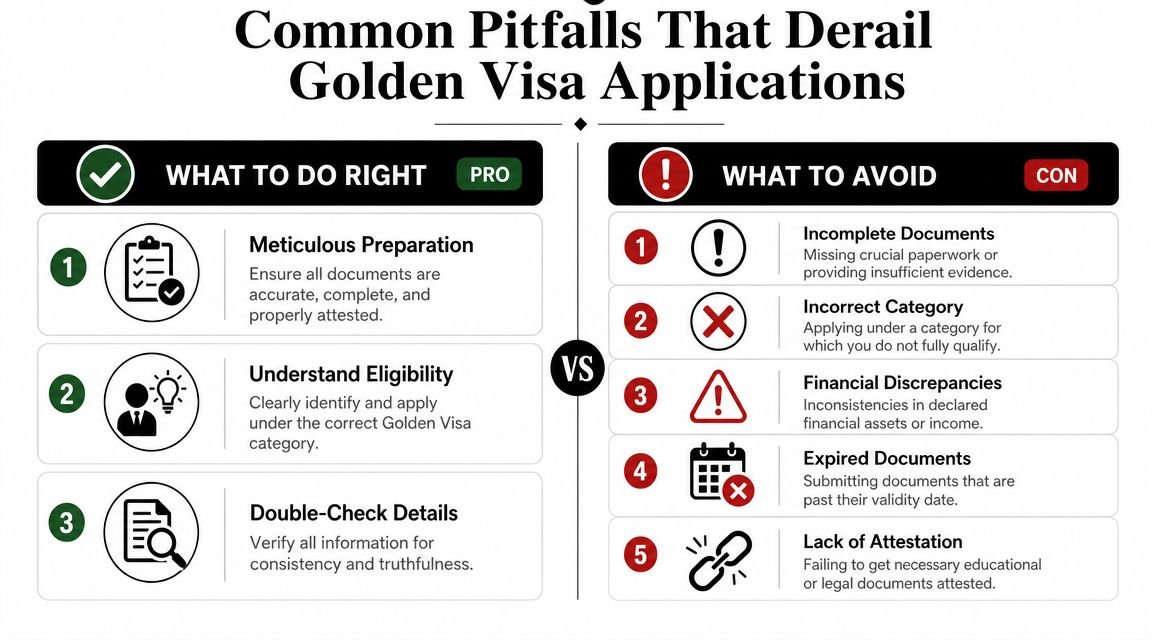
The mistakes that cause the most friction
The first recurring mistake is applying under the wrong category. This usually happens when someone chooses the route they prefer instead of the route they can prove cleanly. The result is a file full of supporting material that doesn't answer the actual eligibility test.
The second is using the wrong property evidence. For the property route, the ownership proof and value proof have to line up with the requirement described earlier. If the file relies on the wrong type of valuation support or leaves questions about whether the asset satisfies the rule, delays become likely.
Another common issue is entrepreneur evidence that proves activity but not qualifying value. Founders often submit incorporation papers, pitch decks, or operating documents and assume the business case is obvious. The authority is not evaluating startup promise in the abstract. It is checking whether the required documentary threshold has been met through the correct evidence.
The file should answer the authority's checklist before it tells your business story.
The fourth problem is simpler but just as damaging. Inconsistent personal data across documents. Different spellings, mismatched passport details, or outdated supporting records can trigger unnecessary verification questions.
How to prevent avoidable delays
The best prevention isn't more paperwork. It's better sequencing.
- Audit the category first: if the route is uncertain, stop there and resolve that before collecting anything else.
- Validate the key document early: the decisive letter or proof document should be reviewed before the application draft is prepared.
- Check attestation and form requirements: credentials and civil documents often fail because they're not in the format the authority expects.
- Review the file as a reviewer would: ask whether a third party could confirm eligibility without additional explanation.
- Keep the submission disciplined: extra documents don't always strengthen a case. Sometimes they just introduce contradictions.
A lot of applicants think speed comes from filing quickly. In reality, speed comes from filing once, properly.
Beyond Approval How Inpro Streamlines Your UAE Journey
A common scenario looks like this. The Golden Visa approval comes through, the client assumes the hard part is over, and then the file slows down on the next government steps because a dependent's documents are incomplete, an old visa needs to be aligned, or a supporting record does not match the approved application.
Approval matters. It is not the final operational step.
The cases that stay on track usually have one thing in common. The work after approval was planned before submission. That includes visa issuance steps, Emirates ID processing, medical and status coordination where required, and family file preparation. If that planning is left until after approval, small issues start creating unnecessary delays.
This is also where weak file preparation shows up later. A document set that was just good enough to secure approval can still create friction when the applicant adds a spouse, sponsors children, or deals with a future renewal. In practice, the original file needs to be clean, consistent, and easy to defend from start to finish.
Outside support is useful for a simple reason. It reduces rework.
A good advisor does more than submit forms. The true value is in checking the category logic early, validating the core documents before filing, coordinating attestation and translations in the right order, and keeping business, residency, and family matters aligned. That saves time because the process stays controlled, not because someone fills in an application faster.
Inpro Corporate Services L.L.C. handles UAE company formation, PRO work, and visa processing, including Golden Visa support. For applicants, that means one team can review eligibility, prepare the file, coordinate supporting documents, and manage the government process without splitting responsibility across multiple providers.
If the goal is to apply for a UAE Golden Visa with fewer delays, the practical approach is simple. Test the case first. Confirm the exact route you can prove. Prepare the file to match that route. Then submit. That extra discipline at the start usually saves far more time than rushing into an avoidable correction cycle.