


UAE VAT returns are filed online through the Federal Tax Authority e-Services portal within 28 days after the end of each tax period, and payment is due by that same deadline. If your period is quarterly or monthly, treat the whole job as one file-and-pay process, not two separate admin tasks.
If you're staring at invoices, bank entries, and the FTA portal while wondering whether you've missed something, you're in the normal founder position. The fix is simple: get your records clean before you log in, calculate the VAT properly, submit the return in the portal, and make sure the payment lands by the same due date.
Table of Contents
- How VAT Returns Work in the United Arab Emirates
- What You Need Before You Can File
- How to Prepare Your VAT Calculation Correctly
- Completing and Submitting Your Return on the FTA e-Services Portal
- Deadlines Frequencies Amendments and Penalties to Avoid
- When to Handle Filing Yourself and When to Get Help
How VAT Returns Work in the United Arab Emirates
It is the 24th day after your VAT period closed. Finance has one number, the bank shows another, and the founder is asking whether filing can wait until next week. It cannot. In the UAE, VAT filing works as one 28-day file-and-pay workflow. If the return is submitted but the payment arrives late, you still have a problem.
VAT is a tax charged on taxable goods and services in the UAE. For many businesses, the standard rate is 5% according to ClearTax's UAE VAT overview. The Federal Tax Authority, or FTA, is the authority that receives your return and your payment through its online system.
What is a VAT return actually declaring
A VAT return is your formal statement to the FTA for one assigned tax period. It reports output VAT charged on sales, input VAT claimed on eligible costs, and the balance you must pay or can recover.
Treat it as a controlled reconciliation, not a data-entry chore. The boxes on the return are the final output of your accounting records, tax invoices, credit notes, import treatment, and adjustments. If those records are not aligned before you log in, the portal will only expose the mess faster.
Practical rule: Close your numbers first. Open the portal after that.
How often do you file in the UAE
A tax period is the reporting cycle assigned by the FTA to your business. Filing is usually monthly or quarterly, and the return must be submitted within 28 days after the end of that period through the UAE government VAT return filing guidance.
The payment follows the same clock. Founders often separate the two jobs internally, with accounting filing and finance planning the transfer later. That is the wrong habit. For VAT control, submission and payment belong in the same deadline plan from day one of the period close.
Why the 28-day cycle matters more than the form itself
A clean UAE VAT process runs on discipline. You close the period, reconcile sales and purchases, check what is recoverable, confirm the figures against the FTA return fields, submit, and make sure cash is ready before the due date.
That is the point many businesses miss.
The risk is not only a wrong box in the portal. The pressure point is timing. If your calculation is finished on day 27, you have left no room for review, management approval, bank limits, or payment delays. With penalty enforcement tightening, the smart approach for 2026 is simple. Build the return as a 28-day workflow with a filing checklist and a payment plan, not as a last-minute form-filling task.
What You Need Before You Can File
Most filing stress starts before the portal. People log in too early, then realise the numbers aren't ready, the period isn't confirmed, or the supporting documents are incomplete.
What is the minimum setup required
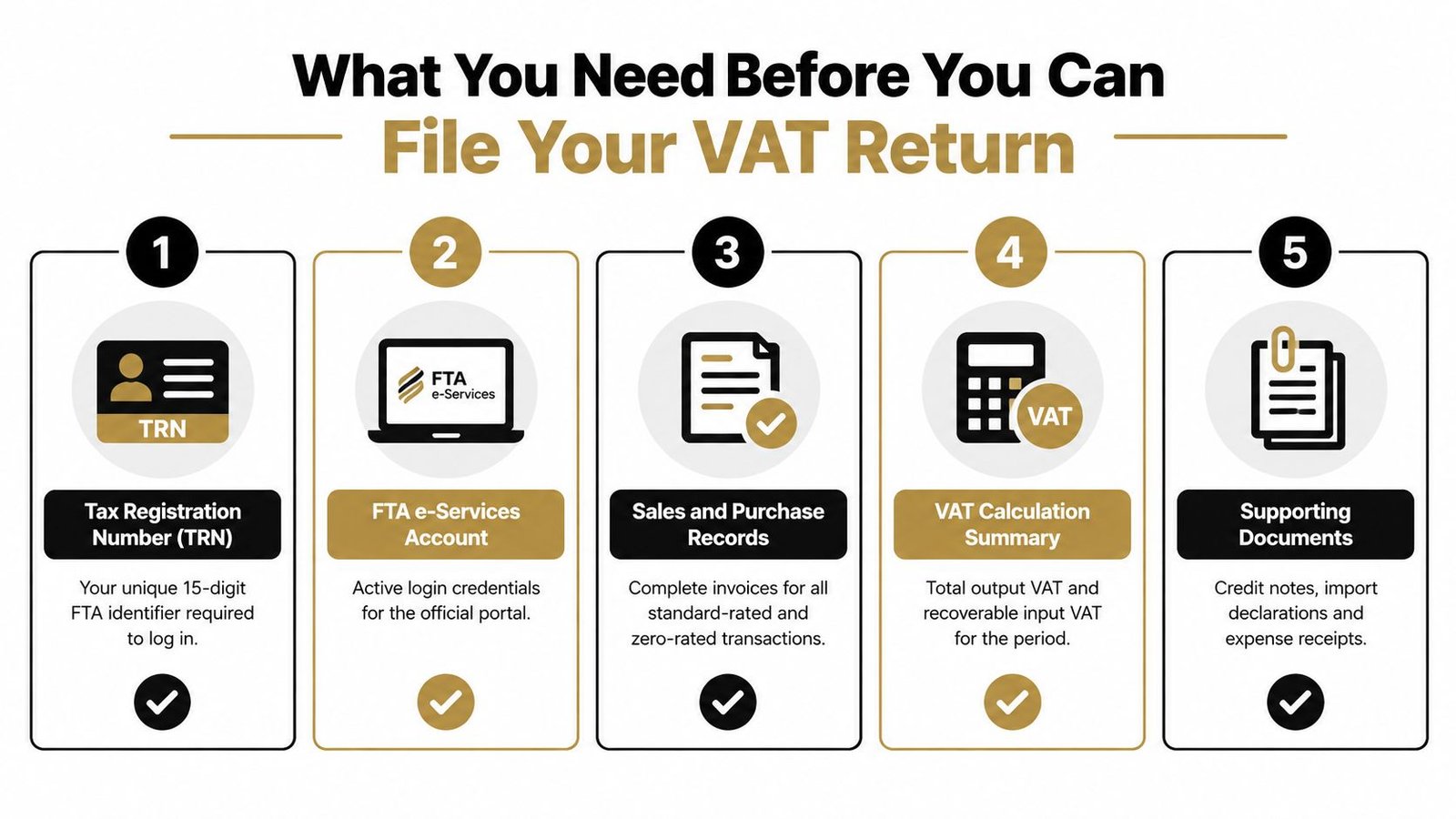
A Tax Registration Number, or TRN, is your registered VAT identifier with the FTA. You'll also need active FTA e-Services login credentials tied to the registered business account.
FTA e-Services is the official online portal used to submit the VAT return. If the wrong person holds the login, if the registered email is inaccessible, or if the business record isn't organised internally, filing day turns into a chase.
What is a tax period
A tax period is the specific month or quarter assigned by the FTA for your VAT reporting cycle. Don't guess it from your bookkeeping habits. Confirm it from your FTA account before preparing the return.
Some founders in the United Arab Emirates assume they can file “for the month” because that's how they manage internal reporting. That's not the test. The assigned FTA period is the test.
Who needs to keep what records
You need records that support both sides of the return. That includes your sales ledger, purchase ledger, tax invoices, credit notes, import documents where relevant, and any reverse charge entries your business must account for.
Use this pre-filing checklist before you even open the VAT return screen:
- Confirm the legal filer: Make sure the person submitting has the right FTA portal access and knows which entity they're filing for.
- Match the period: Check the exact tax period in the portal, especially if you run more than one UAE company or free zone entity.
- Reconcile sales: Tie invoice totals to the sales ledger and make sure VAT treatment is consistent.
- Reconcile purchases: Pull expenses that may support input VAT recovery and make sure the invoices are complete.
- Collect adjustment documents: Include credit notes, import records, and reverse charge support if they apply to your business.
Filing gets easier when your books tell the same story as your invoices and your bank records.
What should founders prepare in one folder
Keep one period folder, physical or digital, with the final sales summary, purchase summary, invoice support, credit notes, and payment approval notes. Don't scatter this between an accountant, a finance manager, and someone in operations.
If your company is still lean, set a routine. Close revenue first, check supplier invoices second, then review edge cases like imports or corrected invoices before anyone touches the FTA form.
How to Prepare Your VAT Calculation Correctly
Accuracy lives here. If the calculation is wrong, a smooth portal submission still produces a wrong return.
What is output VAT and input VAT
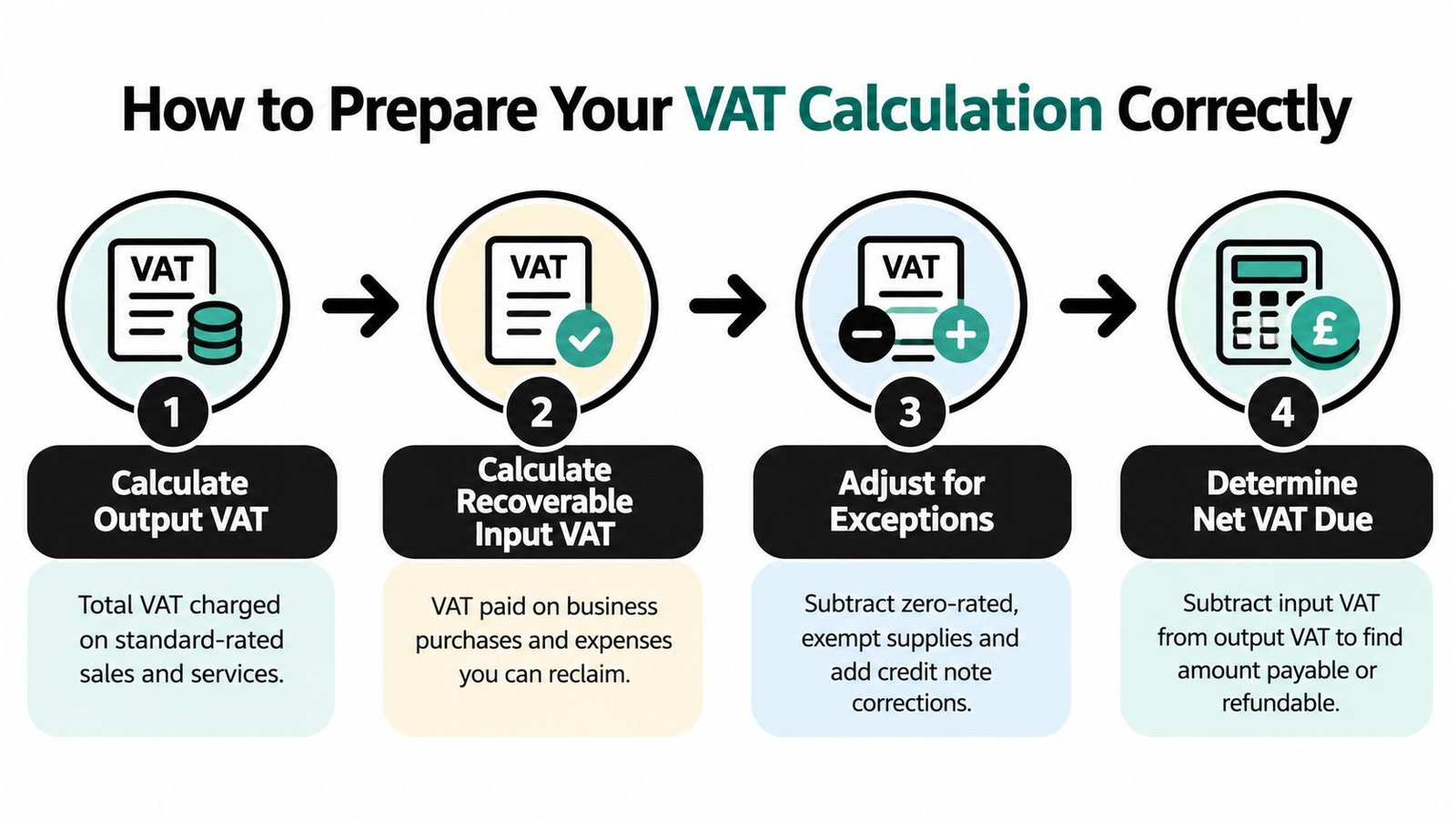
Output VAT is the VAT your business charges customers on taxable sales. Input VAT is the VAT your business pays on eligible purchases and expenses that can be recovered, subject to the applicable rules.
Your return compares those two figures. If output VAT is higher, you pay the difference. If recoverable input VAT is higher, the return may show a refundable position.
How do you work out the numbers before login
Start outside the portal. Build a period summary from your accounting records and only enter the final checked figures into the FTA system.
A clean calculation usually follows this order:
- List taxable sales and separate standard-rated, zero-rated, and exempt items according to your records.
- Calculate output VAT on standard-rated sales at the UAE standard rate already noted above.
- Review purchases and expenses and identify input VAT you believe is recoverable.
- Apply adjustments such as credit notes and corrections for the reporting period.
- Reconcile the net result so the amount ties back to your ledgers.
A simple example for a Dubai services company
Take a Dubai consulting company with standard-rated client invoices and normal business running costs. The company reviews all issued sales invoices for the tax period, then totals the VAT charged on those sales. Next, it reviews supplier invoices for office costs, software, and business services, then totals the input VAT it expects to recover.
If the sales VAT total is higher than the recoverable purchase VAT total, the company owes the difference to the FTA. If the purchase side is higher, the return may show a reclaim position.
Here's the part founders skip too often. Reconciliation.
- Check invoice dates: The document date needs to fit the filing period you're reporting.
- Check credit notes: If you issued one after correcting a client invoice, your output VAT position may need to change.
- Check imports and reverse charge treatment: If your business buys services from outside the UAE or imports goods, don't leave those entries to memory.
- Check duplicated expenses: A duplicated supplier invoice can distort input VAT without anyone noticing until later.
What about zero rated and exempt items
Zero-rated supplies are transactions taxed at a VAT rate of zero while still remaining within the VAT system. Exempt supplies are outside standard VAT charging in a way that affects how recovery works.
Founders often lump both together as “no VAT”. That shortcut causes bad returns. Keep them separate in your working papers so your internal logic matches the tax treatment.
If a transaction feels unusual, stop and classify it before filing. Guessing inside the portal is how people create amendment work later.
When is your calculation ready
Your VAT calculation is ready when someone can trace every figure back to a ledger and supporting document without debate. That sounds strict, but it's the fastest way to file with confidence.
If your business runs on low transaction volume, this can be a disciplined spreadsheet exercise. If you have imports, multiple revenue streams, or mixed supply types, use a proper review step before submission.
Completing and Submitting Your Return on the FTA e-Services Portal
It is day 26 after your tax period closed. The numbers are approved, the bank signatory is travelling, and someone is asking whether filing can wait until payment clears. Do not split those steps. In the UAE, VAT filing works best as one 28-day file-and-pay workflow, with one owner, one checklist, and one deadline.
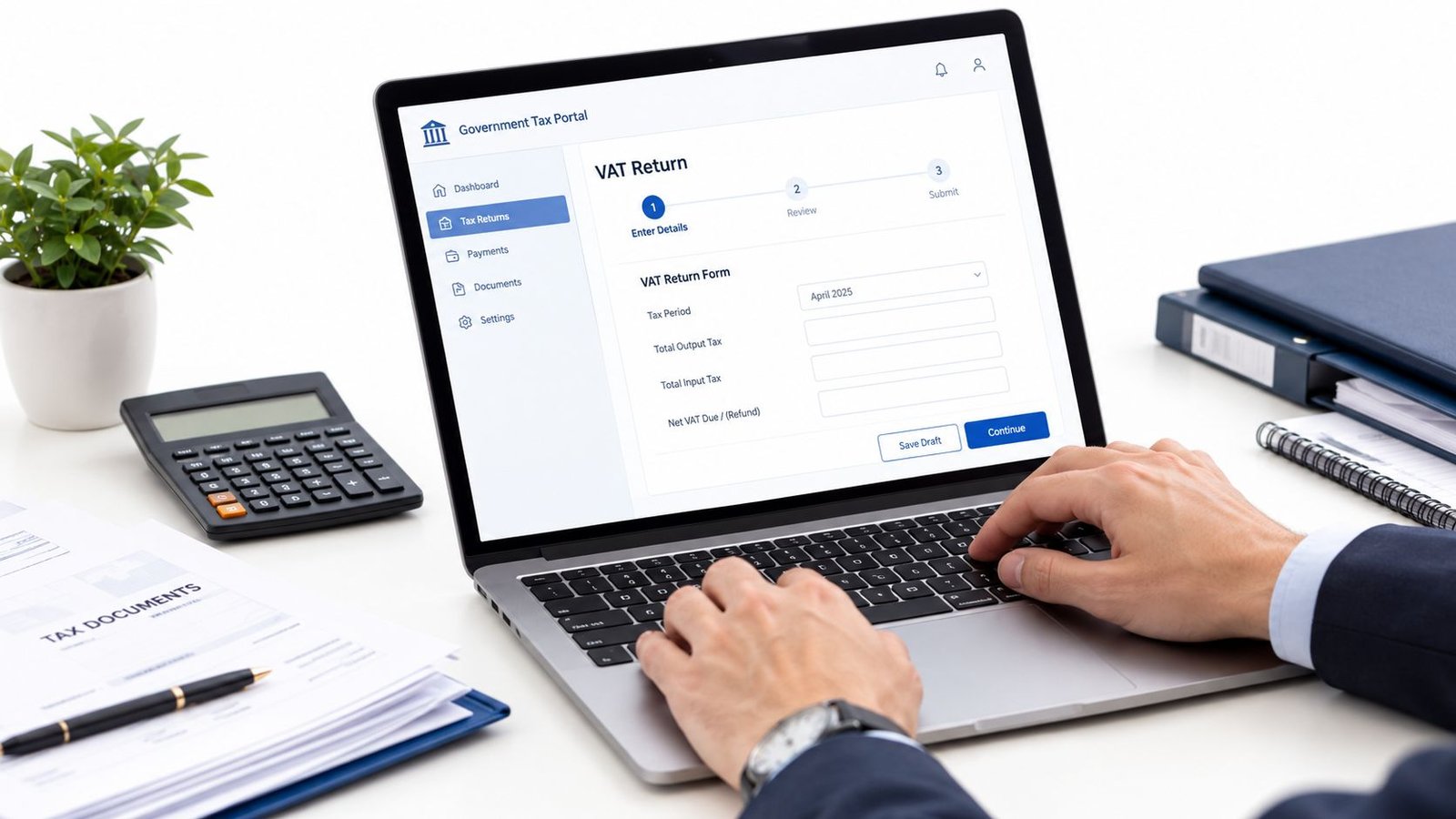
The portal is for entering a finished return. It is not the place to debate classifications, hunt for missing invoices, or guess adjustment treatment. If a figure still needs discussion, stop and fix it offline first.
How do you file the return step by step
Use one controlled sequence inside FTA e-Services.
- Log in with the registered account: Use the correct entity access. Shared credentials create avoidable mistakes and approval confusion.
- Open the VAT tile and select the return: Choose the live return for the exact tax period shown in your working papers.
- Check the taxable person details: Confirm you are inside the right TRN and legal entity before you type anything.
- Enter each box from your final VAT summary: Copy values from the approved calculation, not from memory and not from a draft spreadsheet.
- Review the summary screen line by line: Compare the portal figures against your filing pack, including payable or recoverable VAT.
- Submit the declaration: Save evidence of submission straight away, usually as a PDF or screenshot confirmation for your records.
- Complete payment within the same workflow: Treat cash settlement as part of the return, not an admin task for later in the week.
According to Quicktax's explanation of UAE VAT deadlines and filing workflow, taxable businesses file through the FTA online portal, and filing and payment should be managed as one controlled workflow because the same deadline applies to both.
What should you check before pressing submit
Run a short portal checklist. It prevents rushed errors.
- Right period
- Right entity and TRN
- Figures match the approved VAT working paper
- Adjustments entered in the intended boxes
- Declaration reviewed by the assigned approver
- Payment method and bank approval already cleared
That last point matters more in 2026, when penalty exposure and cash-flow discipline will punish messy internal handoffs faster than any portal mistake. If finance submits on time but treasury pays late, the business still has a problem.
Submit only after the payment path is confirmed for the same deadline.
What if you spot an error while you are in the portal
Do not edit blindly just because a number looks odd on screen.
If the portal figure does not match your approved calculation, pause the filing and return to the working paper. If the working paper is wrong, correct the calculation first, reapprove it, then enter the revised number. If you already filed and then found the error, handle it as an amendment question under the FTA correction process. Do not overwrite internal files and pretend the first version never existed.
That amendment logic saves time. It also leaves a clean audit trail if the FTA asks how the original figure changed.
What if the due date lands on a weekend or holiday
As noted earlier, the formal deadline can move to the next business day if it falls on a weekend or public holiday. Do not build your process around that extension.
Aim to file a few working days early. Signatories travel. Banks cut off payment processing at awkward times. Portal traffic gets worse near deadlines. Calm filers respect the 28-day window and finish before the final rush.
What does a calm filing day look like
A calm filing day is simple. The return is already reviewed, the portal entries are copied from a final file, the payment instruction is approved, and the submission evidence is saved in the tax folder the same day.
If you want a visual walkthrough before you submit, this video gives a useful overview of the portal flow:
That is the standard to aim for across mainland entities and free zone companies in the UAE. Filing should feel controlled, not dramatic.
Deadlines Frequencies Amendments and Penalties to Avoid
It is day 24 of your VAT window. The numbers are ready, but the signatory is travelling, treasury has not queued the payment, and someone has just found a coding error in purchases. That is how founders end up with penalties. UAE VAT filing works as one 28 day file and pay workflow, not two separate admin tasks.
When is the VAT return due
As noted earlier, the UAE filing deadline is 28 days after the end of the tax period. Payment is due by that same deadline.
Treat that as one clock. If you file on time but leave payment for later, you have not finished the job. For 2026, that distinction matters more because late payment risk is getting tighter and more expensive.
A better rule is simple. By the time you open the FTA portal to submit, the payment instruction should already be approved internally.
How often do businesses file
The FTA assigns your filing frequency in your tax account. It is usually monthly or quarterly. Use the period shown in the portal, not the period that feels easier for your team.
Check this directly in the FTA account before each cycle if you manage more than one entity. Founders get caught when one company is monthly and another is quarterly, then the internal calendar follows the wrong rhythm.
What should happen inside the 28 day window
Strong VAT compliance is mostly calendar discipline.
Use this workflow:
| Day range | What should be done |
|---|---|
| Days 1 to 10 | Close sales, purchases, imports, credit notes, and reverse charge entries |
| Days 11 to 18 | Reconcile VAT balances, review exceptions, clear missing documents |
| Days 19 to 23 | Final management review, approve the return figures, confirm payable cash |
| Days 24 to 28 | Enter the return in the FTA portal, submit, pay, and save evidence |
If your team is still debating invoice treatment in the last few days, the process is already late.
What if a return is wrong or not submitted
Do not fix a filed error by changing the spreadsheet and carrying on. Keep the original file, document the issue, and handle the correction through the FTA process.
If the return has not been submitted yet, stop and correct the calculation before filing. If it has already been submitted, treat it as an amendment question. The FTA VAT Returns User Guide explains the return process and notes that the FTA may issue an assessment if a return is not submitted by the due date.
That is the practical rule. Uncertainty is not a reason to sit on the return until the deadline passes.
What changed around filing risk in 2026
The filing risk is no longer only about whether the form gets submitted. It is about whether the business can close, approve, file, and pay inside one controlled cycle.
Recent UAE coverage has focused on tougher payment consequences from 2026, including late filing penalties and late payment interest from 14 April 2026, according to Insight Dubai's 2026 VAT filing coverage. Even if your return is accurate, weak cash planning can still turn a routine filing into a cost problem.
Use this checklist on filing week inside the FTA portal:
- Confirm the correct tax period before you start the return.
- Match portal figures to the final approved VAT working file.
- Recheck payable tax before submission.
- Confirm who will authorise payment and when the bank cut off applies.
- Save the submission confirmation and payment evidence on the same day.
Which mistakes cause the most avoidable trouble
These are the failures that keep repeating:
- Separating filing from payment. The return gets submitted, but nobody owns the bank transfer.
- Using the final week to do reconciliations. Review work gets pushed too close to the deadline.
- Missing amendment logic. A real error is found, but nobody decides whether to correct before filing or amend after filing.
- Trusting draft numbers in the portal. The FTA form is for entry and declaration, not for working things out.
- Ignoring assigned frequency. The team uses a quarterly timetable for an entity that is set to monthly.
Build two internal deadlines. One for locked numbers. One for portal submission and payment. Keep both ahead of the legal due date.
When to Handle Filing Yourself and When to Get Help
DIY filing is fine for some businesses. It isn't a badge of honour when the setup has become too messy for one founder or office manager to handle cleanly.
When does self filing make sense
Self-filing usually works when your business is simple. You issue a manageable number of invoices, your expenses are straightforward, your bookkeeping is current, and one person can reconcile the period without chasing half the company.
A freelancer in Dubai with clean records may be able to handle this. A small consultancy in Abu Dhabi with one revenue stream and organised supplier invoices may also be fine doing it internally.
When should you stop doing it alone
Get help when the filing risk rises faster than your internal control. Common triggers are imports, mixed transaction types, free zone complexity, multiple entities, delayed management approvals, or a close process that always runs late.
If your team keeps asking the same questions every period, that's your answer. The issue isn't only tax knowledge. It's repeatable process discipline inside a fixed legal window.
What does outside support usually handle
External support typically means someone helps reconcile the ledgers, reviews the VAT treatment, prepares the return figures, submits through the proper channel, and keeps the filing calendar under control. That's useful when your founder time is better spent running the business than correcting ledger issues before a deadline.
For stressed teams in the United Arab Emirates, value is calm execution. Whether you're in Sharjah, a Dubai free zone, or managing growth from Abu Dhabi, the best VAT process is the one that gets filed and paid on time without last-minute confusion.
If you can keep your books accurate and your file-and-pay workflow disciplined, do it yourself. If you can't, get support before the deadline becomes the emergency.
If you want help with VAT registration, reconciliations, filing, and the wider PRO side of running a company in the UAE, Inpro can handle the process in a clear, practical way. If you're setting up in Dubai, Abu Dhabi, Sharjah, or a free zone and you want fewer compliance headaches, visit Inpro and speak with the team about your next filing cycle.