

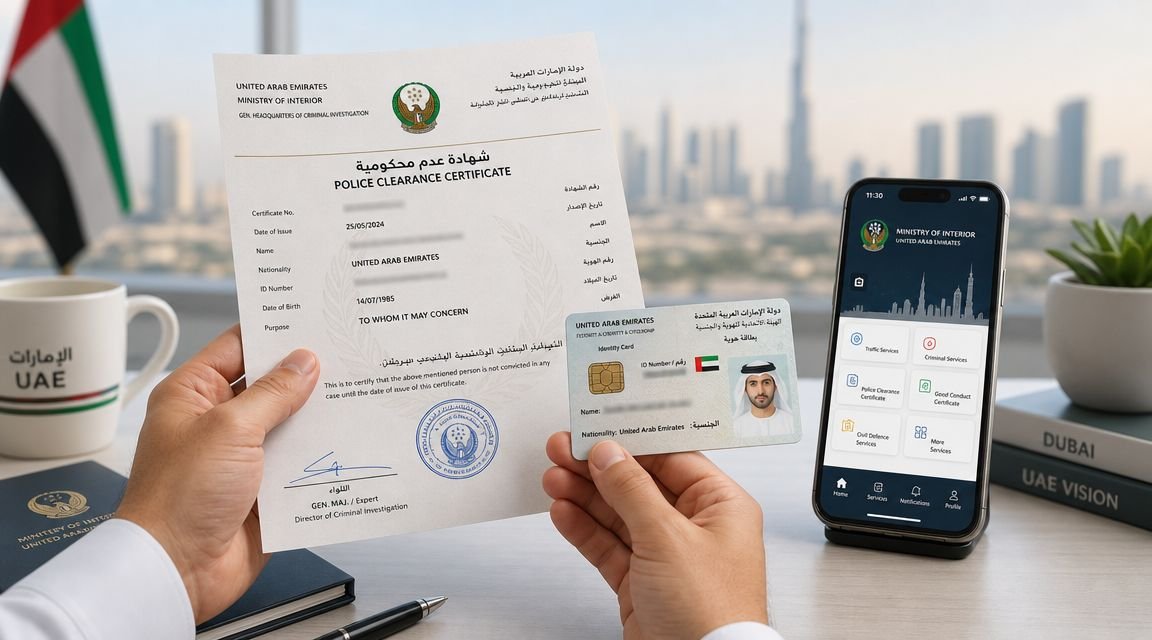
You're usually searching for how to get a police clearance certificate when something important is already moving. A visa file is open. A new employee is due to join. A licence application is waiting on one missing document. In the UAE, that missing document often isn't just paperwork. It can sit directly on the critical path of immigration, hiring, banking, and regulated business activity.
Most delays happen because people treat the police clearance certificate, or PCC, as a single document with a single process. It isn't. In practice, you may need a UAE-issued certificate for your period of residence in the Emirates, a foreign-issued certificate from your home country or prior country of residence, or both. The right answer depends on where you lived, what the receiving authority is asking for, and whether the document must also be attested, legalised, or translated before submission.
Table of Contents
- Why a Police Clearance Certificate Is a Critical Business Document
- Securing a UAE Police Certificate as a Resident
- Getting a Foreign PCC for Your UAE Move
- The Critical Path of Document Legalization and Translation
- Common PCC Mistakes That Stall Your Application
- Beyond the Certificate Managing Timelines and Compliance
Why a Police Clearance Certificate Is a Critical Business Document
A stalled onboarding often starts with a sentence that sounds harmless: “We still need the police certificate.” Then the actual problem appears. The candidate has a home-country certificate, but the UAE authority wants local history too. Or the founder has a UAE certificate, but the bank or immigration file also requires a certificate from the country of citizenship or prior residence.
That confusion is common because generic guides flatten the issue into one step. For many UAE immigration and business processes, applicants need a certificate from their country of citizenship or prior residence, plus a UAE PCC for any local residency periods, as noted in the US guidance on criminal records for international use.
The two questions that matter first
Before you do anything, answer these two questions:
- Which country's record is being requested?
- What is the document being used for?
Those answers determine almost everything that follows. An investor visa file, employee work permit, professional licensing submission, or bank onboarding pack may look similar on the surface, but the document expectations can differ in a meaningful way.
Here's the working distinction:
| Document type | What it usually covers | Typical use case |
|---|---|---|
| UAE PCC | Your police record linked to your UAE identity and residency history | UAE residence periods, local hiring, local compliance checks |
| Foreign PCC | Your record in your home country or prior country of residence | New UAE immigration files, licensing, regulated onboarding, banking reviews |
The biggest practical mistake is assuming one certificate will satisfy every authority involved in the same transaction.
Why businesses should care early
Founders often discover this during a visa filing. HR teams hit it during onboarding. Compliance teams hit it when a bank or regulator asks for a refreshed file. In each case, the PCC sits inside a broader document chain. If the chain breaks, everything behind it waits.
A police clearance certificate matters because it affects timing, sequencing, and document validity. If you order the wrong one, you lose time. If you order the right one too early, it may no longer be usable by the time the receiving authority reviews it. If you skip attestation for a foreign-issued PCC, the document may be technically valid in its home country but still unusable in the UAE.
That's why the right approach isn't just learning how to get police clearance certificate paperwork issued. It's learning how to get the correct certificate, in the correct form, for the correct filing stage.
Securing a UAE Police Certificate as a Resident
If you're a current or former UAE resident, this is the more convenient side of the process. The UAE has moved police clearance services into digital channels through the Ministry of Interior and emirate-level police portals, with applications tied to identity records and Emirates ID details. That digital setup reduces the need for in-person visits for applicants already captured in the system, as described in the reference on UAE criminal record service handling.
Use the right issuing channel
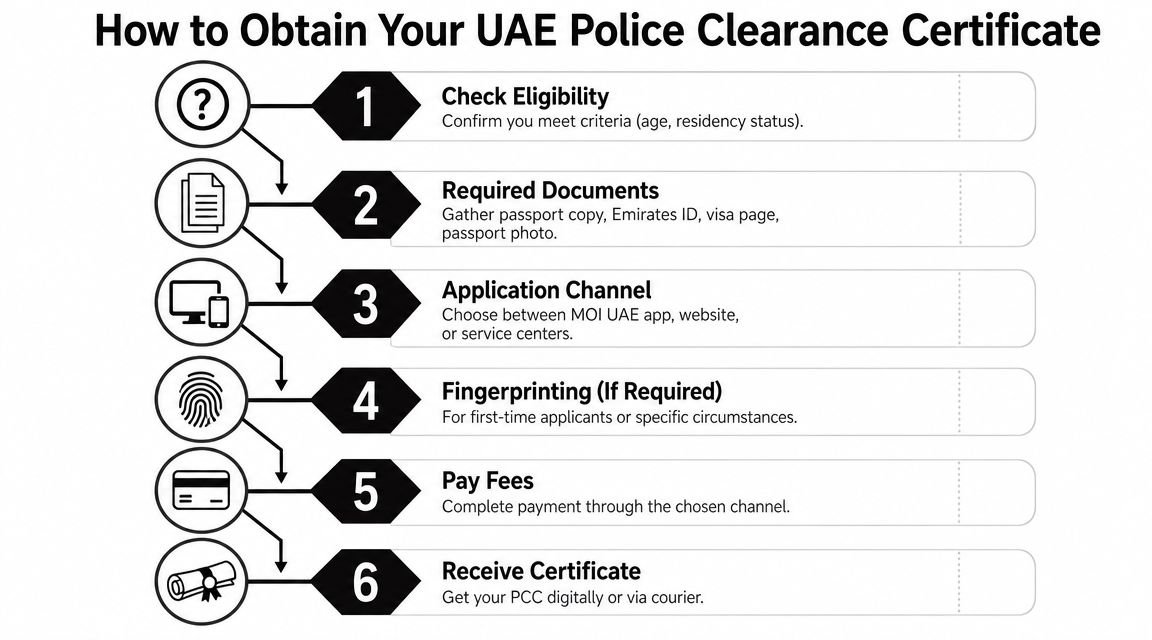
For UAE use, applicants generally obtain a Good Conduct Certificate or Police Clearance Certificate through the Ministry of Interior or the relevant local police portal. The practical workflow is usually digital and follows a familiar pattern:
- Authenticate identity through UAE Pass where available.
- Enter Emirates ID details and related identity information.
- Upload a recent passport-style photo and supporting residency or visa data.
- Pay the service fee online.
- Track the application digitally and receive the certificate electronically.
For residents applying from within the UAE, that's the standard success path. You're usually not starting from zero because the system already links to identity and biometric records from prior immigration and residency steps.
A short explainer is useful before you apply:
Prepare the file before you upload anything
The application itself is often straightforward. The preparation is where people slip.
The most important checks happen before submission:
- Match names exactly. Use the same transliteration and order appearing on your Emirates ID and passport.
- Check residency status. If your filing depends on active legal status, don't assume an outdated visa record will pass review.
- Use a current photo. Outdated photo formats regularly cause avoidable delays.
- Keep supporting data aligned. Passport number, nationality, visa details, and identity fields should read like one record, not several versions of the same person.
What usually works best
The strongest applications are boring. Everything matches. Nothing requires manual interpretation. No officer needs to decide whether two similar names refer to one person or two.
Practical rule: Build your PCC file from the Emirates ID outward, not from memory. Copy names and identity details exactly as they appear on the official records most likely to be checked.
Applicants often overcomplicate this part by gathering extra documents that the portal didn't ask for, or by rushing a submission with inconsistent details. A better approach is disciplined minimalism. Provide the required documents, make sure they align, and submit once the underlying residency data is current.
If you're a former resident, the process can still be digital, but the practical friction rises when old records, expired identity documents, or legacy passport versions don't align cleanly with today's file. In those cases, accuracy matters more than speed.
Getting a Foreign PCC for Your UAE Move
Many first-time UAE applicants often lose time. They obtain a police certificate in their home country, assume the job is finished, and only later discover that the document still isn't ready for UAE use.
For immigration, licensing, or bank onboarding in the UAE, a foreign-issued PCC often has to do more than prove local criminal history in its country of origin. It usually has to travel through a legal chain that makes it acceptable to UAE authorities.
Start with the country that actually issued your record
A foreign PCC must come from the jurisdiction that holds the relevant record. That sounds obvious, but it's where many cross-border applicants make the first mistake.
If someone has citizenship in one country, long-term residence in another, and is now moving to the UAE, the correct certificate requirement may follow prior residence, citizenship, or both, depending on the receiving authority. Generic “get a police certificate” advice doesn't help much in that situation.
A practical filing approach looks like this:
- Identify the requesting authority's wording. “Police certificate” can mean different things depending on the process.
- List every country that may be relevant. Focus on citizenship and meaningful prior residence.
- Order the certificate from the proper issuing body in each country.
- Check whether the document is intended for international use or only domestic use.
- Confirm whether the UAE authority expects legalisation, translation, or both before the document is submitted.
What founders and HR teams should decide early
This is less about paperwork and more about sequencing. Foreign police certificates commonly take longer than UAE-issued certificates, and the legalisation chain adds more time after issuance. Teams that start late usually discover the delay only when a visa file is otherwise ready to submit.
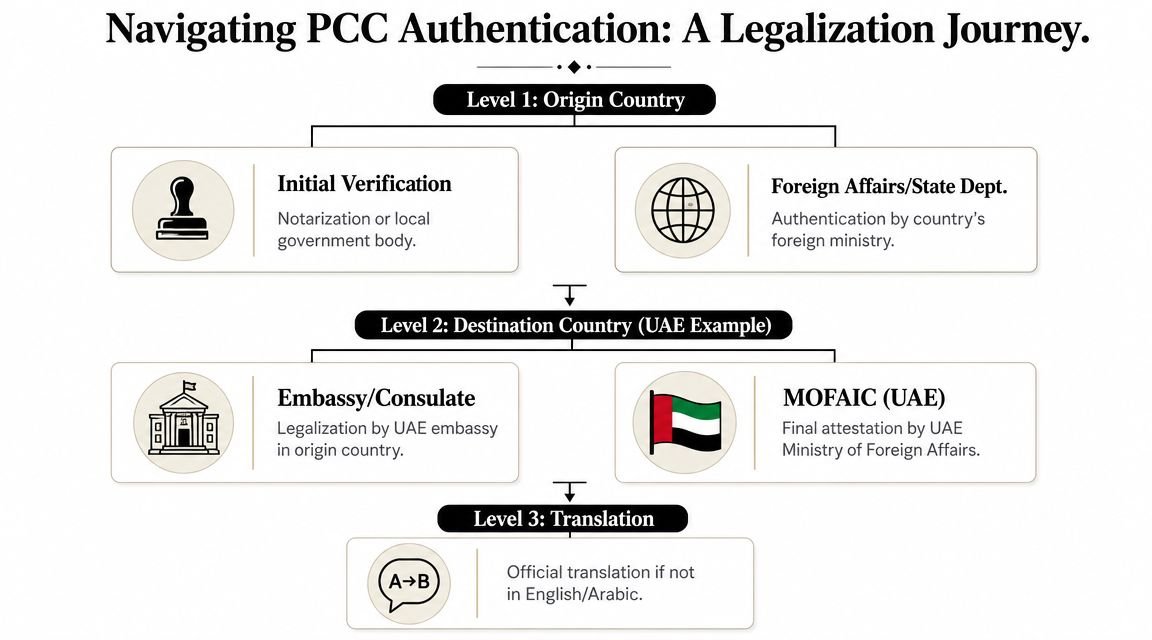
For UAE immigration or licensing, a PCC from outside the UAE typically requires notarisation, attestation by the home country's foreign affairs authority, and then legalisation by the UAE embassy in that country, according to the verified process summary based on guidance on document legalisation for UAE use. Many applicants incorrectly assume the original police letter is enough. It often isn't.
Consider the trade-offs in this comparison:
| Approach | What seems convenient | What usually happens |
|---|---|---|
| Order the PCC late | Avoids early expiry risk | Visa or licensing pack waits on the certificate |
| Order the PCC very early | Gives more time for legalisation | Document may no longer fit the receiving authority's validity window |
| Order the PCC and legalise it as one planned workflow | Requires tighter coordination | Best chance of matching issue date to submission date |
A foreign PCC is not one document. It is a document plus a chain of recognitions.
That's why experienced operators treat home-country police certificates like a mini-project. Someone owns the timeline. Someone checks whether the country issues the certificate centrally or locally. Someone confirms whether notarisation applies. Someone tracks the embassy step. Without that ownership, the certificate often exists but still can't be filed.
The Critical Path of Document Legalization and Translation
Legalisation is where simple how-to articles usually stop being useful. They tell you how to obtain the certificate. They don't explain why the certificate still gets rejected after you've obtained it correctly.
For UAE use, the issue is rarely the existence of the document alone. It's whether the document has moved through the acceptance chain required by the receiving authority.
What each legalisation step actually means
People often use apostille, attestation, and legalisation as if they were interchangeable. They aren't. In practice, they describe different points in the chain.
Here's the simplest working breakdown:
| Term | Practical meaning |
|---|---|
| Notarisation | A local formal certification step, where applicable |
| Attestation | Authentication by a government authority in the issuing country |
| Legalisation | Recognition by the UAE embassy or consulate for use in the UAE |
| MOFAIC attestation | Final UAE-side recognition in cases where local submission requires it |
Apostille creates confusion because people hear it and assume it solves everything internationally. For UAE-facing use, you need to think in operational terms, not label terms. Ask one question: Has the document completed the chain required for this UAE filing?
A practical chain for UAE use
For applicants outside the UAE, the working sequence is often close to this:
- Obtain the police certificate from the issuing authority.
- Complete notarisation if the country and document type require it.
- Submit it to the relevant foreign affairs or state-level authentication authority in that country.
- Legalise it through the UAE embassy or consulate there.
- If required for the final filing, complete UAE-side attestation after arrival.
- Add certified translation if the document isn't in Arabic or English.
That last point matters more than many applicants expect. A certificate may be valid and fully legalised, but still unusable if the receiving authority can't accept the language version presented.
Submit the document only after checking the full chain backwards from the final user. Bank, licensing authority, immigration file, and employer may each apply the chain a little differently.
When translation becomes part of the critical path
Translation is often treated like a finishing touch. It isn't. If your PCC is not in Arabic or English, UAE-facing practice commonly requires a certified translation before submission. That can affect timing because some authorities want the translation to reflect the final authenticated document set, not an earlier draft.
A few practical rules help:
- Translate after confirming the final legalised version if your process requires the translated text to mirror the completed document.
- Use a certified legal translator where the authority expects formal acceptance.
- Keep the original and translation together in every submission pack.
- Check names and document numbers again after translation. Translation errors can create identity mismatches even when the original was perfect.
The broader lesson is simple. When people ask how to get police clearance certificate documents for the UAE, the useful answer isn't only “apply online” or “request it from your home country”. The complete answer is to manage issuance, authentication, translation, and submission as one chain.
Common PCC Mistakes That Stall Your Application
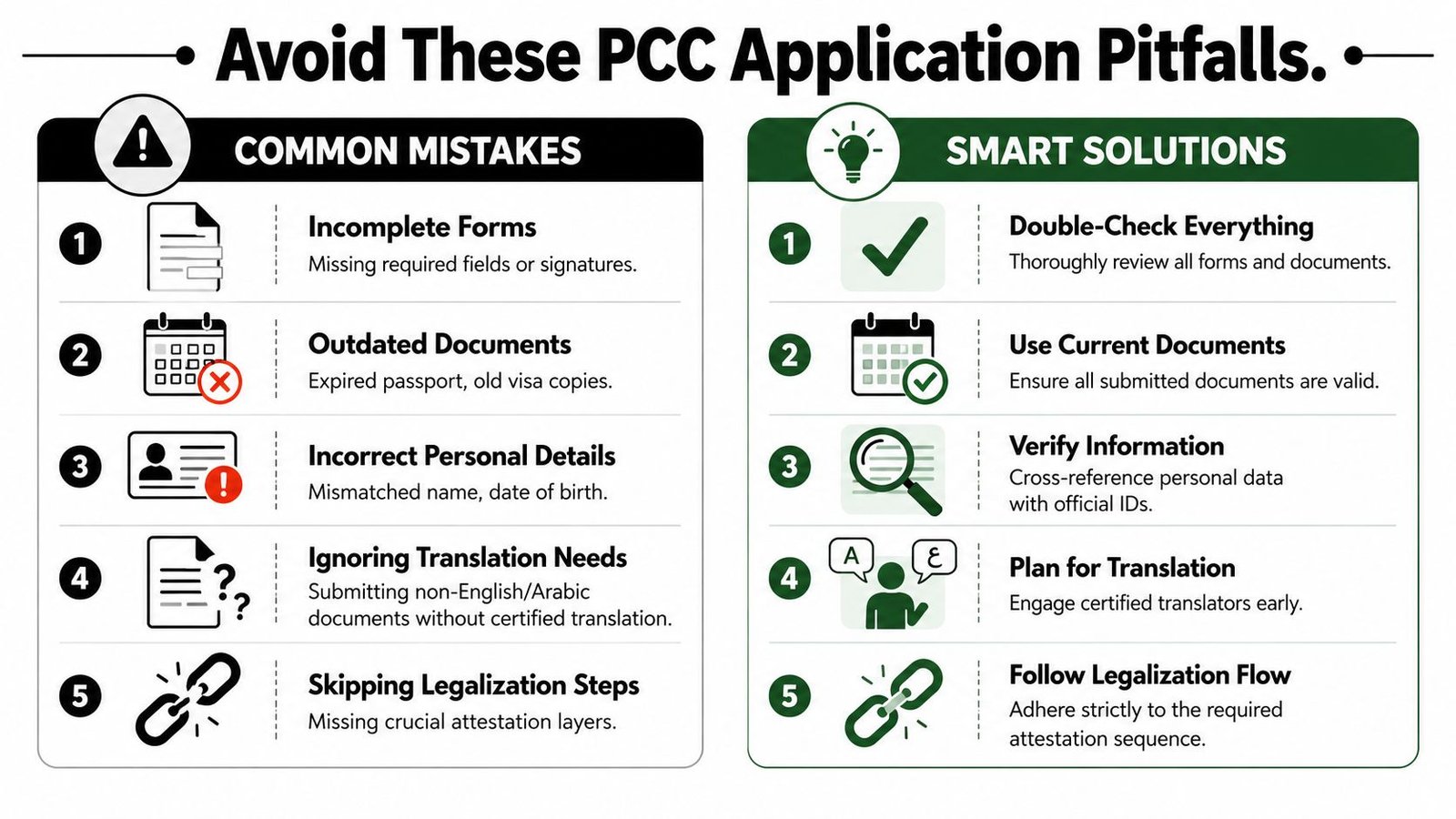
Most PCC problems aren't dramatic. They're administrative. That's why they're dangerous. Small inconsistencies create manual review, and manual review breaks the timeline you thought you had.
Identity errors that trigger rejection
One of the most common technical failure points is mismatched identity data. That includes different name transliterations between passport and Emirates ID, inconsistent nationality fields, and outdated passport photos. These inconsistencies are specifically noted as common causes of delay in UAE-facing PCC workflows in the practical guidance on PCC application pitfalls.
The fastest way to avoid that problem is to treat your passport, Emirates ID, visa record, and application form as a single identity packet. If one record says “Mohamed” and another says “Muhammad”, don't assume the reviewer will bridge the gap for you.
Common identity mistakes include:
- Name drift. Different spellings across passport, Emirates ID, and old residence records.
- Photo issues. Uploading a photo that doesn't meet current format expectations.
- Stale residency data. Filing while visa status, expiry details, or nationality records are out of date.
- Mixed supporting documents. Combining old and new passport versions without checking the record trail.
If a reviewer has to guess whether your documents belong to the same person, your timeline is already at risk.
Process mistakes that waste the most time
The second cluster of problems comes from process control, not identity.
Here are the mistakes that cost the most time in practice:
Using the wrong certificate type
A local police letter from one place may not satisfy a broader immigration or licensing request. Check the jurisdiction before you request anything.Skipping part of the legalisation chain
Many applicants stop after receiving the foreign PCC itself. For UAE use, that often leaves the document unusable until the remaining attestations are completed.Leaving translation to the end
If a non-English or non-Arabic certificate needs certified translation, waiting until the file is otherwise ready can stall the whole submission.Submitting too early in the broader process
A certificate can be valid on the day you receive it and still become unusable before visa stamping or onboarding.
A simple control list is more effective than a long explanation:
| Don't do this | Do this instead |
|---|---|
| Request a PCC before you know which country's record is needed | Confirm the exact jurisdiction tied to the application |
| Upload data from memory | Copy identity details directly from the official record set |
| Assume issuance means submission-ready | Verify legalisation and translation requirements |
| Treat the PCC as a stand-alone document | Tie it to the actual visa, licence, or onboarding milestone |
The companies that avoid repeat work usually have one habit in common. They run a final pre-submission review on the whole document pack, not just the PCC in isolation.
Beyond the Certificate Managing Timelines and Compliance
The PCC becomes easier to manage when you stop treating it as a form and start treating it as part of a regulated workflow. That shift matters most for founders, operations leads, and HR managers who are coordinating multiple dependencies at once.
A UAE-issued certificate can move relatively smoothly through digital channels when the applicant is already in the system. A foreign-issued certificate is different. It carries issuance risk, authentication risk, translation risk, and timing risk. If you compress all of that into the final stage of a visa or licensing process, you create preventable delays.
Treat the PCC as a workflow, not a task
The sharpest timing mistake is getting the certificate too early. In immigration contexts, police certificates can be subject to age limits and validity windows, and a document may need replacing if it's older than the permitted period or if later travel affects acceptability, as reflected in the overview of police certificate validity issues in immigration use. For founders and HR teams, that creates a familiar failure mode. The document is ready before the rest of the process is, then expires before visa stamping or onboarding completes.
That's why timing should be built around the milestone that consumes the document. Not the day someone remembers to order it.
A practical operating model looks like this:
- Map the end use first. Visa submission, bank onboarding, licence approval, or employee joining.
- Count backwards through the dependencies. Issuance, authentication, embassy legalisation, translation, UAE-side attestation if needed.
- Assign ownership. One person should control dates, document versions, and submission readiness.
- Review validity close to filing. Don't assume a certificate obtained early will still fit the window later.
Where strong document control makes the difference
Strong teams don't only ask how to get police clearance certificate documents. They ask whether the document will still be acceptable on the day the authority reviews it.
That mindset changes behaviour. It reduces duplicate applications. It limits re-attestation. It prevents situations where a candidate is ready, the company is ready, but the file still can't move because one document has aged out or missed a legalisation step.
For businesses entering or expanding in the UAE, document handling is part of operational execution. The PCC sits alongside visa processing, labour files, company records, and regulated onboarding. Managed well, it disappears into a smooth workflow. Managed poorly, it creates avoidable friction at exactly the wrong moment.
If you need support with the full PCC lifecycle, from identifying the correct certificate to managing attestation, legalisation, visa sequencing, and UAE submission, Inpro Corporate Services L.L.C. can help you handle the process with clearer timelines and fewer compliance mistakes.