

You can get a trade licence in the UAE by matching your business activity to the correct licence and jurisdiction, then completing the related sequence of legal-form selection, trade-name reservation, initial approval, premises registration, external clearances, document submission, and fee payment. The licence isn't a single online form, and most delays happen when the activity, ownership documents, tenancy, or approvals don't match.
Table of Contents
- What a UAE Trade Licence Actually Is
- Choosing Between Mainland, Free Zone, and Offshore
- The Real Sequence Behind the Application
- Documents Authorities Actually Ask For
- Where Applications Usually Get Stuck
- What Happens After the Licence Is Issued
- Start Your UAE Setup the Right Way
What a UAE Trade Licence Actually Is
A UAE trade licence is the government authorisation that allows a company to carry out approved economic activities in the United Arab Emirates. In practical terms, it connects four decisions that must agree with one another: what the company does, how it is legally formed, where it operates, and which authority must approve it.
Dubai's formal business-licensing workflow starts with choosing a business activity, legal form, and trade name. The applicant then obtains initial approval, secures premises, clears sector-specific approvals where required, and pays the relevant fees before receiving the licence. The Dubai Government business-licensing guidance notes that Dubai covers more than 2,000 business activities and uses six licence types. It also states that an application can be cancelled if the approved licence isn't collected and paid for within 30 days after the approval milestones are completed.
That sequence explains why the activity comes first. A consultancy, restaurant, online retailer, healthcare provider, and general trading company won't necessarily use the same legal form, premises evidence, or regulator approvals. The licence follows the business model, not the other way around.
What do DED, MOA, and MOHRE mean?
DED commonly refers to the Department of Economy and Tourism in Dubai, or to the equivalent economic department in another emirate. Abu Dhabi, Sharjah, and other emirates have their own licensing authorities, even though the broad logic remains similar.
MOA means Memorandum of Association. It records the company's ownership and constitutional arrangements and can require notarisation, particularly for mainland structures. MOHRE means the Ministry of Human Resources and Emiratisation, the federal authority associated with employment matters, work permits, and labour-related company files.
The trade licence becomes the foundation for later workflows, including immigration files, employee visas, banking, and tax administration. That doesn't mean every post-licence step is automatic. Each one may require its own documents, approvals, and checks.
Practical rule: Don't choose a jurisdiction because its licence appears easy to obtain. Choose it because its activity, premises, ownership, and market-access rules fit the company you actually intend to operate.
Choosing Between Mainland, Free Zone, and Offshore
The jurisdiction decision should happen before you reserve a name or prepare forms. Mainland means registering through the economic department of the emirate where the company will operate. Free Zone means incorporating through a designated economic zone with its own licensing framework. Offshore generally refers to a structure intended for holding or asset-related purposes, rather than ordinary operating activity inside the UAE.
Mainland is usually the practical route when the company needs direct access to the local UAE market, local premises, or contracts that depend on an onshore operating presence. It can suit professional services, retail, restaurants, contracting, and businesses that expect to deal directly with customers or counterparties across Dubai, Abu Dhabi, or Sharjah. The trade-off is that legal form, tenancy, MOA requirements, and external approvals may need closer coordination.
A free zone can be a strong fit for international entrepreneurs, freelancers, and service companies serving clients outside the UAE. The zone may offer a more focused setup path, but the founder still needs to confirm the permitted activity, office or workspace requirements, visa eligibility, and any limitations on conducting business directly in the mainland market. A free-zone licence isn't a universal substitute for a mainland licence.
Offshore structures have a different purpose. They can suit holding companies, ownership arrangements, or asset-protection planning where the entity isn't intended to conduct day-to-day trading from UAE premises. An offshore company generally isn't the right answer for a founder who needs employee visas, a local operating office, or regular sales to UAE customers.
| Criteria | Mainland | Free Zone | Offshore |
|---|---|---|---|
| Local UAE market | Direct operating access, subject to activity and regulatory rules | May require additional arrangements for direct mainland activity | Generally unsuitable for ordinary local trading |
| Ownership | Depends on activity, legal form, and applicable rules | Often attractive for international founders, subject to zone rules | Designed around holding or ownership objectives |
| Premises | Tenancy and, in Dubai, Ejari may be required | Workspace requirements vary by zone and activity | Not generally an operating-office solution |
| Service businesses | Suitable where local clients or contracts are central | Often suitable for export-oriented or international services | Usually unsuitable for active service delivery |
| Trading companies | Suitable where local distribution or premises matter | Can suit international trading, subject to activity and logistics rules | Generally not intended for operating trade |
| Holding purposes | Possible, but may be more structure than needed | Possible within the relevant zone framework | Commonly considered for holding and asset planning |
| Tax substance | Requires a structure and operations consistent with the business | Requires genuine business purpose and appropriate records | Needs careful advice on ownership, substance, and banking |
The Ministry of Economy guidance on establishing a business in the UAE separates setup into stages such as trade-name reservation, initial approval, and issuing or renewing the economic licence. That distinction is useful when comparing jurisdictions. A low-friction registration step doesn't remove the need to prove that the chosen activity and structure make sense.
The Real Sequence Behind the Application
The licensing file should be built in the order the authority expects to review it. Start with the activity, then decide the legal form, reserve the trade name, obtain initial approval, arrange premises, secure any outside clearances, and complete the final submission and payment.
How should the activity be selected?
Use the exact activity wording approved by the relevant authority. A broad description such as “consulting” may not be enough if the intended work involves technology development, recruitment, financial services, education, healthcare, or regulated advice. The activity determines the licence category, the legal form available to the founders, and whether another regulator must review the application.
Dubai's business setup guidance states that the process links activity selection, legal structure, tenancy registration, and external authority sign-offs. That makes activity selection a compliance decision, not a marketing label.
When should the legal form be decided?
The legal form should be chosen before the ownership documents are drafted. Depending on the activity and ownership, the structure may involve a sole proprietorship, limited liability company, branch, or another permitted form. The form affects the MOA, manager details, signature documents, and the evidence needed from corporate shareholders.
Reserve the trade name only after the proposed activity and structure are reasonably settled. A name that looks acceptable in isolation can still create problems if it conflicts with naming rules, implies an unapproved activity, or doesn't align with the intended legal form.
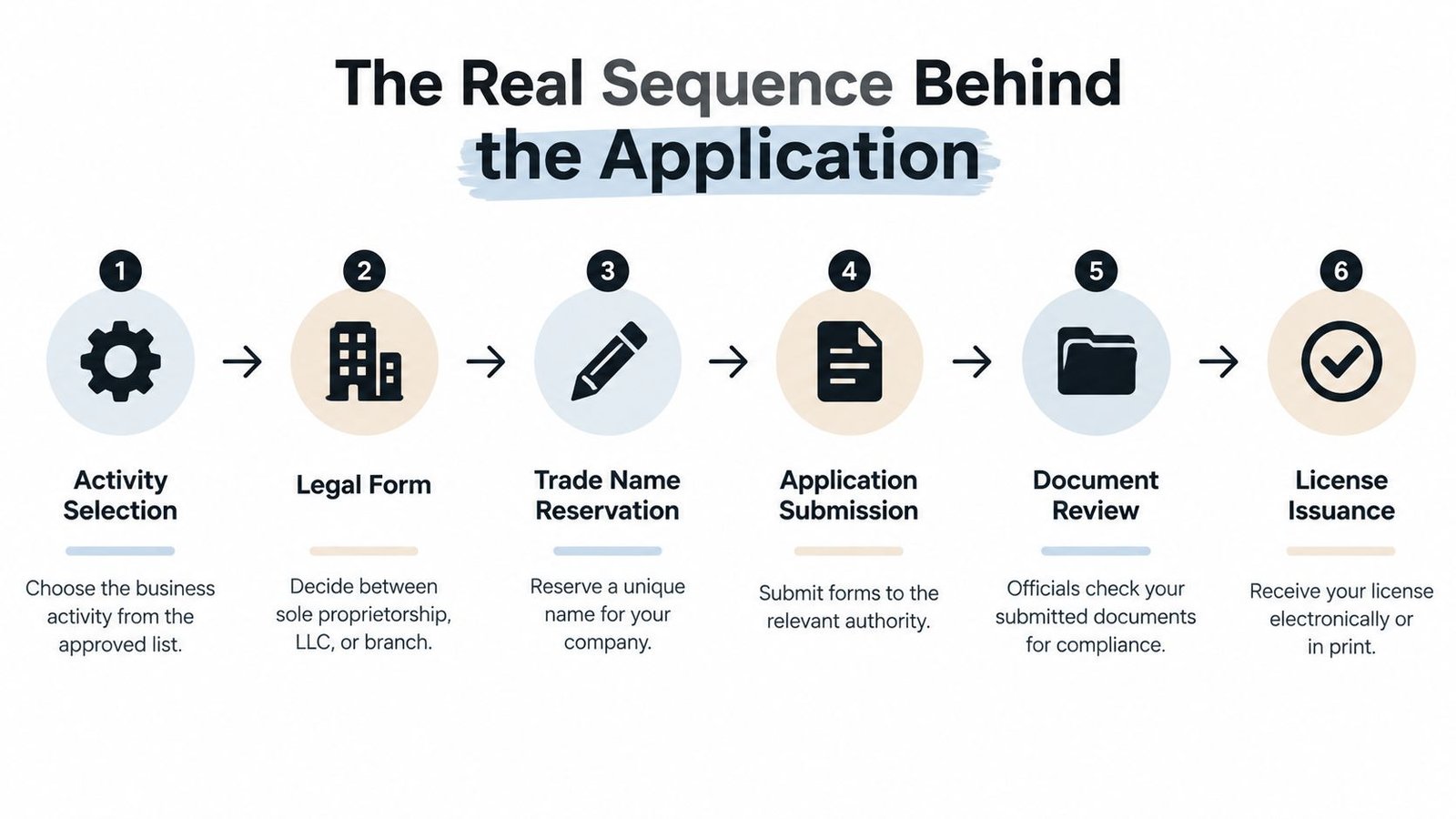
What does initial approval actually mean?
Initial approval means the authority has accepted the proposed formation at an early stage, but it isn't always the final operating licence. The applicant may still need to provide premises evidence, sign or notarise the MOA, and obtain approval from a sector regulator.
Dubai premises commonly involve a tenancy contract and Ejari, the Dubai system used to register tenancy information. The premises must suit the licence type and activity. A mismatch between the office, tenancy record, and proposed activity can send the application back for correction.
Sector-specific approvals can change both timing and cost. Depending on the business, the relevant authority may include the Dubai Health Authority, Dubai Municipality, the Knowledge and Human Development Authority, or the Central Bank. A healthcare activity, food business, education provider, and financial-services company shouldn't be assessed using the same checklist.
The Ministry of Economy's business establishment service also reinforces that trade-name registration and business establishment are handled through emirate-level economic departments. The practical lesson is simple: don't sign a lease or promise a launch date until the authority has confirmed that the activity, legal form, premises, and external approvals fit together.
Documents Authorities Actually Ask For
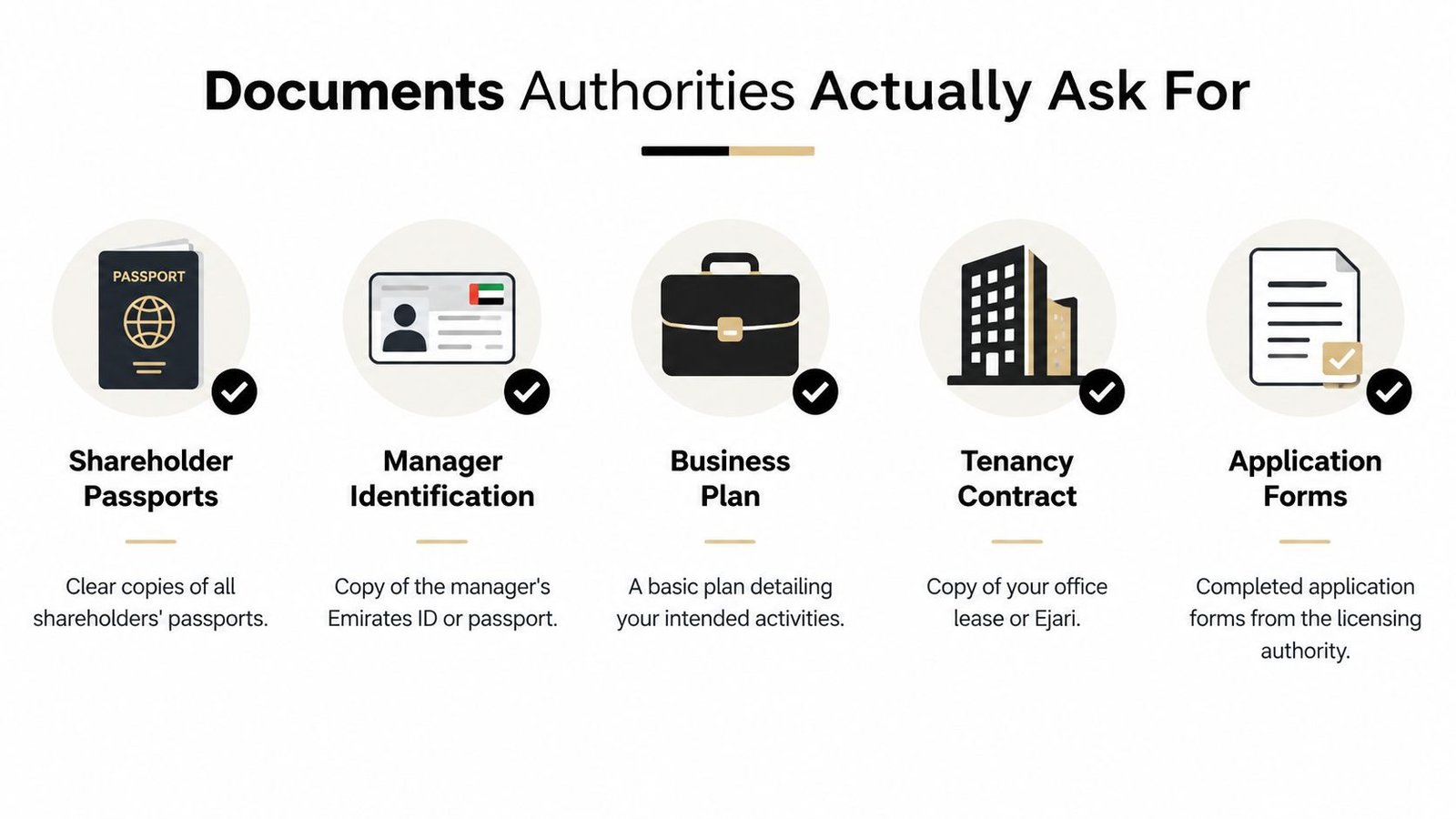
A clean application starts with a document matrix, not a loose folder of attachments. The exact list depends on the emirate, jurisdiction, activity, legal form, and applicant type, but authorities commonly review identity, ownership, management, premises, and purpose.
The Ministry of Economy's free-zone establishment guidance lists initial-approval documents that can include an application form, business plan, shareholder passport copies, the registry identification code for the appointed manager, signature copies, and, in some cases, a no-objection letter, title deed, or audited financial reports.
Which documents does an individual founder usually prepare?
An individual founder will commonly need clear passport copies, completed authority forms, manager identification, and a description or business plan for the proposed activity. The authority may also request signature specimens and evidence relating to the premises.
A NOC, or No Objection Certificate, is a letter confirming that an existing sponsor doesn't object to the proposed business activity or formation. Whether it applies depends on the applicant's circumstances and the authority's requirements. It shouldn't be assumed that every founder needs one, but it also shouldn't be ignored when the authority asks for it.
What changes for corporate shareholders?
A company joining as a shareholder may need corporate registration documents, evidence of authorised signatories, ownership information, and documents showing who can act for the entity. Foreign-issued documents may require attestation before the UAE authority accepts them.
Attestation is the process of authenticating a document through the required official channels so that it can be used in the United Arab Emirates. The chain can differ by issuing country and document type, so a document that is valid in its home country may still need additional treatment before submission.
What should freelancers and free-zone applicants check?
Freelancers and solo applicants often assume passport copies and a form will be enough. The official free-zone guidance shows why that assumption fails. Depending on the applicant, the zone may request a business plan, manager identification, signature copies, a title deed, audited financial information, or an NOC.
Use this checklist before submission:
- Identity: Prepare legible passport copies for all shareholders and the proposed manager.
- Ownership: Confirm that shareholder names and ownership percentages match across every form and constitutional document.
- Management: Provide the appointed manager's required identification and registry details where requested.
- Purpose: Keep the business plan consistent with the selected activity and expected operations.
- Premises: Match the tenancy contract, Ejari or equivalent registration, and licence type.
- Authority forms: Complete the current forms issued by the relevant licensing authority.
- Foreign documents: Check whether certificates, powers of attorney, or corporate records require attestation or notarisation.
Where Applications Usually Get Stuck
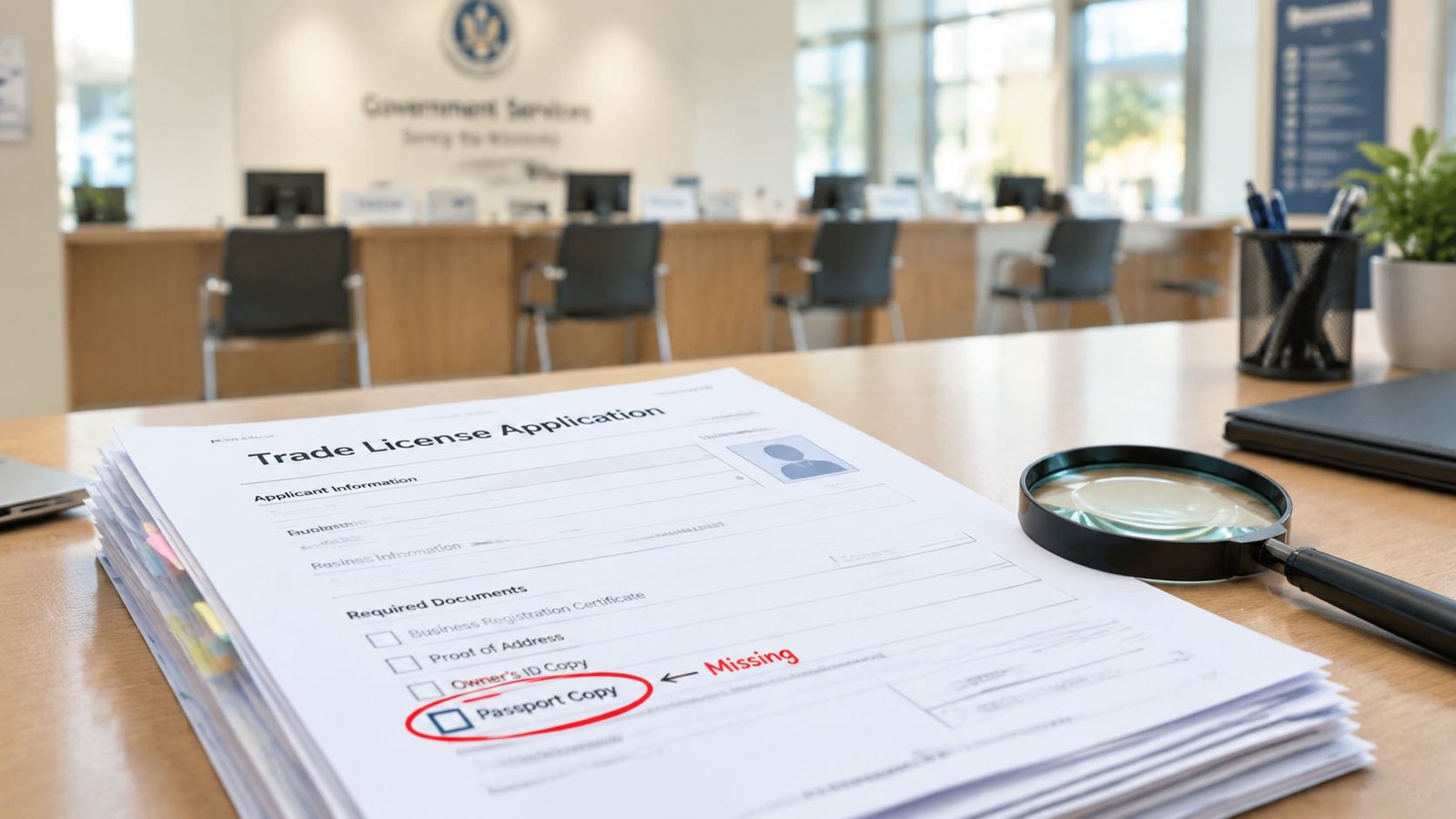
Applicants often blame the government queue when the problem sits inside the file. Common blockers include missing passport copies, inconsistent shareholder details, an absent or improperly notarised MOA, and tenancy registration that doesn't match the proposed licence.
The most effective preparation happens before submission. Confirm the activity wording with the authority, settle the ownership structure, prepare the MOA where required, and verify that the premises support the licence category. Correcting a defect after submission usually takes longer than checking it before the file reaches the licensing desk.
Which errors cause the most rework?
Inconsistent names create avoidable questions. The spelling on passports, forms, shareholder resolutions, and the MOA should match. Differences in initials, order of names, or transliteration can result in a request for clarification.
Incorrect activity wording can send the application to the wrong review path. Copying an informal description from a website or proposal isn't a substitute for selecting the approved wording used by the authority.
Premises defects are another frequent cause of delay. The office lease, Ejari or tenancy registration, and selected licence should describe a compatible arrangement. A small office may suit a professional activity but not a business that needs customer-facing space, storage, inspection, or specialist facilities.
How long can a straightforward application take?
Dubai-focused market guidance cites one to five business days for issuance in straightforward cases and three to seven business days when documents are complete, as reported in the Dubai trade-licence procedures guide. These are useful benchmarks, not promises. The same source reports nearly 19,000 commercial licences in Q1 2025, illustrating the volume handled in Dubai, while also identifying document defects as a major reason files are returned.
Abu Dhabi uses a submission path through the Abu Dhabi Registration and Licensing Authority, commonly known as ADRA, and the TAMM government-services platform once the required approvals are in place. The route can be efficient, but a fast digital submission doesn't repair incomplete evidence.
A first-pass approval strategy is more reliable than chasing a fast submission. Build the file so the reviewer doesn't need to guess what the company will do, who owns it, or where it will operate.
What Happens After the Licence Is Issued
The licence is the operating foundation, not the final administrative task. Once it's issued, the company may need to establish immigration and labour files, apply for investor or employee visas, arrange health insurance or other visa-related requirements, and begin corporate banking checks.
The bank will usually assess the company beyond the licence itself. It may ask about the owners, business model, expected transactions, source of funds, contracts, and operating plans. A licence that says “consultancy” won't by itself explain the company's banking profile.
Tax administration also follows the business model. The company may need to assess VAT and corporate tax registration and filing obligations, maintain accounting records, and keep evidence that supports its transactions. These requirements should be reviewed with a qualified tax adviser because the correct treatment depends on the business and its activities.
Renewal planning deserves the same attention as formation. Abu Dhabi's Registration and Licensing Authority reported 16% growth in new economic licences in 2024, along with a 27% increase in renewed mainland licences and a 9% rise in active licences compared with 2023, according to the ADRA 2024 licensing update. The figures show that licensing is a recurring business milestone, not a one-time certificate.
For a mainland company, approval doesn't erase the underlying requirements. Keep the legal form, tenancy, MOA, manager records, and activity information aligned throughout the licence period. UAE companies legislation also continues to develop, including updated companies legislation published by the Ministry of Economy in 2025, so older checklists may not reflect current practice.
Start Your UAE Setup the Right Way
The reliable route is to match activity, jurisdiction, legal form, documents, premises, and external approvals before submission. That preparation reduces rework and gives you a clearer basis for visas, banking, tax registration, and renewal planning.
If you're comparing Dubai, Abu Dhabi, Sharjah, or a free zone, start by listing your activities, intended customers, ownership, office needs, and visa plans. Then confirm which authority and licence category fit those facts rather than selecting a package first.
Inpro Corporate Services L.L.C. helps founders compare Mainland, Free Zone, and Offshore routes, prepare licensing documents, manage attestations and government submissions, and coordinate related visa and compliance workflows. Visit Inpro Corporate Services L.L.C. to book a free strategy call or use the cost estimator for your UAE setup.