

You can open a bank account in the UAE by selecting the right pathway, preparing the required identity and business documents, and completing the bank's customer due diligence checks. Straightforward applications may be approved within a few hours to a few days, while corporate structures, non-resident files, and unclear ownership usually take longer.
You may be a founder waiting for a trade licence, an employee preparing for a salary transfer, or an international entrepreneur trying to understand why a bank wants more than a passport. The process can feel uncertain because UAE banks assess both eligibility and risk. In practice, most delays come from incomplete ownership records, weak source-of-funds evidence, missing address proof, or practical verification problems, not from the basic application form.
Table of Contents
- Opening a UAE Bank Account Without the Stress
- Choosing Your Account Type and Pathway
- Documents You Will Need
- Understanding UBO and KYC Verification
- The Practical Blockers Most Guides Miss
- Common Rejection Reasons and How to Avoid Them
- Your Action Plan and Next Steps
Opening a UAE Bank Account Without the Stress
What are the main ways to open an account?
There are three common routes: a resident personal account, a non-resident personal account, and a corporate account for a UAE-registered business. Your residency status, salary arrangement, company structure, expected transactions, and source of funds determine which route fits.
For a resident personal account, banks commonly ask for a valid passport, Emirates ID, proof of UAE residence, and salary evidence. A non-resident application usually needs a larger compliance file because the bank has less local information about the applicant. A corporate application adds the company's licence, ownership structure, authorised signatories, and evidence explaining how the business earns and receives money.
The UAE's strict approach reflects its customer due diligence framework. Licensed financial institutions must identify and verify customers, beneficial owners, and controlling persons before or during the start of a banking relationship, and they can't keep anonymous accounts or onboard fictitious names under the UAE Central Bank account-opening rules.
How long does the process take?
The official UAE government banking guide says approval usually takes a few hours to a few days, depending on the bank and the application. The UAE government banking guidance also explains that many banks offer online or mobile application routes.
The UAE Central Bank states that a low-risk customer profile can be completed within three business days when the bank has sufficient standard customer due diligence documents, as set out in its account-opening rulebook. That timing shouldn't be treated as a promise for a complex company. A founder with layered ownership, overseas shareholders, unusual activity, or incomplete documents may enter enhanced due diligence instead.
Practical rule: The bank's review starts with the quality of your file, not with how urgently you need the account.
Why does preparation matter more than bank-hopping?
Submitting the same incomplete file to several banks rarely solves the underlying issue. Each institution may have different products and risk preferences, but every licensed bank still needs to understand who owns the account, where the money comes from, and how the account will be used.
A 2025 survey reported that 94% of UAE residents held a personal bank account, compared with 85% in 2021, using World Bank Global Findex data, as reported by Arabian Business. That high ownership rate shows that ordinary applicants generally succeed. The difficult cases are usually founders, newcomers, and non-residents whose circumstances don't fit a standard salary-account profile.
Prepare the documents first, map your ownership chain, confirm your mobile and address details, and write a clear explanation of your business activity. That sequence removes more friction than choosing a bank based only on brand familiarity.
Choosing Your Account Type and Pathway
Which UAE account pathway applies to you?
Start with the account's intended use. A salary account, a non-resident savings account, and a company operating account are assessed under different requirements, even when the applicant uses the same bank.
| Account Type | Typical Minimum Balance | Key Documents | Processing Time |
|---|---|---|---|
| Resident personal account | Varies by bank and product. Emirates NBD's Classic package has no minimum salary requirement, while its Plus and Plus Maximizer packages require a minimum salary of AED 5,000, according to Emirates NBD | Passport, Emirates ID, proof of UAE residence, salary certificate or other salary evidence | A few hours to a few days in straightforward cases, according to the UAE government banking guide |
| Non-resident personal account | Some non-resident openings may require AED 25,000 or more, according to the UAE Life Guide | Passport, overseas address proof, bank statements, source-of-funds evidence, and potentially a bank reference letter | Depends on the bank's due diligence and the completeness of overseas evidence |
| Corporate or business account | Varies by bank, activity, structure, and risk profile | Trade licence, constitutional documents, UBO information, signatory documents, business model evidence, and source-of-funds material | Often longer than a simple personal application when ownership or activity needs further review |
A resident personal account is usually the most direct option when the applicant has a salary transfer, valid Emirates ID, and stable UAE address. Product rules still vary. Emirates NBD offers tiered salary requirements depending on the package selected, so confirm eligibility before submitting an application.
Why are non-resident applications harder?
A non-resident account is a personal account for someone who doesn't hold UAE residency. The bank therefore has to verify identity, address, financial background, and the reason for opening an account using evidence from another country.
Expect requests for an overseas address issued within about three months, bank statements, source-of-funds documents, and possibly a bank reference letter. Gulf News' non-resident banking guide also notes that applicants may be asked for six months of bank statements, a CV, and proof of foreign address.
Some non-residents qualify only for limited savings products, while initial deposit expectations may be higher than for residents. If relocation is close, compare opening an account now with waiting for UAE residency documents. The immediate route can involve more evidence and fewer features.
When does a corporate account make sense?
A corporate account is a bank account held by a company rather than an individual. A Mainland company in Dubai or Abu Dhabi, a Free Zone company in Sharjah or another emirate, and an Offshore structure each need an account that matches the licensed activity and expected transactions.
The bank will focus closely on the ownership chain, UBO verification, authorised signatories, and source of funds. If overseas shareholders or layered ownership are involved, prepare a clear ownership chart and supporting identity documents before applying. An unexplained gap in the chain can delay the file even when the trade licence is valid.
Do not route company revenue through a personal account because the corporate review takes longer. That creates accounting confusion and weakens the separation between personal wealth and business funds. A business account gives the bank context for invoices, payroll, suppliers, investment receipts, and transfers.
Documents You Will Need
A clean document pack does not guarantee approval. Files that are outdated, inconsistent, or unable to explain the company's ownership and money flows are common reasons an application stalls.
What documents do residents need?
A UAE resident opening a personal account will commonly need:
- Passport: Provide a valid copy that matches the identity details in the application.
- Emirates ID: Banks use this as a key UAE identity document and may request the original card for verification.
- Proof of residence: A tenancy contract or utility bill can confirm your UAE address, subject to the bank's format and recency requirements.
- Salary evidence: A salary certificate, appointment letter, or payslips can support a salary account or payroll relationship.
Emirates Islamic states that salary-transfer or payroll current-account documents should be dated within the last three months, as explained in its account-opening document guidance. Use a recently issued salary certificate rather than an older letter from a previous application, and check the date before uploading.
Banks may also ask for your employer details, expected monthly activity, tax residence, and the account's purpose. Keep every answer consistent. A mismatch between the application, salary letter, mobile number, or expected transactions can trigger further questions even when the main documents are valid.
What belongs in a corporate file?
Corporate applications require a wider pack because the bank must verify the legal entity and the people behind it. Prepare the following where applicable:
- Trade licence: This confirms the company's licensed activity and jurisdiction.
- Memorandum of Association: The Memorandum of Association records constitutional arrangements and ownership details.
- Board resolution: A board resolution can approve account opening and identify authorised signatories.
- UBO register and ownership chart: These show the individuals who ultimately own or control the company.
- Identity documents: Include passport and Emirates ID copies for shareholders, directors, authorised signatories, and relevant controllers.
- Address evidence: Provide residential address records for the people connected to the account.
- Business evidence: Contracts, invoices, a company profile, website details, supplier information, or business account statements can explain genuine activity.
- Source-of-funds and source-of-wealth documents: These explain where incoming money comes from and how the owners accumulated their wealth.
The exact pack differs between a Mainland company, a Free Zone entity, and an Offshore company. A Mainland company may need documents issued through the relevant Department of Economy and Tourism or economic department. A Free Zone company will generally provide documents from its Free Zone registrar. An Offshore structure may face more questions about its purpose, controlling persons, and expected use in the UAE.
Do not treat source-of-funds evidence as a formality. Bank statements, sale agreements, loan documents, investment records, or invoices must support the explanation given in the application. Weak evidence here can delay a file even when the trade licence and identity documents are complete.
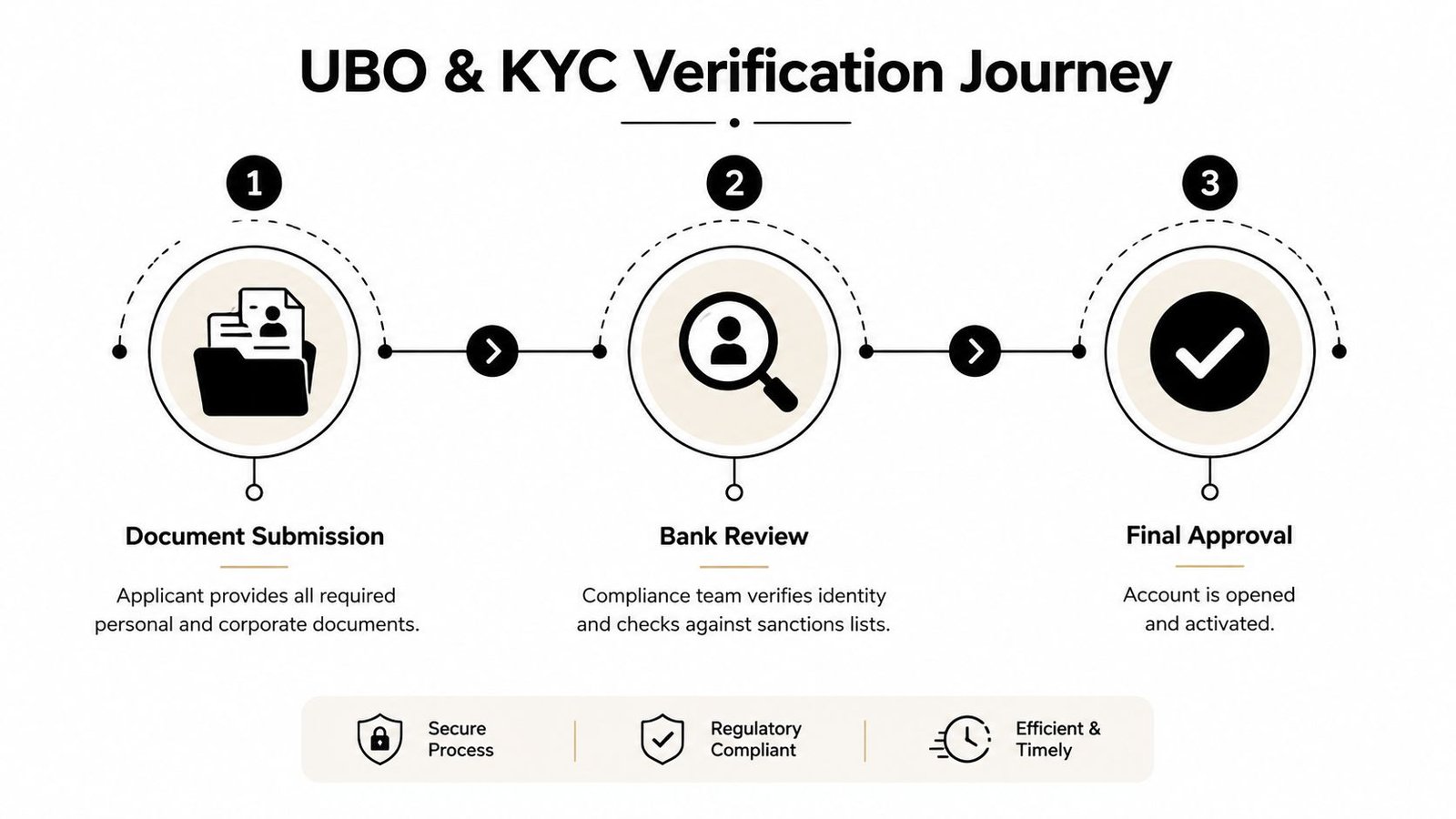
How should you organise the file?
Use one controlled folder containing final document versions, consistent file names, and clear translations where needed. Certified copies and properly attested documents can reduce back-and-forth when the bank verifies overseas corporate records.
Confirm that the registered mobile number works and belongs to the applicant or authorised representative. Banks commonly use it for verification codes and follow-up contact, so an inaccessible or mismatched number can stop progress before compliance review is complete.
Do not send different ownership charts to different contacts. If the application says one person controls the company but the trade documents show another arrangement, the compliance team will pause the file to reconcile the difference.
Understanding UBO and KYC Verification
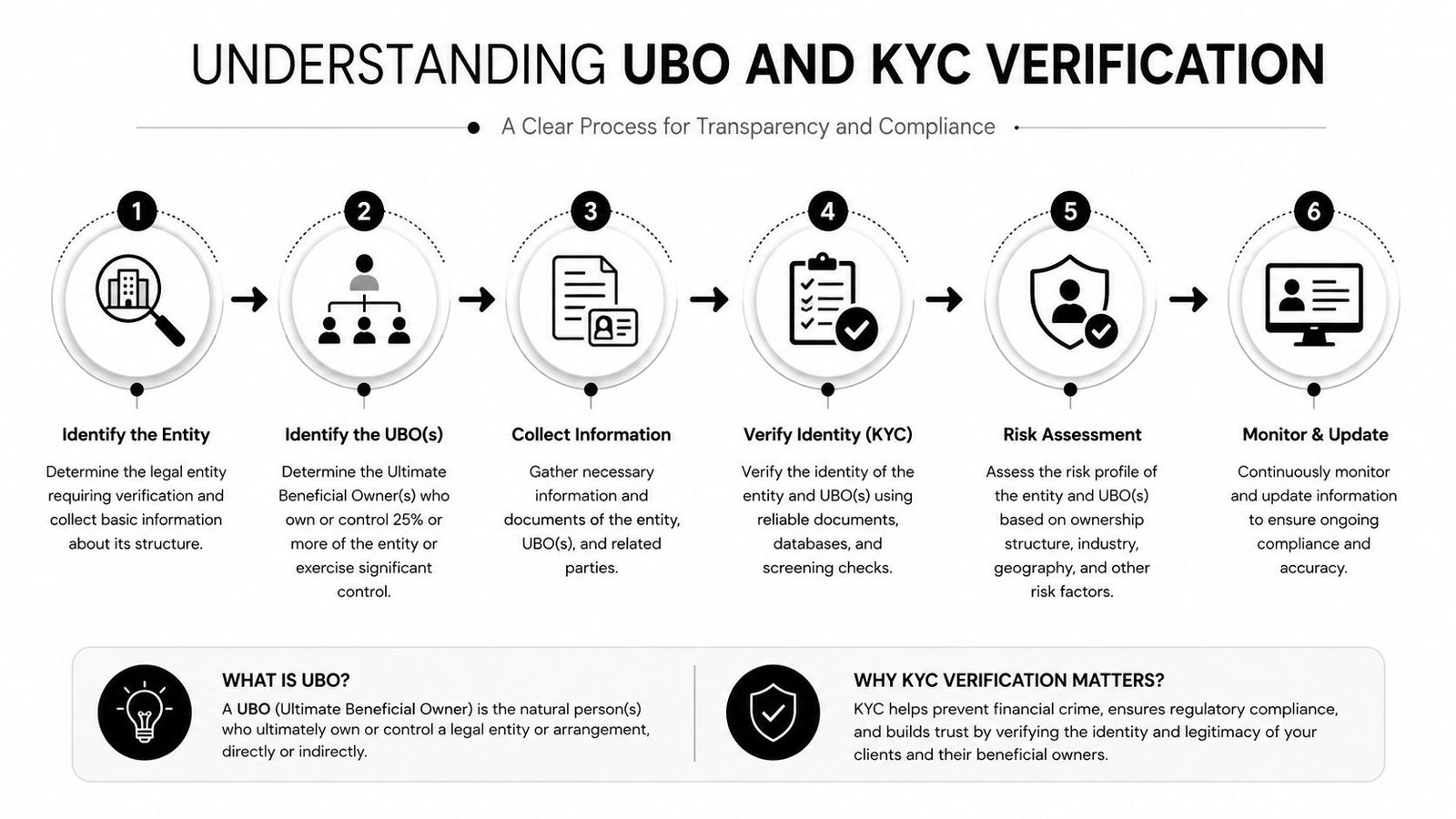
What is a UBO?
A UBO, or Ultimate Beneficial Owner, is the natural person who ultimately owns or controls a legal entity. Under UAE requirements, the bank must identify and verify every individual who directly or indirectly owns or controls 25% or more of the company, according to the UAE legislation on customer identification and beneficial ownership.
The calculation must follow the ownership chain. If your UAE company is owned by another company, and that company is owned by individuals or a further holding entity, the bank will trace the chain until it identifies the natural persons behind it.
A UBO register should therefore show names, ownership interests, control arrangements, and the route through which each person owns or controls the company. An ownership chart should make the same information easy to understand at a glance.
What happens if nobody reaches the threshold?
The 25% threshold doesn't mean the bank can stop its review when no individual appears to own that amount. If no such person exists, the bank must still complete verification using reliable and independent sources before onboarding the customer, as described in the UAE legislation.
The bank may then focus on the person who exercises control through management, voting rights, contractual arrangements, or another form of authority. This is why a simple statement saying “no UBO” isn't a sufficient corporate explanation.
Why do identity documents receive close examination?
UAE rules require banks to physically examine the UAE ID card or passport used to open the account, record the account holder's residential address and workplace, and keep an initialled copy of the identity document on file, according to the UAE legislation.
That requirement explains why a blurred scan, an expired document, or an identity copy that doesn't match the application can stop progress. It also explains why remote onboarding still includes identity checks rather than relying only on uploaded paperwork.
Ownership must tell one consistent story. The licence, register, chart, passports, resolutions, and application answers should all point to the same people and control structure.
What does enhanced due diligence look like?
Enhanced due diligence is a deeper review applied when the bank sees additional risk or uncertainty. Unclear ownership chains, inconsistent names, unexplained transfers, unusual business activities, and weak source-of-funds evidence can all lead to further questions.
The usual problem isn't that the company has a complex structure. The problem is that the structure isn't explained clearly enough for the reviewer to verify it. Provide a clean chart, supporting corporate documents, certified identity copies, address evidence, and a written explanation of ownership before the bank asks for them.
The Practical Blockers Most Guides Miss
Why does an active UAE mobile number matter?
A complete document pack can still stall if the bank cannot complete its verification workflow. Applicants must be at least 18 and have an active UAE mobile number for verification and ongoing communications, as noted in the account-opening guidance above.
That number may receive one-time passwords, application updates, identity prompts, and security messages. A foreign number that handles ordinary calls may not support a UAE banking workflow. Arrange a reliable UAE mobile number before starting an online application, then ensure you can access it while travelling or waiting for approval.
How do banks check your address?
Proof of address connects you to a real residential location. Residents may provide a tenancy contract or utility bill. Non-residents may need overseas address evidence dated within about three months. The document should show your name and address in a format the bank can verify.
A common error is submitting a company address when the bank requested the shareholder's residential address. These records serve different purposes. Keep personal address evidence separate from registered office documents, and confirm acceptable formats with the bank before submission.
Is digital onboarding replacing paperwork?
Digital onboarding changes how banks collect and check information, but it does not remove compliance requirements. Abu Dhabi Islamic Bank, commonly called ADIB, launched a fully digitised wholesale banking account-opening flow in January 2025, according to its announcement about digital onboarding solutions.
A digital application may be faster when its workflow is built around verification. It can also expose inconsistencies immediately because the system compares names, identity records, ownership details, and uploaded documents. Treat online onboarding as a structured compliance interview, not a lighter paper application. Before pressing submit, check that the mobile number, address evidence, and source-of-funds records support the same account story.

Common Rejection Reasons and How to Avoid Them
Why do applications stall?
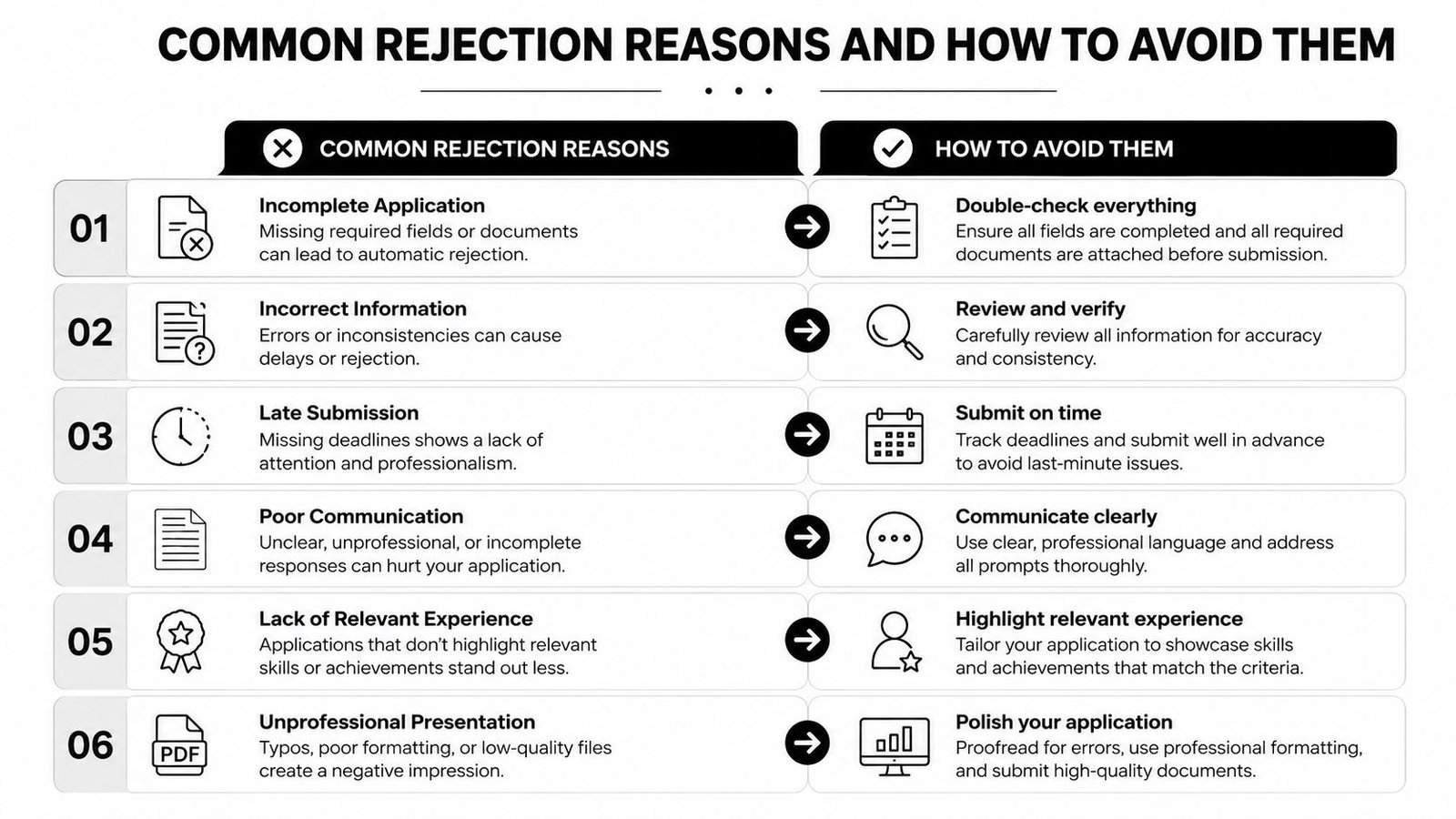
A bank file usually stalls because one part of the account story cannot be verified. The issue may involve ownership, business purpose, residential address, or the movement of funds. In practice, hidden compliance gaps often matter more than missing items on a standard checklist.
Unclear source of funds is a frequent blocker. State whether the money comes from operating revenue, personal savings, an investment round, an asset sale, or another lawful source. Then provide records that connect the funds to that origin, such as bank statements, contracts, invoices, or investment documents. Those records should support the story you tell in the application.
Inconsistent ownership documents create another blockage. Compare the trade licence, Memorandum of Association, UBO register, ownership chart, board resolution, and application answers before submission. Names, spellings, ownership interests, and signing authority should match across the file. A small inconsistency can trigger further questions about who controls the company.
Weak address evidence can also delay review. A company document does not prove where an individual shareholder lives. Keep personal address evidence separate from registered office records, and check that each document is current and belongs to the person or entity named in the application.
Insufficient business activity evidence affects new companies with limited trading history. Give the reviewer a clear profile of the business, including customer or supplier contracts, a website, invoices, projected transaction activity, and relevant prior experience. The aim is to show what the company does, who it deals with, and why the expected payments make sense.
What should you check before submission?
Use this focused review:
- Identity: Confirm every passport and Emirates ID copy is clear, valid, and matched to the correct person.
- Ownership: Reconcile the UBO register with the ownership chart and constitutional documents.
- Funds: Show how the initial deposit and expected account activity will be funded.
- Address: Check that each residential or registered address document identifies the correct person or entity.
- Activity: Explain the products, customers, suppliers, territories, and expected payment flows in plain language.
- Access: Confirm the UAE mobile number, email address, and availability for digital identity checks.
For non-resident applicants, the file may include six months of bank statements, a CV, proof of foreign address, and a bank reference letter, as described in the earlier Gulf News banking guidance. Those records should support the story you tell in the application.
A clear explanation beats a large pile of unrelated documents. Give the reviewer evidence that answers the question being asked.
Your Action Plan and Next Steps
What should you do first?
Start with the pathway, then assemble the evidence in the same order the bank will review it:
- Confirm whether you're applying as a UAE resident, non-resident, or company.
- Gather current identity, address, salary, licence, and constitutional documents.
- Build the UBO register and ownership chart before submitting a corporate application.
- Prepare source-of-funds and source-of-wealth evidence that matches the expected account activity.
- Arrange an active UAE mobile number and access to digital verification.
- Submit one consistent file and respond promptly to follow-up questions.
Straightforward cases may take a few hours to a few days, while complex corporate files can take longer. If a conventional bank isn't suitable, ask whether a licensed fintech provider or multi-currency account fits your lawful business needs, but don't treat an alternative provider as a way around customer due diligence.
Keep a downloadable checklist with document names, issue dates, certifying requirements, and submission status. That simple record prevents expired documents and conflicting versions from entering the file.
Inpro Corporate Services L.L.C. helps founders prepare corporate banking files, organise ownership and compliance documents, and coordinate bank account-opening support alongside UAE company formation and PRO services. Visit Inpro Corporate Services L.L.C. to discuss your structure, documents, and next steps before you submit.