

Most advice on how to register business in Dubai starts with forms and fees. That's backwards. The first move is choosing the right jurisdiction, licence activity, and tax position so you don't build a cheap setup that blocks how you intend to trade in Dubai and the wider UAE.
Table of Contents
- The First Decision Mainland, Free Zone, or Offshore
- Choosing Your Licence and Finalizing Your Name
- The Core Paperwork MOA, Approvals, and Documents
- Understanding Timelines and Typical Costs
- Post-Licence Essentials Visas, Banking, and Tax
- Common Pitfalls and Your Go-Forward Plan
The First Decision Mainland, Free Zone, or Offshore
If you want to understand how to register business in Dubai properly, start with jurisdiction. This choice decides who you can invoice, where you can work, what office solution you'll need, and how your tax position may be treated in the United Arab Emirates.
Why does jurisdiction matter more than paperwork
A founder usually asks about cost first. That's understandable, but it's rarely the right filter. A lower-cost setup can become expensive fast if it stops you from selling where your customers are, hiring the people you need, or keeping the tax treatment you assumed you were getting.
The practical test is simple. Ask where revenue will come from, where the team will sit, and whether you need direct access to the local UAE market. Once those answers are clear, the paperwork becomes easier because the structure starts to fit the business instead of the other way around.
Practical rule: Choose the company around the revenue model, not around the cheapest first-year package.
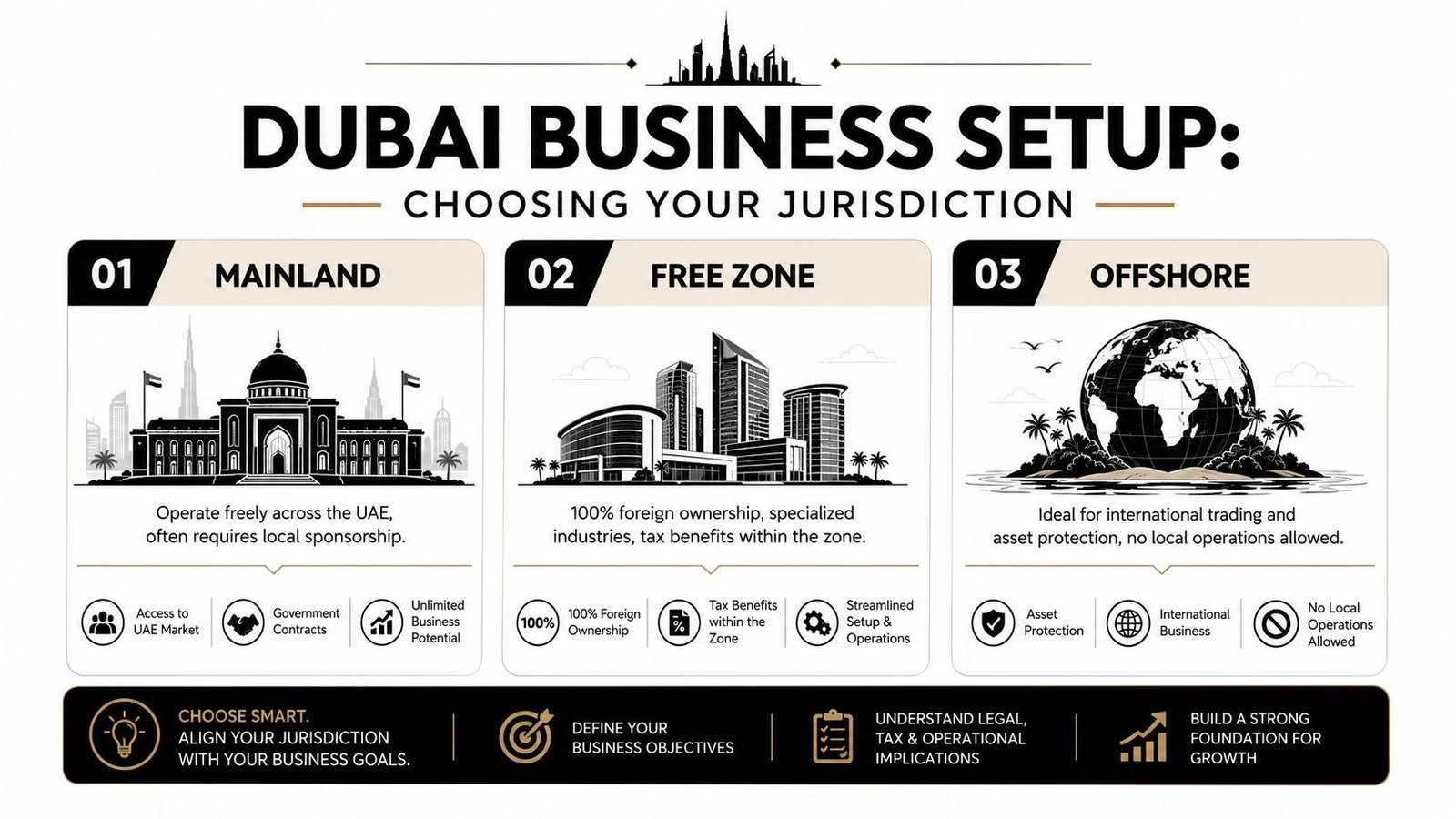
What is a Mainland company
A Mainland company is a business licensed to operate in the local UAE market under the relevant government authority in Dubai. In day-to-day terms, it's the option founders choose when they want the widest operating freedom inside Dubai, Abu Dhabi, Sharjah, and the rest of the United Arab Emirates.
Mainland often suits consultancies serving local clients, retail concepts, construction-related businesses, and firms that expect regular dealings across the UAE market. It also tends to involve more operational substance, especially around office requirements and in-person compliance.
One legal point matters more than many founders realise. A free zone company generally can't trade in mainland Dubai without an additional licence from the Department of Economy and Tourism or the Department of Economic Development, depending on how the authority is referenced in practice. Law No. 13 of 2011 gives that licensing authority to the mainland regulator, as explained in Al Tamimi's note on mainland trading through a free zone entity.
What is a Free Zone company
A Free Zone company is a business registered inside a designated economic zone with its own authority and rules. Founders usually choose this route for 100% foreign ownership, easier entry, and sector-focused ecosystems.
Free zones work well for many service businesses, holding structures, digital businesses, trading firms with regional or international clients, and founders who don't need unrestricted direct trade into the local Dubai mainland market from day one. In many cases, the office requirement is also lighter than Mainland because flexi-desk solutions are common.
The legal form also matters at the naming stage. In a UAE free zone, the company may be structured as a Private Limited Liability Company, Free Zone Company (FZ Co.), or Free Zone Establishment (FZE), and the trade name must include that legal form for approval, as set out on the official UAE government guidance for starting a business in a free zone.
What is an Offshore company
An Offshore company is a structure generally used for international holding, asset protection, and cross-border business outside the UAE local market. It isn't the right tool if you plan to trade onshore in Dubai, open a customer-facing office there, or build a local operating business.
Founders sometimes make a category mistake. Offshore looks lean on paper, but it's designed for a different purpose. If your real goal is relocation, visas, staff, local clients, or office operations, Offshore is usually the wrong starting point.
How should you think about tax before you register
The old shortcut of saying “Dubai is 0% tax” no longer helps anyone. It creates false confidence at exactly the point where founders need accuracy.
Many guides oversimplify tax as “0% income tax” without dealing with the post-2023 corporate tax rules. Free zone entities that earn non-qualifying income, including some transactions involving mainland UAE, may face 9% corporate tax, while the 0% rate applies only to profits under AED 375,000 or to qualifying free zone activities, according to the UAE Ministry of Finance guidance on establishing companies. The same source states that in 2024, over 6,200 free zone companies had already restructured to comply.
That point changes how you should choose your jurisdiction. If you expect to bill mainland clients directly, your structure and licensed activity need extra care from day one. The cheapest free zone package can stop looking cheap if you later discover your revenue model doesn't fit the tax or market-access rules you assumed.
A good jurisdiction choice usually follows this logic:
- Choose Mainland if your business needs broad local market access in Dubai and across the UAE.
- Choose Free Zone if you want foreign ownership, lighter entry conditions, and your activity can be kept inside the free zone or structured properly for compliant cross-border work.
- Choose Offshore if the company is for international holding or external trading and not for local UAE operations.
Choosing Your Licence and Finalizing Your Name
In the UAE, your business isn't defined only by your brand. It's defined by the licensed activity on the trade licence. That activity affects approvals, legal form, office rules, and sometimes your tax treatment.

Why does your business activity matter so much
A business activity is the official description of what your company is allowed to do. In practice, this matters more than the marketing label you use on your website.
Founders often pick an activity that sounds close enough, then discover later that the licence doesn't cover the contract they want to sign, the regulated approval they need, or the tax position they expected. Changing activities later is possible, but it's slower and messier than getting it right at formation.
If your revenue model is mixed, pick activities that match how money will actually enter the company, not how you describe the business in a pitch deck.
What licence categories do founders usually consider
A Commercial licence is generally for trading and buying or selling goods. A Professional licence is generally for services, consulting, and expertise-based work. An Industrial licence is generally for manufacturing or production activity.
Those labels sound simple, but the approved activity list beneath them is what matters in real filings. A consultancy that also wants to trade software, hardware, or physical products should check whether one licence and one authority can cover that combination cleanly.
One practical issue in free zones is document preparation. For initial approval of a free zone licence in the UAE, applicants must submit a business plan, coloured passport copies of all shareholders and the appointed manager, and a notarised Registry Identification Code form for the manager, according to the Ministry of Economy and Tourism guidance on establishing a business in free zones. Generic checklists often leave out that manager form, which is why some applications stall before founders even reach final review.
How do you choose a trade name that won't get rejected
A trade name is the legal business name reserved during setup. Approval depends on naming rules, similarity checks, and the legal form attached to the entity.
The safest approach is to shortlist names that are simple, descriptive enough to fit the activity, and clean from restricted wording. If you're registering in a free zone, make sure the legal suffix is built into the final name format because the authority may require it exactly that way.
Use this screening list before you file:
- Match the activity: A consulting name for a trading licence creates questions fast.
- Keep the format legal: If the chosen structure is FZE or LLC, the name should reflect that where required.
- Avoid risky wording: Religious references and other prohibited terms can trigger rejection.
- Prepare backups: Name reservations can fail for similarity reasons even when the name looks original to you.
A founder with a clear activity list and three compliant name options usually moves faster than a founder who spends weeks refining branding before confirming what the licence can legally support.
The Core Paperwork MOA, Approvals, and Documents
This is the part founders usually imagine when they think about company formation. It matters, but by now the hard strategic decisions should already be made.
What is the MOA and why does it matter
A Memorandum of Association (MOA) is the legal document that sets out the company's ownership and governing terms. In Mainland setups, it's one of the documents that has to be right both in substance and in timing.
I've seen founders treat the MOA like a standard formality, then lose time because a shareholder detail, activity description, or signing sequence wasn't aligned with the application file. When that happens, the trade name, approval sequence, and notary timeline start affecting each other.
What does initial approval actually mean
Initial approval is the authority's preliminary consent for the proposed company setup. It doesn't mean the company is finished. It means the authority is prepared to let you proceed, subject to the rest of the legal and documentary steps being completed correctly.
For Mainland Dubai, this phase often becomes the first real stress test. Shareholder identity documents, trade name compliance, office documentation, and the MOA all need to line up. If one piece is weak, the whole file slows down.
Where do applications usually get stuck
A common Mainland scenario looks like this. The founder secures initial approval, assumes the hard part is over, then delays notarisation or realises one shareholder's documents don't match the filing standard. At that point, the file doesn't just wait. It starts falling out of sequence.
In Dubai's Mainland jurisdiction, the MOA must be notarised within 15 days of initial approval, and failure contributes to a 32% delay rate in LLC registrations due to incomplete shareholder documentation or rejected trade names. The same process also requires all shareholders to physically visit the Dubai Department of Economic Development for know-your-customer verification, according to this step-by-step jurisdiction guide from MAS.
That in-person point matters for international founders. A remote founder may prefer a free zone route because some authorities are more flexible on shareholder presence. But if the business model really needs Mainland access, avoiding the trip can become a false economy.
Bring the final passport copies, shareholder details, and name approval into one checked bundle before booking travel. Most delays come from mismatch, not from complexity.
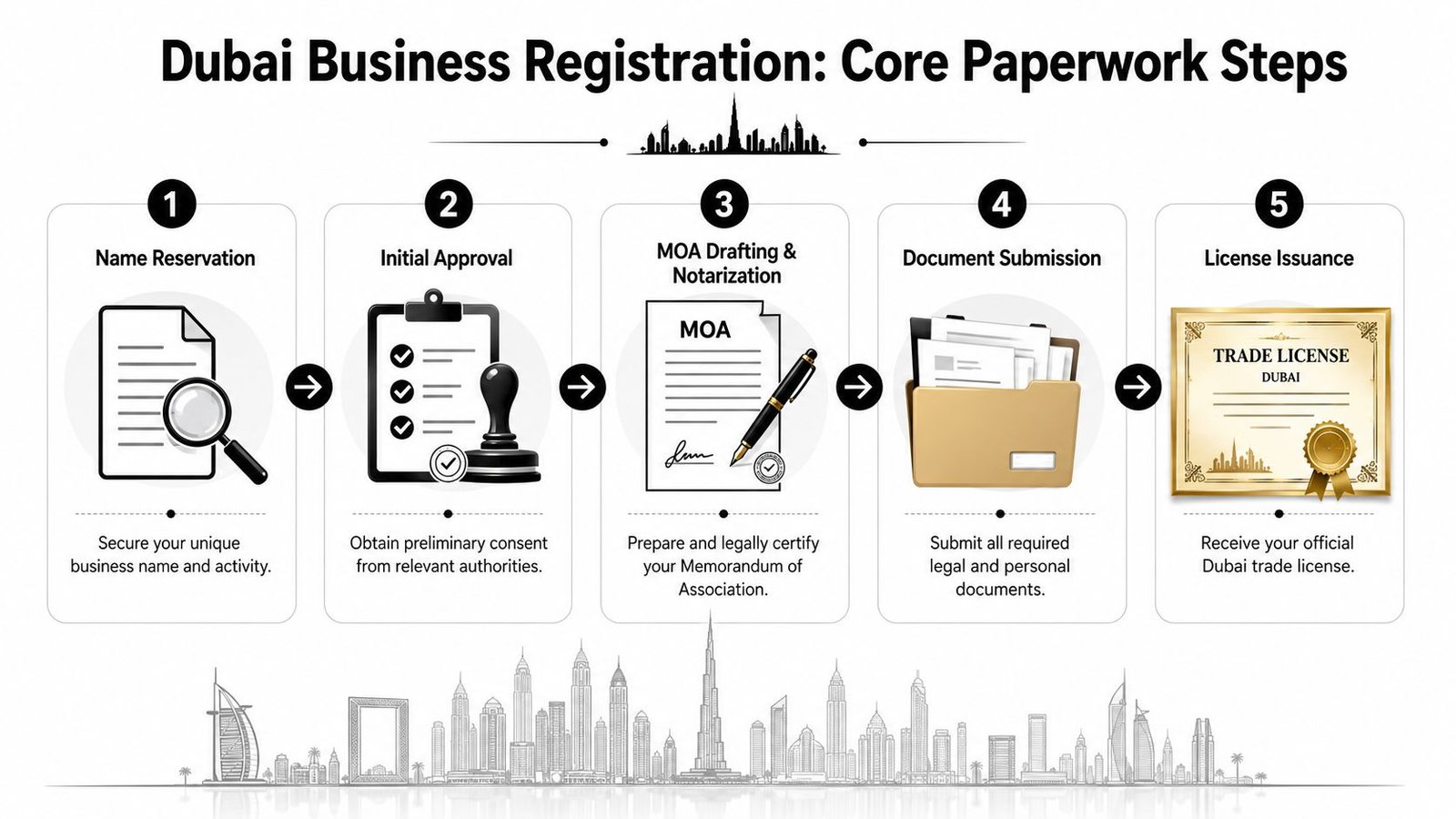
A cleaner paperwork flow usually looks like this:
- Reserve the name and confirm the activity
- Obtain initial approval
- Draft and notarise the MOA on time
- Submit the full legal file
- Receive the licence
The pattern is simple. Precision beats speed at this stage. Fast filings with incomplete details often end up slower than careful ones.
Understanding Timelines and Typical Costs
Fast setup in Dubai is usually decided before the application starts. Key factors are the same strategic choices that shape tax treatment and operating flexibility later: jurisdiction, business activity, visa needs, and whether the structure will match how the company earns revenue after Corporate Tax came into force.
How much does it usually cost to register a business in Dubai
The clearest way to budget is still by jurisdiction, but founders should read those ranges as entry points, not finished budgets. Mainland registration is estimated at AED 15,000 to AED 30,000, Free Zone at AED 12,000 to AED 20,000, and Offshore at AED 5,000 to AED 12,000, based on this Dubai company registration cost guide from Kayrouz & Associates.
That spread reflects three different commercial models.
| Jurisdiction | Estimated Initial Cost (AED) | What usually drives the cost |
|---|---|---|
| Mainland | AED 15,000 to AED 30,000 | Licence fees, office requirements, approvals tied to the activity, and a structure built for trading into the UAE market |
| Free Zone | AED 12,000 to AED 20,000 | Zone package, visa quota, facility type, and whether the business needs only regional headquarters functions or real UAE trading access |
| Offshore | AED 5,000 to AED 12,000 | Registration for holding or international business use, without the operating features most founders need for an active UAE business |
A cheap licence can become an expensive decision if it creates a tax or operational mismatch. I regularly see founders choose a free zone package for the first-year saving, then spend more correcting the structure once they realise their clients, invoicing model, or staffing plan points them elsewhere.
How long does registration usually take
For a clean file, many Dubai company setups are completed within one to three weeks. That is the practical planning range for most founders.
Shorter timelines do happen. Some straightforward cases can be issued very quickly through digital channels if the activity is standard, the name is accepted without revision, and every shareholder document is already in order. Those are outlier cases, not a planning benchmark.
A better way to estimate timing is to break the file into decision risk and admin risk:
- Low decision risk, low admin risk: standard consulting, trading, or service activity with clear shareholder documents
- Low decision risk, higher admin risk: overseas shareholders, attestations, or extra signatory coordination
- Higher decision risk: regulated activities, unclear business model, or a jurisdiction choice that does not fit the actual revenue plan
The third category is where timelines slip. The authority is not usually the actual issue. The issue is that the founder is still making structural decisions during filing.
What costs catch founders by surprise
The first surprise is that licence cost and launch cost are different numbers.
Office commitments, establishment card and visa processing, document attestation, health insurance, and bank onboarding can all sit outside the headline formation quote. Under the post-2023 tax rules, there is another cost founders should budget for early: proper accounting and Corporate Tax readiness. A setup that qualifies for a free zone benefit on paper still needs the right income profile, compliance discipline, and supporting records. If those are weak, the tax position can change.
The second surprise is that lower upfront pricing can bring tighter operating limits. Offshore is the clearest example. It is cheaper, but it is usually unsuitable for founders who need UAE residency, local invoicing presence, or a practical route to day-to-day operations in Dubai.
Use two budgets from the start:
- Licence issuance budget
- Operational launch budget, including visas, office position, banking preparation, insurance, and tax compliance support
Those numbers are rarely the same, and treating them as one figure is where budget shock starts.
For founders comparing authorities and filing routes, Inpro Corporate Services L.L.C. handles company formation, PRO processing, visas, and banking support across Mainland, Free Zone, and Offshore structures in the UAE. That kind of support is useful when the harder question is not how to submit the form, but which structure makes commercial and tax sense before submission.
Post-Licence Essentials Visas, Banking, and Tax
The licence gives you a legal entity. It does not give you a working company on day one.
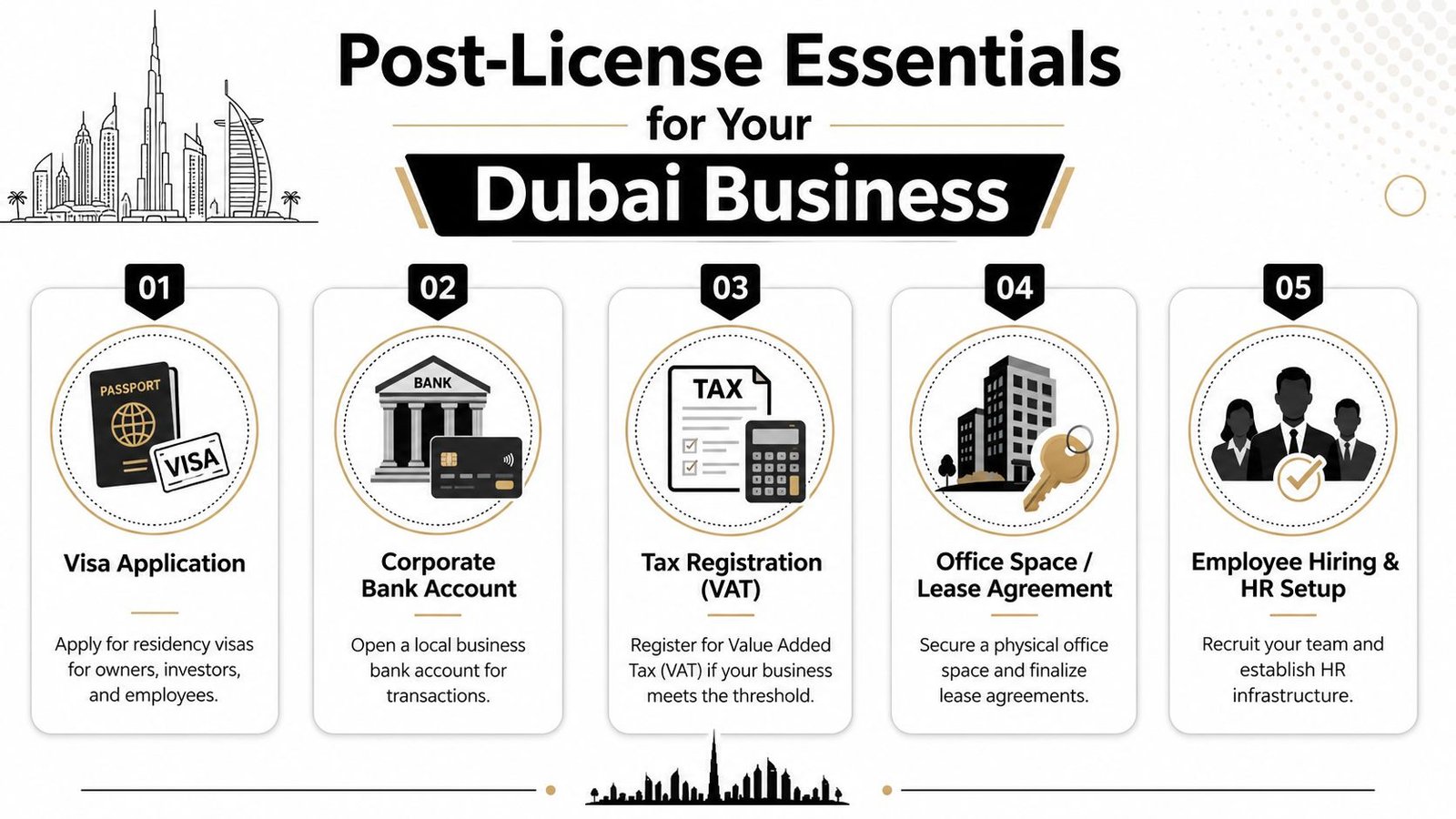
Post-licence work is where founders feel the effect of the choices made earlier. Jurisdiction, activity wording, office model, and shareholder profile all show up again in visa quotas, bank compliance questions, and tax treatment. If those decisions were made only to get the licence issued cheaply, the cleanup starts here.
What should you do right after the licence is issued
The order matters because each step depends on the file being complete before it.
Start with the company immigration file and establishment card. Then process the investor or partner visa if the owner needs UAE residency. After that, prepare the banking file with a clear explanation of the business, ownership, source of funds, expected clients, and transaction profile. Employee visas and HR setup usually make sense only once the company has an active bank account, office position where required, and a realistic hiring plan.
Founders often try to open the bank account first because it feels commercial. In practice, banks are more comfortable when the company already shows substance, residency status where relevant, and documents that line up cleanly.
Why is opening a bank account often slower than company formation
Company formation is an approvals process. Banking is a risk review.
A corporate bank account is the operating account for receiving customer payments, paying suppliers, running payroll, and handling daily business transactions. UAE banks review the licence, but they also review the people behind it and the commercial logic of the business. They want to understand what the company does, who it deals with, where funds will come from, and whether the expected transaction pattern fits the licensed activity.
The process swiftly exposes weak setup decisions. A licence for “general trading” with no product story, no supplier trail, no customer profile, and no clear reason for choosing that activity can sit in review for far longer than founders expect. The same happens when the website, business plan, and licence wording point in different directions.
A bank-ready file usually includes:
- Clear activity explanation that matches the licence
- Shareholder profile and source-of-funds support
- Basic commercial proof, such as draft contracts, supplier discussions, invoices, or a business plan
- Office or operating explanation that makes sense for the business model
- Residency and immigration documents where relevant
Banks do not reject companies because they are new. They reject files that are unclear.
When does VAT become mandatory
Value Added Tax (VAT) should be reviewed early, before invoicing starts. Once the business crosses the mandatory registration threshold for taxable supplies, registration is no longer optional. Waiting too long creates a messy fix, especially if invoices have already gone out without the right treatment.
The threshold was noted earlier in the article. The practical point here is broader. Founders should check VAT exposure based on the actual revenue model, not just the licence category. Consulting, trading, digital services, import activity, and cross-border work can create very different VAT positions even when two companies look similar on the formation documents.
How should founders think about Corporate Tax after 2023
This is the part many setup guides still treat too lightly.
Under the post-2023 Corporate Tax rules, the right question is not “Mainland or free zone for lower tax?” The better question is whether the company's actual income, clients, transactions, and compliance record will support the tax position it expects to claim. A free zone entity may still be attractive, but only if the business is structured and operated in a way that fits the relevant rules. If the company starts earning revenue outside that profile, the tax result can change.
That is why bookkeeping, invoicing discipline, related-party records, and contract quality matter from the first quarter. Founders who wait until year-end often discover that the commercial reality of the business does not match the formation logic they started with.
Get the licence. Then get the operating file, the bank file, and the tax file aligned before revenue starts coming in.
Common Pitfalls and Your Go-Forward Plan
Most registration problems in Dubai aren't caused by hidden bureaucracy. They come from a poor early decision that keeps causing trouble later.
Which mistakes cause the most trouble
The first mistake is choosing a free zone because it looks simpler, then discovering the business needs regular access to the mainland UAE market. The second is selecting activities that are too narrow, too vague, or misaligned with the intended revenue model. The third is assuming “0% tax” applies automatically without checking how the business will earn income after launch.
Another recurring issue is weak document discipline. Names, passport copies, shareholder details, and legal forms need to match exactly. Small inconsistencies create larger delays because each approval stage depends on the one before it.
Here's the short list I'd use before any founder files:
- Check market access first: If your customers are in local Dubai or wider UAE mainland, test that against the jurisdiction before you look at package pricing.
- Match the activity to the revenue: Licence wording should reflect what the business will invoice for.
- Treat tax as a design issue: Don't bolt it on after formation.
- Respect documentary timing: Missing a legal window can throw the whole file off schedule.
- Budget beyond the licence: Banking, visas, office commitments, and compliance all sit outside the simple headline quote.
What does a sensible setup plan look like
A sensible plan is narrow at the start. Pick the operating model, confirm the authority that fits it, choose the exact activity, reserve a compliant name, then move into approvals and post-licence execution in order.
That sounds basic, but it's the difference between a company that can trade smoothly and one that keeps needing amendments. In Dubai, speed comes from good sequencing. It doesn't come from rushing past the decision points.
Choose the structure for the business you intend to run in twelve months, not the one that feels easiest this week.
Not sure where to start? Inpro Corporate Services L.L.C. can help you compare Mainland, Free Zone, and Offshore options, map the licence and tax implications, and build a practical setup plan for your business in Dubai and the wider UAE.