


If you've just hired your first person in Dubai, the paperwork can feel bigger than the business. HR services in Dubai are the systems that keep contracts, visas, payroll, leave, and employee records aligned with UAE rules, so you can keep operating without last-minute fixes.
Table of Contents
- What HR Services in Dubai Actually Cover
- UAE Labour Law and Immigration Basics Every Employer Must Know
- In-House vs Outsourced HR vs Employer of Record
- How Much HR Services in Dubai Really Cost
- A Practical Onboarding Checklist for UAE Employees
- Common Mistakes When Buying HR Services in Dubai
- How Integrated PRO and Corporate Services Simplify HR in the UAE
What HR Services in Dubai Actually Cover
A founder hires one engineer in Dubai and suddenly needs a contract, visa support, payroll setup, leave tracking, and a clean employee file. That bundle is what HR services in Dubai cover in practice, not just the recruitment side that many providers advertise.
What sits inside the minimum HR stack
At a basic level, HR is the work that keeps the employment relationship documented and compliant. That includes employment contracts, employee records, payroll administration, leave tracking, offboarding calculations, and the internal policies that explain how those items are handled. In the UAE, this is not optional admin, because labour and immigration obligations are tied together from the first hire.
Practical rule: if a provider only talks about hiring candidates, but not contracts, payroll, and record control, they are not covering the full HR picture.
The market data explains why this matters. The UAE HR outsourcing market was valued at USD 421.2 million in 2023 and is projected to reach USD 800.2 million by 2032, according to The Report Cubes. That growth reflects real demand for back-office HR support across the UAE and the United Arab Emirates, not just a passing trend.
What good HR support looks like on the ground
Good HR support in Dubai centralises employee data, sets reminders for expiring documents, and keeps payroll and attendance tied together. It also makes sure contracts, leave balances, visa dates, and end-of-service tracking are easy to audit, which matters when founders are juggling more than one jurisdiction or free zone.
A lot of small companies don't need a full internal HR department. They need a reliable operating layer that can keep the files straight, answer employee questions, and keep the company out of trouble when paperwork changes.
That is why the useful question is not, “Do I need HR?” The question is, what minimum HR stack keeps the company compliant without overbuying services you won't use.
UAE Labour Law and Immigration Basics Every Employer Must Know
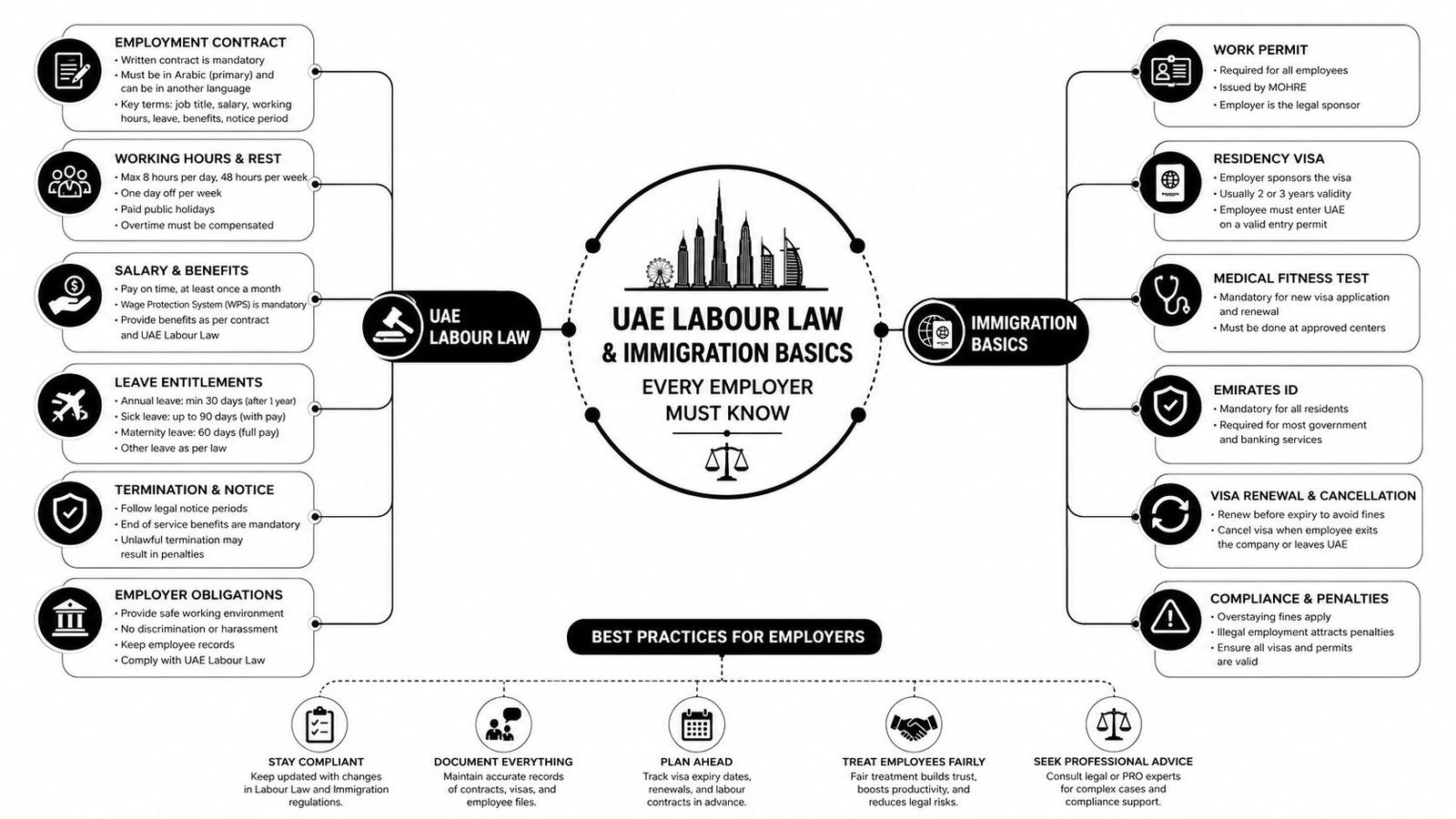
In Dubai, HR and immigration are joined at the hip. If the contract is wrong, the payroll file is sloppy, or the visa paperwork is late, the problem usually lands on the employer, not on the provider.
What the employment contract must contain
Under Federal Decree-Law No. 33 of 2021, private sector employment contracts in the UAE must be fixed-term and registered with MOHRE, which is the Ministry of Human Resources and Emiratisation. The contract must be in writing, state the start date, job role, wage, duration, and place of work, and it must be in Arabic and a language the employee understands, with Arabic prevailing in disputes, according to VJM Global.
That sounds technical, but the practical point is simple. If the contract template is old, incomplete, or only prepared in one language, the employer is carrying avoidable risk from day one.
Why PRO services sit inside HR, not beside it
In the UAE, PRO services are the government-relations tasks that deal with visas, Emirates IDs, labour cards, and other official filings. PRO stands for Public Relations Officer, although in practice it means the person or team that handles document flow with government channels.
For most employers, HR and PRO work should be coordinated. A visa cannot be treated as a separate afterthought if the employee file, payroll record, and contract dates all need to line up.
When the HR file and the immigration file live in different places, delays multiply. One team waits for a document the other team assumed was already approved.
The same logic applies across Dubai, Abu Dhabi, Sharjah, and free zones. Different jurisdictions may have different operational steps, but the employer still needs one joined-up record of who is employed, under what terms, and on what immigration basis.
What compliance really means for founders
Compliance in this context means being able to show clean records, correct dates, and proper registrations. It is not enough to have a signed PDF sitting in an inbox.
A sensible HR process in the UAE keeps the employment contract, visa status, payroll support, leave records, and offboarding evidence in one controlled workflow. That is the standard most founders need, especially when they are still small and every error costs time.
In-House vs Outsourced HR vs Employer of Record
The right model depends on headcount, jurisdiction, and how much internal control you want to keep. Many early-stage companies in Dubai assume they need a full HR team, but that often means paying for capacity they won't use yet.
| Model | Typical Cost | Control | Compliance Burden | Best For |
|---|---|---|---|---|
| In-house HR | Higher fixed payroll cost | Highest | Internal team carries most of it | Larger teams that need daily people operations |
| Outsourced HR | Service fee varies by scope | Moderate | Shared with provider | SMEs that need payroll, compliance, and admin support |
| Employer of Record | Service-based, tied to employment arrangement | Lower direct control | Provider carries much of the administration | Companies hiring without building a local entity |
When in-house makes sense
In-house HR works when the company has enough people activity to justify a dedicated specialist or team. That usually means more hiring volume, more employee issues, and more internal process design than a small startup has on day one.
The upside is control. The downside is that the company must hire, manage, and retain the HR capability itself, which is expensive if the workload is still uneven.
When outsourcing is the better fit
Outsourced HR is often the cleaner choice for founders who need payroll, contract handling, file control, and compliance support without building a full department. That is where modular HR support is usually smarter than a broad retainership.
Best-fit test: if your main pain is contracts, payroll, and compliance files, not constant recruitment, you probably need targeted HR operations rather than a large outsourced bundle.
Many smaller firms overbuy. They pay for recruitment-heavy or full-service packages when what they really need is a focused stack around payroll, policy, and labour-file management.
When Employer of Record is used
An Employer of Record is a provider that legally employs staff on behalf of another business. It can help when a company is testing the market, expanding carefully, or hiring before its own setup is complete.
It is not always the cheapest route, and it does not replace the need to understand your own obligations. It is a structural choice, not a shortcut around HR discipline.
How Much HR Services in Dubai Really Cost
Pricing in Dubai depends less on headcount alone and more on the complexity of the work. Two companies with the same team size can pay very different amounts if one needs frequent visa coordination, WPS payroll, and more employee-relations support.
What drives the price up
The biggest cost drivers are payroll complexity, WPS-compliant processing, visa and PRO coordination, and the amount of employee support the company needs. WPS is the Wage Protection System, the UAE payroll filing framework that ties salary processing to official compliance, so errors create more work than a simple bank transfer would.
For a 50-employee company in the UAE, HR outsourcing commonly sits in the AED 28,000 to 55,000 per month range when it includes payroll, compliance, hiring, employee relations, and senior advisory, according to Element MEA. That equals roughly AED 560 to 1,100 per employee per month and is reported as 40 to 55% cheaper than building an equivalent in-house team, based on the same source.
Those figures matter, but only if you compare like with like. A low headline fee that excludes payroll or immigration support can cost more later once separate vendors are brought in.
Why integrated support changes the bill
When HR, PRO, and company services are split across different suppliers, someone on your side ends up chasing documents, dates, and approvals. That creates hidden cost in time, not just invoices.
An integrated provider can reduce duplicate data requests and keep the employee file, payroll file, and immigration file aligned. For founders, that often matters more than shaving a small monthly fee off the invoice.
Simple test: ask who is responsible when a visa date, payroll date, or contract date doesn't match. If the answer is unclear, the true cost is already higher than the quote.
What a fair quote should explain
A good proposal should state what is included, what is excluded, and which tasks require extra filings or government charges. If a quote is vague about payroll, visas, or compliance handling, it usually means the missing work will show up later as variation charges or delays.
A Practical Onboarding Checklist for UAE Employees
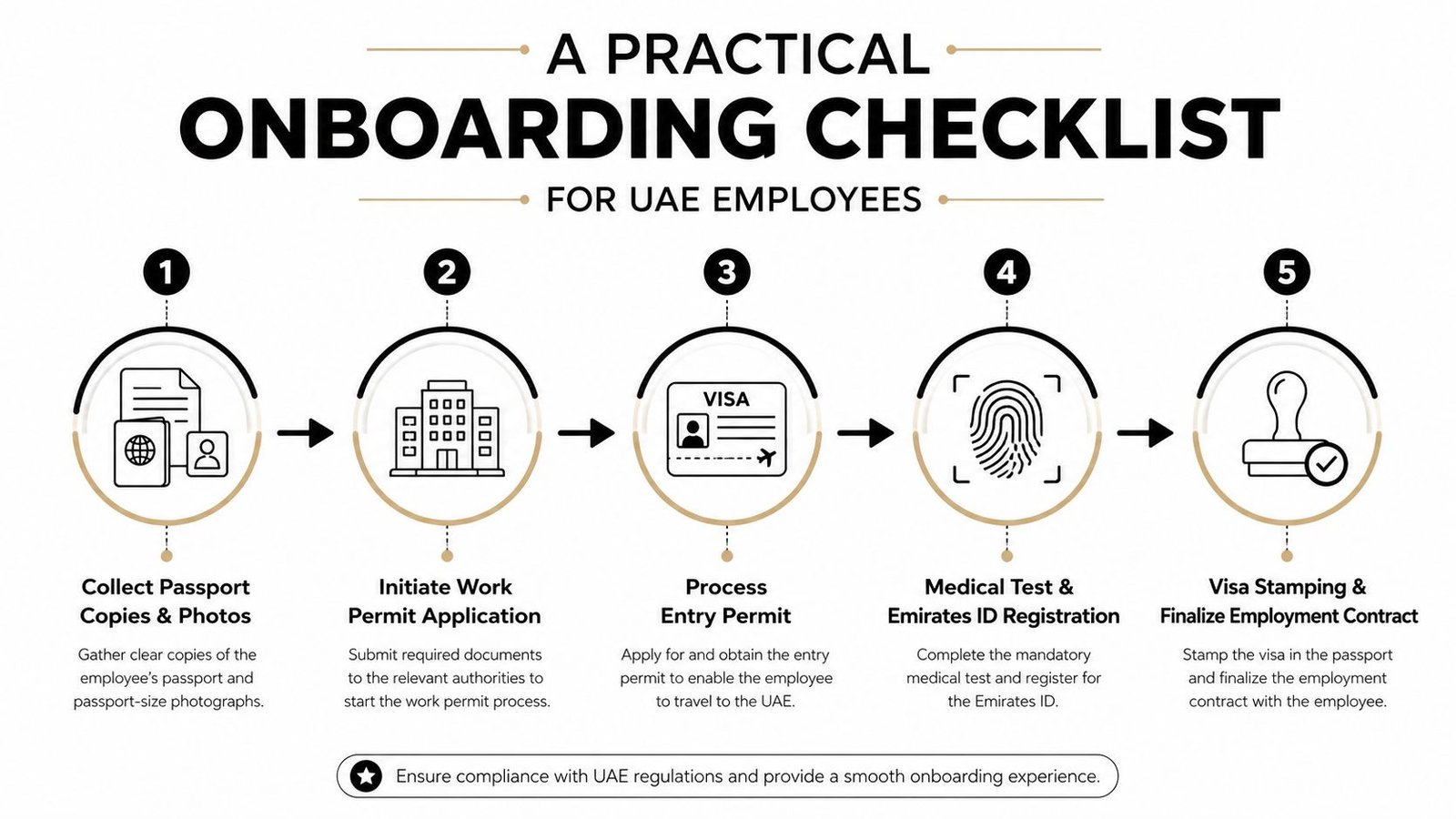
The cleanest onboarding flow starts before the employee enters the office. In Dubai and across the United Arab Emirates, the order matters because contracts, permits, and payroll setup are linked, and a skipped step can slow the whole file.
What to do before the start date
First, collect the employee's passport copy, photo, and any supporting identity documents. Then initiate the work permit and entry permit process through the correct channel for the company's jurisdiction.
At this stage, the contract should already be ready for registration with MOHRE if the role is under mainland employment rules. The employee should not begin work on an assumption that the paperwork can be fixed later.
What happens during the first weeks
Once the employee enters the UAE or completes the relevant local steps, the medical test and Emirates ID registration usually follow. After that, visa stamping and the final employment contract record should be completed in the correct sequence.
A practical onboarding checklist usually looks like this:
- Collect Passport Copies and Photos: build the file early so the government forms do not stall on missing identity documents.
- Initiate Work Permit Application: start the formal employment process before the first working day.
- Process Entry Permit: ensure the employee can legally enter or change status where required.
- Complete Medical Test and Emirates ID Registration: tie the immigration steps to the identity record.
- Finalise Visa Stamping and Contract Registration: close the loop so payroll, leave, and employment records match the legal file.
What to track after onboarding
Once the person is active, HR should maintain leave balances, payroll status, visa expiry dates, and offboarding notes in one place. That matters because UAE leave rules include 30 days of annual leave after one year of service, 90 days of sick leave per year on a sliding pay scale, 60 days of maternity leave with 45 days fully paid and 15 days half-paid, and 5 working days of paternity leave, according to Taysir Bridge.
If the company keeps these records separately, a simple employee query can turn into a paperwork scramble. The better process is boring, organised, and repeatable.
Common Mistakes When Buying HR Services in Dubai
The most common buyer mistake is assuming the broadest package is the safest one. In reality, many early-stage companies need a narrower setup focused on compliance, payroll, and employee records, not a full outsourced HR department.
Why full-service packages are often the wrong first buy
A provider may sell recruitment, embedded HR, payroll, and advisory together, but that does not mean your company needs all of it. For many SMEs, the better answer is a smaller support layer that handles the duties that trigger risk, while leaving recruitment and broader people strategy for later.
That view is reinforced by the market gap in Dubai. The visible content and provider messaging are still often broad and recruitment-heavy, while the need for smaller firms is modular HR support around labour-file management, payroll, and controls, as noted in the earlier section on market structure from Element MEA.
What to watch for in a vendor proposal
Look for process detail, not just service labels. A serious HR provider should be able to explain how they handle document storage, alerts for expiring visas and Emirates IDs, payroll timing, and who owns each step when a filing gets delayed.
- Missing workflow detail: if the proposal lists services but not sequence, approvals, or ownership, expect confusion later.
- No mention of audit readiness: if the provider does not talk about records, evidence, and file control, the compliance side may be weak.
- Recruitment first, administration second: if the pitch starts with candidate sourcing, but not the employee lifecycle, it may not fit your real need.
- No clarity on Emiratisation support: companies hiring in the UAE should ask how the provider tracks obligations and documentation, especially as operating rules keep shifting.
Why the best provider is not always the biggest one
Recent UAE guidance has put more weight on Emiratisation tracking, audit-ready documentation, payroll and WPS governance, and compensation design, especially for firms comparing providers in Dubai. That means the right vendor is often the one that can prove discipline, not the one with the longest service menu.
Short rule: choose the team that can show you its process, not just its brochure.
How Integrated PRO and Corporate Services Simplify HR in the UAE
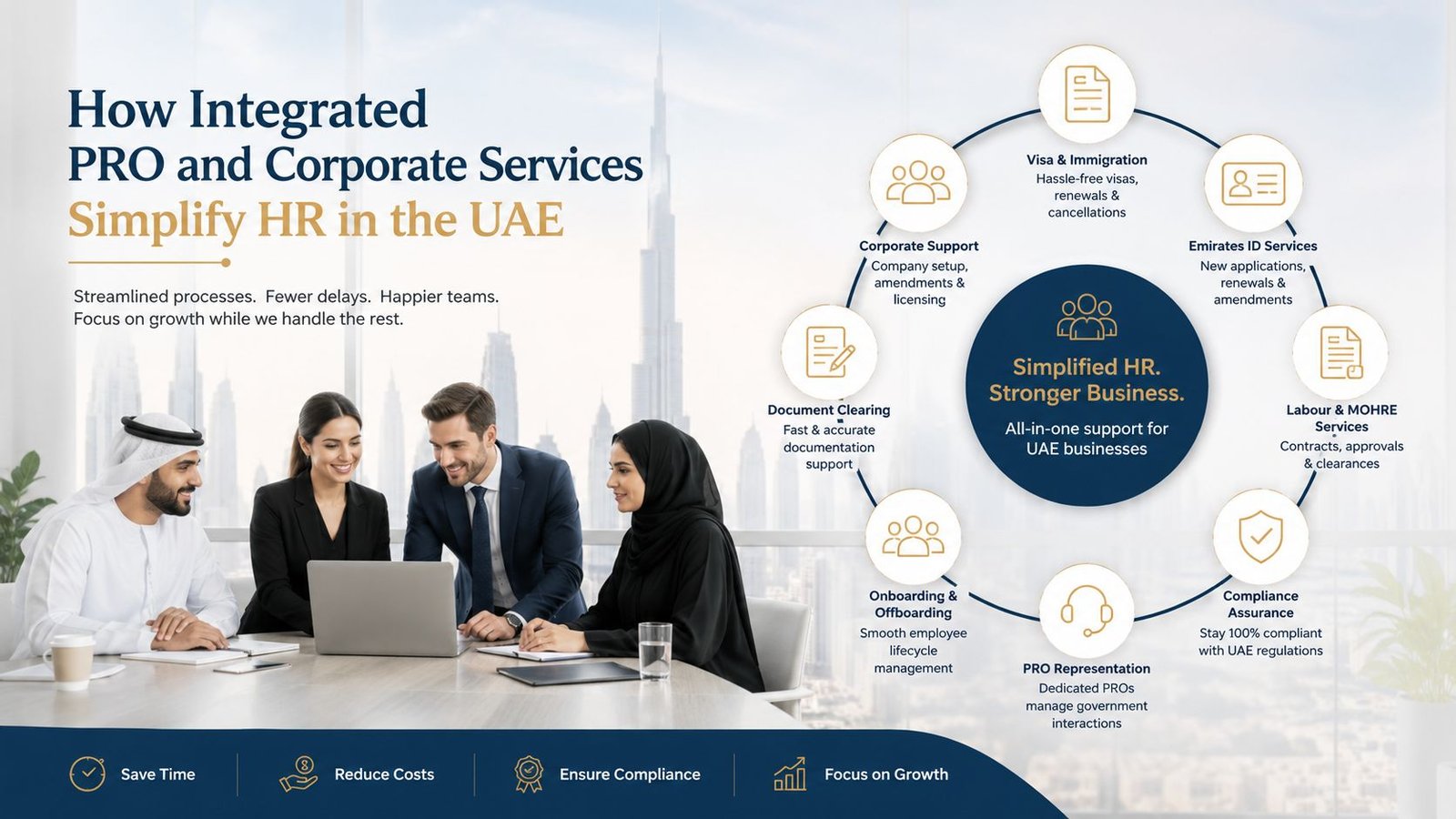
HR in the UAE works best when it is tied to PRO, visas, and company administration in one workflow. That reduces duplicate document requests, avoids mismatched dates, and gives founders a clearer record across labour and immigration obligations.
Why one team reduces friction
When one provider handles formation, licensing, immigration, and HR, the employee file stays connected to the company file. That matters for Dubai, Abu Dhabi, Sharjah, and free zone entities alike, because every change in status creates a chain of follow-up tasks.
Integrated support also makes it easier to keep an audit trail. If a founder ever needs to show what was filed, when it was filed, and who handled it, a single workflow is easier to verify than three disconnected inboxes.
What a good provider should be able to show
A practical provider should explain how they manage company setup, employee visas, document control, and ongoing compliance without sending the founder back and forth between teams. That is the difference between a smooth operating layer and a pile of fragmented admin.
Inpro Corporate Services L.L.C. fits that integrated model by combining company formation, PRO support, visa processing, and ongoing operational support around one coordinated process. For founders who want the minimum compliant HR stack without creating extra noise, that kind of alignment can save time and reduce avoidable errors.
If you want a clearer view of the HR, PRO, and visa steps your UAE setup needs, visit Inpro Corporate Services L.L.C. and book a strategy call with the team. They help founders and growing companies set up the right compliance stack for Dubai and the wider UAE, so you can move from paperwork to operations with less friction.