


The surprising part of LLC company formation in Dubai isn't how fast you can start. It's how easy it is to start the wrong way.
The UAE has made business setup far quicker than most founders expect. The government offers more than 2,000 economic activities, LLCs can have 1 to 50 shareholders, and eligible cases can be completed through Basher in 15 minutes, as noted in this overview of Dubai LLC formation and UAE setup channels. That sounds simple. In practice, speed only helps after you've made the right structural decisions.
Most problems in llc company formation in Dubai don't come from the final licence issue. They start earlier, when a founder picks the wrong jurisdiction, assumes old ownership rules still apply, or treats office space and legal drafting as admin tasks instead of strategic decisions. Dubai is still one of the most founder-friendly places to build, but it's no longer a one-size-fits-all market. The structure you choose affects where you can trade, how you bank, what substance you need, and how smoothly you can scale.
Table of Contents
- Rethinking Dubai LLC Formation in 2026
- The Critical Choice Mainland vs Free Zone LLC
- Your Dubai Mainland LLC Formation Blueprint
- The Essential Documentation and Cost Checklist
- Post-License Activation Visas Banking and PRO Services
- Launch Your Dubai Business with Confidence
Rethinking Dubai LLC Formation in 2026
Dubai setup advice used to be reduced to slogans. Tax-friendly. Fast. International. Those things still matter, but they don't help much when you're choosing between a mainland commercial licence and a free zone structure that may not match how you sell.
In 2026, the sharper question is this. What operating model are you building, and does your legal structure support it from day one? If your revenue depends on direct UAE market activity, local contracts, physical trading, regulated services, or building a local team with substance, the setup decision becomes commercial, not clerical.
The old shortcut no longer works
A lot of founders still approach Dubai setup as if there's one default answer. That was never fully true, and it's less true now. The UAE has become more accessible, but also more specialised. Faster incorporation doesn't remove the need for upfront judgement.
Founders now have to align several moving parts:
- Market access: Can the company invoice and operate where your customers are?
- Ownership fit: Does your chosen activity qualify for the ownership structure you want?
- Operational substance: Will you need a lease, staff presence, or external approvals early?
- Banking narrative: Will a bank understand the business model from the documents you present?
Practical rule: In Dubai, setup speed is rarely the bottleneck. Misalignment between business model, licence activity, and jurisdiction is.
Structure first, speed second
The best founders don't start with “How fast can I get a licence?” They start with “What must this company be able to do in the first year?” That question changes everything.
A consultancy serving overseas clients may prioritise ownership simplicity and flexible operating costs. A distributor targeting UAE buyers usually needs a structure built for mainland access. A founder planning to raise capital may care more about shareholder flexibility and clean legal drafting than launch-day speed alone.
That's why llc company formation in Dubai should be treated as a design exercise. The legal form is part of your operating model. If it fits, the rest of the process tends to move cleanly. If it doesn't, you spend time amending documents, adding approvals, shifting premises, or rebuilding your banking file after the fact.
The Critical Choice Mainland vs Free Zone LLC
The most expensive mistake at formation stage isn't overpaying a service provider. It's choosing a jurisdiction that forces workarounds later.
For most founders, the main choice is between a Dubai Mainland LLC and a Free Zone FZ-LLC. Both can work well. Neither is universally better. The right answer depends on where your customers are, how you'll contract, what activity you need licensed, and whether your company needs direct commercial reach inside the UAE.
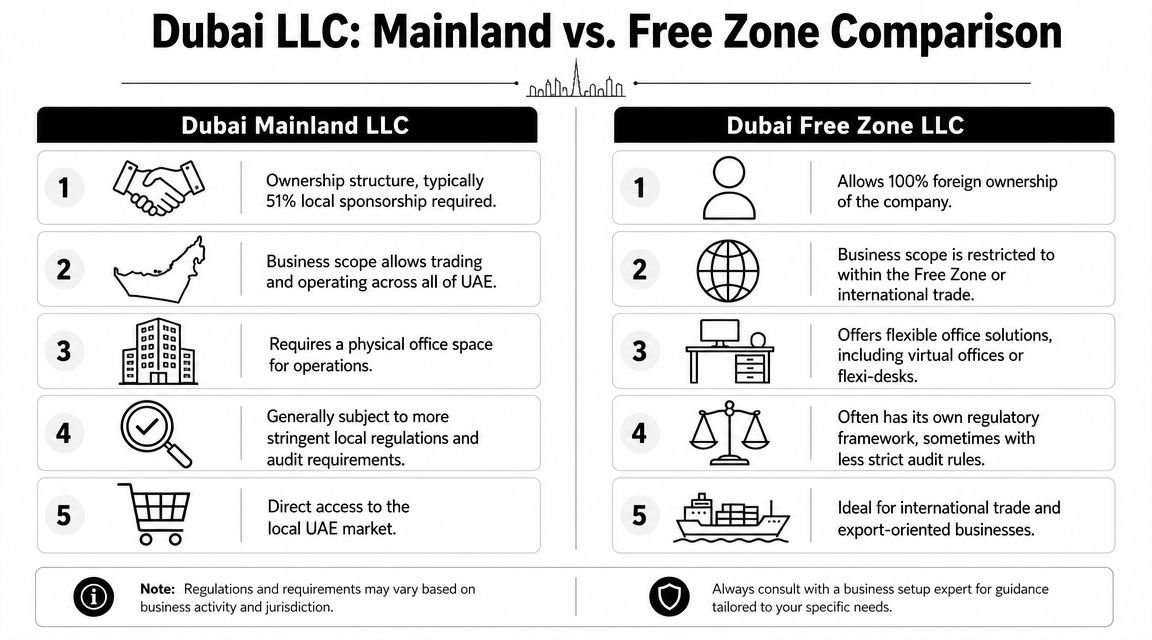
What actually changes when you choose jurisdiction
The old internet advice about mandatory local majority ownership still causes confusion. Current UAE guidance is more nuanced. 100% foreign ownership is now permitted for a wide range of mainland commercial and industrial activities, while strategic sectors may still have restrictions, as explained in this analysis of UAE LLC ownership rules and mainland versus free zone choice.
That matters because founders often make one of two wrong assumptions. They either assume mainland still always requires a local majority arrangement, or they assume every activity now qualifies for full foreign ownership. Neither assumption is safe.
Your jurisdiction choice affects four things immediately:
- Commercial reach: Mainland is usually the cleaner route if your business model depends on direct UAE market activity.
- Activity fit: Some activities sit comfortably in a free zone. Others become awkward if customers, regulators, or counterparties expect a mainland presence.
- Premises and substance: Mainland setups often demand earlier decisions around office location and tenancy.
- Compliance rhythm: Different jurisdictions come with different filing habits, approval paths, and practical expectations.
Mainland LLC vs Free Zone FZ-LLC at a glance
| Factor | Dubai Mainland LLC | Dubai Free Zone FZ-LLC |
|---|---|---|
| Ownership | Activity-dependent. Many activities now allow full foreign ownership, but some restricted areas still need closer review | Typically structured for foreign ownership convenience |
| UAE market access | Better suited for direct trading and operating in the local UAE market | Usually best for operating within the free zone or for international business models |
| Office expectations | Often tied more closely to physical office readiness and lease documentation | Usually offers more flexible workspace formats depending on the zone |
| Approvals | Can involve external approvals depending on activity | Approval flow depends on the free zone authority and activity category |
| Best fit | Local trading, services with onshore delivery, businesses needing broad UAE market access | International consulting, digital businesses, holding structures, export-oriented models |
Where founders usually misjudge the decision
A founder selling software to international clients may not need mainland complexity on day one. A founder planning a showroom, local distribution, or direct B2B sales into the UAE often does. The issue isn't preference. It's operating reality.
I've seen founders choose a free zone because it looked cheaper and cleaner, then discover their real sales model needed onshore flexibility. I've also seen businesses rush into mainland without confirming whether the target activity, office model, and approval path made sense for an early-stage company.
Choose the jurisdiction that matches your customer journey, not the one with the shortest sales brochure.
If you're still comparing, ask three blunt questions:
- Where will revenue be generated in practice?
- Does the activity need local market access or only international invoicing capability?
- Will your customers, landlord, bank, or regulator expect visible UAE substance from the start?
Those answers usually point to the right structure faster than any generic “best company type in Dubai” guide.
Your Dubai Mainland LLC Formation Blueprint
Mainland formation works best when you respect the sequence. Founders get into trouble when they treat the trade licence as the main event and everything before it as paperwork. On the mainland, the pre-licensing file is the primary engine of the application.
A key official requirement is that a RERA-attested lease in Dubai and a duly attested MOA must be in place before licence issuance, alongside the broader pre-licensing chain of activity selection, trade name reservation, initial approval, and any external clearances, as described in the UAE government guide to starting a business on the mainland.
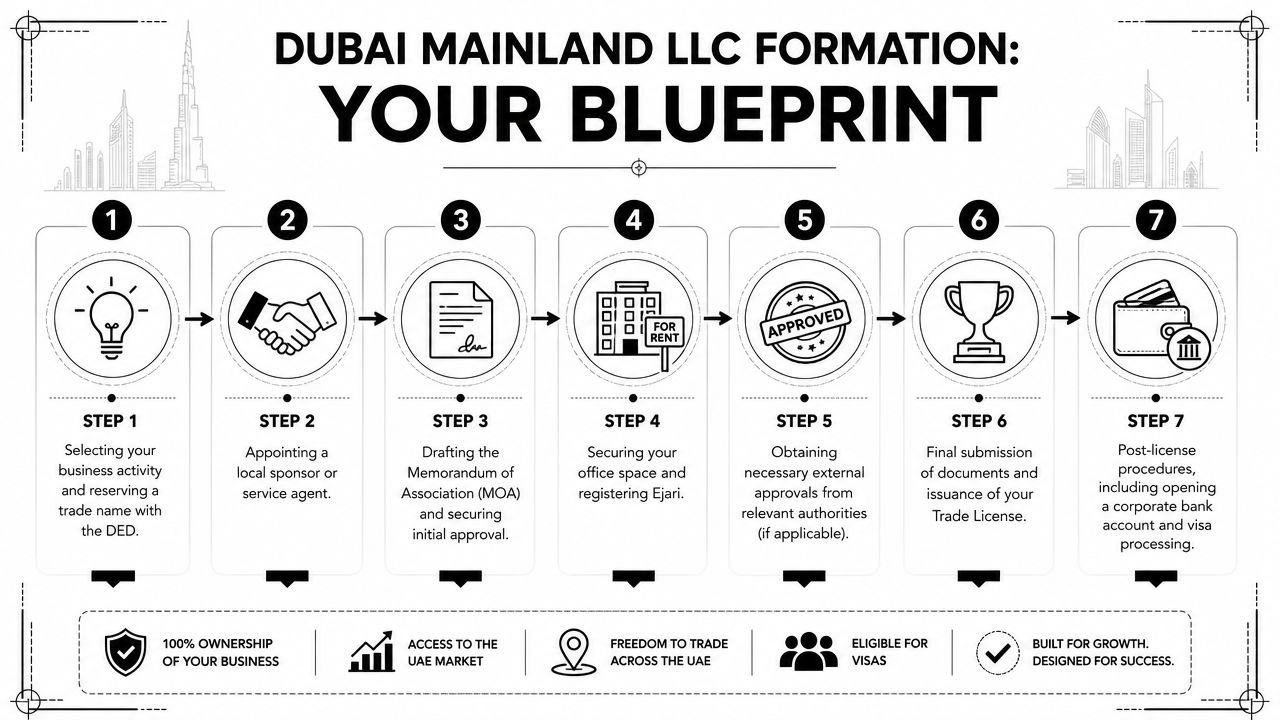
The real critical path
For a mainland LLC, the order usually looks like this:
- Choose the activity carefully. This drives licence type, ownership treatment, and possible external approvals.
- Reserve the trade name. Founders often underestimate how often names need revision for compliance reasons.
- Obtain initial approval. This confirms the authorities have no objection in principle to the setup.
- Draft and notarise the MOA. Shareholder rights, management authority, and core legal mechanics must be accurately defined here.
- Secure premises and register Ejari. On mainland, office readiness isn't a post-licence clean-up task.
- Collect external approvals if the activity requires them.
- Submit the final file for licence issuance.
The sequence matters because later stages depend on earlier ones being done properly. If the activity isn't correctly framed, the MOA may need revision. If the office isn't suitable, the lease file can stall the application.
A short visual overview helps clarify the workflow:
What delays most mainland applications
Founders usually expect friction at the licence counter. In reality, delays happen upstream.
Common issues include:
- Activity mismatch: The selected activity doesn't fully reflect what the company intends to do.
- Weak MOA drafting: The legal document is treated as a template instead of a control document.
- Late office search: The team starts looking for space after assuming approval is already secured.
- Missing approvals: A regulated activity is filed without the external consent it needs.
- Document inconsistency: Names, passport details, or shareholder data don't match across forms.
Field note: Ejari and the MOA aren't supporting documents. They are gating documents.
How to keep the process moving
The best mainland files are built backwards from the final approval standard. Before submitting anything, pressure-test the application against operational reality.
Use this filter:
- Can the chosen activity support the actual revenue model?
- Does the lease fit both licensing and practical operations?
- Does the MOA reflect how decisions will really be made between shareholders?
- Are regulated elements identified early, not after filing?
That's the difference between a mainland setup that issues cleanly and one that turns into a chain of amendments. In llc company formation in Dubai, mainland success usually comes from disciplined sequencing, not speed.
The Essential Documentation and Cost Checklist
Paperwork problems usually don't look dramatic. They look small. A missing visa page. An unsigned annexure. A document that needs attestation but arrives unprepared. Those small misses create real delays because UAE incorporation is document-led from the start.
For founders, the smart move is to separate two questions early. What must be prepared for the authority file, and what must be budgeted for the company to become usable? Those aren't the same thing.
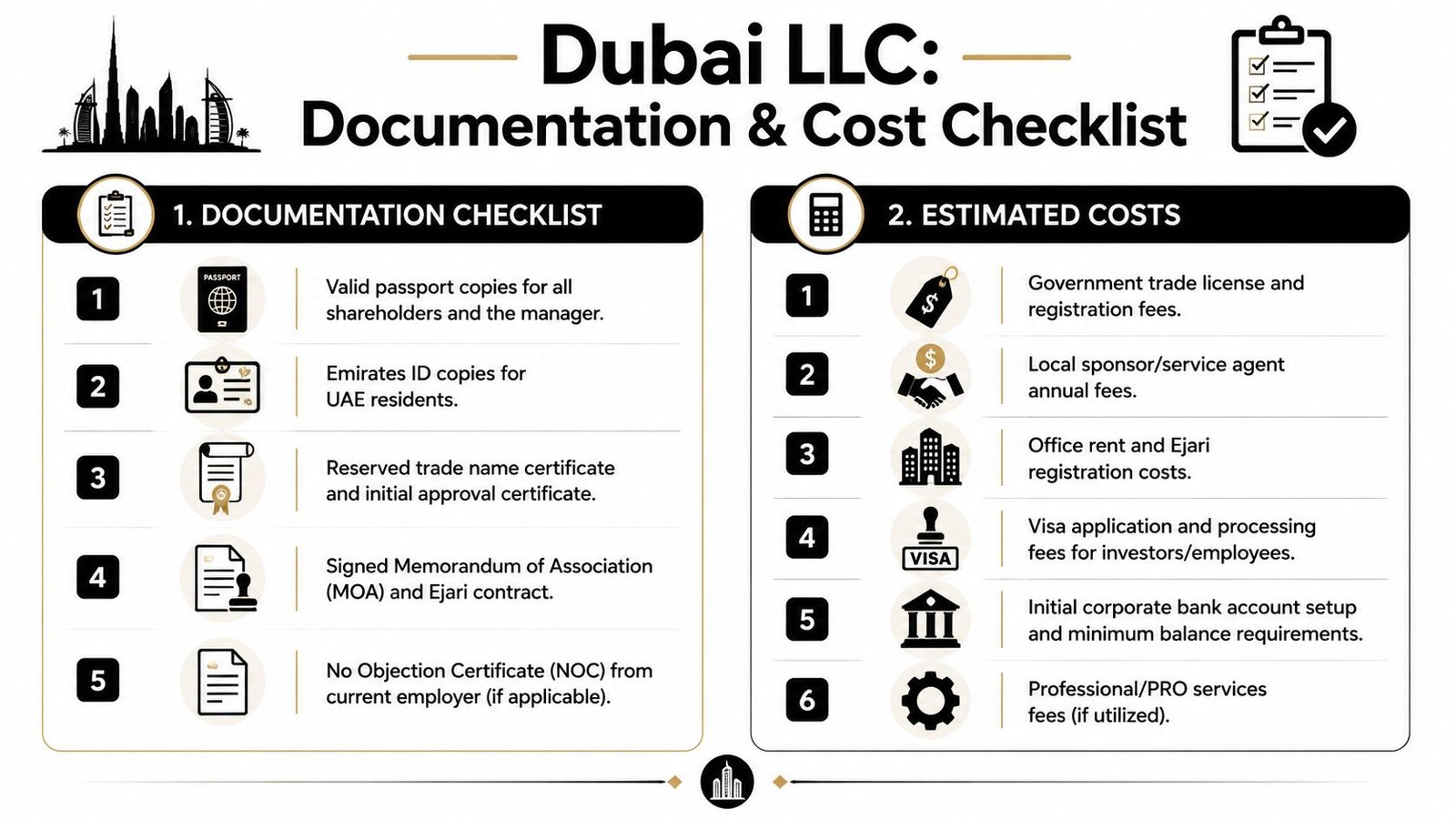
Documents to prepare before you apply
The exact file depends on activity, shareholder type, and jurisdiction. Still, most founders should expect to prepare a working pack that includes the following:
- Passport documents: Valid passport copies for shareholders and the appointed manager.
- Residency documents: Emirates ID copies for UAE residents, plus visa or entry documentation where relevant.
- Core approval papers: Trade name reservation and initial approval records where the process requires them.
- Constitutional documents: The signed MOA and tenancy evidence such as Ejari for mainland setups.
- Conditional support papers: A No Objection Certificate if someone is already sponsored in the UAE and the case requires it.
- Corporate shareholder papers: If a company is becoming a shareholder, expect the incorporation chain, board resolution, and supporting legalisations to be reviewed carefully.
The practical point isn't just collecting documents. It's making sure names, signatures, and capacities are consistent across the file. That's where many avoidable rejections start.
How to think about costs without guessing
A serious budget for llc company formation in Dubai shouldn't be reduced to one headline number. The useful way to budget is by category.
Expect costs to sit across these buckets:
- Government charges: Trade name, initial approval, registration, and trade licence issuance.
- Legal document costs: MOA preparation, notarisation, and any attestation steps.
- Premises costs: Office rent, lease processing, and Ejari where required.
- Immigration setup costs: Establishment-related processing and later visa workflows.
- Operational activation costs: Banking preparation, document translation, and compliance support.
- Professional services: If you use a corporate services or PRO team to run filings and coordination.
Budget for the company you need to operate, not just the licence you need to print.
That distinction matters. A founder may secure the legal entity, then realise actual launch costs sit in office commitments, immigration processing, banking preparation, and regulated document work. If you budget only for incorporation, you'll almost always under-budget for activation.
Post-License Activation Visas Banking and PRO Services
The trade licence is a milestone, not the point where the company starts functioning smoothly. After issuance, the file shifts from formation to activation. At this stage, founders often discover that legal existence and operational readiness are different things.
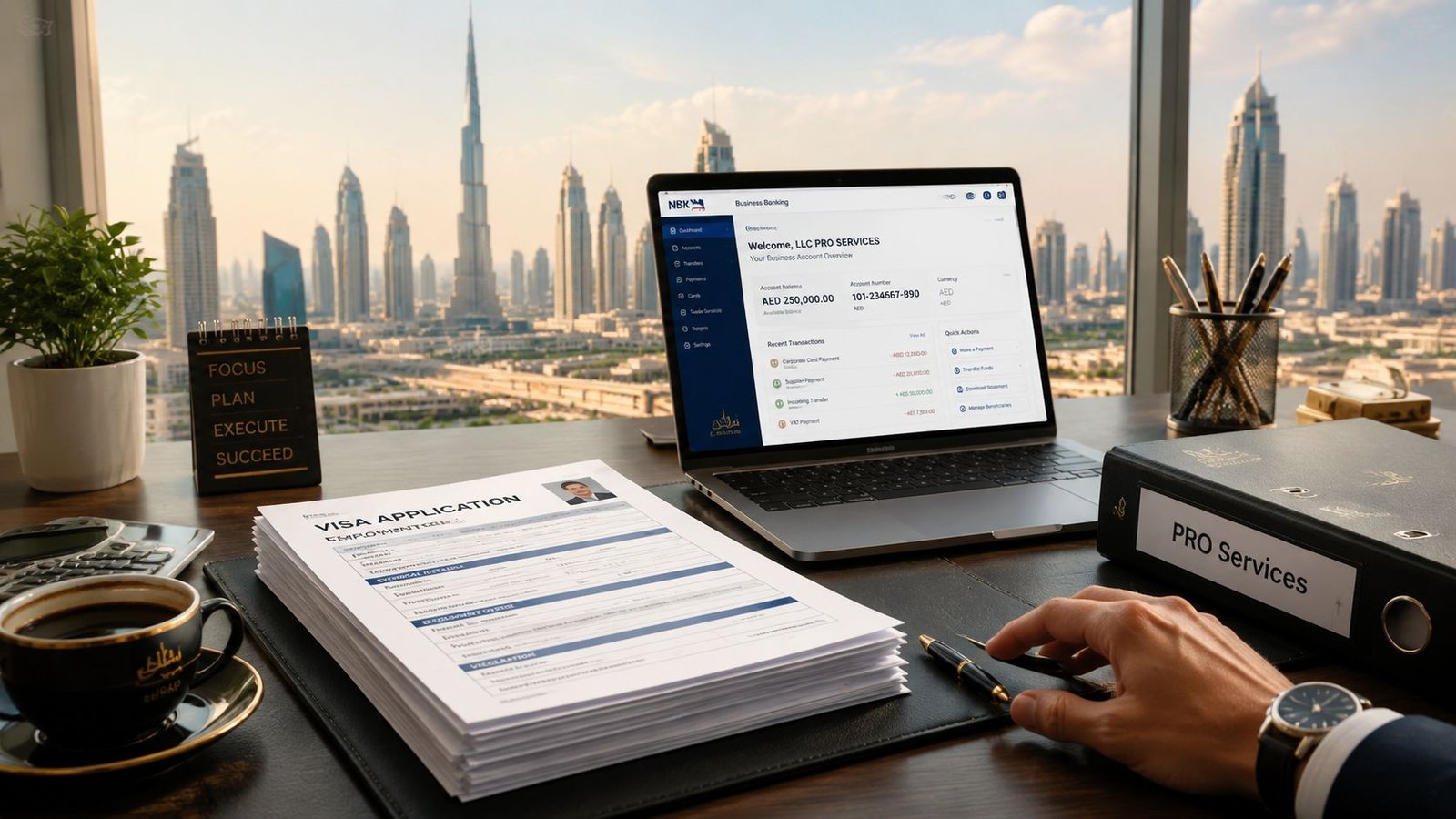
Licence in hand doesn't mean operational
Once the licence is issued, the company usually needs a post-formation workflow that includes immigration setup, investor or partner visa processing where relevant, and then employee onboarding capacity if the business is hiring.
That sequence matters because each stage leans on the previous one being complete and coherent. If shareholder details, authorised signatory powers, tenancy records, or establishment paperwork are untidy, the slowdown shows up after licence issuance, not before.
Founders should treat post-licence work as a controlled activation plan:
- Company immigration readiness: The entity must be properly reflected in the relevant government channels before visa processing runs smoothly.
- Investor and partner visas: These often come first because founders need legal residency status tied to the business.
- Employee visas: Hiring becomes easier once the company's own file is already clean and active.
- Ongoing renewals and updates: Immigration records, licence renewals, and government data must stay aligned.
Banking is a commercial review not a formality
Corporate bank account opening is where many new businesses lose time. Not because the business is invalid, but because the application story is weak.
Banks typically want a coherent picture of the company. They review what the business does, where it operates, who owns it, how it expects to transact, and whether the documentation supports that narrative. A company with a broad licence activity, vague commercial purpose, and thin supporting documents may face more questions than a company with a clear business model and tidy file.
Useful preparation usually includes:
- A consistent business description: The licence activity, website, contracts, and business summary should point in the same direction.
- Clear shareholder documentation: Ownership and control should be simple to verify.
- Evidence of substance where relevant: Lease documents, commercial plans, and operational materials can matter.
- Realistic transaction logic: The expected customer base, suppliers, and geographies should make sense.
Banks don't open accounts for paperwork alone. They open them for businesses they can understand.
Where PRO support actually matters
Good PRO support isn't about standing in queues. It's about managing the government-facing chain without gaps.
A capable PRO function helps with application sequencing, immigration coordination, document submissions, renewals, labour-related workflows where applicable, and status tracking across departments. That matters most when several tasks are running at once, such as partner visas, employee onboarding, medical and ID steps, and licence-linked updates.
For an active company, PRO discipline reduces two common risks. First, deadlines get missed because no single person owns the calendar. Second, records drift out of sync across licensing and immigration systems. Both problems are avoidable, but only if someone is managing the file end to end.
Launch Your Dubai Business with Confidence
Good founders don't just ask how to form a company. They ask what kind of company they need to build.
That's the key lesson in llc company formation in Dubai. The winning decision usually happens before the first application is filed. It happens when you choose the right jurisdiction for your market, confirm whether your activity fits mainland or free zone logic, understand the ownership position correctly, and build the company around operational reality instead of setup marketing.
Three decisions deserve the most care:
Choose for the business model
If you need direct UAE market access, a mainland route may be the right commercial answer. If your model is international, digital, or structurally lighter, a free zone may fit better. The wrong choice creates friction that no fast licence issuance can fix.
Treat documents as control points
The MOA, lease, approvals, and supporting file aren't box-ticking exercises. They define what the company can do, how it is governed, and how smoothly it can move through licensing, visas, and banking. Founders who respect the documentation stage usually save time later.
Plan for activation not just incorporation
A company becomes real when it can contract, bank, sponsor visas, hire, and renew cleanly. That requires sequencing, consistency, and realistic budgeting. The formation file should support all of that from the start.
The easiest Dubai company to form isn't always the easiest one to operate.
Founders who approach setup strategically tend to avoid the usual traps. They don't rely on outdated ownership advice. They don't choose jurisdiction based only on a headline package. They don't leave office planning, visa sequencing, or bank readiness until the end.
If you want the process to feel clear and predictable, work backwards from how the business will trade, hire, and grow. That's what turns incorporation from an admin task into a strong commercial foundation.
If you want expert support with jurisdiction selection, licensing, visas, banking preparation, and ongoing compliance, Inpro Corporate Services L.L.C. helps founders build the right UAE setup from the start with clear timelines, transparent execution, and practical guidance that goes beyond generic formation packages.