


A UAE mainland licence doesn't have one fixed price. In Dubai, a realistic first-year all-in budget is typically AED 25,000–60,000, while Abu Dhabi's Standard Economic Licence can start at AED 1,200, before you add office, visa, immigration, and activity-related costs.
That spread surprises many first-time founders because “licence cost” often means only the government issuance line. Your actual mainland setup budget is stacked: approval charges, name reservation, legal documents, licence issuance, premises, immigration registration, visas, and sometimes specialist activity approvals. The right answer depends on which emirate you choose, what your company does, and which legal form you need.
Table of Contents
- What a UAE Mainland License Actually Covers
- How Mainland License Fees Are Built Step by Step
- How Activity Type and Legal Form Change Your Cost
- Dubai vs Abu Dhabi vs Sharjah Cost Comparison
- Office Requirements Visa Quotas and PRO Service Fees
- Renewal VAT and Ongoing Annual Costs to Budget For
- Real Cost Examples and How to Plan Your Budget
What a UAE Mainland License Actually Covers
What is a mainland licence?
A mainland licence is permission to conduct business onshore in the United Arab Emirates through the economic authority of the emirate you select. In Dubai, that authority is the Department of Economy and Tourism, or DET. Abu Dhabi and Sharjah have their own economic departments and licensing bodies.
A mainland company can generally serve customers across the UAE and contract with organisations in the local market, provided it follows the rules for its approved activity. A free zone company operates under a different framework tied to its designated economic zone, including separate requirements for premises, activity scope, market access, and regulatory approvals.
The licence records two foundations of the business: its approved activity and its legal structure. It does not automatically include every permission needed to operate. A consultancy, retailer, general trading company, manufacturer, or regulated professional firm may each face different premises rules and external approvals.
Practical rule: Treat the licence as the legal foundation, not the complete cost of opening and running the business.
Why does the price vary so widely?
Dubai-focused 2026 guidance places a standard mainland licence at AED 10,000–25,000. After adding office, activity, registration, and visa-related items, first-year setup is commonly estimated at AED 25,000–60,000. Another 2026 estimate puts the first-year total at AED 25,000–55,000. The Dubai mainland licence cost breakdown explains the components behind these ranges.
The difference between quotations often comes from what each one includes. One may show only licence issuance, while another adds a registered office, establishment card, investor visa, employee visa processing, and government liaison work. The lower headline figure can therefore leave out a substantial part of the cash required before trading begins.
Dubai's total also changes with the legal form. A simple e-trader or sole-proprietorship-type structure may begin near AED 1,070. An expatriate-partner Limited Liability Company, or LLC, is reported from around AED 15,000 and above, depending on the activity and approvals required. These figures appear in 2026 Dubai mainland licence pricing guidance.
The practical takeaway is a stacked budget. Emirate, activity, legal form, premises, and visa needs can shift the total by multiples, even when both businesses require a mainland licence.
How Mainland License Fees Are Built Step by Step
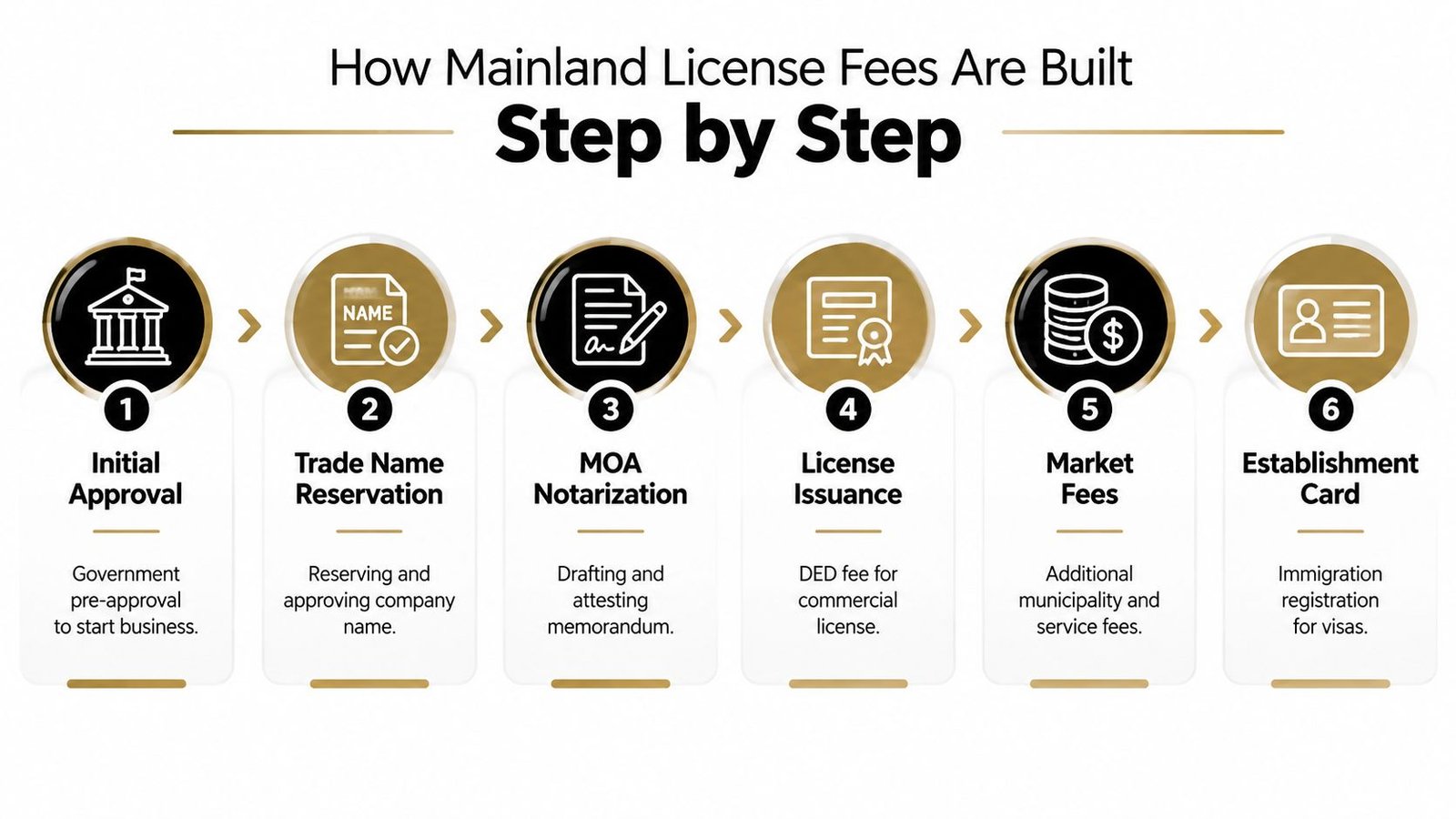
A quotation becomes easier to understand when you separate the filing stages. UAE mainland registration normally involves several government and documentation charges, rather than one payment made at the start.
What does each charge cover?
Initial approval is the authority's confirmation that the proposed business can proceed in principle. A 2026 UAE mainland setup breakdown places this charge at around AED 235. It isn't the final licence, and it doesn't by itself allow you to begin all business activities.
Trade name reservation secures the company name with the authority. The same breakdown places this at around AED 735. The name must meet naming rules and may be rejected if it conflicts with an existing registration or includes restricted wording. The 2026 mainland company setup breakdown separates these charges from the licence fee.
Memorandum of Association, or MOA, notarisation records the company's ownership and operating structure. The MOA is the legal document setting out matters such as partners, shareholding, and management. Notarisation is reported at around AED 1,500–3,200, depending on share capital.
Licence issuance is the charge for issuing the commercial, professional, or industrial licence itself. It sits on top of the earlier steps. The exact amount depends on the activity, authority, legal form, and emirate.
Which items are often missing?
A regulated activity may need approval from another government body before the licence can be issued. Examples include activities connected with health, education, finance, engineering, transport, food, or construction. The approval body and fee depend on the specific activity, so a generic licence quote shouldn't be treated as final until the activity code is confirmed.
Some quotations also exclude municipality charges, service-centre charges, document attestation, external approvals, and immigration registration. Ask the provider to label each line as included, excluded, or not applicable.
The full process also moves beyond licensing into immigration. A company that plans to sponsor an owner or employees will need an establishment card, which opens the company's immigration file. The video below gives a visual explanation of how these stages connect.
How Activity Type and Legal Form Change Your Cost
Your business activity often sets the direction of the mainland licence budget. Selecting “commercial” because it sounds broad can cause problems if the company provides professional services, imports goods, manufactures products, or performs regulated work. The activity code works like a label on the application. It determines which licence category and approvals apply.
Which activity bands apply in 2026?
These ranges describe typical government fee guidance, not a universal invoice. The Dubai mainland cost guide for 2026 reports the following broad bands:
| Activity Type | Typical Government Fee Band | Note |
|---|---|---|
| Professional licence | AED 10,000–18,000 | Common for consultancy and professional services |
| Commercial or trading licence | AED 10,000–20,000 | Covers many sales and trading activities |
| Industrial licence | AED 15,000–25,000+ | May involve premises and additional approvals |
| General trading | About AED 29,685 for the licence alone | Includes a mandatory additional DET fee |
A professional licence generally suits service-based work, including consultancy and certain specialist practices. A commercial licence covers trading or selling specified goods. An industrial licence applies to manufacturing and industrial activity, where the company may also need suitable premises, equipment, and approvals from other authorities.
Why is general trading more expensive?
General trading is a specific activity category, not a commercial licence with a wider description. A 2026 guide states that it includes a mandatory additional AED 15,000 DET fee, taking the licence-only government total to about AED 29,685. The general trading fee explanation explains why founders should confirm the exact activity before accepting a quotation.
“General” also does not mean every product is automatically approved. Certain product categories can require separate permissions, customs procedures, or sector controls. A trading company selling ordinary goods and one handling controlled products may therefore face very different total budgets.
Does the legal form affect the budget?
Yes. A sole establishment or e-trader-type structure may cost less when the activity and ownership profile permit it. An LLC, or limited liability company, is a separate legal entity with partners and a formal ownership arrangement. That structure often fits international founders, operating businesses, and teams with multiple shareholders.
The lowest initial fee may not match the company's needs. Compare ownership, liability, visa sponsorship, banking expectations, partner arrangements, and activities you may add later. Changing the legal form after incorporation can mean new paperwork and extra cost, just as changing the foundation of a building is harder than choosing it correctly at the start.
Dubai vs Abu Dhabi vs Sharjah Cost Comparison
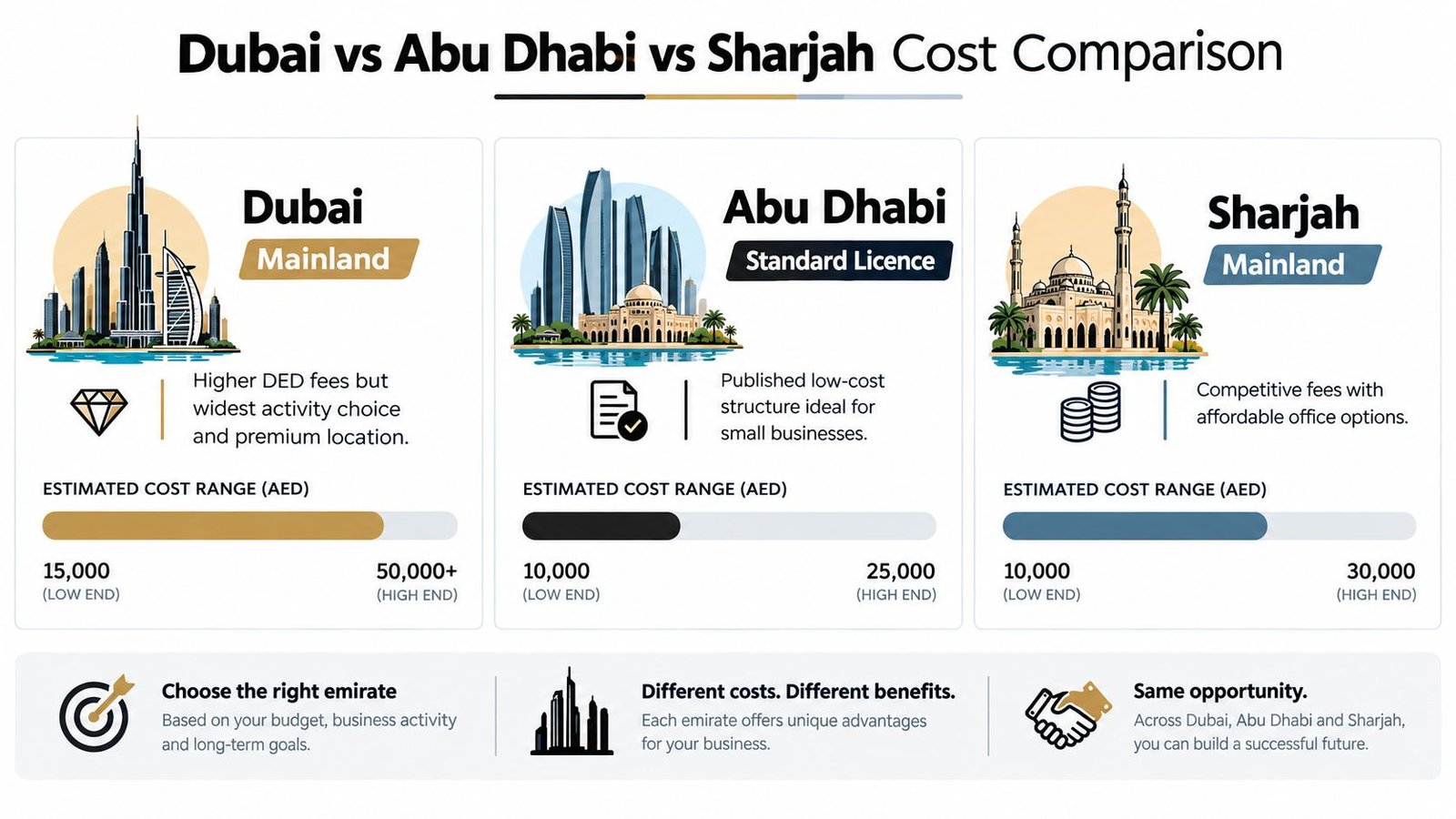
Mainland licence cost is a stacked budget, not one emirate-wide price. The same activity can produce different totals in Dubai, Abu Dhabi, and Sharjah because each authority applies its own licensing process, while office, immigration, and activity requirements add separate layers.
Why is Abu Dhabi a useful benchmark?
Abu Dhabi's Standard Economic Licence is published at AED 1,200 and covers six investor-selected activities. Each additional activity costs AED 100, according to the Abu Dhabi Registration Authority licence schedule.
This model can suit a small company with several related activities. The licence line is clear, but it is only the first layer. Office arrangements, legal documents, immigration processing, and permissions for regulated activities can increase the final budget.
Why does Dubai produce wider estimates?
Dubai's Department of Economy and Tourism, or DET, does not publish one fixed public fee schedule for every mainland business model. Market quotations therefore vary according to the activity, legal form, and application details.
Some comparisons place Abu Dhabi promotional mainland pricing at around AED 1,125 to issue and AED 960 to renew, while Dubai structures vary by activity and legal form. These figures are reported in the 2026 UAE mainland licence comparison.
Dubai can still be the practical choice when clients, employees, suppliers, or the company's commercial identity are based there. A cheaper licence elsewhere may lose that advantage if the business then needs Dubai premises, extra operating arrangements, or regular travel.
Where does Sharjah fit?
Sharjah often attracts founders comparing mainland access with potentially more economical office options than central Dubai. Its total still depends on the licensing authority, selected activity, legal form, premises, and immigration plan.
Use identical assumptions when comparing emirates. Otherwise, the result is like comparing a basic car price with a fully equipped model.
- Activity scope: Compare identical activity categories.
- Legal form: Compare an LLC, or limited liability company, with another LLC rather than with a sole establishment.
- Premises: Apply the same office standard and registration requirements.
- Visas: State the number and type of visas required.
- Renewals: Request year-two costs, not only incorporation pricing.
Office Requirements Visa Quotas and PRO Service Fees
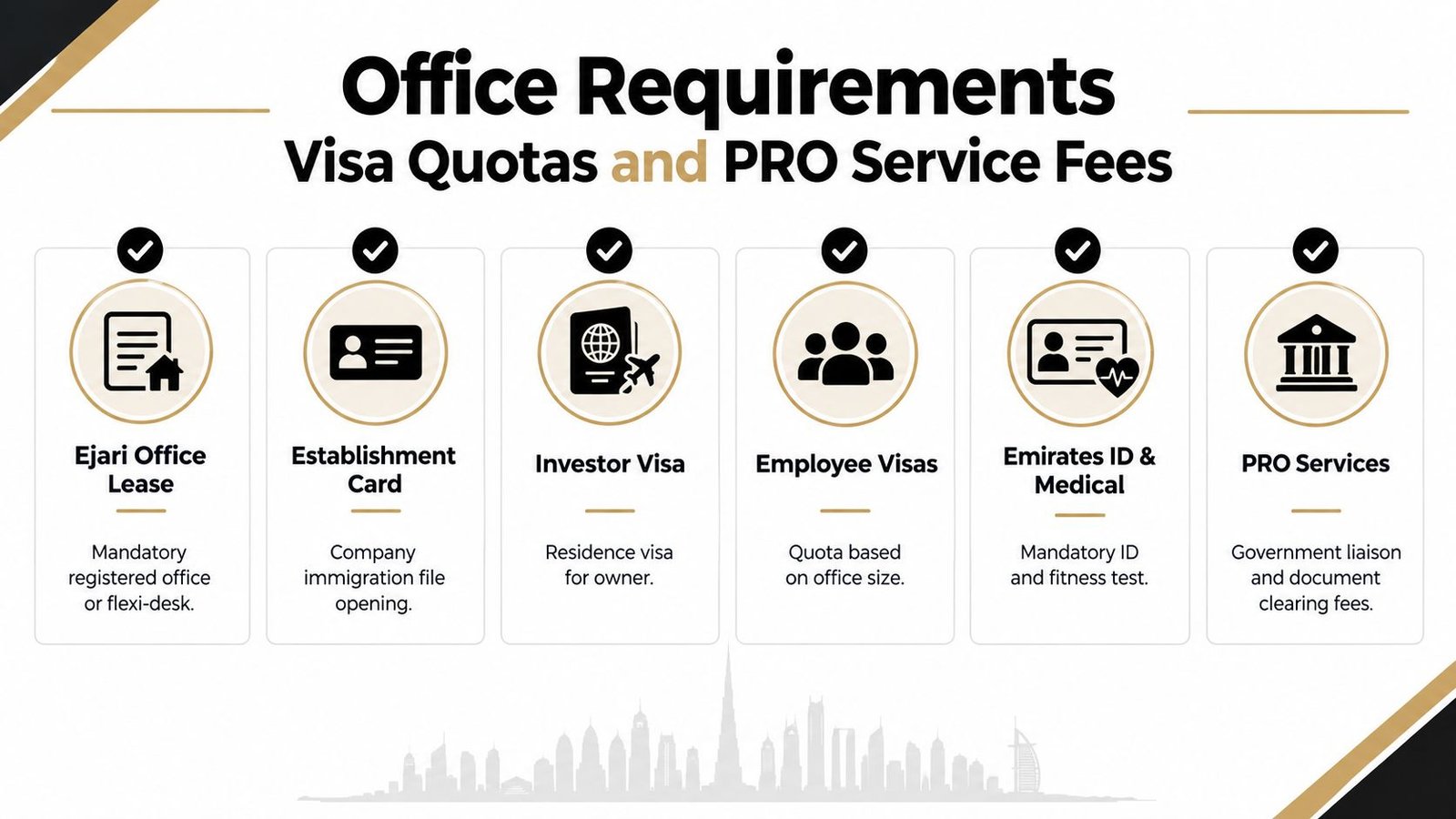
The office can change the economics of a mainland setup more than the licence line itself. Many mainland companies need a registered business address, and Dubai premises may involve an Ejari registration. Ejari is the Dubai system used to register a tenancy contract with the relevant authority.
How does the office affect visas?
Office size and suitability can affect the number of employee visas a company may request. A flexi-desk may work for a small operation with limited staffing, while a growing company may need a physical office that supports its intended visa quota and activity.
The exact arrangement depends on the emirate and activity. Before signing a lease, confirm that the premises is acceptable for the licence category and that it supports the intended immigration plan.
Which immigration items should you list?
A founder sponsoring themselves usually needs an investor or partner residence process. Employees need their own work and residence processing. Each case can involve medical fitness testing, an Emirates ID, and immigration file charges.
An Emirates ID is the identity card issued to UAE residents. The company may also need an establishment card, which is the immigration registration that allows it to sponsor visas. These are separate from the economic licence.
Write the quote in this format:
- Office: Lease, Ejari registration, deposit, and service charges.
- Establishment card: Company immigration file opening and renewal.
- Owner visa: Entry, status change where relevant, medical, Emirates ID, and stamping.
- Employee visas: Per-person processing and any quota-related requirements.
- Labour file: Registration with the Ministry of Human Resources and Emiratisation, or MOHRE, where required.
- PRO work: Government liaison, submissions, renewals, document collection, and follow-up.
A Public Relations Officer, or PRO, handles government-facing administrative work such as applications, document submissions, and status follow-up. PRO fees are often quoted separately from government charges, so ask whether the proposal includes only service work or both service work and official fees.
Budget check: Ask for a first-year total, a renewal total, and a per-visa total. Those three views expose most omissions.
Renewal VAT and Ongoing Annual Costs to Budget For
Incorporation is only the first budget decision. A mainland company needs an annual operating plan that accounts for licence renewal, premises, immigration files, visas, accounting, and tax administration.

What renews each year?
The economic licence needs renewal, and the office arrangement may also need renewal. If the company sponsors the owner or employees, establishment cards and residence documents create separate renewal dates.
A useful compliance calendar should track:
- Licence renewal: Confirm the expiry date and required documents.
- Tenancy renewal: Check the lease and Ejari status before the licence deadline.
- Immigration renewal: Track the establishment card and each sponsored person.
- Accounting: Keep invoices, bank records, payroll information, and expense evidence organised.
- Tax administration: Review whether corporate tax registration, filings, and records apply to the business.
- VAT: Value Added Tax, or VAT, registration and filing may apply when the business meets the relevant turnover conditions.
The licence renewal amount may not match the first-year issuance amount. Abu Dhabi's published benchmark, for example, lists renewal separately from issuance, while Dubai costs are more dependent on the selected structure and activity.
How should you plan for VAT and tax work?
VAT registration isn't merely another licence fee. It creates record-keeping and filing responsibilities where the business meets the applicable conditions. Corporate tax registration and filing can also require accurate accounts, supporting records, and timely submissions.
Don't wait until renewal month to gather documents. A company that separates government fees, rent, visa costs, accounting, tax work, and PRO support can see its true annual run rate more clearly.
Late renewal can interrupt business administration and may expose the company to penalties or other consequences. The practical approach is to set internal reminders well before expiry and confirm the authority's current requirements before filing.
Real Cost Examples and How to Plan Your Budget
A mainland licence budget is a stack, not a single fee. The activity, emirate, legal form, office, immigration file, visas, and professional support can change the total by multiples. The examples below are planning models based on the applicable activity and emirate ranges, not fixed quotations.
What might a freelancer budget?
A freelancer providing eligible professional services may need a professional licence and a modest office solution. The professional government fee guidance is around AED 10,000–18,000. Office costs, an immigration file, owner visa, medical examination, Emirates ID, and PRO support can then raise the first-year total.
The useful comparison is between structures, not headline prices. Choose the arrangement that permits the service, supports self-sponsorship if required, and meets premises rules without paying for unused capacity.
What might a small Dubai trading LLC cost?
A small Dubai trading limited liability company, or LLC, may fall within the commercial or trading government fee band of AED 10,000–20,000 before the remaining setup costs. Once office, registration, immigration, and visa-linked expenses are included, the wider first-year Dubai budget guidance is AED 25,000–60,000, as outlined in the Dubai mainland setup cost guidance.
General trading can produce a different calculation from a defined commercial activity because the separate DET surcharge may apply. Confirm the product categories and activity code before comparing provider quotations.
What might a multi-activity Abu Dhabi company cost?
An Abu Dhabi company using the Standard Economic Licence has a published licence price of AED 1,200, including six selected activities. Additional activities are priced at AED 100 each, making the licence line a useful starting point for a company with related activities, as shown in the official Abu Dhabi licence information.
The final budget still includes the office, legal documents, visas, immigration registration, and any external approvals. A lower licence line may not produce a lower operating budget if the customers and team are based in Dubai.
Use a worksheet with five columns: authority fees, premises, immigration, visas, and professional support. Ask each provider to complete the same worksheet. Compare exclusions, renewal dates, and one-off costs alongside the headline amount.
Inpro Corporate Services L.L.C. helps founders select a mainland, free zone, or offshore structure, arrange licensing and permits, and manage PRO, investor, Golden, and employee visa processes. Visit Inpro Corporate Services L.L.C. to request a setup estimate based on your activity, emirate, office needs, and visa plan.