


A Memorandum of Association is the constitutional legal document for a UAE company, and its job is to define the company's rules, shareholder rights, and legal scope of operations. In the United Arab Emirates, it isn't optional. It must be drafted in Arabic, the Arabic version prevails in disputes, and practical registration guidance notes that notarisation and authority registration usually take 3 to 7 business days.
That catches many founders off guard. They expect the trade licence to be the main document, but in practice the licence follows the MoA, not the other way around. If the MoA is drafted badly, too vaguely, or out of step with your approved business activity, your setup in Dubai, Abu Dhabi, Sharjah, or a free zone can stall long before you start trading.
For international founders, the issue isn't understanding the definition. It's understanding the effect. The Memorandum of Association in the UAE is the document that turns an idea into a registrable business with defined owners, powers, and limits. Once you see it that way, the process becomes easier to manage.
Table of Contents
- What Is a Memorandum of Association in the UAE
- How the MoA Differs Across UAE Jurisdictions
- Drafting Your MoA What Key Clauses Are Required
- The MoA Signing and Registration Process Step by Step
- How to Amend Your Company MoA
- Common MoA Pitfalls and a Founder's Checklist
- Frequently Asked Questions about the UAE MoA
What Is a Memorandum of Association in the UAE
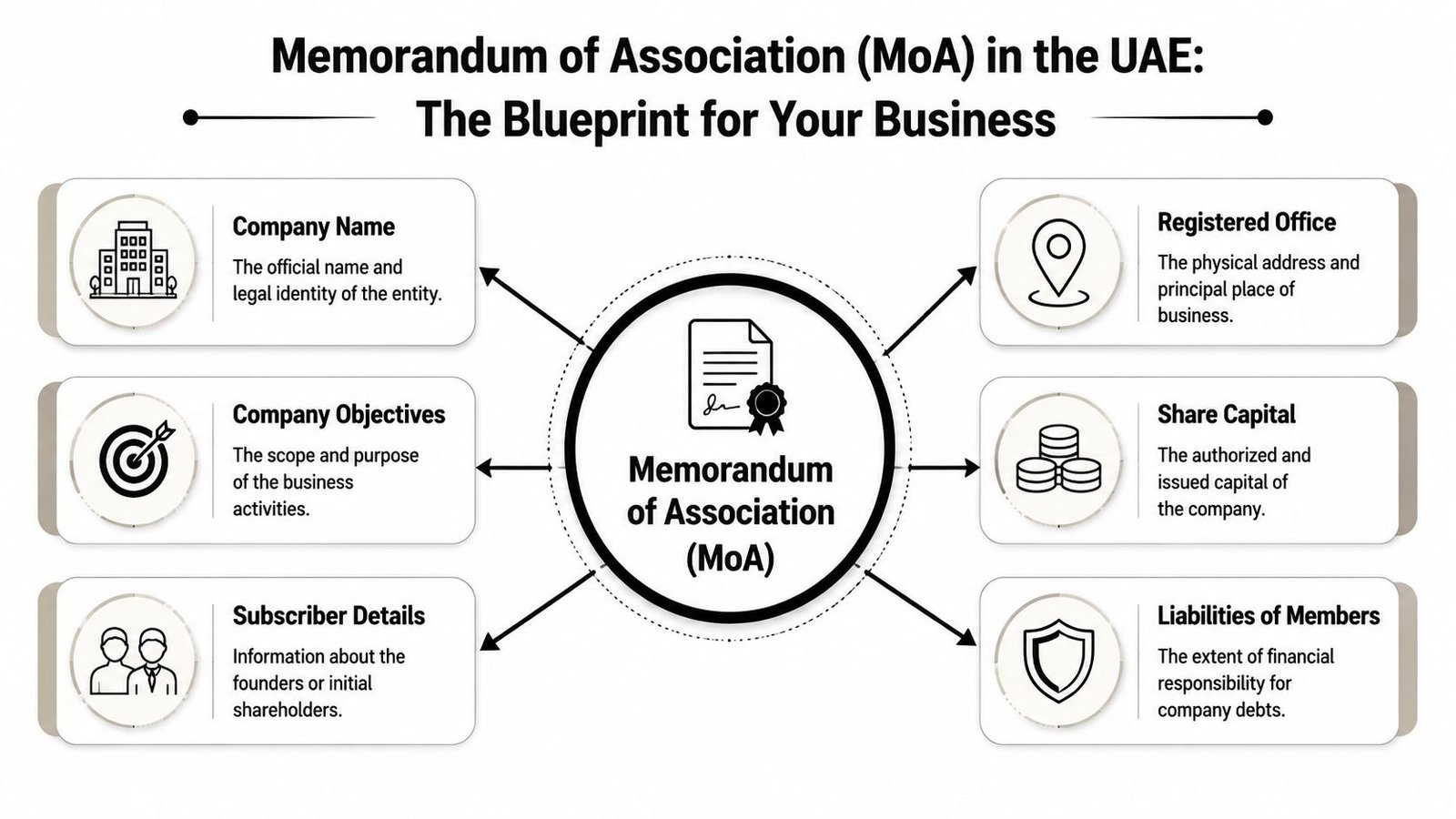
A Memorandum of Association is the constitutional document of a company in the UAE. It sets out the company's legal identity, business purpose, ownership structure, and the rights and responsibilities attached to that structure.
The MoA isn't just filed and forgotten; it is a registration prerequisite for company formation and the legal base on which your licence, shareholder arrangement, and governance are built. Practical guidance published in the UAE also states that it must be drafted in Arabic, with the Arabic version taking priority in disputes, and that notarisation and authority registration typically take 3 to 7 business days according to this UAE MoA registration guide.
Why founders should treat it like a rulebook
If you're setting up a company in the United Arab Emirates, think of the MoA as the document that answers basic legal questions before the authorities do. What can the company do. Who owns it. How is capital divided. Who has authority to act.
That's why founders run into trouble when they copy wording from another company or treat the draft as routine admin. A weak draft often creates friction later with licence amendments, internal disputes, or operational approvals.
Practical rule: if your MoA doesn't match how you actually plan to run the company, fix the MoA before the licence is issued, not after.
Who reviews it during setup
The reviewing authority depends on where you incorporate. On the mainland, the relevant economic authority handles trade licensing. In Dubai, founders will usually deal with the Department of Economy and Tourism, commonly called DET. Older references often say Department of Economic Development, or DED. In free zones, the free zone authority reviews its own formation documents.
For most founders, that means the MoA sits between your commercial plan and government approval. If those two don't line up, the file usually comes back for correction.
How the MoA Differs Across UAE Jurisdictions
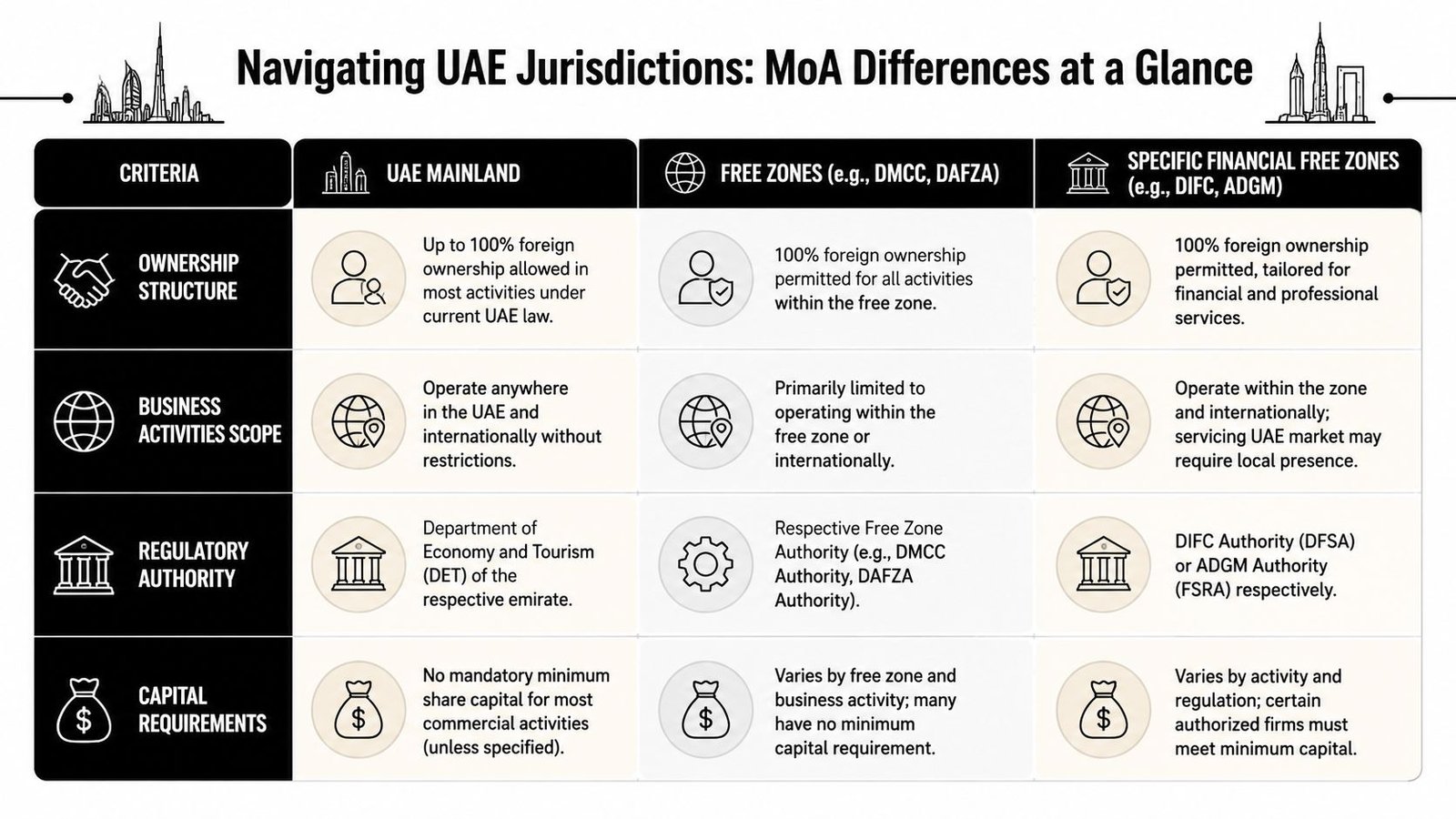
The same phrase, Memorandum of Association UAE, can mean slightly different drafting work depending on where you set up. A mainland limited liability company, a general free zone company, and a company in a financial free zone all live under different authority rules and approval habits.
That's why two founders with the same business model can face different drafting questions. The jurisdiction choice shapes the level of template standardisation, the flexibility around clauses, and how your ownership and management provisions should be expressed.
What changes between mainland and free zone setups
For mainland companies, the MoA is usually more closely shaped by the licensing authority's accepted format. There is often less room for casual wording changes, so founders need to focus on getting the approved business activities, shareholder details, and authority provisions right within the authority's structure.
For free zone companies, the authority often provides a standard constitutional format or its own incorporation documents. That can make setup feel simpler, but it doesn't remove the need to review what the document says. A free zone template may be easy to sign and still be a poor fit for a joint venture, uneven profit arrangement, or investor entry plan.
For financial free zones, such as the Dubai International Financial Centre and the Abu Dhabi Global Market, the drafting environment is often more designed for structured corporate governance. Founders there usually need more precision around governance language and shareholder mechanics, especially if the business expects investment, regulated activity, or a parent-subsidiary structure.
What foreign ownership reforms changed in practice
One of the biggest practical questions after the UAE's foreign ownership reforms is not whether ownership rules changed. It's how those changes should appear in the MoA. Public guidance still leaves a gap here, especially for foreign founders and joint venture structures, as noted in this discussion of post-reform MoA drafting questions.
The practical effect is simple. Ownership freedom doesn't remove drafting discipline. A founder may be allowed full ownership in principle, but the MoA still needs to correctly reflect shareholder rights, management power, capital language, and any agreed profit distribution. If those clauses are left on old assumptions or generic wording, the document may not reflect the deal the founders think they have.
A common mistake is assuming that because ownership rules are now more open, the standard draft will automatically protect the parties. It won't.
How to choose the right structure for your drafting approach
A useful way to decide is to ask three questions early:
| Setup question | Why it affects the MoA |
|---|---|
| Will you trade mainly inside the UAE market or within a specific zone ecosystem | Your activity scope and authority review process will differ |
| Are you a solo founder, equal partners, or an uneven joint venture | Shareholder rights and management wording become more sensitive |
| Do you expect investor changes or restructuring later | You'll want cleaner amendment and governance language from day one |
If the founders are simple and the activity is straightforward, a standard authority-aligned draft often works well. If the business has layered ownership, special management rights, or a corporate shareholder, spending more time on the opening draft usually saves time later.
Drafting Your MoA What Key Clauses Are Required
When founders ask what belongs in a Memorandum of Association in the UAE, the short answer is this: the document must define the entity's name, purpose, capital structure, and liability limits before registration. It is not enough for the draft to sound legally polished. It must align with the exact business you're asking the authority to approve, because any mismatch between the drafted activities and the approved licence can block registration or later approvals, as explained in this outline of UAE MoA registration requirements.
Which clauses matter most at registration stage
Some clauses are routine. Others decide whether your file moves forward.
Company name. The legal name in the MoA must match the approved trade name and legal form. Small inconsistencies create avoidable corrections.
Legal form. The document needs to state what type of entity you are forming, such as a limited liability company. This isn't just a label. It affects ownership mechanics, management powers, and the authority's expected template.
Business purpose or activity clause. This is the clause founders should read twice. If your licence application says management consultancy but the MoA wording implies broader commercial services, the authority may ask for revision. If the wording is too narrow, you may later discover the company can't support an approval you assumed would be routine.
Capital structure. The MoA should clearly set out how capital is divided between shareholders. That includes who holds what and how the ownership arrangement is expressed.
Which clauses deserve more negotiation than founders expect
Founders often spend too much time on the opening recital and too little on the clauses that affect control.
Consider these carefully:
Profit and loss allocation
Ownership percentage and commercial expectation are not always the same thing in practice. If one founder is passive and another is running the company, that should be reflected in the broader legal package, and the MoA should not conflict with it.Management powers
This clause decides who can sign, represent the business, and act before authorities. If the company will need one founder to move quickly, don't leave the authority wording too vague.Share transfer restrictions
If a founder wants flexibility to bring in an investor later, rigid drafting can become a problem. If the founders want tighter control, loose drafting creates risk.Liability limits
This clause should accurately reflect the company structure and the member relationship to the company's obligations.
Don't ask only “Is this clause acceptable?” Ask “Will this clause still work when we open a bank account, appoint a manager, change a partner, or raise investment?”
A practical drafting approach is to prepare the authority-facing version and then compare it against the commercial reality of the founders. That's where a lot of hidden problems appear.
The MoA Signing and Registration Process Step by Step
A well-drafted MoA can still delay your licence if the signing route, Arabic text, or authority format is wrong. In the UAE, filing is not clerical cleanup. It is the point where your commercial deal has to match the regulator's record.
That matters even more after the recent shift toward digital formation workflows. Many authorities now accept parts of the process online, and some notarisation steps can be handled through approved digital channels, as discussed in this review of LLC MoA execution options in the UAE. The practical point for international founders is simple. Digital filing saves time only when the documents were prepared for that route from the start.
What the filing workflow usually looks like
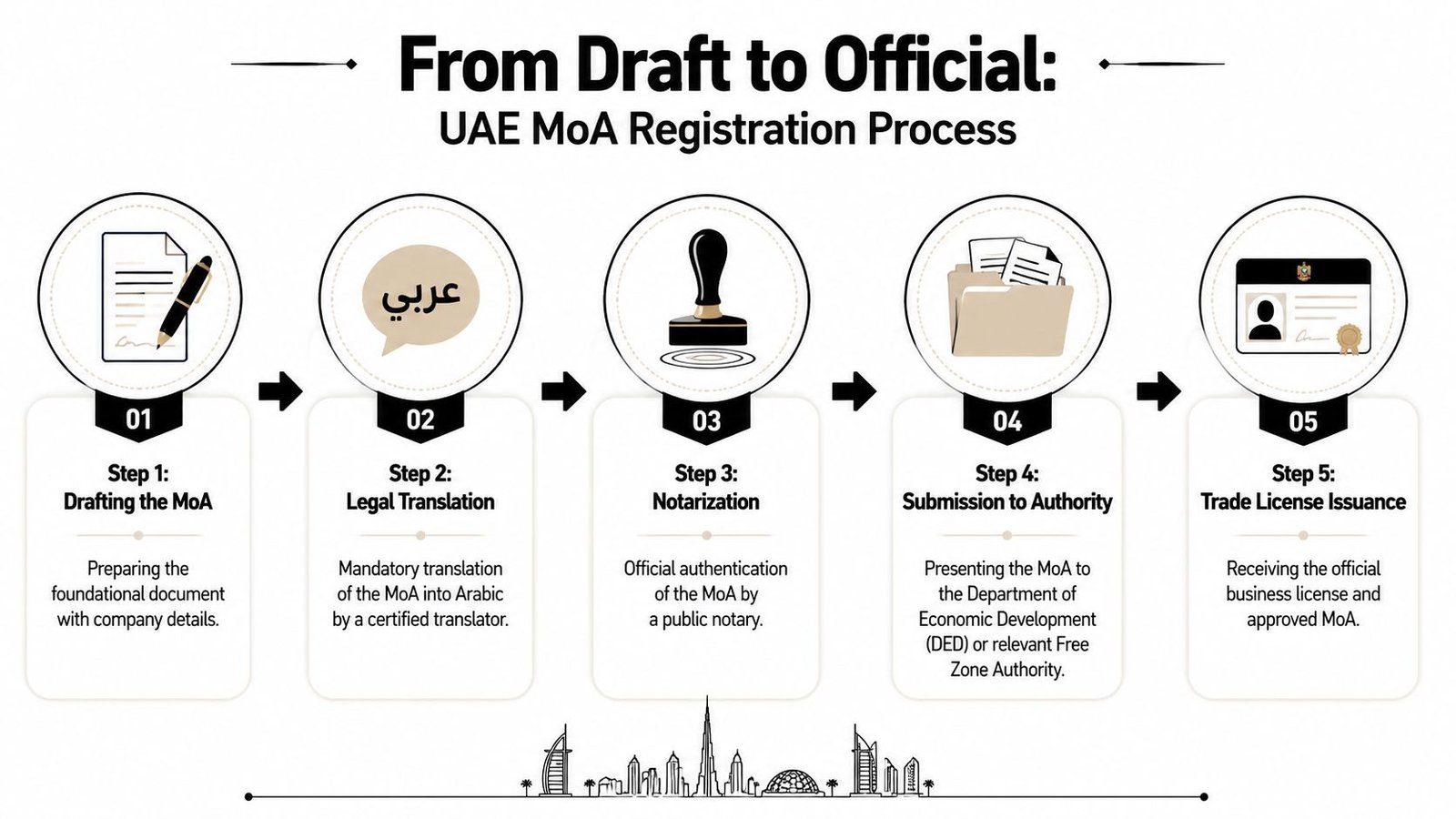
Draft the English working version
This is usually the fastest way to settle the business terms, especially where there are overseas founders or a foreign parent company. Keep in mind that a working draft is only useful if it can be converted cleanly into the authority-facing version.Prepare the Arabic legal text
In many mainland setups, the Arabic text carries legal weight. Founders should review this stage carefully, not treat it as a routine translation. If the management powers or share terms are expressed loosely here, the filing may still go through, but problems can surface later with banks, counterparties, or shareholder disputes.Check the authority's format and signing rules
This step changes by jurisdiction. A mainland authority, a financial free zone, and a general free zone may each ask for different templates, supporting resolutions, signature methods, and ID documents. Founders lose time here when they assume one UAE process applies everywhere.Arrange signing and notarisation
Some files can be signed digitally through approved channels. Others still need in-person execution, notarisation, or extra steps for foreign corporate shareholders. The trade-off is straightforward. Standard structures move quickly online. Custom structures need tighter document control.Submit for registration and licence issuance
The company is not properly set up just because everyone has signed the MoA. The process only moves cleanly once the authority accepts the constitutional documents and ties them to the licence application.
What remote founders should prepare early
Remote incorporation is often possible in 2026, but the faster files are usually the ones prepared before the MoA is final. For international founders, I would have these ready at the outset:
- Passport details exactly matching the application record
- Constitutional documents for any corporate shareholder
- Proof that the corporate signatory has authority to sign
- A confirmed manager appointment structure
- A practical signing plan for any party outside the UAE
One missing detail can stall the whole file.
Corporate shareholders need extra care. Attestation, board resolutions, and proof of signing authority are often what determine whether the MoA can be filed this week or has to wait for revised documents from another country.
Where digital shortcuts help and where they do not
Digital channels work best for clean incorporations. A sole founder, standard activity wording, and ordinary manager powers can often move through an online process with fewer delays.
The benefit drops when the setup includes negotiated shareholder rights, a foreign parent company, customized authority clauses, sensitive activity descriptions, or documents issued outside the UAE. In those cases, the issue is rarely the platform itself. The issue is whether the documents line up across the MoA, application forms, shareholder papers, and identification record.
Founders should choose support based on the actual bottleneck. If the problem is legal wording, use legal drafting support. If the problem is authority coordination and document handling, use a formation consultant or PRO team with experience in that jurisdiction. That distinction saves time and avoids paying for the wrong kind of help.
How to Amend Your Company MoA
Your MoA must be amended when the company's legal details change. If the licence, shareholder record, or management structure moves in one direction and the MoA stays behind, the file stops matching the legal record the authority relies on. That mismatch creates delays at the next approval stage, and in some cases it creates a wider compliance problem.
When is an amendment required?
An amendment is usually required when a core MoA term changes. In practice, that often includes admitting a new shareholder, removing one, transferring shares, changing the company name, revising share capital, expanding or narrowing approved activities, or changing manager powers where those powers are set out in the constitutional documents.
Use a simple test. If the change affects ownership, control, capital, or the company's permitted scope, treat it as an MoA amendment issue until the relevant authority confirms otherwise.
This matters more for international founders than many expect. A change that looks administrative on the commercial side can trigger a document chain on the legal side, especially where foreign shareholders, board approvals, or cross-border signing authority are involved.
What the amendment process usually looks like
The process is usually straightforward, but it is document-sensitive. The revised terms must be captured in an amendment, addendum, or restated MoA, then submitted in the format accepted by the mainland authority or free zone registrar. That normally means aligned drafting, Arabic text where required, valid signatures, and supporting approvals that match the amended terms exactly.
Post-reform digital filing has made some amendments faster in 2026, particularly simple changes with clean shareholder records. The speed drops once the amendment touches ownership, bespoke voting rights, or overseas corporate documents. In those files, the issue is rarely the portal. The issue is whether every supporting document says the same thing.
Founders should also plan the order properly. Some authorities will not process the related licence update until the constitutional change is approved or filed in the correct sequence. That is the practical trade-off. Rushing the commercial update can cost more time than preparing the amendment file properly at the start.
Keep the MoA current so it reflects the company you operate, not the company you launched with.
Common MoA Pitfalls and a Founder's Checklist
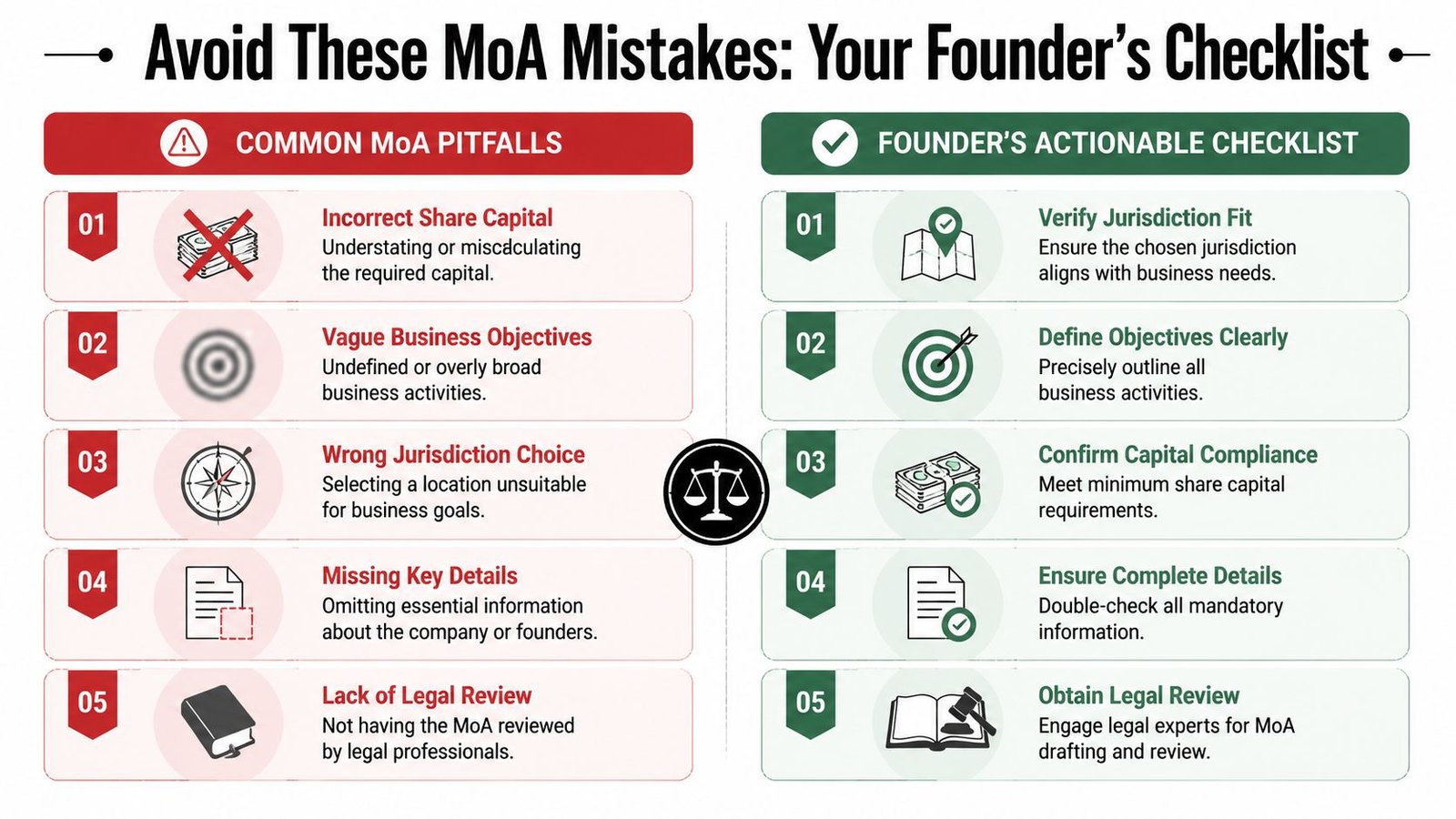
Most MoA delays come from ordinary mistakes, not complicated law. The founders are ready, the business plan is clear, but the paperwork doesn't line up cleanly across the licence application, translation, and signing file.
Mistakes that delay approvals
Activity wording that is too broad. Founders often describe what they hope to do commercially, not what the authority has approved legally.
Names that don't match supporting documents. A passport spelling difference or missing middle name can create avoidable resubmissions.
Arabic text not reviewed by the founders. If the parties only read the English draft, they may sign a controlling Arabic text they haven't checked properly.
Authority powers left unclear. This shows up later when one person needs to sign for banking, employment, leasing, or other operational steps.
Using a template without adapting it. Standard wording is helpful. Blindly accepting it is not.
A practical pre-signing checklist
Use this before anyone signs:
- Check shareholder identity details against passports and company documents.
- Confirm the licensed activity wording matches the intended MoA purpose clause.
- Review the Arabic version with the same care as the English version.
- Verify who has management authority and whether that wording fits real operations.
- Test future changes mentally. If you add an investor or change activities later, will the current structure still work?
If a file feels “almost right”, it usually needs one more review. “Almost right” is where most registration friction lives.
Frequently Asked Questions about the UAE MoA
What is the difference between an MoA and AoA
The Memorandum of Association is the core formation document. It sets out the company's identity, shareholding position, approved activities, and key authority points that regulators, banks, and counterparties may rely on.
The Articles of Association, where used in that jurisdiction and entity type, deal more with internal rules. That includes decision-making, meeting procedures, and other governance mechanics between shareholders and managers.
For founders, the practical point is simple. If the MoA is wrong, setup and post-licensing tasks can stall. If the AoA is weak, disputes and governance friction show up later.
Can you rely on a standard MoA template
A standard template is often acceptable for a straightforward setup with one or two founders, a clear activity set, and no negotiated ownership terms.
It is rarely enough for more complex structures. Joint ventures, foreign corporate shareholders, different profit arrangements, reserved matters, and planned investor entry usually need customized drafting. The same applies if the founders want flexibility for future amendments without rewriting the whole document.
In 2026, many authorities offer digital drafting flows that make the process faster. That does not remove the need to review the wording carefully. Faster drafting is not the same as better drafting.
How does a corporate shareholder sign the MoA
A corporate shareholder signs through an authorised signatory with documented authority. The approval team will usually ask for the shareholder company's constitutional documents, registration records, and proof that the named signatory can sign the incorporation papers.
This is one of the main pressure points for international founders.
If the board resolution, power of attorney, or legalisation chain is missing or inconsistent, the file usually slows down at the signing stage, not at the first draft stage. Preparing authority documents early saves time, especially in remote incorporations.
Does every UAE business need an MoA
The document name can vary by jurisdiction, legal form, and licensing authority. The underlying requirement stays the same. The authority needs a valid founding document that records the ownership structure, legal form, and operating scope of the entity.
For a founder, the question is less about the label and more about the filing standard that applies to that specific setup. Mainland LLCs, free zone companies, and branch structures do not all follow the same format.
Is the Memorandum of Association in the UAE only relevant at setup stage
No. The MoA remains active corporate paperwork throughout the life of the business.
It comes back into play when you add a shareholder, change activities, revise capital terms, update management powers, or restructure the group. If the original wording was drafted too narrowly, even a routine change can turn into a longer amendment exercise.
Founders who treat the MoA as a working legal document, not a one-time form, usually handle growth with fewer approval issues.
If you are setting up in Dubai, Abu Dhabi, Sharjah, or another UAE jurisdiction and you are unsure whether your MoA wording matches the licence plan, Inpro Corporate Services L.L.C. can help review the structure, filing steps, and supporting documents before the paperwork turns into a delay.