

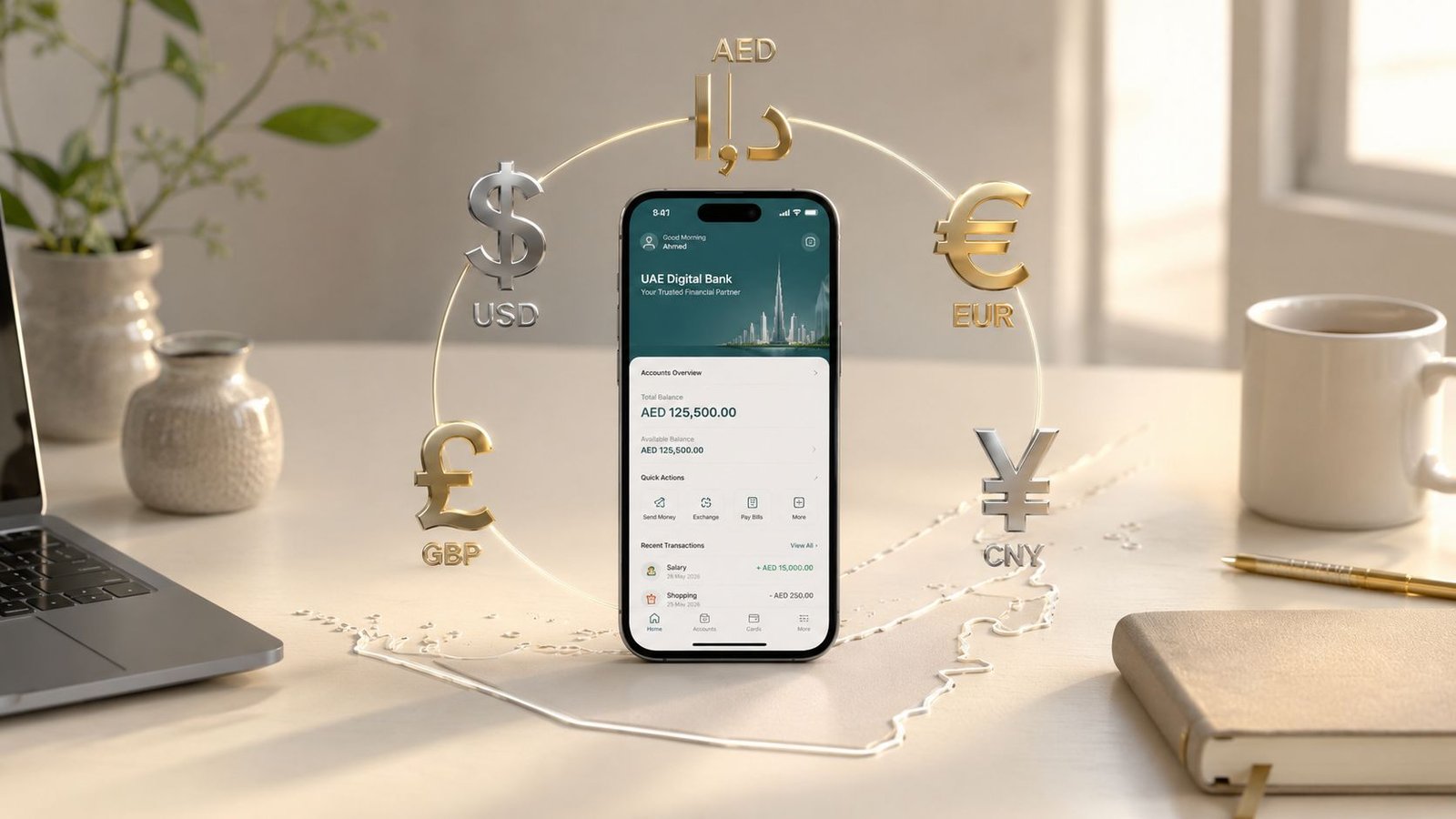
The UAE processed AED 12.8 trillion in external payments and receipts in 2023, and that scale explains why multi-currency accounts are now operational infrastructure for founders, not a nice-to-have. In the United Arab Emirates, where the dirham has been pegged to the US dollar at about AED 3.6725 per USD for decades, the primary question is not whether to use one. It's whether your account setup can handle collections, supplier payments, and treasury control without forcing avoidable conversion at the wrong time.
Table of Contents
- Why Multi-Currency Accounts Matter in the UAE
- How Multi-Currency Accounts Function
- Corporate vs Personal and Bank vs Fintech Options
- UAE Jurisdiction and Compliance Considerations
- Understanding Fees and FX Mechanics
- Step-by-Step Account Opening Checklist
- Next Steps for UAE Founders
Why Multi-Currency Accounts Matter in the UAE
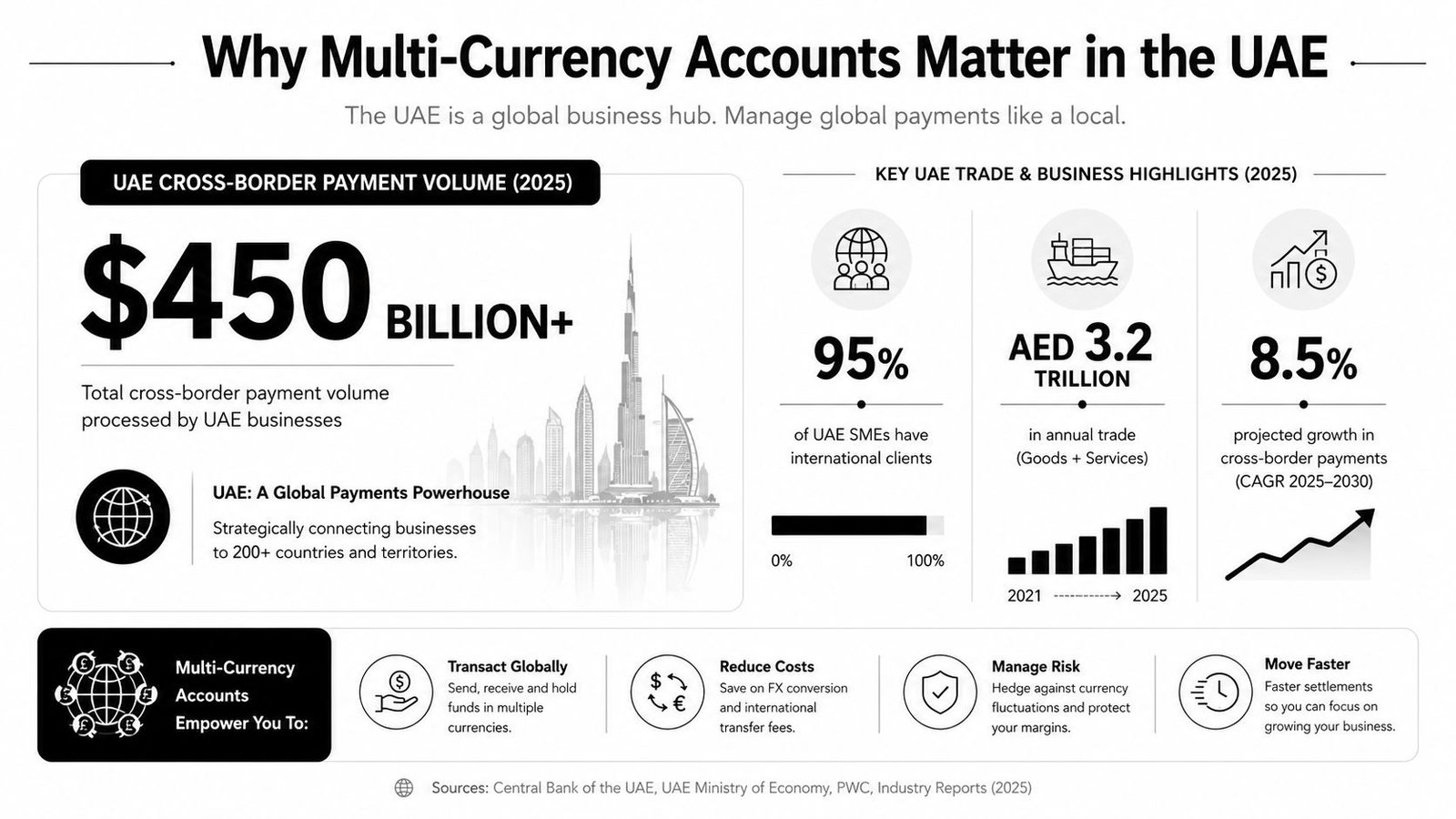
The UAE's cross-border payment volume makes this a treasury decision, not a convenience feature. When a market processes AED 12.8 trillion in external payments and receipts in a single year, the practical reality is that many businesses are already living in more than one currency, whether they like it or not (TopMoneyCompare, citing the Central Bank of the UAE 2023 Annual Report). That matters in Dubai, Abu Dhabi, Sharjah, and the free zones alike, because suppliers, customers, and payroll obligations often don't share the same currency preference.
Why the dirham peg changes the way founders think
The UAE dirham peg to the US dollar means USD liquidity sits at the centre of a lot of business planning. If you invoice clients in USD, EUR, or GBP but spend in AED, you're managing timing risk as much as currency risk. Holding funds in the original currency until settlement can reduce unnecessary spread costs and cut down on accounting noise when income lands before you've decided what to do with it.
A multi-currency account is best understood as treasury architecture. It lets a founder separate the receipt of money from the decision to convert it, which is useful when invoices settle on different days, vendor terms vary, or payroll is due in a fixed currency. In the UAE, that difference can be the line between clean cash management and a lot of avoidable friction.
Practical rule: if your business receives money in one currency and pays out in another, the account structure should be planned before the bank application goes in.
Why this matters for SMEs and new entities
For founders and SMEs, the issue is rarely “Can I receive foreign currency?”. The core issue is whether the setup supports trade, payroll, supplier payments, and regional expansion without forcing separate accounts for every market. The UAE banking sector held AED 4.1 trillion in total assets at end-2023, which shows how large the corporate banking base is for services such as foreign-currency accounts and cash management products (TopMoneyCompare, citing the Central Bank of the UAE 2023 Annual Report).
That scale doesn't remove the need for judgement. A founder selling across borders needs to think about settlement timing, treasury policy, and reporting discipline, not just whether a provider advertises low FX fees. In practice, the best setup is the one that fits your actual payment pattern, not the one that looks simple on a pricing page.
How Multi-Currency Accounts Function
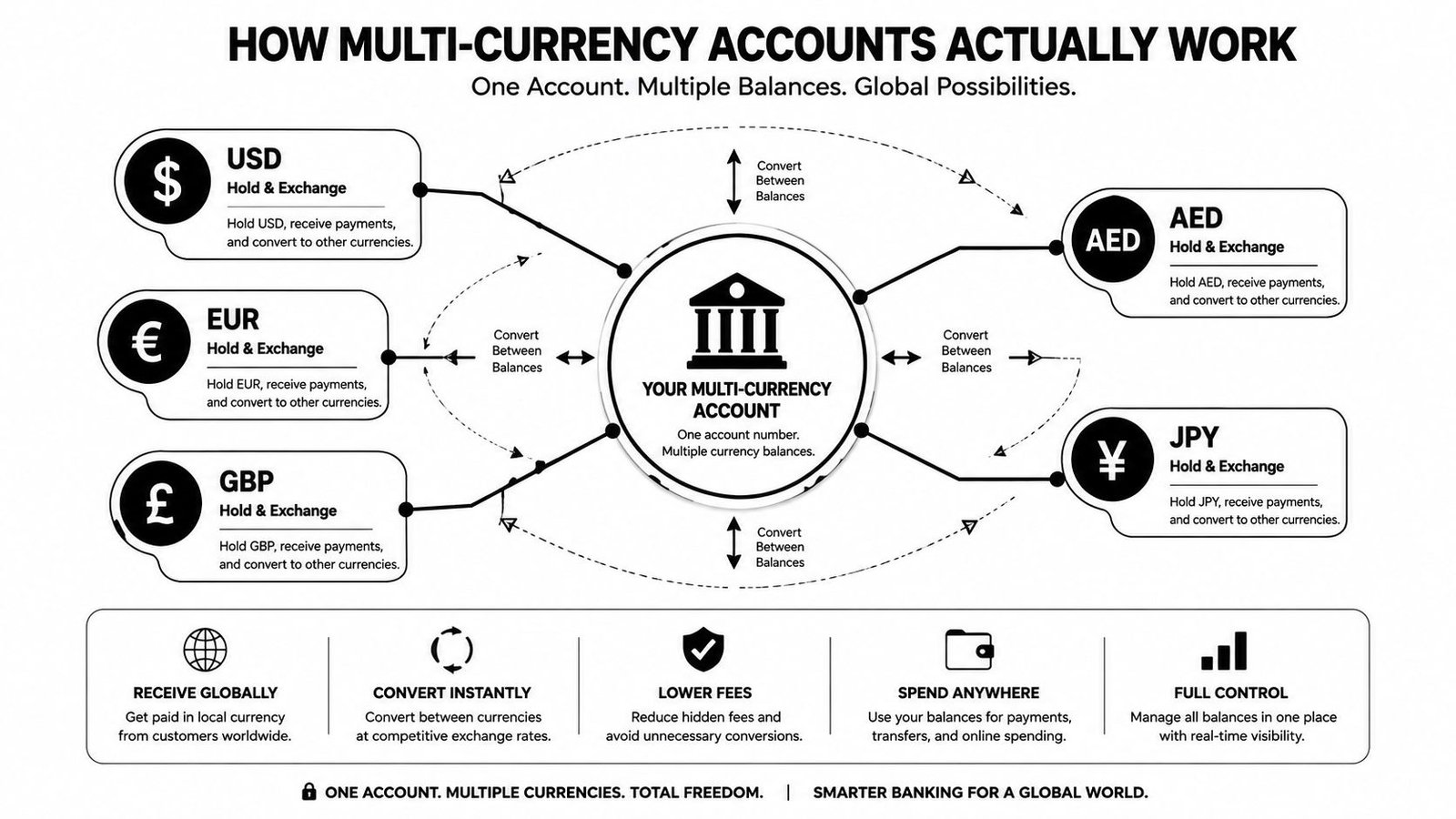
A multi-currency account is a single account structure that holds separate balances for different currencies, often through virtual sub-accounts. A receipt in USD can stay in USD, while a receipt in EUR stays in EUR, until you decide to convert one of them. Oracle's banking documentation describes this structure as a way to consolidate receipts, payouts, and reporting without creating a separate account for every currency (Oracle banking product documentation).
What the operating model looks like
The cleanest way to read the setup is one account, many balances. A customer pays you in GBP, the balance sits in GBP, and your team decides whether to keep it there, convert part of it, or use it for a GBP supplier payment. That centralised model is also the reason these accounts are used to reduce account sprawl and keep processing under one treasury view.
For UAE founders handling collections from overseas customers, that changes the day-to-day operating model. Instead of auto-converting every incoming payment, the business can align conversion with treasury policy, supplier timing, or month-end reporting. That gives finance teams more control over where cash sits and when it changes currency.
Why conversion timing changes the economics
Automatic conversion on receipt can eat margin when you are working across borders. If your supplier invoice is due next week, there is no need to convert the cash today just because it arrived today. In multicurrency accounting, the original-currency transaction is recorded first, then translated later at the relevant rate, which helps preserve accurate ledgers and financial statements (NetSuite multi-currency accounting overview).
Holding the currency first and converting later is basic treasury discipline.
That matters most when your business has predictable foreign outflows, such as vendor invoices, platform payouts, or overseas contractor payments. A well-set-up account lets you act on timing, not on the provider's default behaviour.
Corporate vs Personal and Bank vs Fintech Options
The first decision is whether the account is for a company or an individual. A personal multi-currency account can be fine for travel or occasional receipts, but it usually isn't the right tool for trading, payroll, or supplier payments tied to a UAE business. A corporate account gives you cleaner books, clearer ownership, and a better story when compliance teams ask how the money flows.
The practical differences founders feel
Traditional banks and fintech platforms both offer multi-currency features, but they don't behave the same way. Banks usually bring stronger familiarity with regulated deposit accounts and relationship-managed onboarding, while fintech platforms often move faster and provide better dashboards for day-to-day treasury use. The trade-off is that many fintech offerings are delivered by non-bank payment institutions, which affects how you assess fund protection, KYC, and whether the product is a bank account.
OFX, for example, states that its global business account is not a bank account but a virtual transaction account or non-cash payment facility, while still offering multi-currency balances and local details for some currencies (OFX business multi-currency account). That distinction matters because a founder shouldn't assume every platform with local receiving details has the same regulatory profile or the same hold behaviour.
Comparison table
| Feature | Corporate Bank Account | Fintech Platform |
|---|---|---|
| Account type | Formal business banking relationship | Often a virtual or payment-account structure |
| Onboarding | Usually heavier KYC and document review | Often faster digital onboarding |
| Currency handling | Can support treasury, collections, and local payments | Often better dashboards for multi-currency control |
| Local receiving details | Depends on the bank and market | Can be available for selected currencies or markets |
| Compliance profile | Clear bank framework | May be a non-bank payment institution |
| Best fit | Established entities with deeper banking needs | Startups, cross-border sellers, and lean finance teams |
What works and what doesn't
A fintech platform can work well if your priority is speed, clean UX, and managed conversion control. A corporate bank account works better if your business needs stronger institutional depth, more conventional compliance comfort, or a broader relationship with the bank. The wrong move is trying to use a personal account for business payments because onboarding felt easier. That creates friction later, especially when a bank asks for source-of-funds detail or transaction purpose.
UAE Jurisdiction and Compliance Considerations
Your UAE jurisdiction affects what kind of banking conversation you'll have. Mainland companies are licensed to trade in the UAE market more broadly, Free Zone entities operate under zone-specific rules, and Offshore structures are usually used for holding or international activity rather than local trading. Those differences shape documentation, bank comfort, and the kind of receiving profile a provider is willing to approve.
Why jurisdiction affects banking access
A provider is not just checking whether you have a licence. It's assessing the legal shape of the entity, the business activity, and how the payments will move. That's why a mainland trading company, a consultancy in a Free Zone, and an offshore holding entity can all face different onboarding questions even if they need the same multi-currency features.
Founders often get surprised. Some accounts are easier to open for entities with a clearer operating footprint, while others require more explanation if the business has cross-border income but limited local presence. In the UAE, the quality of your application matters almost as much as the product itself.
Tax and reporting don't disappear with one account
The OECD Common Reporting Standard (CRS) applies across more than 120 countries and treats a multi-currency account as one financial account for reporting purposes, with balances consolidated into a single reporting view (CRS reporting overview). That means banks generally report identity, tax identification number, account balance, and income information annually, rather than separately for each currency balance in the same structure.
For UAE founders, the practical point is simple. Multi-currency convenience doesn't remove reporting obligations, and it doesn't change the need for accurate records. If you're planning to operate in Dubai, Abu Dhabi, Sharjah, or through a Free Zone, the account has to fit both the business model and the compliance story.
If your structure is hard to explain in one paragraph, the bank will probably ask for more documents.
Understanding Fees and FX Mechanics
A multi-currency account can look cheap at first glance and still turn expensive once money starts moving. The test is the full payment cycle, including conversion spreads, inward payment fees, outbound transfer charges, and monthly account fees. For UAE founders, that matters because collections, supplier payments, and treasury balances often move through different currencies in the same week.
How to think about true cost
Start with the exchange rate, then check every point where the provider can take a cut. Some providers earn from the spread on conversion, some from transfer charges, and some from fixed account fees plus add-ons for specific payment types. If your business receives regular international collections, a low-fee account can still become costly when every incoming payment triggers a conversion or a receipt charge.
The accounting side matters too. Foreign-currency transactions are usually recorded first in the original currency, then retranslated at the relevant rate for settlement or reporting. That keeps the books cleaner when an AED ledger has invoices issued in USD, EUR, or another currency that settles at a different time, and NetSuite notes the same basic treatment for multi-currency accounting. Treasury teams and finance managers rely on that structure because it separates the business trade from the later FX movement.
A simple cost checklist
- Conversion spread: check how far the exchange rate sits from the market rate.
- Inbound payment fee: confirm whether local or international receipts attract a charge.
- Outbound transfer fee: ask what it costs to send to suppliers, contractors, or group entities.
- Monthly account fee: don't ignore fixed charges if balances sit idle.
- Currency-by-currency rules: some providers are strong in USD, but thin in other currencies.
The spread is often where the quiet cost sits. A provider may advertise free transfers or no monthly fee, then recover margin through a weaker rate on every conversion. That trade-off can still make sense for a business that only needs one or two currencies, but it is a poor fit for founders using the account as working treasury for collections, payroll, and supplier disbursements across several markets.
If the account will hold balances instead of converting them immediately, ask how each currency is priced and what happens when funds are moved between wallets. Some banks are strong on holding major currencies, while others are better for receiving but less competitive for outgoing payments. The right setup is the one that matches the path your money takes, not the one with the tidiest pricing page.
Step-by-Step Account Opening Checklist
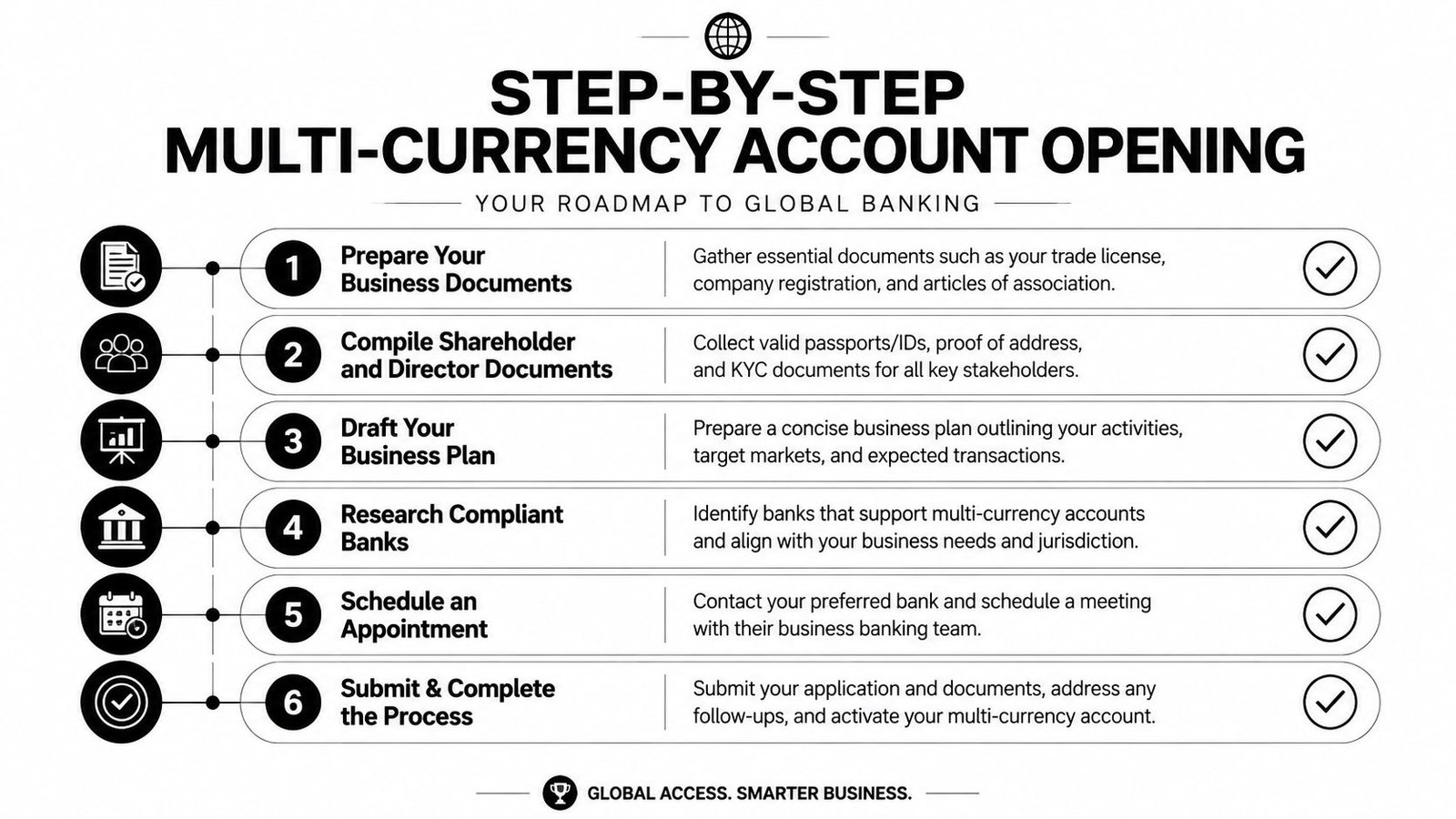
A strong application saves time. Banks and payment providers want to see a real business, a sensible transaction pattern, and a founder who can explain where money is coming from and where it will go. If the paperwork looks rushed, onboarding slows down.
What to prepare before you apply
- Trade licence: have the current licence ready, with the activity clearly aligned to your actual business.
- Memorandum of Association, or MOA: this is the constitutional document that shows ownership and powers.
- Passport copies: gather clear copies for all shareholders and signatories.
- Proof of address: prepare current address evidence for directors and beneficial owners.
- Bank statements: include statements that help explain existing turnover and source of funds.
- Business activity summary: keep it plain, specific, and consistent with the licence.
What KYC teams usually ask about
KYC is Know Your Customer, the compliance review used to verify identity, ownership, and risk. In practice, the team will want to know what you sell, who you sell to, which countries you deal with, and how often funds move. The cleaner your answers, the fewer follow-up questions you get.
Be ready to explain expected transaction volume in qualitative terms if you don't have a long operating history. You should also be prepared for questions about overseas counterparties, especially if the business has customers in several markets or pays suppliers outside the UAE. That is normal, not a red flag by itself.
What slows applications down
Inconsistent documents are the most common issue. If the licence says one activity, the website says another, and the application form says a third, the compliance team will pause. A better application tells one coherent story about the business, the currencies involved, and the payment pattern.
Put the documents in the same language, name the same activities, and keep the payment story simple.
Next Steps for UAE Founders
The right multi-currency account depends on what problem you're trying to solve. If you mainly need cross-border collections, a platform with clean receiving details may be enough. If you need supplier payments, treasury control, and a structure that stands up to compliance review, the account choice needs to fit the company, not just the currency list.
For UAE founders, the decision is usually tied to company setup, jurisdiction, and banking readiness all at once. A Mainland, Free Zone, or Offshore structure can all be valid, but the banking path is different in each case. That's why it helps to plan the entity, the documents, and the payment flow together instead of treating the bank account as an afterthought.
If you're forming in the UAE, relocating, or expanding from Dubai or Abu Dhabi into the wider Gulf, get the banking and compliance piece sorted early. It saves time later, and it keeps the finance side from becoming a bottleneck right when the business starts moving.
Inpro Corporate Services L.L.C. helps founders set up UAE companies, prepare the right documents for banking and compliance, and keep the process clear from the first step. If you want practical support with UAE company formation, visas, and account-opening readiness, visit Inpro Corporate Services L.L.C. and speak with the team about your setup.