


You're ready to sign a lease, transfer a property, amend a licence, or hire someone already in the UAE. Then a new requirement appears in the checklist: NOC. For many founders, that's the moment a simple transaction turns into a compliance puzzle.
The confusing part is that no objection certificate dubai can mean very different things depending on the transaction. In one context, it's no longer broadly needed. In another, it's the document that determines whether your file moves forward at all. That distinction matters because a lot of outdated advice still treats every NOC as if the rules never changed.
A No Objection Certificate is a formal approval letter from the relevant party stating they have no objection to a specific action. That party might be an employer, a developer, a Free Zone authority, a government body, or a sponsor. The practical question isn't “What is an NOC?” It's “Who must approve this exact step, and through which channel?”
Table of Contents
- Your Essential Guide to the No Objection Certificate in Dubai
- The Modern NOC Landscape What Changed and What Remains
- Common NOC Types and Their Business Use Cases
- The Process for Obtaining Your No Objection Certificate
- Common Reasons for NOC Rejection and How to Avoid Them
- How Inpro Streamlines Your NOC and Visa Workflows
- Frequently Asked Questions About Dubai NOCs
Your Essential Guide to the No Objection Certificate in Dubai
The fastest way to understand the no objection certificate dubai system is to stop thinking of it as one universal form. It isn't. It's a category of approvals used across labour, property, licensing, infrastructure, and sponsorship matters.

That matters because the rules changed sharply in employment, but they didn't disappear everywhere else. According to Meydan Free Zone's overview of NOC rules in Dubai, the NOC has been part of UAE regulatory practice since 1971, and UAE Cabinet Resolution No. 1 of 2022 abolished the mandatory NOC for most employment transfers, impacting over 90% of private sector expatriates. The same source also notes that NOCs remain mandatory in 25+ specific contexts, including 100% of Dubai Land Department property transfers.
For founders, that creates a practical split:
- Employment transfer assumptions are often outdated. Many people still believe every job move requires employer consent in the old format.
- Commercial transactions still depend on approvals. Property transfers, certain licence actions, and project-related works can still stop cold without the right NOC.
- The issuer changes from case to case. Your employer, your landlord, your developer, the RTA, a Free Zone authority, or a licensing body may be the party that matters.
Practical rule: Before you prepare documents, identify the transaction first. Property sale, office lease amendment, branch opening, activity change, and visa action each trigger a different approval path.
What works is specificity. Ask for the exact NOC tied to the exact action. What doesn't work is using a generic letter template from another process and hoping an authority will accept it.
A founder setting up in a Free Zone might not need an employment NOC to move roles in the way people once did, but the same founder may still need a landlord, developer, or authority approval to complete a business step. That's why the modern answer to “Do I need an NOC in Dubai?” is usually: for what, from whom, and through which portal?
The Modern NOC Landscape What Changed and What Remains
A founder hires a strong candidate, assumes the old employer must sign off, and loses days chasing a document that is no longer the main issue. In the same week, that founder tries to complete a property or licence step and gets held up because the approval that still matters was never requested. That is the mistake I see most often. People apply old employment rules to current business transactions, or assume all NOCs disappeared after labour reforms.
Before the reforms
Under the older labour framework, employer-issued NOCs often controlled whether an employee could move to another company. That affected hiring speed, resignation planning, and visa transfers. For startups, it created avoidable uncertainty because a candidate could be ready to join while the file still depended on sponsor consent.
After the reforms
The rule set changed for employment matters. According to Rosemont Partners' summary of recent UAE labour law reforms, 2025 reforms further simplified visa transfers by waiving employer NOCs for contract completions or mutual terminations, reducing processing from 10–14 days to 3–5 days. The same source adds that Free Zone-specific NOCs from sponsors are still required for actions like opening a new branch or changing licensed activities.
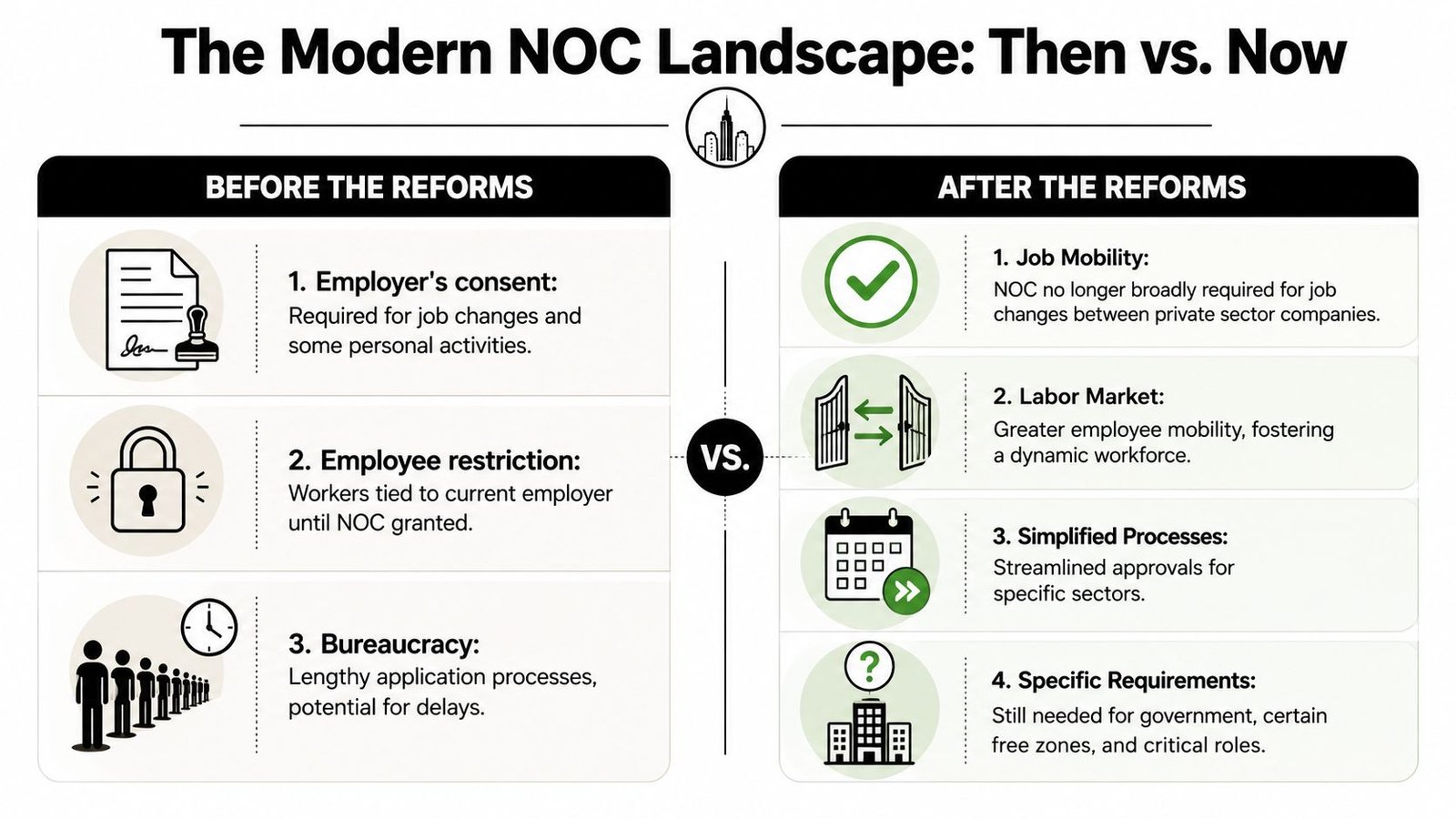
The practical point is simple. Employment NOCs are no longer the default obstacle they once were. Business, property, and authority-specific NOCs still stop transactions every day.
For hiring, the first question is whether the employee transfer falls under the current labour rules. The second question is whether the company structure creates a separate approval requirement through a Free Zone authority, sponsor, or licensing body. Those are different checks, and mixing them up causes delays.
Where NOCs still matter
Several categories still need close attention:
- Property transfers. Developer approval remains part of many DLD-related transfer files.
- Licence amendments. Activity changes, branch approvals, and jurisdiction-specific updates may still require formal consent from the relevant authority.
- Infrastructure and fit-out works. Technical approvals for utilities, roads, or site access often need a separate NOC before work starts.
- Sponsor and dependent matters. Some immigration files still require supporting consent letters depending on the case and the authority reviewing it.
DIY filing often breaks down at this stage. The issue is rarely the idea of an NOC itself. The issue is identifying the correct issuer, matching the wording to the exact transaction, and submitting it through the right channel the first time. A professional PRO service usually earns its fee by preventing the predictable mistakes: wrong signatory, outdated template, missing supporting document, or an application filed under the wrong authority.
The current rules are easier on employment mobility than they used to be. They are not a free pass across every business or property process. Founders who treat NOCs as transaction-specific approvals, rather than one generic document, usually avoid the worst delays.
Common NOC Types and Their Business Use Cases
A founder can clear employment mobility rules and still get stuck on a property transfer, a licence amendment, or a fit-out approval because the wrong NOC was requested. That is the practical distinction that matters now. Employment NOCs have been reduced in many cases, but transaction-specific NOCs still control a lot of business activity in Dubai.
The four categories below come up most often in real files. What changes from one case to another is the issuing authority, the supporting documents, and the level of review behind the approval.
Property NOCs
Property NOCs are usually issued by the developer. They are used to confirm that the developer has no objection to a sale or transfer and that the unit can move forward in the transfer process, subject to the rest of the file being in order.
This is one of the most delay-prone approvals because the problem often sits outside the form itself. Service charges may still be outstanding. A seller may be missing a signatory. Mortgage documents may not match the title details. The transfer appointment may be booked before the developer file is ready. In practice, the NOC is often where a transaction shows whether the parties prepared properly.
Developer fees and turnaround times vary by project and developer. As noted earlier, those costs can be meaningful, so it makes sense to confirm the current fee, signatory requirements, and supporting documents before you book the transfer steps.
Business and licence NOCs
These are the approvals founders run into during company setup, restructuring, expansion, and post-licensing changes. The issuer depends on where the company is registered and what exactly is changing.
Common examples include:
- licence amendments
- activity additions or removals
- branch-related approvals
- office or tenancy-related approvals tied to a licence update
- shareholder or manager changes where an authority, Free Zone, or third party consent is required
The post-reform point is simple. A business or licence NOC is not the old employment NOC in another form. It is a separate approval tied to a corporate action. Founders who miss that distinction often assume a visa rule change means the whole file will be straightforward. It usually does not.
DIY submissions can work for very standard amendments. They slow down quickly when the request involves multiple parties, such as the authority, landlord, master developer, or an external approver. A PRO usually adds value here by checking the exact format, the authorised signatory, and whether the approval must be issued before the main amendment application is lodged.
Infrastructure and utility NOCs
These are technical approvals linked to physical works. If a company is planning fit-out works, utility connections, road access works, trenching, or activity near regulated infrastructure, the relevant authority may require an NOC before work starts.
The review is usually more technical than a standard corporate filing. Drawings, contractor details, method statements, site plans, and authority forms may all be part of the file. Timing can also shift depending on whether comments come back from engineering or operations teams.
This is one area where founders should be careful about assuming their contractor is handling everything. Some contractors prepare the engineering side well but do not control the corporate authorisations or tenancy documents needed to support the request.
Personal and sponsorship NOCs
These still appear in selected immigration, dependent, banking, education, and administrative files. They are less standardised than business or property NOCs because the receiving institution often decides what wording and attachments it wants to see.
A sponsor letter for one authority may not be accepted by another. The signatory title matters. The stated purpose matters. Even a small mismatch between the letter wording and the receiving party's checklist can send the file back for revision.
That is why template hunting is rarely the best approach. The better method is to draft the letter against the receiving authority's current requirement and confirm who must sign it before the file is submitted.
Dubai NOC Quick Reference Guide
| NOC Type | Primary Purpose | Issuing Authority | Typical Fee (AED) | Typical Timeline |
|---|---|---|---|---|
| Property NOC | Clear developer approval for sale or transfer | Property developer | Varies by developer and project | Usually a few working days, if the file is complete |
| Mainland licence NOC | Support licence amendment or related approval | Dubai Economy services / relevant Mainland authority | Varies by transaction and authority | Often depends on the amendment type and document accuracy |
| Free Zone NOC | Support zone-specific licence or office action | Relevant Free Zone authority | Not standardised publicly in the verified data | Often a few working days, subject to the zone's process |
| Infrastructure NOC | Permit regulated works in controlled areas | Relevant authority such as RTA-linked channels or utility authority | Not stated in the verified data | Varies by authority and technical review |
The practical rule is to identify the NOC by transaction, not by name alone. "Need an NOC in Dubai" is too vague to file correctly. A founder who knows the exact action, issuer, signatory, and submission channel will usually move faster. A founder who does not will usually end up paying for urgency later.
The Process for Obtaining Your No Objection Certificate
A founder can have every commercial term agreed, every signature ready, and still lose days because the NOC request went to the wrong authority or used the wrong format. That is the practical reality in Dubai. The process is usually straightforward once the transaction is identified correctly, but small filing errors still cause expensive delays.
The first question is not, "How do I get an NOC?" It is, "Who has the power to object to this step?"
For a property transfer, that is usually the developer or a DLD-linked process. For a Free Zone amendment, it is the zone authority. For regulated works, it may be an infrastructure authority using an eNOC system. For employment matters, founders need to be careful with old advice. Many employment-related NOC requirements were removed under UAE labour reforms, so the right process may now be a standard labour, immigration, or sponsor approval flow rather than a classic NOC letter.
Identify the exact issuer before preparing anything
DIY applications often start to slip at this stage. Applicants gather passport copies, draft a letter, and only then ask where the file should go.
Start from the end transaction instead. If the goal is a visa step, licence amendment, property sale, office move, fit-out, or utility work, identify the authority that will approve that final action. Then confirm what supporting approval that authority expects to see. In practice, that one check prevents a large share of avoidable rework.
Build the document pack around the transaction
There is no universal NOC bundle that works for every case. The supporting documents change with the issuing authority and the purpose of the request.
A clean file usually includes:
- Identity documents: passport copy, Emirates ID copy, and current visa page if relevant
- Corporate records: trade licence copy, establishment documents, or authority-issued company records
- Transaction documents: sale papers, tenancy contract, amendment request, developer form, fit-out details, or contract documents
- Authority proof: signatory ID, company stamp if required, and power of attorney or authorisation letter where someone else is filing
The trade-off is simple. A lean file can move faster if the authority accepts it. A file that is too lean usually comes back for clarification. In higher-friction cases, especially property and infrastructure, it is often better to submit a fuller pack the first time.
Draft the request in the authority's language
Many authorities still want a formal request on company letterhead. What matters is precision. Broad wording such as "for all legal purposes" or "for visa use" creates review delays because the officer has to work out what approval is being requested.
State the purpose clearly, name the beneficiary exactly as it appears on the passport or licence, and match every reference number to the supporting documents.
Use this structure:
Subject: Request for No Objection Certificate
To [Issuing Authority / Department Name],
We request the issuance of a No Objection Certificate in favour of [full name / company name] for the purpose of [specific purpose].
Applicant details:
Passport number: [number]
Emirates ID number: [number]
Visa number, if applicable: [number]
Trade licence number, if applicable: [number]We confirm that the above request is made for [brief transaction description], and we have attached the supporting documents for your review.
For any clarification, please contact [name, phone, email].
Sincerely,
[Authorised signatory]
[Company name]
[Stamp, if required]
One practical point matters here. The signatory must be the person the authority recognises. A well-drafted letter signed by the wrong manager still gets returned.
Submit through the correct system
Dubai does not have one central NOC counter. Submission depends on the type of approval.
A typical route looks like this:
- Infrastructure and utility works may go through an eNOC platform linked to the relevant authority.
- Property transactions may involve the developer, Dubai REST, or another DLD-linked channel.
- Business licence actions are usually filed through the relevant Mainland or Free Zone authority.
- Sponsor or personal approvals may still require a signed letter and supporting identity documents, depending on the case.
Infrastructure requests need extra care. These files are often checked against controlled areas and technical conditions, not just against uploaded documents. In practice, that means a contractor or business owner can be fully ready on paper and still be blocked until the location-based approval is cleared.
If speed matters, this is usually the point where a PRO service earns its fee. A good PRO does not just submit forms. They confirm the issuer, match the signatory, prepare the file in the format the authority expects, and chase the approval through the right channel before the transaction stalls.
Common Reasons for NOC Rejection and How to Avoid Them
Most rejected NOC files aren't rejected because the applicant asked for something improper. They're rejected because the file doesn't line up with how the issuing authority reviews risk, compliance, or responsibility.

The wrong authority or portal
This is the cleanest avoidable error. Applicants often know they need “an NOC” but don't confirm which authority owns the transaction. They submit a business-style request for a property step, or a general sponsor letter for a Free Zone action that needs a portal-issued approval.
Fix it by tracing the transaction backward. Ask which authority will process the final step. Then ask what supporting approval that authority expects to see.
Incomplete or inconsistent paperwork
A missing visa page, a passport close to expiry, a mismatch in company name format, or unsigned company letterhead can all trigger rejection or a return for correction. These aren't dramatic errors, but they waste time because the file goes back into the queue after resubmission.
Use a pre-submission check:
- Check identity data: spelling, passport number, Emirates ID number.
- Check document validity: especially passport and licence copies.
- Check signatures and stamps: where the authority expects them.
- Check purpose alignment: the letter must match the supporting documents.
The quickest way to delay a straightforward NOC is to submit a file that forces the reviewer to ask basic questions the documents should have answered.
Financial or compliance issues not cleared in advance
Property NOCs are a classic example. If there are unresolved charges, mortgage-related issues, or other developer-side clearance problems, the NOC can stall before it's even substantively reviewed. The same logic applies elsewhere when dues, approvals, or prior obligations sit unresolved in the background.
The solution is simple and often ignored. Clear the commercial issue before you start the paperwork.
A request that does not match the underlying licence or transaction
Authorities compare the requested approval to the legal structure already on record. If your request describes an activity, branch action, or occupancy use that doesn't fit the existing file, the authority may reject it or ask for a different path.
DIY applicants lose the most time by drafting the letter around what they want commercially, not around what the current licence, lease, or authority file can support today.
How Inpro Streamlines Your NOC and Visa Workflows
Founders rarely struggle with the concept of an NOC. They struggle with the execution. The actual drain on time comes from choosing the wrong authority, using the wrong wording, assembling the wrong document set, or missing a dependency that only appears after submission.

What a managed process changes
A professional PRO workflow removes guesswork at the start. Instead of asking whether an NOC exists in the abstract, the file is classified by transaction type, jurisdiction, issuing authority, and submission channel. That sounds basic. In practice, it prevents most avoidable delays.
A strong PRO team also works differently from a DIY applicant in one important way. They check the dependencies first. Is there a developer clearance issue? Is the licence wording aligned with the request? Does the receiving authority need a portal-issued approval rather than a generic letter? Those checks save more time than rushing to file.
Where professional handling pays off
The advantage isn't magic access. It's process discipline.
A managed approach usually includes:
- Document control: collecting the right pack before submission, not after a rejection.
- Authority matching: routing the file to the right portal or department the first time.
- Drafting precision: using purpose-specific wording rather than recycled templates.
- Follow-up management: responding quickly to clarification requests and resubmissions.
For founders handling office setup, immigration, licensing, and banking at the same time, that difference is material. The cost of DIY isn't just the application effort. It's the opportunity cost of leadership time diverted into admin.
This short walkthrough shows the kind of document and visa workflow founders often need to coordinate alongside NOC requirements:
The best use of a PRO service is early, before the first submission. Once a file has been rejected, the process usually becomes slower because the authority is no longer seeing a fresh application. It's seeing a corrected one.
Frequently Asked Questions About Dubai NOCs
How long is an NOC valid after issue
There isn't one universal validity period across all Dubai NOCs. The issuing authority, developer, sponsor, or institution sets the usable window. Some NOCs are intended for immediate use in a linked transaction and can become practically stale if the next step isn't completed promptly. The safe approach is to ask for the validity period at the time of issue and align the downstream appointment or filing around it.
Can the issuer cancel or revoke an NOC
Sometimes, yes. It depends on the type of NOC and whether the underlying facts change before the transaction is completed. If the approval was issued based on a condition that later becomes inaccurate, or if a linked clearance is withdrawn, the issuer may refuse to proceed further. That's why it's risky to treat an NOC as a permanent right rather than a transaction-specific approval.
Is an NOC the same as a salary certificate
No. They serve different functions. A salary certificate confirms employment and compensation details. An NOC confirms that the issuer has no objection to a defined action. Authorities and institutions usually won't treat them as interchangeable unless the receiving side specifically states otherwise.
If you'd rather avoid trial-and-error with Dubai approvals, Inpro Corporate Services L.L.C. helps founders and operators handle company setup, licensing, PRO work, visas, and regulatory document workflows with clear timelines and direct execution across Mainland, Free Zone, and Offshore structures.