


Offshore companies in the UAE can still give founders 0% tax on qualifying foreign-source income, asset protection through legal separation, and simpler administration, but they're no longer a shortcut with no oversight. In 2026, the question is whether the structure still fits your activity, reporting profile, and substance obligations.
The surprise is that offshore can be both more useful and more demanding than many older guides suggest. For the right founder, it remains a clean holding and international planning tool in the United Arab Emirates, but the compliance burden now has to be modelled before incorporation, not after.
Table of Contents
- How UAE Offshore Structures Have Evolved
- Three Core Benefits That Still Deliver Value
- Comparing Popular UAE Offshore Jurisdictions
- Structuring Your Offshore Entity for Maximum Benefit
- The Compliance Reality Most Guides Ignore
- Real-World Use Cases and Examples
- Next Steps and Strategic Recommendations
How UAE Offshore Structures Have Evolved
UAE offshore structures were once marketed as a simple answer to tax friction. That pitch is outdated. The benefit still exists, but it only works when the company's activity, ownership, and reporting are aligned with the post-2024 compliance environment.
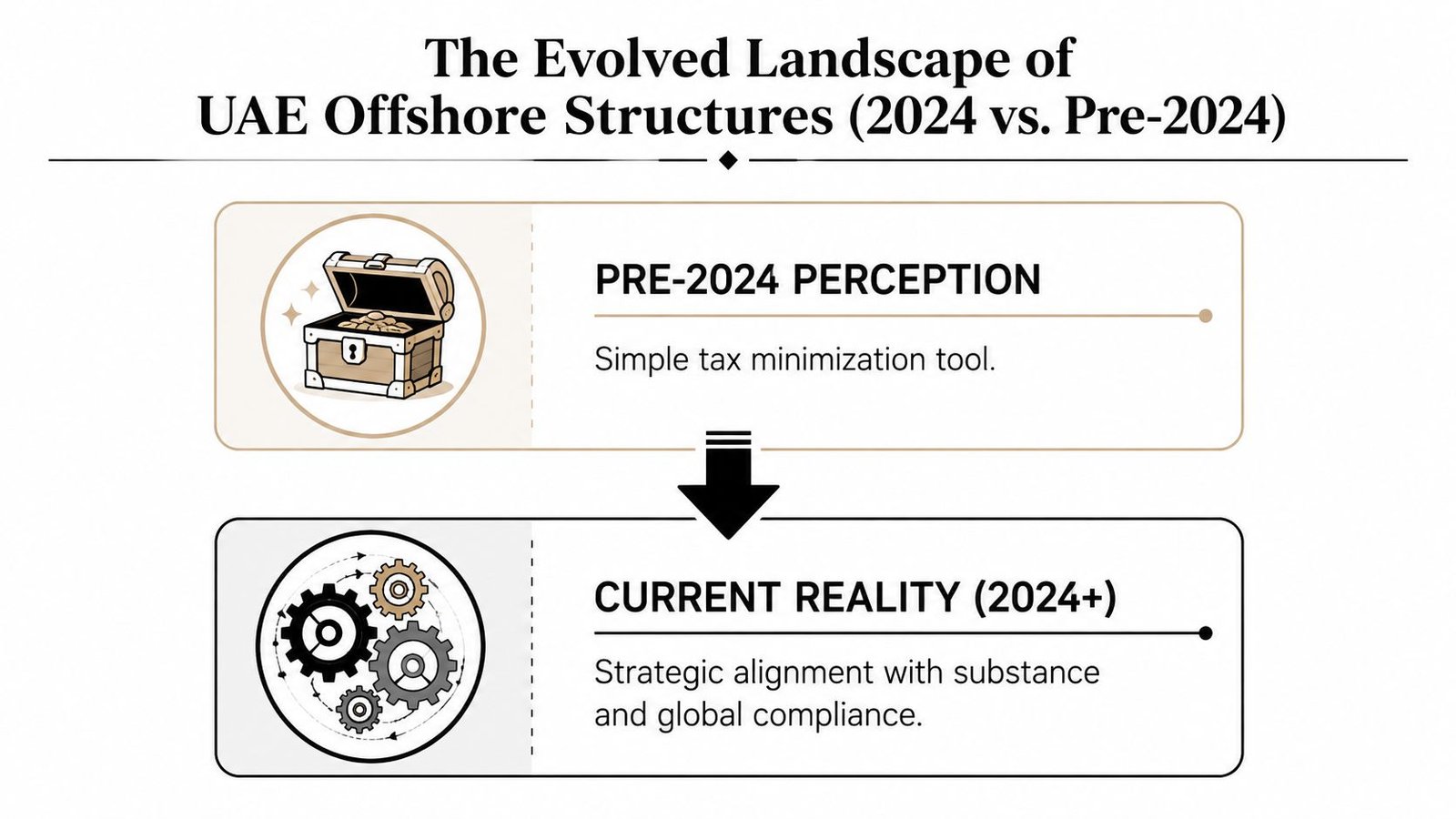
The practical shift matters because offshore is no longer only about incorporation. In the UAE, the 9% federal corporate tax applies to taxable profits above AED 375,000 Kraemer Law, while offshore jurisdictions are still often used as tax-neutral holding vehicles for non-local income when the entity has no UAE onshore business activity and follows the relevant registry and tax rules Offshore Pro.
Governance has also changed. Offshore structures are still used for privacy, asset separation, and international holding, but the old assumption that “offshore” means minimal paperwork is false. Industry references describe simplified administration rather than no administration, and that distinction is what founders miss when they budget for setup but not for maintenance Sterling Offshore.
Practical rule: if your main reason for forming offshore is “zero tax”, pause. If your reason is holding, asset segregation, or international structuring with a compliant footprint, the model can still make sense.
| Requirement | Previous Standard | Current Standard |
|---|---|---|
| Tax treatment | Often marketed as simple zero-tax planning | Must fit UAE corporate tax and foreign-source treatment rules |
| Compliance load | Light filing expectations | More structured reporting, ownership records, and substance review |
| Purpose | General tax minimisation | Tax-neutral holding, asset protection, and cross-border planning |
| Operational profile | Paper company mentality was common | Substance, management, and activity location matter |
| Privacy | Limited disclosure was the headline | Privacy can still exist, but transparency obligations are tighter |
A useful way to read the change is this. Before 2024, many founders asked whether they could “get away with” an offshore company. In 2026, the better question is whether the offshore entity can withstand bank review, tax review, and beneficial ownership scrutiny while still doing the job you need.
Three Core Benefits That Still Deliver Value
The strongest offshore company benefits have not disappeared. They are narrower now, and they only work when the structure fits the business model and the compliance burden has been priced in from the start.
Why tax efficiency still matters
Offshore jurisdictions are still used for tax efficiency and holding activity because many of them charge 0% corporate tax on foreign-source income or otherwise keep tax off profits earned outside the place of incorporation. Research cited by ScienceDaily also noted one academic analysis that found offshore headquarters averaging 11.5% effective corporate tax rates versus 36.5% for offshore subsidiaries. That does not mean every founder gets the same result, but it explains why offshore structures are still selected for planning rather than local operating trade.
For UAE founders, the tax benefit usually works best in holding, investment, and non-local income structures. It works poorly when someone tries to run a domestic UAE trading business through an offshore entity and assumes the label alone creates relief. In practice, the decision is whether the entity is holding value, collecting foreign income, or sitting in the middle of an operating chain that needs a different structure.
Why asset protection remains a real use case
Offshore companies are also used for asset protection because they create legal separation between the owner and the business Ascot International. Legal commentary in the same source also explains that foreign jurisdictions can make it harder for courts to pierce the corporate veil, which supports the basic principle that company assets are generally treated separately from personal assets.
That separation matters for family wealth, intellectual property holding, and cross-border investment. It does not make an owner untouchable, and it does not replace proper contracts, insurance, clean books, or a structure that can withstand banking and beneficial ownership review. For founders who expect disputes, creditor pressure, or multi-jurisdiction ownership later, the value is not secrecy, it is disciplined separation of risk.
Why administration can still be simpler
Many founders still choose offshore because they want less operational drag. Offshore regimes commonly require only basic incorporation and annual renewal mechanics rather than full operating-company compliance, with lower reporting intensity in many cases. That lighter footprint is one reason offshore entities are often used as holding vehicles rather than trading companies.
The value is not “no compliance”. The value is less operating-company complexity when your business genuinely does not need a full onshore footprint.
That said, the compliance trade-off is where founders get surprised. In 2026, the practical burden often shifts from day-to-day filings to ownership records, bank diligence, substance review, and keeping the structure defensible if tax authorities ask why it exists. I tell clients to test the setup against a simple question, can the entity hold its purpose under banking review, tax review, and beneficial ownership scrutiny without creating more work than it saves.
Another practical benefit is transaction efficiency. Offshore jurisdictions often allow zero stamp duty on share transfers, while one comparison notes that Hong Kong limited companies pay 0.2% of share value on transfers GenAcct. For a holding structure where ownership may change later, that can matter more than annual filing chatter.
Comparing Popular UAE Offshore Jurisdictions
Not every offshore registry in the UAE is built for the same outcome. The right choice depends on whether you want a holding company, a privacy-oriented structure, or a vehicle that fits a broader group design across Dubai, Abu Dhabi, or a free zone.
How the main options differ
JAFZA Offshore is usually the best-known UAE offshore option because it sits close to Dubai's commercial ecosystem. It tends to suit founders who want a recognisable UAE structure for holding assets, group ownership, or cross-border planning, especially when banking relationships and counterparties value familiarity.
RAK ICC is often chosen for flexibility and holding use cases. In practice, it's frequently discussed by founders who want a lean structure for international ownership and asset segregation, rather than a vehicle tied to local trading.
Sharjah GlobaLink appears in conversations about newer offshore-style structuring, but founders should check current registry rules carefully before relying on any marketing summary. In UAE structuring, the registry details matter more than the brochure language.
| Jurisdiction | Annual License Range | Banking Access | Best For |
|---|---|---|---|
| JAFZA Offshore | Varies by agent and registry package | Often familiar to regional banks, but still document-heavy | Holding companies, property-linked structures, international founders |
| RAK ICC | Varies by agent and registry package | Can be workable, subject to source-of-funds review | Asset holding, family structures, cross-border planning |
| Sharjah GlobaLink | Varies by agent and registry package | Depends on the bank and supporting documents | Founders seeking an alternative offshore-style UAE setup |
What founders should compare beyond price
Price is only one variable. Banking readiness, renewal process, ownership record handling, and how the structure will look during due diligence matter just as much as the setup fee.
A founder in Dubai who plans to hold shares in multiple operating companies may prefer a registry that banks and lawyers recognise quickly. A family office in Abu Dhabi may care more about asset segregation and document discipline than brand familiarity. A freelancer or consultant with no UAE clients may care most about clean administration and avoiding unnecessary local trading exposure.
The mistake I see most often is choosing the cheapest option first, then discovering the bank, auditor, or counterparties want a different level of substance. That becomes a hidden cost very fast.
Structuring Your Offshore Entity for Maximum Benefit
A good offshore structure starts with the business purpose, not the incorporation form. If the purpose is unclear, the entity usually becomes expensive to defend later.
Start with the activity, not the jurisdiction
First, define whether the entity will hold shares, own intellectual property, receive foreign dividends, or sit between operating companies. Activity designation is the simplest way to keep your structure coherent. If the company is only meant to hold assets, don't give it trading habits that contradict that role.
Second, map where management will happen. Tax and banking review often look at who signs, who directs, and where decisions are made. If the company is incorporated in an offshore registry but effectively run as an onshore trading desk, the structure can lose its logic.
Keep the ownership chain clean
A clean ownership chain is easier to defend than a tangled one. Single holding companies work well when you want one entity to own shares, receive distributions, or centralise family assets. Multiple entities make sense when you need risk separation, but only if the added complexity has a real commercial reason.
Good structures have a story that matches the paperwork. When the commercial story, board minutes, bank files, and ownership records all tell the same story, due diligence becomes much easier.
Match documentation to the benefit you want
If the main goal is foreign-source tax treatment, document why the income is foreign, why the entity sits offshore, and why it doesn't have local UAE trading activity. If the main goal is asset protection, keep contracts, registers, and separation documents tidy so the corporate veil is not weakened by sloppy behaviour.
Common mistakes are easy to spot. Founders mix personal and company expenses, use the offshore entity for UAE operating revenue, or leave directors and signatories unrecorded. Those habits don't just create compliance noise, they weaken the core argument for the structure.
The Compliance Reality Most Guides Ignore
Offshore still works, but only for founders who treat compliance as part of the structure, not an afterthought. The old idea that you set up an entity once and leave it untouched does not hold up in the UAE.

Why substance now matters more
The question is whether an offshore company still delivers value once economic substance, beneficial ownership disclosure, and corporate tax rules are in play. It can, but only if the structure matches the activity. The benefit now turns on structure, activity location, and reporting profile, not on the incorporation label alone.
That is the hidden cost many guides leave out. Founders plan for registration, then find they also need disciplined recordkeeping, renewal control, and a management story they can defend if a bank, regulator, or tax authority asks for it.
What to check before you form the company
Before you form the company, check the points that usually decide whether the structure holds up in practice.
- Tax profile: Will the income be foreign-source, or is there a genuine UAE trading element?
- Decision-making: Where will management and control sit?
- Ownership records: Are beneficial owners documented clearly?
- Banking file: Can you explain source of funds without improvising?
- Operational purpose: Is the entity holding, protecting, or trading?
The more “no” answers you have here, the more likely the offshore structure is the wrong fit. If you need an active UAE trading presence, a mainland or free zone setup may be cleaner and easier to defend.
What offshore won't fix
It will not remove tax obligations in the owner's home country, and it will not repair poor bookkeeping. It also will not make bank due diligence go away. Offshore is a planning tool, not a shield from practical compliance.
The founders who do best with offshore think in governance terms. They know why the entity exists, who controls it, what income it receives, and how they will prove that story later.
Real-World Use Cases and Examples
The strongest use cases are usually boring in the best possible way. They're built around ownership, holding, and international activity, not flashy tax slogans.
An e-commerce founder with non-UAE buyers
A founder selling into Europe and North America may use an offshore company to hold the brand and receive foreign revenue, while keeping local UAE activity out of the structure. The benefit is cleaner international ownership and simpler separation between the company and personal assets.
That founder still needs a bank file, records for source of funds, and a clear explanation of where fulfilment, marketing, and management happen. If orders are fulfilled from the UAE, the structure needs to be checked against the actual business flow.
A family holding structure
A family with assets in several jurisdictions may place shares, property interests, or investment holdings in one offshore vehicle. The practical value is legal separation and easier cross-border administration.
Offshore structures often shine. A holding company can centralise ownership, reduce transfer friction later, and make succession planning easier, provided the family keeps records and signatory powers organised.
A consulting business serving non-UAE clients
A professional services firm with mostly foreign clients may use offshore for billing and ownership, but only if the work is non-local. The offshore company helps with international administration and can fit a cross-border client base.
This model fails when the business is really serving the UAE market. If the clients, staff, and delivery point are in Dubai or Abu Dhabi, an offshore label won't change the underlying operating reality.
A startup holding intellectual property
A tech founder may use offshore to own software rights, trademarks, or licensing arrangements. That can help separate the IP from the operating entity and create cleaner international licensing flows.
The caution is simple. IP ownership only works if the contracts, transfers, and valuation logic are documented properly. A loose arrangement can be harder to defend than no structure at all.
Next Steps and Strategic Recommendations
Start with one question, not ten. Does your business earn foreign-source income, hold assets, or need a cross-border ownership vehicle? If the answer is yes, offshore may be worth a closer look. If the answer is mixed, compare it against a free zone or mainland company before you commit.
Then choose the jurisdiction based on your banking needs, ownership model, and how much ongoing maintenance you can handle. Don't choose by reputation alone. Choose the setup that gives you the cleanest path through tax, compliance, and administration.
Before incorporation, ask service providers three things. What filings will I need each year, what banking documents will I need ready, and what activity would make this structure inappropriate? Those answers tell you more than a glossy sales page ever will.
If you want an offshore structure that holds up in the UAE and the wider United Arab Emirates compliance environment, work with a team that handles setup, visas, PRO support, and regulatory paperwork together. Inpro Corporate Services L.L.C. can help you compare jurisdictions, map the compliance load, and set up the right structure without guesswork. Visit Inpro Corporate Services L.L.C. to get started with a practical UAE setup discussion.