


You're considering an offshore company in the UAE because you want a clean way to hold shares, intellectual property, or overseas assets, but you're unsure whether it will also let you trade, open a bank account, or obtain residency. In most cases, a UAE offshore company is a holding and cross-border ownership vehicle, not a local operating company, and the right choice usually comes down to RAK ICC or JAFZA Offshore, your asset strategy, and your compliance profile.
Table of Contents
- Introduction to Offshore Companies in the United Arab Emirates
- What an Offshore Company Is and How It Works
- RAK ICC vs JAFZA Offshore and Other Options Compared
- Benefits and Limitations You Should Weigh Before You Decide
- Compliance Banking and Nominee Considerations in 2026
- When to Choose Offshore vs Mainland vs Free Zone
- How to Set Up Your Offshore Company Step by Step
Introduction to Offshore Companies in the United Arab Emirates
An offshore company in the United Arab Emirates is a legal entity incorporated in the UAE for activities conducted mainly outside the country. Founders commonly use it to hold shares in other companies, own intellectual property, manage foreign contracts, or separate assets from an individual's personal ownership.
That purpose is easy to confuse with a normal UAE business licence. A mainland company can serve customers across Dubai, Abu Dhabi, Sharjah, and the wider United Arab Emirates. A free zone company can support certain local and international activities, subject to its licence and market-access rules. An offshore company generally isn't designed to invoice UAE customers, lease an operating office, or sponsor employee visas. UAE offshore structures are generally restricted from local business activity and visa sponsorship.
The UAE offshore market has two main regimes, RAK ICC, meaning Ras Al Khaimah International Corporate Centre, and JAFZA Offshore, meaning the offshore regime linked to Jebel Ali Free Zone Authority in Dubai. They aren't interchangeable labels. Their legal rules, property implications, registry experience, and practical fit can differ.
A major change arrived in 2024, when Emiri Decree No. 12 of 2024 amended the RAK ICC framework to allow RAK ICC companies to own freehold property in designated areas of Dubai. That expanded a right long associated with JAFZA Offshore and changed how founders should assess property-holding structures. The 2024 RAK ICC property development and the wider offshore framework are discussed by Ancova Associates.
Tax also changed the conversation. The UAE Corporate Tax regime was introduced under Federal Decree-Law No. 47 of 2022, so an offshore label no longer guarantees a tax-free outcome. The result depends on the entity's actual income, activities, counterparties, and any UAE permanent establishment.
Practical rule: If you need a UAE licence to sell locally, hire staff, obtain employment visas, or operate from premises, start by testing mainland and free zone options. If you need a corporate owner for assets or international contracts, offshore may be a better starting point.
This guide explains how the structure works, compares RAK ICC with JAFZA Offshore, then covers benefits, limits, banking, beneficial ownership, tax, economic substance, and setup steps.
What an Offshore Company Is and How It Works
What is an offshore company in the UAE?
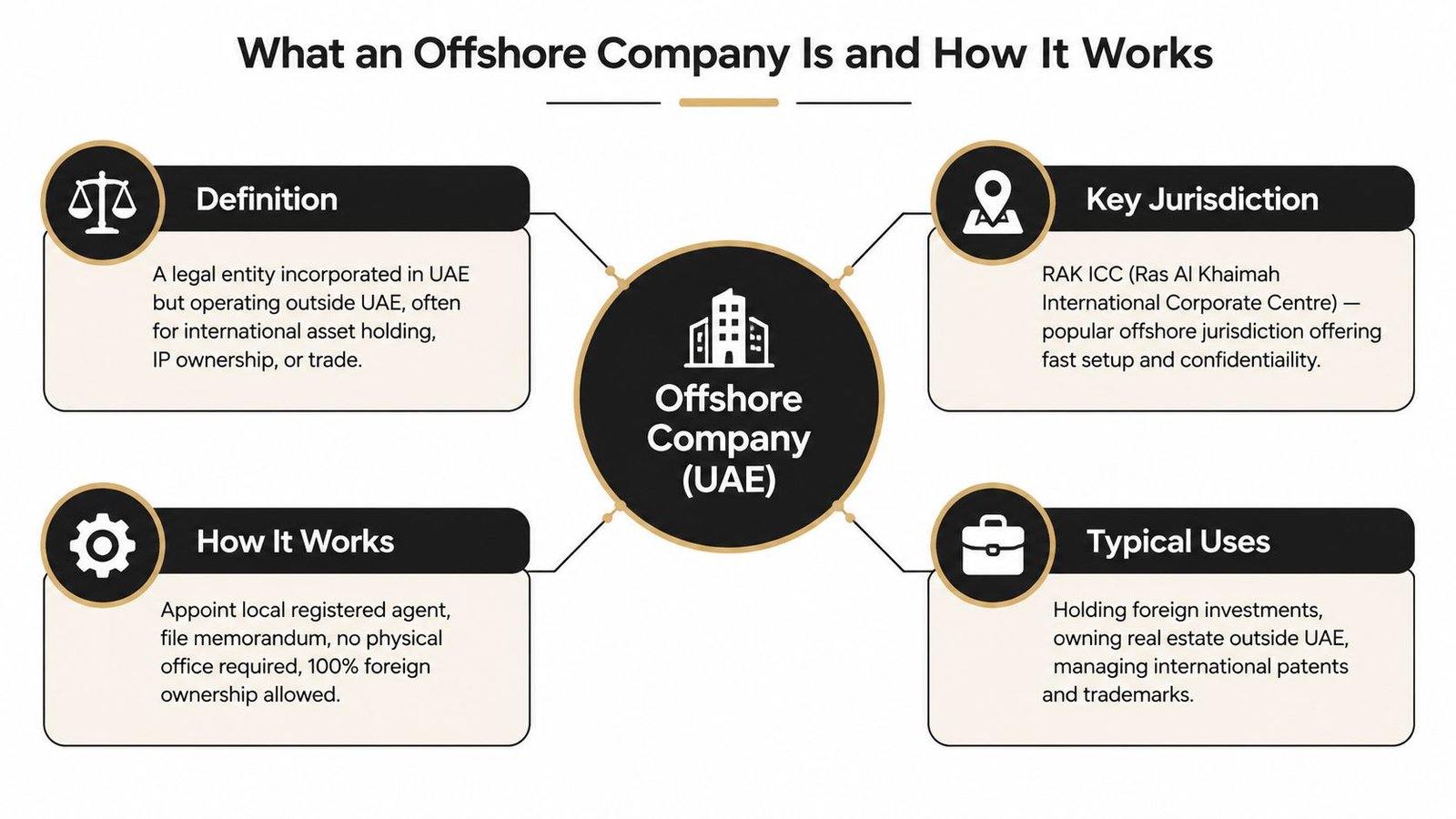
An offshore company is a legal entity incorporated in a UAE offshore jurisdiction but intended to operate outside the UAE. It can hold shares, intellectual property, foreign investments, or overseas contracting rights without functioning as a conventional shop, consultancy, or trading office in Dubai or Abu Dhabi.
A simple analogy helps. Think of offshore as a secure vault, while mainland and free zone companies are more like shops with doors to customers. The vault can own valuable items and organise ownership, but it isn't automatically permitted to welcome local customers, employ staff, or run a UAE-facing operation.
RAK ICC and JAFZA Offshore are the two principal UAE offshore regimes. RAK ICC is based in Ras Al Khaimah, while JAFZA Offshore is associated with Dubai's Jebel Ali business environment. Both are separate from mainland entities registered through an emirate's economic department and from ordinary free zone companies licensed for specific activities.
How does the structure operate?
The company normally works through a registered agent. The founder provides identification, ownership information, corporate documents, and the intended business purpose. The agent supports incorporation, statutory records, and communication with the relevant registry.
An offshore entity generally doesn't need a physical operating office in the UAE. It also doesn't receive a commercial licence for ordinary local trading, and incorporation doesn't create a right to UAE residence visas for directors, investors, or employees. A comparison of RAK ICC and JAFZA Offshore describes these entities as lean structures without the premises, visas, or commercial licence associated with operating companies.
What can an offshore company hold?
Common uses include:
- Shares: The company can hold ownership interests in other companies, including international subsidiaries or, where permitted, UAE property-owning structures.
- Intellectual property: A founder may place patents, trademarks, or other intellectual property under a corporate owner and license them to operating businesses.
- Foreign contracts: An offshore company may be suitable for contracting with counterparties outside the United Arab Emirates, subject to tax, legal, and banking advice.
- Investment assets: It can provide a separate legal owner for overseas investments or family assets.
The important distinction is between ownership and operation. Owning shares in a business isn't the same as conducting that business. Holding intellectual property isn't the same as providing local services. An offshore structure can support the first part, but the operating activity may require a mainland or free zone company.
That distinction also affects banks. A bank will want to understand who owns the company, what assets it holds, where money comes from, and why the UAE structure is commercially appropriate. A vault still needs a clear ownership record and a credible explanation of what it contains.
RAK ICC vs JAFZA Offshore and Other Options Compared
How do RAK ICC and JAFZA Offshore differ?
RAK ICC and JAFZA Offshore serve similar broad purposes, but their practical strengths aren't identical. RAK ICC is often chosen for international holding structures, while JAFZA Offshore can be attractive when a founder's plan is closely linked to Dubai property or the Jebel Ali business ecosystem.
RAK ICC is widely described as the largest UAE offshore registry. One industry source reported that it had processed more than 40,000 incorporations across 160 nationalities by 2026. The same source listed RAK ICC incorporation fees at AED 3,250, annual renewal at AED 3,950, and incorporation at about one business day once a complete application was filed. These RAK ICC scale, fee, and timing benchmarks are published by JB Consultants.
JAFZA Offshore remains relevant where Dubai property ownership and established commercial relationships matter. After Emiri Decree No. 12 of 2024, RAK ICC companies can also own freehold property in designated areas of Dubai, so property investors shouldn't assume that JAFZA is the only possible route. The actual property, title, lender, and registry requirements still need checking before incorporation.
Which registry fits your priority?
| Feature | RAK ICC | JAFZA Offshore |
|---|---|---|
| Primary fit | International holding, share ownership, intellectual property, and foreign contracting | Holding and asset structures connected to Dubai and the Jebel Ali ecosystem |
| Registry scale | Widely described as the largest UAE offshore registry | Established Dubai-linked offshore regime |
| Indicative incorporation benchmark | AED 3,250, with annual renewal at AED 3,950, according to an industry listing | Confirm current fees directly for the proposed structure |
| Indicative timing | About one business day after a complete application, according to the same listing | Timing depends on documents, agent review, and registry processing |
| Dubai freehold property | Permitted in designated areas following Emiri Decree No. 12 of 2024 | Historically associated with this property-holding capability |
| UAE residence visas | Not provided by the offshore entity | Not provided by the offshore entity |
| Local operating licence | Not provided | Not provided |
A founder should treat the table as a decision aid, not a substitute for checking the asset and transaction. Property ownership can involve developer rules, title registration, lender consent, and restrictions attached to a specific designated area. Banking decisions also depend on the owners, source of funds, business model, and expected transactions rather than the registry name alone.
Should you compare offshore with mainland and free zone?
Yes. Offshore is a separate category, not a cheaper version of a free zone licence. Mainland companies operate through the relevant emirate's economic authority and generally provide the broadest route to UAE customers. Free zones offer activity-specific licensing and can suit international or sector-focused businesses.
The United Arab Emirates also removed the old general requirement for Emirati shareholders in onshore companies, changing the ownership mechanics for founders comparing mainland, free zone, and offshore structures. Baker McKenzie's UAE business guide discusses mainland, free zone, and offshore structures and the change to onshore foreign ownership.
Benefits and Limitations You Should Weigh Before You Decide
What are the main benefits?
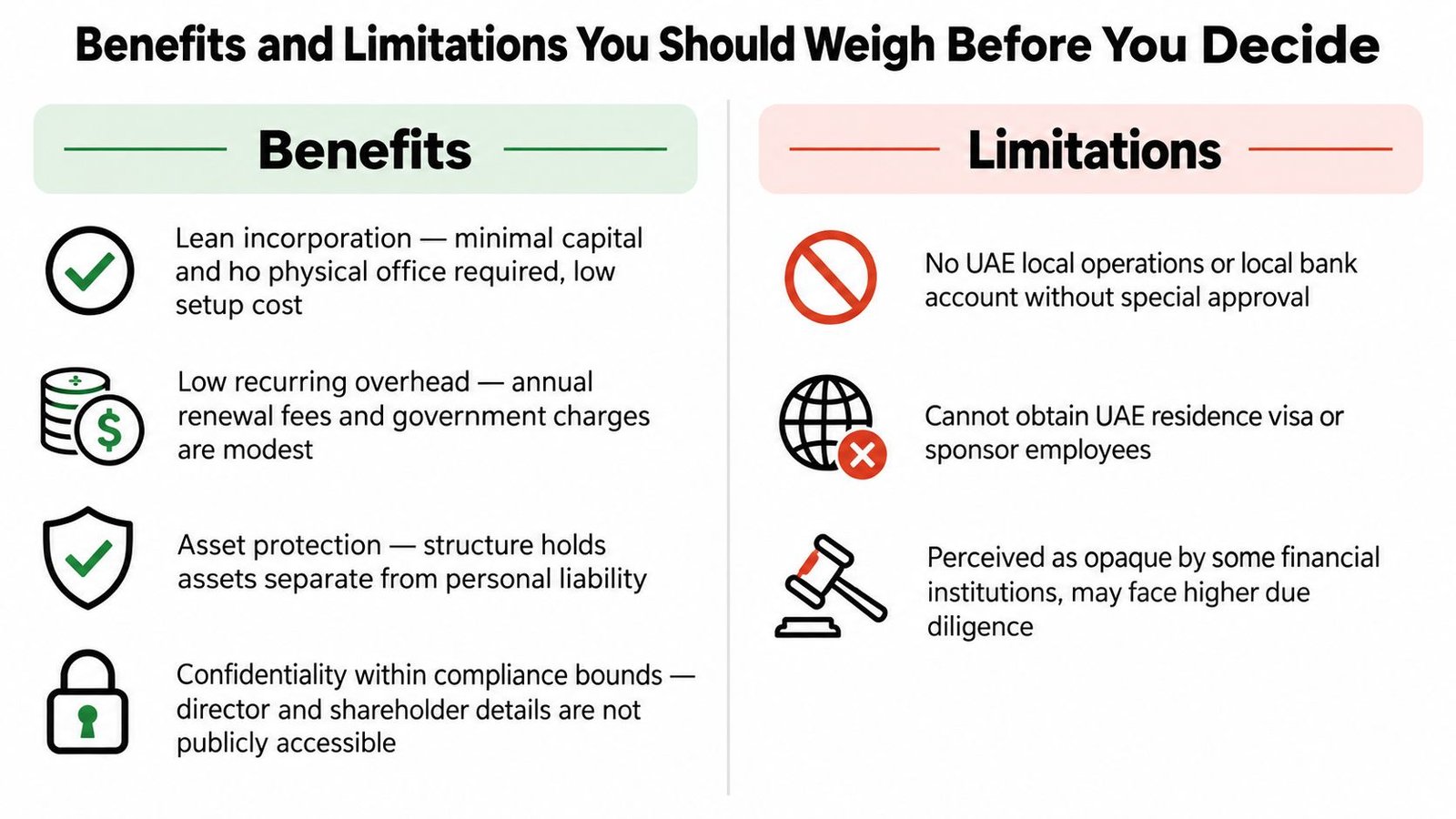
An offshore company can keep a holding structure lean. It usually doesn't require an operating office, employee visa allocation, or the same premises-based setup associated with a mainland business. That can make it suitable for an investor who wants a corporate owner for shares, foreign property, or intellectual property rather than a UAE trading platform.
The legal separation can also help organise ownership. Assets held by the company belong to the company, subject to applicable law, creditor rights, disclosure duties, and proper administration. This isn't a guarantee against every personal claim, and it doesn't replace estate planning, insurance, or advice in the country where the asset is located.
Other practical benefits include:
- Cross-border ownership: The structure can hold international investments or shares in foreign companies.
- Administrative simplicity: A passive holding company may have fewer operational moving parts than a staffed trading business.
- Ownership planning: Multiple founders or family members can hold interests through shares, subject to accurate beneficial ownership records.
- Property structuring: RAK ICC companies may now own freehold property in designated Dubai areas under the 2024 legal change.
Confidentiality has limits. Beneficial ownership must be identified and kept current, and banks, registrars, tax authorities, and other competent bodies may require information. Privacy should mean orderly disclosure to the right parties, not hiding the person who controls the company.
What can't an offshore company do?
The limitations are often more decisive than the benefits. UAE offshore companies are generally not allowed to conduct business activity inside the UAE, and they can't use the structure to obtain employee or director visas. They also typically aren't designed for a UAE commercial premises or local trading licence. GSL's overview of UAE offshore zones outlines these operating restrictions.
An offshore entity therefore isn't suitable for a consultant billing Dubai clients from a UAE office, a restaurant serving Abu Dhabi customers, or an e-commerce company selling directly into the local market under its own UAE operating licence.
Remember the distinction: An offshore company is closer to a vault for ownership. A mainland or free zone company is closer to a shop with customers, staff, premises, and an operating licence.
Tax is another limitation to plan properly. Under Federal Decree-Law No. 47 of 2022, offshore companies aren't automatically exempt from UAE Corporate Tax. UAE-sourced income can be subject to the standard 9% corporate tax rate, depending on the company's structure and activity. The analysis can also consider whether the company has a UAE permanent establishment, where the income arises, and how counterparties are located. Ancova Associates explains why offshore status alone doesn't determine the UAE tax result.
A structure that holds foreign shares passively may have a different profile from one that contracts with UAE customers, directs local operations, or earns mainland-linked revenue. That difference should be assessed before incorporation, not after a bank or tax authority asks questions.
Compliance Banking and Nominee Considerations in 2026
Who is the ultimate beneficial owner?
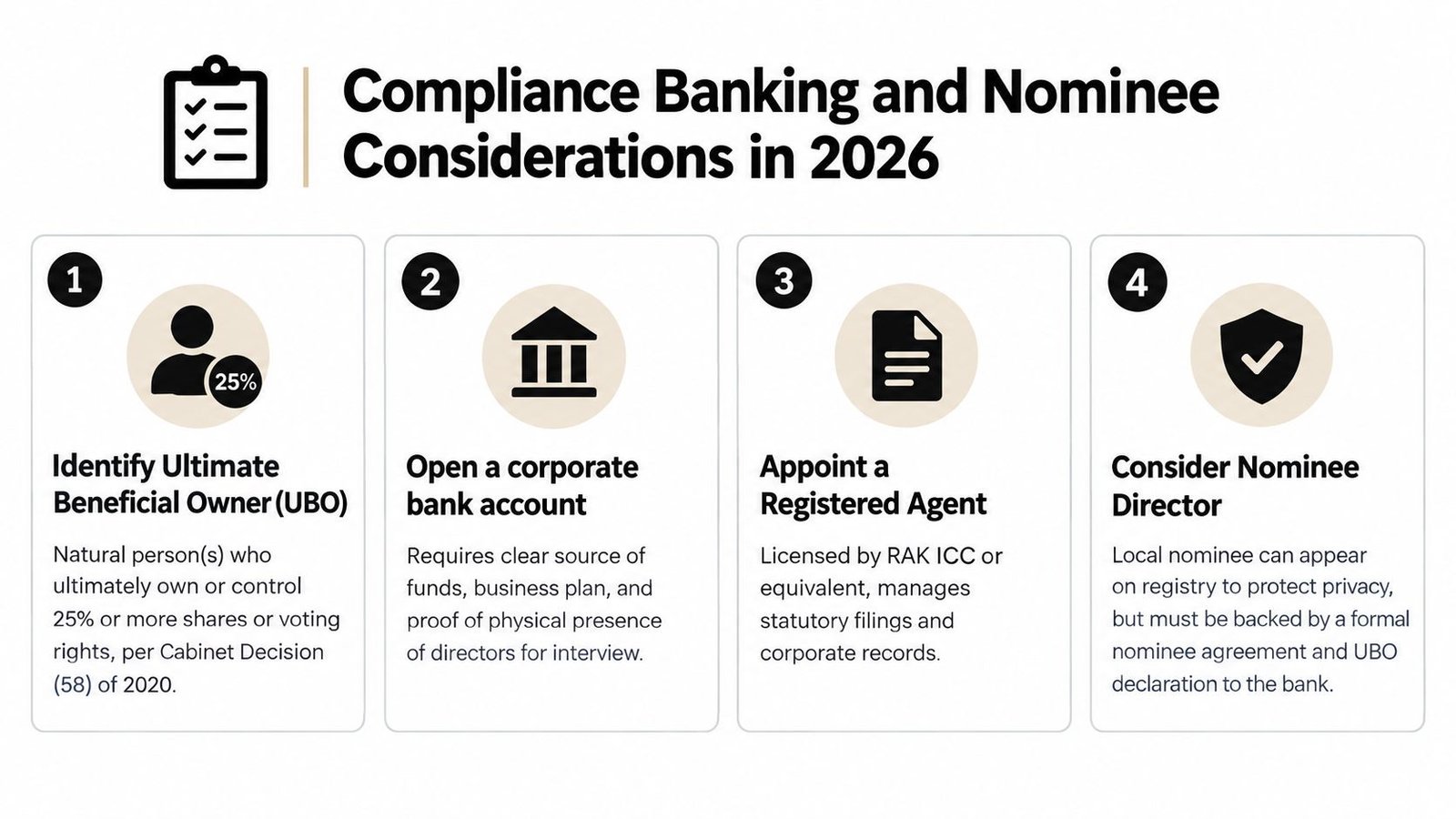
An Ultimate Beneficial Owner, or UBO, is the natural person who ultimately owns or controls a company. Under Cabinet Decision No. 109 of 2023, control can arise through direct or indirect ownership, voting rights, or other means of control. If no individual meets the control test, the senior managing official becomes relevant. Boru Consulting explains the control-based UBO approach for UAE legal persons.
The UBO rules apply to UAE mainland, commercial free zone, and offshore companies, while the framework described in the cited guidance excludes entities in the Dubai International Financial Centre, or DIFC, and Abu Dhabi Global Market, or ADGM. A nominee director or shareholder doesn't replace the owner. The company must maintain a UBO register, a shareholder or partner register, and a nominee director register at its registered office in the UAE, keeping the information accurate and current. Lexology records the effect of Cabinet Resolution No. 109 of 2023 and its registers.
Why do UBO records affect banking?
Banks perform Know Your Customer, or KYC, checks before opening and maintaining corporate accounts. They need to understand the ownership chain, the source of funds, expected transactions, business purpose, and the people who control the account.
Incomplete records create friction. If the incorporation documents name one person, the UBO declaration identifies another, and the bank application presents a third explanation, the compliance team may pause the application or request additional evidence. A nominee can be lawful when properly disclosed, but it can still lead to more questions because the bank needs to understand the relationship between the nominee and the person giving instructions.
A sensible banking file should tell one consistent story:
- Ownership: Show the full chain until it reaches the natural person or persons who control the company.
- Source of funds: Explain how the initial capital and expected receipts were generated.
- Commercial purpose: Match the company's stated purpose to its assets, contracts, and expected payments.
- Management: Identify directors, authorised signatories, and the people making decisions.
- Documents: Keep passports, corporate records, agreements, and declarations consistent.
The bank account isn't an automatic consequence of incorporation. It is a separate approval decision based on risk, evidence, and the bank's policies.
When can economic substance rules matter?
The UAE Economic Substance Regulations can apply to mainland, free zone, and offshore entities carrying on relevant activities. Where the rules apply, the company may need to file annual notifications or reports and show adequate people, premises, and expenditure in the UAE. Relevant activity can make a major difference, so a passive holding company shouldn't be assessed in the same way as a finance, leasing, or headquarters-type structure. The UAE Ministry of Finance FAQ explains the scope and substance expectations under the Economic Substance Regulations.
Corporate Tax brings a separate analysis. Income linked to UAE mainland business can trigger the standard 9% rate above AED 375,000, while free zone relief depends on meeting Qualifying Free Zone Person conditions, including adequate UAE substance, qualifying income, and transfer-pricing compliance. The technical treatment of offshore income and mainland-linked activity is outlined by UAE Offshore.
For a founder, the practical sequence is straightforward. Map the income, identify where the counterparties are located, record who performs each function, assess any UAE permanent establishment, and prepare the evidence before opening the bank account or signing contracts.
When to Choose Offshore vs Mainland vs Free Zone
Which structure fits a holding company?
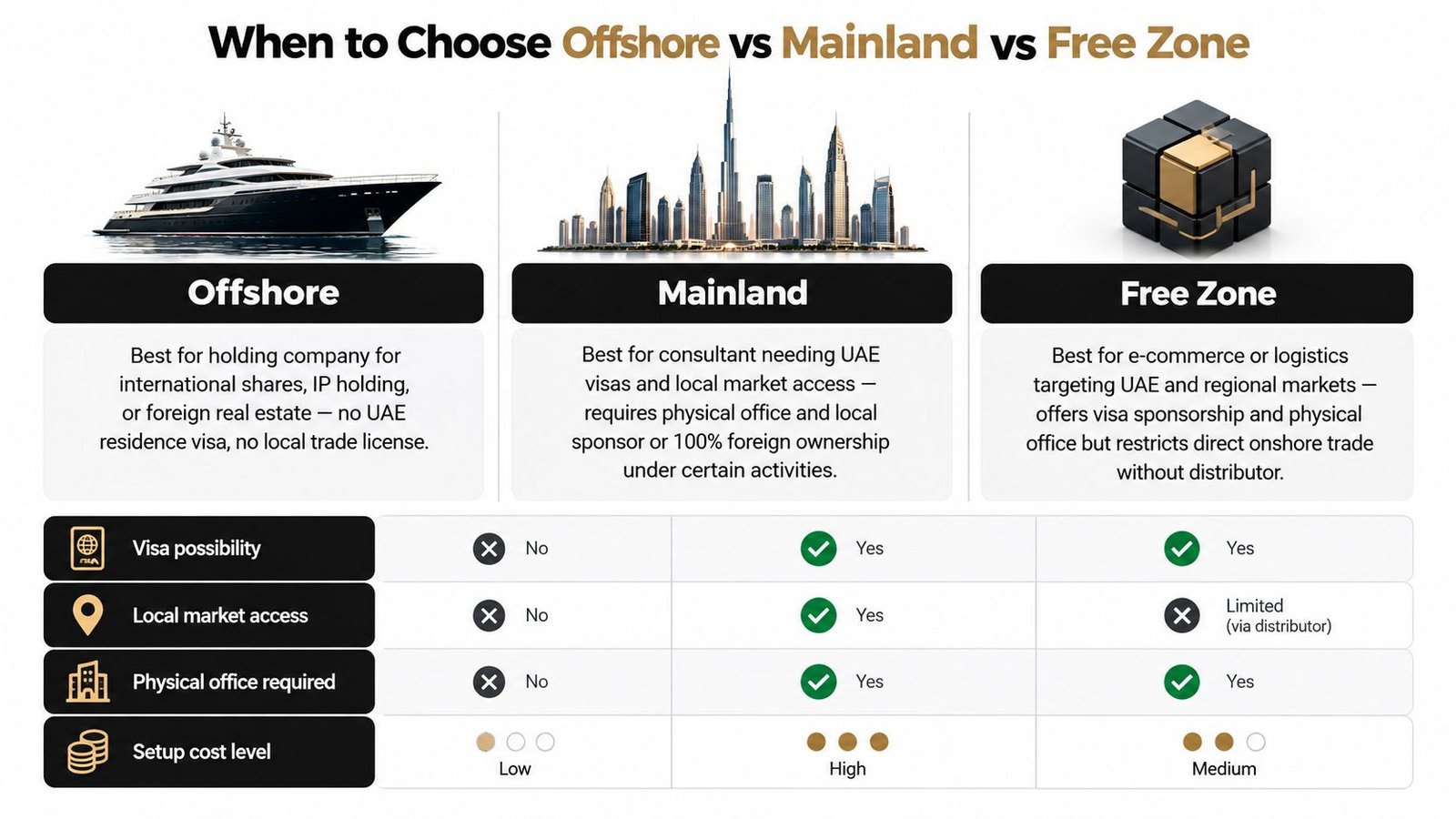
Choose offshore when the main purpose is holding international shares, intellectual property, or foreign property and the company won't conduct ordinary UAE trading. The structure can sit above an operating company, but the ownership chain and tax treatment need to be documented clearly.
Choose mainland when you need direct UAE market access. Mainland is generally the practical route for a consultant serving local clients, a clinic, a restaurant, a construction company, or a business seeking contracts in Dubai, Abu Dhabi, or another emirate. It also fits founders who need employee visas, an operating office, local invoicing, or direct customer relationships.
A free zone company sits between these models. It can provide a licensed UAE base, premises options, and visa sponsorship, while its permitted activities and ability to trade directly on the mainland depend on the relevant free zone and business model.
What should a founder ask before choosing?
Use these questions rather than starting with the cheapest package:
- Do you need UAE residence? Offshore won't sponsor an investor or employee residence visa. Mainland or free zone may fit better, while a qualifying Golden Visa is a separate route.
- Will you invoice UAE customers directly? If yes, test mainland licensing first and obtain advice on any free zone restrictions.
- Will you employ staff? Offshore isn't an employer platform. A business with an HR team, payroll, or growing headcount usually needs an operating entity.
- Do you need premises? Offshore generally doesn't provide a commercial office. A mainland or free zone licence is more suitable for a physical workplace.
- Are you holding property? Compare the specific property rules for RAK ICC and JAFZA Offshore, particularly after the 2024 RAK ICC amendment.
- Where is the income generated? Contract location, management, counterparties, and activity can affect Corporate Tax.
A Dubai-focused e-commerce seller may need a free zone or mainland structure rather than offshore. A freelancer relocating to the UAE and seeking a residence visa also needs an operating licence. An international investor holding shares in companies outside the United Arab Emirates may find offshore more proportionate.
Free zone tax relief isn't automatic either. A Qualifying Free Zone Person, or QFZP, must meet the relevant conditions, including adequate substance, qualifying income, and transfer-pricing compliance. The choice is therefore about the business model, not the registration location.
How to Set Up Your Offshore Company Step by Step
What happens first?
Start by defining the activity and asset. Write down whether the company will hold shares, own intellectual property, hold property, or enter foreign contracts. Then compare RAK ICC and JAFZA Offshore against the asset's location, intended bank, ownership chain, and any Dubai property requirements.
The usual sequence is:
- Select the jurisdiction: Confirm that RAK ICC or JAFZA Offshore permits the intended holding purpose.
- Appoint a registered agent: The agent handles registry communication, statutory documents, and incorporation coordination.
- Prepare KYC and UBO documents: Provide passports, address evidence, ownership details, source-of-funds information, and corporate documents where relevant.
- Reserve the name and file incorporation documents: The agent submits the application and memorandum or equivalent constitutional records.
- Issue shares and complete company records: Record shareholders, directors, beneficial owners, and any nominee arrangements accurately.
- Assess post-setup obligations: Review Corporate Tax registration, Economic Substance Regulations, accounting records, and any filing duties.
- Prepare for banking separately: Build a business profile, explain the expected transactions, and keep ownership and source-of-funds evidence consistent.
How much does it cost and how long can it take?
For RAK ICC, an industry listing gives a benchmark of AED 3,250 for incorporation, AED 3,950 for annual renewal, and about one business day once a complete application is filed. The fee and timing source is JB Consultants' RAK ICC comparison. JAFZA Offshore pricing and processing depend on the current registry and agent quotation, so obtain a written breakdown before payment.
Don't judge the total budget by the incorporation fee alone. Allow for registered-agent services, document certification, translations where needed, accounting, tax advice, banking preparation, and any property or lender-related work. A precise estimate depends on the owners, assets, jurisdictions, and expected activity.
Whether you're based in Dubai, Abu Dhabi, Sharjah, or abroad, the safest setup is the one that matches the company's real purpose. Inpro Corporate Services L.L.C. supports UAE company formation across offshore, mainland, and free zone structures, along with licensing, document workflows, compliance, banking support, accounting, and tax services.
If you want to test whether an offshore company in the UAE fits your assets and planned transactions, speak with Inpro Corporate Services L.L.C.. The team can compare RAK ICC and JAFZA Offshore, outline the required documents and compliance checks, and help you choose a structure that won't need an expensive redesign later.