


Offshore company setup in Dubai is often sold as a simple low-cost structure. In practice, the harder question is whether offshore is the right tool for the job in 2026.
Post-Corporate Tax, a UAE offshore company still has a clear role, but it is no longer enough to describe it as a basic holding vehicle. Used properly, it can support international trade flows, separate valuable assets from operating risk, hold intellectual property, and sit above a cross-border group with cleaner ownership. Used in the wrong context, it creates friction from day one.
The core mistake is straightforward. Founders use an offshore company when they need local UAE trading access, staff visas, or a visible operating presence. Offshore structures are built for cross-border ownership and international business planning. They are not a substitute for a free zone or mainland company.
That distinction saves time, banking effort, and restructuring costs later. A well-planned offshore setup can be efficient and commercially useful. A badly matched one is cheap only at incorporation, then expensive to fix.
Table of Contents
- What a UAE Offshore Company Is in 2026
- Offshore vs Free Zone vs Mainland Your First Decision
- Choosing Your UAE Offshore Jurisdiction JAFZA vs RAKICC
- The Step-by-Step Offshore Formation Process
- Corporate Banking Governance and Annual Compliance
- Avoiding Common Pitfalls in Your Dubai Offshore Setup
What a UAE Offshore Company Is in 2026
A UAE offshore company in 2026 is a precision tool, not a default Dubai setup. Used well, it can sit at the center of an international ownership, licensing, or trading structure. Used badly, it creates banking friction, tax confusion, and a company that cannot do the job the founder expected.
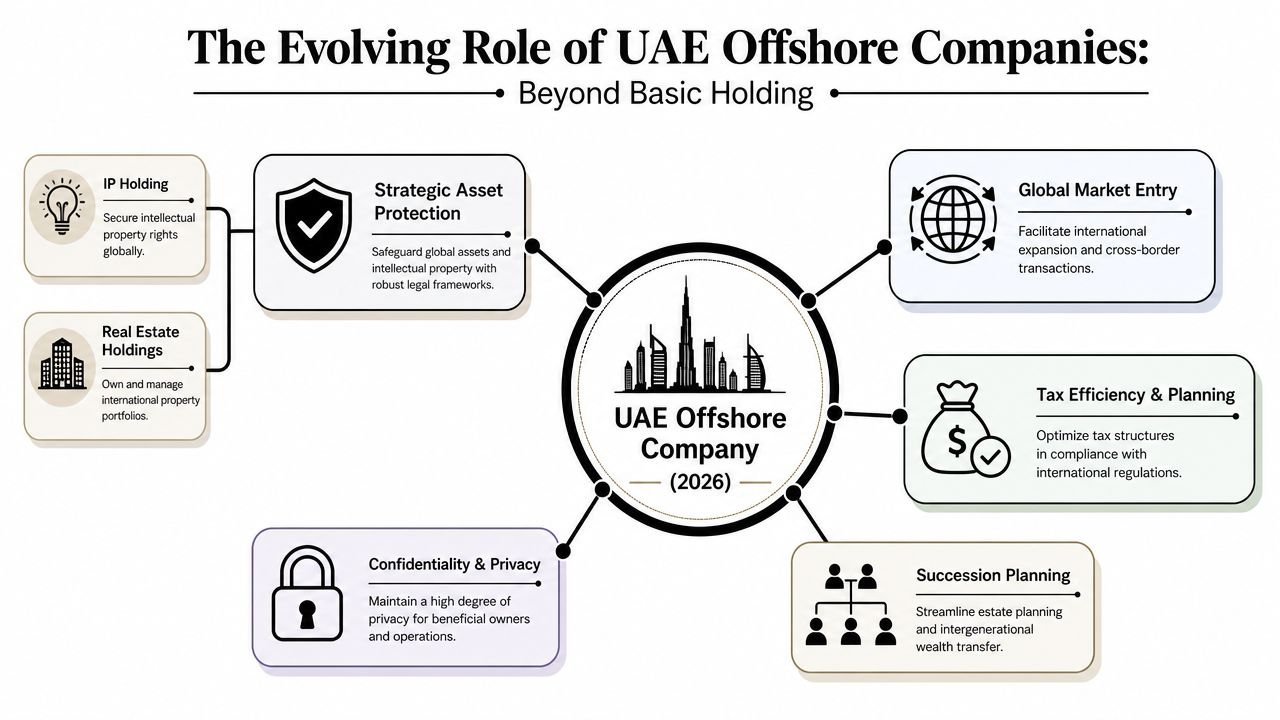
A UAE offshore company is a non-operating corporate vehicle set up for ownership, control, ring-fencing risk, and selected cross-border activities. It is usually the right structure when the company is meant to hold shares, own assets, receive dividends, license intellectual property, or act as part of an international group structure. It is usually the wrong structure when the goal is to trade inside the UAE, build a local team, secure visas, or run day-to-day operations from Dubai.
That distinction matters more in the post-Corporate Tax UAE. Offshore companies still have a place, but they now need a clearer commercial purpose and cleaner documentation. Founders who treat offshore as a generic low-cost company often run into problems later, especially at the banking stage or when explaining substance, control, and transaction flow.
What offshore is good for
The best offshore structures tend to have a narrow, disciplined purpose.
- Holding shares in other companies: Often used to consolidate ownership of foreign subsidiaries or joint ventures under one UAE entity.
- Asset protection: High-value assets can be kept separate from the liabilities of the trading business.
- IP ownership and licensing: Trademarks, software, designs, and other rights are often easier to manage through a dedicated ownership vehicle.
- International trade support: In the right fact pattern, offshore can be used for cross-border contracts and trade flows that do not amount to UAE domestic business.
- Succession planning: Share transfers are often simpler when family or investment assets sit in a company rather than across multiple personal names.
A practical rule works well here. If the company's main role is to own, hold, receive, license, or protect, offshore may fit. If the company needs to sell locally, hire staff, rent operating premises, or sponsor people, another structure is usually better.
What offshore is not
Offshore is not a general-purpose UAE operating company. That point sounds obvious, but it is where many setups go wrong.
It does not give founders a platform to conduct business in the UAE domestic market in the same way a mainland or free zone company can. It is also not the vehicle for residence visas, local staffing, or an active UAE commercial presence. In practice, this means offshore should be chosen for structural reasons, not because the incorporation itself looks simple.
The stronger 2026 use case is strategic. Offshore can sit above operating entities, hold family or investor assets, centralise IP, or support international trade documentation where the business activity is outside the UAE market. That is very different from the old sales pitch of "open a Dubai company and do anything."
The trade-off is straightforward. Offshore can be efficient for ownership and risk separation, but it is restrictive by design. Founders who accept those limits usually get a clean structure. Founders who ignore them usually end up restructuring later.
Offshore vs Free Zone vs Mainland Your First Decision
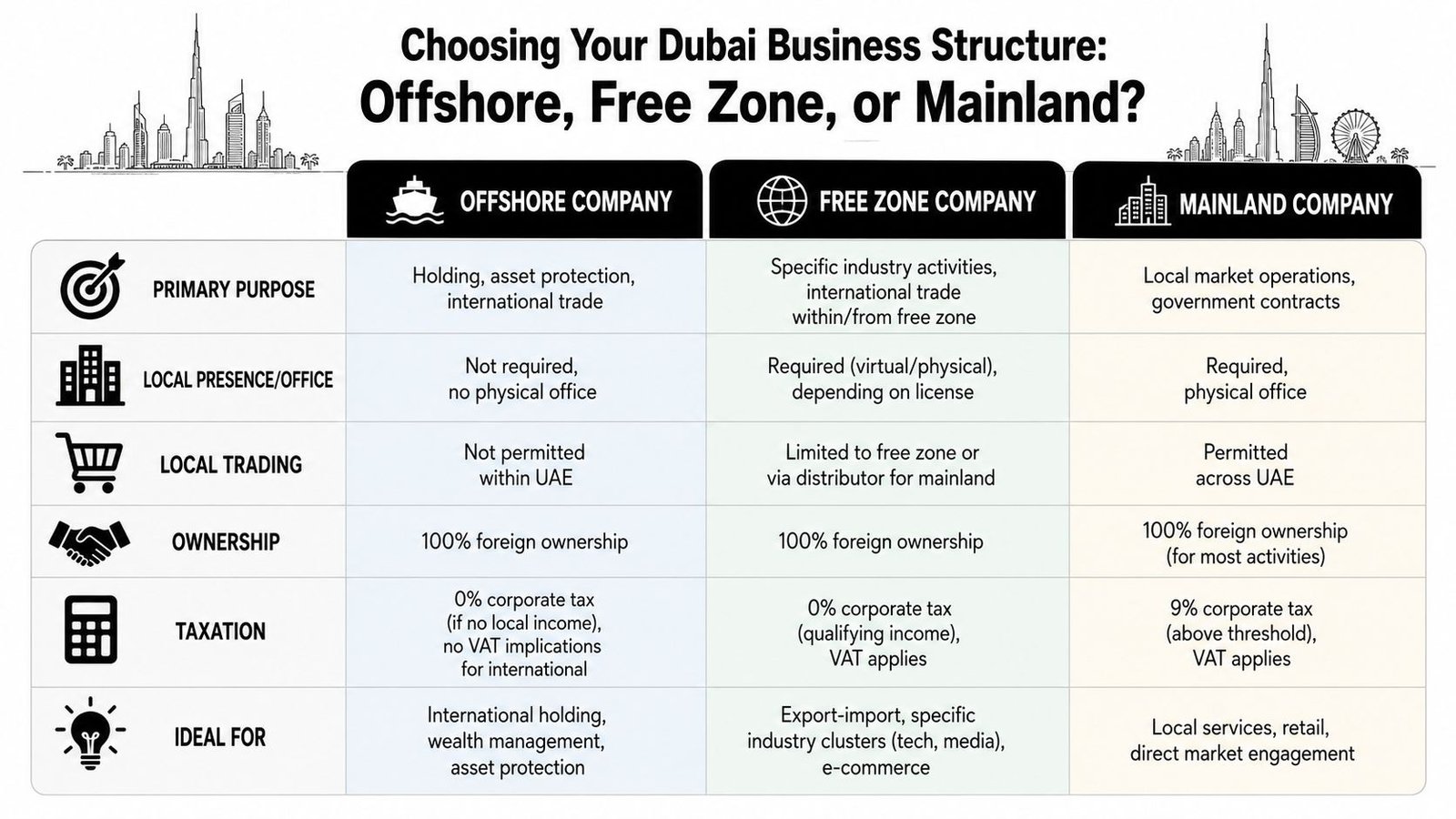
Most founders compare jurisdictions too early. The first decision is structural. Offshore, Free Zone, and Mainland companies solve different problems, and cost is usually the least important one if the company can't perform the activity you need.
Start with the activity, not the price
If you need to trade directly inside the UAE, sign local service contracts in your own name, open a retail presence, or pursue many government-facing opportunities, Mainland is usually the correct route.
If you need an operating company with office options, visa capability, and a recognised platform for regional or international business, Free Zone is often the better answer.
If you need a holding company for overseas assets, group ownership, cross-border investment, or ring-fenced IP, Offshore is often the cleanest fit.
That's why the phrase offshore company setup Dubai can mislead founders. Dubai offers several company types, but only one of them qualifies as offshore. The right choice depends on what the company must do after incorporation, not how quickly the certificate can be issued.
A quick visual helps when clients are deciding:
A practical decision framework
Use this filter before starting any application:
- Choose Offshore if you need an ownership vehicle for international assets, a topco for a group structure, or a dedicated entity for asset protection or IP management.
- Choose Free Zone if you need visas, a lease solution, an operating licence, and the ability to run a real business from the UAE with cross-border flexibility.
- Choose Mainland if you need broad UAE market access and direct local commercial activity.
Here's the simplest side-by-side view:
| Structure | Best used for | Usually a poor fit for |
|---|---|---|
| Offshore | Holding assets, owning shares, international structuring | Local UAE trade, visas, staffing inside the UAE |
| Free Zone | Running an operating business with regional or global focus | Some forms of unrestricted UAE market access |
| Mainland | Local operations across the UAE | Pure passive holding structures where operational licensing isn't needed |
A founder building a global SaaS group may use a Free Zone company as the operating entity and an offshore company as the holding layer above it. A founder who only sets up offshore, then tries to hire locally and bill UAE clients, has chosen the wrong tool.
The strategic trade-off is simple. Offshore gives scope discipline. Free Zone gives operational flexibility. Mainland gives local market reach. Once that's clear, the rest of the process becomes far easier.
Choosing Your UAE Offshore Jurisdiction JAFZA vs RAKICC
Jurisdiction choice affects cost, banking conversations, and how the company is perceived in a deal. It does not rescue a weak structure. That is the right way to compare JAFZA and RAKICC in 2026.
For many founders, the question is not which registry is more prestigious. The question is which one fits the job the offshore company is meant to do. If the company will hold shares in operating subsidiaries, warehouse intellectual property, own investment assets, or sit in an international trading group without UAE onshore activity, both can work. If the founder expects visas, local staff, or direct UAE trading, neither is the right answer.
JAFZA. Better fit when Dubai signalling matters
JAFZA usually appeals to founders who want a Dubai-linked offshore vehicle and are prepared to pay more for that association. That tends to matter in family office structures, group holding arrangements, and transactions where counterparties pay attention to the jurisdiction named in the corporate documents.
Trident Trust's JAFZA offshore overview states that JAFZA was established in 1985 and authorised to register offshore companies in 2003. The same source gives a clear fee benchmark, which is useful because it lets founders compare JAFZA against market pricing rather than marketing language alone.
RAKICC. Usually the more cost-efficient offshore tool
RAKICC is commonly chosen for clean holding structures where the company's purpose is functional rather than presentational. That includes holding shares, ring-fencing assets, receiving dividends, centralising IP ownership, or placing a neutral parent above operating entities in different countries.
The commercial appeal is straightforward. RAKICC setup costs are usually lower than JAFZA, but the exact figure depends heavily on the registered agent, beneficial owner profile, and whether extra documents need legalisation. In practice, market pricing for a standard RAKICC offshore incorporation is often quoted by UAE corporate service providers in the approximate range of USD 1,500 to USD 3,000, with annual renewal commonly below JAFZA on a like-for-like basis. That is a benchmark, not a fixed government tariff, and founders should ask for the authority fee and agent fee to be split out before approving the file.
Here is the comparison that matters in real transactions:
| Feature | JAFZA (Jebel Ali Free Zone Authority) | RAKICC (Ras Al Khaimah International Corporate Centre) |
|---|---|---|
| Core positioning | Dubai-linked offshore company with stronger location signalling | Cost-aware offshore structure focused on function |
| Historical reference point | Established in 1985, authorised for offshore companies in 2003 | Widely used UAE offshore registry for international holding and structuring |
| Incorporation cost benchmark | US$2,725 government incorporation fee | Often quoted in the market at roughly US$1,500 to US$3,000 total setup for standard cases, depending on agent and file complexity |
| Annual cost benchmark | US$681 annual licence fee | Commonly lower than JAFZA, but renewal pricing varies by provider and service scope |
| Typical founder priority | Dubai name, transaction presentation, institutional familiarity | Efficiency, lower cost, straightforward asset or share holding |
The best choice depends on what the company has to do after incorporation.
Choose JAFZA if the offshore company will sit in front of investors, lenders, acquisition counterparties, or internal governance teams that value a Dubai nexus. Choose RAKICC if the offshore company is mainly a holding, IP, or asset-protection vehicle and there is no commercial reason to pay extra for Dubai branding.
A practical warning belongs here. Founders often spend too much time comparing registries and too little time testing the structure against banking, tax residence of the ultimate owners, substance expectations outside the UAE, and source-of-funds documentation. Those points usually create more friction than the jurisdiction name itself.
The post-Corporate Tax context makes that even more important. Offshore companies still have legitimate uses in UAE and cross-border structuring, especially for passive holding, international asset ownership, and ring-fenced IP. They are a poor fit for founders who require a UAE operating platform. In those cases, using offshore to save setup cost often creates larger problems later.
The Step-by-Step Offshore Formation Process
A UAE offshore company is quick to incorporate on paper. In practice, the file succeeds or stalls based on preparation, sequencing, and how well the ownership story stands up to review.
The sequence that works
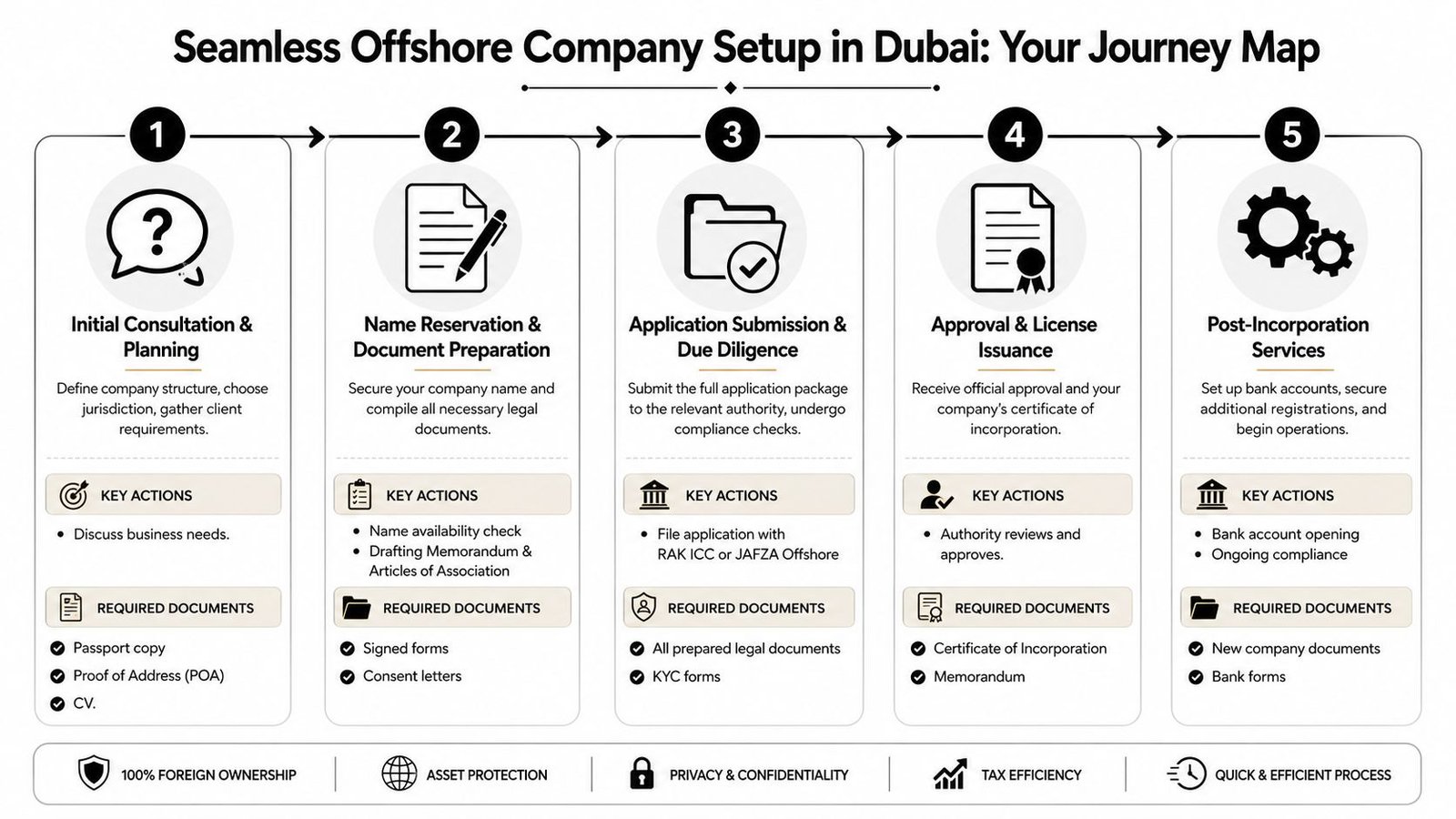
As outlined in GTAG's UAE offshore setup guide, the process usually runs in a fixed order: choose the jurisdiction, clear the company name, prepare the KYC file, submit the application, receive the incorporation documents, then move to banking and annual maintenance. If the documents are clean and the ownership chain is straightforward, approval is often relatively fast. If the file is inconsistent, even a simple structure can drag.
The order matters because offshore setup in 2026 is no longer just a registry exercise. In the post-Corporate Tax UAE, founders often use these entities for cross-border holding, IP ownership, investment assets, or ring-fenced international trade relationships. That makes the setup file more than an incorporation form. It becomes the first test of whether the structure can survive later scrutiny from banks, counterparties, auditors, and tax advisers.
A workable filing process usually looks like this:
- Confirm the use case before choosing the vehicle. If the company will hold shares, own IP, or sit over international assets, offshore may fit. If it needs contracts with UAE customers, invoicing from the UAE market, staff, office space, or residence visas, the structure is usually wrong from the start.
- Choose the jurisdiction based on function, not marketing. JAFZA and RAKICC can both form an offshore company, but the right choice depends on the intended assets, counterparties, and budget.
- Clear the company name early. Name rejections are common enough to disrupt signing packs, draft resolutions, and banking paperwork if left too late.
- Build the KYC file before submission. Passports, proof of address, source-of-funds support, and corporate shareholder documents should match across the file.
- Submit one consistent application set. Partial submissions create avoidable follow-up questions and increase review time.
- Wait for incorporation documents before treating the structure as operational. A certificate gives legal existence. It does not, by itself, make the company bankable or usable for transactions.
- Prepare the post-incorporation file immediately. Registers, resolutions, compliance records, and supporting documents should be in order from day one.
Where files slow down
The common problem is not complexity. It is mismatch.
A founder says the offshore company will hold IP, but the supporting documents describe general trading. A corporate shareholder appears in the ownership chain, but its registry extract is outdated or not properly legalised. The passport spelling differs from the proof of address. Those are small defects individually. Together, they signal a weak file.
Delays usually come from four areas:
- Identity inconsistencies: expired passports, unclear scans, different spellings, or missing residential evidence
- Ownership gaps: incomplete documents for intermediate holding companies, trusts, or nominee arrangements
- Poor document control: unsigned forms, outdated versions, or resolutions that do not match the application details
- Legalisation timing: foreign corporate records may require notarisation, attestation, or consular steps that take longer than the incorporation itself
Experienced founders save time. They do not ask only, “What does the registry need?” They ask, “Will this same file make sense later to a bank compliance team or a foreign tax adviser?” That is the better standard.
The authority is testing transparency, lawful purpose, and document integrity. Founders who treat KYC as box-ticking usually create their own delays.
The best offshore company setup Dubai process is not the one with the shortest quoted timeline. It is the one built for the company's real job after incorporation, whether that is holding international assets, isolating liability around IP, or supporting a defined cross-border trade structure. If offshore is the wrong vehicle, the most efficient formation process is not to form it at all.
Corporate Banking Governance and Annual Compliance
The incorporation certificate isn't the finish line. It's the point where the structure becomes testable. If the company can't open and maintain usable banking, demonstrate a coherent ownership story, and stay current on annual obligations, the setup has limited practical value.
A company without banking is only half built
For offshore entities, banking is often an operational hurdle. Banks don't look only at the certificate. They usually want a clear explanation of what the company does, where money will come from, who controls it, and why the UAE offshore vehicle makes commercial sense.
That means vague descriptions hurt. “General trading” with no transaction logic, no supplier profile, and no ownership context usually creates friction. The offshore structure is easier to bank when the business model is narrow and understandable. Holding shares in subsidiaries, owning a defined IP portfolio, or managing identifiable investment assets is usually easier to explain than a broad, undefined trading narrative.
Founders also need to separate legal formation from banking strategy. Some structures are technically incorporable but practically weak for account opening if the beneficial ownership chain is opaque or the business rationale is thin.
Governance matters more than founders expect
Offshore doesn't mean unmanaged. The company still needs directors, shareholders, corporate records, and a coherent decision-making process. Where privacy is important, founders may explore nominee arrangements, but privacy tools don't remove the need for transparent beneficial ownership disclosure to the relevant authorities and regulated institutions.
Good governance is usually simple:
- Clear director authority: Banks and counterparties want to know who can act for the company.
- Consistent ownership records: Share registers, corporate resolutions, and supporting documents should match exactly.
- Commercial rationale in writing: A short internal note explaining why the offshore entity exists often helps with banking and compliance conversations.
- Separation of roles: If the offshore entity holds IP or shares, document that function distinctly from any operating company below it.
Compliance is ongoing, not ceremonial
Every offshore company should be treated as an active legal file with recurring obligations. At a minimum, that means annual renewal and maintaining current records. Depending on the structure and activities, there may also be reporting, ownership updates, and broader regulatory touchpoints.
The strategic point in 2026 is this: a post-Corporate Tax UAE has made substance, documentation, and consistency more important. Offshore still works well when the company does what its documents say it does. Problems start when founders treat it like a dormant shell while asking banks and counterparties to treat it like a credible international business vehicle.
A disciplined offshore company can still be highly effective for holding assets, licensing IP, or sitting at the top of a group. A neglected one tends to create friction everywhere at once.
Avoiding Common Pitfalls in Your Dubai Offshore Setup
The biggest offshore mistakes in Dubai are usually made before the file is even submitted. Founders choose the wrong vehicle for the job, underestimate document standards, or leave banking logic too vague for a post-Corporate Tax compliance review.
The mistakes that cause preventable delays
In practice, the same issues stall offshore formations again and again. The requirements are not unusual. The problem is that many founders prepare them to a casual standard, while registrars, banks, and corporate service providers review them to a strict one.
Common friction points include recent proof of address, clear passport copies, properly legalised foreign corporate documents where required, and full disclosure of the beneficial ownership chain. None of that is complicated in theory. It becomes expensive when one missing item holds up the whole structure, especially if the offshore company sits above an acquisition, an IP transfer, or a group reorganisation.
The delays usually come from five areas:
- Stale KYC documents: Address proof that is too old or inconsistent with the application creates immediate follow-up.
- Unreadable identity documents: Low-quality passport scans slow verification and trigger resubmission.
- Foreign shareholder documents prepared too late: If a parent company or corporate shareholder is involved, notarisation and attestation often become the longest lead item.
- Unclear beneficial ownership: If the control chain is layered across several entities or jurisdictions, explain it cleanly from the start.
- Generic stated purpose: “General trading” or similarly broad wording creates more questions than answers for an offshore file.
A better approach is simple:
| Pitfall | Better approach |
|---|---|
| Old or weak KYC documents | Refresh identity and address documents before submission |
| Foreign documents not legalised | Confirm attestation requirements at the start |
| Generic company purpose | Define the offshore role precisely, such as holding shares, owning IP, or acting as an international contracting vehicle |
| Opaque shareholding chain | Prepare a clear ownership chart before incorporation |
| Banking left as an afterthought | Prepare a credible explanation of counterparties, fund flows, and commercial purpose from day one |
One more point matters in 2026. Offshore companies now face more scrutiny when their legal form and economic story do not match. If the company is meant to hold IP, the documents should show that. If it is meant to sit at the top of an international trading structure, the contracts, invoicing logic, and governance should support that position.
When offshore is the wrong answer
If the business needs visas, staff, office premises, or direct UAE operating activity, choose Free Zone or Mainland instead. Offshore works best as a focused international holding, asset protection, or IP vehicle, not as a substitute for an operating company.
If you need help deciding whether offshore, Free Zone, or Mainland is the right route, Inpro Corporate Services L.L.C. helps founders structure, form, and maintain UAE entities with support across incorporation, attestations, banking coordination, and ongoing compliance.