

You've got the trade licence, the first hire is waiting, and now the paperwork starts multiplying. PRO visa services in Dubai exist to keep that process moving, because one missed step can hold up the whole residence file and waste days you don't have.
Table of Contents
- What Founders and HR Teams Deal With on Day One
- What PRO and Visa Services Mean
- The Main Visa Categories a PRO Will Handle
- How an Employee Residence Visa Moves Through the System
- How Jurisdiction Choice Changes the PRO Scope
- Why the Cheapest PRO Quote Is Rarely the Cheapest Outcome
- Documents, Common Mistakes and Practical Next Steps
What Founders and HR Teams Deal With on Day One
The first headache is rarely the visa itself. It's the stack of approvals, identity checks, and portal steps that sits between a signed offer letter and a person being able to work in the UAE, or the United Arab Emirates. If you've just set up a company in Dubai, or you're an HR lead onboarding your first employee, this is the point where the process feels bigger than the business.
That reaction is normal. Dubai's government systems are built for volume, not hand-holding, and the numbers show the scale clearly, GDRFA Dubai reported 12,116,843 entry permits and 6,998,414 residence transactions in its 2025 open-data release, which means visa work sits inside a large, formal, digital machine rather than a small local office queue. The practical takeaway is simple, there's a reason founders outsource the liaison work.
Practical rule: if a file depends on more than one authority, assume delays come from sequencing, not just paperwork quality.
A founder usually sees the problem first in the gaps. Someone has the trade licence, but not the right signatory setup. Someone else has a visa sponsor in mind, but hasn't lined up the medical fitness step or Emirates ID appointment. The business is operational on paper, but not yet operational in government systems.
That is where PRO support earns its place. A good provider is not just dropping documents at a counter, it is tracking which authority needs what, in what order, and which step can block the next one. If you're trying to hire, relocate, or renew without disruption, that sequencing matters more than the logo on the invoice.
What PRO and Visa Services Mean
PRO is short for Public Relations Officer, but in UAE business use it means something more concrete. A PRO is the person, or team, that handles government liaison work for a company, so the business does not have to deal with every department on its own.
Visa services sit inside that wider admin work. They cover the immigration and residence-permit steps that turn a person's eligibility into a valid residency position in Dubai, Abu Dhabi, Sharjah, or a free zone. PRO work is the link between the business and the state. Visa services are the file-based immigration tasks inside that link.
The authorities you deal with depend on your structure. MOHRE is the Ministry of Human Resources and Emiratisation, and it handles labour and work-permit steps in mainland employment cases. GDRFA is the General Directorate of Residency and Foreigners Affairs, and in Dubai it handles entry permit and residence-visa processing. ICP is the Federal Authority for Identity, Citizenship, Customs and Port Security, which runs federal identity and residency systems. In some setups you also deal with DED, the Department of Economy and Tourism, plus free-zone bodies such as DIFC and ADGM, the Dubai International Financial Centre and Abu Dhabi Global Market.
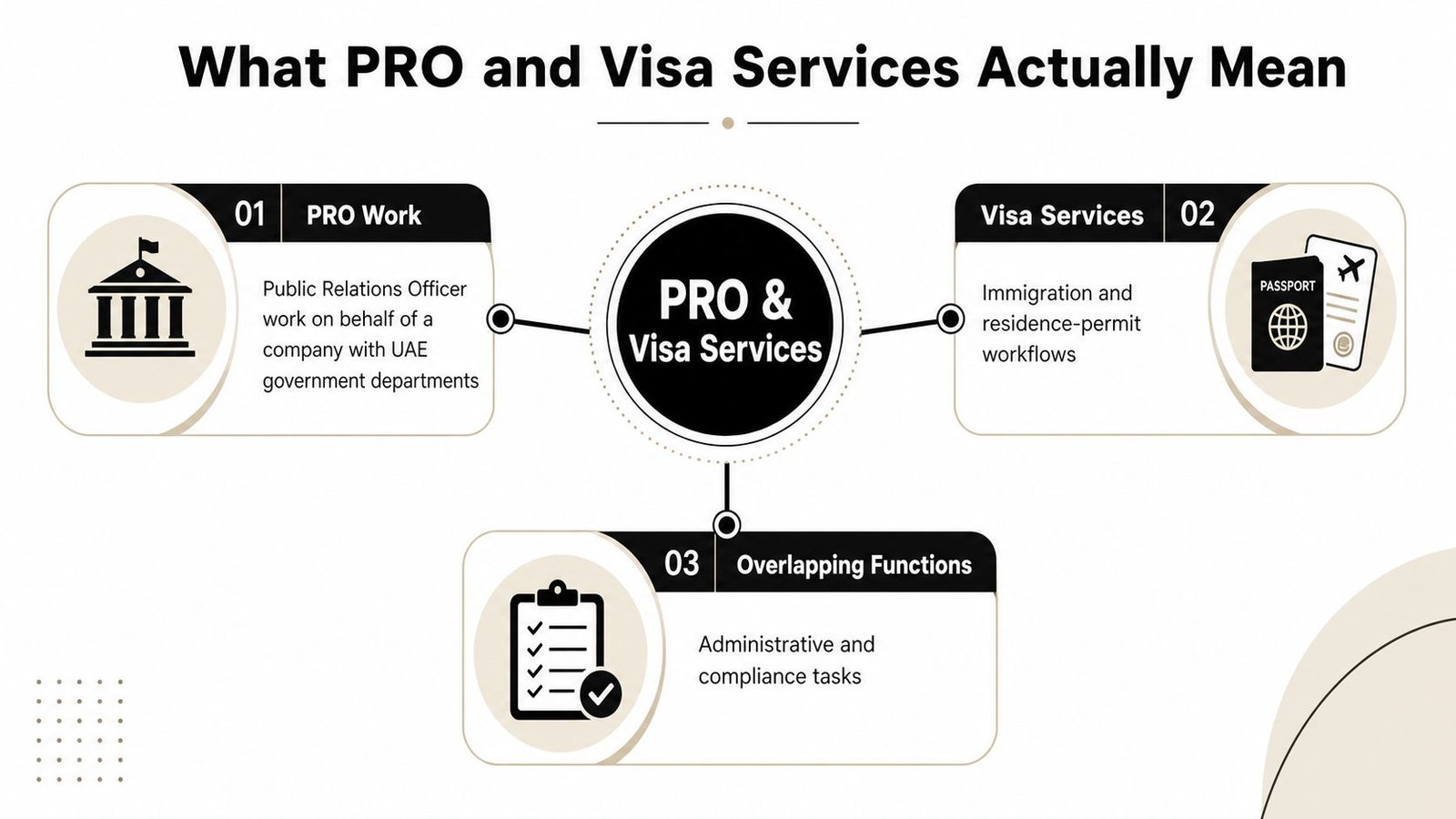
A good provider tracks which authority needs what, in what order, and which step can block the next one. That matters because these systems do not behave like a single office. If your file needs approvals from more than one portal, one missed field or expired document can stall the whole process. A competent PRO keeps the file moving and tells you what needs your attention before it becomes a delay.
Cost is where founders and HR teams get misled. The total bill is rarely just one filing fee or one monthly retainer. It sits across renewals, amendments, status changes, courier runs, portal coordination, and the back-and-forth that happens when one document is approved and another one is still pending. A provider that prices only the obvious filing steps can look cheap up front and expensive once the workflow starts bending.
Plain truth: the value is in keeping the whole chain from breaking, and in showing where the extra coordination cost sits before it lands on your desk.
The Main Visa Categories a PRO Will Handle
The visa name matters less than the workflow it triggers. A founder often asks for “the visa cost”, but the answer changes depending on whether the person is an investor, employee, dependent, freelancer, or Golden Visa applicant.
Investor and partner routes
An Investor visa is for someone tied to ownership or investment in a UAE business. The exact paperwork usually centres on company ownership documents, licence records, and signatory authority, because the visa follows the business relationship.
A partner route is similar in logic, though the company structure may differ. The PRO workload here is heavier on company records and approvals than on recurring labour steps. If you're in Dubai mainland or a free zone, the provider will usually need to match the visa file to the legal structure first, not last.
Golden Visa routes
A Golden Visa is a long-term residence route with eligibility thresholds, not a general-purpose file. Dubai's official investor criteria have included either a public investment fund deposit of AED 2 million or a company with capital of at least AED 2 million, and the visa is issued as a 5- or 10-year residence permit depending on category, according to Dubai-linked PRO guidance on Golden Visa criteria.
That changes the PRO task completely. The provider isn't only filing a residence application, it's checking that the applicant meets the measurable criteria and that the supporting documentation matches the category. For investors, founders, and senior talent, this is usually more document-heavy than a standard employee file.
Employee, dependent and freelance routes
An Employee visa is the common corporate route, tied to a work relationship and a sponsoring entity. A Dependent visa is for family members sponsored through a valid resident, and the file usually follows the sponsor's status and supporting proof. A Freelance visa is most realistic in some Dubai and Sharjah free zones, where the permit structure is built around independent work rather than a traditional employer-employee relationship.
These routes all trigger different PRO sequences. The employee file tends to be process-heavy, the dependent file tends to be status-sensitive, and the freelance file tends to depend on where the permit sits. The smart move is to choose the visa family after you've chosen the jurisdiction, because the workflow, documents, and follow-up burden are not the same.
How an Employee Residence Visa Moves Through the System
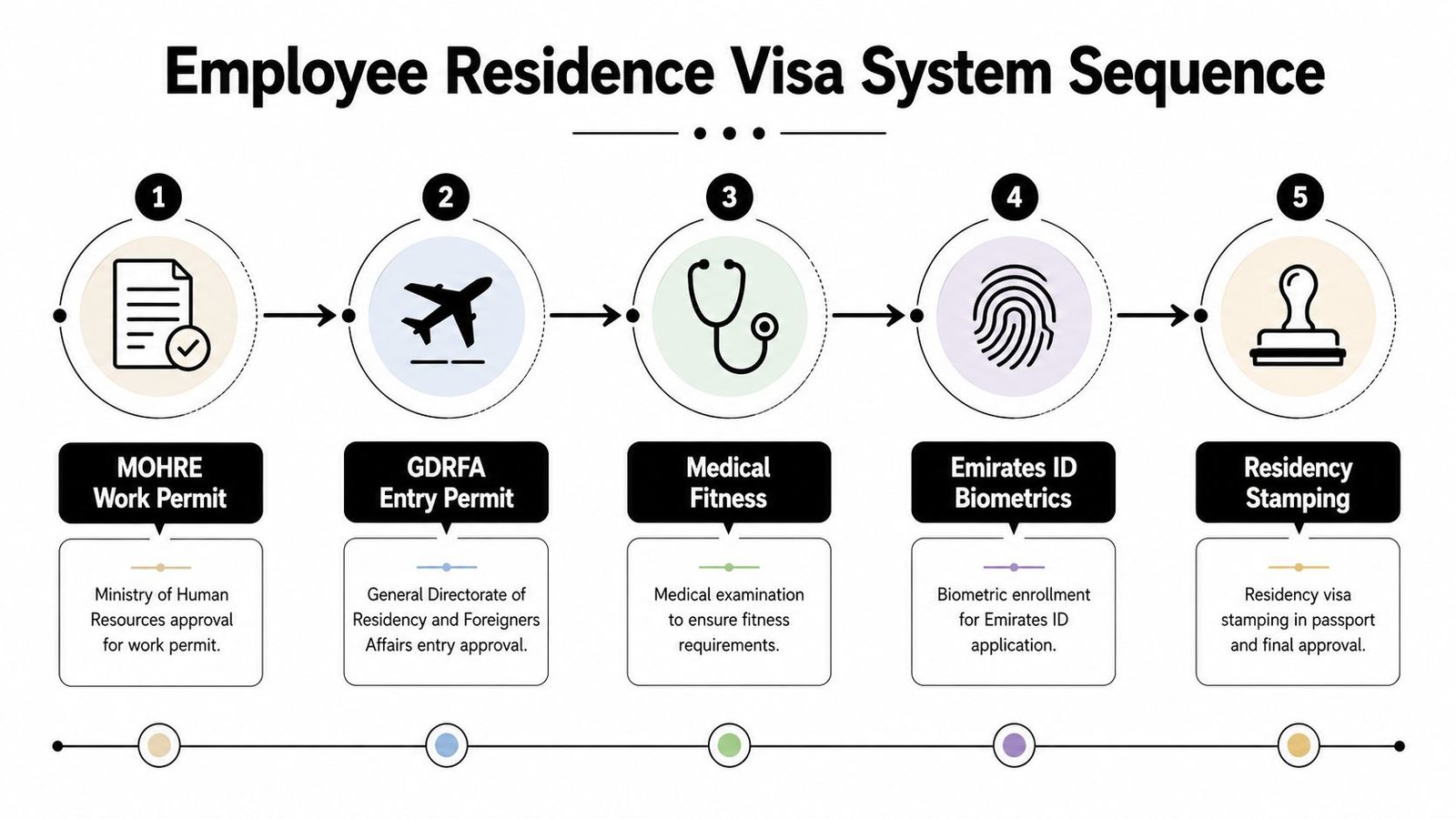
A mainland employee visa in Dubai is a chain, not a single application. In practice, the sequence usually runs through MOHRE for the work permit, then GDRFA-Dubai for the entry permit and residence visa, with medical fitness testing and Emirates ID biometrics before final issuance. If one step slips, the next one can't move cleanly.
Practical rule: don't judge a PRO by whether it “submits” files. Judge them by whether they sequence the file correctly.
The reason this matters is simple. MOHRE handles employment authorisation, GDRFA handles immigration approval in Dubai, and Emirates ID registration adds the identity layer needed for the final residency record. A PRO is doing follow-up across those steps, not just pushing one form into a portal and hoping the rest sorts itself out.
Industry guides estimate standard visa processing at about 7 to 15 working days, with faster free-zone or priority channels sometimes compressing this to 3 to 7 days according to Dubai PRO service guidance. That timeline is realistic only when the file is clean, the signatory is ready, and the medical and biometrics appointments happen without friction.
Here's the part people miss. A visa file doesn't end at issuance. Renewals, cancellations, and amendments can create the same kind of delay if the records, Emirates ID, or sponsorship details are out of sync. Those are the lifecycle exceptions that often produce hidden cost later, because they're separate operational steps, not a single “visa renewal” line on a quote.
How Jurisdiction Choice Changes the PRO Scope
Your PRO burden is determined by where the company sits. A mainland company licensed through DED usually faces broader licensing and immigration coordination than a free zone entity in Dubai or Sharjah. An offshore structure usually carries lighter day-to-day immigration work, but heavier attestation and corporate-document handling.
Here's the quickest way to see the difference.
| Jurisdiction | Typical PRO Focus | Visa Intensity |
|---|---|---|
| Mainland | Labour, immigration, renewals, licence-linked filings | Higher |
| Free Zone | Entity setup, employee visas, portal coordination, renewals | Medium to higher, depending on zone |
| Offshore | Attestation, corporate documents, limited immigration | Lower for visas, higher for document chain |
The practical mistake is choosing jurisdiction first and asking about PRO later. That often leads to mismatched expectations, because a mainland file through DED can create different touchpoints from a free zone entity in Dubai or Sharjah. DIFC and ADGM also have their own internal processes, so even within the UAE, the file path changes with the regulator.
What this means for founders is blunt. A “PRO service” is not one product. It's a set of actions that changes with the licence location, the licensing authority, and the visa type attached to the business. If you're setting up now, the smarter move is to choose the jurisdiction and the visa strategy together, not as separate decisions.
Why the Cheapest PRO Quote Is Rarely the Cheapest Outcome
A low monthly retainer looks tidy until the extra charges start appearing. The cost of PRO services in Dubai sits inside separate workflows, not one neat fee. That includes entry permits, renewals, amendments, cancellations, status changes, Emirates ID, medical fitness, biometrics, trade licence renewals, establishment cards, and WPS coordination.
Industry sources place full UAE visa processing at AED 2,500 to 7,000 per visa, with document attestation adding AED 150 to 500 per document and SME PRO retainers commonly running AED 1,000 to 5,000 per month per current UAE-oriented pricing guidance. Those ranges matter because they show why a flat quote can hide a lot of variability.
What a serious buyer should ask for
- A per-workflow price matrix: Ask for a line item for renewals, amendments, cancellations, status changes, and onboarding, not just a monthly number.
- A document-attestation view: Check how many attestations sit inside the file and whether each one is billed separately.
- A government-touchpoint count: More portals, more steps, more coordination, more room for hidden cost.
- A renewal and cancellation policy: These steps are where weak providers often add surprise charges.
Clear advice: compare the number of government touchpoints, not the number of visas. The file with fewer visas can still cost more if the workflow is fragmented.
A transparent provider stands out. Inpro Corporate Services L.L.C. is one option that works on company formation, visa processing, and compliance support across the UAE, including the kind of file mapping that shows founders what sits inside each workflow. That approach is more useful than a cheap headline fee, because it lets you budget for the actual process instead of guessing at the leftovers.
Documents, Common Mistakes and Practical Next Steps
For a first-time immigration PRO card in Dubai, the core pack usually includes a valid trade licence, the company Memorandum of Association or Articles of Association, Ejari or a Free Zone lease, the nominated PRO's passport and Emirates ID, a specimen signature, and sometimes a No Objection Certificate and company IBAN as set out in Dubai PRO card guidance. If you don't have that pack ready, the file will stall before work begins.
Three mistakes show up again and again. First, people leave Emirates ID renewal too late and create a gap in the residency chain. Second, they forget WPS registration, which causes payroll problems for mainland teams. Third, they underestimate attestation chains for educational and commercial documents, then wonder why the file sits untouched.
A practical founder checklist
- Trade and ownership papers: Keep the licence, MoA or AoA, and signatory proof ready.
- Lease evidence: Make sure the Ejari or free zone lease matches the entity name.
- Identity records: Check passport validity, Emirates ID, and any status changes.
- Payroll readiness: Confirm WPS setup before hiring begins.
- Attestation chain: Review any document that needs notarisation, translation, or embassy steps.
A few questions founders keep asking
A freelancer does not always need the same PRO depth as a mainland employer, but they still need proper visa and permit handling in the right zone. Golden Visa dependents are added through the sponsor's status and family documentation, so the family file should be checked against the main holder's eligibility before you start. Before signing any PRO contract, ask what is included, which workflows are billed separately, and who handles renewals, cancellations, and amendments.
If you want less stress and fewer surprises, ask for the workflow matrix first and the retainer second.
Inpro Corporate Services L.L.C. handles UAE company formation, visa processing, and compliance support across Mainland, Free Zone, and Offshore setups, which makes it a practical fit when you need the paperwork sequenced properly from the start. If you want a clear view of your PRO and visa costs before you commit, visit Inpro Corporate Services L.L.C. and speak with the team about your file.