


If you're staring at a list of Dubai business activities and wondering which licence you need, the answer is usually simpler than it looks. A professional license in Dubai is the licence used for service-based work, but the decision starts with your activity code, then splits into Mainland or Free Zone based on how you plan to sell, hire, and grow.
Table of Contents
- What a Professional License in Dubai Actually Is
- Who Needs One and Which Activities It Covers
- Mainland vs Free Zone Professional License
- What a Professional License in Dubai Costs in 2026
- Documents and Eligibility You Need to Prepare
- How the Application Process Works Step by Step
- Regulated Professions and the Extra Approvals They Require
- Common Pitfalls, Timelines, and How to Streamline the Setup
What a Professional License in Dubai Actually Is
A professional license in Dubai is a business licence that lets a person or company provide skilled services rather than sell physical goods. In practice, that means consulting, design, software, legal, accounting, education, healthcare, and similar work where the value comes from expertise.
What the law says
Dubai treats licensing as a legal requirement, not paperwork. Under Dubai Law No. (13) of 2011%20of%202011.html), a natural or legal person may carry out an economic activity in the Emirate only through a business licensed by the Dubai Department of Economy and Tourism, which is the authority that issues Mainland licences in Dubai. The same law also ties licences to Dubai's official economic activity classification and says a business can't market its products or services without the relevant commercial authorisation.
That matters because your licence isn't just a certificate on the wall. It's the legal permission that defines what you can do.
Practical rule: In Dubai, the licence follows the activity code. If your activity code is wrong, the rest of your setup is built on the wrong base.
How it differs from other licence types
A professional activity is service-led work based on knowledge, credentials, judgement, or technical skill. A commercial licence is generally for trading goods. An industrial licence is for manufacturing or production.
Here's the simple test:
- You advise clients. That points to a professional licence.
- You buy and resell products. That usually points to a commercial licence.
- You make or process goods. That usually points to an industrial licence.
A management consultant, software developer, training provider, or branding agency usually sits in the professional category. If you're opening an online store for electronics or fashion, that's a different path.
Why founders get confused
Most founders don't struggle with the word “professional”. They struggle with scope. Dubai licensing is granular. Independent Dubai licensing guides note that the register includes more than 3,000 approved business activities, and one trade licence can cover up to 10 activities if they are compatible and within the same category, according to this Dubai licensing guide.
That's why I tell founders not to start with “What company do I want?” Start with “What exactly will I invoice for?”
Who Needs One and Which Activities It Covers
Three groups usually need a professional licence. Solo specialists need it when they sell their own expertise. Multi-partner firms need it when the business itself delivers professional services. Foreign companies need it when they open a branch to provide services in Dubai or elsewhere in the UAE.
Who typically needs this licence
A solo practitioner is a person offering expert services directly, such as a consultant, designer, translator, trainer, or software specialist.
A professional firm is a company formed by one or more partners to deliver specialist services such as legal work, consulting, accounting, technical services, or education.
A foreign branch is an overseas company extending its service business into the United Arab Emirates.
Which activities are commonly covered
The exact list depends on the Dubai Department of Economy and Tourism or the Free Zone authority you choose, but these are common professional activities in Dubai:
- Consulting work such as management consulting, strategy, HR advisory, or business process support
- Technology services such as IT services, software development, and systems support
- Marketing services such as advertising, digital marketing, branding, and content work
- Creative work including design, production support, and related service activities
- Financial professions such as accounting and audit-related services
- Language services including translation and interpretation
- Technical services where the activity is service-based rather than product trading
- Education services such as training, tutoring, and learning support
- Healthcare and legal work where an activity may fit the professional category but also needs sector approval
According to a Dubai activity guide on professional licence use, a professional licence in Dubai is generally used for service-based activities rather than trading goods, and applicants usually need a valid passport, approved trade name, defined business activities, a registered office address, and payment of the licence fee. Regulated activities need extra approval.
If the client is paying for your time, judgement, technical output, or qualifications, you're probably looking at a professional licence, not a trading licence.
The only safe way to choose the activity
Don't choose a broad label because it sounds right. Choose the activity code that matches the service line you will invoice. “Consultancy” can mean one thing in Dubai Mainland, another in Dubai Internet City, and something narrower again in an education or healthcare setting.
Mainland vs Free Zone Professional License
Founders don't really ask “What is a professional licence?” They ask whether they should set up on the Mainland or in a Free Zone, and what that choice changes in real life.
The decision that matters
A Mainland licence is issued by the Dubai Department of Economy and Tourism and gives you wider access inside Dubai and across the UAE. A Free Zone licence is issued by a zone authority such as Dubai Internet City, Dubai Media City, or Dubai International Academic City, and it is built around operating within that zone's framework.
Neutral UAE guidance shows that a Mainland licence allows businesses to operate anywhere in Dubai and across the UAE, work with government entities, and access unlimited visas based on office size. A Free Zone licence is typically limited to operations inside the zone and may require a local distributor for direct UAE trading, as explained in this Mainland versus Free Zone analysis for Dubai. The same source notes that Dubai recorded 58,337 new commercial licences in H1 2026 and 231,989 licence issuance and renewal transactions overall. This isn't a niche choice. It's one of the most common setup decisions founders make.
Mainland vs Free Zone Professional License in Dubai
| Decision Factor | Mainland (DET) | Free Zone |
|---|---|---|
| Market access | Can operate across Dubai and the UAE | Usually structured around the zone and may need extra routing for direct Mainland activity |
| Government work | Can work with government and semi-government entities | Often limited unless additional structure is added |
| Visa model | Visa capacity linked to office space | Visas linked to the zone package and facility rules |
| Office requirement | Usually tied to physical premises and Ejari registration | Often tied to flexi-desk or zone office options |
| Business fit | Better for founders selling widely across the UAE | Better for founders who want a contained setup model |
| Expansion path | Direct UAE market presence from day one | Expansion may later require a dual-licence or separate Mainland route |
My recommendation
Start on the Mainland if you plan to pitch local corporates, government-linked entities, or clients across the UAE from day one. Start in a Free Zone if your first goal is a simpler launch structure, a contained office solution, or an international services model that doesn't need broad UAE market access immediately.
What I don't recommend is choosing a Free Zone only because the first quote looks cleaner. If your actual business model needs Mainland access, you'll feel that limitation quickly.
What a Professional License in Dubai Costs in 2026
Most founders ask, “What does the licence cost?” That's the wrong question. The useful question is, “What will I spend in year one to get licensed, staffed, and visa-ready?”
What the licence fee does and doesn't cover
For Dubai Mainland, independent setup guides place the licence itself around AED 7,000 to AED 12,000 or AED 12,000 to AED 15,000, depending on the package and source. The bigger issue is the bundle around it. A first-year Mainland setup is often estimated at roughly AED 20,000 to AED 50,000+, while lower-cost setups can land closer to AED 15,000 to AED 20,000 when the DET Instant License route is used because it can waive Ejari in year one via a virtual address, according to this Dubai professional licence cost breakdown.
Independent Dubai guides also place Mainland professional licences commonly in the AED 12,000 to AED 15,000 range, with Mainland starting costs from AED 9,950, while some Free Zone professional licences can range from AED 12,500 to AED 50,000, as noted in this Dubai economic activity and licensing guide.
Professional License Cost Breakdown: Mainland vs Free Zone (2026 estimates)
| Cost Item | Mainland (DED) | Free Zone |
|---|---|---|
| Trade name reservation | Separate setup cost | Usually separate or bundled depending on zone |
| Initial approval and licence issue | Licence fee forms one part of total setup | Often shown as a package, but scope varies by zone |
| Office or desk requirement | Ejari-registered premises often drives cost | Flexi-desk or zone office can reduce entry cost |
| Establishment card | Extra first-year setup item | Extra first-year setup item in many cases |
| Residence visas | Added per shareholder or employee | Added per shareholder or employee |
| Regulator approvals | Extra where activity is controlled | Extra where activity is controlled |
| Renewal costs | Licence renewal plus premises and support costs | Zone renewal plus facility and support costs |
The budget I tell founders to use
For a lean service business, expect your final number to depend less on the word “professional” and more on four cost drivers:
- Your jurisdiction. Mainland and Free Zone pricing behave differently.
- Your premises model. Full office, shared office, or year-one virtual allowance changes the bill.
- Your visa count. Founder-only is one budget. Founder plus staff is another.
- Your activity risk. Regulated work adds approval layers and document costs.
Budget for the setup, not the licence line item. A cheap licence with the wrong office, visa, or approvals usually becomes the expensive option.
Documents and Eligibility You Need to Prepare
A clean file gets approved faster. A messy file sits in review while you're trying to book travel, open a bank account, or move staff into the UAE.
The core documents most applicants need
A standard application file usually starts with identity documents, the proposed business activity, and the trade name choices. If the shareholder is already resident in the UAE under another sponsor, a no-objection letter may also be needed.
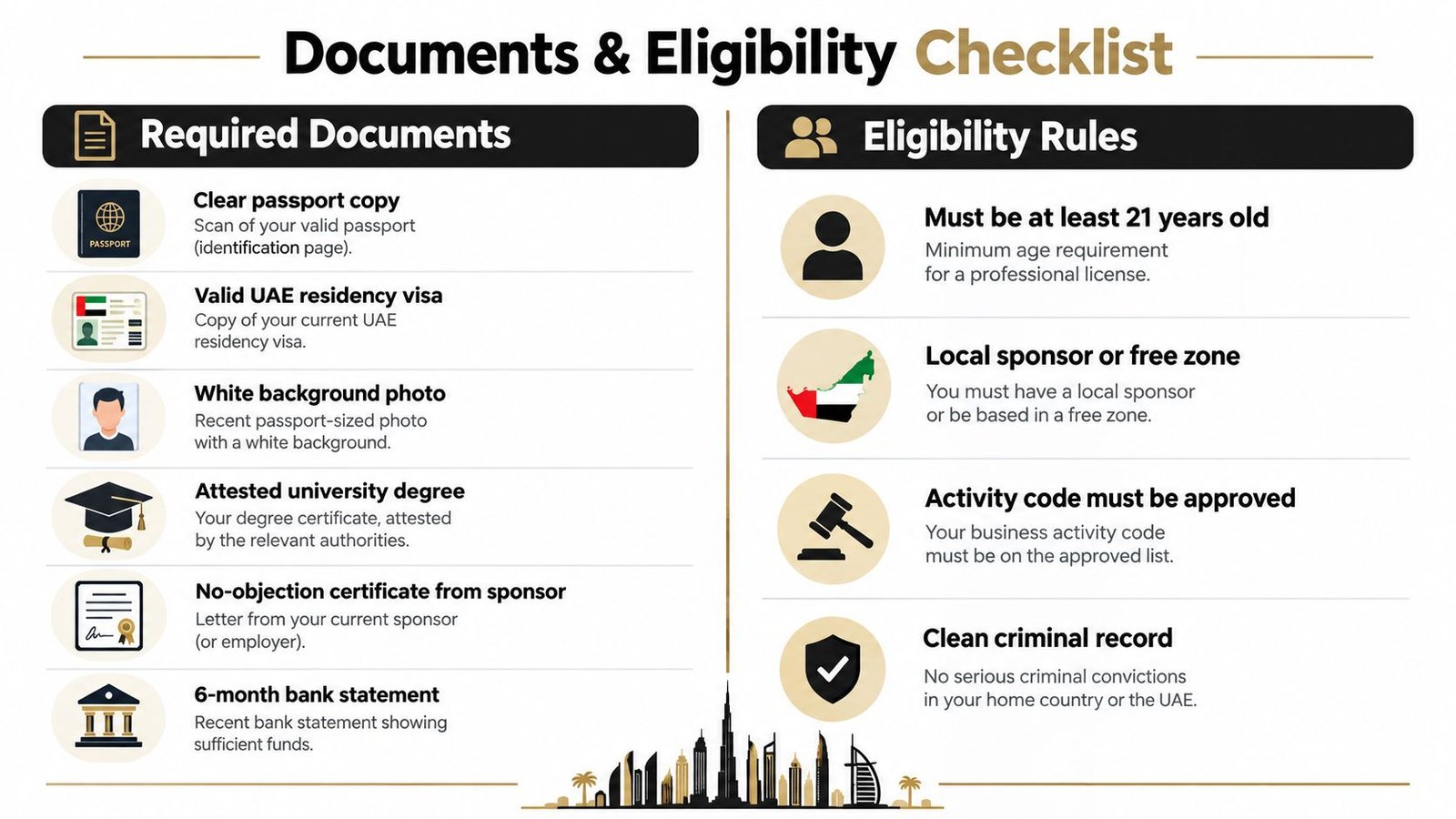
Typical preparation includes:
- Passport copies for each shareholder and manager
- Passport-style photos in the required format
- Current UAE status document such as an entry stamp or residency status, where relevant
- Trade name options that fit the authority's naming rules
- Business activity description that matches the code you plan to use
- No-objection certificate if you're sponsored by an employer or family member and the jurisdiction asks for it
If an existing company will own the new entity, you'll usually add parent company documents such as the trade licence, constitutional documents, a board resolution, and proof of good standing.
The eligibility points that trip people up
A qualified applicant is someone whose documents and background fit the chosen activity. For many service lines, documented qualifications matter. According to this Dubai licensing guide on qualifications and authority approvals, applicants are commonly asked for attested educational or professional certificates, and some sectors need extra authority approvals such as Dubai Health Authority enrolment for healthcare or Dubai Legal Affairs Department enrolment for legal services.
Prepare your certificates early. Attestation delays are one of the most common reasons a licence file slows down after the easy part appears to be done.
How the Application Process Works Step by Step
The process is orderly once the activity is right. Most problems start before the application is submitted, not after.
The first half of the workflow
Step one is choosing your jurisdiction and confirming the exact activity code with the relevant authority. Step two is reserving a compliant trade name. Step three is initial approval, where the authority checks whether the proposed activity and applicant can move forward.
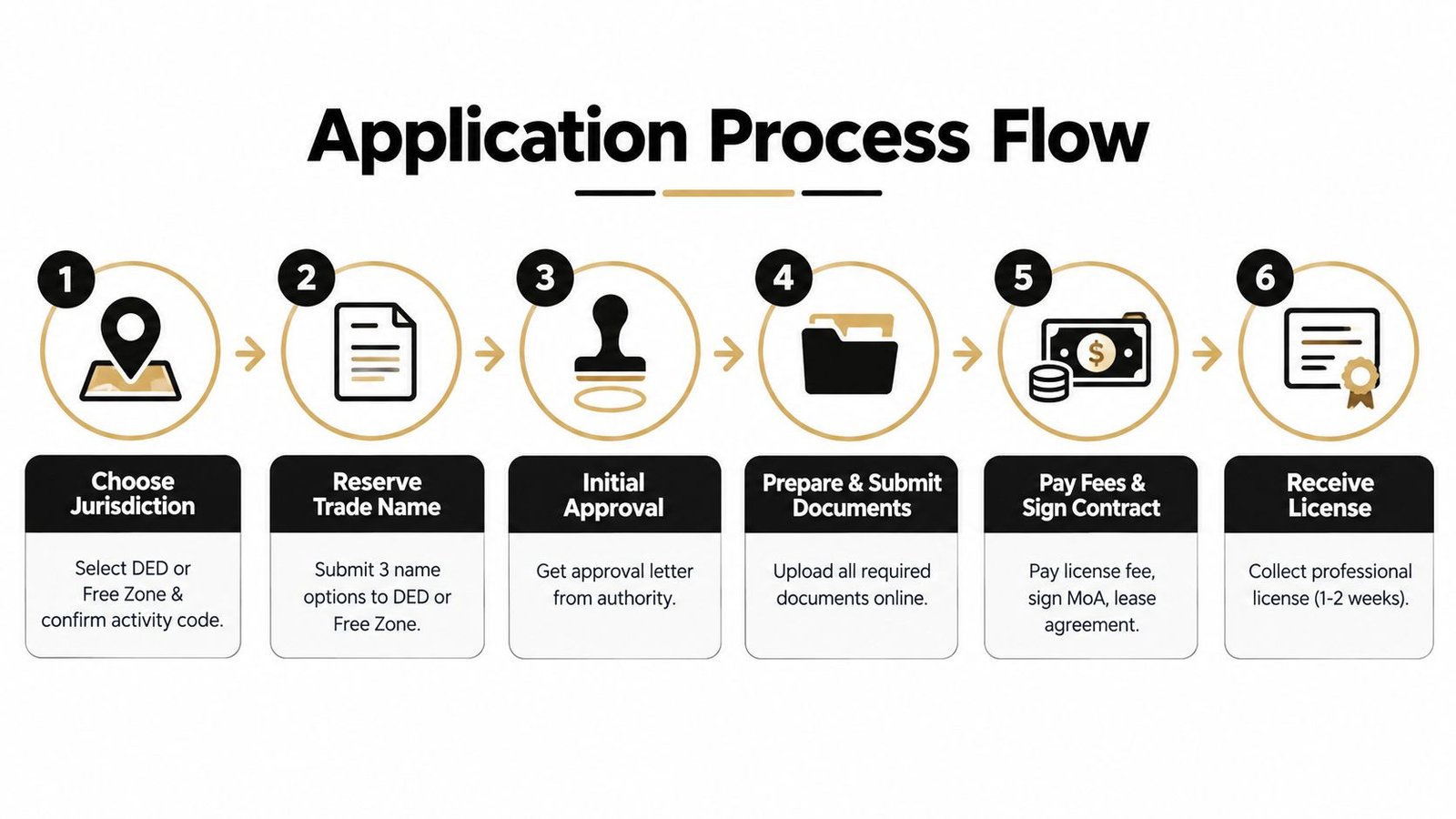
Once that is clear, you move into premises and final submission. For Mainland setups, that usually means an office linked to Ejari, which is Dubai's tenancy registration system. In many Free Zones, it means a flexi-desk, office unit, or another zone-approved facility contract.
The second half after approval
After the authority issues the licence, the immigration side starts. That usually includes the establishment card, then residence visa processing, then Emirates ID, which is the UAE national identity document for residents.
This short explainer gives a simple visual overview before you start filing:
Typical issue timelines are often described as 3 to 7 working days on the Free Zone side and 5 to 14 working days for Mainland issuance, plus additional weeks for visa processing, based on the planning benchmarks provided for this guide. Treat those as planning ranges, not promises. Regulated professions can take longer because the regulator's review sits ahead of normal licence issuance.
A clean setup usually moves in a straight line. An unclear activity code sends you backwards.
The regulated profession exception
Healthcare, legal, education, and some technical professions don't follow the standard founder checklist from start to finish. Their regulator may need to clear qualifications, experience, or professional standing before the trade licence stage can fully move.
Regulated Professions and the Extra Approvals They Require
Many founders get bad advice. A professional licence is not one product. Some occupations sit inside a separate regulatory system, and that changes both documents and timing.
Which sectors need extra approval
A regulated profession is an occupation that needs approval from a sector authority in addition to the business licensing authority. In Dubai, healthcare is the clearest example. Gulf News coverage on Dubai's social-sector licensing and healthcare rules states that 991 professionals had been licensed by end-2025, 115 more were licensed in H1 2026, and the total reached 1,144 by July 2026. The same report notes that the Dubai Health Authority introduced a new Manual for Licensing Healthcare Professionals with an effective date of 18/07/2025.
Legal services can require Dubai Legal Affairs Department enrolment. Education activities may involve the Knowledge and Human Development Authority or the Ministry of Education. Engineering consultancies and similar technical activities may also face external review depending on scope.
What changes in practice
The standard licence process becomes a two-layer process. First, you prove you're personally or professionally eligible. Then the business file proceeds with the authority that issues the trade licence.
The common rejection points are predictable:
- Mismatch between qualification and activity
- Unattested certificates
- Applying under the wrong professional scope
- Assuming a normal consultancy code can replace a regulated approval
If you're in a regulated field, don't compare your timeline to a basic consulting company. It's a different lane.
Common Pitfalls, Timelines, and How to Streamline the Setup
Most delays come from a small number of avoidable mistakes. The frustrating part is that founders usually discover them after they've already paid for translations, travel, or office commitments.
What goes wrong most often
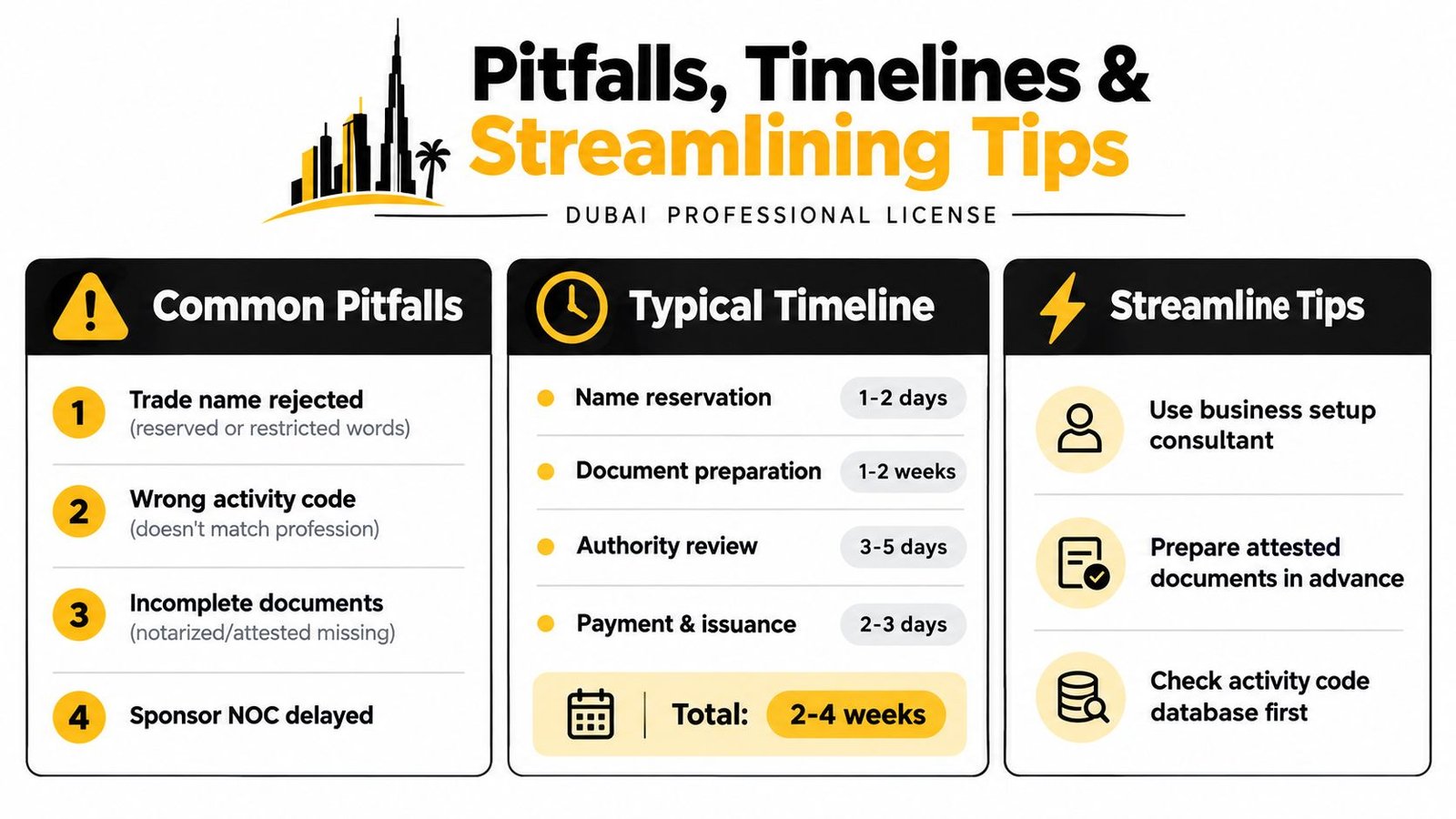
The first problem is usually the trade name. Names get rejected when they clash with an existing reservation, include restricted wording, or don't fit the activity. The second is the activity itself. A code that slips between professional and commercial categories can trigger resubmission or force a change in structure.
The third issue is document readiness. Passports expire sooner than expected. No-objection letters are vague. Degree certificates aren't attested. Office paperwork doesn't line up with the authority's premises rules.
What timeline to actually expect
For straightforward applications, planners often use these working ranges:
- Free Zone files often move in about 7 to 14 working days when the file is clean
- Mainland files often land in about 10 to 20 working days
- Regulated professions or rejected names can stretch the process to 6 to 8 weeks
These are operating expectations, not legal service guarantees. The practical point is simple. The cleanest file wins.
The Free Zone first question
A lot of founders assume they should start in a Free Zone, then move to Mainland later if the business grows. Sometimes that's sensible. Often it isn't.
Dubai now has a dual-licence pathway for eligible Free Zone firms to obtain Mainland permission through the Dubai Unified License platform, but eligibility depends on the zone, as noted earlier in the Mainland versus Free Zone section. That means “we'll just expand later” is not a strategy unless you've already checked whether your chosen zone supports that path for your activity.
Start where your client access needs to be, not where the brochure looks simpler.
If your first-year business comes from overseas clients, remote delivery, or a contained niche inside a specific zone ecosystem, a Free Zone can make sense. If your plan involves direct local contracting across Dubai, Abu Dhabi, Sharjah, or the wider UAE, a Mainland structure is often the cleaner answer from day one.
How to make the process easier
Before you ask for quotations, prepare three items:
- A one-line service description that says exactly what clients will pay you for
- Your target market list inside Dubai, across the UAE, or internationally
- Your visa plan for founders, staff, or dependants
That short brief is enough for a setup specialist to map your likely activity code, jurisdiction, and starting budget.
If you want help with the execution, a corporate services provider can pre-screen trade names, align the activity code with the licence category, organise attestations, and handle authority follow-up. Inpro is one example of a UAE provider that handles licensing, visas, and document workflows across Mainland and Free Zone setups.
Ask for a structured quote, not a package headline. The quote should separate licensing fees, visa costs, office costs, and attestation costs so you can compare options.
If you want a clear answer on which professional licence fits your activity, Inpro can help you map the right activity code, compare Mainland and Free Zone options, and break down the first-year cost before you commit. If you're unsure where your service sits, book a strategy call and get a fixed-scope view of the licence, visa, and office path that matches your plan.