


You may be searching for a RAK Bank zero balance account because your UAE company is newly licensed, cash flow is still developing, and you don't want to lock funds into a high minimum-balance requirement. For most startup founders, the relevant product is RAKBANK's RAKstarter business account, designed for companies with a valid UAE trade licence that have operated for less than one year, not a universal account for every resident or business.
Table of Contents
- What Is a RAK Bank Zero Balance Account
- Eligibility Requirements and Account Benefits
- Documentation Checklist for Your Application
- How to Apply for Your RAKstarter Account
- Common Reasons Applications Get Rejected
- Alternatives and Next Steps for UAE Founders
What Is a RAK Bank Zero Balance Account
A RAK Bank zero balance account is a business banking account that lets an eligible UAE startup operate without maintaining a minimum monthly average balance. RAKBANK offers this structure through its RAKstarter product family, which the bank positions for newly formed companies rather than general retail customers. The bank's business product page says RAKstarter is intended for companies with a valid UAE trade licence that have been operating for less than one year. You can review the current RAKstarter business account eligibility details before applying.
The product family was formalised by RAKBANK in early 2023, with the business product page dated 20 January 2023 and the Islamic business version dated 17 February 2023, as shown in the bank's product materials. That history matters because it places the zero-balance model within an established UAE startup banking product, rather than treating it as a temporary introductory offer.
Who is the account designed for
RAKstarter is aimed at founders who have already incorporated a company in the United Arab Emirates and hold an active trade licence. That may be a Dubai mainland company, an Abu Dhabi entity, or a company established in a UAE free zone such as one in Sharjah or Ras Al Khaimah. The business must also fall within the bank's stated operating-age requirement.
This makes the account particularly relevant during the early operating stage, when founders are paying for licences, visas, office arrangements, software, suppliers, and professional services before revenue becomes predictable. A zero-balance structure can preserve working capital for those commitments.
Practical rule: “Zero balance” describes the balance condition. It does not mean automatic approval, no documentation, or no account restrictions.
The account should not be confused with every RAKBANK product carrying the same label. RAKBANK's Islamic personal digital banking page for Emiratis also describes a zero-balance account with no minimum balance requirement. That product belongs to a different customer segment, and eligibility may depend on nationality or account type. A founder applying for a company should select the business product, not assume that a personal zero-balance account can serve as a corporate account.
What the account is not
A zero-balance business account isn't a substitute for choosing the right banking infrastructure. It may suit a new consultancy, technology company, agency, or professional services firm with straightforward payments and limited cash handling. A business expecting substantial trade finance, complex collections, or extensive credit facilities may eventually need a broader corporate banking relationship.
The sensible approach is to treat RAKstarter as a potential operating account for an eligible early-stage company. Check the activity, ownership, residency, transaction profile, and supporting documents before you submit anything. The bank still needs to understand who owns the company, what it does, where its funds come from, and how money is expected to move through the account.
Eligibility Requirements and Account Benefits
A founder can meet the balance requirement and still fail the application. RAKstarter is intended for a company with a valid UAE trade licence operating for less than one year, according to RAKBANK's RAKstarter product information. An inactive licence, an older company, or business activity that does not match the licence can stop the application before the zero-balance feature becomes relevant.
The account works best when its operating conditions are compared with a standard business account. The bank's digital application flow shows AED 0 as the required minimum balance for the zero-balance option, with AED 0 monthly digital banking fee and AED 0 fall-back fee for that tier. These figures appear on the RAKBANK digital business application page.
How the business tiers compare
| Feature | RAKstarter Zero Balance | Standard Business Current Account |
|---|---|---|
| Eligibility focus | UAE companies with a valid trade licence operating for less than one year | Standard business banking tier |
| Required average balance | AED 0 according to the digital application flow | AED 25,000 monthly average credit balance |
| Digital banking fee shown in the application flow | AED 0 | Treatment depends on the applicable waiver and balance conditions |
| Fall-back fee shown for the zero-balance tier | AED 0 | AED 52.50 or AED 103.95 monthly charges may apply when conditions are not met |
| Additional features stated by the bank | Free remittances and preferential foreign-exchange rates | Different maintenance and fee treatment based on balance conditions |
The standard tier's AED 25,000 monthly average credit balance is a useful comparison for founders planning cash reserves. A company that can maintain that amount may prefer the service profile of a conventional account. A company that needs to keep funds available for payroll, suppliers, or early operating costs may find the zero-balance structure more practical, provided its eligibility and compliance file are clear.
What benefits matter in daily operations
RAKBANK states that the zero-balance option includes free remittances and preferential foreign-exchange rates. Those features can help companies paying overseas contractors, receiving international revenue, or settling supplier invoices outside Dubai, Abu Dhabi, and the wider United Arab Emirates.
The compliance trade-off remains important. The fee structure does not remove the bank's need to understand the company's activity, ownership, source of funds, expected transactions, and customer relationships. A mismatch between the trade licence and the application narrative can create more difficulty than the account balance requirement.
Personal and business products also need separate treatment. RAKBANK's savings-account page states that certain savings customers have no minimum balance requirement for the first three months and lists an AED 0.25 annual interest rate on AED savings balances. Those conditions apply to the savings product, not automatically to RAKstarter. Founders should compare corporate fees with corporate fees, rather than use a personal savings account as a proxy for business banking costs. The RAKBANK savings account page sets out those savings conditions.
Documentation Checklist for Your Application
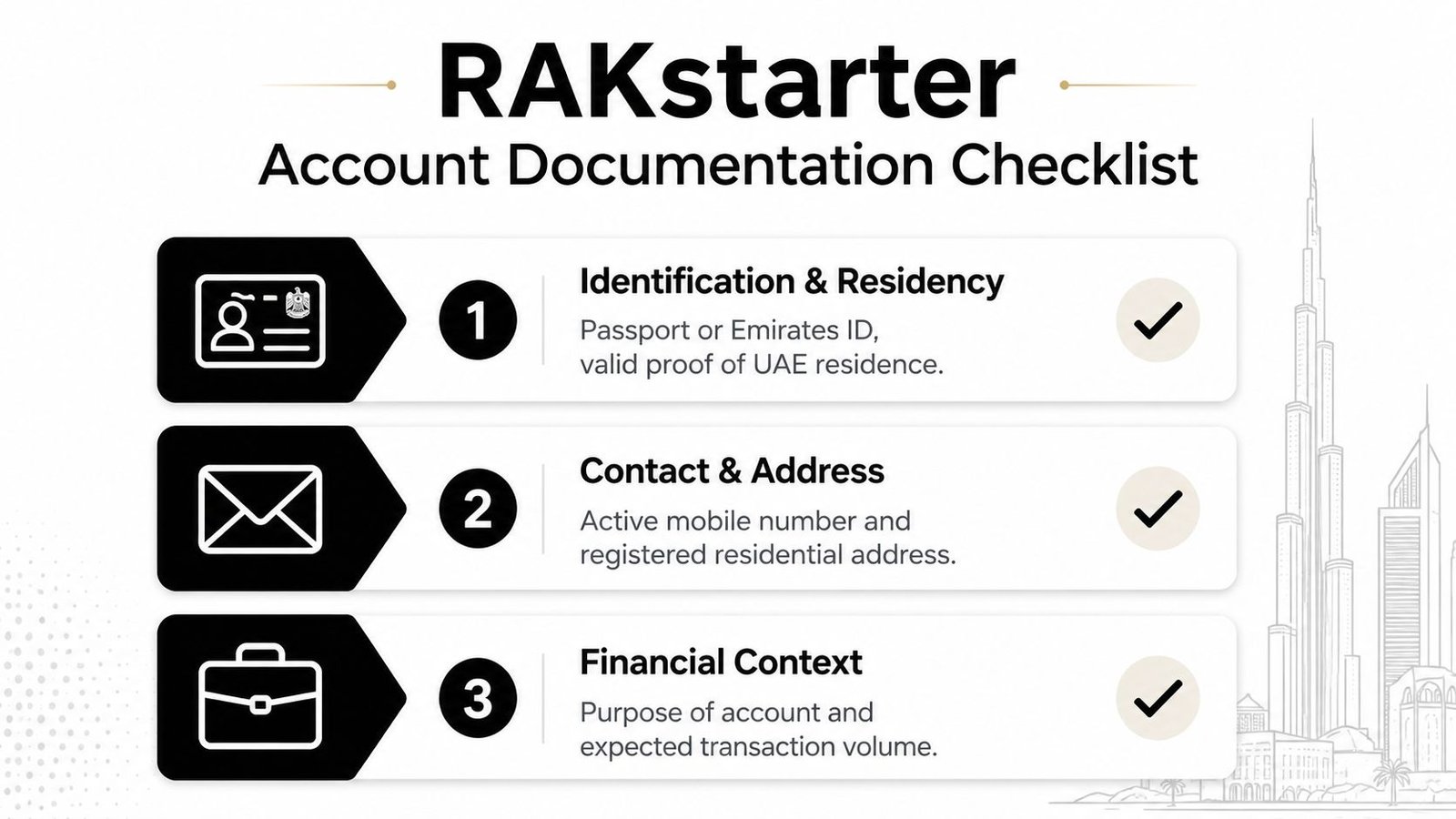
A bank account application can fail even when the trade licence is valid. The usual problem is an inconsistent compliance file. The licensed activity, ownership, source of funds, expected transactions, and business address must describe one credible operating model. A zero-balance structure does not remove the bank's identity and risk checks.
RAKBANK's business application overview identifies three document areas that commonly support the review: source-of-income evidence, current business-address evidence, and company constitution documents. Prepare these alongside identity and ownership records, rather than uploading them only after the bank asks.
What should you prepare first
Build the identity and residency file for each relevant person. The application should identify the authorised signatory and everyone who owns or controls the company. Keep names, passport details, nationality, Emirates ID information, and residential addresses consistent across the form and supporting documents.
Organise the company file in the same order a compliance reviewer will assess it:
- Trade licence: Check that it is valid and that the licensed activities match the business explanation.
- Company constitution: Provide the incorporation and constitutional documents requested for the entity.
- Ownership records: Show the shareholding and control structure clearly, including corporate shareholders and the individuals behind them.
- Business address: Supply current evidence for the registered or operating address. Free-zone companies should ensure the address matches the authority's records.
- Source of income: Explain how the company and its owners generate funds. Support the explanation with contracts, invoices, financial records, or other relevant evidence where available.
- Expected transactions: State how the account will be used, including expected counterparties, currencies, payment destinations, and transaction patterns.
Existing companies may be asked for six months of bank statements, together with further ownership and operations documents, according to the independent UAE banking guidance supplied for this guide. This is more likely to matter when an established business is changing banks, moving from a free zone, or operating through a newly formed mainland structure.
Where applications usually slow down
Review the file as one connected explanation before submission. For example, a licence describing professional consulting does not support an application narrative centred on product trading. A shareholder register that conflicts with the constitutional documents creates the same problem. A source-of-income statement referring to revenue that the company cannot evidence invites further questions.
Before submitting, ask: Could a compliance officer understand the company, its owners, its address, and its expected money flows without requesting a second explanation?
Incomplete or inconsistent information can lead to follow-up requests, delays, or rejection during anti-money-laundering checks. Submit a coherent compliance narrative, not a collection of unrelated attachments.
How to Apply for Your RAKstarter Account
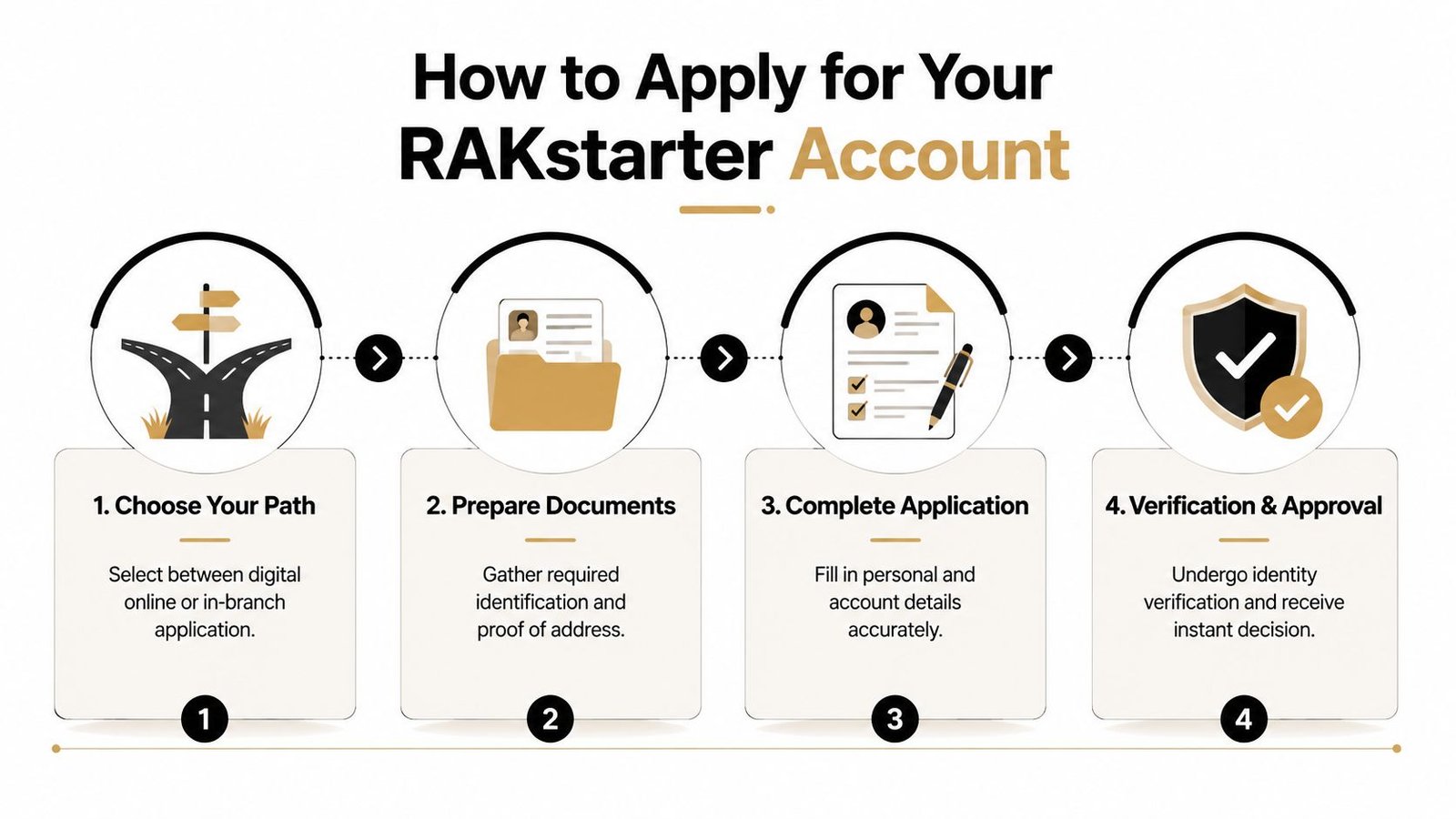
You can begin through RAKBANK's digital business application route or discuss the account through a branch. The digital route is useful for founders who have a clean document file and can respond promptly to verification requests. An in-branch conversation may be more suitable when the ownership structure, activity, residency position, or expected transactions need explanation.
How the digital route works
Use the bank's quick-apply portal, select the appropriate business account, and complete the company and authorised-signatory information. The form should reflect the trade licence exactly, including the legal name, licensed activity, registered address, ownership details, and contact information.
Upload clear documents in the format requested by the portal. Before pressing submit, compare every spelling, date, address, and licence detail across the application. A small mismatch can create a manual review that would have been avoidable.
The review stage may include follow-up requests for source-of-income evidence, business-address evidence, company constitution documents, or clarification of expected transactions. Reply with a complete answer rather than sending a partial document and waiting for another request.
When a branch visit helps
A branch route can help when your company is based in a free zone, has foreign shareholders, is moving from another jurisdiction, or has a business model that needs more context. RAKBANK has locations in Dubai, Abu Dhabi, Sharjah, and other Emirates, so the practical route may depend on where the founders and authorised signatories are based.
The bank may contact you for a verification call. Keep the explanation simple: what the company sells, who pays it, where suppliers or customers are located, why the account is needed, and what activity you expect during the early operating period. Don't describe a business model that differs from the licensed activity or the documents you submitted.
A bank decision and account activation are separate milestones. Once the account is approved, follow the bank's instructions for digital banking access, security credentials, and any card or account-service activation. Exact processing times depend on the application and compliance review, so don't promise a launch date until the bank confirms activation.
A short video can help new founders understand the general account-opening journey before they begin:
Common Reasons Applications Get Rejected
Founders rarely fail because they selected a zero-balance product. Applications usually stall because the documents do not give the bank a clear, verifiable view of the business. Reviewers need to understand identity, ownership, source of income, business address, expected transactions, and overall risk before opening the account.
Incomplete or inconsistent KYC
KYC means Know Your Customer. It is the process banks use to verify the people and company behind an account. Missing identity documents, expired records, unclear address evidence, or incomplete company papers can stop an application before the bank considers its commercial merits.
Check one point carefully: Does every document identify the same legal entity and authorised people?
A mismatch between licence and money flows
A trade licence for marketing consultancy does not, by itself, explain expected payments for large volumes of physical goods. The same concern arises when the stated income source conflicts with invoices, contracts, website content, or the ownership background.
Describe the business in operational terms. State what you sell, who pays you, where customers and suppliers are located, how payments move, and why the requested account services fit that activity. Broad descriptions create avoidable follow-up questions.
Ownership that is difficult to trace
Free-zone companies may have corporate shareholders, several ownership layers, or overseas holding companies. These structures are not automatically unacceptable, but the bank still needs a clear path from the UAE entity to the individuals who ultimately own or control it.
Ask yourself: Could you draw the full ownership structure and support every step with official documents?
If the answer is no, collect the missing incorporation, shareholder, and control documents before submitting the application.
An unsupported transaction profile
Writing “international business” as the expected account use does not explain the activity clearly enough. The bank may need expected counterparties, payment purposes, currencies, and a sensible connection between projected turnover and the licensed business.
Founders who recently relocated may face further questions if they have limited local financial history. Prepare evidence showing the source of initial capital, then explain how the company expects to generate revenue in the UAE and overseas.
High-risk activities and weak business substance
Virtual assets, money services, precious metals, precious stones, and high-volume cash activity can receive closer scrutiny. Foreign ownership, a recently relocated founder, or a minimal office arrangement may also require a clearer explanation of how the company operates.
A zero-balance product reduces the balance burden. It doesn't reduce the bank's responsibility to complete anti-money-laundering checks.
Treat every clarification request as part of the compliance review. Provide a direct answer and attach documents that allow the reviewer to verify it. A consistent explanation is more useful than a polished description that conflicts with the licence, contracts, or expected payment activity.
Alternatives and Next Steps for UAE Founders
RAKstarter can suit a newly established company, but it is not the only option. Compare it with digital-first business accounts, traditional banks offering startup programmes, and standard corporate accounts. The right choice depends on your payment profile and whether you need international remittances, cash handling, cheque services, trade finance, credit, or a relationship manager.
A digital-first account often fits freelancers, software companies, agencies, and online service providers that receive and send money electronically. Traditional banking may be more practical for businesses expecting larger facilities, structured collections, substantial supplier payments, or services beyond daily transfers. Confirm those needs before applying, because choosing an account that cannot support the company's activity creates avoidable compliance questions later.
When should you reassess the account
Review the account when operations change, not only when revenue increases. Reconsider your banking arrangement if customers request unsupported services, the company needs credit, or payment activity becomes more complex.
The standard Business Current Account waiver conditions may change at an AED 250,000 average monthly credit balance, according to RAKBANK's business digital banking information. Founders should factor that condition into a comparison between a startup product and a broader business banking arrangement.
Keep the trade licence, ownership records, address evidence, and transaction explanation current. A newly formed Dubai consultancy may later need a different account after hiring staff, expanding into Abu Dhabi, serving international customers, or adding a regulated activity. Update the bank before those changes create a mismatch between the account profile and actual transactions.
Inpro Corporate Services L.L.C. helps founders form and license UAE companies, prepare compliant documents, and coordinate corporate bank account applications for Mainland, Free Zone, and Offshore structures. Visit Inpro Corporate Services L.L.C. to book a free strategy call or use the cost estimator for your UAE setup.