


You're probably at the point where the UAE visa question has stopped being administrative and started affecting real business decisions.
You need a residence visa to live in the UAE, open the right operational doors, and build with confidence. But the bigger issue is usually this: which visa path matches the company you're building, the ownership structure you want, and the flexibility you'll need later. Founders often start by asking what documents to submit. The better question is what kind of residency position they want to create for themselves in the first place.
That matters because UAE residency is no longer limited to the old employer-sponsored model. The government now offers multiple routes, including sponsored visas, Green Visas, Golden Visas, and other long-term options with different income, education, and asset requirements, as shown by the ICP residency pathway guidance. If you choose the wrong structure early, you can create friction later around hiring, travel, family sponsorship, or corporate control.
Table of Contents
- Navigating the Modern UAE Visa Landscape
- The Core Pillars of UAE Residency
- Choosing Your Path Main UAE Residence Visa Types
- Your Essential Visa Document Checklist
- The Step-by-Step UAE Visa Processing Timeline
- Common Visa Application Pitfalls to Avoid
- How Inpro Guarantees a Smooth Visa Process
Navigating the Modern UAE Visa Landscape
A founder sets up a company, secures a trade licence, then discovers the visa route they assumed would work creates limits they did not plan for. I see this regularly. The visa decision should be made earlier, because it affects how the business is structured, who sponsors whom, and how much flexibility the founder keeps.
The UAE visa system now gives founders more than one credible route to residency. That is good news, but it also means the choice carries more weight. An investor visa, a Green Visa, and a Golden Visa do not solve the same problem. Each one points to a different setup model, different evidence requirements, and a different level of dependence on an employer, mainland company, free zone entity, or personal qualifying profile.
That is the key shift. Visa selection is no longer just an immigration task handled after incorporation. It is part of setup strategy.
Why visa choice is a business decision
The right visa should match the role you will actually play in the business.
If you are a founder who will hold shares and direct the company, a route linked to ownership may fit better than one tied to payroll. If you are building a UAE base while working independently, a category built around personal income or professional status may give you more control than a standard employment visa. If the company is scaling and bringing in senior staff, the founder's visa path and the team's visa path often need to be separated from the start.
Those choices have operational consequences:
- Control over sponsorship. Some visa routes keep your status tied to a company or employer. Others give you more independence.
- Setup flexibility. Your visa path can influence whether a simple structure works now or whether you should build for a more durable ownership model.
- Future restructuring risk. A quick visa choice can create extra paperwork later if the business grows, ownership changes, or your role shifts.
- Long-term fit. Founders planning to stay, invest more, or expand family residency usually need a route that still makes sense after year one.
The cheapest file to open is not always the smartest file to build.
What usually works
Strong applications begin with role clarity. Define whether you are entering as an owner, employee, investor, or independent professional. Once that is clear, the document set, sponsorship logic, and approval path become much easier to align.
Problems start when founders force every case into one template. That usually leads to the wrong sponsor, weak supporting documents, or a visa structure that has to be changed once the company becomes more active. A better approach is to choose the residence path that supports the business you are building, not just the one that gets a stamp fastest.
The Core Pillars of UAE Residency
Every visa category has its own details, but most UAE residence applications rest on the same foundation. If you understand that foundation properly, the whole process becomes more manageable.
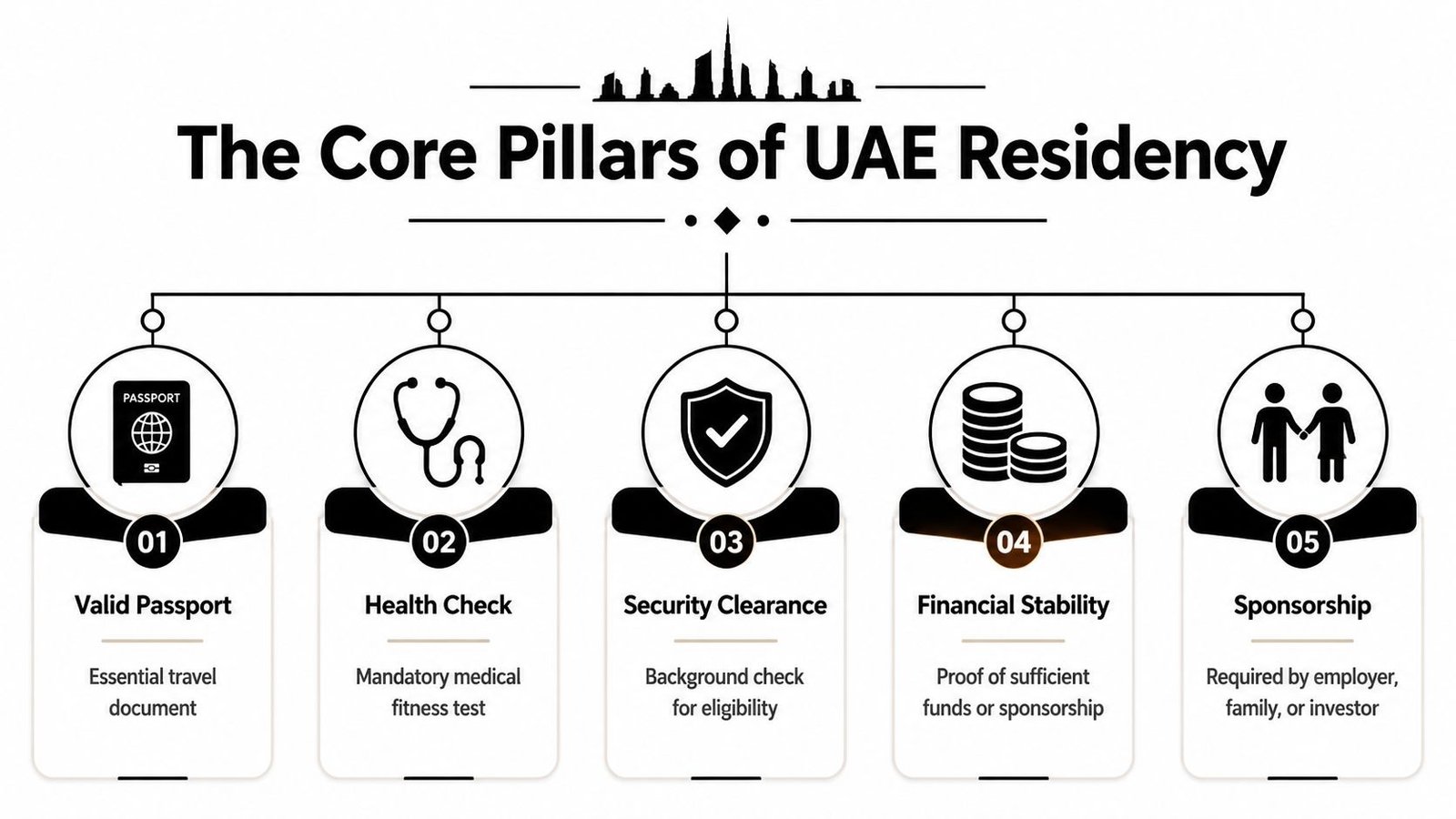
The official UAE position is clear. Applicants generally need a passport with at least 6 months' validity, and the process commonly includes Emirates ID registration, a medical fitness test, and health insurance where required, as outlined on the UAE government residence visa guidance. This is why UAE residency should be treated as a compliance workflow, not a single application form.
Think in systems, not forms
Most applicants focus on paperwork. The authorities focus on whether your status is supportable and verifiable. That distinction matters.
The core pillars usually look like this:
- Valid passport. If the passport doesn't meet the required validity window, the file is weak from the start.
- Sponsorship basis. There must be a legal basis for your residency, whether through employment, ownership, family, or another recognised route.
- Medical clearance. Residency isn't finalised on documents alone.
- Identity registration. Emirates ID sits at the centre of practical life in the UAE.
- Insurance and supporting proof. Depending on route and jurisdiction, this can become a gating requirement.
What founders often misunderstand
The first misunderstanding is thinking sponsorship is always the same thing. It isn't. In one case, sponsorship may come from an employer. In another, it may be tied to your own business position or self-sponsored pathway. The strategic difference is significant.
The second misunderstanding is treating Emirates ID as an afterthought. It isn't just an ID card. It's part of the residency framework that makes your status functional for banking, leasing, and day-to-day administration.
Practical rule: Build your visa file like an audit trail. Every document should support a clear answer to one question: why does this person qualify to reside in the UAE under this category?
A well-prepared file usually feels boring. That's a good sign. Clean identity documents, consistent company records, correct category selection, and aligned supporting papers are what move cases through with fewer surprises.
Choosing Your Path Main UAE Residence Visa Types
There isn't one best UAE residence visa. There's only the best fit for your role, ownership position, and timeline.
The UAE has moved decisively towards longer-term options. The Abu Dhabi Golden Visa can be valid for up to 10 years, and qualifying applicants from abroad first receive a 6-month entry visa before converting to residency. The Abu Dhabi Green Visa is valid for 5 years and is aimed at professionals, freelancers, investors, and partners, according to Abu Dhabi's long-term residency guidance.
A strategic comparison
| Visa Type | Ideal For | Typical Validity | Sponsorship Requirement | Key Eligibility Criteria |
|---|---|---|---|---|
| Investor or Partner Visa | Founders, shareholders, business owners | Depends on category and authority | Usually linked to company ownership or partnership status | Company documents, ownership proof, supporting corporate records |
| Employee Visa | Staff, executives, operational hires | Often linked to standard sponsored terms | Employer-sponsored | Employment relationship, company quota and labour alignment, role-based documentation |
| Golden Visa | Long-term founders, investors, high-value talent | Up to 10 years | Self-sponsored in qualifying categories | Category-specific proof tied to talent, investment, or recognised qualification |
| Green Visa | Freelancers, skilled professionals, self-sponsored operators, some investors and partners | 5 years | Designed to remove need for employer sponsorship in qualifying cases | Category-specific proof such as income, education, professional standing, or business basis |
The table is the starting point. The actual decision sits underneath it.
How to think about each route
Investor or Partner Visa
This route often makes the most sense when your legal identity in the UAE is tied to a company you own or co-own. It aligns well with founders who want residency to sit close to their shareholding position rather than depend on a salary relationship.
Its strength is structural alignment. If you are the person behind the entity, the visa logic reflects that reality. Its weakness is that the quality of the application depends heavily on the company file being clean. Licence activity, incorporation documents, shareholder records, and supporting filings all need to match.
Employee Visa
This is still the right answer for many people. Not every founder needs to be on an investor route, and not every senior operator qualifies for a self-sponsored path.
Employee visas work best when the person's UAE role is straightforward: they're employed by a UAE entity, the company sponsors them, and the immigration and labour position move together. The trade-off is reduced independence compared with self-sponsored categories. If your role or ownership position changes, the visa may need to change too.
Golden Visa
For long-term planning, this is often the most strategically attractive route if you qualify. It can reduce the need to constantly rework residency around employment or short-cycle company changes.
The practical advantage isn't just duration. It's stability. If you're building over multiple years, raising capital, relocating family, or structuring a regional base, a long-term category can simplify decisions that would otherwise keep circling back to sponsorship mechanics.
The right long-term visa can remove friction from decisions that have nothing to do with immigration on the surface, such as board composition, compensation design, and founder mobility.
Green Visa
This route speaks directly to the modern UAE economy. It's useful for professionals and independent operators whose work doesn't fit neatly into old sponsorship patterns.
For consultants, freelancers, and some founders, the Green Visa can create cleaner operational logic than an employee visa. But category fit matters. If the supporting evidence doesn't properly match the selected path, the file becomes harder than it needs to be.
Your Essential Visa Document Checklist
A good visa file is organised before the application starts. That's where many delays are avoided.
Founders often underestimate document quality because the headline requirements look simple. Passport copy. photo. application form. company papers. In reality, problems usually come from inconsistency, poor attestation, stale supporting documents, or documents that make sense in one jurisdiction but not in the one processing the visa.
The master file every applicant should prepare
Start with the core set and build outward:
- Passport documents. Keep a clear copy of the passport bio page and check that validity is comfortably beyond the minimum requirement.
- Personal photo. Use a recent photo that meets application standards.
- Current status papers. If you're already in the UAE, keep copies of your current entry or residency records where relevant.
- Health insurance evidence. Some categories and jurisdictions require this as part of the final package.
- Category support documents. These prove why your file belongs under a specific visa route.
A disciplined founder keeps these in one controlled folder, with final versions only. Mixed drafts and old scans cause avoidable confusion.
Documents that change by visa type
The document set changes based on who you are in relation to the UAE entity.
For an investor or partner file, expect the focus to shift towards company records. That usually means incorporation papers, licence details, shareholder or partner evidence, and any supporting corporate approvals needed to justify the application.
For an employee file, the centre of gravity moves to the employment relationship. That can include labour-linked papers, company sponsorship records, and role-specific documents.
For family-linked applications, the pressure point is usually civil documentation. Marriage and birth certificates often need proper attestation and, where required, translation. If these are prepared late, the visa process slows down even when everything else is ready.
Files don't usually fail because one document is impossible to obtain. They fail because applicants discover too late that a perfectly real document isn't acceptable in its current form.
A simple working method helps:
- List the visa category first.
- Map every document to that category.
- Check whether any document needs attestation or translation.
- Make sure names, passport numbers, and company details match exactly across the file.
- Freeze the final pack before submission.
What works is precision. What doesn't work is submitting a “close enough” pack and hoping the authority or typing centre will correct the logic for you.
The Step-by-Step UAE Visa Processing Timeline
Applicants relax too early once the initial submission is made. Much of the effort often lies in the subsequent steps.
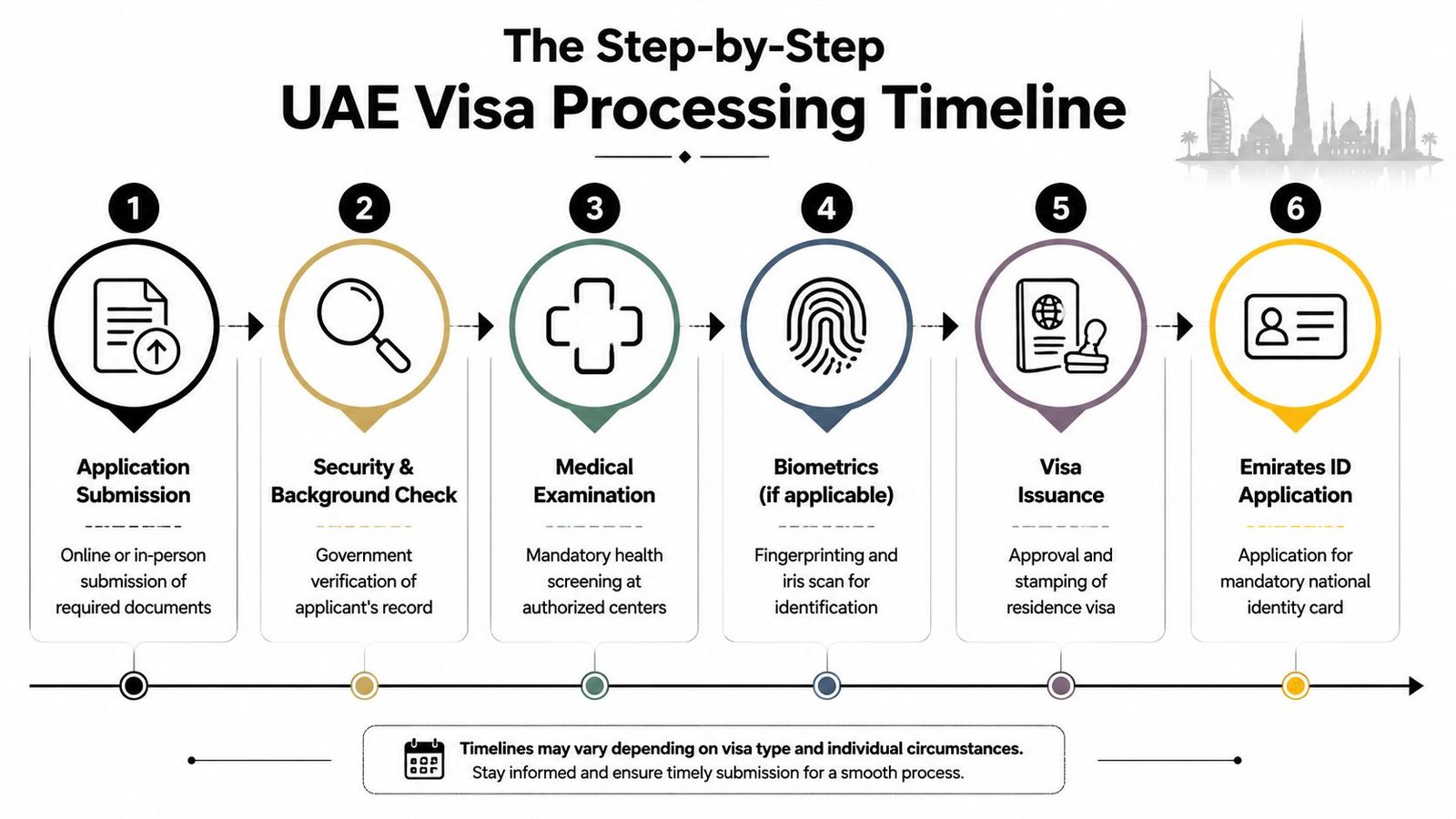
For most applicants aged 18 and over, the UAE treats the medical fitness test as a mandatory control point, alongside Emirates ID registration and a security check, under the general provisions for UAE residence visas. The same guidance notes that standard sponsored visa validity is typically 1, 2, or 3 years, while some other categories can run up to 5 or 10 years, depending on class and status.
What happens in sequence
The path is usually easier to manage when you think of it as a project with gates.
Initial application submission
The file is prepared and lodged through the relevant authority or processing channel attached to the visa category and jurisdiction.Security and background review
The authorities review the application before the residency can progress. This is one reason why clean, consistent documents matter from the outset.Medical fitness test
For adult applicants, this is a real pass-or-block stage, not a routine formality.Biometrics and Emirates ID registration
Identity capture and registration move the file towards usable resident status.Residence visa issuance
Once approvals complete, the residence position is finalised through the applicable process.
This visual summary helps show the sequence clearly:
Where timelines usually slip
Most delays don't come from one dramatic problem. They come from poor sequencing.
A few examples are common:
- Medical booked too late. The file sits waiting for a mandatory step.
- Biometrics delayed. Emirates ID progress slows the rest of the process.
- Travel booked at the wrong point. The applicant leaves or plans movement during a stage that needs in-country availability.
- Category confusion. The authority reviews one profile while the papers suggest another.
If you're handling residence visa requirements in the UAE for a founder team, build an internal checklist around dependencies, not just tasks. Submission is not the end of preparation. It's the moment preparation is tested.
Common Visa Application Pitfalls to Avoid
Most visa problems don't come from obscure law. They come from ordinary assumptions that turn out to be wrong.
One of the most expensive examples is travel complacency. Under most UAE residence visas, spending more than 180 consecutive days outside the UAE can invalidate the permit, and re-entry after that absence often requires a fresh process from outside the country, as explained in this guide discussing the UAE's 180-day residence visa rule.

The assumptions that cause problems
A few show up repeatedly.
“My visa stays active because it hasn't expired.”
Expiry date and residency validity in practice are not always the same thing if absence rules are breached.“We can fix the documents after submission.”
Sometimes you can. Often you lose time, create conflicting records, or trigger unnecessary rework.“Medical is a routine checkbox.”
It's a control point. If there's an issue, the process stops.“Any visa type is fine for now.”
A temporary shortcut can create restructuring work when banking, family sponsorship, travel, or corporate governance become more important.
How to avoid preventable delays
The fix is operational discipline.
- Track travel carefully. If you'll be mobile, calendar your absence periods and don't rely on memory.
- Validate the category before filing. Make sure the visa route matches your real role.
- Prepare attested civil and company documents early. These are frequent bottlenecks.
- Keep naming consistent. Passport spelling, shareholder records, and supporting papers should align exactly.
- Plan around processing windows. Don't insert avoidable travel in the middle of medical, biometrics, or issuance stages.
If a founder expects to spend long periods outside the UAE, that travel pattern should be reviewed before choosing the residency path, not after the visa is issued.
What usually goes wrong is timing. The file may be legally possible, but operationally messy. Good planning keeps it both valid and workable.
How Inpro Guarantees a Smooth Visa Process
The hardest part of UAE residency isn't filling in forms. It's making the right decision early, then keeping every document, approval step, and authority interaction aligned to that decision.
That's where experienced execution matters. A founder needs more than a typing service. They need someone who can connect visa category, company setup, attestations, government workflow, and timeline management into one coherent process.
Inpro Corporate Services L.L.C. does that by handling the parts that usually create drag for founders and operations teams: company formation alignment, PRO support, investor and employee visa processing, document workflow control, attestations, and direct coordination with the relevant UAE channels. That reduces guesswork and gives clients a process that is easier to plan around.
The practical advantage is clarity. When the visa strategy fits the business model from the start, fewer things need to be corrected later. When the document pack is checked properly before filing, approvals are easier to predict. When someone is actively managing the sequence, the founder can stay focused on launching and running the business instead of chasing administrative details.
Good visa support doesn't just help you get approved. It helps you avoid building the wrong residency structure around the company in the first place.
If you want a faster, cleaner route through UAE residence planning, Inpro Corporate Services L.L.C. can help you choose the right visa path, prepare the correct file, and manage the process from setup to approval with clear timelines and direct support.