


You're probably at the point where the UAE opportunity looks real enough to act on. Maybe you've validated demand, spoken to a few customers, and now one practical question is blocking the next move. Should you start as a sole proprietor, or should you form an LLC?
In the UAE, that choice affects much more than your trade licence. It changes how risk sits on your shoulders, how banks look at you, how clients contract with you, and how easily you can add visas, partners, or new activities later.
Many founders encounter difficulties navigating this distinction. A sole establishment can look attractive because it feels quick and lean. A single-owner LLC can look similar from the outside because you still control the business day to day. But in practice, they operate very differently once you start signing contracts, opening accounts, hiring staff, or expanding beyond a simple owner-operated model.
The confusion gets worse when jurisdiction enters the picture. A mainland setup solves one type of problem. A free zone setup solves another. Offshore structures sit in a different category altogether. The right answer isn't just “sole proprietor vs llc”. It's which structure, in which jurisdiction, for which operating plan.
Table of Contents
- The First Big Decision for Your UAE Business
- Understanding the Core Legal Structures
- Detailed Comparison Across Key Business Criteria
- Comparing Setup Costs Timelines and Renewals
- Impact on Visas Banking and Taxation
- Which Structure Is Right for You Founder Scenarios
- From Decision to Launch Your Next Steps with Inpro
- Frequently Asked Questions
The First Big Decision for Your UAE Business
A founder in Dubai often starts with a simple assumption. “It's just me for now, so I should probably register in the simplest way possible.” That logic sounds sensible until the first landlord asks who is signing the lease, the first enterprise client asks for company documents, or the first bank asks for a clearer ownership and activity profile.
That's why this first decision matters so much.
A sole proprietorship, usually structured in the UAE as a sole establishment, fits the owner-operated model. One person owns it, controls it, and runs it directly. An LLC creates a company that exists separately from the founder, even if there is only one owner.
That difference sounds technical. It isn't. It affects what happens when the business owes money, when a dispute arises, when a client wants to contract with you, or when you want to add a shareholder later.
Practical rule: If your business will stay small, service-based, and centred on your own work, a sole establishment can be workable. If the business will hold stock, hire staff, sign larger contracts, or scale beyond you, founders usually benefit from thinking like a company from day one.
In the UAE, the answer also depends on where you want to operate. Mainland, free zone, and offshore structures don't just change the paperwork. They shape market access, visa use, banking conversations, and how easily the business can grow into something larger than its original setup.
Understanding the Core Legal Structures
A founder can own 100 percent of a business in the UAE under either model, but the legal result is different from day one.
What a sole establishment really means
In UAE practice, a sole establishment is the closest match to what many founders call a sole proprietorship. It is built around one individual owner and usually suits work that depends mainly on that person's own skill, licence, and client relationships.
The practical point is liability. The business does not create the same legal separation that an LLC does, so the owner remains personally exposed to the business's obligations. If the business signs a lease, takes on supplier debt, faces a claim, or runs into a payment dispute, that exposure does not stay neatly inside a separate company vehicle.
That risk is often acceptable for a solo consultant, designer, or specialist providing low-volume services with limited overhead. It becomes harder to justify once the business starts hiring staff, renting premises, ordering inventory, or signing larger contracts with penalties and longer payment terms.
Jurisdiction also matters here. A sole establishment on the mainland can be workable for certain professional activities where the founder wants to trade directly in the UAE market. In free zones, founders more often choose a company form rather than a sole-style structure because the operating model is already geared toward licences, visas, office packages, and banking under a registered company. Offshore is a different case again. It is generally used for holding structures or international ownership planning, not for a founder who wants to personally run day-to-day UAE operations.
Why an LLC changes the legal position
An LLC creates a separate legal entity. The company can contract in its own name, hold assets, add shareholders, and continue beyond the original founder more cleanly than a sole establishment.
For many founders, that separation matters less in theory than in operations. Banks usually want to understand who owns the company, what activity it conducts, and how funds will move. Enterprise clients often prefer contracting with a company rather than with an individual establishment. If you plan to add a partner, issue shares, bring in an investor, or sell part of the business later, an LLC gives you a structure built for that conversation.
It also changes how growth feels in practice.
- Banking is often more straightforward because the business presents as a company with clearer governance and ownership records.
- Client contracting is cleaner because agreements sit with the company, not only with the founder personally.
- Hiring and visas are easier to plan for because company structures are generally better aligned with multi-person operations.
- Expansion is more realistic because ownership can be restructured without rebuilding the business around a single individual.
A single-owner LLC can still be simple to run. The difference is that it is simple inside a company wrapper, not simple because the business and the founder are treated as nearly the same thing.
The UAE jurisdiction layer changes the calculation again. A mainland LLC usually makes more sense if the business needs broad access to the local UAE market, physical premises, or a wider operating footprint. A free zone LLC or free zone company can work well for founders who want lower setup friction, a zone-specific package, and a structure that supports visas and cross-border business, while accepting the limits tied to that jurisdiction. An offshore company can be useful for asset holding or international structuring, but it is usually the wrong vehicle for a founder who needs local staff visas, active UAE trading, or day-to-day commercial substance.
The better question is not which structure sounds simpler on paper. It is which one fits how the business will operate over the next 12 to 24 months.
Detailed Comparison Across Key Business Criteria
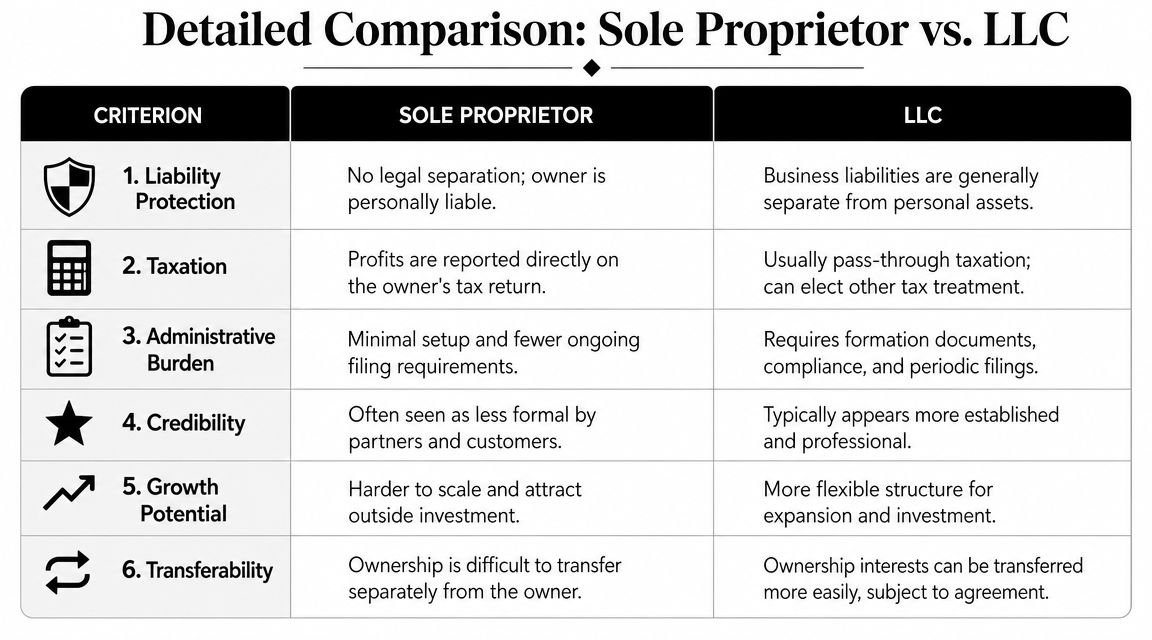
A founder in the UAE often reaches this stage after the first practical questions start piling up. Can this structure open the right bank account. Can it support visas. Will larger clients contract with it. Can it absorb a second owner later without forcing a restart.
Those questions matter more than the label on the licence.
UAE at a glance comparison table
| Criterion | Sole Proprietorship (Establishment) | Limited Liability Company (LLC) |
|---|---|---|
| Legal status | Closely linked to the owner | Separate legal entity |
| Liability | Owner is personally exposed | Liability is generally limited to company capital, subject to compliance and conduct |
| Ownership model | One natural person only | One or more shareholders, depending on jurisdiction and licence type |
| Banking perception | Often more scrutiny for certain activities and risk profiles | Usually easier to position as an operating business with formal structure |
| Suitability | Personal services, owner-led professional work | Trading, hiring, contracts, multi-person operations, growth |
| Transferability | Hard to transfer cleanly | Better suited to share transfers, restructuring, and partner entry |
Liability and legal exposure
This is the clearest legal dividing line.
With a sole establishment, the business and the owner remain closely connected for liability purposes. If the business takes on debt, faces a contractual claim, or runs into a dispute, the founder carries more direct personal exposure. For low-risk professional work, some founders accept that trade-off. For trading, procurement, logistics, construction support, or any activity with recurring contractual obligations, that exposure becomes much harder to justify.
An LLC gives you a separate vehicle for contracts, invoicing, and asset holding. In practice, that matters most when the business starts signing larger client agreements, taking advance payments, leasing premises, or working with suppliers that impose penalties and credit terms.
The test is simple. Ask what happens if a client claim, supplier dispute, or unpaid obligation appears in month nine, not month one.
Ownership flexibility and future changes
A sole establishment is easy to understand because ownership is fixed from the start. It also means the structure has very little room to evolve.
If a spouse, co-founder, investor, or senior operator may join later, a sole establishment usually becomes restrictive. Changing that setup often means restructuring the business rather than adjusting it. That creates extra work around contracts, bank mandates, ownership records, and sometimes licensing.
An LLC is built for change. A single-owner LLC works well if one founder wants control today but wants the option to admit another shareholder later. That point matters in the UAE because many businesses start as owner-operated ventures and only add partners after revenue becomes predictable.
Mainland, Free Zone, and Offshore impact
Jurisdiction changes how each structure works in practice.
A mainland sole establishment can suit a licensed professional who wants to operate under personal ownership and keep the business tightly tied to their own service. It is less comfortable once the business needs broader staffing, heavier contracting, or more complex commercial positioning.
A mainland LLC usually gives the strongest operating profile for businesses serving the local UAE market directly. It is often the cleaner route for trading businesses, multi-staff operations, and companies that expect landlords, banks, corporate clients, and government-related counterparties to review the legal form closely.
A free zone company or free zone LLC often appeals to founders who want a more contained setup process, visa packages, and a base for regional or international work. The operational question is whether the planned activity, customer flow, and banking profile fit the chosen zone. Two free zone companies can both be valid on paper and perform very differently in practice depending on activity and substance.
An offshore company serves a different purpose. It can be useful for holding shares, assets, or international structures. It is usually the wrong answer for a founder who needs UAE residence visas, active local invoicing, office operations, or an account profile that supports day-to-day trading in the UAE.
Activities and commercial flexibility
The structure should match the operating model.
A sole establishment works best when the founder is delivering the service personally and the activity stays narrow. That can fit consultants, designers, trainers, or certain licensed professionals whose clients are buying their expertise rather than a broader organisation.
An LLC handles operational complexity better. It is usually the safer choice if the business expects to:
- hire a team under the same licence
- carry stock or deal with suppliers at volume
- sign recurring client contracts with service levels and liability clauses
- add business lines over time
- bring in a second owner without rebuilding the licence structure
I often tell founders to look at the business they want in 18 months, not the one they can describe today. If the model includes staff, systems, larger contracts, or expansion into multiple activities, an LLC usually avoids an early restructure.
This short explainer is useful before deciding how much structure you need:
Credibility with banks and clients
This point is practical, not theoretical.
Banks review the legal form, activity, ownership clarity, and expected transaction profile together. A sole establishment can absolutely obtain banking access, but the review is often more sensitive when the business is closely tied to one individual, especially if the activity is cross-border, advisory, digital, or hard to evidence through contracts and substance. An LLC usually gives the bank a more familiar company profile to assess.
Clients react in a similar way. A sole establishment may be perfectly acceptable for individual consulting assignments or specialist retainers. Larger companies often prefer to onboard and contract with an entity that looks and behaves like a company, with shareholder records, company documents, and clearer separation from the individual founder.
That preference shows up early with procurement forms, compliance checks, and contract negotiations. It shows up again later when you ask for credit terms, distributor status, or larger account approvals.
Comparing Setup Costs Timelines and Renewals
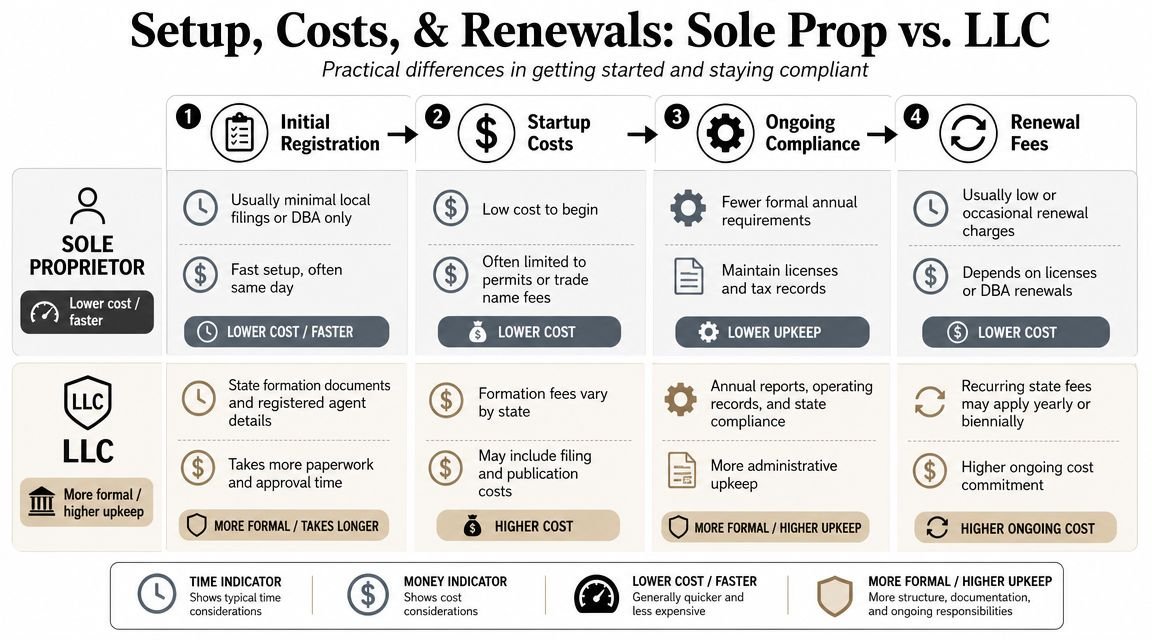
A lot of founders ask for a simple answer here. Which one is cheaper, faster, and easier to keep alive every year?
At a high level, a sole establishment is usually the lighter route. An LLC usually asks for more formation work, more administration, and more discipline on renewals and supporting documents. The exact costs and timing depend heavily on jurisdiction, activity, immigration needs, office requirements, and licensing authority, so it's better to think in terms of complexity levels rather than pretending there is one universal setup number.
What usually makes sole establishments simpler
A sole establishment is often more straightforward because the ownership picture is clean from day one. One owner, one activity direction, fewer moving parts.
That simplicity tends to show up in three places:
- Formation documents are generally leaner.
- Approvals are often easier when the activity is narrow and personal-service based.
- Annual upkeep tends to be lighter than a company structure built for multiple stakeholders.
For an owner-operated consultancy or professional practice, this can be the right kind of efficiency. The structure doesn't try to solve problems the business doesn't yet have.
Where LLC formation takes more effort
An LLC usually requires more planning because it's meant to support a fuller operating framework. That includes clearer governance, formal company records, and more structured compliance over time.
The extra effort tends to come from:
- Shareholder setup, even when there is only one member.
- Licensing and documentation alignment across company name, activity, and jurisdiction.
- Renewal discipline, especially where immigration, office arrangements, or regulated activity approvals are involved.
Mainland and free zone both sit inside this broader LLC logic, but they behave differently in practice. Mainland can make sense where the business needs stronger local market integration. Free zones often offer a more packaged setup experience, but founders still need to check whether the zone fits the activity, banking profile, and growth plan.
Operational takeaway: Cheap formation can become expensive rework if the original structure can't support your first hires, bank account application, or client contracts.
Offshore deserves a separate note. It may look administratively neat on paper, but it's not a substitute for an operating business setup if you need UAE visas, active local trade, or day-to-day commercial substance.
Impact on Visas Banking and Taxation

A common founder mistake is treating visas, banking, and tax as admin tasks to sort out after the licence is issued. In the UAE, those three areas often expose whether the structure was chosen for the actual operating plan or only for the setup price.
Visas and operational planning
Visa capacity needs to match the way the business will run.
A sole establishment can suit a founder who is delivering the work personally and plans to stay lean. That model is often workable for consultants, advisers, and solo service providers. The pressure starts when the business needs sales staff, operations support, or multiple hires within a short period.
Jurisdiction changes the practical outcome. A mainland setup may give more flexibility if the business will serve the local market directly and build a team around that activity. A free zone setup can be efficient for founders who want an easier launch process and a clearer package around immigration support, but the zone still has to fit the business model. Visa allocation, desk or office requirements, and the way clients are served all need checking before incorporation, not after.
Offshore is different. It is generally not the right tool if the founder needs UAE residence visas or a staffed operating presence.
Banking realities
Bank account opening is often where founders feel the difference between a sole proprietor style setup and an LLC.
Banks review more than the trade licence. They look at the activity, expected transaction pattern, source of funds, client profile, ownership structure, and whether the company setup makes sense for the stated business. A clean file with clear contracts and a credible reason for operating in that jurisdiction usually moves better than a cheap structure with weak commercial logic.
For straightforward owner-led work, a sole establishment can still bank well if the activity is easy to explain and the incoming payments match the licence. An LLC tends to present better for businesses that expect supplier agreements, payroll, higher transaction volumes, outside investors, or institutional clients. It also helps when the company needs to show separation between the founder's personal affairs and the business itself.
Mainland, free zone, and offshore do not land the same way with compliance teams. Free zone companies are common and workable, but some banks look closely at whether the chosen zone aligns with the activity and customer base. Mainland companies can be easier to explain where the business has a clear UAE trading story. Offshore entities often face more questions if the founder is trying to use them as an active operating vehicle rather than a holding structure.
Tax and compliance consequences
Tax is usually less about finding a cheaper label and more about making sure the setup can be maintained properly.
The UAE corporate tax framework applies based on the business facts and legal position, not on marketing language around the licence. As noted earlier, the current federal corporate tax structure includes a 0% rate up to the relevant threshold and 9% above it for taxable income within scope. For most founders, the bigger issue is recordkeeping. The structure affects how cleanly contracts, invoices, ownership records, expense support, and filings line up once the company starts trading.
That matters in practice.
A sole establishment may be simpler on paper, but poor separation between personal and business transactions can create problems during bank reviews, tax registration checks, or renewal time. An LLC usually asks for more discipline from day one, yet that same discipline often makes growth easier once the business adds staff, signs larger contracts, or prepares for outside investment.
The best setup is the one you can operate cleanly for the next two years, not the one that looked fastest in week one.
Which Structure Is Right for You Founder Scenarios
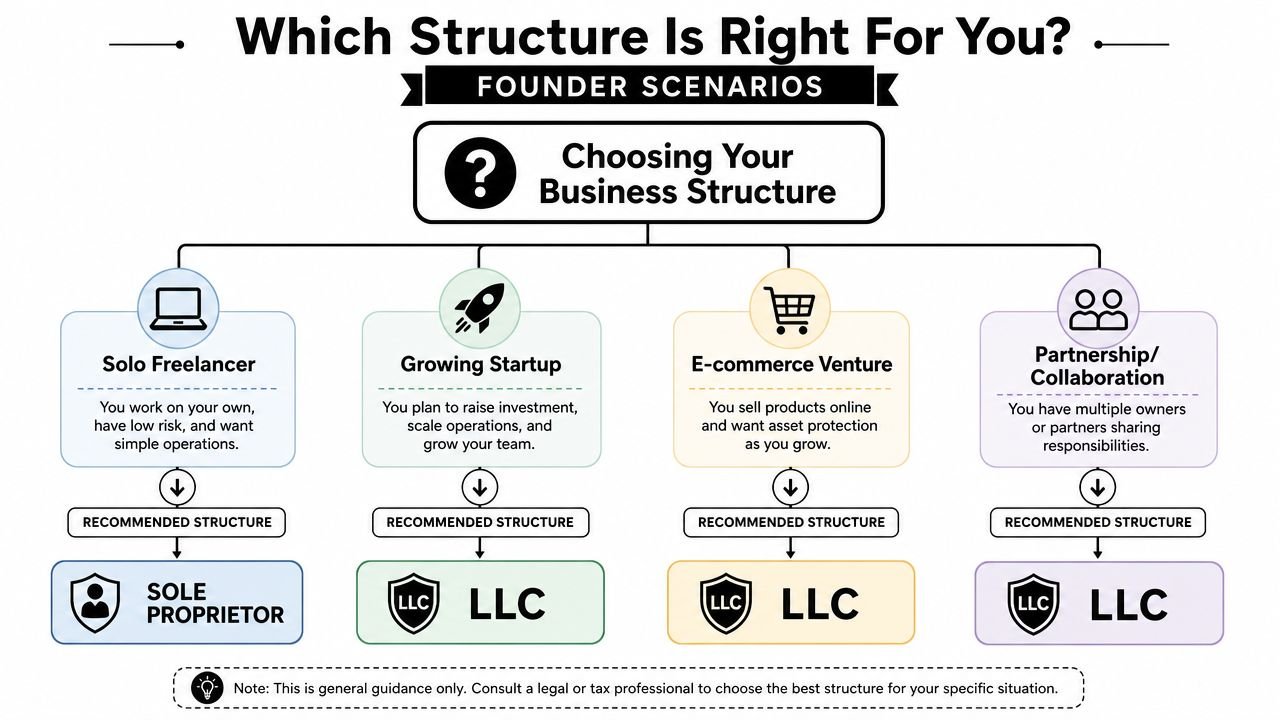
A founder often reaches this point after the first real opportunity appears. A larger client asks for a company contract, a marketplace requests clearer business documents, or a bank starts asking sharper questions about activity. The right structure is the one that still works after that moment.
The solo consultant
A sole establishment can work well for a consultant, trainer, creative professional, or specialist adviser who is selling personal expertise and keeping operations simple. That is often true in mainland and some free zone setups where the business is closely tied to the founder's own service delivery.
It suits founders with low operational risk, limited supplier exposure, and no near-term plan to add shareholders.
The pressure point is usually operational, not theoretical. If clients start asking for company-style procurement documents, if subcontracting becomes routine, or if you want to build delivery that runs without you in every client call, an LLC usually fits better. In practice, many solo founders start as a one-person operation but are already building a company.
The e-commerce operator
An LLC is usually the safer choice for e-commerce.
You are dealing with inventory, payment providers, logistics partners, customer complaints, refund risk, and product liability questions. Even in a free zone model aimed at online trading, the business quickly becomes more than one individual selling products. Separate legal identity helps with supplier contracts and gives the operation a clearer profile for banking and platform reviews.
Jurisdiction matters here. A free zone LLC can suit a digital-first business that does not need broad onshore retail activity at the start. A mainland LLC often makes more sense if the plan includes wider UAE trade, local warehousing arrangements, or direct commercial relationships across the domestic market.
The agency or service firm planning to hire
Once hiring is part of the plan, the structure should support management, authority, and continuity.
An agency with account managers, sales staff, project leads, or delivery teams usually outgrows a sole establishment quickly. The issue is not only liability. It is also about how the business signs contracts, gives authority to staff, allocates ownership, and prepares for future changes. UAE guidance from the Dubai Department of Economy and Tourism on legal forms and business activities reflects that legal form should match the nature and scale of the activity, which is exactly the issue for a founder planning to build beyond a one-person practice.
Ask the harder questions early:
- Will clients contract with the business, not just with me
- Will I give managers signing or operational authority
- Will I want to add a partner or investor later
- Will the company need to continue if I step back from delivery
If the answer is yes to even two of those, an LLC usually saves a restructure later.
The investor or holding structure founder
Founders need to separate ownership planning from day-to-day operations.
An offshore entity can make sense for holding shares, intellectual property, or assets where the purpose is ownership rather than active UAE trading. It is not usually the right answer for a founder who needs staff visas, regular invoicing inside the UAE, or an operating presence that banks and counterparties can assess easily.
For active business, the main comparison is mainland LLC versus free zone LLC. Mainland usually gives wider onshore flexibility. Free zone can work well if the operating model fits the zone's rules, customer profile, and visa needs. Offshore is usually a holding tool, not the vehicle for running a growing UAE business.
A simple test helps. If the business needs to trade, hire, sign customer contracts, and scale in the UAE, choose an operating structure. If it mainly needs to own assets or hold investments, a holding vehicle may be the better fit.
From Decision to Launch Your Next Steps with Inpro
Most founders don't need more theory. They need a decision they won't regret six months from now.
If the business is personal, low-risk, and intentionally lean, a sole establishment can be the right answer. If the business needs liability separation, stronger banking posture, cleaner contracting, or room to scale, an LLC is usually the more durable choice. Then comes the second filter. Mainland for broader onshore market access, free zone for a contained operating framework, offshore for holding rather than active trading.
A good launch decision usually comes down to five checks:
- Risk level in contracts, stock, staff, or customer exposure
- Jurisdiction fit for where you'll operate
- Bankability for your target transaction profile
- Visa planning for founders and team
- Scalability if you expect partners, investors, or expansion
When founders want clarity on those points, the process moves faster and with fewer expensive changes later.
Frequently Asked Questions
Can you convert a sole establishment into an LLC later
Yes, founders often start lean and then move into an LLC when the business becomes more complex. In practice, the question isn't whether conversion is possible. It's whether waiting creates avoidable friction with contracts, banking, client onboarding, or ownership restructuring.
Is offshore the best option if I want lower admin
Not for an operating business. Offshore can suit holding or ownership purposes, but it usually isn't the right answer if you need active UAE trading, visas, staff, or direct local operations.
Should a foreign founder choose mainland or free zone first
That depends on how the business will operate. If you need broader onshore commercial flexibility and direct local market presence, mainland often deserves serious consideration. If you want a contained setup for services, digital activity, or cross-border operations, a free zone may fit better.
Does a single-owner LLC really help if I'm the only founder
Yes, when the business needs a separate legal identity. Even with one owner, an LLC is built to hold contracts, support institutional relationships, and scale more cleanly than a structure tied directly to one individual.
If you're deciding between a sole establishment, mainland LLC, free zone company, or offshore structure, Inpro Corporate Services L.L.C. can help you compare the practical options, map the visa and banking implications, and launch with a structure that fits how your business will operate in the UAE.