


Most advice about a startup in Dubai starts with Free Zone versus Mainland. That's incomplete. In 2026, the founders who move well in Dubai usually get three things aligned at the same time: legal structure, funding path, and the local network that opens doors once the licence is issued.
Table of Contents
- Your 2026 Dubai Startup Blueprint
- Mainland vs Free Zone vs Offshore What's the Right Fit
- From Paperwork to License in Hand
- Getting Your Team Legal and Your Finances Ready
- What Will It Really Cost to Launch in Dubai
- Beyond Setup Gearing for Growth and Funding
Your 2026 Dubai Startup Blueprint
Launching a startup in Dubai isn't a checklist exercise. It's a sequencing exercise. You need the right jurisdiction for your business model, the right budget for actual operating costs, and a realistic plan for how you'll win customers, hire, bank, and get in front of the people who matter in the United Arab Emirates.
The opportunity is real. Dubai hosts over 3,500 active startups, representing 86% of all startups in the UAE, and the emirate captures more than 90% of the nation's total startup funding. In 2025 alone, the Dubai Chamber of Digital Economy supported 1,690 digital startups, a 39.7% increase from the previous year, according to this 2025 ecosystem snapshot.
That growth tells you two things. First, Dubai is not a fringe market. Second, founders are arriving fast, which means basic registration advice isn't enough anymore.
Practical rule: Pick your structure based on where revenue will come from, not on whichever package looks cheapest on day one.
A founder selling software across borders has different needs from a founder opening a local retail business in Dubai, Abu Dhabi, or Sharjah. A holding structure has different logic again. The mistake I see most often is founders treating setup as the destination, then discovering later that their licence activity, visa capacity, office requirement, banking profile, or investor readiness doesn't match how the company needs to operate.
A good Dubai setup plan answers five questions early:
- Where will you trade: Inside the UAE market, outside the United Arab Emirates, or both.
- Who needs to own the entity: Founder only, co-founders, group company, or holding vehicle.
- What approvals will your activity need: Some activities are straightforward. Others need extra regulatory review.
- How many visas do you need: Just the founder, or a team from the start.
- How will you fund the first phase: Personal capital, client revenue, angels, or accelerator support.
If you get those answers right, the paperwork becomes manageable. If you get them wrong, setup is still possible, but the clean path gets more expensive and slower.
Mainland vs Free Zone vs Offshore What's the Right Fit
Founders lose time in Dubai when they treat jurisdiction as a filing choice instead of a market-entry decision. In 2026, the right structure is the one that fits how you will win customers, move money, hire people, and build trust with banks, partners, and investors.
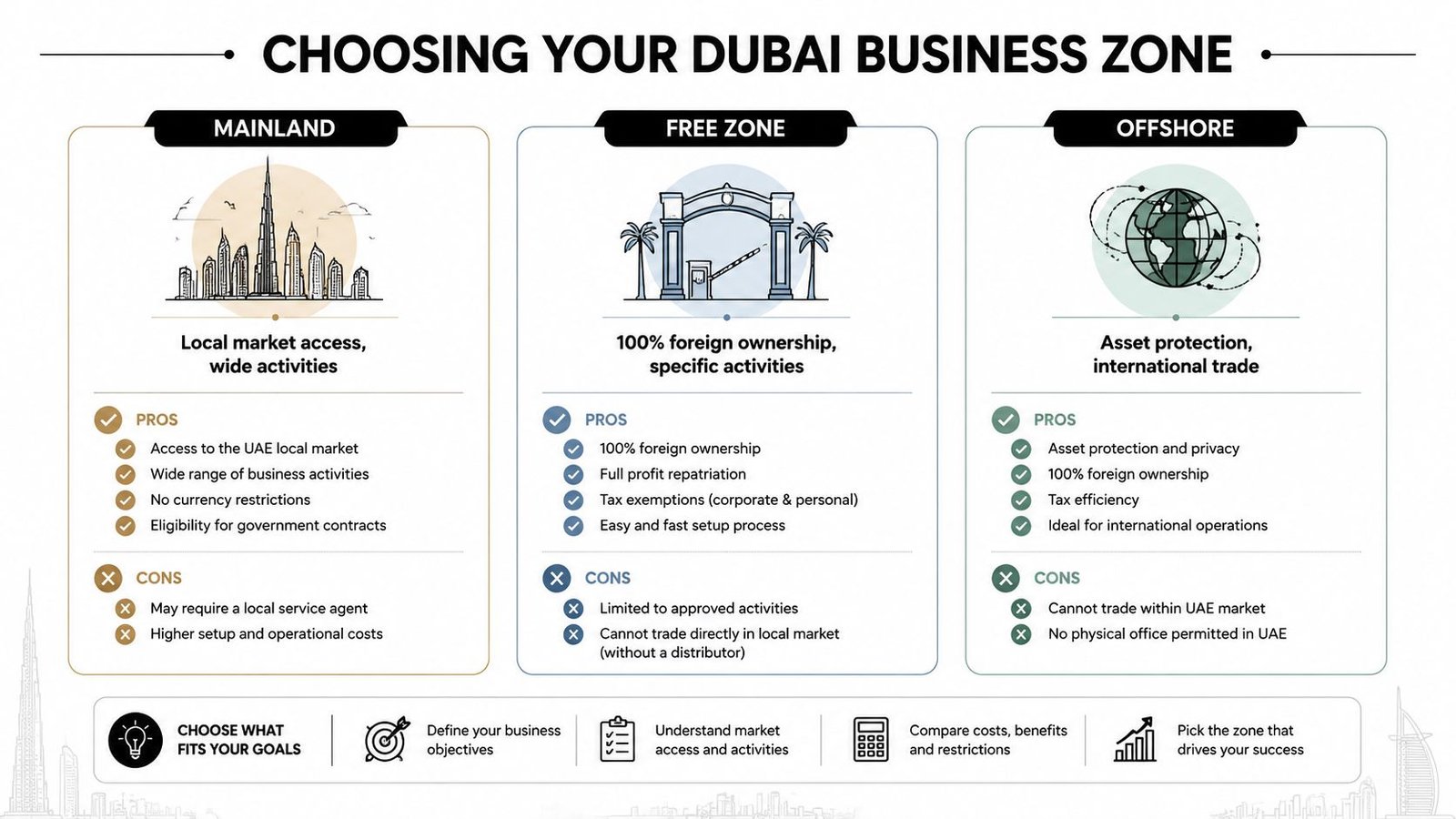
A cheap licence that looks efficient on day one can create expensive friction later. I see this often with founders who pick a free zone for speed, then realise their sales model depends on direct UAE market access, a larger visa allocation, or a banking profile that suits active local operations. The reverse happens too. Some founders choose Mainland because it sounds more flexible, then pay for office and compliance commitments they did not need in the first year.
What is a Mainland company
A Mainland company is licensed to operate in the UAE domestic market. In Dubai, many of these licences are issued through the Department of Economy and Tourism.
Mainland usually fits businesses that need to sell directly inside the UAE, sign local commercial contracts in their own operating name, open customer-facing premises, or build a team with a meaningful onshore presence. For retail, food and beverage, construction-linked services, logistics, many trading models, and a lot of B2B work with government or large local counterparties, Mainland is often the cleanest structure.
The trade-off is practical, not theoretical. Mainland can bring broader operating freedom, but it can also mean more moving parts around office arrangements, approvals for certain activities, and ongoing administration. If your early revenue is mostly international, that extra scope may not help you yet.
What is a Free Zone company
A Free Zone company is incorporated under the rules of a specific economic zone with its own authority. Free zones remain attractive because many structures allow 100% foreign ownership without a local sponsor, including FZE and FZCO entities, as stated by Jebel Ali Free Zone company formation guidance.
Free Zone works well for founders building cross-border businesses, regional service companies, holding entities, consulting firms, software businesses, and lean e-commerce operations. The mistake is assuming all free zones are interchangeable. They are not. The authority, activity list, office rules, ecosystem, and reputation with banks can differ in ways that matter once the company starts operating.
That point gets missed in many setup guides.
A founder raising from Gulf-based angels may benefit from a jurisdiction that investors already see often. A regulated fintech or fund structure may need a very specific environment. A solo consultant may care more about cost control and visa practicality than brand value. A commodities business has different needs again. Structure is not only about formation. It signals how the business is meant to operate.
Free zones also vary across the UAE. The UAE Ministry of Economy free zones directory shows the range of jurisdictions available, which is useful for checking whether a zone matches your activity instead of just offering a low headline price.
What is an Offshore company
An Offshore company is usually built for holding assets, owning shares, estate planning, or certain international ownership arrangements. It is rarely the right starting vehicle for a founder who needs visas, staff, an active operating presence, or day-to-day trading in Dubai.
Offshore still has valid uses. It can be sensible in a group structure, for intellectual property holding, or for ring-fencing ownership. But using Offshore as a substitute for an operating company often creates problems later, especially when banking, substance, and commercial credibility start to matter.
How do you choose the right jurisdiction
Use the revenue model first. Then test the structure against funding and relationship realities.
| Attribute | Mainland Company | Free Zone Company | Offshore Company |
|---|---|---|---|
| Typical purpose | Active UAE operations | Cross-border operations, selected regulated activities, lean operating setups | Holding, asset ownership, ownership structuring |
| Local market access | Direct | Depends on activity, counterparties, and operating model | Limited for active local business |
| Ownership position | Depends on the activity and current rules | 100% foreign ownership available in free zones | Usually chosen for ownership efficiency rather than operations |
| Visa pathway | Commonly available | Commonly available, subject to package and facility | Usually not the preferred route for an operating team |
| Best for | UAE trading, local service delivery, physical commercial presence | SaaS, consulting, regional HQ models, holding structures, some e-commerce setups | Holdings and asset protection planning |
| Main risk | Paying for operating scope you do not need yet | Picking the wrong zone for the actual business model | Using it for an operating business it was not designed to support |
Here is what this means for you.
Choose Mainland if your first serious revenue depends on the UAE domestic market, local contracts, premises, or broad operating freedom inside the country.
Choose Free Zone if your early customers are mostly outside the UAE, your team starts lean, foreign ownership and setup efficiency matter, and you want a structure that can support regional expansion without unnecessary overhead.
Choose Offshore if the immediate objective is ownership, holding, or asset planning, not active operating trade.
The strategic layer matters just as much as the legal one. If you expect outside funding, expansion into Saudi or other GCC markets, or a later holding structure above the operating company, pick a setup that will still make sense after the first licence is issued. In Dubai, good founders do not only ask, "What can I register?" They ask, "Will this structure still work when I hire, raise, open accounts, and start building local relationships?"
There is no prize for choosing the most complicated route. There is only a cost for choosing a structure that does not match the business you are building.
From Paperwork to License in Hand
Dubai company setup feels confusing for first-time founders because too many guides treat it like a form-filling exercise. On the ground in 2026, speed comes from getting the sequence right, choosing documents that match the actual business, and avoiding decisions that create trouble later with banks, visas, or investors.
Start with the process below, but read it strategically rather than mechanically.
What does the setup sequence look like
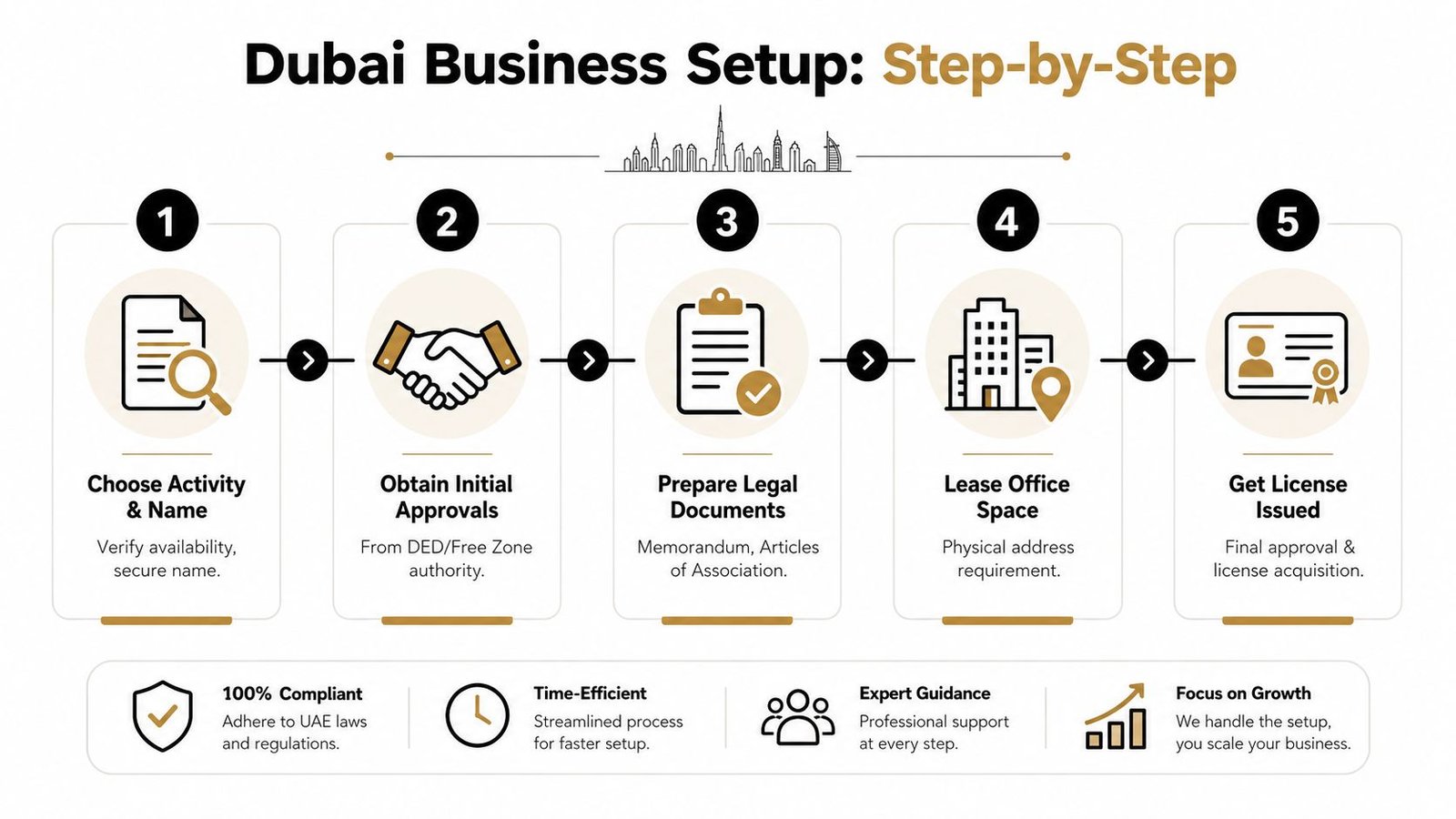
The licensing path usually follows five working stages. The order looks simple on paper. The trade-offs sit inside each step.
Choose the activity and trade name
The activity is not a label to pick loosely. It affects the issuing authority, possible external approvals, office requirements, banking questions, and in some cases your ability to invoice for what you plan to sell. The trade name then needs to meet the authority's naming rules and clear reservation.Get initial approval
Initial approval is the authority's preliminary acceptance of the proposed company setup. It does not mean the company is live. It means you can move to the legal documentation and facility stage, subject to the authority's conditions.Prepare legal documents
This usually includes shareholder documents, incorporation forms, constitutional documents, and corporate resolutions where a parent company is involved. Overseas founders often lose time here, especially when passports, signatures, attestations, or board resolutions do not line up cleanly.Secure the address or facility package
Authorities want the facility arrangement to fit the licence type and activity. Some models work with flexi-desk packages. Others need a lease, warehouse, shop, or a more formal office footprint. Cheap space that does not match the licence often creates expensive delays.Submit, review, and issue the licence
Once the file is complete, the authority reviews the application, fees are settled, and the licence is issued if everything matches. The operative phrase is "if everything matches."
The practical point is simple. Dubai setup rarely stalls because one authority is unusually slow. It stalls because the file says one thing, the business model says another, and the supporting documents say something else.
The cleanest applications are the ones built around the founder's first 12 to 18 months of trading, not around a generic package that looked cheap at the start.
A visual walkthrough can help if this is your first UAE setup:
What is a PRO and why does it matter
A PRO is a Public Relations Officer who handles government-facing processing for UAE businesses. In day-to-day terms, that means submissions, approvals, attestations, immigration coordination, corrections, and follow-up across the relevant departments.
For an international founder, this is where execution quality matters. A weak PRO service can register a company and still leave you with avoidable rework because the activity wording, shareholder documents, facility arrangement, and immigration logic were never aligned. A good PRO keeps the sequence tight and spots inconsistencies before they become delays.
That matters more in Dubai than many founders expect. The market is relationship-driven. If your launch is tied to a bank meeting, a client contract, an incubator intake, or an investor trip, a one-week paperwork slip can affect far more than admin timing.
Service providers vary widely. Some stop at incorporation. Others handle licensing, immigration, attestations, compliance coordination, and banking support. Inpro Corporate Services L.L.C. is one example of a UAE firm that handles formation across Mainland, Free Zone, and Offshore structures together with PRO, visa, and compliance support.
What is an MOA and when do you need one
An MOA is a Memorandum of Association. It is one of the core legal documents that records ownership and key operating terms of the company.
Founders do not need to become document specialists, but they do need to understand what can go wrong here. If the shareholding is wrong, the signatory powers are unclear, the parent company is reflected incorrectly, or the stated activity does not fit the actual business, the problem often shows up later during account opening, due diligence, commercial contracts, or restructuring.
Three habits save time and protect future flexibility:
- Match the licensed activity to the revenue model: If you plan to sell software implementation, advisory, and managed services, make sure the licence supports that mix in a commercially credible way.
- Prepare foreign shareholder documents early: Corporate shareholders, notarised resolutions, and legalisation chains can slow the file if they are treated as an afterthought.
- Check amendment friction before you sign: Some structures are easier to expand, add partners to, update for fundraising, or adapt to a larger office and visa footprint.
What this means for you is straightforward. The licence is not the finish line. It is the operating base for hiring, banking, fundraising, and building market trust in Dubai. If the setup is only "good enough" for issuance, you often pay for that shortcut a few months later.
Getting Your Team Legal and Your Finances Ready
Once the company exists, two tracks start running in parallel. One is immigration. The other is banking. Founders often treat them as admin tasks, but both directly affect launch speed.
How do founder and employee visas work
An investor visa is the residency route commonly linked to an owner or shareholder of the company. An employee visa is the residency and work authorisation route for staff hired by the company.
The sequence usually starts with the company's immigration establishment file, then entry permit steps where applicable, medical testing, identity registration, and residence stamping or its current digital equivalent. Timing varies by authority, but the main practical issue is not the government process itself. It's whether the company's documents, tenancy position, and quota logic are properly in place before the visa file starts.
Which government bodies handle employment and residency
MOHRE is the Ministry of Human Resources and Emiratisation. It regulates labour matters for many mainland employment relationships in the UAE.
GDRFA is the General Directorate of Residency and Foreigners Affairs. In Dubai, it handles residency and immigration processing. Free zones may also have internal channels or linked immigration desks, depending on the authority.
For founders unfamiliar with the United Arab Emirates, confusion often arises. Labour approval, immigration approval, medical fitness, Emirates ID registration, and health insurance are related, but they are not the same task. If one part is missing, the whole visa chain can stall.
Field note: The cleanest visa files come from founders who treat immigration as an operations project, not as an afterthought once staff have already booked flights.
How do you improve your chances with corporate banking
Opening a corporate bank account in Dubai can feel less predictable than getting the licence. Banks are checking business substance, ownership clarity, source of funds, expected transaction profile, and whether the company's story makes sense on paper.
You improve your position when your file is coherent. That usually means:
- Clear activity alignment: Your licence, website, deck, and expected invoices should tell the same story.
- Visible business substance: A lease, client pipeline, signed contracts, or a credible operating plan helps the bank understand that the company is real and active.
- Document discipline: Banks often ask for shareholder IDs, corporate charts, proof of address, source of funds material, and supporting commercial documents.
- Realistic transaction profile: If you claim one type of business but expect unrelated incoming and outgoing transfers, questions follow.
A common mistake is opening the company before deciding how the bank will read the business. If you're a consulting firm, say that clearly. If you're a software startup serving clients in MENA, present the commercial model cleanly. If you're a holding company, don't file the same way as an operating startup.
What Will It Really Cost to Launch in Dubai
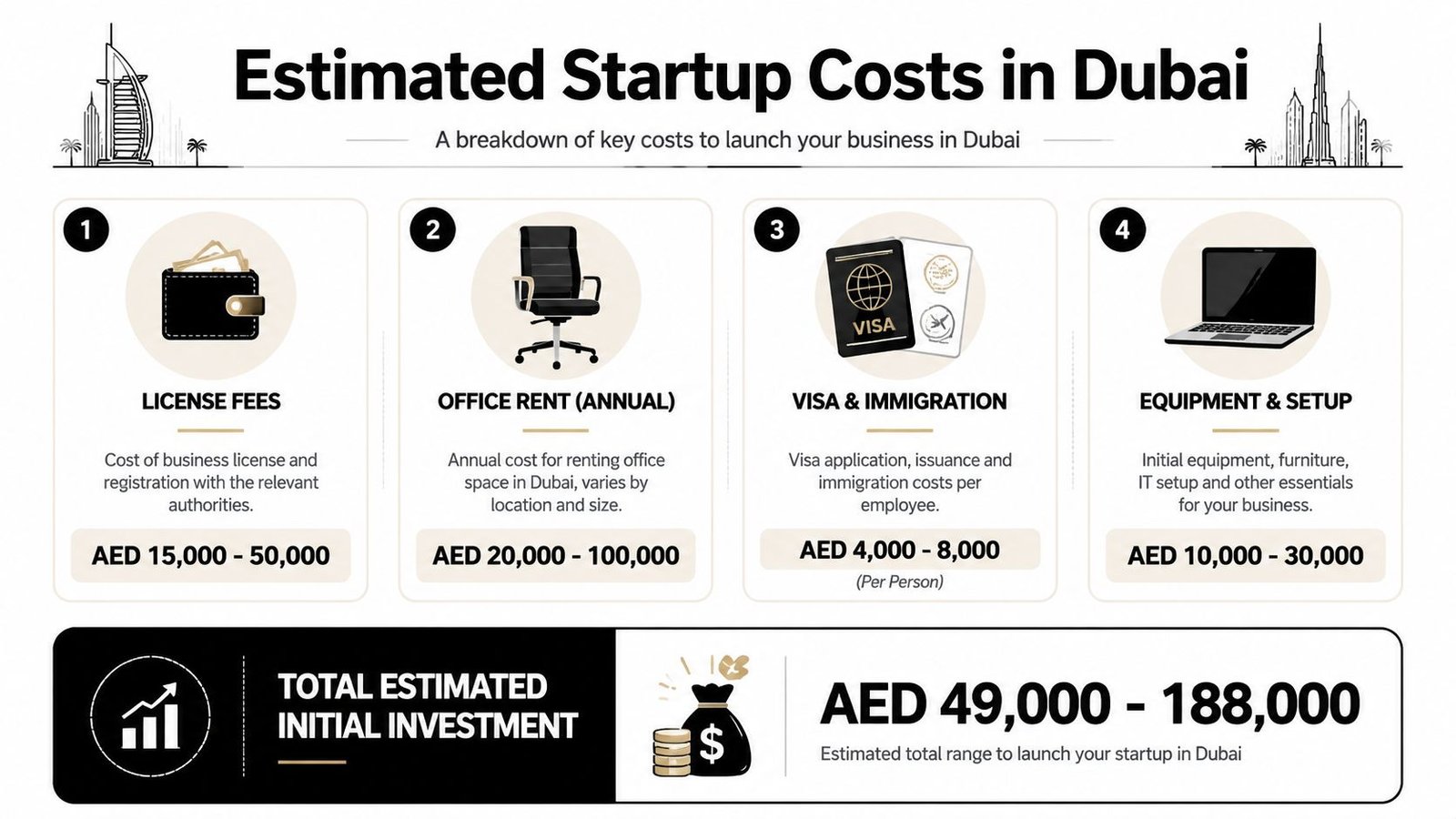
The cheapest advertised package is rarely the actual cost of launching a startup in Dubai. Founders need to budget for setup, immigration, insurance, banking friction, and whatever physical presence the chosen authority requires.
What are the baseline setup costs
For entry-level planning, the most useful hard figures come from current free zone packaging. According to this cost breakdown video on Dubai startup setup, entry-level free zone packages start between AED 5,500 and AED 13,000 per year. The same source states that visa packages for shareholders and employees range from AED 15,000 to AED 20,000, with mandatory health insurance and bank account minimum balances of AED 25,000 to AED 50,000 as additional baseline costs.
Those numbers matter because founders often budget only for the licence. The company may be incorporated, but you still need to fund the people and operations around it.
Another published guide gives a broader setup range across different models. It notes that initial setup can start from AED 12,000 for basic freelancer packages and exceed AED 500,000 for larger operations requiring offices and visa quotas, while also highlighting annual audit fees, renewal charges, and possible customs duties for mainland trading. It also states that Dubai was projected as the third most startup-friendly city globally for 2026 in the Startup Friendly Cities Index, in part because founders can form companies within days in the right structure. See this 2026 Dubai free zone guide.
Which costs founders often miss
The missed items are usually the ones that sit outside the headline package.
- Insurance spend: Health cover is not optional for visa holders.
- Renewal cycle: The first-year registration fee is only the start. Licence renewals, facility renewals, and related compliance continue.
- Banking readiness: If the bank expects minimum balances or stronger business substance, your cash plan must account for that.
- Document work: Attestation, translation, couriering, and legalisation can add friction, especially with foreign shareholders.
A founder should also separate one-time costs from recurring costs. Setup fees hurt once. Office commitments, payroll, visa renewals, and compliance sit in the business model every year.
How should you budget by stage
A practical way to budget is by operating stage, not by legal jargon.
| Stage | Budget focus | Main cost pressure |
|---|---|---|
| Solo founder or freelancer | Lean licence package, founder visa, insurance, banking file | Keeping fixed overhead low |
| Small startup team | Visa count, desk or office requirement, onboarding admin | Team legalisation and monthly burn |
| Scaling operation | Office footprint, audit and renewal discipline, additional immigration capacity | Structure that supports hiring and investor diligence |
If you're still validating the market, don't overbuild. If you already know Dubai or the wider UAE will be a serious operating base, don't underbuy a structure you'll outgrow in one renewal cycle.
Beyond Setup Gearing for Growth and Funding
The biggest misconception about a startup in Dubai is that the hard part ends when the licence arrives. For many founders, that's when the true test begins.

Why isn't company formation enough
A legal entity gets you into the system. It doesn't get you distribution, investor trust, or a place in local deal flow.
That gap is where most generic guides fail. They spend pages on jurisdiction choice, then say almost nothing about founder readiness. Yet the harder question in Dubai is often not “How do I register?” but “How do I get credible access once I'm registered?”
The current market is relationship-driven. According to this analysis of Dubai angel access and founder readiness, success in Dubai hinges less on company formation paperwork and more on pre-validated traction, local mentorship pipelines, and structured investor ecosystems. The same source states that warm introductions convert at roughly double the rate of cold outreach in the UAE, while 90% of founders still rely on blind outreach.
Most founders don't lose time because the market rejected them. They lose time because nobody relevant took the first meeting.
How do founders actually access deal flow in Dubai
Founders usually need a local route into the ecosystem, not just a licence. In practice, that means accelerators, founder communities, angel databases, and trusted introductions from people already in-market.
A separate investor market review notes that 1,700+ verified angel profiles in Datapile's database cover the true pre-seed market, with check sizes of $150K to $750K. It also states that 40% of Dubai-based startups build for the wider MENA region of 400M+ people, and that founders looking for pre-revenue funding should focus on UAE-specific accelerators, government-endorsed startup recognition, and structured investor access rather than generic fundraising advice. See Datapile's 2026 UAE and Dubai angel investor analysis.
That doesn't mean every founder needs fundraising on day one. It means your structure should support your next move. If you plan to raise, your documents, cap table logic, and business story should look investor-ready early. If you plan to grow through sales first, focus on local partnerships and commercial proof that a Dubai-based investor or bank will recognise immediately.
Some practical routes founders use:
- Accelerator entry: Programmes such as Flat6Labs or Techstars Dubai can create structured visibility and better introductions.
- Community access: Founder groups in Dubai and Abu Dhabi often produce the first useful referral, whether for talent, customers, or investors.
- Recognition and validation: Some investors care less about where you incorporated and more about whether someone credible has already screened you.
What does this mean for your next move
Treat setup, funding, and network-building as one plan. Don't buy a company package in isolation, and don't assume cold outreach will carry the growth story by itself.
For a founder entering the UAE or wider United Arab Emirates market in 2026, the better question is simple. What structure gives me legal clarity today without blocking commercial or funding options tomorrow?
Not sure where to start? Book a free strategy call with Inpro Corporate Services L.L.C. if you want a practical view on setup, visas, banking readiness, and the right UAE structure for your business model.