


You can sign a lease in the UAE and still be blocked from electricity, visas, or licence paperwork if the contract isn't registered. For founders and relocating professionals, the key issue with a tenancy contract UAE process is not the signature, it's whether the lease has been converted into a government-recognised record that functions properly in Dubai or Abu Dhabi.
Table of Contents
- Why Your Signed Lease Is Not Enough in the UAE
- What a Tenancy Contract Is and What It Must Contain
- Ejari vs Tawtheeq How Registration Differs by Emirate
- Documents and Steps to Register Your Tenancy Contract
- Hidden Costs and Clauses That Change Your True Rent
- Using Your Tenancy Contract for Visas and Business Setup
- Your Tenancy Contract Checklist and When to Call a PRO
Why Your Signed Lease Is Not Enough in the UAE
A founder lands in Dubai, signs the office lease, hands over the cheques, and thinks the hard part is done. Then the utility portal rejects the file, the visa team asks for a registered contract, and the trade licence process stalls because the lease is only a private agreement, not a registered one.
Practical rule: in the UAE, a lease becomes operational only after it's registered in the correct emirate system.
That gap matters because the United Arab Emirates treats tenancy paperwork as part of the compliance chain, not as a side document. In Dubai, the contract has to go through Ejari, and in Abu Dhabi it has to go through Tawtheeq, otherwise many government-linked actions don't move forward. An unregistered lease can still exist between the parties, but the practical damage shows up fast when you need utilities, immigration steps, or dispute access.
For a relocating founder, the mistake usually comes from assuming the signed PDF is enough. It isn't. The lease is the starting point, registration is the step that makes it usable.
Dubai's market shows why this formalisation exists. In 2025, the Dubai Land Department reported 1.38 million registered tenancy contracts with a combined value of about AED 126.4 billion (around $34.4 billion), with new contracts up 10% to more than 513,000 and renewed contracts up 3% to over 514,000. That volume shows how central registered tenancy paperwork is to the emirate's rental economy and to recurring lease activity across the UAE Dubai Land Department contract data, 2025.
What a Tenancy Contract Is and What It Must Contain
A tenancy contract is a written lease between a landlord and a tenant. In plain terms, it sets out who is renting what, for how long, for how much, and on what payment terms.
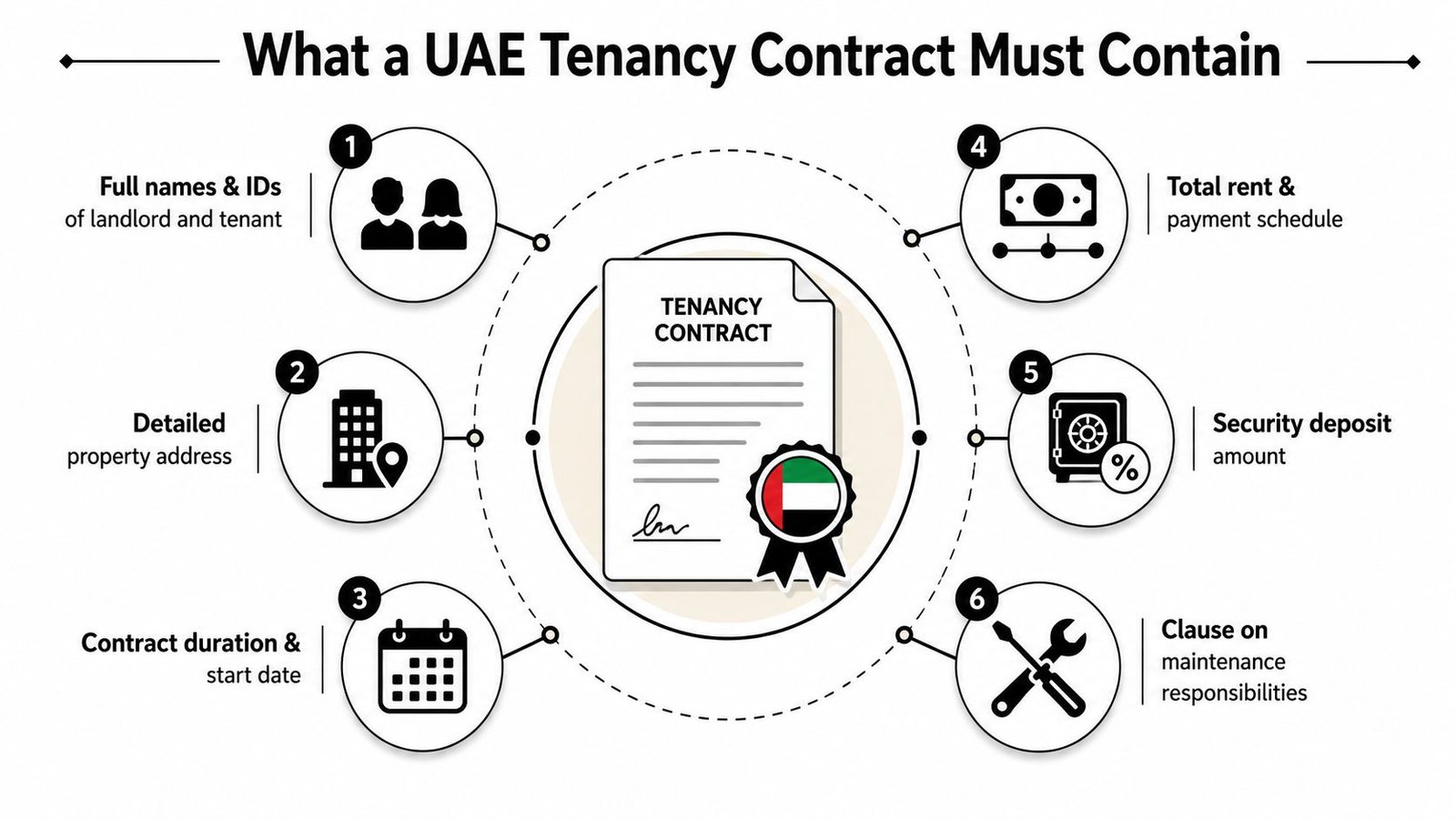
Under Dubai Law No. 26 of 2007, as amended by Law No. 33 of 2008, the lease must identify the leased property without uncertainty, specify the purpose of the lease, state the lease term, name the rent, explain the payment method, and include the owner's name if the landlord is not the direct owner Dubai law text%20of%202008%20Amending%20Law%20No.%20(26)%20of%202007.pdf). That is why a tenancy document in the UAE is not just a receipt or an email thread. It is a structured legal instrument with mandatory fields.
What should you check before you sign
Start with the property itself. The address must be clear, the unit must be identifiable, and the use must match what you need, whether that's residential, office, retail, or another permitted purpose.
Then check the money terms. Rent amount, payment method, and duration need to be written down, not left in side messages or verbal agreements. If the landlord isn't the owner, the contract should show the owner's name, because that helps prevent later disputes about authority.
Why registration changes the contract's function
Once the contract is registered, it can be used as a government-recognised document. That's the difference between a lease that governs a private relationship and a lease that can support related processes like utilities, visas, and licensing. A signed lease without the proper registry entry may look complete, but it won't behave like a complete file when a portal checks it.
A lease should read like a document you can defend in front of a government officer, not like a casual agreement between two parties.
Ejari vs Tawtheeq How Registration Differs by Emirate
A signed lease can still stall operations if it is filed in the wrong emirate system. That becomes a real problem for founders and SMEs, because the paperwork is often what facilitates utilities, supports visa-related steps, and gives you a path into the dispute process if the landlord stops cooperating.
Ejari in Dubai and Tawtheeq in Abu Dhabi
Ejari is Dubai's official tenancy registration system. Tawtheeq is Abu Dhabi's equivalent registry. In Dubai, the practical aim is to get the lease into the official system so it can support linked procedures. In Abu Dhabi, document language is handled more strictly, and the registry rejects English-only tenancy contracts, requiring Arabic or bilingual Arabic-English documentation UAE tenancy law guide.
Abu Dhabi also has a clear regulatory history behind that approach. Law No. (3) of 2005 originally required registration only for leases longer than four years, but Resolution No. (4) expanded that so that all tenancy contracts of less than four years also had to be registered, with landlords given until 31 July 2011 to complete registrations Abu Dhabi tenancy registration update. The point is simple. Abu Dhabi moved lease registration from a selective requirement into a broad compliance step that landlords and tenants both have to take seriously.
How the operational risk differs
In Dubai, the main risk is usually a lease that never makes it through Ejari, which leaves the contract weak for related government workflows. In Abu Dhabi, the risk is often more immediate because the wrong language format or missing registration can interfere with utility links, visa and sponsorship services, and legal enforcement practical tenancy guidance.
| Feature | Ejari (Dubai) | Tawtheeq (Abu Dhabi) |
|---|---|---|
| Official system | Ejari | Tawtheeq |
| Language expectation | English contracts are commonly processed through the registration system | English-only contracts are rejected, Arabic or bilingual required |
| Registration focus | Government-recognised lease record for Dubai processes | Formal registration tied closely to Abu Dhabi compliance |
| If you skip registration | Problems with utility activation, tenant rights, and dispute handling | Problems with utility connections, visa or sponsorship services, and legal enforcement |
| Historical rule change | Mandatory registration operates through the emirate system | Expanded from only long leases to all tenancy contracts |
Who should handle the filing
The filing should be handled by the party who can move it forward without delay, and that depends on the emirate, the contract setup, and whether the landlord has already prepared the ownership paperwork. In Dubai, tenants or authorised typing centres often complete the registration once the lease package is ready. In Abu Dhabi, the landlord more often takes the lead, because the registry expects the contract to come through the correct municipality or registration channel and in the accepted format.
For a founder or SME, the trade-off is practical, not theoretical. If you are relocating staff, fitting out a branch, or trying to activate services before operations start, a missed filing can slow the whole chain. Utilities may wait. Visa processing may wait. A dispute can sit unresolved because you do not have the registered record that the authority wants to see.
What the older Abu Dhabi rule still teaches
The older registration history matters because it shows how Abu Dhabi treats tenancy paperwork as a compliance instrument, not an optional admin step. If you are moving an employee family, opening a branch, or setting up a residential base before relocation, the wrong contract format can slow down everything else. The business cost is usually time, friction, and avoidable follow-up with the landlord or registry.
Documents and Steps to Register Your Tenancy Contract
The cleanest registrations are the ones prepared before anyone starts clicking through a portal. Most delays come from missing ownership proof, mismatched names, or a lease that wasn't signed in the right format for the emirate.
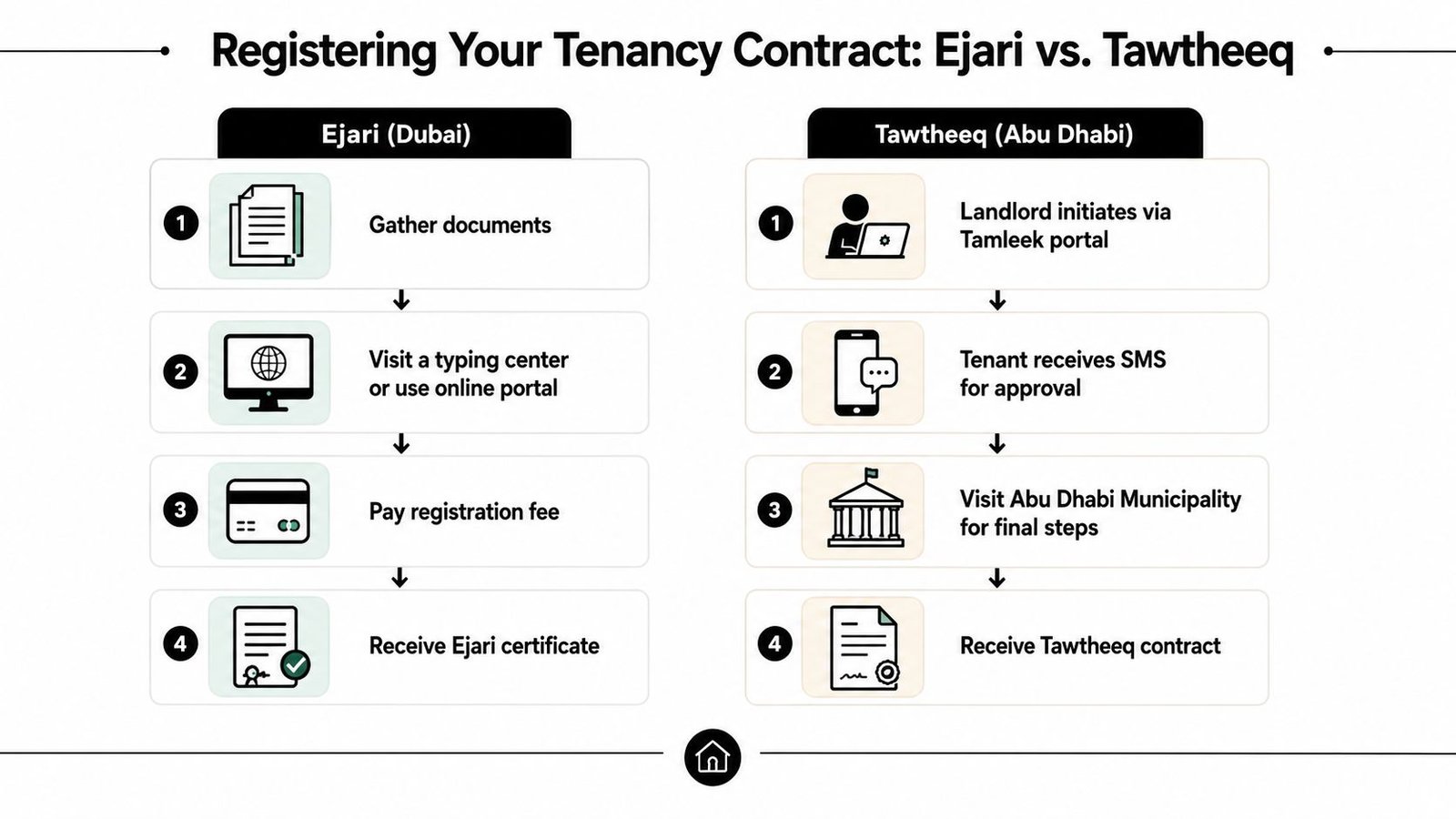
For Ejari in Dubai, the usual file includes the signed tenancy contract, Emirates ID copies, passport copies, title deed or ownership proof, and the landlord's trade licence if it applies. Registration is then handled through approved typing centres or the Dubai REST app. For Tawtheeq in Abu Dhabi, the landlord is typically the party who initiates registration, and the contract needs to be in the bilingual format accepted by the registry.
The simple workflow that usually works
- Collect the core documents. Get the signed lease, identity documents, and ownership proof in one folder before submission.
- Check the names and addresses. The spelling on the lease should match the IDs and ownership documents.
- Use the right channel. Dubai filings normally go through Ejari channels, while Abu Dhabi filings go through the authorised municipality or registry path.
- Keep the final certificate. The registration proof is the document you'll reuse for linked processes.
The Abu Dhabi process can involve the landlord confirming the registration and the tenant receiving an approval prompt before the final contract is issued. That is another reason why renters should not wait until the day they need utilities or residency paperwork.
Who should actually handle the filing
If the landlord is responsive and the file is clean, a tenant can often get through Dubai registration without much friction. If the lease is for a business unit, the owner is overseas, or the documents need coordination across departments, the process is easier when one person owns it end to end.
Practical rule: the person chasing utilities, visas, and licence approvals should also own the lease-registration checklist.
Hidden Costs and Clauses That Change Your True Rent
A lot of UAE lease problems are not rent problems. They're drafting problems, and they show up after the contract is signed, when the tenant realises the headline rent is only one piece of the actual cost.
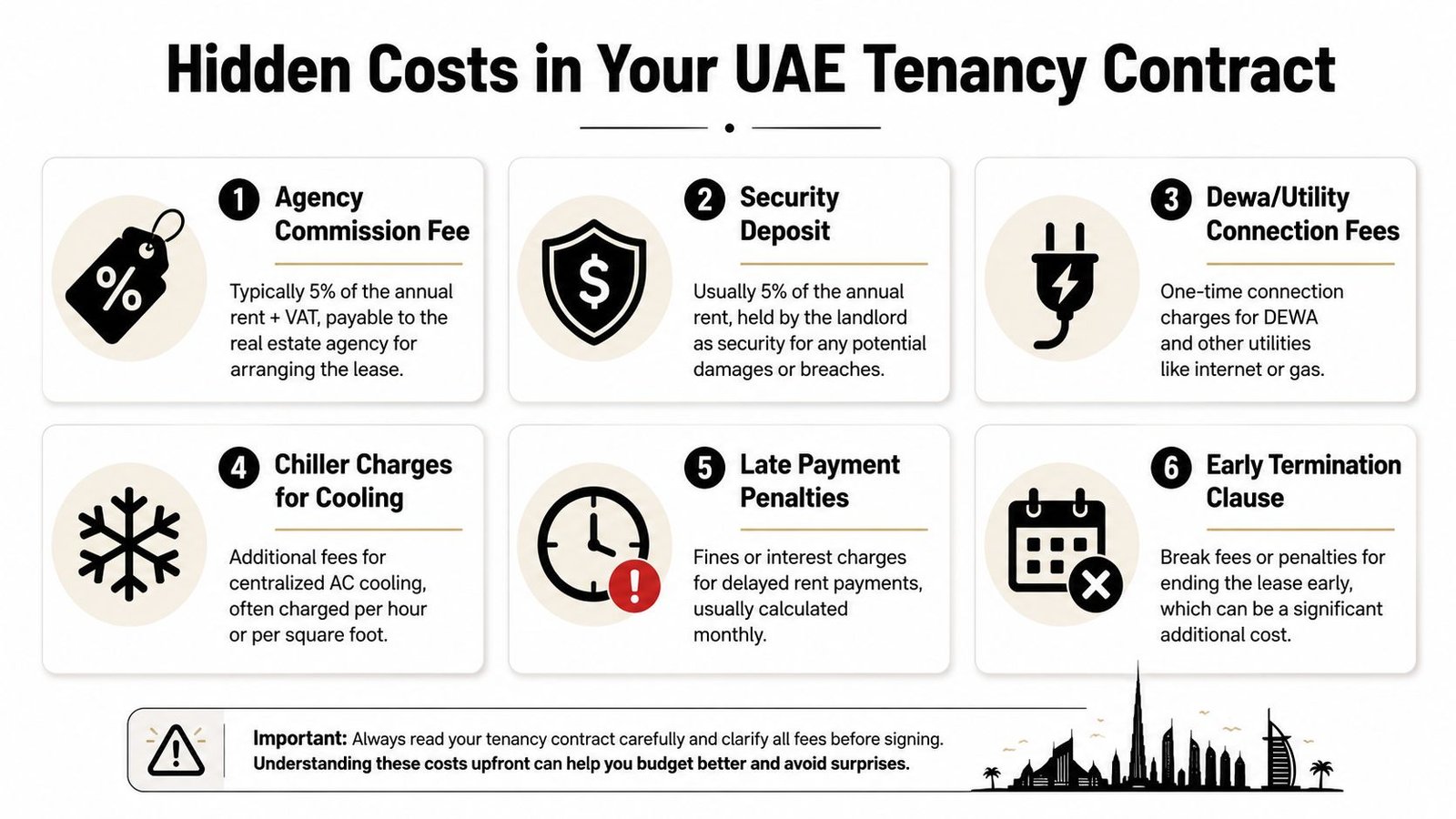
Gulf News and other UAE property guidance consistently point tenants towards checking who pays for maintenance, service charges, and extra expenses before signing Gulf News rental contract guidance. That advice sounds basic, but it's where many budgets get damaged. In office and retail leases, the extra costs can change the economics of the space more than the headline rent itself.
The clauses that change cash flow
Look for the items that sit outside the base rent. Chiller fees, district cooling charges, service charges, maintenance obligations, and penalties for late or unauthorised renewal all change what you really pay each month or each year. If those costs aren't written clearly, the landlord and tenant often end up arguing about what was “understood”, which is a weak position for both sides.
The stronger habit is to ask direct questions before you commit.
- Who pays for major repairs? If the air-conditioning fails or a common area breaks down, the contract should say who carries the cost.
- Are service charges included? If not, ask how they are billed and whether they can rise during the term.
- Does cooling come separately? If the building has district cooling, get the billing line clarified.
- What happens at renewal? Make sure the lease spells out the renewal process so nobody improvises later.
Why ownership checks matter more than people think
A lease is only useful if the person signing it can legally lease the property. That sounds obvious, yet it's one of the first places international tenants get tripped up, especially when a broker manages the conversation and the owner isn't directly visible.
A quick ownership or authorisation check protects you from signing a document that looks valid but becomes hard to enforce later. For SMEs, that matters because the office lease can affect operating budgets, staff move-in timing, and even whether the business can open on schedule.
Using Your Tenancy Contract for Visas and Business Setup
A signed lease is useful. A registered lease is what usually lets the wider process keep moving. For a founder arriving with staff, family, or a launch timeline, the tenancy contract is often the address document that sits behind residency files, utility setup, and company registration work.
In Dubai, the utility process often runs through DEWA, the Dubai Electricity and Water Authority. In Abu Dhabi, the same type of coordination often runs through TAMM, the emirate's unified government services platform. If the tenancy contract is still sitting only as a signed agreement and not a registered record, the next step can stop there, and the move starts absorbing time that was supposed to go into operations.
Why an unregistered lease causes real operational damage
A lease that has not been registered can create problems long before anyone talks about a formal dispute. If the file is not recognised in the right system, utility activation can stall, and tenancy rights are harder to rely on if the landlord, agent, or tenant later disagrees about the terms Dubai tenancy guidance. That is the practical issue for founders and SMEs. One missing registration step can delay getting the premises live, slow down move-in, and leave the business with no clean paper trail when a government desk asks for proof of occupancy.
The impact shows up in specific files. A Golden Visa applicant may need a tenancy record to support evidence of accommodation stability. An HR team may need a confirmed address before employee paperwork can be completed cleanly. A company forming in a mainland or free zone structure may also need the lease address to line up with the licence file, the office use, and the place where the business is allowed to operate.
Practical examples that usually break first
The problems are usually not abstract. A founder signing from abroad may find that the utility account cannot be opened until the lease is properly registered. An employee sponsorship file can stall if the address on the tenancy contract does not match the rest of the submission. A new office fit-out can also lose time when the licence team, the landlord, and the utility provider are all waiting on the same proof of occupancy.
That is why lease registration belongs in the setup checklist, not in the “we'll sort it later” pile. If the address on the tenancy contract does not match the relocation plan, the visa file, or the company paperwork, each mismatch becomes another round of corrections.
The practical takeaway for relocations
If you are arriving before your family, signing from abroad, or asking a broker to coordinate the move, treat the tenancy contract as part of the full setup chain. Keep the address details consistent across the lease, the residence paperwork, and the business file. When those details line up, the rest of the process has a chance to move on schedule. When they do not, the delays usually show up in the places that are hardest to ignore, utilities, visas, and the licence desk.
Your Tenancy Contract Checklist and When to Call a PRO
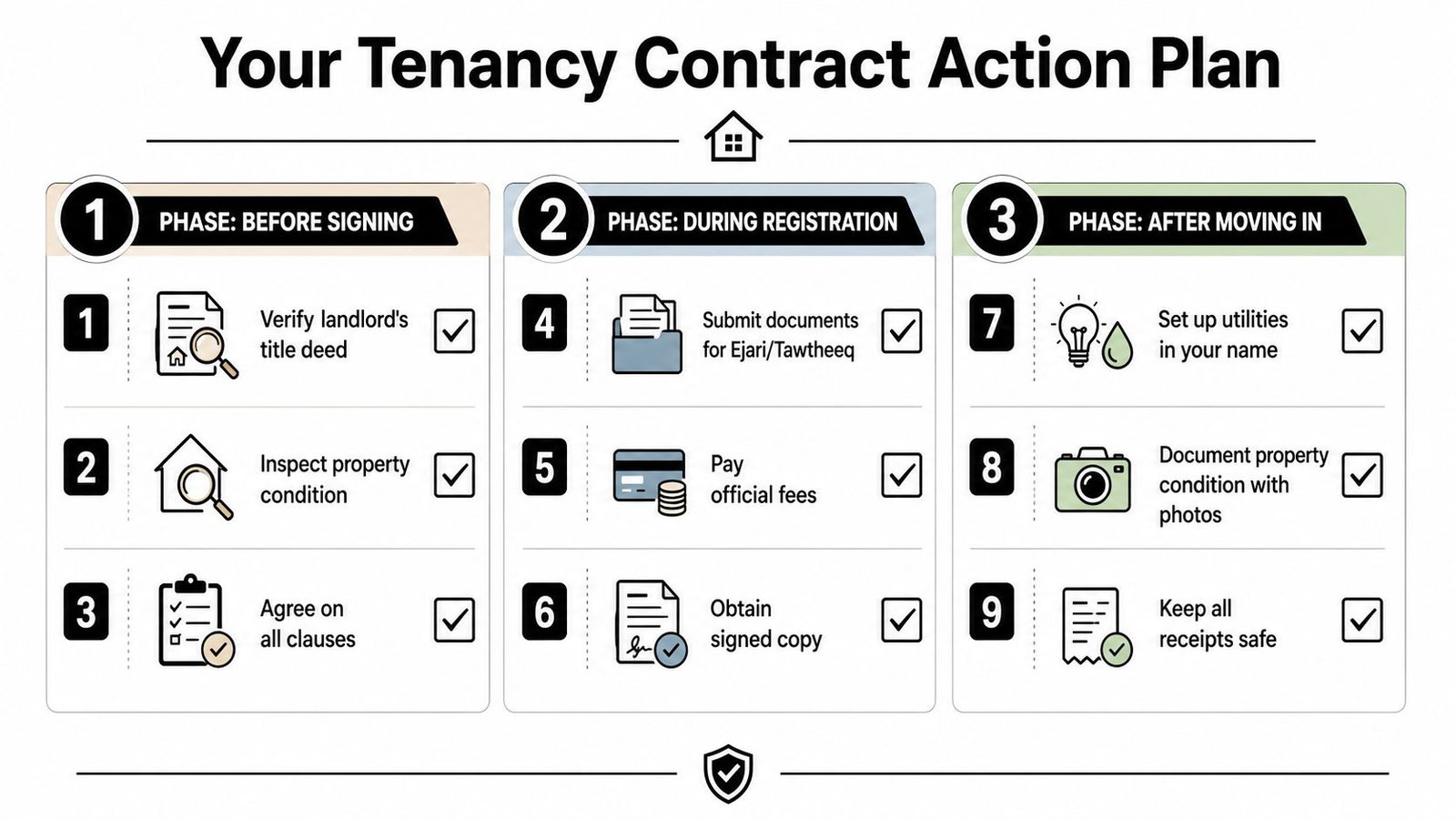
The safest approach is to treat lease handling as a three-part task. Check it before signing, register it properly, then keep the proof and receipts after you move in.
Before signing
- Verify the landlord's ownership. Ensure the person leasing the unit has the authority to do so.
- Read every cost clause. Ask who pays for repairs, cooling, service charges, and renewal-related costs.
- Confirm the property details. The address, unit, term, and purpose should match what you need.
During registration
- Use the right emirate system. Ejari for Dubai, Tawtheeq for Abu Dhabi.
- Keep the language format correct. Abu Dhabi requires Arabic or bilingual documentation.
- Save the final registration proof. You'll need it for utilities and linked government work.
After moving in
- Set up utilities in your name. Don't leave the account in a previous occupant's or agent's name.
- Photograph the property condition. A dated record helps if there's a later handover dispute.
- Keep receipts and copies. If someone asks for proof, you won't want to reconstruct the file from memory.
Abu Dhabi also has a payment-timing rule that affects enforcement risk. Residential tenants must pay the agreed rent within 21 days of the due date unless the parties agree otherwise, while commercial, industrial, or vocational tenants have 30 days Abu Dhabi tenancy law directory. That shorter default window for residential leases can move a dispute along faster than some tenants expect.
If you're managing one lease, you may handle it yourself. If you're handling multiple employee moves, a business setup, or a lease tied to a free zone or mainland licence, a PRO can save time by keeping the document chain aligned from the start.
Inpro Corporate Services L.L.C. helps founders, SMEs, and relocating professionals handle UAE setup work without the back-and-forth that slows lease-linked processes. If you need support with tenancy paperwork, visa files, or company formation in the UAE, visit Inpro Corporate Services L.L.C. to speak with a team that works through the practical steps with you.