

Ajman issued 1,665 new business licences in the first quarter of 2019, up 59% on the same three months a year earlier, according to the Ajman government's licensing announcement. That pace explains the question founders now arrive with: what does an Ajman trade licence allow, and what does it really cost?
An Ajman trade licence is a certificate from the emirate's licensing authority that permits one named activity for one named legal owner, issued either through the mainland Department of Economic Development or through Ajman Free Zone. It is permission for that activity, not a general pass to trade across the United Arab Emirates.
The distinction matters more than most setup pages admit. Below you'll find the categories and their real volumes, the published dirham charges, the papers each route wants, the order to file in, and the point at which the licence stops being enough.
Table of Contents
- What an Ajman Trade Licence Covers
- Mainland Issuance Fees You Should Budget
- Where an Ajman Licence Lets You Sell
- Eligibility and Documents for Each Route
- How the Ajman Application Actually Runs
- Renewal Costs and What Stops a Renewal
- Choose Mainland or Free Zone Before You File
What an Ajman Trade Licence Covers
A trade licence in Ajman names one activity and one legal owner. The external approvals, the premises you may use, the visas you can sponsor and the invoices you are allowed to raise all hang off the single activity printed on that certificate.
Founders tend to arrive thinking of a licence as blanket permission to do business. It isn't. The emirate counts licences in a handful of categories, and the volumes recorded by the Ajman Statistics Centre in 2018 show how the local market divides.
| Licence type | What it covers | Valid licences in 2018 | Share |
|---|---|---|---|
| Commercial | Buying and selling goods | 24,012 | About 49.2% |
| Professional | Services such as consultancy and freelance work | 22,583 | About 46.3% |
| Industrial | Manufacturing | 1,177 | About 2.4% |
| Investment | Investment activities | 592 | Under 2% |
| Beginnings | Smaller startup category in the official count | 401 | Under 1% |
| Local industry | Local industrial activity | 33 | Under 1% |
The Ajman Statistics Centre's 2019 statistical publication put total valid licences at 48,799 for 2018. Commercial licences led at 24,012, professional followed at 22,583, and industrial reached 1,177. Together, commercial and professional held roughly 95% of the register, which tells you what the emirate's licence system is mostly built to handle.
Which Category Matches What You'll Invoice
Work backwards from your revenue rather than from the licence brochure.
- Commercial is the trading category. Import, export, distribution, wholesale, general trading, a shop selling stock: money comes from moving goods, so the licence is commercial.
- Professional covers services sold as expertise. A marketing agency, an IT consultancy, a designer billing clients, an accountant, a freelance trainer. Money comes from your skill, not from inventory.
- Industrial covers making things, including assembly, production and packaging lines. Only 1,177 of these were valid in 2018, which is why the category feels specialist.
- Investment, Beginnings and local industry are narrower official categories, at 592, 401 and 33 licences. They fit particular structures rather than general trading.
The activity you choose is the label the rest of the system reads. A bank opens an account against it. A landlord signs a tenancy that suits it. Customs, the municipality or the health authority check it before issuing anything of their own.
Plain test: describe what you'll invoice for in one sentence, then match that sentence to a category. Selling a product points to commercial. Selling your time or expertise points to professional.
Why Do Renewals Outnumber New Licences
The same publication counted 30,330 new and renewed licences in 2018, of which 4,831 were newly issued and 25,499 were renewals, about 84.1% of the total. Transactions rose from 28,861 in 2017, a gain of roughly 5.1%.
That ratio tells you something practical. Most licensing work in Ajman in any given year is existing companies keeping themselves compliant, not new arrivals. You're joining a system built around renewal rhythm. Year one is approvals and paperwork. From year two, the calendar matters as much as the fee.
Before you reserve a trade name, confirm the exact activity classification with the licensing authority. The same business can often be described several ways, and only one description matches what you'll do.
Mainland Issuance Fees You Should Budget
The published Ajman mainland charges total AED 1,500. Treat that as the base for issuance, not the full launch budget: activity approvals, premises and Chamber charges can add to it.
| Charge | Amount (AED) |
|---|---|
| Economic-licence issuance | 600 |
| Administrative application form | 50 |
| Commercial-name signboard permit | 350 |
| Commercial-register registration | 200 |
| Unified Economic Activities Register registration | 200 |
| Advertising-signboard specification approval | 100 |
| Published base total | 1,500 |
The Ajman economic licence issuance service lists these six charges: AED 600 for the licence, AED 50 for the application form, AED 350 for the commercial-name signboard permit, AED 200 each for commercial-register and Unified Economic Activities Register registration, and AED 100 for advertising-signboard specification approval.
Why Isn't the Licence Fee the Whole Bill
The licence fee covers issuance and registration. The final bill depends on what your chosen activity and legal structure require.
- External activity approvals. Regulated work may need approval from a ministry, municipality or other relevant body, with a separate charge.
- Premises. Some activities require an office or warehouse, and the tenancy may need attestation. Budget for this separately.
- Chamber charges. Membership or system fees may apply.
- Corporate-structure notices. Some legal forms require publication, which carries a separate fee.
- Other government assessments. Authorities set these charges, and amounts can change.
Set the activity and ownership structure before estimating your total. If your activity needs an external approval, include its cost and timing in the launch budget rather than treating AED 1,500 as the whole bill.
What Do You Upload, and Where
The application route is digital. Sign in with UAE Pass, submit the application and supporting papers, pay the assessed charges, then collect the commercial licence.
The listed documents include the trade-name reservation certificate, passport and Emirates ID copies for the owner or partners, and security clearance for anyone already resident in the UAE. Clean, legible scans before you start reduce the chance of a rejected upload, which can delay the application.
A licence grants permission for the activity named on it. The fee schedule is only one part of deciding whether that activity fits your plans.
Ask for government charges and professional fees as separate line items. Government filing charges are set by the relevant authority and are often billed separately from a service provider's fee, so you can see what each part of the launch cost covers.
Where an Ajman Licence Lets You Sell
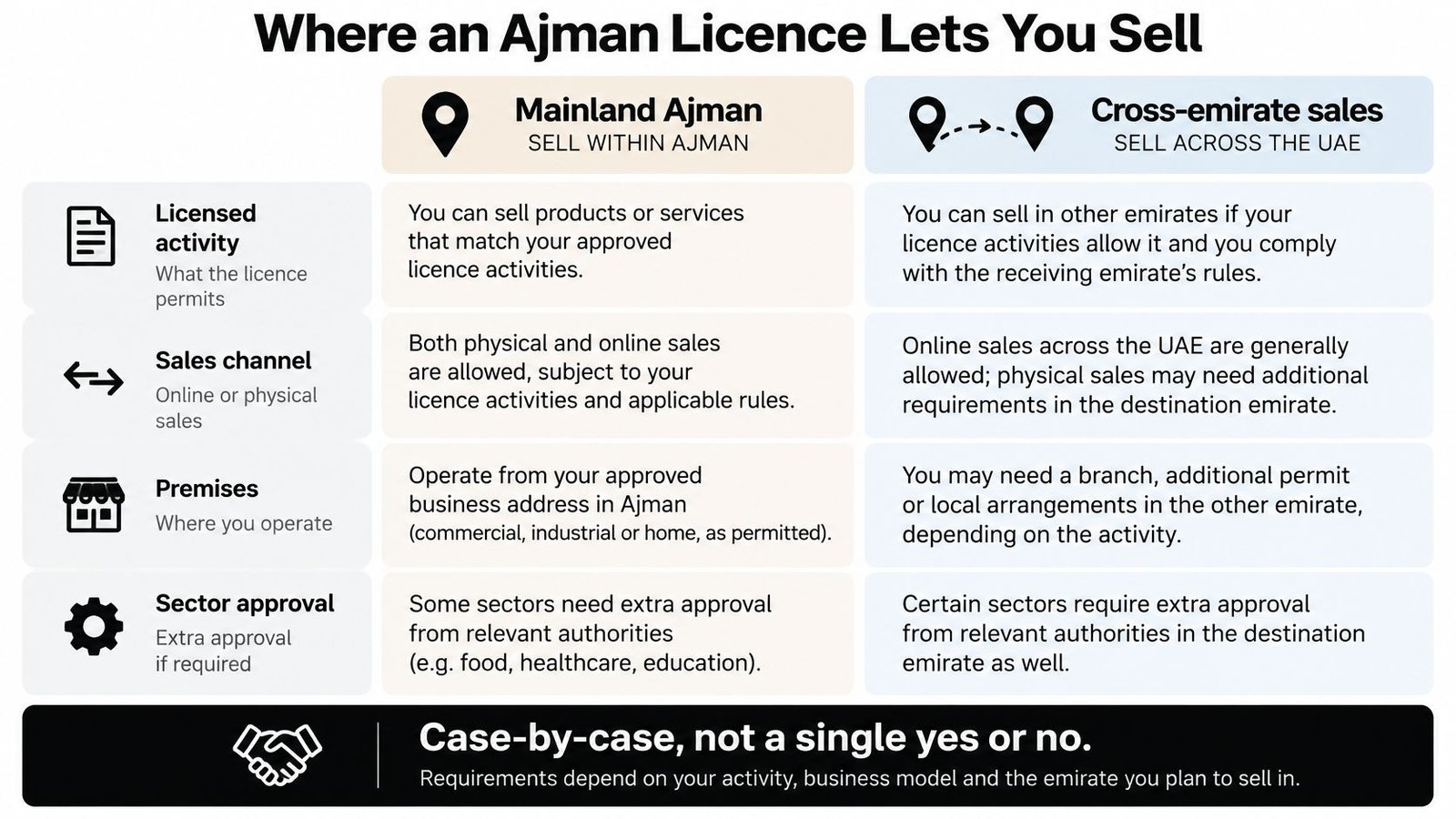
An Ajman trade licence covers the activity named on it. Where you can sell also depends on your sales channel, premises and any sector approvals. The licence is permission for specified business activity, not a pass to operate from any location across the UAE.
A marketing consultant licensed for that activity may be able to serve clients in Dubai and Abu Dhabi remotely. A showroom in Sharjah or a kiosk in a Dubai mall raises a different question: the Ajman licence alone does not establish permission to occupy premises or trade from them in another emirate.
The Ajman economic department's renewal requirements state that regulated activities may require external approvals. High-risk activities may also need approval or a no-objection document from the relevant government body.
| Situation | What decides it | Practical result |
|---|---|---|
| Remote services to clients in other emirates | Licensed activity and whether a local premises rule applies | Possible when the activity covers that service |
| Shop, showroom or warehouse outside Ajman | Need for mainland premises and local trade | Check the applicable local licensing and premises requirements; a free-zone licence alone does not grant this access |
| Government tender | Tender and market-access requirements | Confirm eligibility with the contracting authority; a mainland licence may be required |
| Food, health, transport or other regulated work | External approval or no-objection document | Either route only after the required approval |
| Staff at a client site in Dubai or elsewhere | Visa and work-location rules | The licence alone does not authorise the work location |
Where Does a Free Zone Licence Stop
An Ajman Free Zone company has its own legal personality and can be 100% owned by an individual or another company. That describes who owns the company, not where it may trade. Ownership is one part of the setup; the licensed activity, customer-facing premises and any required local permissions determine how the business can operate.
The paperwork each route requests looks like this.
Ask two questions before choosing a route: How will customers find you, and where will they take delivery? The answers help distinguish remote service work from activity that depends on a shop, warehouse or other premises.
Eligibility and Documents for Each Route
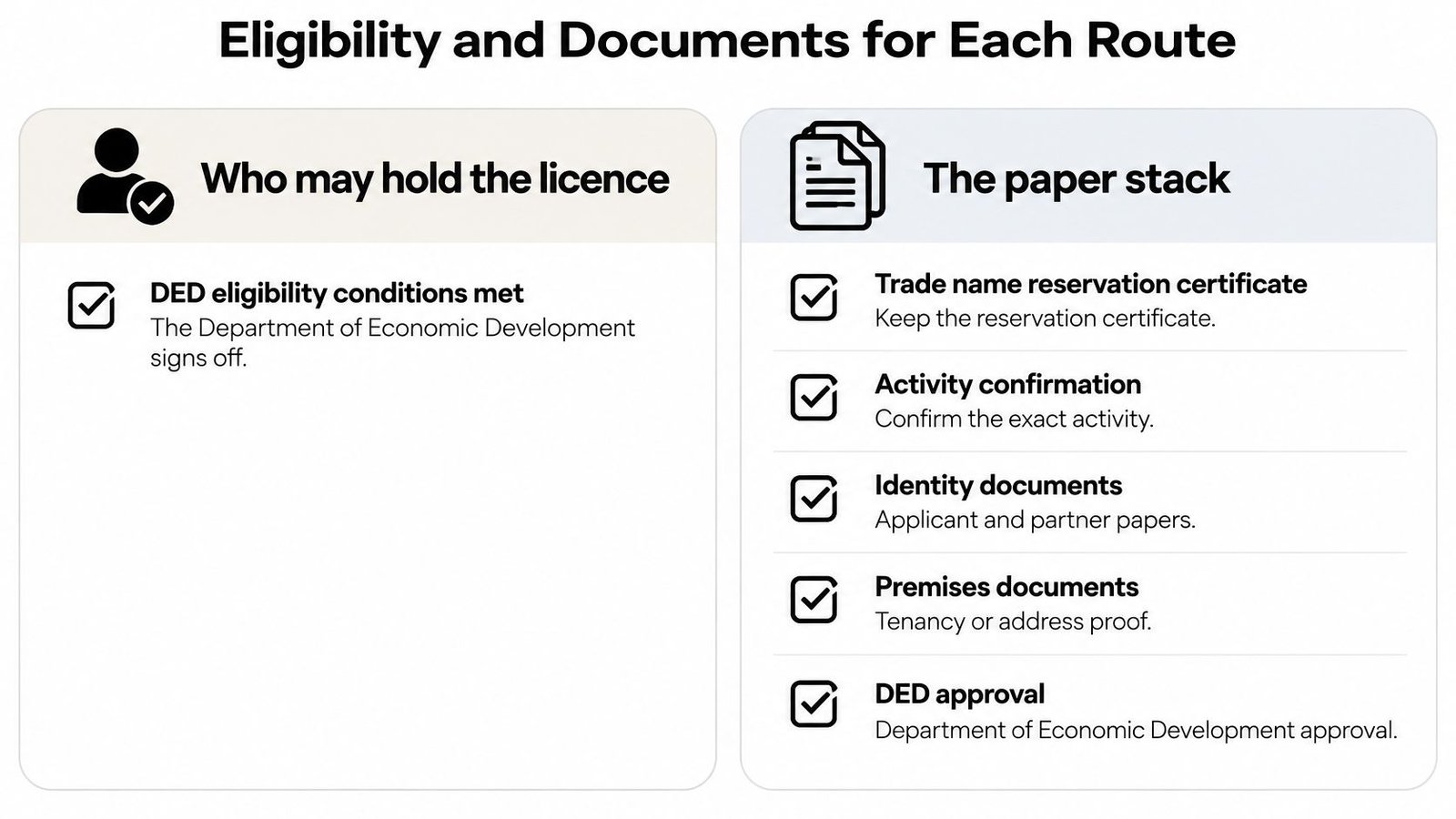
Who may hold an Ajman trade licence depends on which of the two routes issues it. On the mainland, the Department of Economic Development, usually shortened to DED, licenses the business and applies eligibility conditions to the activity. In the free zone, Ajman Free Zone registers the company under its own rules, including its own ownership position.
Who Qualifies on the Mainland
A natural person or a legal entity can hold a commercial licence once the activity's conditions are met. In practice the owner is either an individual founder or a company, and the file is built around that owner's identity documents.
A resident owner supplies a passport, an Emirates ID and a security clearance. An owner still living abroad supplies a passport valid for the process, and should plan to be in the United Arab Emirates later for medical tests and biometrics if a residence visa is part of the plan. Neither set of papers is difficult. Both are unforgiving about expired documents and mismatched name spellings.
What Does the Free Zone Ask For
Ajman Free Zone states that a free-zone establishment has an independent legal personality and may be 100% owned by an individual or a legal person such as another company. Its free-zone application requirements list a passport valid for at least six months, a colour passport photograph, and, for an applicant already resident in the UAE, a no-objection letter from the current sponsor. Trade-name approval is listed at AED 100.
Industrial, service and electronic activities also need a feasibility study. If a foreign company is opening a branch or representative office, the stack thickens: the parent company's registration certificate must be attested by the UAE Embassy in the country of origin and by the UAE Ministry of Foreign Affairs, and the board resolution and incorporation documents need the specified notarisation steps.
Here's how the mainland application looks when it's explained end to end.
What Should You Check Before Choosing
Four checks narrow the route faster than any cost comparison.
- The activity name. Nail the exact wording first, because every later approval refers back to it.
- Whether the owner is a person or a company. A corporate shareholder changes the document list and the attestation work.
- Whether anyone is already resident in the UAE. A residence visa triggers a no-objection letter and a different timing sequence.
- Whether a foreign parent company is involved. Branch structures add embassy and ministry attestation before anything else moves.
How the Ajman Application Actually Runs
Mainland files follow a fixed order, and the order explains why some applications stall. Preliminary approval from Ajman's Economic Department comes before a commercial licence is issued, so a trade name and a signed lease on their own won't produce a licence.
The Ajman DED service guide gives the definition behind that rule: a business licence is a certificate issued by the licensing authority that allows a natural person or legal entity to conduct a particular activity after meeting that activity's legal requirements and conditions. Confirm the activity classification and any external approval before assuming a name or a tenancy is enough.
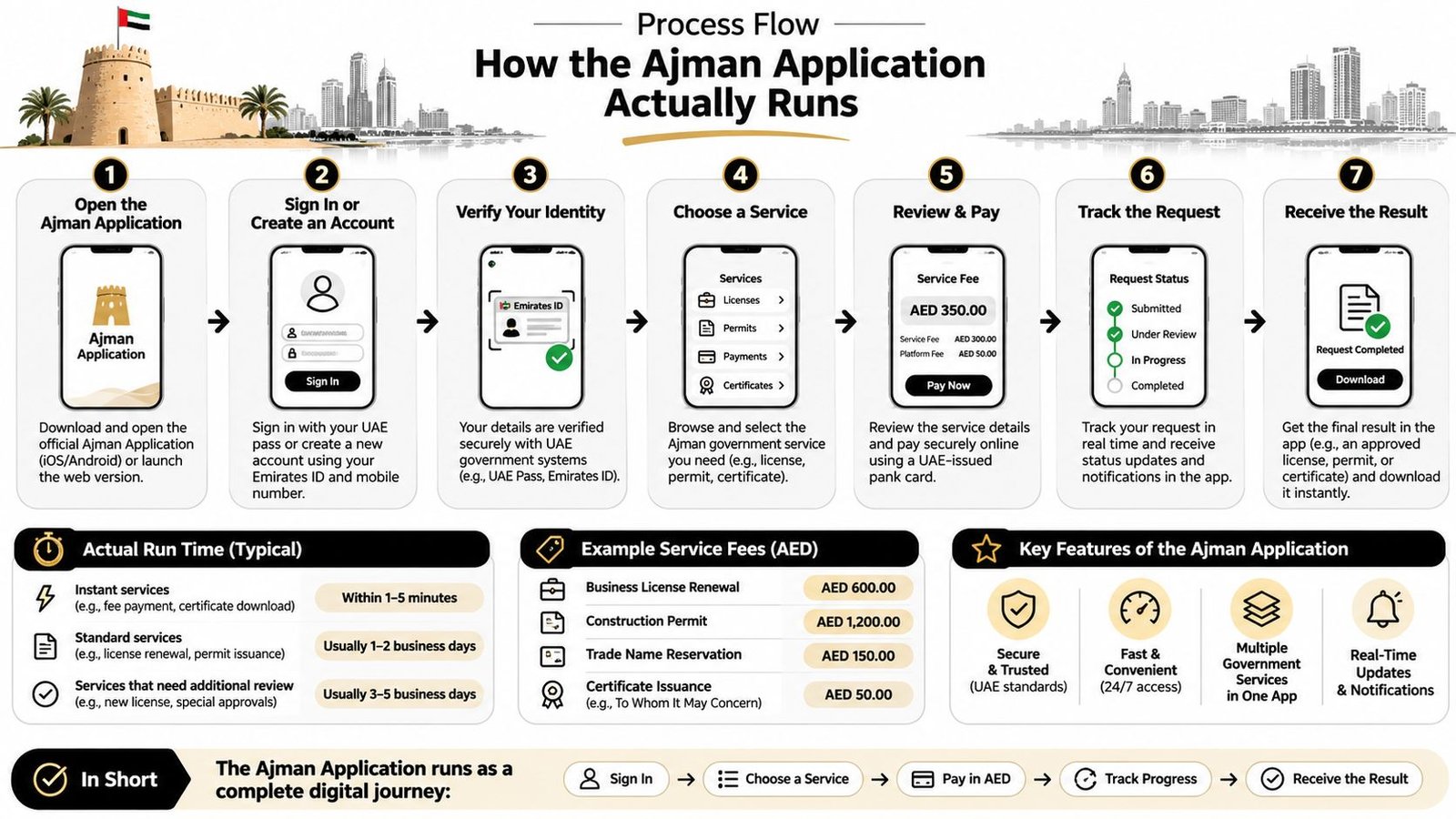
What Order Do You File In
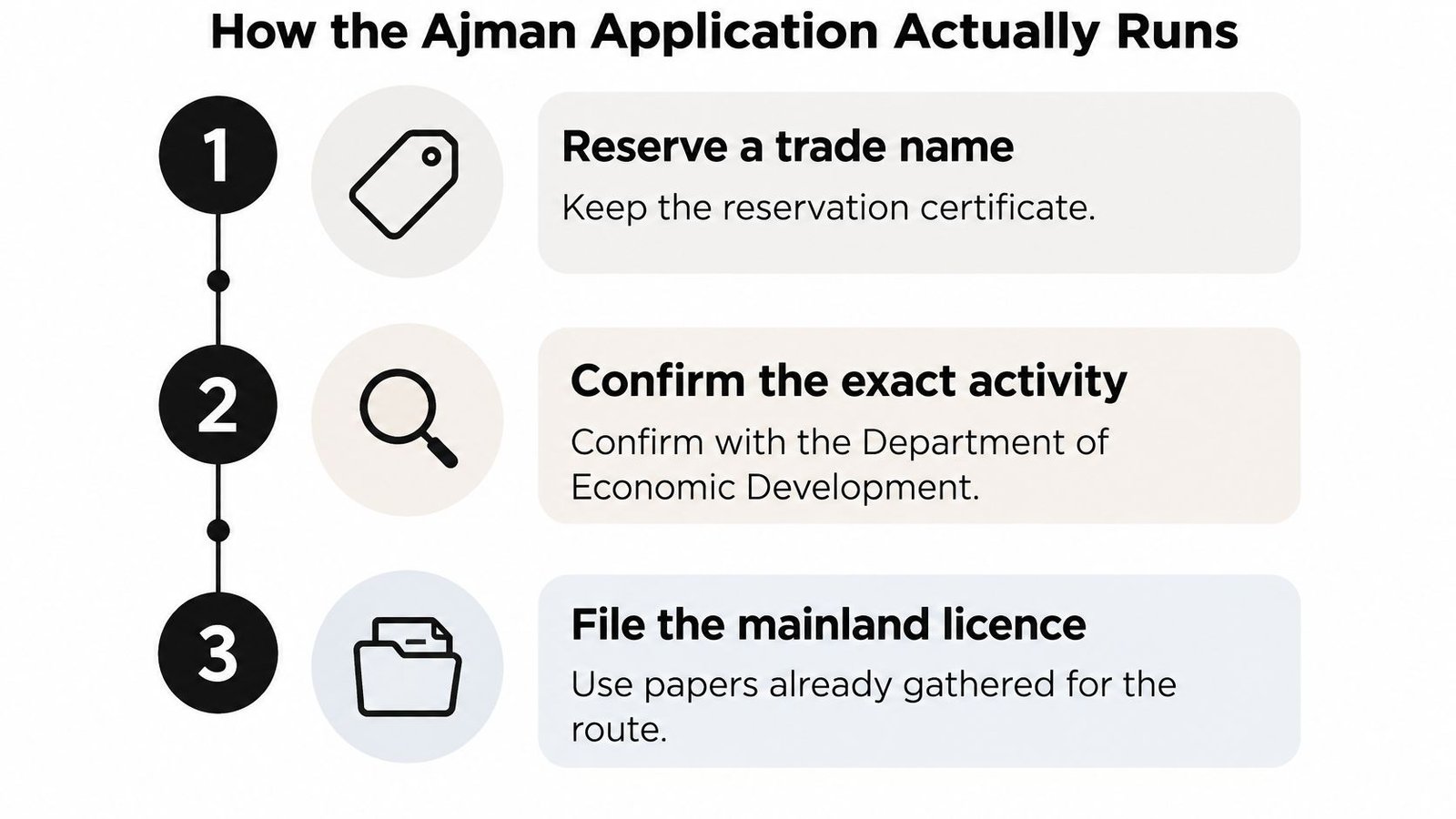
- Reserve the trade name and keep the certificate. Trade name registration is a separate step with its own output, and a reservation lapses if it isn't used.
- Confirm the exact activity with the department. Ask directly whether the municipality, the health authority, the transport authority or another body must approve it. Ask before paying anything.
- Obtain preliminary approval. This is the gate. Everything after it assumes the activity itself is cleared.
- Arrange premises and an attested lease where the activity requires a physical office. Signing a tenancy and attesting one are two different tasks.
- Sign in with UAE Pass and submit the application with the documents already gathered for your route.
- Pay the assessed charges, starting from the base items you've budgeted and adding external approvals and Chamber items.
- Collect the commercial licence.
Don't skip step two. Activity classification is the cheapest thing to fix before filing and the most expensive thing to fix afterwards, because an amendment pulls the approvals, the lease description and the bank file along with it.
What Happens After the Licence Lands
A new company still needs an establishment card before an investor or employee visa can be processed, and each visa needs medical tests, biometrics and an Emirates ID. Timing follows government approvals and can move.
A free-zone file swaps step three for the zone's own forms and decision, and runs the name approval inside the zone's application. The rest of the discipline is identical: same activity wording, same document quality, same expiry date to diarise.
The activity on the form has to match the work the company will do in the United Arab Emirates. That isn't a formality. A mismatch surfaces months later, usually when a customer asks for an approval the licence can't support.
Renewal Costs and What Stops a Renewal
An Ajman commercial licence is renewed every year to avoid fines, even though the renewal service can extend validity for one to three years where the conditions allow. File before the expiry date rather than on it.
| Renewal item | Amount (AED) |
|---|---|
| Economic-licence renewal | 600 |
| Administrative application form | 50 |
| Trade-name signboard permit | 350 |
| Commercial-register renewal | 100 |
| Unified Economic Activities Register renewal | 10 |
| Commercial-register certificate | 200 |
| Chamber of Commerce system fees | 1,000–5,000 |
The Ajman economic licence renewal service lists AED 600 for the economic-licence renewal, AED 50 for the administrative application form, AED 350 for the trade-name signboard permit, AED 100 for commercial-register renewal, AED 10 for the Unified Economic Activities Register renewal, and AED 200 for issuing the commercial-register certificate.
What Actually Stops a Renewal
The usual blocker isn't the fee. It's the tenancy paper. An expired or improperly attested lease can stop a renewal even when the activity and the owners haven't changed by a single character.
Check the tenancy before you open the form. Attestation status, expiry date and the address wording on the lease should all match the licence before submission.
Branches carry a second condition: the parent licence must also stay renewed. Regulated activities need their external approval refreshed, so the health, municipality or transport sign-off that took weeks in year one has to be scheduled again in year two.
Chamber of Commerce system fees may apply too, with the displayed Chamber amount shown as a range of AED 1,000 to 5,000. Those are separate from the issuance base items covered earlier in this guide, and they belong in a different line of the budget.
What Does an Expired Licence Cost
An expired licence affects more than the certificate. It can stall premises compliance, block related government transactions and hold up work tied to visas that an HR team expects to keep moving. None of that appears on the renewal invoice, which is why the deadline gets missed.
Renewal is recurring work, not a one-off, which is why teams hand trade licence renewal to the same people who already hold the government logins, rather than tracking it in someone's personal calendar. Diarise at least a month before expiry so a lease problem has room to be fixed.
Choose Mainland or Free Zone Before You File
Pick on how the company meets customers, not on the headline number. Go mainland if you'll open premises, sell into the local market or bid for government work. Go with Ajman Free Zone if you need separate legal personality and full ownership without a mainland shop or warehouse. Ajman Free Zone company formation covers that route in detail.
Write the activity in one line, confirm any external approval it needs, and only then budget past the published base. In our work, most UAE trade licences are issued within 3 to 5 working days, depending on the jurisdiction and the business activity, and government approvals can still move that date. We handle PRO work, the government paperwork side of a licence, for Dubai mainland companies and free-zone partners including IFZA and RAKEZ, alongside Ajman.
Owners based outside the UAE can be represented on government matters, though they must attend the steps that require them in person, such as their own biometrics and medicals. Compare the routes with the cost estimator, or book a strategy call if the activity or the sales channel is still open.
Inpro handles Ajman trade licence work from trade-name reservation and activity confirmation through to the licence, establishment card and first investor visa, and it keeps renewals on a tracked calendar so an expiry date never becomes a fine. If your plan involves selling into Dubai or Abu Dhabi rather than within Ajman, we'll map the activity wording against the approvals and premises it needs before you file. Visit Inpro to compare setup paths and start the file.