


A trade license in Dubai is the legal permit issued by a mainland authority such as the Department of Economy and Tourism, or by a free zone authority, allowing a business to conduct an approved activity. Typical year-one mainland costs cluster around AED 12,000–25,000, while the wider annual range is roughly AED 10,000–50,000.
The licence isn't a single approval that covers everything a founder might want to do. It connects your legal entity, business activity, jurisdiction, premises, visas, and ongoing compliance. Choosing the right structure at the beginning can prevent amendments, delayed banking, and avoidable approval work later.
Table of Contents
- What a Trade License in Dubai Actually Is
- Commercial, Professional, and Industrial Licences Explained
- Mainland, Free Zone, and Offshore Jurisdictions Compared
- How to Apply for a Trade License Step by Step
- What a Dubai Trade License Costs and How Long It Takes
- Common Pitfalls and Visa and Banking Implications
- Renewal, Compliance, and Getting Help From a PRO Partner
What a Trade License in Dubai Actually Is
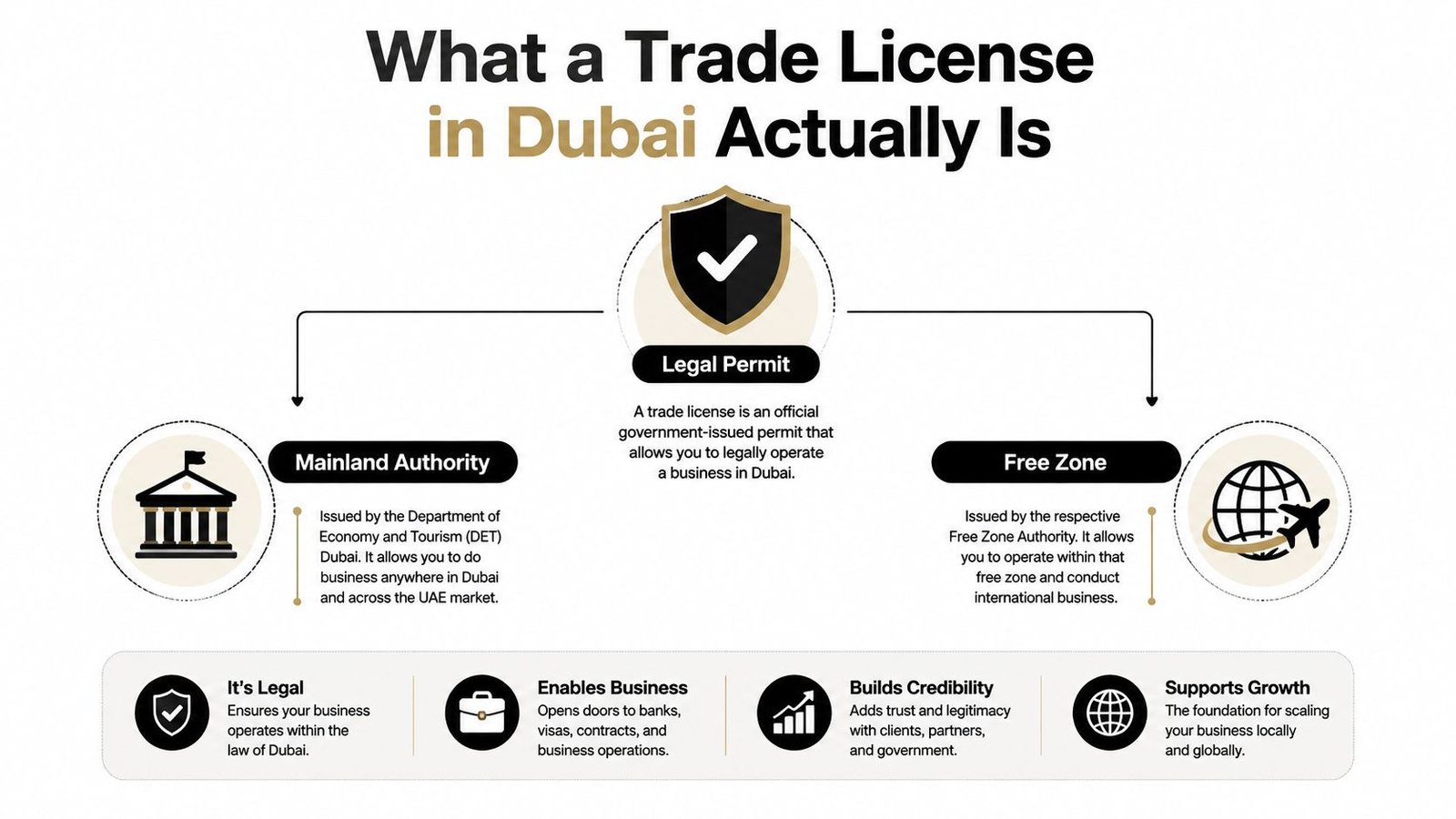
A Dubai trade licence is a legal permit that allows a company to conduct a defined business activity in the emirate. Mainland licences are issued by Dubai's Department of Economy and Tourism, or DET, while free zone licences come from the relevant free zone authority.
The word “trade” can be misleading. A licence isn't a general permission to operate any business. It authorises the activities listed on the certificate, so a consultancy, online retailer, manufacturer, recruitment firm, and import business may need different classifications or additional approvals.
Why does the licence matter?
The licence gives government departments, banks, landlords, clients, and immigration authorities a formal record of what your company is allowed to do. It also creates the compliance reference used for renewals, amendments, office details, and visa-related processes.
Dubai's licensing system operates at significant scale. DET issued 72,152 new business licences in 2021, compared with 42,729 in 2020, an increase of 69%, according to reported DET business licensing figures. Of the 2021 total, 59% were professional licences and 41% were commercial, showing that Dubai's licensing market covers both service companies and trading businesses.
What decisions come before applying?
You need to settle three connected questions:
- Activity: What exactly will the company sell, provide, manufacture, or manage?
- Jurisdiction: Will it operate on the mainland, within a free zone, or mainly outside the UAE?
- Structure: Will the entity be a limited liability company, branch, holding structure, or another permitted form?
The application becomes manageable once those decisions are separated. The main control points are the activity classification, trade name, initial approval, premises, external permissions, and final issuance. The difficult part usually isn't completing a form. It's making sure the form describes the business accurately.
Commercial, Professional, and Industrial Licences Explained
Dubai's licence type should match the way the company earns revenue. Commercial, professional, and industrial licences aren't interchangeable labels. Each can affect ownership arrangements, premises, approvals, and the documents required before issuance.
What is a commercial licence?
A commercial licence is permission to buy, sell, import, export, or distribute goods within the approved activity scope. Trading companies, retail businesses, product distributors, and many e-commerce models commonly begin with commercial activities.
A company selling clothing online may need a different activity description from a company importing construction materials or distributing food products. “General trading” can sound attractive, but a broader description doesn't automatically remove product-specific requirements, customs processes, or other permissions.
What is a professional licence?
A professional licence is permission to provide services based on skill, expertise, or professional knowledge. Consulting, marketing, information technology, design, training, and agency work may fall within this category, subject to the precise activity selected.
Professional structures often suit freelancers and service-led founders, but the practical fit depends on how the company contracts, invoices, hires staff, and delivers work. A business that starts as a consultancy and later adds software resale may need to review its activity classification rather than assume the original licence covers the new revenue stream.
What is an industrial licence?
An industrial licence is permission to manufacture, process, assemble, or transform goods. It usually involves more than registration because the authority may need information about production, premises, equipment, safety, and the nature of the goods.
The physical workspace becomes a more significant planning issue for industrial operations than for a low-footprint professional consultancy. External approvals can also enter the process where the activity affects health, safety, environment, food, construction, or other regulated areas.
| License Type | Typical Activities | Workspace Requirement | Approval Complexity |
|---|---|---|---|
| Commercial | Trading, retail, e-commerce, import, export, distribution | Office, shop, warehouse, or other premises suited to the activity | Varies by goods and operating model |
| Professional | Consulting, design, marketing, information technology, training, agencies | Office or permitted professional workspace | Usually linked to the service and any professional regulator |
| Industrial | Manufacturing, processing, assembly, production | Industrial premises with suitable operational facilities | Often requires technical, premises, safety, or sector approvals |
Practical rule: Select the activity from the official classification, not from the description that sounds closest in everyday language.
The most expensive early mistake is choosing an activity that doesn't match the core business. A mismatch can affect invoices, client contracts, permits, bank reviews, and later amendments. The cheapest licence on paper may become the costliest option if it forces a restructuring soon after incorporation.
Mainland, Free Zone, and Offshore Jurisdictions Compared
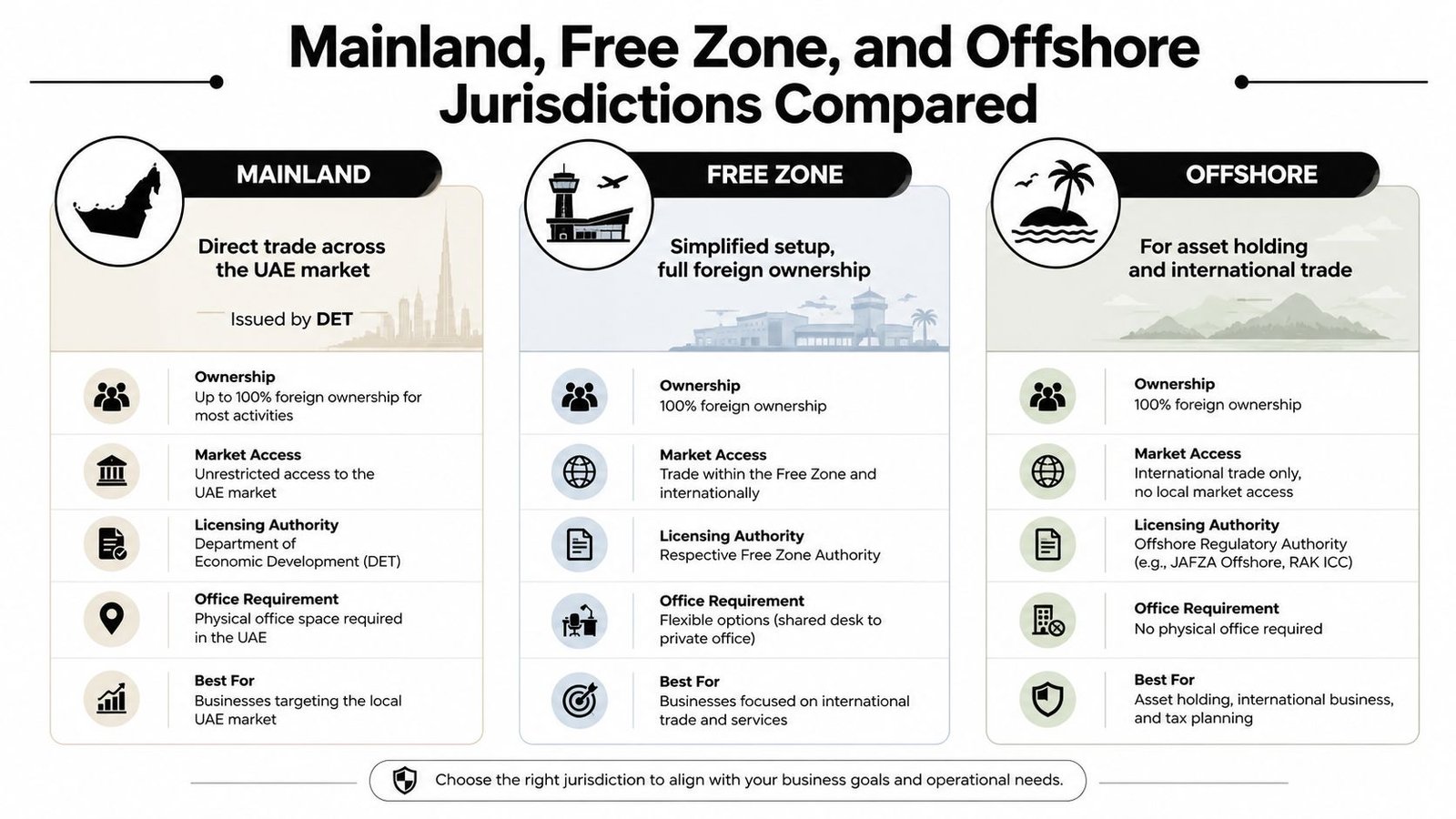
Jurisdiction determines where the company can operate most easily, which authority manages the licence, and how the business is perceived by customers, banks, and regulators. The old shortcut was simple: choose mainland for UAE trading, free zone for foreign ownership and zone operations, or offshore for holding assets. That framework still helps, but it no longer tells the whole story.
What does a mainland licence provide?
A mainland licence is issued by DET and is designed for operating in Dubai's wider commercial market. It generally suits companies that need direct dealings with customers, suppliers, government entities, or commercial premises outside a free zone.
The trade-off is that mainland planning can involve a tenancy contract, activity-specific approvals, and a closer connection between the company's operations and its physical location. The office requirement isn't just a line item. It can affect both the application and the ongoing licence condition.
How does a free zone licence differ?
A free zone licence is issued by a particular free zone authority and operates under that zone's rules. Free zones can offer simplified formation routes, full foreign ownership for eligible structures, and facilities designed for particular sectors such as technology, logistics, media, or finance.
Historically, a free zone company's ability to sell directly into Dubai's mainland market was more limited. Founders often had to use an approved distributor, establish a mainland branch, or create another structure, depending on the activity and the transaction.
What is an offshore structure used for?
An offshore structure is generally used for holding assets, owning investments, or supporting international transactions rather than running an active UAE operating business. It isn't usually the right answer for a founder who needs local premises, employee visas, or direct day-to-day trading in Dubai.
The choice should reflect market access, ownership, substance, banking, and future expansion, not just the lowest formation fee.
What changed after 2025?
Dubai Executive Council Resolution No. 11 of 2025 allows eligible non-financial free zone entities to operate on the mainland through a branch licence or temporary permit. In July 2025, the Dubai Free Zones Council also launched the Freezone One Passport, allowing participating free zone firms to expand across Dubai without a fresh incorporation, as explained in KPMG's UAE business environment guide.
That change makes jurisdiction a more flexible compliance choice. A free zone company may be suitable at launch, while a branch or permit can support mainland access later. The arrangement still depends on eligibility, activity, authority requirements, and the exact commercial plan, so it shouldn't be treated as a blanket substitute for a mainland company.
How to Apply for a Trade License Step by Step
A mainland application follows a sequence of defined checkpoints. Each checkpoint answers a different question, so rushing ahead with an incomplete decision usually creates more delay than it saves.
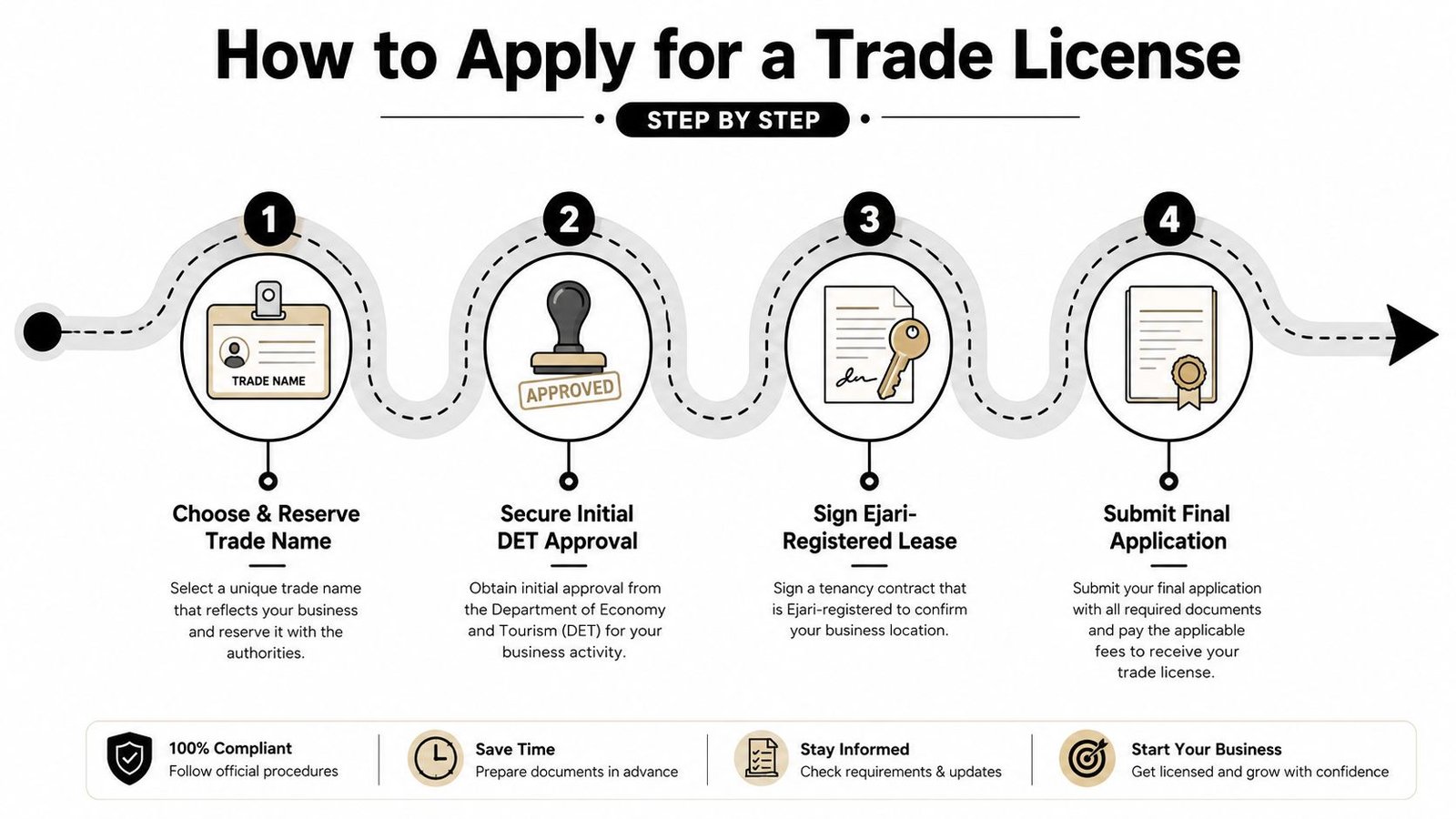
How do you reserve a trade name?
Start by selecting a name that fits Dubai's naming rules and doesn't conflict with an existing reservation or registered entity. Trade name reservation is the formal hold placed on the proposed company name, but it doesn't approve the business activity or give permission to trade.
The name should also make commercial sense. If the company expects to expand from consulting into product sales, choosing a highly narrow name may create avoidable amendment work later.
What does initial DET approval confirm?
Initial approval from DET confirms that the proposed legal entity and activity can proceed to the next stage. It isn't the final licence. Regulated activities may also require permission from another government department or sector authority before issuance.
The approval stage is where the business description should be checked carefully. If the activity wording is wrong, the problem can follow the file into premises, banking, invoicing, and visa discussions.
Why is an Ejari tenancy contract required?
Ejari is Dubai's rental registration system. For a mainland setup, the tenancy contract normally needs to be registered through Ejari so the authority can connect the legal entity with a recognised business premises.
The lease is more than proof of an address. It helps DET validate the office premise and enforce location-based requirements linked to the activity. The official Dubai business licensing service describes the licensing workflow around trade name reservation, initial approval, and an Ejari-registered tenancy contract.
When is the licence issued?
Once the name, initial approval, premises documentation, company documents, and any external approvals are ready, the final application can be submitted. DET then issues the payment voucher and, after the required fees are settled, provides the trade licence.
Free zone applications follow the authority's own portal, document list, premises rules, and payment process. A PRO services provider can prepare related tasks in parallel, but no provider can remove an approval that the activity legally requires.
What a Dubai Trade License Costs and How Long It Takes
Public UAE-region guidance places the broad annual cost of a Dubai trade licence at roughly AED 10,000–50,000, while year-one costs for standard mainland setups commonly cluster around AED 12,000–25,000, depending on the activity, premises, and approvals, as set out in this Dubai trade licence cost and renewal guide.
Those figures are planning bands, not a universal quotation. A simple professional structure with a modest workspace can sit near the lower end. A regulated activity, retail location, warehouse, manufacturing premises, or additional approval path can push the total higher.
What drives the cost?
The activity classification is the first driver. A professional consultancy and a product importer may not face the same approval or premises requirements. The second driver is the workspace. Mainland companies need to plan for the office condition connected to their licence, while industrial and retail businesses may need premises that support the actual operation.
Other costs can arise from:
- External approvals: Regulated activities may require permissions from another authority.
- Legal documents: Certain structures require additional drafting, signing, or attestation.
- Visa planning: Visa applications, medical checks, Emirates identity processes, and immigration work sit outside the basic licence fee.
- Banking preparation: Corporate account opening may require a clear business model and supporting records beyond the incorporation file.
How long does the process take?
Name reservation, initial approval, tenancy registration, external permissions, and final issuance don't all take the same amount of time. A clean, non-regulated application with complete documents is easier to process than a file involving regulated activities, unsuitable premises, or unclear ownership documents.
The wider market context matters. Around 250,000 companies launched in the UAE in 2025, and Dubai accounted for 59% of UAE business licences in Q1 2025, according to reported UAE and Dubai licensing figures. That level of demand can affect queues and service availability, but document readiness remains one of the most controllable timing factors.
The licence itself is only part of the launch timeline. Visa quotas, immigration processing, office readiness, and corporate banking can add work after issuance. Treat the end-to-end plan as the period required to become operational, not merely the day the certificate is printed.
Common Pitfalls and Visa and Banking Implications
Founders often focus on getting any licence quickly, then discover that the certificate doesn't support the business they actually want to run. The recurring problems are predictable: an unsuitable activity code, an office that doesn't meet the requirement, missing external approval, or the assumption that a licence automatically provides visas.
What happens when the activity code is wrong?
Symptom: The company wants to sell or invoice for something that isn't clearly covered by its licence.
Cause: The founder selected a familiar-sounding activity rather than checking the official classification.
Fix: Confirm the activity before reserving the name or signing a lease. If the business model changes later, assess whether to amend the licence or create a separate company.
Why do office assumptions cause delays?
Symptom: The proposed workspace is too small, unsuitable for the activity, or can't produce the required tenancy registration.
Cause: The founder treated the office as an address purchase instead of a licensing condition.
Fix: Check the premises requirement against the activity and jurisdiction before committing to a lease. Retail, industrial, and client-facing operations need a different workspace plan from a consultancy.
Does a trade licence automatically provide visas?
No. Visa eligibility and capacity depend on factors including the licence type, jurisdiction, and company structure, and each application has its own immigration requirements. Investor, Golden Visa, and Employee Visa routes shouldn't be promised solely because a company has been incorporated.
For HR teams, the practical lesson is to connect licence planning with employee onboarding. A company may be legally registered while its visa workflow, immigration file, or quota planning remains incomplete.
Why can banking be harder than licensing?
A licence proves the entity exists and identifies its activity. A bank also needs to understand the company's expected transactions, ownership, business model, and operational substance. Keep the activity, website or business profile, contracts, invoices, ownership records, and premises information consistent across the application.
A low licence fee doesn't compensate for a structure that can't explain how it will trade, hire, invoice, or receive funds.
Renewal should also be tracked from the first day. Letting a licence expire can interrupt legal continuity, affect visas and banking, and create administrative work that could have been avoided with a calendar reminder and early document review.
Renewal, Compliance, and Getting Help From a PRO Partner
A Dubai trade licence is a continuing obligation, not a one-time certificate. Mainland licences are renewed through DET, including the government's Invest in Dubai renewal service, while free zone companies renew through the relevant free zone authority.
Dubai Development Authority guidance says free zone licences must be renewed on time each year to maintain legal continuity and good standing, as stated in its official licence renewal guidance. Public guidance based on DET practice says mainland renewal can begin up to 90 days before expiry, and eligible online renewals may complete within one to three working days after payment clears, as described in this Dubai licence renewal explainer.
A PRO partner can coordinate jurisdiction comparison, activity selection, government-channel filings, tenancy documentation, renewal tracking, visa workflows, and corporate banking support. Inpro Corporate Services L.L.C. also supports company formation, licensing, Investor, Golden, and Employee Visa workflows, plus accounting, tax, and VAT registration and filing for UAE businesses.
If you're still weighing Dubai mainland, a free zone in Dubai, Abu Dhabi, or Sharjah, or an offshore holding structure, prepare the activity and operating model before requesting a price. That produces a more useful cost estimate than choosing a licence from a headline fee.
Inpro Corporate Services L.L.C. helps founders compare Dubai mainland, free zone, and offshore structures, obtain the appropriate trade licence, and manage PRO, visa, renewal, and banking workflows. Visit Inpro Corporate Services L.L.C. to request a clear setup plan or book a free strategy call.